Kazan State Medical
University
Ultrasound of the pancreas
Radiology Project
Ultrasound of the pancreas
Ultrasound of the pancreas.
What to look for in pancreatic US.
. Size
. Contour
. Texture
. Echogenicity
. Main pancreatic duct.
. Common bile duct
. Major peripancreatic vessels(Portal vein,
superior mesenteric artery and vein, Splenic
artery and vein, Aorta and inferior vena cava.
ULTRASOUND OF THE PANCREAS – Normal.
Pancreas Scan Plane. Normal Pancreas and surrounding anatomy.
Sagittal Scan Plane Pancreatic Head. Head of pancreas.
Pancreas and its proportions + neighboring anatomical
structures in classic transverse epigastrial plain.
Pancreatic lipomatosis refers to fatty replacement of pancreatic parenchyma.
This finding is most often associated with obesity and aging.
It tends to be commonest pathological condition involving the pancreas. The condition
may occasionally simulate a mass like lesion particularly when fatty replacement is
uneven.
Pathology
Subtypes
even pancreatic lipomatosis
uneven pancreatic lipomatosis
type 1a: preferential fatty replacement of head
type 1b: preferential fatty replacement of head, neck and body
type 2a: preferential fatty replacement of head and uncinate process
type 2b: fatty replacement of most of pancreas except peri biliary region
Causes
Systemic
cystic fibrosis (most common cause in childhood)
metabolic/endocrine: hyperlipidemia, diabetes mellitus
storage disease: haemochromatosis
drugs: steroids
infectious: viral infection, sepsis
Local
chronic pancreatitis
Lipomatous pancreas - Pancreatic tissue brightness is much higher than the liver one.
Pancreas - Cystic Lesions
Pseudocyst - Think pseudocyst when there is a history of pancreatitis,
alcohol abuse, stone disease or abdominal trauma and the lesion is
unilocular or contains non-enhancing dependent debris.
Cystic neoplasm- Think of the possibility of a cystic neoplasm, when there
is no history of pancreatitis or trauma, or when the cyst has internal septa,
a solid component, central scar or wall calcification.
Mucinous cystic neoplasm - This is usually a unilocular cyst filled with
mucin sometimes with wall calcification, exclusively seen in women.
Serous cystic neoplasm - This is a microcystic lesion, that contains serous
fluid with sometimes a characteristic scar which may calcify. It can look
like a branch-duct IPMN, but SCN has no communication with the
pancreatic duct. The typical appearance makes a specific diagnosis
possible, which is important, because SCN is the only tumor that is not
premalignant.
Branch-duct IPMN - This tumor can look like a SCN, but has no scar or
calcifications. MRCP or heavily weighted T2WI may show the connection
to the pancreatic duct, which is highly specific.
Benign cyst in the pancreatic tail.
Mucinous cystadenoma manifesting as a
multiseptated cyst. High-resolution endoscopic
US image demonstrates the septated internal
architecture of the cyst.
Mucinous cystic tumor. Endoscopic US image shows
a complex pancreatic cyst with internal septa.
Mucinous cystadenoma (MCA).
Acute pancreatitis refers to acute inflammation
of the pancreas. The sonographic findings in acute
pancreatitis include increased anteroposterior
measurement of the pancreatic body at the level of
the superior mesenteric artery. Decreased pancreatic
echogenicity compared with the liver, heterogeneous
echo pattern, Focal intrapancreatic regions of
abnormal echogenicity, Focal masses,Hypoechoic
peripancreatic areas of inflammation and acute
peripancreatic fluid collections. Diffuse decreased
echogenicity, focal contour, and focal echogenicity
changes within the pancreas are associated with
extra-pancreatic disease is also noted.
Causes of Acute Pancreatitis
Gallstones (45%)
Alcohol (35%)
Other (10%)
Medications
Hypercalcemia
Hypertriglyceridemia
Obstruction
After endoscopic retrograde cholangiopancreatography
Heredity
Trauma
Viral infection
Vascular ischemia
Idiopathic (10%)
Pancreatic Diseases.
Acute pancreatitis - Pancreatic gland (P) is edematous and there is a fluid visible in
front of the pancreas. (Black anechogenic strip marked by arrows). From other
anatomical structures we see splenic vein (SV), aorta (A) and inferior vena cava (IVC).
Acute pancreatitis:
Pancreatitis with inhomogeneous swollen pancreas and extra-pancreatic
soft tissue edema caused by an obstructing bile duct stone
Acute pancreatitis with area of inflammation localized to the at the pancreatic neck.
Pancreatitis with inhomogeneous pancreas and peripancreatic effusion.
Pseudo-cyst - Big round object in a narrow contact with pancreatic head.
A tumour could be similar, but it would not be probably so anechogenic.
Chronic pancreatitis - Granular structure of the gland with calcifications
Chronic pancreatitis. Transverse sonogram shows an
echogenic, enlarged pancreas with multiple small
hyperechoic non-shadowing foci in the pancreas.
Chronic pancreatitis. Longitudinal sonogram through the
head of the pancreas (in the same patient as in the previous
image) shows an echogenic pancreas with multiple, small,
hyperechoic, nonshadowing foci.
Pseudo-cyst within the
pancreatic head.
Chronic pancreatitis presented with moderate left upper quadrant pain. Transverse sonogram
through the pancreas shows a 4.37-cm pseudocyst in the tail of the pancreas (arrow).
Pseudocyst at (a) conventional and (b) echo-enhanced ultrasound. (a) Lesion with an echo-
free pattern and a sharply delineated wall.
Endoscopic US of small pancreatic head tumor obstructing the common bile duct.
Pancreatic carcinoma.
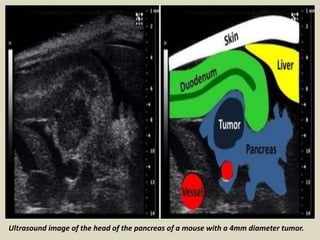
Ultrasound image of the head of the pancreas of a mouse with a 4mm diameter tumor.
Endoscopic Ultrasound (EUS) of pancreatic head mass and liver metastasis.
Pancreatic tumour - Pancreatic head is enlarged by a hypoechogenic mass.
The tumour probably also blocks the pancreatic duct which seems to be dilated.
Cystic mass in the pancreatic head with a normal pancreatic corpus and tail
and normal bile ducts. Histology proved this to be a pancreatic adenocarcinoma.
Pancreatic adenocarcinoma with solid, focal irregular hypoechoic mass.
Ultrasonographic examination
of pancreatic
carcinoma localized in the head
of the pancreas.
Pancreatic endocrine islet cell tumors (PETs) are
predominantly well-differentiated pancreatic or peripancreatic
tumors that demonstrate endocrine differentiation. They
include Insulinoma, Gastrinoma, Glucagonoma,
Somatostatinoma and VIP-Oma (vasoactive intestinal
polypeptide). Endoscopic US is sensitive for diagnosis.
Islet cell tumor manifesting as a cyst with a solid component. endoscopic US image
obtained in a patient with a malignant primary neuroendocrine tumor of the pancreas
show a cystic lesion in the pancreatic body with peripheral mural nodules (arrows).
EUS image of gastrinoma (TU) in the tail of the pancreas, next to the pancreatic
duct (P GANG) and splenic vein (V.LIENALIS), measuring 1 cm in diameter.
Insulinoma of the pancreatic body, US and CT images.
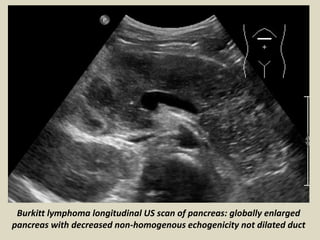
Burkitt lymphoma longitudinal US scan of pancreas: globally enlarged
pancreas with decreased non-homogenous echogenicity not dilated duct
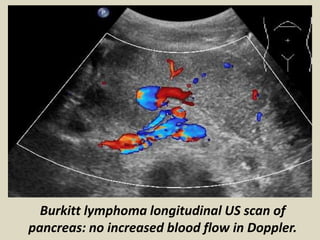
Burkitt lymphoma longitudinal US scan of
pancreas: no increased blood flow in Doppler.
Thank You.

Ultrasound of pancrease in Radiology

  • 1.
    Kazan State Medical University Ultrasoundof the pancreas Radiology Project
  • 2.
  • 3.
    Ultrasound of thepancreas. What to look for in pancreatic US. . Size . Contour . Texture . Echogenicity . Main pancreatic duct. . Common bile duct . Major peripancreatic vessels(Portal vein, superior mesenteric artery and vein, Splenic artery and vein, Aorta and inferior vena cava.
  • 4.
    ULTRASOUND OF THEPANCREAS – Normal. Pancreas Scan Plane. Normal Pancreas and surrounding anatomy.
  • 5.
    Sagittal Scan PlanePancreatic Head. Head of pancreas.
  • 6.
    Pancreas and itsproportions + neighboring anatomical structures in classic transverse epigastrial plain.
  • 8.
    Pancreatic lipomatosis refersto fatty replacement of pancreatic parenchyma. This finding is most often associated with obesity and aging. It tends to be commonest pathological condition involving the pancreas. The condition may occasionally simulate a mass like lesion particularly when fatty replacement is uneven. Pathology Subtypes even pancreatic lipomatosis uneven pancreatic lipomatosis type 1a: preferential fatty replacement of head type 1b: preferential fatty replacement of head, neck and body type 2a: preferential fatty replacement of head and uncinate process type 2b: fatty replacement of most of pancreas except peri biliary region Causes Systemic cystic fibrosis (most common cause in childhood) metabolic/endocrine: hyperlipidemia, diabetes mellitus storage disease: haemochromatosis drugs: steroids infectious: viral infection, sepsis Local chronic pancreatitis
  • 9.
    Lipomatous pancreas -Pancreatic tissue brightness is much higher than the liver one.
  • 10.
    Pancreas - CysticLesions Pseudocyst - Think pseudocyst when there is a history of pancreatitis, alcohol abuse, stone disease or abdominal trauma and the lesion is unilocular or contains non-enhancing dependent debris. Cystic neoplasm- Think of the possibility of a cystic neoplasm, when there is no history of pancreatitis or trauma, or when the cyst has internal septa, a solid component, central scar or wall calcification. Mucinous cystic neoplasm - This is usually a unilocular cyst filled with mucin sometimes with wall calcification, exclusively seen in women. Serous cystic neoplasm - This is a microcystic lesion, that contains serous fluid with sometimes a characteristic scar which may calcify. It can look like a branch-duct IPMN, but SCN has no communication with the pancreatic duct. The typical appearance makes a specific diagnosis possible, which is important, because SCN is the only tumor that is not premalignant. Branch-duct IPMN - This tumor can look like a SCN, but has no scar or calcifications. MRCP or heavily weighted T2WI may show the connection to the pancreatic duct, which is highly specific.
  • 12.
    Benign cyst inthe pancreatic tail.
  • 13.
    Mucinous cystadenoma manifestingas a multiseptated cyst. High-resolution endoscopic US image demonstrates the septated internal architecture of the cyst. Mucinous cystic tumor. Endoscopic US image shows a complex pancreatic cyst with internal septa.
  • 14.
  • 17.
    Acute pancreatitis refersto acute inflammation of the pancreas. The sonographic findings in acute pancreatitis include increased anteroposterior measurement of the pancreatic body at the level of the superior mesenteric artery. Decreased pancreatic echogenicity compared with the liver, heterogeneous echo pattern, Focal intrapancreatic regions of abnormal echogenicity, Focal masses,Hypoechoic peripancreatic areas of inflammation and acute peripancreatic fluid collections. Diffuse decreased echogenicity, focal contour, and focal echogenicity changes within the pancreas are associated with extra-pancreatic disease is also noted.
  • 18.
    Causes of AcutePancreatitis Gallstones (45%) Alcohol (35%) Other (10%) Medications Hypercalcemia Hypertriglyceridemia Obstruction After endoscopic retrograde cholangiopancreatography Heredity Trauma Viral infection Vascular ischemia Idiopathic (10%)
  • 19.
  • 20.
    Acute pancreatitis -Pancreatic gland (P) is edematous and there is a fluid visible in front of the pancreas. (Black anechogenic strip marked by arrows). From other anatomical structures we see splenic vein (SV), aorta (A) and inferior vena cava (IVC).
  • 21.
  • 22.
    Pancreatitis with inhomogeneousswollen pancreas and extra-pancreatic soft tissue edema caused by an obstructing bile duct stone
  • 23.
    Acute pancreatitis witharea of inflammation localized to the at the pancreatic neck.
  • 24.
    Pancreatitis with inhomogeneouspancreas and peripancreatic effusion.
  • 26.
    Pseudo-cyst - Biground object in a narrow contact with pancreatic head. A tumour could be similar, but it would not be probably so anechogenic.
  • 27.
    Chronic pancreatitis -Granular structure of the gland with calcifications
  • 29.
    Chronic pancreatitis. Transversesonogram shows an echogenic, enlarged pancreas with multiple small hyperechoic non-shadowing foci in the pancreas. Chronic pancreatitis. Longitudinal sonogram through the head of the pancreas (in the same patient as in the previous image) shows an echogenic pancreas with multiple, small, hyperechoic, nonshadowing foci. Pseudo-cyst within the pancreatic head.
  • 30.
    Chronic pancreatitis presentedwith moderate left upper quadrant pain. Transverse sonogram through the pancreas shows a 4.37-cm pseudocyst in the tail of the pancreas (arrow). Pseudocyst at (a) conventional and (b) echo-enhanced ultrasound. (a) Lesion with an echo- free pattern and a sharply delineated wall.
  • 31.
    Endoscopic US ofsmall pancreatic head tumor obstructing the common bile duct. Pancreatic carcinoma.
  • 32.
    Ultrasound image ofthe head of the pancreas of a mouse with a 4mm diameter tumor.
  • 33.
    Endoscopic Ultrasound (EUS)of pancreatic head mass and liver metastasis.
  • 34.
    Pancreatic tumour -Pancreatic head is enlarged by a hypoechogenic mass. The tumour probably also blocks the pancreatic duct which seems to be dilated.
  • 35.
    Cystic mass inthe pancreatic head with a normal pancreatic corpus and tail and normal bile ducts. Histology proved this to be a pancreatic adenocarcinoma.
  • 36.
    Pancreatic adenocarcinoma withsolid, focal irregular hypoechoic mass.
  • 37.
    Ultrasonographic examination of pancreatic carcinomalocalized in the head of the pancreas.
  • 38.
    Pancreatic endocrine isletcell tumors (PETs) are predominantly well-differentiated pancreatic or peripancreatic tumors that demonstrate endocrine differentiation. They include Insulinoma, Gastrinoma, Glucagonoma, Somatostatinoma and VIP-Oma (vasoactive intestinal polypeptide). Endoscopic US is sensitive for diagnosis.
  • 39.
    Islet cell tumormanifesting as a cyst with a solid component. endoscopic US image obtained in a patient with a malignant primary neuroendocrine tumor of the pancreas show a cystic lesion in the pancreatic body with peripheral mural nodules (arrows).
  • 41.
    EUS image ofgastrinoma (TU) in the tail of the pancreas, next to the pancreatic duct (P GANG) and splenic vein (V.LIENALIS), measuring 1 cm in diameter.
  • 42.
    Insulinoma of thepancreatic body, US and CT images.
  • 43.
    Burkitt lymphoma longitudinalUS scan of pancreas: globally enlarged pancreas with decreased non-homogenous echogenicity not dilated duct
  • 44.
    Burkitt lymphoma longitudinalUS scan of pancreas: no increased blood flow in Doppler.
  • 45.