Teaching & Training
Decentralization in Health Care –
is there evidence for it?
Guest lecture at
School of Public Health, National University of
Kyiv-Mohyla Academy
Kiev, 18 February 2014
Axel Hoffmann, PhD
Swiss Tropical and Public Health Institute
Overview
• Recapitulation: what is a health system?
• What are global challenges for health
• How can a decentralized system work?
• Will it solve problems of inequity and quality?
14 March 2014 2
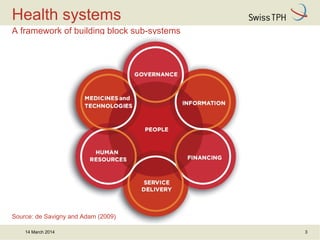
Health systems
A framework of building block sub-systems
Source: de Savigny and Adam (2009)
14 March 2014 3
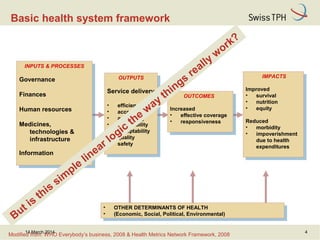
Basic health system framework
INPUTS & PROCESSES
Governance
Finances
Human resources
Medicines,
technologies &
infrastructure
Information
INPUTS & PROCESSES
Governance
Finances
Human resources
Medicines,
technologies &
infrastructure
Information
OUTPUTS
Service delivery
• efficiency
• access
• availability
• affordability
• acceptability
• quality
• safety
OUTPUTS
Service delivery
• efficiency
• access
• availability
• affordability
• acceptability
• quality
• safety
OUTCOMES
Increased
• effective coverage
• responsiveness
OUTCOMES
Increased
• effective coverage
• responsiveness
IMPACTS
Improved
• survival
• nutrition
• equity
Reduced
• morbidity
• impoverishment
due to health
expenditures
IMPACTS
Improved
• survival
• nutrition
• equity
Reduced
• morbidity
• impoverishment
due to health
expenditures
• OTHER DETERMINANTS OF HEALTH
• (Economic, Social, Political, Environmental)
• OTHER DETERMINANTS OF HEALTH
• (Economic, Social, Political, Environmental)
Modified from: WHO Everybody’s business, 2008 & Health Metrics Network Framework, 2008
But is
this
sim
ple
linear logic
the
way
things
really
work?
14 March 2014 4
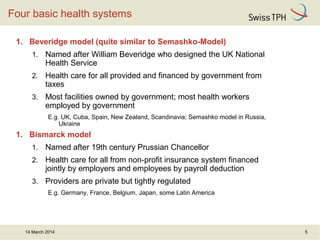
Four basic health systems
1. Beveridge model (quite similar to Semashko-Model)
1. Named after William Beveridge who designed the UK National
Health Service
2. Health care for all provided and financed by government from
taxes
3. Most facilities owned by government; most health workers
employed by government
E.g. UK, Cuba, Spain, New Zealand, Scandinavia; Semashko model in Russia,
Ukraine
1. Bismarck model
1. Named after 19th century Prussian Chancellor
2. Health care for all from non-profit insurance system financed
jointly by employers and employees by payroll deduction
3. Providers are private but tightly regulated
E.g. Germany, France, Belgium, Japan, some Latin America
14 March 2014 5
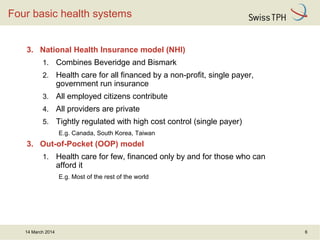
Four basic health systems
3. National Health Insurance model (NHI)
1. Combines Beveridge and Bismark
2. Health care for all financed by a non-profit, single payer,
government run insurance
3. All employed citizens contribute
4. All providers are private
5. Tightly regulated with high cost control (single payer)
E.g. Canada, South Korea, Taiwan
3. Out-of-Pocket (OOP) model
1. Health care for few, financed only by and for those who can
afford it
E.g. Most of the rest of the world
14 March 2014 6
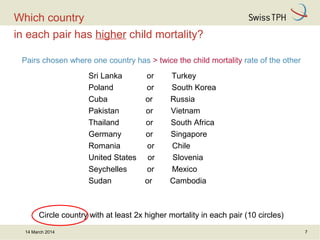
Which country
in each pair has higher child mortality?
Sri Lanka or Turkey
Poland or South Korea
Cuba or Russia
Pakistan or Vietnam
Thailand or South Africa
Germany or Singapore
Romania or Chile
United States or Slovenia
Seychelles or Mexico
Sudan or Cambodia
Pairs chosen where one country has > twice the child mortality rate of the other
Circle country with at least 2x higher mortality in each pair (10 circles)
14 March 2014 7
Sri Lanka or Turkey
Poland or South Korea
Cuba or Russia
Pakistan or Vietnam
Thailand or South Africa
Germany or Singapore
Romania or Chile
United States or Slovenia
Seychelles or Mexico
Sudan or Cambodia
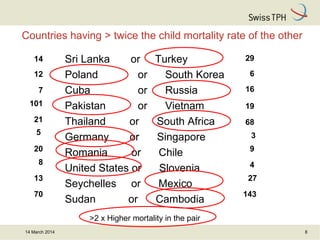
Countries having > twice the child mortality rate of the other
14 29
12 6
7 16
101 19
21 68
5
20
3
9
8 4
2713
70 143
>2 x Higher mortality in the pair
14 March 2014 8
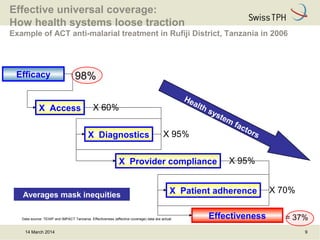
14 March 2014 9
= 37%
98%
Effective universal coverage:
How health systems loose traction
Example of ACT anti-malarial treatment in Rufiji District, Tanzania in 2006
Efficacy
X Access
X Diagnostics
X Provider compliance
X Patient adherence
Effectiveness
X 95%
X 95%
X 70%
X 60%
Health system
factors
Averages mask inequities
Data source: TEHIP and IMPACT Tanzania. Effectiveness (effective coverage) data are actual.
14 March 2014 10
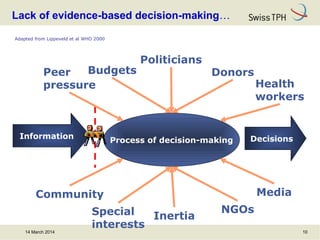
Process of decision-making
Information Decisions
DonorsBudgets
Politicians
MediaCommunity
Special
interests
Inertia
Peer
pressure
NGOs
Health
workers
Adapted from Lippeveld et al WHO 2000
Lack of evidence-based decision-making…
14 March 2014 11
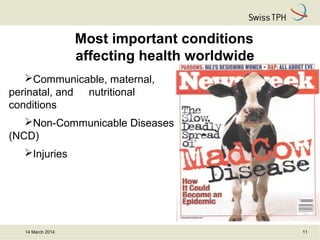
Most important conditions
affecting health worldwide
Communicable, maternal,
perinatal, and nutritional
conditions
Non-Communicable Diseases
(NCD)
Injuries
14 March 2014 12
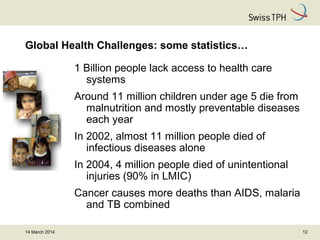
Global Health Challenges: some statistics…
1 Billion people lack access to health care
systems
Around 11 million children under age 5 die from
malnutrition and mostly preventable diseases
each year
In 2002, almost 11 million people died of
infectious diseases alone
In 2004, 4 million people died of unintentional
injuries (90% in LMIC)
Cancer causes more deaths than AIDS, malaria
and TB combined
14 March 2014 13
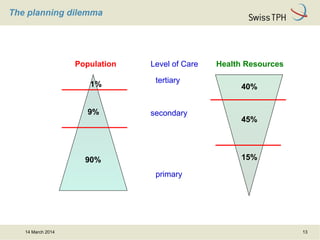
The planning dilemma
tertiary
secondary
primary
Population Health ResourcesLevel of Care
9%
90%
1%
15%
45%
40%
14 March 2014 14
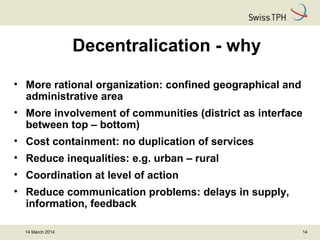
Decentralication - why
• More rational organization: confined geographical and
administrative area
• More involvement of communities (district as interface
between top – bottom)
• Cost containment: no duplication of services
• Reduce inequalities: e.g. urban – rural
• Coordination at level of action
• Reduce communication problems: delays in supply,
information, feedback
14 March 2014 15
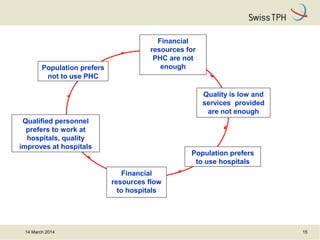
Financial
resources for
PHC are not
enough
Quality is low and
services provided
are not enough
Population prefers
to use hospitals
Financial
resources flow
to hospitals
Qualified personnel
prefers to work at
hospitals, quality
improves at hospitals
Population prefers
not to use PHC
14 March 2014 16
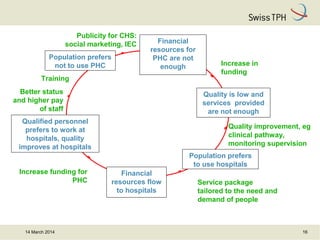
Financial
resources for
PHC are not
enough
Quality is low and
services provided
are not enough
Population prefers
to use hospitals
Financial
resources flow
to hospitals
Qualified personnel
prefers to work at
hospitals, quality
improves at hospitals
Population prefers
not to use PHC Increase in
funding
Quality improvement, eg
clinical pathway,
monitoring supervision
Service package
tailored to the need and
demand of people
Increase funding for
PHC
Training
Better status
and higher pay
of staff
Publicity for CHS:
social marketing, IEC
14 March 2014 17
Four pillars of decentralization
• Deconcentration
• Administrative authority
• Devolution
• Strengthening of Local Government
• Delegation
• Managerial responsibility
• Privatization
• Transfer of governmental functions
14 March 2014 18
Decentralisation – How?
 Adopt national policies
 Provide support for districts - rayons
 Decentralize
 Responsibility and power for each function to level of system to reach
flexibility within districts in adapting national policies for resource use
according to local priorities
 Develop district leadership
 Create district health teams (DHT) – all providers and users represented.
 Develop district planning process
 Define objectives and set targets
 Define activities based on objectives and targets
 Budget activities and specify and mobilize financing from all sources
 Strengthen community involvement
 By creating appropriate mechanisms by strengthening the knowledge and
skills of communities in solving health and development problems –
“creative listening”
14 March 2014 19
Decentralisation – How? (cont.)
 Promote inter-sectorial action
 By creating mechanisms to give health concerns higher priority on the
agenda of district development and helping each sector define its role in
health activities
 Redefine the role and functioning of hospitals
 Within a district as integral parts of the district health systems: First contact
versus referral function
 Ensure sustainability
 By integrating all programmes into the district health system and improving
the basic management skills of DHTs/health personnel
 Ensure equity between districts
 By allocation of national resources on the basis of need
 Use health systems research
 As a tool for solving problems of the district health system
14 March 2014 20
Possible changes at rayon level
Reallocate staff and partly drugs
Inefficiencies, inequity
Reassess resource combination & PHC packages
Quality of care, community satisfaction
Change service delivery strategies
Quality of care, community satisfaction
Improve supervision and monitoring
Performance, satisfaction of users & providers
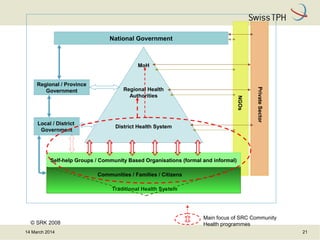
Main focus of SRC Community
Health programmes
NGOs
MoH
Regional Health
Authorities
District Health System
Self-help Groups / Community Based Organisations (formal and informal)
Communities / Families / Citizens
Traditional Health System
National Government
Regional / Province
Government
Local / District
Government
PrivateSector
© SRK 2008
14 March 2014 21
14 March 2014 22
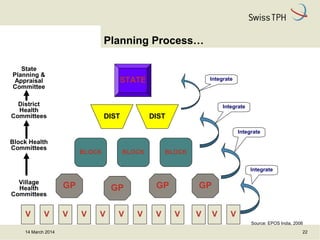
Planning Process…
V
GP GP GP GP
BLOCK BLOCK BLOCK
DIST DIST
STATE Integrate
Integrate
Integrate
Integrate
VV VVVV V V V V V
Village
Health
Committees
Block Health
Committees
District
Health
Committees
State
Planning &
Appraisal
Committee
Source: EPOS India, 2006
14 March 2014 23
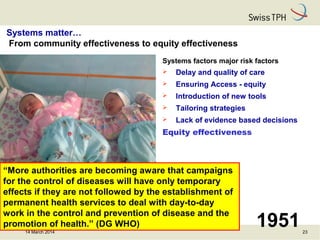
Systems matter…
From community effectiveness to equity effectiveness
Systems factors major risk factors
 Delay and quality of care
 Ensuring Access - equity
 Introduction of new tools
 Tailoring strategies
 Lack of evidence based decisions
Equity effectiveness
“More authorities are becoming aware that campaigns
for the control of diseases will have only temporary
effects if they are not followed by the establishment of
permanent health services to deal with day-to-day
work in the control and prevention of disease and the
promotion of health.” (DG WHO) 1951

Health care system decentralization

  • 1.
    Teaching & Training Decentralizationin Health Care – is there evidence for it? Guest lecture at School of Public Health, National University of Kyiv-Mohyla Academy Kiev, 18 February 2014 Axel Hoffmann, PhD Swiss Tropical and Public Health Institute
  • 2.
    Overview • Recapitulation: whatis a health system? • What are global challenges for health • How can a decentralized system work? • Will it solve problems of inequity and quality? 14 March 2014 2
  • 3.
    Health systems A frameworkof building block sub-systems Source: de Savigny and Adam (2009) 14 March 2014 3
  • 4.
    Basic health systemframework INPUTS & PROCESSES Governance Finances Human resources Medicines, technologies & infrastructure Information INPUTS & PROCESSES Governance Finances Human resources Medicines, technologies & infrastructure Information OUTPUTS Service delivery • efficiency • access • availability • affordability • acceptability • quality • safety OUTPUTS Service delivery • efficiency • access • availability • affordability • acceptability • quality • safety OUTCOMES Increased • effective coverage • responsiveness OUTCOMES Increased • effective coverage • responsiveness IMPACTS Improved • survival • nutrition • equity Reduced • morbidity • impoverishment due to health expenditures IMPACTS Improved • survival • nutrition • equity Reduced • morbidity • impoverishment due to health expenditures • OTHER DETERMINANTS OF HEALTH • (Economic, Social, Political, Environmental) • OTHER DETERMINANTS OF HEALTH • (Economic, Social, Political, Environmental) Modified from: WHO Everybody’s business, 2008 & Health Metrics Network Framework, 2008 But is this sim ple linear logic the way things really work? 14 March 2014 4
  • 5.
    Four basic healthsystems 1. Beveridge model (quite similar to Semashko-Model) 1. Named after William Beveridge who designed the UK National Health Service 2. Health care for all provided and financed by government from taxes 3. Most facilities owned by government; most health workers employed by government E.g. UK, Cuba, Spain, New Zealand, Scandinavia; Semashko model in Russia, Ukraine 1. Bismarck model 1. Named after 19th century Prussian Chancellor 2. Health care for all from non-profit insurance system financed jointly by employers and employees by payroll deduction 3. Providers are private but tightly regulated E.g. Germany, France, Belgium, Japan, some Latin America 14 March 2014 5
  • 6.
    Four basic healthsystems 3. National Health Insurance model (NHI) 1. Combines Beveridge and Bismark 2. Health care for all financed by a non-profit, single payer, government run insurance 3. All employed citizens contribute 4. All providers are private 5. Tightly regulated with high cost control (single payer) E.g. Canada, South Korea, Taiwan 3. Out-of-Pocket (OOP) model 1. Health care for few, financed only by and for those who can afford it E.g. Most of the rest of the world 14 March 2014 6
  • 7.
    Which country in eachpair has higher child mortality? Sri Lanka or Turkey Poland or South Korea Cuba or Russia Pakistan or Vietnam Thailand or South Africa Germany or Singapore Romania or Chile United States or Slovenia Seychelles or Mexico Sudan or Cambodia Pairs chosen where one country has > twice the child mortality rate of the other Circle country with at least 2x higher mortality in each pair (10 circles) 14 March 2014 7
  • 8.
    Sri Lanka orTurkey Poland or South Korea Cuba or Russia Pakistan or Vietnam Thailand or South Africa Germany or Singapore Romania or Chile United States or Slovenia Seychelles or Mexico Sudan or Cambodia Countries having > twice the child mortality rate of the other 14 29 12 6 7 16 101 19 21 68 5 20 3 9 8 4 2713 70 143 >2 x Higher mortality in the pair 14 March 2014 8
  • 9.
    14 March 20149 = 37% 98% Effective universal coverage: How health systems loose traction Example of ACT anti-malarial treatment in Rufiji District, Tanzania in 2006 Efficacy X Access X Diagnostics X Provider compliance X Patient adherence Effectiveness X 95% X 95% X 70% X 60% Health system factors Averages mask inequities Data source: TEHIP and IMPACT Tanzania. Effectiveness (effective coverage) data are actual.
  • 10.
    14 March 201410 Process of decision-making Information Decisions DonorsBudgets Politicians MediaCommunity Special interests Inertia Peer pressure NGOs Health workers Adapted from Lippeveld et al WHO 2000 Lack of evidence-based decision-making…
  • 11.
    14 March 201411 Most important conditions affecting health worldwide Communicable, maternal, perinatal, and nutritional conditions Non-Communicable Diseases (NCD) Injuries
  • 12.
    14 March 201412 Global Health Challenges: some statistics… 1 Billion people lack access to health care systems Around 11 million children under age 5 die from malnutrition and mostly preventable diseases each year In 2002, almost 11 million people died of infectious diseases alone In 2004, 4 million people died of unintentional injuries (90% in LMIC) Cancer causes more deaths than AIDS, malaria and TB combined
  • 13.
    14 March 201413 The planning dilemma tertiary secondary primary Population Health ResourcesLevel of Care 9% 90% 1% 15% 45% 40%
  • 14.
    14 March 201414 Decentralication - why • More rational organization: confined geographical and administrative area • More involvement of communities (district as interface between top – bottom) • Cost containment: no duplication of services • Reduce inequalities: e.g. urban – rural • Coordination at level of action • Reduce communication problems: delays in supply, information, feedback
  • 15.
    14 March 201415 Financial resources for PHC are not enough Quality is low and services provided are not enough Population prefers to use hospitals Financial resources flow to hospitals Qualified personnel prefers to work at hospitals, quality improves at hospitals Population prefers not to use PHC
  • 16.
    14 March 201416 Financial resources for PHC are not enough Quality is low and services provided are not enough Population prefers to use hospitals Financial resources flow to hospitals Qualified personnel prefers to work at hospitals, quality improves at hospitals Population prefers not to use PHC Increase in funding Quality improvement, eg clinical pathway, monitoring supervision Service package tailored to the need and demand of people Increase funding for PHC Training Better status and higher pay of staff Publicity for CHS: social marketing, IEC
  • 17.
    14 March 201417 Four pillars of decentralization • Deconcentration • Administrative authority • Devolution • Strengthening of Local Government • Delegation • Managerial responsibility • Privatization • Transfer of governmental functions
  • 18.
    14 March 201418 Decentralisation – How?  Adopt national policies  Provide support for districts - rayons  Decentralize  Responsibility and power for each function to level of system to reach flexibility within districts in adapting national policies for resource use according to local priorities  Develop district leadership  Create district health teams (DHT) – all providers and users represented.  Develop district planning process  Define objectives and set targets  Define activities based on objectives and targets  Budget activities and specify and mobilize financing from all sources  Strengthen community involvement  By creating appropriate mechanisms by strengthening the knowledge and skills of communities in solving health and development problems – “creative listening”
  • 19.
    14 March 201419 Decentralisation – How? (cont.)  Promote inter-sectorial action  By creating mechanisms to give health concerns higher priority on the agenda of district development and helping each sector define its role in health activities  Redefine the role and functioning of hospitals  Within a district as integral parts of the district health systems: First contact versus referral function  Ensure sustainability  By integrating all programmes into the district health system and improving the basic management skills of DHTs/health personnel  Ensure equity between districts  By allocation of national resources on the basis of need  Use health systems research  As a tool for solving problems of the district health system
  • 20.
    14 March 201420 Possible changes at rayon level Reallocate staff and partly drugs Inefficiencies, inequity Reassess resource combination & PHC packages Quality of care, community satisfaction Change service delivery strategies Quality of care, community satisfaction Improve supervision and monitoring Performance, satisfaction of users & providers
  • 21.
    Main focus ofSRC Community Health programmes NGOs MoH Regional Health Authorities District Health System Self-help Groups / Community Based Organisations (formal and informal) Communities / Families / Citizens Traditional Health System National Government Regional / Province Government Local / District Government PrivateSector © SRK 2008 14 March 2014 21
  • 22.
    14 March 201422 Planning Process… V GP GP GP GP BLOCK BLOCK BLOCK DIST DIST STATE Integrate Integrate Integrate Integrate VV VVVV V V V V V Village Health Committees Block Health Committees District Health Committees State Planning & Appraisal Committee Source: EPOS India, 2006
  • 23.
    14 March 201423 Systems matter… From community effectiveness to equity effectiveness Systems factors major risk factors  Delay and quality of care  Ensuring Access - equity  Introduction of new tools  Tailoring strategies  Lack of evidence based decisions Equity effectiveness “More authorities are becoming aware that campaigns for the control of diseases will have only temporary effects if they are not followed by the establishment of permanent health services to deal with day-to-day work in the control and prevention of disease and the promotion of health.” (DG WHO) 1951