Introduction to Health
Systems
Lecture 1
Outline
• Basic definitions
– Different perspectives on health and health care
– Definition of “Health Systems”
• How the pieces fit together
• Dimensions of functioning
• Syndromes of dysfunction
• Syndromic management
Health is A Right
• “… health, which is a state of complete
physical, mental and social wellbeing, and
not merely the absence of disease or
infirmity, is a fundamental human right and
… a most important world-wide social
goal.”
• Alma Ata Declaration-1973
Health Comes from Purchased Medical Care
• “No man . . . has a right to medical
care; if he cannot pay for what he
needs, then he must depend on
voluntary charity.”
—Leonard Peikoff, The Ayn Rand Institute
Health is due to Social Conditions
• “The improvement of medicine will
eventually prolong human life, but the
improvement of social conditions can
achieve this result more rapidly and more
successfully.”
– Virchow
Important Distinctions
• Health vs. Health Care
– Health refers to a state of the human body and
mind
– Health Care refers to chemicals, devices, and
services used by people to improve their
health
• Health insurance
– A system of paying for unpredictable needs for
health care
Basic Definitions
• Economic Units
– groups of individuals brought together for a common
purpose
• Economic Agent-
– an individual with a specific role in the system, e.g. a
patient, a nurse, a manager
• Institutions-
– Norms, rules of conduct, established procedures e.g.
property, corporations, paying fines, tipping waiters
Definition of systems
• Economic systems
– a collection of economic units, agents, and
institutions that interact coherently; adapting
and adjusting to the social and physical
environment
• (Expect definitions of coherence, adaptation,
adjustment)
• Health systems
– economic systems that are concerned with
human health
Adaptation, Adjustment, Coherence
• Adjustment
– transforming and redistributing resources to improve
function, exploit opportunities, resolve weaknesses
within existing institutions
• Adaptation
– evolving or planning new institutions to solve
problems
• Coherence
– Degree to which agents and units coordinate their
activity for common purpose
7 Principal Health Systems
1. Primary health service delivery system
2. Health workforce
3. Leadership and governance to assure quality
4. Health systems financing
5. Supplying medical products and technologies
6. Health systems information
7. Households
Mistake 1
• Mistaken to think that the public sector
service delivery system is “the health
system”
• Public sector is never the whole “health
system”
– Leaves out households
– Private finance, Private supply chain
– Private workforce training
• Health systems are plural
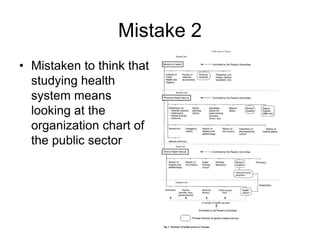
Mistake 2
• Mistaken to think that
studying health
system means
looking at the
organization chart of
the public sector
Understanding Systems
• Analogy: economic
systems are to
society what organ
systems are to the
body
• There is no “system”
there are “systems”
• Dysfunction in one
affects others
• What do systems “do”?
– Adjust
– Adapt
– Cohere
• How do scientists study?
– Reductionism
• Identify institutions
• Examine adaptations etc.
• No best system
Some Examples of Institutions
• Households
• Primary health
service delivery
system
• Financial protection
system
• Governance
• Drugs and supplies
distribution system
• Folk remedies
• Clinics
• Insurance
• Licensing
• Markets
• Inventory
Some Examples of Adjustments
• Special feeding
• Outreach campaign
• Lowering copay
• New examinations
• Making a drug over
the counter
• Folk remedies
• Clinics
• Insurance
• Licensing
• Markets
Pop Quiz
• Which of the following are units in a health
system?
– The neighborhoods in Hanoi
– PEPFAR
– Hewlett Packard
– Medical malpractice courts
Examples of Adaptations
• Decentralizing governance
• Starting a government health insurance
program
• Deploying barefoot doctors
Examples of Coherence
• Relying on tradition
• Using market signals
• Commanding and
controlling from above
• Motivation is an
essential tool for
coherence
• Examples
– Material incentives
– Moral incentives
– Coercion
Power
• Power is relative to the motivations that are
operating in a system
• Examples
– Control of money, titles, space, assets, status
– Power of coercion (different forms of coercion)
– Control of information
Exercise
• Reflect on your role in your health system
– Do you have power?
– What form does it take?
– How do you deploy it?
• If your goal were to be in a position to do
the most to improve your health system
– Who would you be?
– Where would your power come from?
Instruments
• Direct Controls
– Regulations
– Prohibitions
– Compulsions
• Indirect Controls
– Tariffs/Taxes
– Subsidies
– Grants
• Government as a consumer
• Government as a producer
Government Interventions
• Provides
– Provides health insurance
– Provides health care
– Maintains healthy environment
– Informs people about healthy lifestyles
• Sustains
– Funds health research
– Funds health worker training
• Maintains standards
– Licenses health workers
– Approves drugs and devices
– Approves hospital construction
Health Policy Mixes Multiple
Objectives
• Objectives about “Health Insurance”
– Protection against the unpredictability of health care expenses
• Objectives about “Health Care”
– Delivers only “costworthy” (efficient) health care
– Equity and fairness in access to health care
– Making health services more respectful, kind, friendly…
• Objectives about “Health”
– A special concern for the health of disadvantaged groups
– A special concern for the health of workers (human capital)
– Financing public goods that affect health
• Social objectives
– Redistribution of income between rich and poor, healthy and sick, powerful
and weak
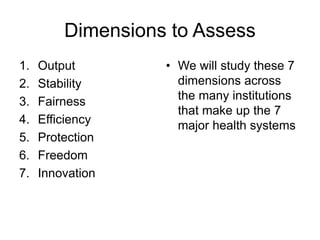
Dimensions to Assess
1. Output
2. Stability
3. Fairness
4. Efficiency
5. Protection
6. Freedom
7. Innovation
• We will study these 7
dimensions across
the many institutions
that make up the 7
major health systems
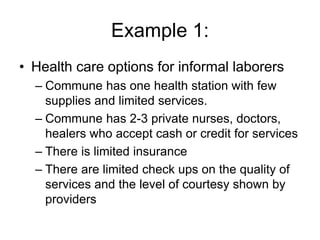
Example 1:
• Health care options for informal laborers
– Commune has one health station with few
supplies and limited services.
– Commune has 2-3 private nurses, doctors,
healers who accept cash or credit for services
– There is limited insurance
– There are limited check ups on the quality of
services and the level of courtesy shown by
providers
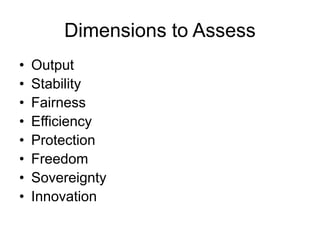
Dimensions to Assess
• Output
• Stability
• Fairness
• Efficiency
• Protection
• Freedom
• Sovereignty
• Innovation
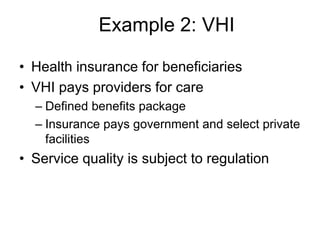
Example 2: VHI
• Health insurance for beneficiaries
• VHI pays providers for care
– Defined benefits package
– Insurance pays government and select private
facilities
• Service quality is subject to regulation
Dimensions to Assess
• Output
• Stability
• Fairness
• Efficiency
• Protection
• Freedom
• Sovereignty
• Innovation
Summarizing
• Distinguish: Health vs. Health Care vs.
Health Insurance
• Defined economic systems
• Defined health systems
– Agents, Units, Institutions
– Adapt, Adjust, Cohere
• 7 Health Systems
• 7 Dimensions

Unit 1_Introduction to Health Systems.ppt

  • 1.
  • 2.
    Outline • Basic definitions –Different perspectives on health and health care – Definition of “Health Systems” • How the pieces fit together • Dimensions of functioning • Syndromes of dysfunction • Syndromic management
  • 3.
    Health is ARight • “… health, which is a state of complete physical, mental and social wellbeing, and not merely the absence of disease or infirmity, is a fundamental human right and … a most important world-wide social goal.” • Alma Ata Declaration-1973
  • 4.
    Health Comes fromPurchased Medical Care • “No man . . . has a right to medical care; if he cannot pay for what he needs, then he must depend on voluntary charity.” —Leonard Peikoff, The Ayn Rand Institute
  • 5.
    Health is dueto Social Conditions • “The improvement of medicine will eventually prolong human life, but the improvement of social conditions can achieve this result more rapidly and more successfully.” – Virchow
  • 6.
    Important Distinctions • Healthvs. Health Care – Health refers to a state of the human body and mind – Health Care refers to chemicals, devices, and services used by people to improve their health • Health insurance – A system of paying for unpredictable needs for health care
  • 7.
    Basic Definitions • EconomicUnits – groups of individuals brought together for a common purpose • Economic Agent- – an individual with a specific role in the system, e.g. a patient, a nurse, a manager • Institutions- – Norms, rules of conduct, established procedures e.g. property, corporations, paying fines, tipping waiters
  • 8.
    Definition of systems •Economic systems – a collection of economic units, agents, and institutions that interact coherently; adapting and adjusting to the social and physical environment • (Expect definitions of coherence, adaptation, adjustment) • Health systems – economic systems that are concerned with human health
  • 9.
    Adaptation, Adjustment, Coherence •Adjustment – transforming and redistributing resources to improve function, exploit opportunities, resolve weaknesses within existing institutions • Adaptation – evolving or planning new institutions to solve problems • Coherence – Degree to which agents and units coordinate their activity for common purpose
  • 10.
    7 Principal HealthSystems 1. Primary health service delivery system 2. Health workforce 3. Leadership and governance to assure quality 4. Health systems financing 5. Supplying medical products and technologies 6. Health systems information 7. Households
  • 11.
    Mistake 1 • Mistakento think that the public sector service delivery system is “the health system” • Public sector is never the whole “health system” – Leaves out households – Private finance, Private supply chain – Private workforce training • Health systems are plural
  • 12.
    Mistake 2 • Mistakento think that studying health system means looking at the organization chart of the public sector
  • 13.
    Understanding Systems • Analogy:economic systems are to society what organ systems are to the body • There is no “system” there are “systems” • Dysfunction in one affects others • What do systems “do”? – Adjust – Adapt – Cohere • How do scientists study? – Reductionism • Identify institutions • Examine adaptations etc. • No best system
  • 14.
    Some Examples ofInstitutions • Households • Primary health service delivery system • Financial protection system • Governance • Drugs and supplies distribution system • Folk remedies • Clinics • Insurance • Licensing • Markets • Inventory
  • 15.
    Some Examples ofAdjustments • Special feeding • Outreach campaign • Lowering copay • New examinations • Making a drug over the counter • Folk remedies • Clinics • Insurance • Licensing • Markets
  • 16.
    Pop Quiz • Whichof the following are units in a health system? – The neighborhoods in Hanoi – PEPFAR – Hewlett Packard – Medical malpractice courts
  • 17.
    Examples of Adaptations •Decentralizing governance • Starting a government health insurance program • Deploying barefoot doctors
  • 18.
    Examples of Coherence •Relying on tradition • Using market signals • Commanding and controlling from above • Motivation is an essential tool for coherence • Examples – Material incentives – Moral incentives – Coercion
  • 19.
    Power • Power isrelative to the motivations that are operating in a system • Examples – Control of money, titles, space, assets, status – Power of coercion (different forms of coercion) – Control of information
  • 20.
    Exercise • Reflect onyour role in your health system – Do you have power? – What form does it take? – How do you deploy it? • If your goal were to be in a position to do the most to improve your health system – Who would you be? – Where would your power come from?
  • 21.
    Instruments • Direct Controls –Regulations – Prohibitions – Compulsions • Indirect Controls – Tariffs/Taxes – Subsidies – Grants • Government as a consumer • Government as a producer
  • 22.
    Government Interventions • Provides –Provides health insurance – Provides health care – Maintains healthy environment – Informs people about healthy lifestyles • Sustains – Funds health research – Funds health worker training • Maintains standards – Licenses health workers – Approves drugs and devices – Approves hospital construction
  • 23.
    Health Policy MixesMultiple Objectives • Objectives about “Health Insurance” – Protection against the unpredictability of health care expenses • Objectives about “Health Care” – Delivers only “costworthy” (efficient) health care – Equity and fairness in access to health care – Making health services more respectful, kind, friendly… • Objectives about “Health” – A special concern for the health of disadvantaged groups – A special concern for the health of workers (human capital) – Financing public goods that affect health • Social objectives – Redistribution of income between rich and poor, healthy and sick, powerful and weak
  • 24.
    Dimensions to Assess 1.Output 2. Stability 3. Fairness 4. Efficiency 5. Protection 6. Freedom 7. Innovation • We will study these 7 dimensions across the many institutions that make up the 7 major health systems
  • 25.
    Example 1: • Healthcare options for informal laborers – Commune has one health station with few supplies and limited services. – Commune has 2-3 private nurses, doctors, healers who accept cash or credit for services – There is limited insurance – There are limited check ups on the quality of services and the level of courtesy shown by providers
  • 26.
    Dimensions to Assess •Output • Stability • Fairness • Efficiency • Protection • Freedom • Sovereignty • Innovation
  • 27.
    Example 2: VHI •Health insurance for beneficiaries • VHI pays providers for care – Defined benefits package – Insurance pays government and select private facilities • Service quality is subject to regulation
  • 28.
    Dimensions to Assess •Output • Stability • Fairness • Efficiency • Protection • Freedom • Sovereignty • Innovation
  • 29.
    Summarizing • Distinguish: Healthvs. Health Care vs. Health Insurance • Defined economic systems • Defined health systems – Agents, Units, Institutions – Adapt, Adjust, Cohere • 7 Health Systems • 7 Dimensions