• Primary optic atrophy
• Secondary optic atrophy
• Consecutive optic atrophy
Based on
ophthalmoscopic
appearance
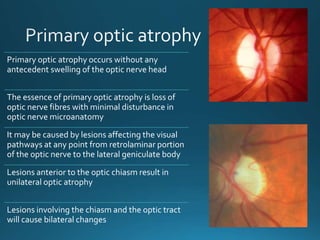
Primary optic atrophy occurs without any
antecedent swelling of the optic nerve head
The essence of primary optic atrophy is loss of
optic nerve fibres with minimal disturbance in
optic nerve microanatomy
It may be caused by lesions affecting the visual
pathways at any point from retrolaminar portion
of the optic nerve to the lateral geniculate body
Lesions anterior to the optic chiasm result in
unilateral optic atrophy
Lesions involving the chiasm and the optic tract
will cause bilateral changes
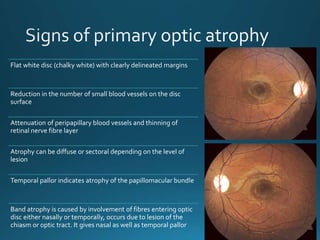
Flat white disc (chalky white) with clearly delineated margins
Reduction in the number of small blood vessels on the disc
surface
Attenuation of peripapillary blood vessels and thinning of
retinal nerve fibre layer
Atrophy can be diffuse or sectoral depending on the level of
lesion
Temporal pallor indicates atrophy of the papillomacular bundle
Band atrophy is caused by involvement of fibres entering optic
disc either nasally or temporally, occurs due to lesion of the
chiasm or optic tract. It gives nasal as well as temporal pallor
Reduction in optic nerve diameter
Reduction in the number of axons
Minimal gliotic changes
Reduction in the number and size of blood vessels
Thickening of connective tissue septa
Optic neuritis
Compression by tumours and aneurysms
Hereditary optic neuropathies
Toxic and nutritional optic neuropathies
• Show early temporal pallor due to affection of papillomacular
fibres
Trauma
Signs vary according to the cause and its course
Slightly or moderately raised white or greyish disc
with poorly delineated margins due to gliosis
Obscuration of the lamina cribrosa
Reduction in the number of small blood vessels on
the disc surface
Peripapillary circumferential retinochoroidal folds
(Paton lines) specially temporal to the disc
Sheathing of arterioles and venous tortuosity may
be present
Loss of fibres
Gliosis of optic nerve head and peripapillary
vasculature
Glial cell proliferation on the surface and
edges of the disc
Astrocytes are seen throughout the optic
nerve head and in heaps anterior to the disc
Chronic papilledema
Anterior ischaemic optic neuropathy
Papillitis
Intraocular inflammatory causes of marked disc swelling are sometimes
considered to cause secondary rather than consecutive optic atrophy
Diffuse enlargement
an bean pot like
cupping of the optic
disc cup
This kind of optic
atrophy is described
classically with
ischaemic lesions of
the optic nerve head
Ascending Primary disease process that causes that causes death of ganglion cells or
their axons which leads to degenerative changes along the optic nerve
head , chiasm, tracts and lateral geniculate body
Retinitis pigmentosa, Leber’s hereditary optic neuropathy
Descending It results from a disease process which primarily behind the optic nerve
head with degenerative changes with the degenerative changes
proceeding downstream all the way to retinal ganglion cell
Seen with compressive lesions, inflammatory diseases and some cases of
toxic, metabolic and nutritional optic atrophy
Usually transsynaptic degeneration does not occur, however, in children
and young adults descending atrophy has been noted following visual
cortex lesions
Presence of optic disc
pallor
• Normally 10 blood vessels are seen passing across the optic
nerve margins
• Kestenbaum’s capillary drop down test – from 10 to 7 or less
Loss of small blood
vessel
• There maybe narrowing of blood vessels over the optic disc
• May be associated with gliosis of blood vessels over the optic
disc head
Changes in the blood
vessels over the optic
disc
• Over the optic nerve head and peripapillary retinaGliotic changes
Morphological appearance of the disc
may vary according to the different
aetiologies
It depends on extent and severity of
optic nerve damage
Accordingly it maybe subclassified as
• Mild, moderate or severe
• Diffuse or sectoral
• Total or partial
In AION there is characteristic superior and inferior disc pallor
In chiasmal lesion, decussating fibres from the nasal retina are
involved, it tends to produce a bow tie pattern of ischaemic optic
neuropathy. It also involves the temporal retina of both sides but
spares superior and inferior retinas
Patients with optic neuritis tend to produce temporal pallor of
the involved optic discs
Thinning of optic nerve secondary to loss of parenchyma
Decrease in number of axon cylinders
Loss of ensheathing myelin
Widening of pial septa, increase in subarachnoid space and dura becoming redundant
Variable degree of gliosis can be noted
Fragmentation and engulfment of myelin by phagocytes may occur along with remyelination
Loss of retinal ganglion cell layers
LGB may or may not show signs of atrophy
Optic disc hypoplasia
Optic disc coloboma
Optic disc pit
Tilted discs
Optic disc drussens
Morning glory syndrome
Healthy optic disc is yellow-pink in colour, due to total internal
reflection through the axonal fibres and reflection from surface
capillaries
The temporal quadrant is normally lighter than the others
Degenerated axons lose this optical property, hence the disc
appears pale
Pallor is also contributed to the loss of pial capillaries which supply
optic disc
Axonal degeneration can be anterograde or retrograde
depending on the location of the inciting factor
Microscopic examination shows excavation of the cup
and baring of the lamina cribrosa
Thinning of axons, gliosis and widening of subarachnoid
space
In vivo microscopic evaluation of optic nerve head can
be done by OCT
Reduced visual acuity (normal to PL neg)
Colour vision is affected more in optic nerve disorders than
those with retinal disorders
RAPD detected by Levantin’s swinging flashlight
Contrast sensitivity is measured by Pelli-Robson contrast
sensitivity chart or Cambridge low-contrast grating test
Pulfrich phenomenon – illusion of horizontally oscillating
object appear to be moving in elliptical orbit
Based on
• Mode of onset
• Distribution of optic disc pallor
• Visual field examination
• Imaging and electrophysiology
Specific patterns discussed before
• In AION there is characteristic superior and inferior
disc pallor
• In chiasmal lesion it tends to produce a bow tie
pattern
• Patients with optic neuritis tend to produce temporal
pallor of the involved optic discs
• Marked attenuation of blood vessels with presence of
retinal pigmentary changes is suggestive of
consecutive optic atrophy
• Generalised reduction of sensitivity, centrocaecal scotomaOptic neuritis
• Superior or inferior altitudinal field defectsAION
• Bitemporal hemianopia
• Total monocular field loss in one eye and quadrantanopia
in the other eye
Chiasmal tumours
• Homonymous hemianopia
Tumours of posterior
visual pathway and
visual cortex
MRI
CT scan
VEP
Prolongation of P100 onVEP
It maybe possible to detect inter eye differences in
latencies
P100 prolongation returns to normal in only 30%
patients
Most other neuropathies show reduction in the
amplitude
No specific P100 pattern
Therefore role of electrodiagnosis is getting
limited in the diagnosis
History taking
Optic nerve head evaluation
Visual testing
Colour vision
Contrast sensitivity
Visual field analysis
Neuro imaging
Systemic
• Diabetes
• Hypertension
• Hyperlipidaemia
• Abnormal carotid circulation
• Hyperhomocysteinemia
Other investigations
• Carotid doppler USG
• VDRL/TPHA
• SerumVitB12
• ANA
• Sarcoidosis work up
• APLA
• TORCH panel
Ophthalmic investigations
Primary optic
atrophy
Optic neuritis
Intracranial mass
Trauma
Hereditary
Toxic
Secondary
optic atrophy
Papilledema
AION
Papillitis
Consecutive
optic atrophy
Retinitis
pigmentosa
Healed vasculitis
Excessive pan
retinal
photocoagulation
Feature Primary Secondary Consecutive
Colour Chalky white Dirty white (grey) Waxy pallor
Cup Shallow Filled up Normal
Vessels Normal Normal/attenuated Grossly thinned out
Margin Well defined Blurred Well defined
Optic atrophy

Optic atrophy

  • 3.
    • Primary opticatrophy • Secondary optic atrophy • Consecutive optic atrophy Based on ophthalmoscopic appearance
  • 4.
    Primary optic atrophyoccurs without any antecedent swelling of the optic nerve head The essence of primary optic atrophy is loss of optic nerve fibres with minimal disturbance in optic nerve microanatomy It may be caused by lesions affecting the visual pathways at any point from retrolaminar portion of the optic nerve to the lateral geniculate body Lesions anterior to the optic chiasm result in unilateral optic atrophy Lesions involving the chiasm and the optic tract will cause bilateral changes
  • 5.
    Flat white disc(chalky white) with clearly delineated margins Reduction in the number of small blood vessels on the disc surface Attenuation of peripapillary blood vessels and thinning of retinal nerve fibre layer Atrophy can be diffuse or sectoral depending on the level of lesion Temporal pallor indicates atrophy of the papillomacular bundle Band atrophy is caused by involvement of fibres entering optic disc either nasally or temporally, occurs due to lesion of the chiasm or optic tract. It gives nasal as well as temporal pallor
  • 6.
    Reduction in opticnerve diameter Reduction in the number of axons Minimal gliotic changes Reduction in the number and size of blood vessels Thickening of connective tissue septa
  • 7.
    Optic neuritis Compression bytumours and aneurysms Hereditary optic neuropathies Toxic and nutritional optic neuropathies • Show early temporal pallor due to affection of papillomacular fibres Trauma
  • 9.
    Signs vary accordingto the cause and its course Slightly or moderately raised white or greyish disc with poorly delineated margins due to gliosis Obscuration of the lamina cribrosa Reduction in the number of small blood vessels on the disc surface Peripapillary circumferential retinochoroidal folds (Paton lines) specially temporal to the disc Sheathing of arterioles and venous tortuosity may be present
  • 10.
    Loss of fibres Gliosisof optic nerve head and peripapillary vasculature Glial cell proliferation on the surface and edges of the disc Astrocytes are seen throughout the optic nerve head and in heaps anterior to the disc
  • 11.
    Chronic papilledema Anterior ischaemicoptic neuropathy Papillitis Intraocular inflammatory causes of marked disc swelling are sometimes considered to cause secondary rather than consecutive optic atrophy
  • 16.
    Diffuse enlargement an beanpot like cupping of the optic disc cup This kind of optic atrophy is described classically with ischaemic lesions of the optic nerve head
  • 17.
    Ascending Primary diseaseprocess that causes that causes death of ganglion cells or their axons which leads to degenerative changes along the optic nerve head , chiasm, tracts and lateral geniculate body Retinitis pigmentosa, Leber’s hereditary optic neuropathy Descending It results from a disease process which primarily behind the optic nerve head with degenerative changes with the degenerative changes proceeding downstream all the way to retinal ganglion cell Seen with compressive lesions, inflammatory diseases and some cases of toxic, metabolic and nutritional optic atrophy Usually transsynaptic degeneration does not occur, however, in children and young adults descending atrophy has been noted following visual cortex lesions
  • 18.
    Presence of opticdisc pallor • Normally 10 blood vessels are seen passing across the optic nerve margins • Kestenbaum’s capillary drop down test – from 10 to 7 or less Loss of small blood vessel • There maybe narrowing of blood vessels over the optic disc • May be associated with gliosis of blood vessels over the optic disc head Changes in the blood vessels over the optic disc • Over the optic nerve head and peripapillary retinaGliotic changes
  • 19.
    Morphological appearance ofthe disc may vary according to the different aetiologies It depends on extent and severity of optic nerve damage Accordingly it maybe subclassified as • Mild, moderate or severe • Diffuse or sectoral • Total or partial
  • 20.
    In AION thereis characteristic superior and inferior disc pallor In chiasmal lesion, decussating fibres from the nasal retina are involved, it tends to produce a bow tie pattern of ischaemic optic neuropathy. It also involves the temporal retina of both sides but spares superior and inferior retinas Patients with optic neuritis tend to produce temporal pallor of the involved optic discs
  • 21.
    Thinning of opticnerve secondary to loss of parenchyma Decrease in number of axon cylinders Loss of ensheathing myelin Widening of pial septa, increase in subarachnoid space and dura becoming redundant Variable degree of gliosis can be noted Fragmentation and engulfment of myelin by phagocytes may occur along with remyelination Loss of retinal ganglion cell layers LGB may or may not show signs of atrophy
  • 22.
    Optic disc hypoplasia Opticdisc coloboma Optic disc pit Tilted discs Optic disc drussens Morning glory syndrome
  • 23.
    Healthy optic discis yellow-pink in colour, due to total internal reflection through the axonal fibres and reflection from surface capillaries The temporal quadrant is normally lighter than the others Degenerated axons lose this optical property, hence the disc appears pale Pallor is also contributed to the loss of pial capillaries which supply optic disc
  • 25.
    Axonal degeneration canbe anterograde or retrograde depending on the location of the inciting factor Microscopic examination shows excavation of the cup and baring of the lamina cribrosa Thinning of axons, gliosis and widening of subarachnoid space In vivo microscopic evaluation of optic nerve head can be done by OCT
  • 26.
    Reduced visual acuity(normal to PL neg) Colour vision is affected more in optic nerve disorders than those with retinal disorders RAPD detected by Levantin’s swinging flashlight Contrast sensitivity is measured by Pelli-Robson contrast sensitivity chart or Cambridge low-contrast grating test Pulfrich phenomenon – illusion of horizontally oscillating object appear to be moving in elliptical orbit
  • 28.
    Based on • Modeof onset • Distribution of optic disc pallor • Visual field examination • Imaging and electrophysiology
  • 30.
    Specific patterns discussedbefore • In AION there is characteristic superior and inferior disc pallor • In chiasmal lesion it tends to produce a bow tie pattern • Patients with optic neuritis tend to produce temporal pallor of the involved optic discs • Marked attenuation of blood vessels with presence of retinal pigmentary changes is suggestive of consecutive optic atrophy
  • 31.
    • Generalised reductionof sensitivity, centrocaecal scotomaOptic neuritis • Superior or inferior altitudinal field defectsAION • Bitemporal hemianopia • Total monocular field loss in one eye and quadrantanopia in the other eye Chiasmal tumours • Homonymous hemianopia Tumours of posterior visual pathway and visual cortex
  • 32.
  • 33.
    Prolongation of P100onVEP It maybe possible to detect inter eye differences in latencies P100 prolongation returns to normal in only 30% patients
  • 34.
    Most other neuropathiesshow reduction in the amplitude No specific P100 pattern Therefore role of electrodiagnosis is getting limited in the diagnosis
  • 35.
    History taking Optic nervehead evaluation Visual testing Colour vision Contrast sensitivity Visual field analysis Neuro imaging
  • 36.
    Systemic • Diabetes • Hypertension •Hyperlipidaemia • Abnormal carotid circulation • Hyperhomocysteinemia Other investigations • Carotid doppler USG • VDRL/TPHA • SerumVitB12 • ANA • Sarcoidosis work up • APLA • TORCH panel Ophthalmic investigations
  • 39.
    Primary optic atrophy Optic neuritis Intracranialmass Trauma Hereditary Toxic Secondary optic atrophy Papilledema AION Papillitis Consecutive optic atrophy Retinitis pigmentosa Healed vasculitis Excessive pan retinal photocoagulation
  • 40.
    Feature Primary SecondaryConsecutive Colour Chalky white Dirty white (grey) Waxy pallor Cup Shallow Filled up Normal Vessels Normal Normal/attenuated Grossly thinned out Margin Well defined Blurred Well defined