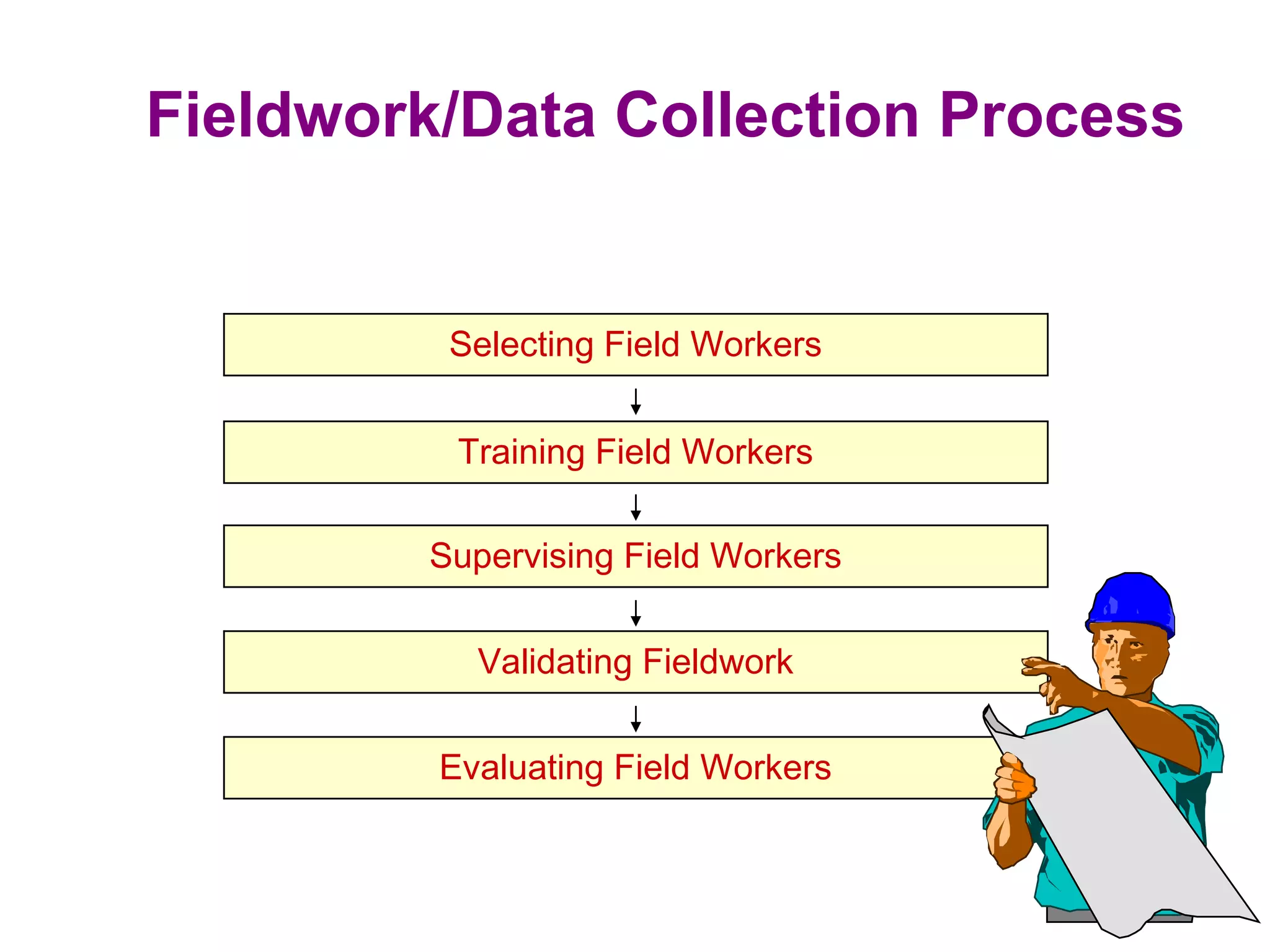
Fieldwork/Data Collection Process
Selecting Field Workers
Training Field Workers
Supervising Field Workers
Validating Fieldwork
Evaluating Field Workers
Selection of Field Workers
The researcher should:
– Develop job specifications for the project, taking
into account the mode of data collection.
– Decide what characteristics the field workers
should have.
– Recruit appropriate individuals.
General Qualifications of Field
Workers
• Healthy. Field workers must have the stamina
required to do the job.
• Outgoing. The interviewers should be able to
establish rapport with the respondents.
• Communicative. Effective speaking and listening
skills are a great asset.
• Pleasant appearance. If the field worker's physical
appearance is unpleasant or unusual, the data
collected may be biased.
• Educated. Interviewers must have good reading and
writing skills.
• Experienced. Experienced interviewers are likely to
do a better job.
Training of Field Workers
• Making the Initial Contact – Interviewers should be trained
to make opening remarks that will convince potential
respondents that their participation is important.
• Asking the Questions
1. Be thoroughly familiar with the questionnaire.
2. Ask the questions in the order in which they appear in
the questionnaire.
3. Use the exact wording given in the questionnaire.
4. Read each question slowly.
5. Repeat questions that are not understood.
6. Ask every applicable question.
7. Follow instructions, probe carefully.
Training of Field Workers
• Probing – Some commonly used probing techniques:
1. Repeating the question.
2. Repeating the respondent's reply.
3. Using a pause or silent probe.
4. Boosting or reassuring the respondent.
5. Eliciting clarification.
6. Using objective/neutral questions or comments.
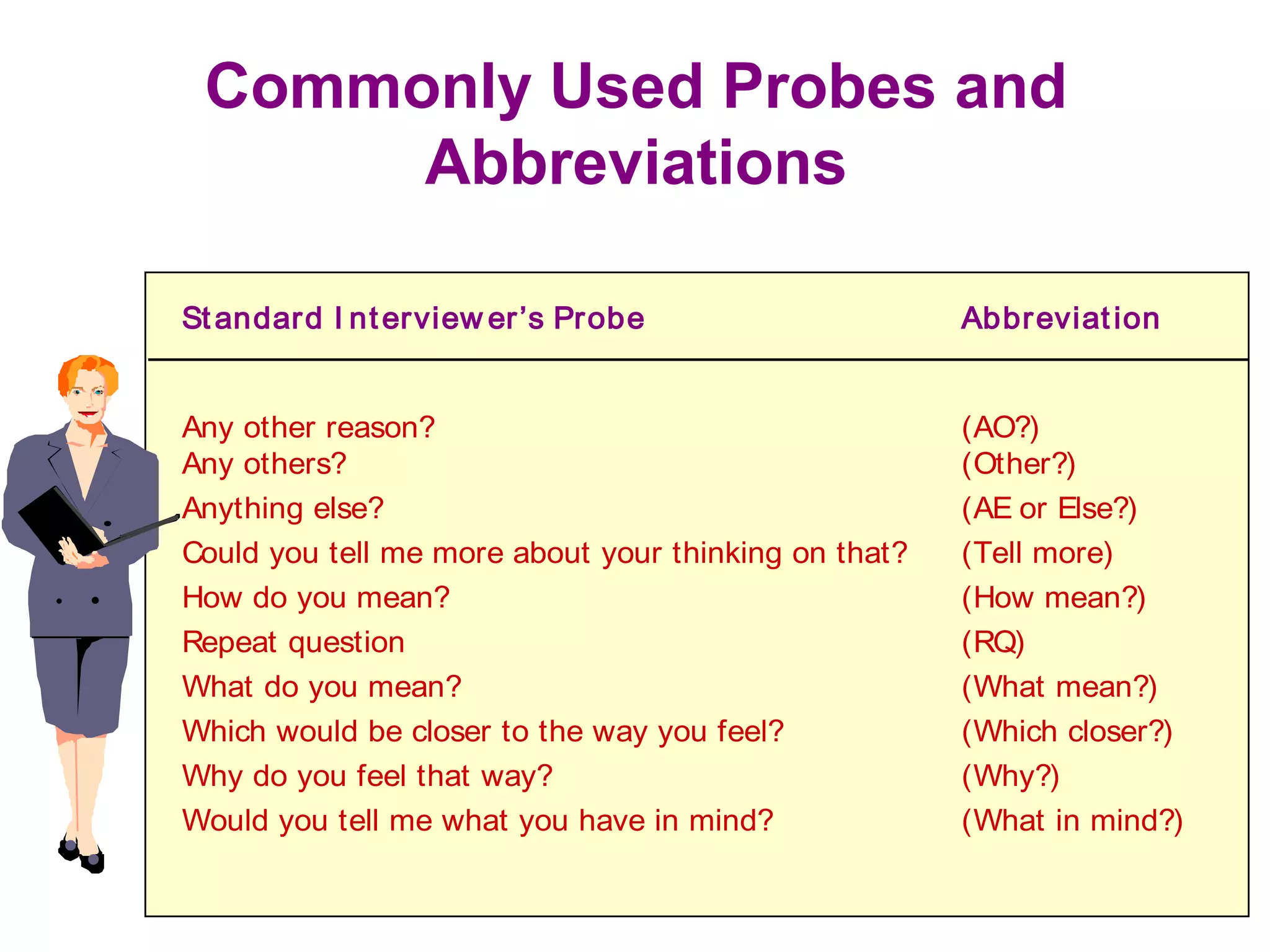
Commonly Used Probes and
Abbreviations
Standard I nterview er’s Probe Abbreviation
Any other reason? (AO?)
Any others? (Other?)
Anything else? (AE or Else?)
Could you tell me more about your thinking on that? (Tell more)
How do you mean? (How mean?)
Repeat question (RQ)
What do you mean? (What mean?)
Which would be closer to the way you feel? (Which closer?)
Why do you feel that way? (Why?)
Would you tell me what you have in mind? (What in mind?)
Training of Field Workers
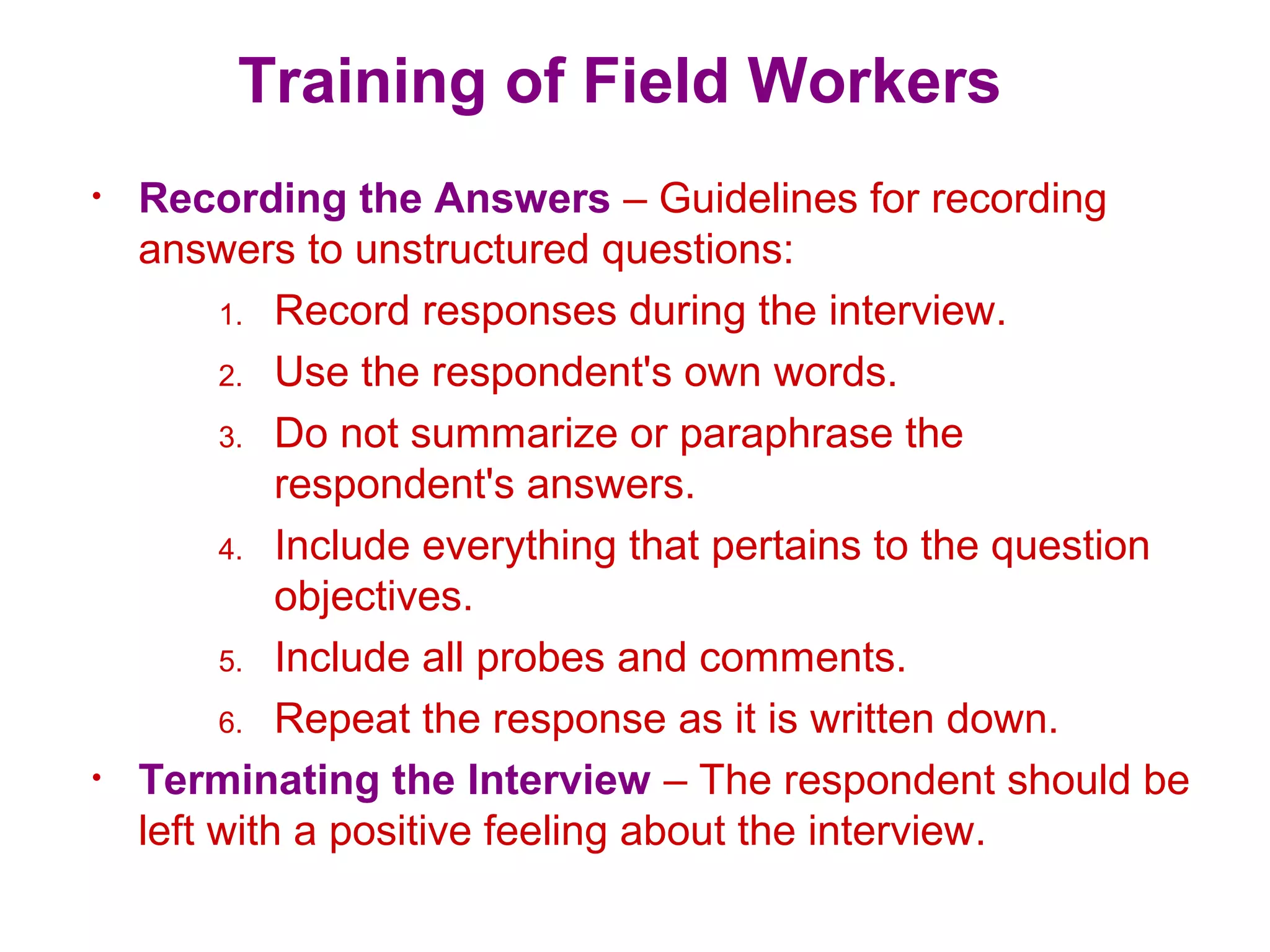
• Recording the Answers – Guidelines for recording
answers to unstructured questions:
1. Record responses during the interview.
2. Use the respondent's own words.
3. Do not summarize or paraphrase the
respondent's answers.
4. Include everything that pertains to the question
objectives.
5. Include all probes and comments.
6. Repeat the response as it is written down.
• Terminating the Interview – The respondent should be
left with a positive feeling about the interview.
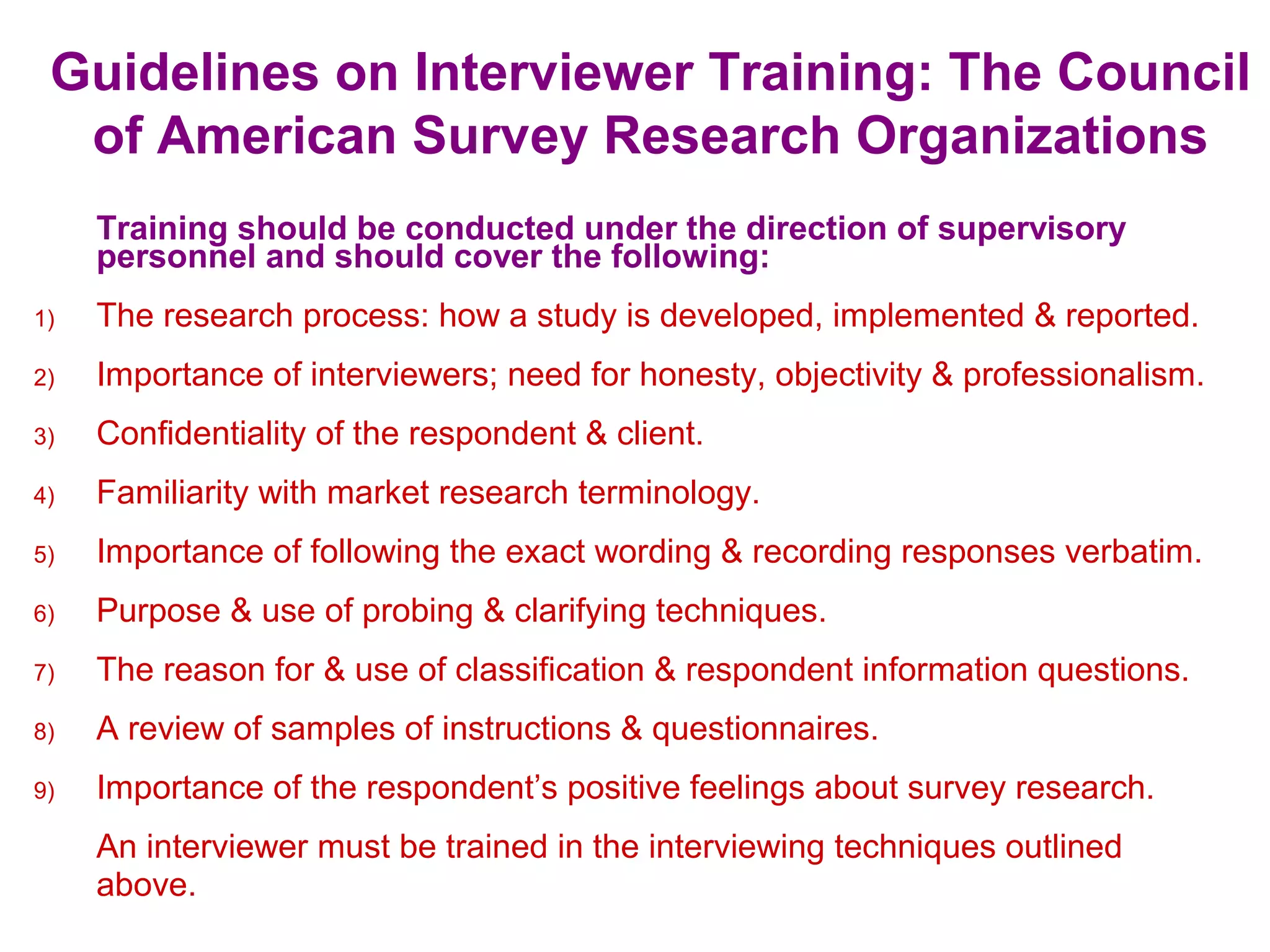
Guidelines on Interviewer Training: The Council
of American Survey Research Organizations
Training should be conducted under the direction of supervisory
personnel and should cover the following:
1) The research process: how a study is developed, implemented & reported.
2) Importance of interviewers; need for honesty, objectivity & professionalism.
3) Confidentiality of the respondent & client.
4) Familiarity with market research terminology.
5) Importance of following the exact wording & recording responses verbatim.
6) Purpose & use of probing & clarifying techniques.
7) The reason for & use of classification & respondent information questions.
8) A review of samples of instructions & questionnaires.
9) Importance of the respondent’s positive feelings about survey research.
An interviewer must be trained in the interviewing techniques outlined
above.
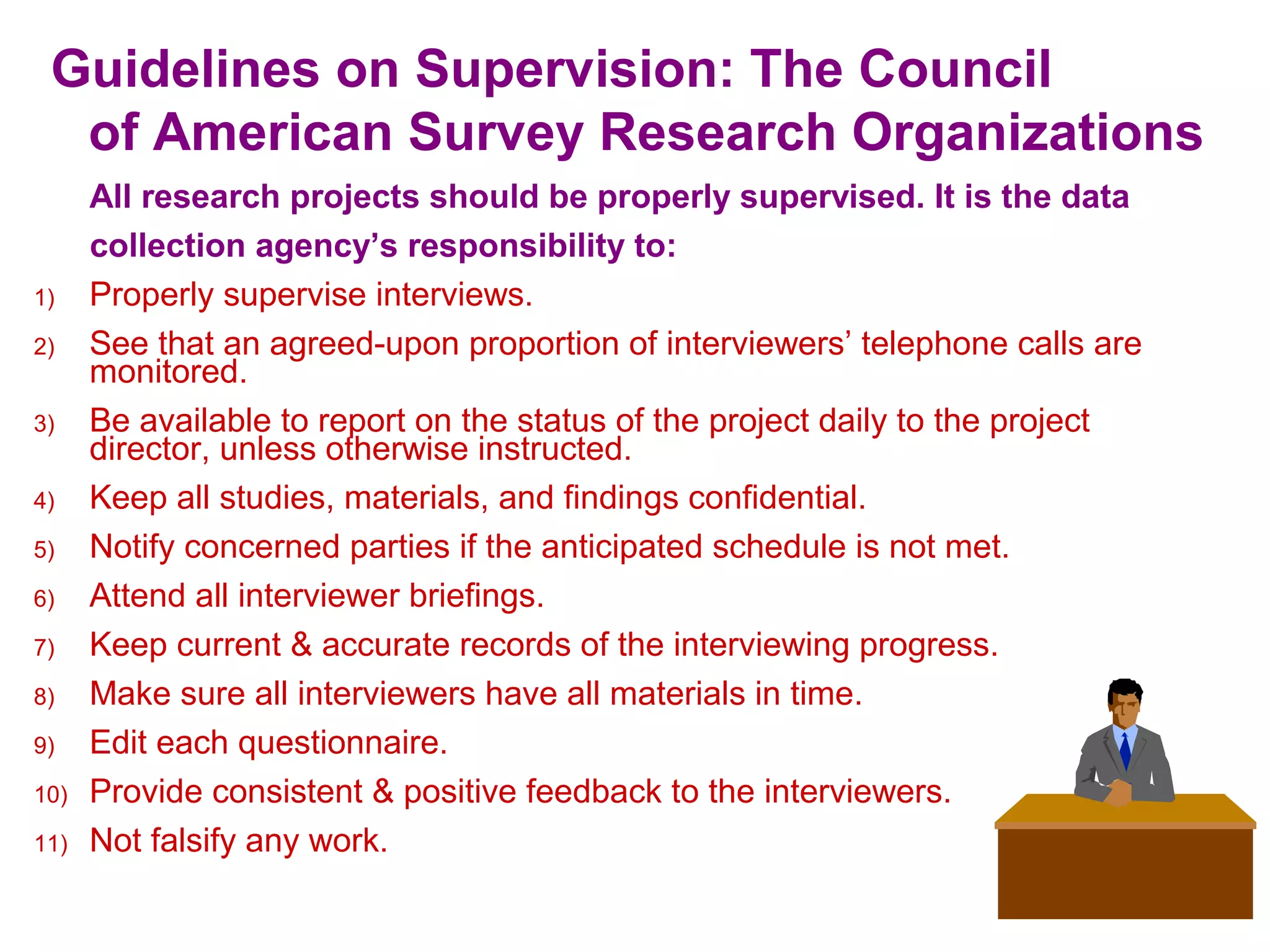
Guidelines on Supervision: The Council
of American Survey Research Organizations
All research projects should be properly supervised. It is the data
collection agency’s responsibility to:
1) Properly supervise interviews.
2) See that an agreed-upon proportion of interviewers’ telephone calls are
monitored.
3) Be available to report on the status of the project daily to the project
director, unless otherwise instructed.
4) Keep all studies, materials, and findings confidential.
5) Notify concerned parties if the anticipated schedule is not met.
6) Attend all interviewer briefings.
7) Keep current & accurate records of the interviewing progress.
8) Make sure all interviewers have all materials in time.
9) Edit each questionnaire.
10) Provide consistent & positive feedback to the interviewers.
11) Not falsify any work.
Guidelines on Interviewing: The Council
of American Survey Research
Organizations
Each interviewer is to follow these techniques for good interviewing:
1) Provide his or her full name, if asked by the respondent, as well as a phone
number for the research firm.
2) Read each question exactly as written. Report any problems to the
supervisor as soon as possible.
3) Read the questions in the order indicated on the questionnaire, following the
proper skip sequences.
4) Clarify any question by the respondent in a neutral way.
5) Not mislead respondents as to the length of the interview.
6) Not reveal the ultimate client’s identity unless instructed to do so.
7) Keep a tally on and the reason for each terminated interview.
8) Remain neutral, do not indicate (dis) agreement with the respondent.
Guidelines on Interviewing: The Council
of American Survey Research
Organizations
9) Speak slowly & distinctly.
10) Record all replies verbatim.
11) Avoid unnecessary conversation with the respondent.
12) Probe & clarify in a neutral manner for additional comments on all
open-ended questions, unless otherwise indicated.
13) Write neatly & legibly.
14) Check all work for thoroughness before turning in to the supervisor.
15) When terminating a respondent, do it neutrally.
16) Keep all studies, materials, and findings confidential.
17) Not falsify any interviews or any answers to any question.
18) Thank the respondent for participating in the study.
Supervision of Field Workers
Supervision of field workers means making sure that
they are following the procedures and techniques in which
they were trained. Supervision involves quality control
and editing, sampling control, control of cheating, and
central office control.
– Quality Control and Editing – This requires checking
to see if the field procedures are being properly
implemented.
– Sampling Control – The supervisor attempts to
ensure that the interviewers are strictly following the
sampling plan.
– Control of Cheating – Cheating can be minimized
through proper training, supervision, and validation.
– Central Office Control – Supervisors provide quality
and cost-control information to the central office.
Validation of Fieldwork
• The supervisors call 10 - 25% of the respondents to
inquire whether the field workers actually conducted
the interviews.
• The supervisors ask about the length and quality of
the interview, reaction to the interviewer, and basic
demographic data.
• The demographic information is cross-checked
against the information reported by the interviewers
on the questionnaires.
Evaluation of Field Workers
• Cost and Time. The interviewers can be compared in
terms of the total cost (salary and expenses) per
completed interview.
• Response Rates. It is important to monitor response
rates on a timely basis so that corrective action can be
taken if these rates are too low.
• Quality of Interviewing. To evaluate interviewers on the
quality of interviewing, the supervisor must directly
observe the interviewing process.
• Quality of Data. The completed questionnaires of each
interviewer should be evaluated for the quality of data.
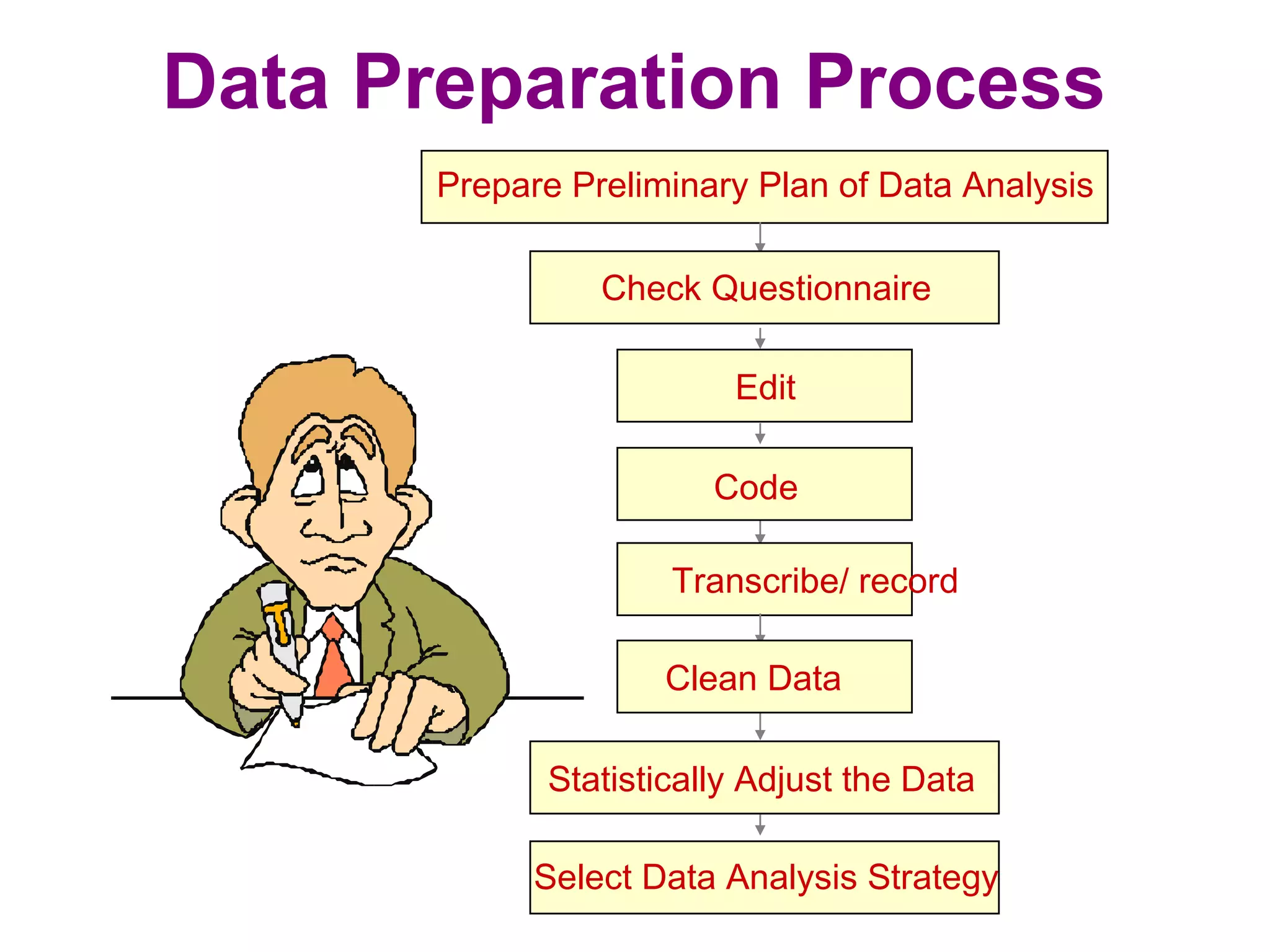
Data Preparation Process
Select Data Analysis Strategy
Prepare Preliminary Plan of Data Analysis
Check Questionnaire
Edit
Code
Transcribe/ record
Clean Data
Statistically Adjust the Data
Questionnaire Checking
A questionnaire returned from the field may be
unacceptable for several reasons.
– Parts of the questionnaire may be incomplete.
– The pattern of responses may indicate that the
respondent did not understand or follow the
instructions.
– The responses show little variance.
– One or more pages are missing.
– The questionnaire is received after the
preestablished cutoff date.
– The questionnaire is answered by someone who
does not qualify for participation.
Editing
Treatment of Unsatisfactory Results
– Returning to the Field – The questionnaires with
unsatisfactory responses may be returned to the
field, where the interviewers recontact the
respondents.
– Assigning Missing Values – If returning the
questionnaires to the field is not feasible, the
editor may assign missing values to unsatisfactory
responses.
– Discarding Unsatisfactory Respondents – In
this approach, the respondents with unsatisfactory
responses are simply discarded.
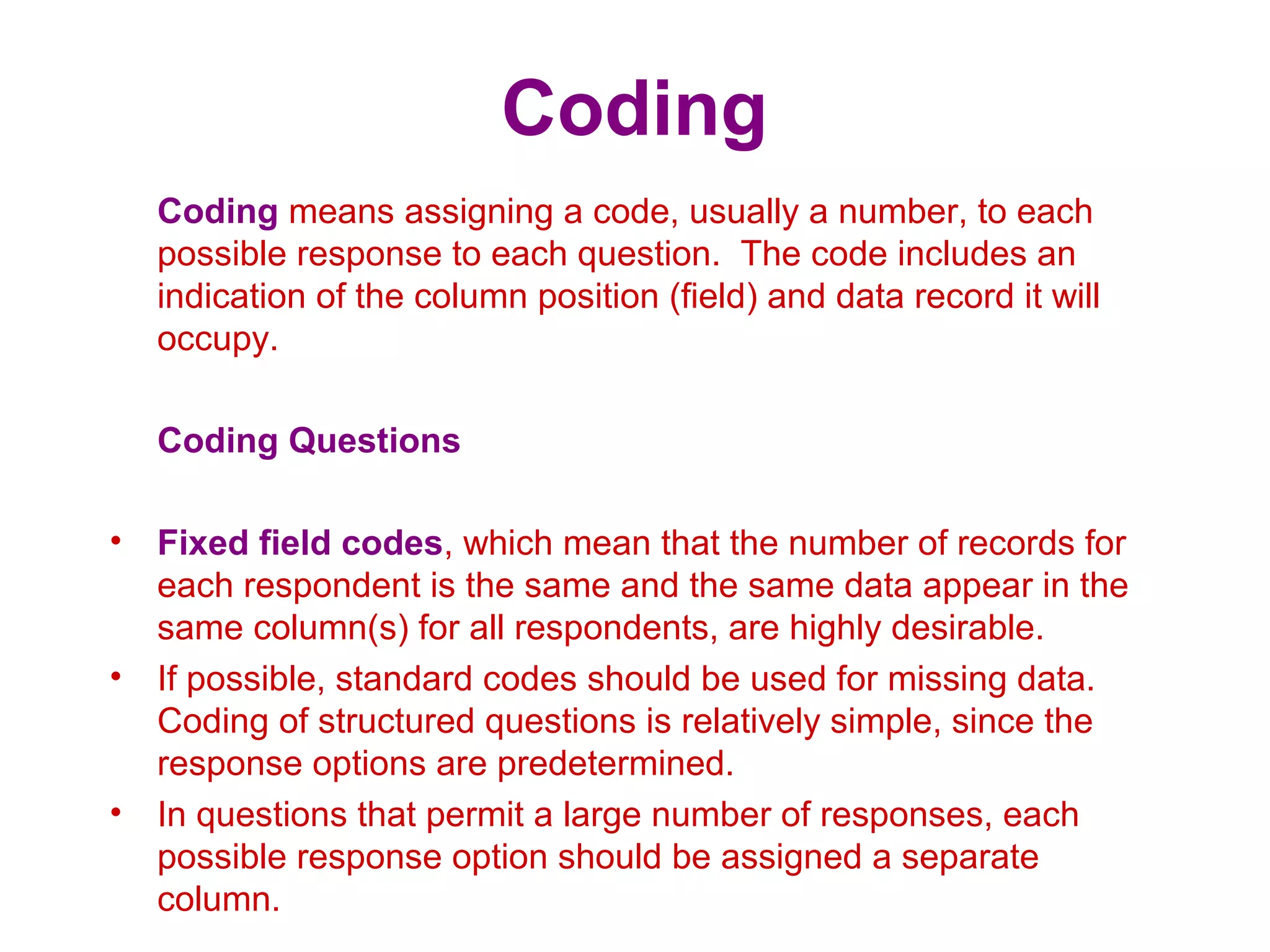
Coding
Coding means assigning a code, usually a number, to each
possible response to each question. The code includes an
indication of the column position (field) and data record it will
occupy.
Coding Questions
• Fixed field codes, which mean that the number of records for
each respondent is the same and the same data appear in the
same column(s) for all respondents, are highly desirable.
• If possible, standard codes should be used for missing data.
Coding of structured questions is relatively simple, since the
response options are predetermined.
• In questions that permit a large number of responses, each
possible response option should be assigned a separate
column.
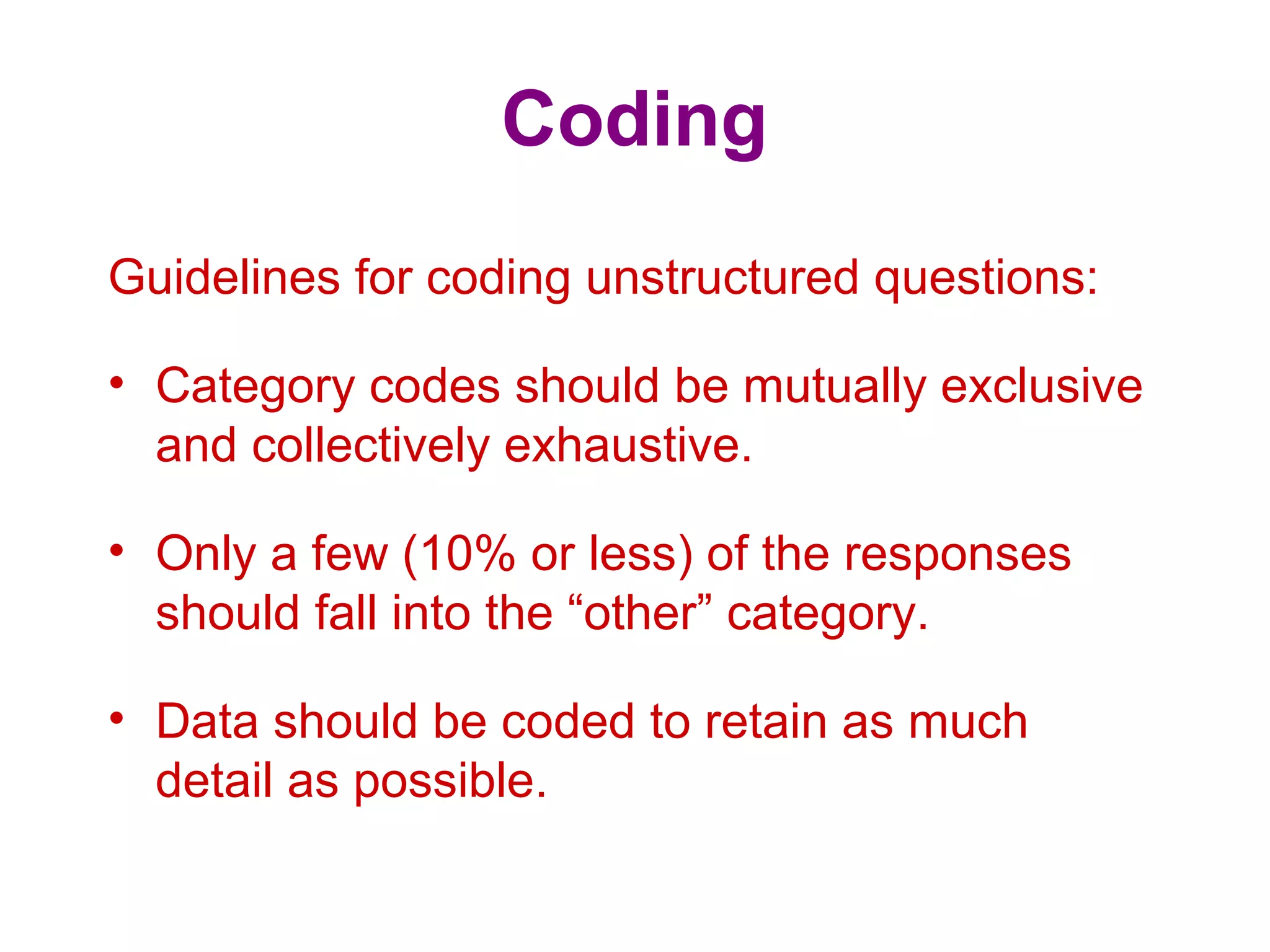
Coding
Guidelines for coding unstructured questions:
• Category codes should be mutually exclusive
and collectively exhaustive.
• Only a few (10% or less) of the responses
should fall into the “other” category.
• Data should be coded to retain as much
detail as possible.
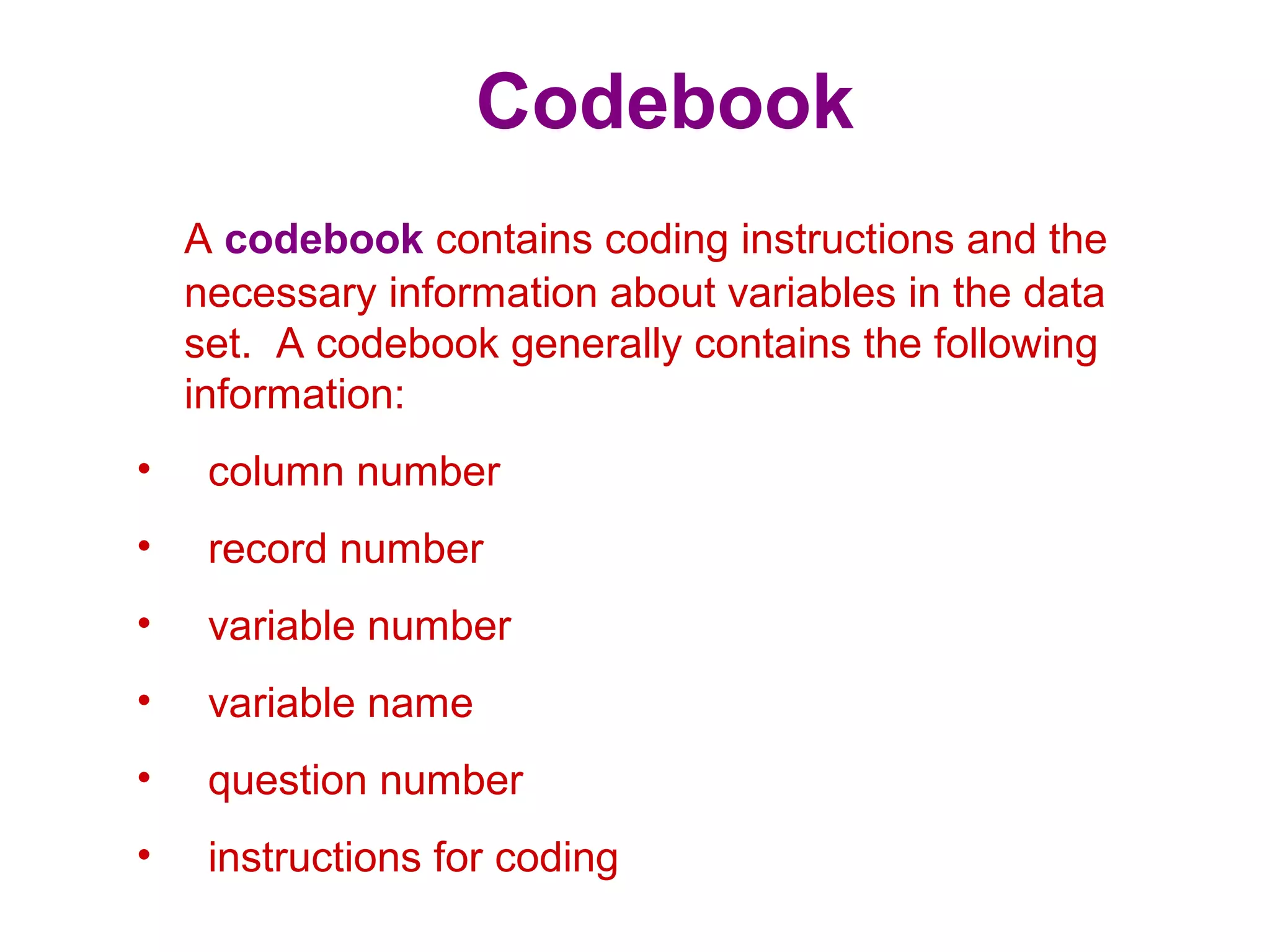
Codebook
A codebook contains coding instructions and the
necessary information about variables in the data
set. A codebook generally contains the following
information:
• column number
• record number
• variable number
• variable name
• question number
• instructions for coding
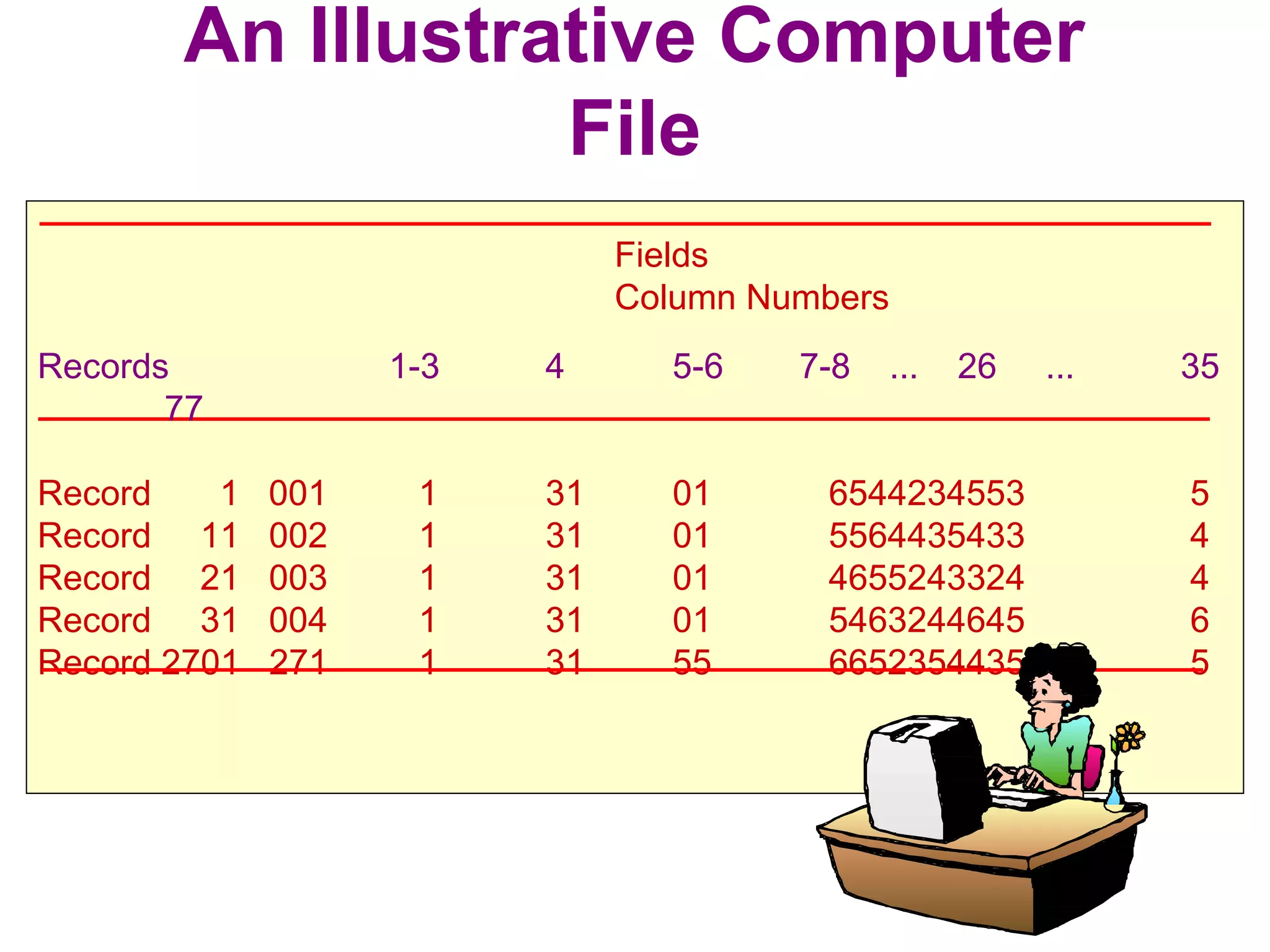
An Illustrative Computer
File
Records 1-3 4 5-6 7-8 ... 26 ... 35
77
Record 1 001 1 31 01 6544234553 5
Record 11 002 1 31 01 5564435433 4
Record 21 003 1 31 01 4655243324 4
Record 31 004 1 31 01 5463244645 6
Record 2701 271 1 31 55 6652354435 5
Fields
Column Numbers
Data Transcription- involves transferring the
coded data from the questionnaires or coded sheets
onto the disk or directly into computers.
-Computer- assisted telephone interviewing
-Computer- assisted personal interviewing
-Optical recognition
-Universal Product Codes
-Bar codes etc
Data Cleaning
Consistency Checks
Consistency checks identify data that are out of
range, logically inconsistent, or have extreme values.
– Computer packages like SPSS, SAS, EXCEL and
MINITAB can be programmed to identify out-of-
range values for each variable and print out the
respondent code, variable code, variable name,
record number, column number, and out-of-range
value.
– Extreme values should be closely examined.
Data Cleaning
Treatment of Missing
Responses
• Substitute a Neutral Value – A neutral value, typically
the mean response to the variable, is substituted for the
missing responses.
• Substitute an Imputed Response – The respondents'
pattern of responses to other questions are used to impute
or calculate a suitable response to the missing questions.
• In casewise deletion, cases, or respondents, with any
missing responses are discarded from the analysis.
• In pairwise deletion, instead of discarding all cases with
any missing values, the researcher uses only the cases or
respondents with complete responses for each
calculation.
Statistically Adjusting the
Data
Weighting
• In weighting, each case or respondent in the
database is assigned a weight to reflect its
importance relative to other cases or respondents.
• Weighting is most widely used to make the sample
data more representative of a target population on
specific characteristics.
• Yet another use of weighting is to adjust the sample
so that greater importance is attached to
respondents with certain characteristics.
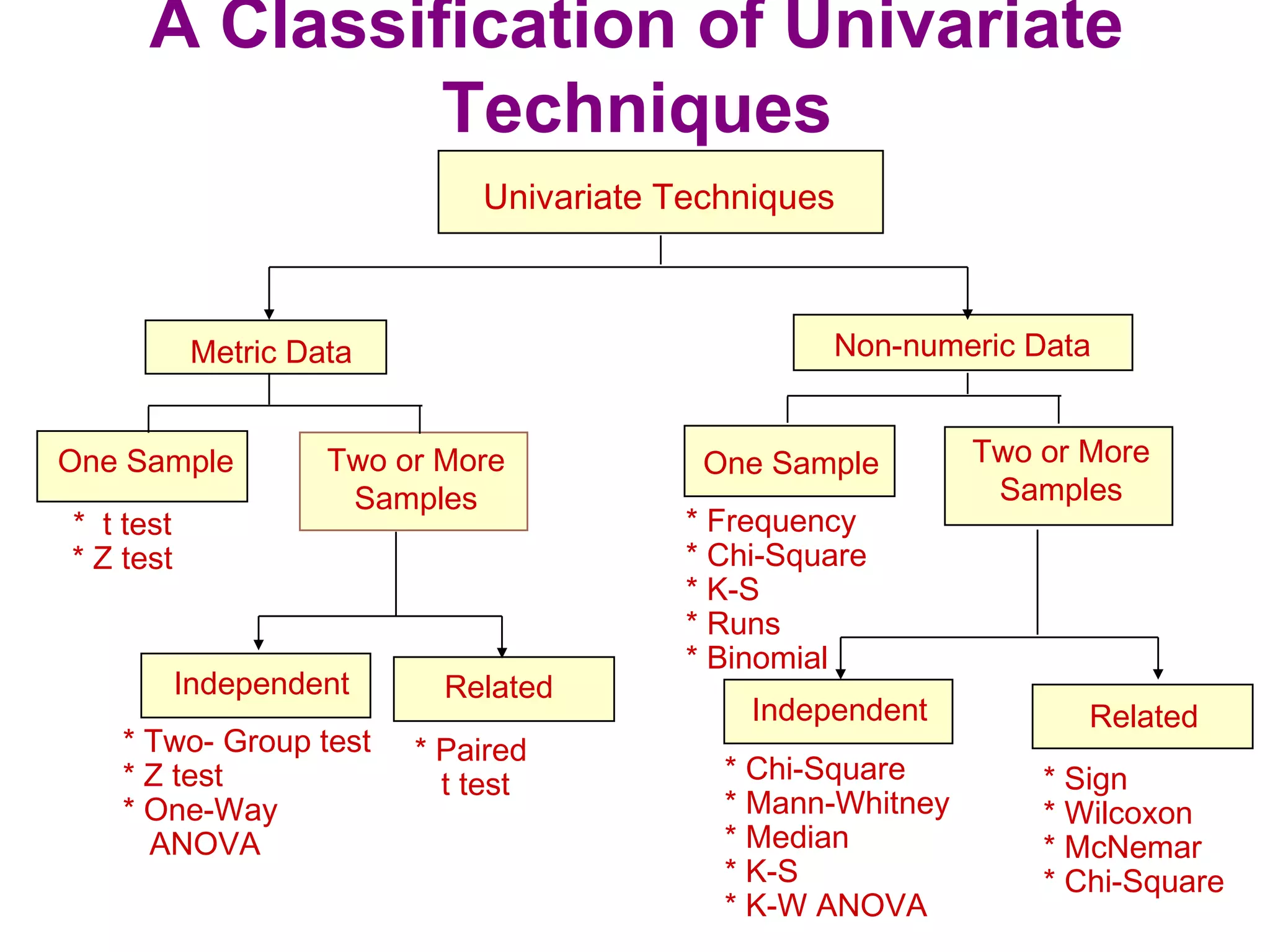
A Classification of Univariate
Techniques
Independent Related
Independent Related
* Two- Group test
* Z test
* One-Way
ANOVA
* Paired
t test * Chi-Square
* Mann-Whitney
* Median
* K-S
* K-W ANOVA
* Sign
* Wilcoxon
* McNemar
* Chi-Square
Metric Data Non-numeric Data
Univariate Techniques
One Sample Two or More
Samples
One Sample Two or More
Samples
* t test
* Z test
* Frequency
* Chi-Square
* K-S
* Runs
* Binomial
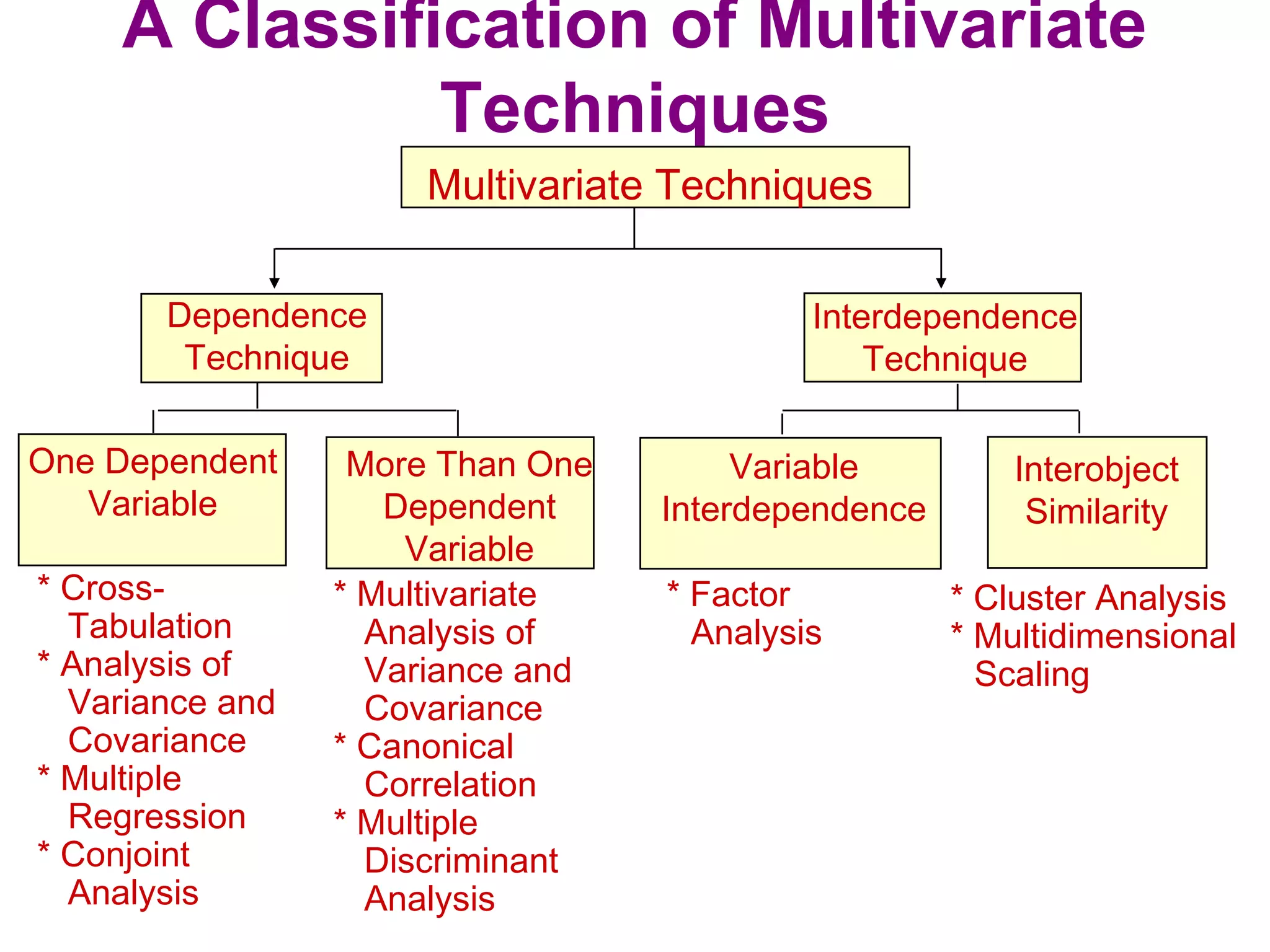
A Classification of Multivariate
Techniques
More Than One
Dependent
Variable
* Multivariate
Analysis of
Variance and
Covariance
* Canonical
Correlation
* Multiple
Discriminant
Analysis
* Cross-
Tabulation
* Analysis of
Variance and
Covariance
* Multiple
Regression
* Conjoint
Analysis
* Factor
Analysis
One Dependent
Variable
Variable
Interdependence
Interobject
Similarity
* Cluster Analysis
* Multidimensional
Scaling
Dependence
Technique
Interdependence
Technique
Multivariate Techniques

Fieldwork/ Data collection process

  • 1.
    Fieldwork/Data Collection Process SelectingField Workers Training Field Workers Supervising Field Workers Validating Fieldwork Evaluating Field Workers
  • 2.
    Selection of FieldWorkers The researcher should: – Develop job specifications for the project, taking into account the mode of data collection. – Decide what characteristics the field workers should have. – Recruit appropriate individuals.
  • 3.
    General Qualifications ofField Workers • Healthy. Field workers must have the stamina required to do the job. • Outgoing. The interviewers should be able to establish rapport with the respondents. • Communicative. Effective speaking and listening skills are a great asset. • Pleasant appearance. If the field worker's physical appearance is unpleasant or unusual, the data collected may be biased. • Educated. Interviewers must have good reading and writing skills. • Experienced. Experienced interviewers are likely to do a better job.
  • 4.
    Training of FieldWorkers • Making the Initial Contact – Interviewers should be trained to make opening remarks that will convince potential respondents that their participation is important. • Asking the Questions 1. Be thoroughly familiar with the questionnaire. 2. Ask the questions in the order in which they appear in the questionnaire. 3. Use the exact wording given in the questionnaire. 4. Read each question slowly. 5. Repeat questions that are not understood. 6. Ask every applicable question. 7. Follow instructions, probe carefully.
  • 5.
    Training of FieldWorkers • Probing – Some commonly used probing techniques: 1. Repeating the question. 2. Repeating the respondent's reply. 3. Using a pause or silent probe. 4. Boosting or reassuring the respondent. 5. Eliciting clarification. 6. Using objective/neutral questions or comments.
  • 6.
    Commonly Used Probesand Abbreviations Standard I nterview er’s Probe Abbreviation Any other reason? (AO?) Any others? (Other?) Anything else? (AE or Else?) Could you tell me more about your thinking on that? (Tell more) How do you mean? (How mean?) Repeat question (RQ) What do you mean? (What mean?) Which would be closer to the way you feel? (Which closer?) Why do you feel that way? (Why?) Would you tell me what you have in mind? (What in mind?)
  • 7.
    Training of FieldWorkers • Recording the Answers – Guidelines for recording answers to unstructured questions: 1. Record responses during the interview. 2. Use the respondent's own words. 3. Do not summarize or paraphrase the respondent's answers. 4. Include everything that pertains to the question objectives. 5. Include all probes and comments. 6. Repeat the response as it is written down. • Terminating the Interview – The respondent should be left with a positive feeling about the interview.
  • 8.
    Guidelines on InterviewerTraining: The Council of American Survey Research Organizations Training should be conducted under the direction of supervisory personnel and should cover the following: 1) The research process: how a study is developed, implemented & reported. 2) Importance of interviewers; need for honesty, objectivity & professionalism. 3) Confidentiality of the respondent & client. 4) Familiarity with market research terminology. 5) Importance of following the exact wording & recording responses verbatim. 6) Purpose & use of probing & clarifying techniques. 7) The reason for & use of classification & respondent information questions. 8) A review of samples of instructions & questionnaires. 9) Importance of the respondent’s positive feelings about survey research. An interviewer must be trained in the interviewing techniques outlined above.
  • 9.
    Guidelines on Supervision:The Council of American Survey Research Organizations All research projects should be properly supervised. It is the data collection agency’s responsibility to: 1) Properly supervise interviews. 2) See that an agreed-upon proportion of interviewers’ telephone calls are monitored. 3) Be available to report on the status of the project daily to the project director, unless otherwise instructed. 4) Keep all studies, materials, and findings confidential. 5) Notify concerned parties if the anticipated schedule is not met. 6) Attend all interviewer briefings. 7) Keep current & accurate records of the interviewing progress. 8) Make sure all interviewers have all materials in time. 9) Edit each questionnaire. 10) Provide consistent & positive feedback to the interviewers. 11) Not falsify any work.
  • 10.
    Guidelines on Interviewing:The Council of American Survey Research Organizations Each interviewer is to follow these techniques for good interviewing: 1) Provide his or her full name, if asked by the respondent, as well as a phone number for the research firm. 2) Read each question exactly as written. Report any problems to the supervisor as soon as possible. 3) Read the questions in the order indicated on the questionnaire, following the proper skip sequences. 4) Clarify any question by the respondent in a neutral way. 5) Not mislead respondents as to the length of the interview. 6) Not reveal the ultimate client’s identity unless instructed to do so. 7) Keep a tally on and the reason for each terminated interview. 8) Remain neutral, do not indicate (dis) agreement with the respondent.
  • 11.
    Guidelines on Interviewing:The Council of American Survey Research Organizations 9) Speak slowly & distinctly. 10) Record all replies verbatim. 11) Avoid unnecessary conversation with the respondent. 12) Probe & clarify in a neutral manner for additional comments on all open-ended questions, unless otherwise indicated. 13) Write neatly & legibly. 14) Check all work for thoroughness before turning in to the supervisor. 15) When terminating a respondent, do it neutrally. 16) Keep all studies, materials, and findings confidential. 17) Not falsify any interviews or any answers to any question. 18) Thank the respondent for participating in the study.
  • 12.
    Supervision of FieldWorkers Supervision of field workers means making sure that they are following the procedures and techniques in which they were trained. Supervision involves quality control and editing, sampling control, control of cheating, and central office control. – Quality Control and Editing – This requires checking to see if the field procedures are being properly implemented. – Sampling Control – The supervisor attempts to ensure that the interviewers are strictly following the sampling plan. – Control of Cheating – Cheating can be minimized through proper training, supervision, and validation. – Central Office Control – Supervisors provide quality and cost-control information to the central office.
  • 13.
    Validation of Fieldwork •The supervisors call 10 - 25% of the respondents to inquire whether the field workers actually conducted the interviews. • The supervisors ask about the length and quality of the interview, reaction to the interviewer, and basic demographic data. • The demographic information is cross-checked against the information reported by the interviewers on the questionnaires.
  • 14.
    Evaluation of FieldWorkers • Cost and Time. The interviewers can be compared in terms of the total cost (salary and expenses) per completed interview. • Response Rates. It is important to monitor response rates on a timely basis so that corrective action can be taken if these rates are too low. • Quality of Interviewing. To evaluate interviewers on the quality of interviewing, the supervisor must directly observe the interviewing process. • Quality of Data. The completed questionnaires of each interviewer should be evaluated for the quality of data.
  • 15.
    Data Preparation Process SelectData Analysis Strategy Prepare Preliminary Plan of Data Analysis Check Questionnaire Edit Code Transcribe/ record Clean Data Statistically Adjust the Data
  • 16.
    Questionnaire Checking A questionnairereturned from the field may be unacceptable for several reasons. – Parts of the questionnaire may be incomplete. – The pattern of responses may indicate that the respondent did not understand or follow the instructions. – The responses show little variance. – One or more pages are missing. – The questionnaire is received after the preestablished cutoff date. – The questionnaire is answered by someone who does not qualify for participation.
  • 17.
    Editing Treatment of UnsatisfactoryResults – Returning to the Field – The questionnaires with unsatisfactory responses may be returned to the field, where the interviewers recontact the respondents. – Assigning Missing Values – If returning the questionnaires to the field is not feasible, the editor may assign missing values to unsatisfactory responses. – Discarding Unsatisfactory Respondents – In this approach, the respondents with unsatisfactory responses are simply discarded.
  • 18.
    Coding Coding means assigninga code, usually a number, to each possible response to each question. The code includes an indication of the column position (field) and data record it will occupy. Coding Questions • Fixed field codes, which mean that the number of records for each respondent is the same and the same data appear in the same column(s) for all respondents, are highly desirable. • If possible, standard codes should be used for missing data. Coding of structured questions is relatively simple, since the response options are predetermined. • In questions that permit a large number of responses, each possible response option should be assigned a separate column.
  • 19.
    Coding Guidelines for codingunstructured questions: • Category codes should be mutually exclusive and collectively exhaustive. • Only a few (10% or less) of the responses should fall into the “other” category. • Data should be coded to retain as much detail as possible.
  • 20.
    Codebook A codebook containscoding instructions and the necessary information about variables in the data set. A codebook generally contains the following information: • column number • record number • variable number • variable name • question number • instructions for coding
  • 21.
    An Illustrative Computer File Records1-3 4 5-6 7-8 ... 26 ... 35 77 Record 1 001 1 31 01 6544234553 5 Record 11 002 1 31 01 5564435433 4 Record 21 003 1 31 01 4655243324 4 Record 31 004 1 31 01 5463244645 6 Record 2701 271 1 31 55 6652354435 5 Fields Column Numbers
  • 22.
    Data Transcription- involvestransferring the coded data from the questionnaires or coded sheets onto the disk or directly into computers. -Computer- assisted telephone interviewing -Computer- assisted personal interviewing -Optical recognition -Universal Product Codes -Bar codes etc
  • 23.
    Data Cleaning Consistency Checks Consistencychecks identify data that are out of range, logically inconsistent, or have extreme values. – Computer packages like SPSS, SAS, EXCEL and MINITAB can be programmed to identify out-of- range values for each variable and print out the respondent code, variable code, variable name, record number, column number, and out-of-range value. – Extreme values should be closely examined.
  • 24.
    Data Cleaning Treatment ofMissing Responses • Substitute a Neutral Value – A neutral value, typically the mean response to the variable, is substituted for the missing responses. • Substitute an Imputed Response – The respondents' pattern of responses to other questions are used to impute or calculate a suitable response to the missing questions. • In casewise deletion, cases, or respondents, with any missing responses are discarded from the analysis. • In pairwise deletion, instead of discarding all cases with any missing values, the researcher uses only the cases or respondents with complete responses for each calculation.
  • 25.
    Statistically Adjusting the Data Weighting •In weighting, each case or respondent in the database is assigned a weight to reflect its importance relative to other cases or respondents. • Weighting is most widely used to make the sample data more representative of a target population on specific characteristics. • Yet another use of weighting is to adjust the sample so that greater importance is attached to respondents with certain characteristics.
  • 26.
    A Classification ofUnivariate Techniques Independent Related Independent Related * Two- Group test * Z test * One-Way ANOVA * Paired t test * Chi-Square * Mann-Whitney * Median * K-S * K-W ANOVA * Sign * Wilcoxon * McNemar * Chi-Square Metric Data Non-numeric Data Univariate Techniques One Sample Two or More Samples One Sample Two or More Samples * t test * Z test * Frequency * Chi-Square * K-S * Runs * Binomial
  • 27.
    A Classification ofMultivariate Techniques More Than One Dependent Variable * Multivariate Analysis of Variance and Covariance * Canonical Correlation * Multiple Discriminant Analysis * Cross- Tabulation * Analysis of Variance and Covariance * Multiple Regression * Conjoint Analysis * Factor Analysis One Dependent Variable Variable Interdependence Interobject Similarity * Cluster Analysis * Multidimensional Scaling Dependence Technique Interdependence Technique Multivariate Techniques