














Scalable and Reliable
Logging at Pinterest
Krishna Gade
krishna@pinterest.com
Yu Yang
yuyang@pinterest.com
Agenda
• What is Pinterest?
• Logging Infrastructure Deep-dive
• Managing Log Quality
• Summary & Questions
What is Pinterest?
What is Pinterest?
Pinterest is a discovery
engine
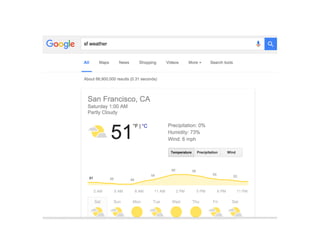
What is the weather in SF today?
What is central limit theorem?
What do I cook for dinner today?
What’s my style?
Where shall we travel this summer?
Pinterest is solving
this
discovery problem
Humans
+
Algorithms
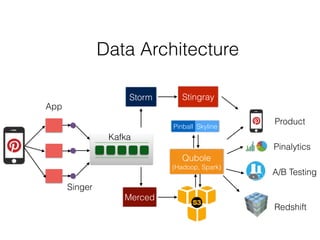
Kafka
App
Data Architecture
Singer
Qubole
(Hadoop, Spark)
Merced
Pinball Skyline
Redshift
Pinalytics
Product
Storm Stingray
A/B Testing
Logging Infrastructure
Requirements
• High availability
• Minimum data loss
• Horizontal scalability
• Low latency
• Minimum operation overhead
Pinterest Logging Infrastructure
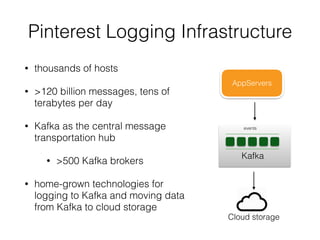
• thousands of hosts
• >120 billion messages, tens of
terabytes per day
• Kafka as the central message
transportation hub
• >500 Kafka brokers
• home-grown technologies for
logging to Kafka and moving data
from Kafka to cloud storage
AppServers
events
Kafka
Cloud storage
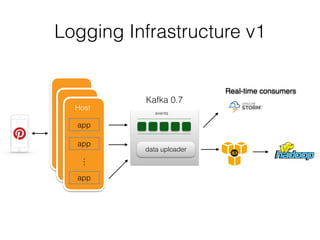
Logging Infrastructure v1
events
Kafka 0.7
Host
app
app
app
data uploader
Real-time consumers
Problems with Kafka 0.7 pipelines
• Data loss
• Kafka 0.7 broker failure —> data loss
• high back pressure —> data loss
• Operability
• broker replacement —> reboot all dependent
services to pick up the latest broker list
Challenges with Kafka that
supports replication
• Multiple copies of messages among brokers
• cannot copy message directly to S3 to
guarantee exact once persistence
• Cannot randomly pick Kafka brokers to write to
• Need to find the leader of each topic partition
• Handle various corner cases
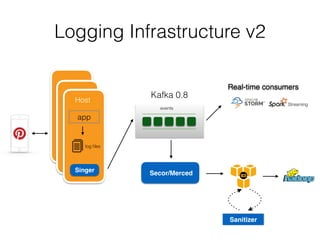
Logging Infrastructure v2
events
Kafka 0.8
Host
app
log files
Singer
Secor/Merced
Sanitizer
Real-time consumers
Logging Agent Requirement
• reliability
• high throughput, low latency
• minimum computation resource usage
• support various log file format (text, thrift, etc.)
• fairness scheduling
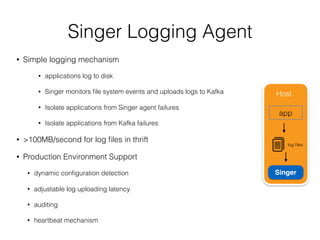
Singer Logging Agent
• Simple logging mechanism
• applications log to disk
• Singer monitors file system events and uploads logs to Kafka
• Isolate applications from Singer agent failures
• Isolate applications from Kafka failures
• >100MB/second for log files in thrift
• Production Environment Support
• dynamic configuration detection
• adjustable log uploading latency
• auditing
• heartbeat mechanism
Host
app
log files
Singer
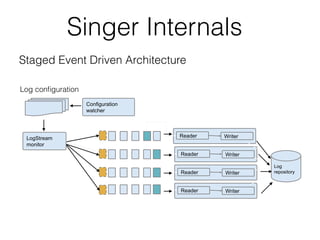
Singer Internals
Singer Architecture
LogStream
monitor
Configuration
watcher
Reader Writer
Log
repository
Reader Writer
Reader Writer
Reader Writer
Log configuration
LogStream processors
A - 1
A -2
B - 1
C - 1
Log configuration
Staged Event Driven Architecture
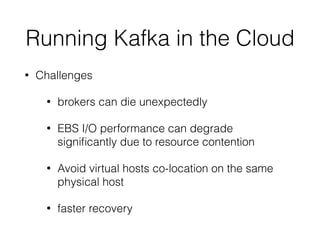
Running Kafka in the Cloud
• Challenges
• brokers can die unexpectedly
• EBS I/O performance can degrade
significantly due to resource contention
• Avoid virtual hosts co-location on the same
physical host
• faster recovery
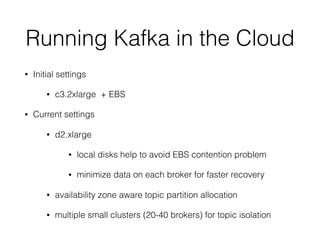
Running Kafka in the Cloud
• Initial settings
• c3.2xlarge + EBS
• Current settings
• d2.xlarge
• local disks help to avoid EBS contention problem
• minimize data on each broker for faster recovery
• availability zone aware topic partition allocation
• multiple small clusters (20-40 brokers) for topic isolation
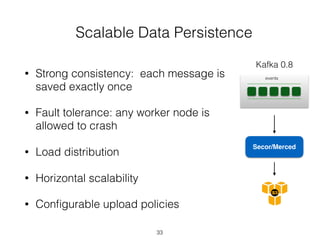
Scalable Data Persistence
33
• Strong consistency: each message is
saved exactly once
• Fault tolerance: any worker node is
allowed to crash
• Load distribution
• Horizontal scalability
• Configurable upload policies
events
Kafka 0.8
Secor/Merced
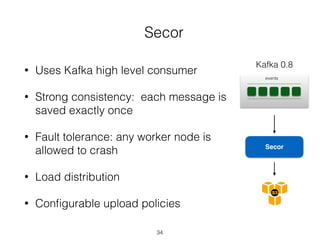
Secor
34
• Uses Kafka high level consumer
• Strong consistency: each message is
saved exactly once
• Fault tolerance: any worker node is
allowed to crash
• Load distribution
• Configurable upload policies
events
Kafka 0.8
Secor
Challenges with consensus-based workload
distribution
• Kafka consumer group rebalancing can prevent
consumer from making progress
• It is difficult to recover when high-level consumer lags
behind on some topic partitions
• Manual tuning is required for workload distribution of
multiple topics
• Inconvenient to add new topics
• Efficiency
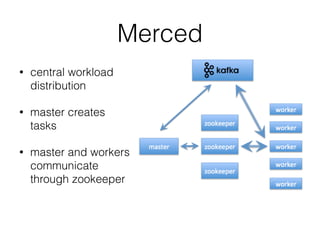
Merced
• central workload
distribution
• master creates
tasks
• master and workers
communicate
through zookeeper
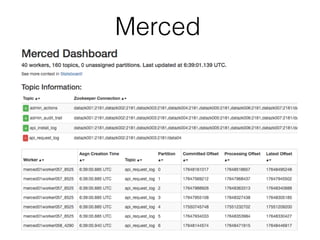
Merced
Log Quality
Log Quality
Log quality can be broken down into two areas:
• log reliability - Reliability is fairly easy to
measure: did we lose any data?
• log correctness - Correctness, on the other
hand, is much more difficult as it requires the
interpretation of data.
Challenges
• Instrumentation is an after-thought for most feature
developers
• Features can get shipped breaking existing logging
or no logging
• Once an iOS or Android release is out, it will keep
generating bad data for weeks
• Data quality bugs are harder to find and fix
compared to code quality
Tooling
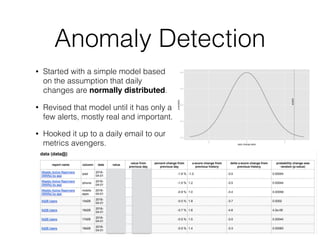
Anomaly Detection
• Started with a simple model based
on the assumption that daily
changes are normally distributed.
• Revised that model until it has only a
few alerts, mostly real and important.
• Hooked it up to a daily email to our
metrics avengers.
How did we do?
• Interest follows went up after we started emailing
recommended interests to follow
• Push notifications about board follows broke
• Signups from Google changed as we ran experiments
• Our tracking broke when we released a new repin
experience
• Our tracking of mobile web signups changed
Auditing Logs
Manual audits will have their limitations, especially with
regards to coverage but will catch critical bugs.
• However, we need two things:
• Repeatable process that can scale
• Tooling required to support the process
• Regression Audit
• Maintain a playbook of "core logging actions"
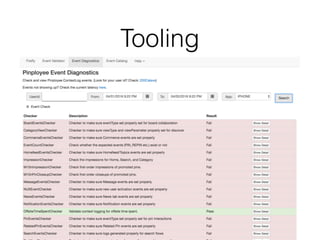
• Use tooling to verify the output of the actions
• New Feature Audit
• Gather requirements for analysis and produce a list of events that
need to be captured with the feature
• Instrument the application
• Test the logging output using existing tooling
Summary
• Invest in your logging infra pretty early on.
• Kafka has matured a lot and with some tuning works
well in the Cloud.
• Data quality is not free, need to proactively ensure it.
• Invest in automated tools to detect quality issues
both pre- and post-release.
• Culture building and education go a long way.
Thank you!
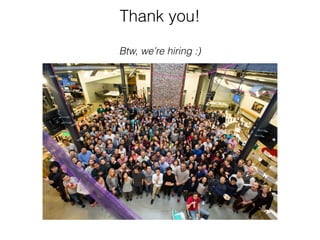
Btw, we’re hiring :)
Questions?

Scalable and Reliable Logging at Pinterest

  • 1.
    Scalable and Reliable Loggingat Pinterest Krishna Gade krishna@pinterest.com Yu Yang yuyang@pinterest.com
  • 2.
    Agenda • What isPinterest? • Logging Infrastructure Deep-dive • Managing Log Quality • Summary & Questions
  • 3.
  • 4.
    What is Pinterest? Pinterestis a discovery engine
  • 5.
    What is theweather in SF today?
  • 7.
    What is centrallimit theorem?
  • 10.
    What do Icook for dinner today?
  • 11.
  • 12.
    Where shall wetravel this summer?
  • 13.
  • 16.
  • 20.
    Kafka App Data Architecture Singer Qubole (Hadoop, Spark) Merced PinballSkyline Redshift Pinalytics Product Storm Stingray A/B Testing
  • 21.
  • 22.
    Logging Infrastructure Requirements • Highavailability • Minimum data loss • Horizontal scalability • Low latency • Minimum operation overhead
  • 23.
    Pinterest Logging Infrastructure •thousands of hosts • >120 billion messages, tens of terabytes per day • Kafka as the central message transportation hub • >500 Kafka brokers • home-grown technologies for logging to Kafka and moving data from Kafka to cloud storage AppServers events Kafka Cloud storage
  • 24.
    Logging Infrastructure v1 events Kafka0.7 Host app app app data uploader Real-time consumers
  • 25.
    Problems with Kafka0.7 pipelines • Data loss • Kafka 0.7 broker failure —> data loss • high back pressure —> data loss • Operability • broker replacement —> reboot all dependent services to pick up the latest broker list
  • 26.
    Challenges with Kafkathat supports replication • Multiple copies of messages among brokers • cannot copy message directly to S3 to guarantee exact once persistence • Cannot randomly pick Kafka brokers to write to • Need to find the leader of each topic partition • Handle various corner cases
  • 27.
    Logging Infrastructure v2 events Kafka0.8 Host app log files Singer Secor/Merced Sanitizer Real-time consumers
  • 28.
    Logging Agent Requirement •reliability • high throughput, low latency • minimum computation resource usage • support various log file format (text, thrift, etc.) • fairness scheduling
  • 29.
    Singer Logging Agent •Simple logging mechanism • applications log to disk • Singer monitors file system events and uploads logs to Kafka • Isolate applications from Singer agent failures • Isolate applications from Kafka failures • >100MB/second for log files in thrift • Production Environment Support • dynamic configuration detection • adjustable log uploading latency • auditing • heartbeat mechanism Host app log files Singer
  • 30.
    Singer Internals Singer Architecture LogStream monitor Configuration watcher ReaderWriter Log repository Reader Writer Reader Writer Reader Writer Log configuration LogStream processors A - 1 A -2 B - 1 C - 1 Log configuration Staged Event Driven Architecture
  • 31.
    Running Kafka inthe Cloud • Challenges • brokers can die unexpectedly • EBS I/O performance can degrade significantly due to resource contention • Avoid virtual hosts co-location on the same physical host • faster recovery
  • 32.
    Running Kafka inthe Cloud • Initial settings • c3.2xlarge + EBS • Current settings • d2.xlarge • local disks help to avoid EBS contention problem • minimize data on each broker for faster recovery • availability zone aware topic partition allocation • multiple small clusters (20-40 brokers) for topic isolation
  • 33.
    Scalable Data Persistence 33 •Strong consistency: each message is saved exactly once • Fault tolerance: any worker node is allowed to crash • Load distribution • Horizontal scalability • Configurable upload policies events Kafka 0.8 Secor/Merced
  • 34.
    Secor 34 • Uses Kafkahigh level consumer • Strong consistency: each message is saved exactly once • Fault tolerance: any worker node is allowed to crash • Load distribution • Configurable upload policies events Kafka 0.8 Secor
  • 35.
    Challenges with consensus-basedworkload distribution • Kafka consumer group rebalancing can prevent consumer from making progress • It is difficult to recover when high-level consumer lags behind on some topic partitions • Manual tuning is required for workload distribution of multiple topics • Inconvenient to add new topics • Efficiency
  • 36.
    Merced • central workload distribution •master creates tasks • master and workers communicate through zookeeper
  • 37.
  • 38.
  • 39.
    Log Quality Log qualitycan be broken down into two areas: • log reliability - Reliability is fairly easy to measure: did we lose any data? • log correctness - Correctness, on the other hand, is much more difficult as it requires the interpretation of data.
  • 40.
    Challenges • Instrumentation isan after-thought for most feature developers • Features can get shipped breaking existing logging or no logging • Once an iOS or Android release is out, it will keep generating bad data for weeks • Data quality bugs are harder to find and fix compared to code quality
  • 41.
  • 42.
    Anomaly Detection • Startedwith a simple model based on the assumption that daily changes are normally distributed. • Revised that model until it has only a few alerts, mostly real and important. • Hooked it up to a daily email to our metrics avengers.
  • 43.
    How did wedo? • Interest follows went up after we started emailing recommended interests to follow • Push notifications about board follows broke • Signups from Google changed as we ran experiments • Our tracking broke when we released a new repin experience • Our tracking of mobile web signups changed
  • 44.
    Auditing Logs Manual auditswill have their limitations, especially with regards to coverage but will catch critical bugs. • However, we need two things: • Repeatable process that can scale • Tooling required to support the process • Regression Audit • Maintain a playbook of "core logging actions" • Use tooling to verify the output of the actions • New Feature Audit • Gather requirements for analysis and produce a list of events that need to be captured with the feature • Instrument the application • Test the logging output using existing tooling
  • 45.
    Summary • Invest inyour logging infra pretty early on. • Kafka has matured a lot and with some tuning works well in the Cloud. • Data quality is not free, need to proactively ensure it. • Invest in automated tools to detect quality issues both pre- and post-release. • Culture building and education go a long way.
  • 46.
  • 47.