GraphGen: Conducting
Graph Analytics over
Relational Databases
Konstantinos Xirogiannopoulos
Amol Deshpande
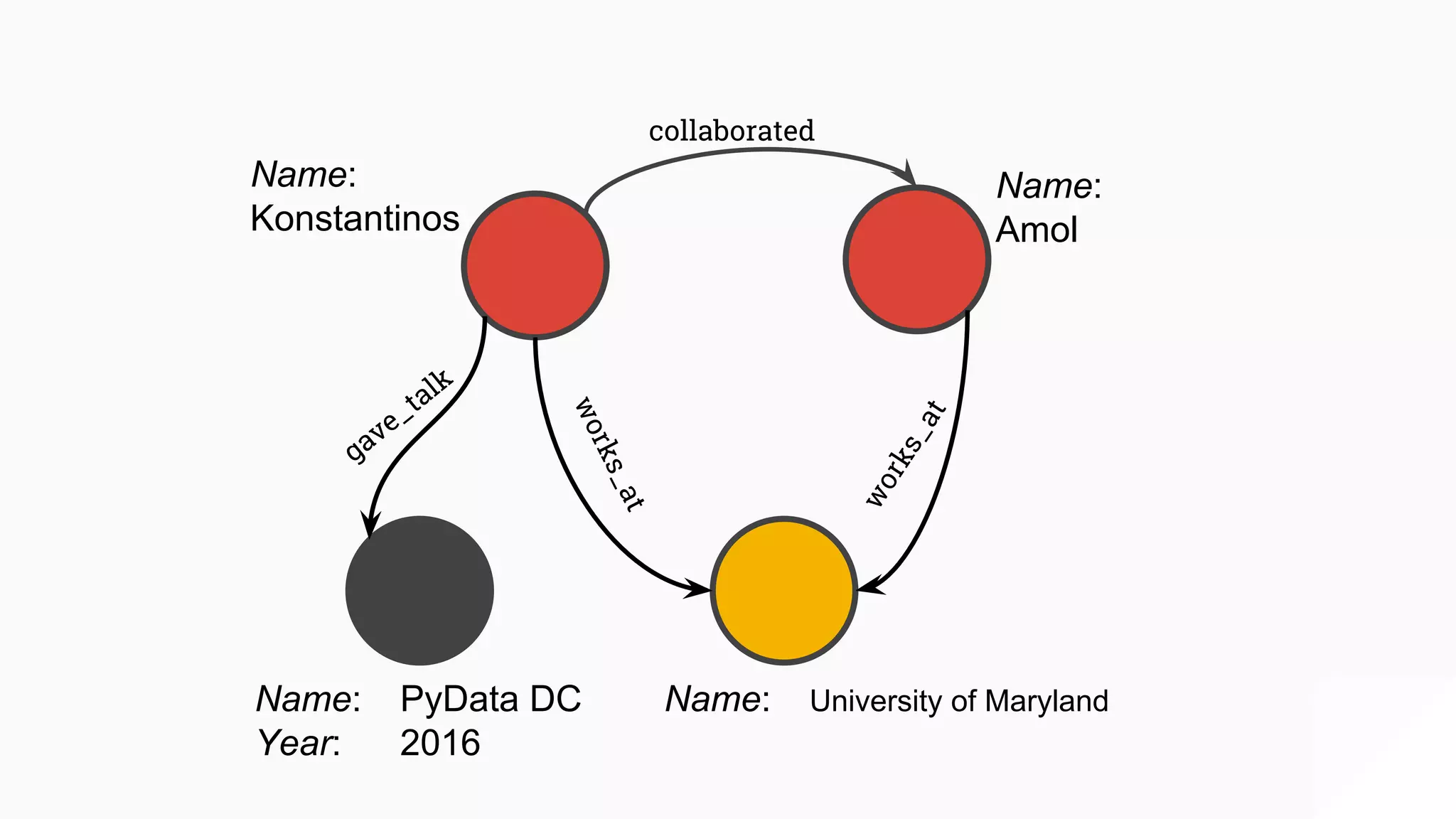
collaborated
Name:
Konstantinos
Name:
Amol
Name: University of MarylandName: PyData DC
Year: 2016
gave_talk
works_at
works_at
Graph Analytics:
(Network Science)
Leveraging of connections between
entities in a network towards gaining
insight about said entities and/or the
network via the use of graph
algorithms.
1) Why graph analytics?
2) How are graph analytics done currently?
3) What are most people dealing with?
4) Bolt-on graph analytics with GraphGen
5) The GraphGen Language
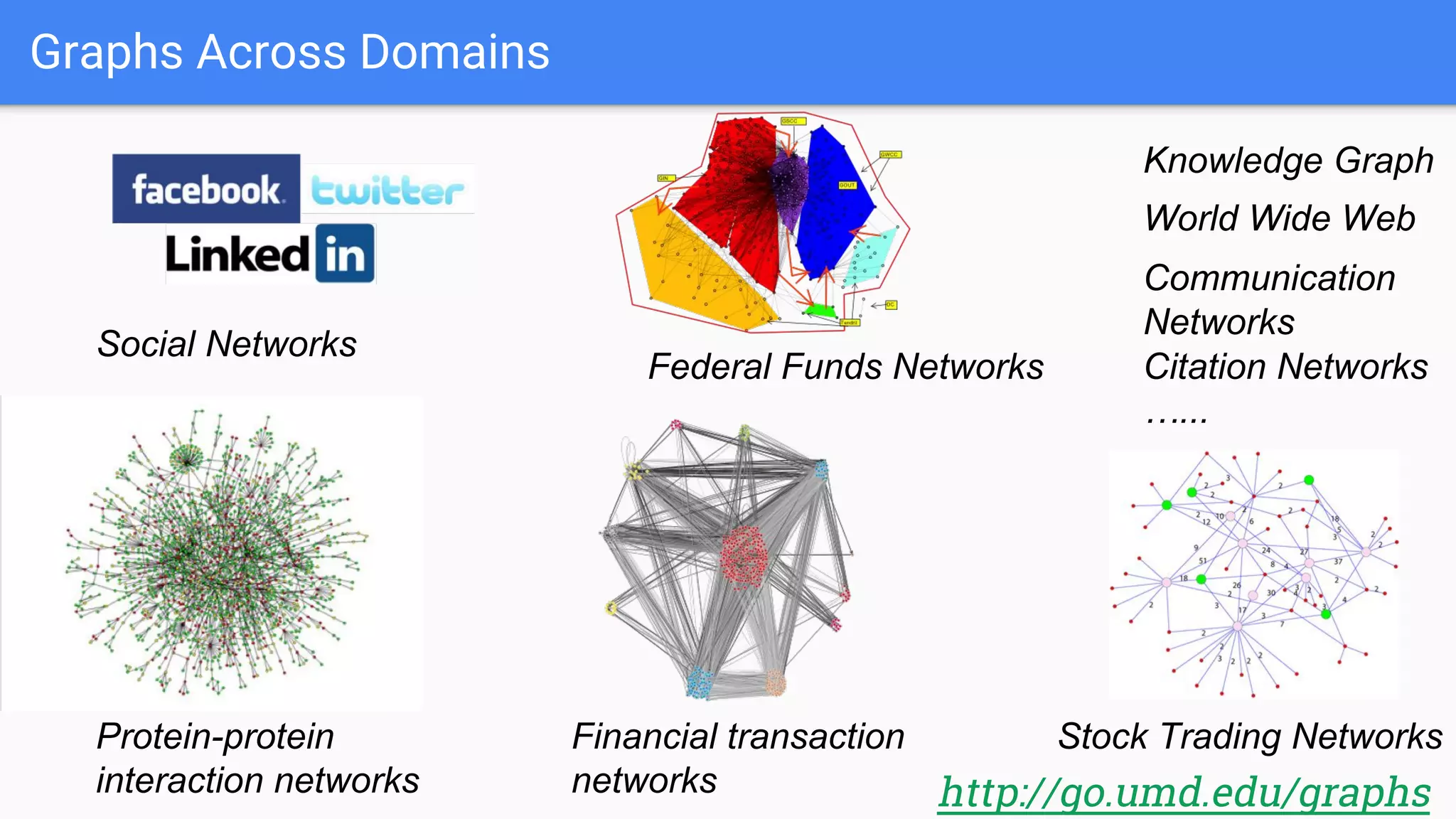
Graphs Across Domains
Protein-protein
interaction networks
Financial transaction
networks
Stock Trading Networks
Social Networks
Federal Funds Networks
Knowledge Graph
World Wide Web
Communication
Networks
Citation Networks
…...
http://go.umd.edu/graphs
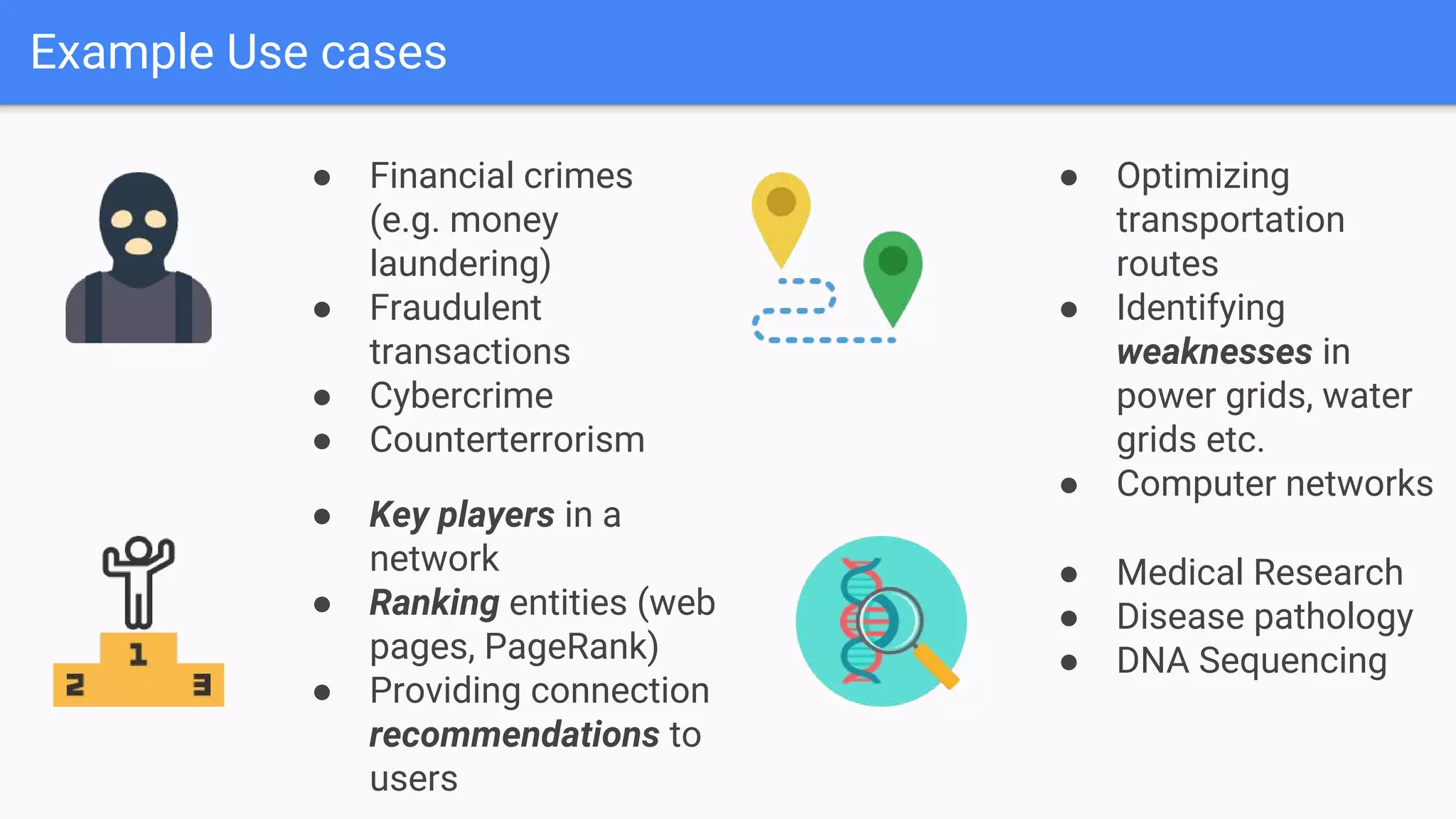
Example Use cases
● Financial crimes
(e.g. money
laundering)
● Fraudulent
transactions
● Cybercrime
● Counterterrorism
● Key players in a
network
● Ranking entities (web
pages, PageRank)
● Providing connection
recommendations to
users
● Optimizing
transportation
routes
● Identifying
weaknesses in
power grids, water
grids etc.
● Computer networks
● Medical Research
● Disease pathology
● DNA Sequencing
1) Why graph analytics?
2) How are graph analytics
done currently?
3) What are most people dealing with?
4) Bolt-on graph analytics with GraphGen
5) The GraphGen Language
Types of Graph Analytics
● Graph “queries”: Subgraph pattern matching, shortest
paths, temporal queries
● Real Time Analytics: Anomaly/Event detection, online
prediction
● Batch Analytics (Network Science): Centrality analysis,
community detection, network evolution
● Machine Learning: Matrix factorization, logistic
regression modeled as message passing in specially
structured graphs.
http://go.umd.edu/graphs
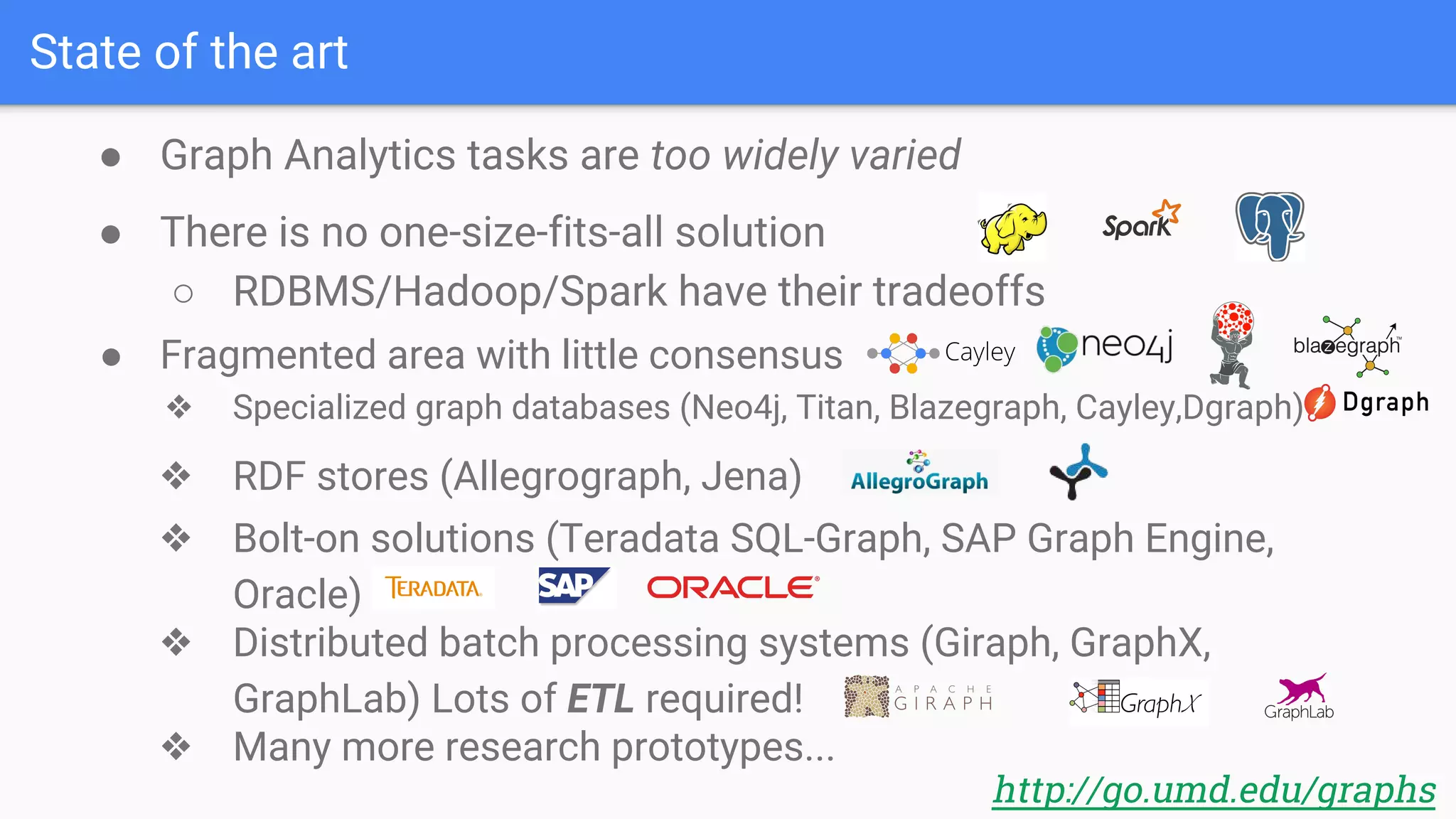
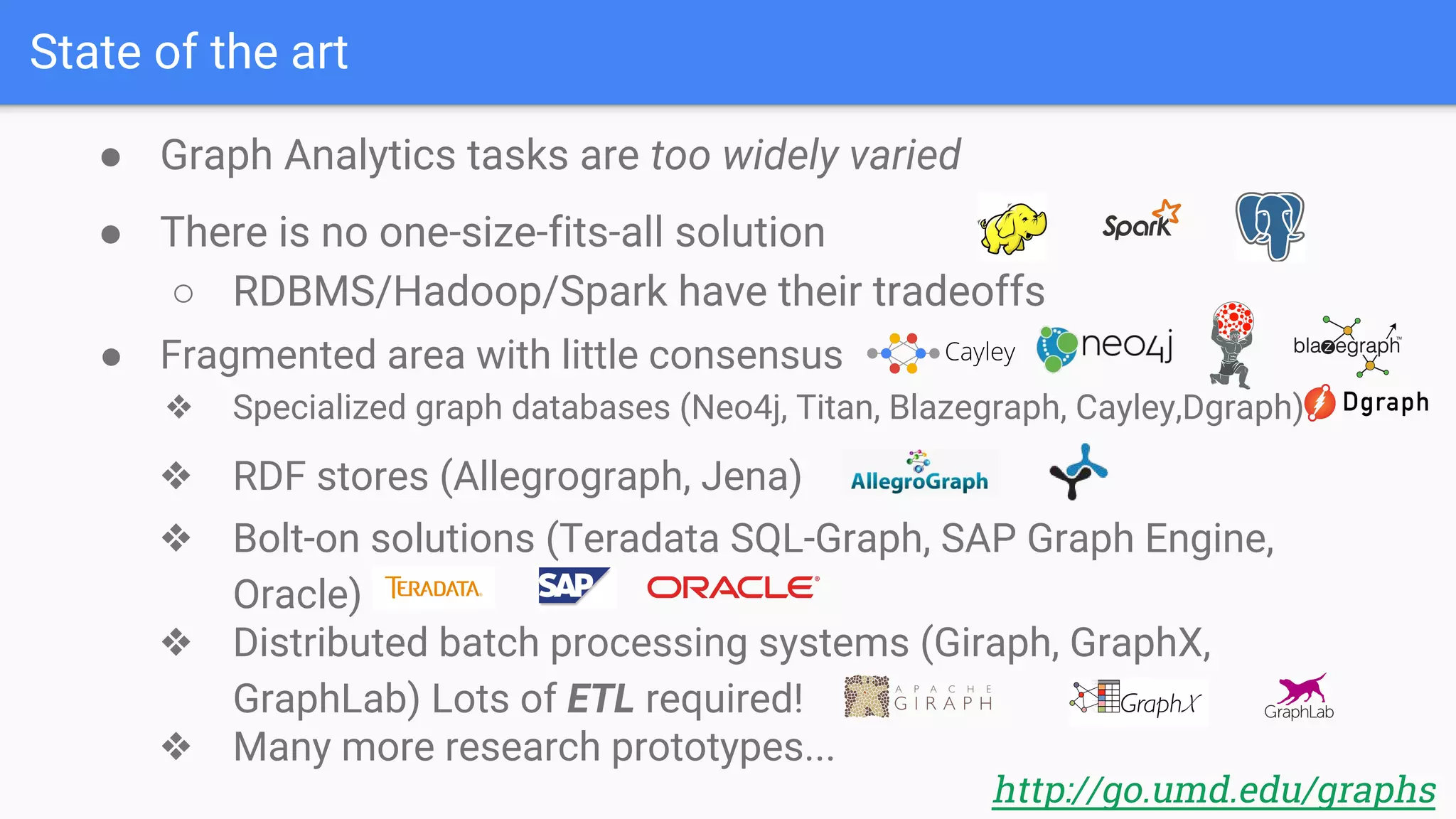
State of the art
● Graph Analytics tasks are too widely varied
http://go.umd.edu/graphs
● There is no one-size-fits-all solution
○ RDBMS/Hadoop/Spark have their tradeoffs
● Fragmented area with little consensus
❖ Specialized graph databases (Neo4j, Titan, Blazegraph, Cayley,Dgraph)
❖ RDF stores (Allegrograph, Jena)
❖ Bolt-on solutions (Teradata SQL-Graph, SAP Graph Engine,
Oracle)
❖ Distributed batch processing systems (Giraph, GraphX,
GraphLab) Lots of ETL required!
❖ Many more research prototypes...
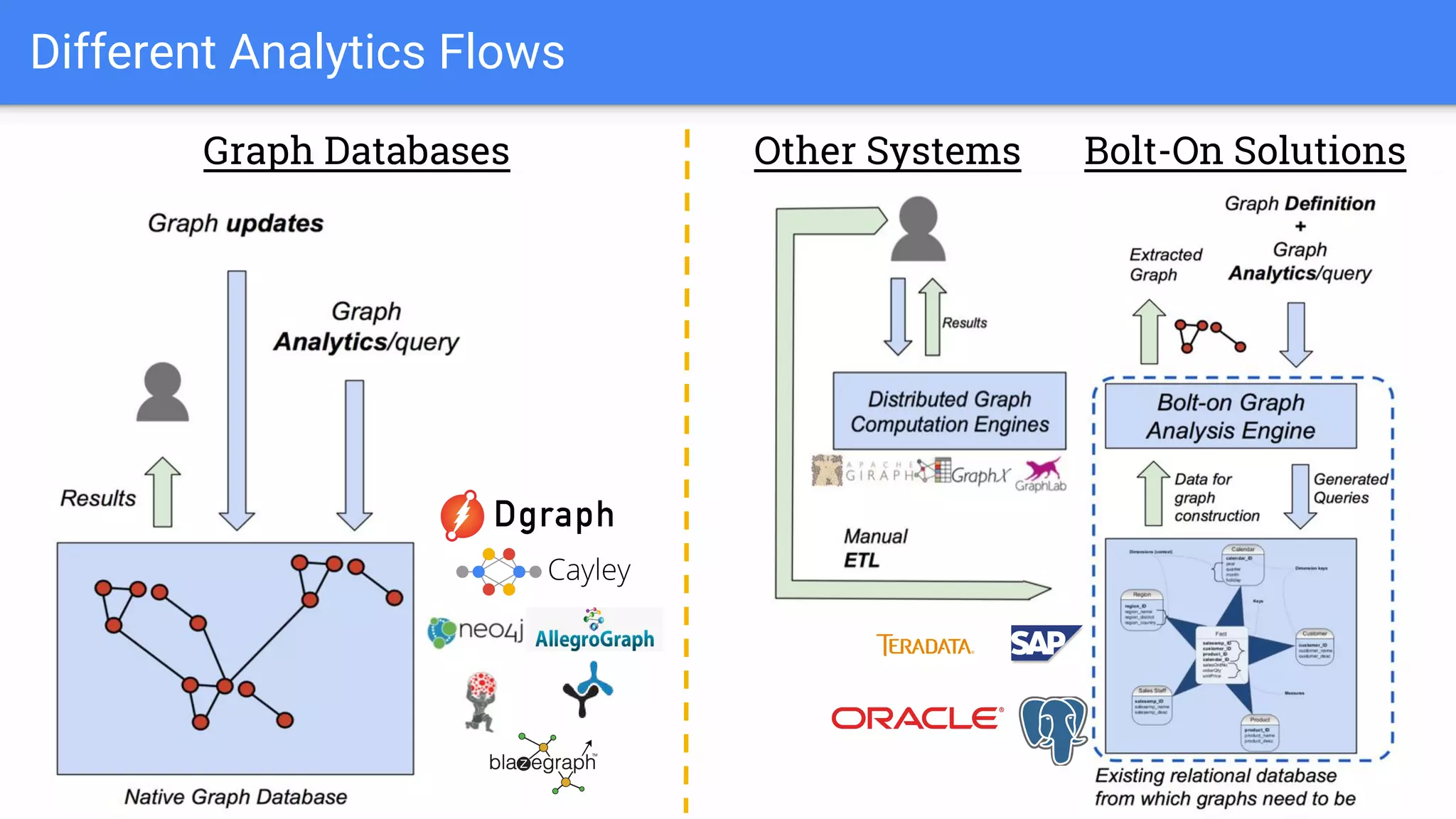
Different Analytics Flows
Other SystemsGraph Databases Bolt-On Solutions
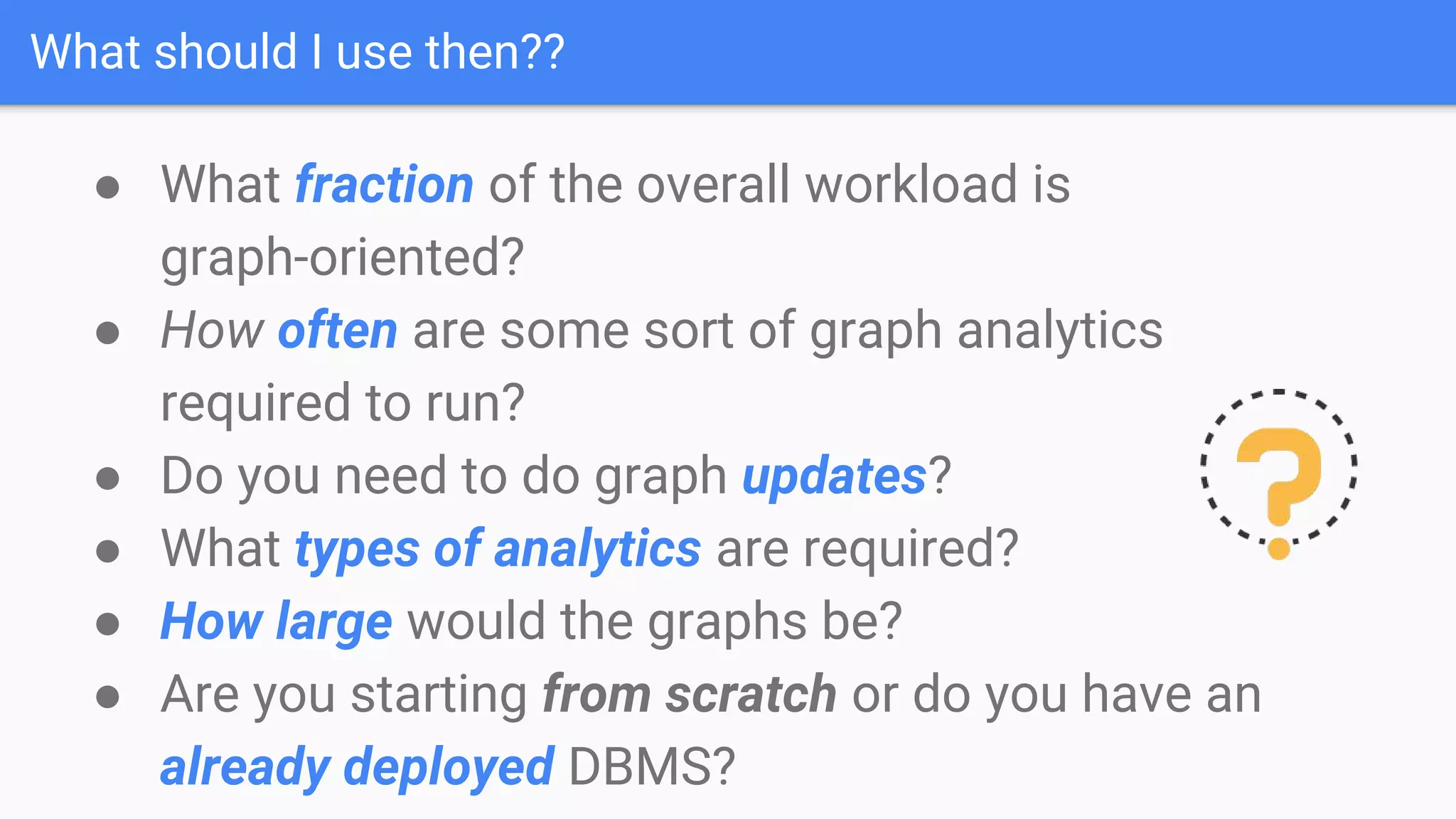
What should I use then??
● What fraction of the overall workload is
graph-oriented?
● How often are some sort of graph analytics
required to run?
● Do you need to do graph updates?
● What types of analytics are required?
● How large would the graphs be?
● Are you starting from scratch or do you have an
already deployed DBMS?
1) Why graph analytics?
2) How are graph analytics done currently?
3) What are most people
dealing with?
4) Bolt-on graph analytics with GraphGen
5) The GraphGen Language
● Most business analytics (querying, reporting,
OLAP) happen in SQL
● Organizations typically model their data
according to their needs
● Graph databases if you have strictly
graph-centric workloads
Where’s the Data?
Where’s the Data?
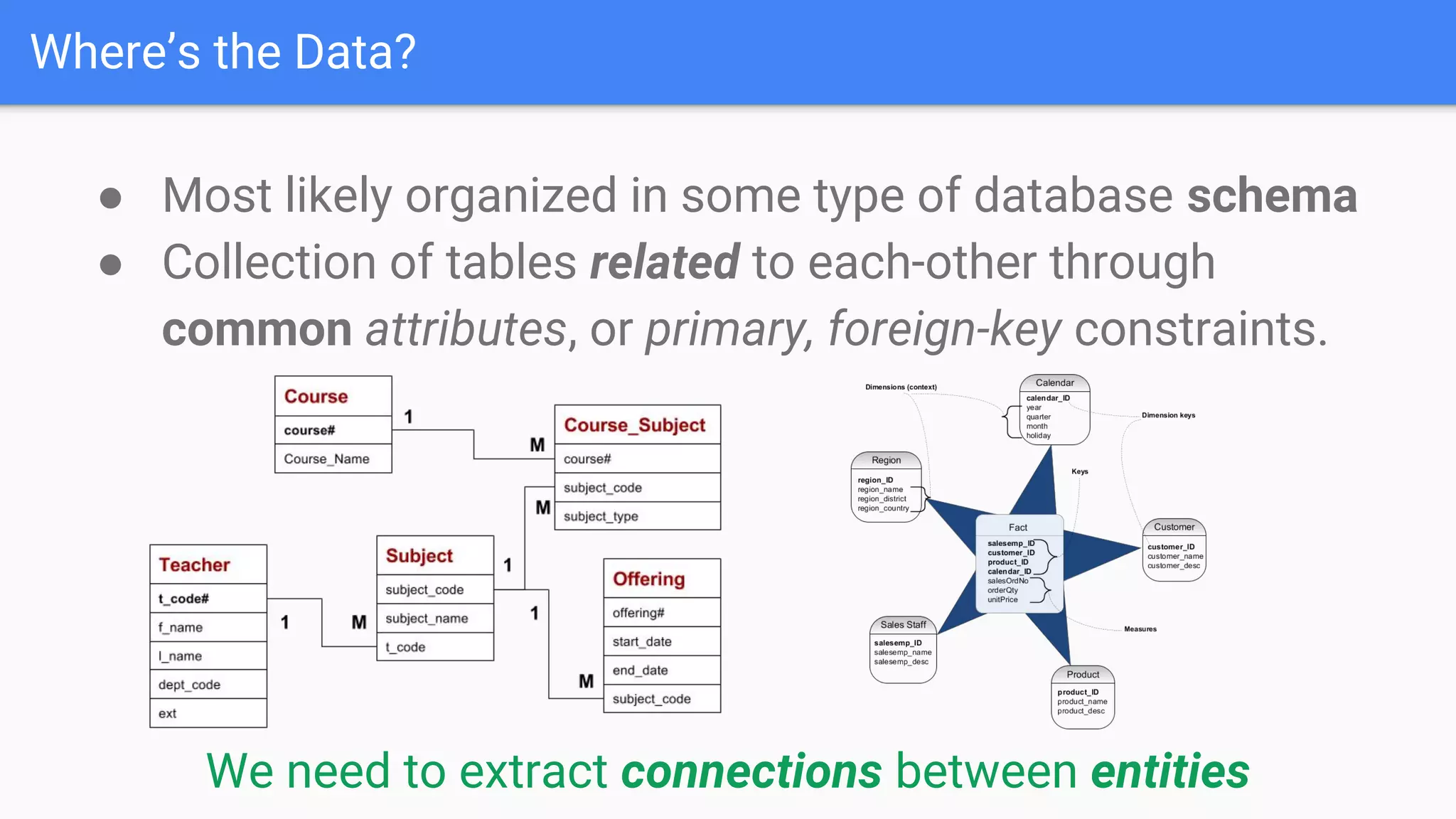
● Most likely organized in some type of database schema
● Collection of tables related to each-other through
common attributes, or primary, foreign-key constraints.
We need to extract connections between entities
Most Likely...
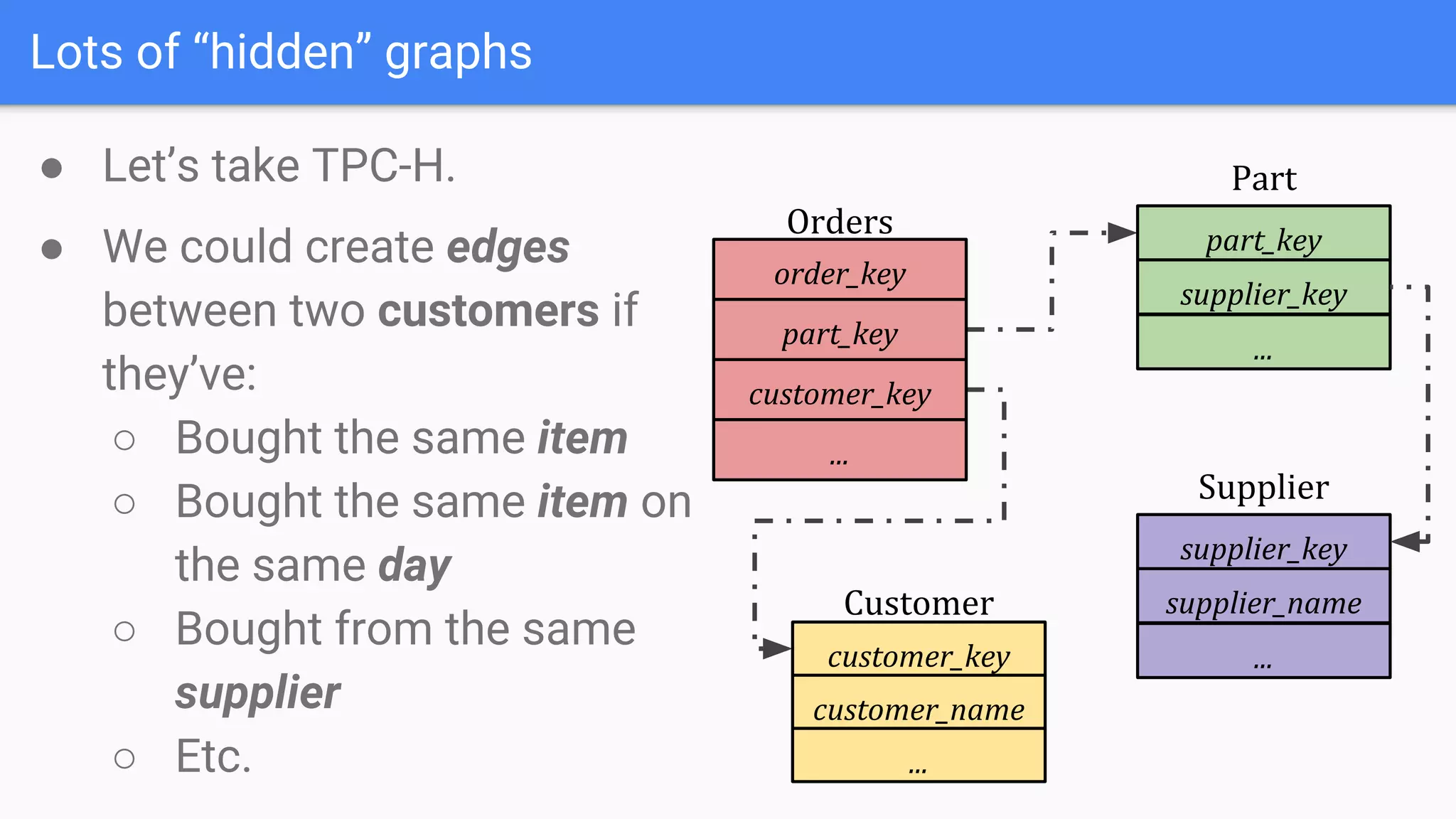
Lots of “hidden” graphs
● Let’s take TPC-H.
part_key
Part
supplier_key
...
customer_key
Customer
customer_name
...
order_key
Orders
part_key
customer_key
...
supplier_key
Supplier
supplier_name
...
● We could create edges
between two customers if
they’ve:
○ Bought the same item
○ Bought the same item on
the same day
○ Bought from the same
supplier
○ Etc.
State of the art
● Graph Analytics tasks are too widely varied
http://go.umd.edu/graphs
● There is no one-size-fits-all solution
○ RDBMS/Hadoop/Spark have their tradeoffs
● Fragmented area with little consensus
❖ Specialized graph databases (Neo4j, Titan, Blazegraph, Cayley,Dgraph)
❖ RDF stores (Allegrograph, Jena)
❖ Bolt-on solutions (Teradata SQL-Graph, SAP Graph Engine,
Oracle)
❖ Distributed batch processing systems (Giraph, GraphX,
GraphLab) Lots of ETL required!
❖ Many more research prototypes...
State of the art
● Graph Analytics tasks are too widely varied
http://go.umd.edu/graphs
● There is no one-size-fits-all solution
○ RDBMS/Hadoop/Spark have their tradeoffs
● Fragmented area with little consensus
❖ Specialized graph databases (Neo4j, Titan, Blazegraph, Cayley,Dgraph)
❖ RDF stores (Allegrograph, Jena)
❖ Bolt-on solutions (Teradata SQL-Graph, SAP Graph Engine,
Oracle)
❖ Distributed batch processing systems (Giraph, GraphX,
GraphLab) Lots of ETL required!
❖ Many more research prototypes...
1) Why graph analytics?
2) How are graph analytics done currently?
3) What are most people dealing with?
4) Bolt-on graph analytics
with GraphGen
5) The GraphGen Language
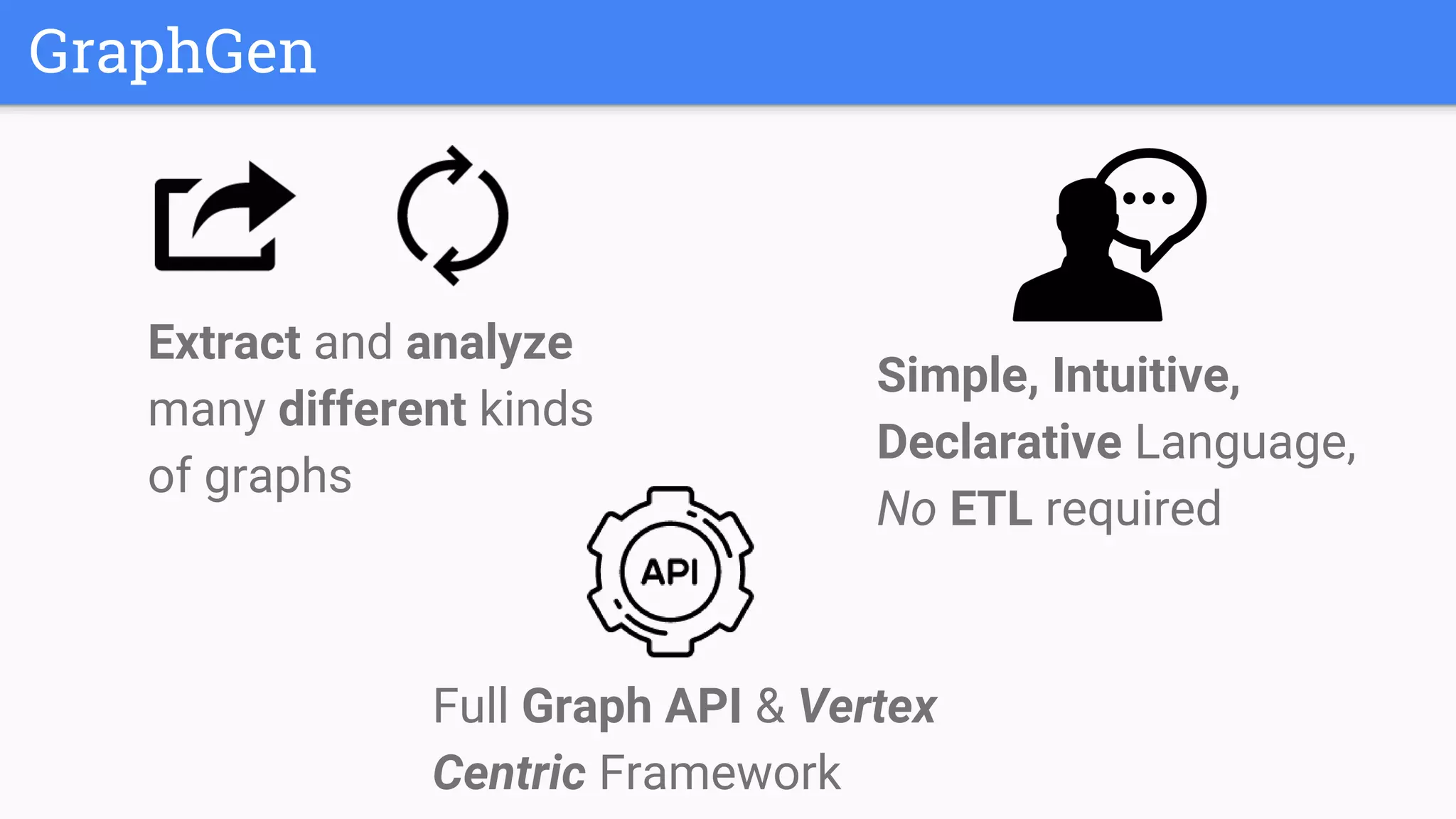
GraphGen
Extract and analyze
many different kinds
of graphs
Simple, Intuitive,
Declarative Language,
No ETL required
Full Graph API & Vertex
Centric Framework
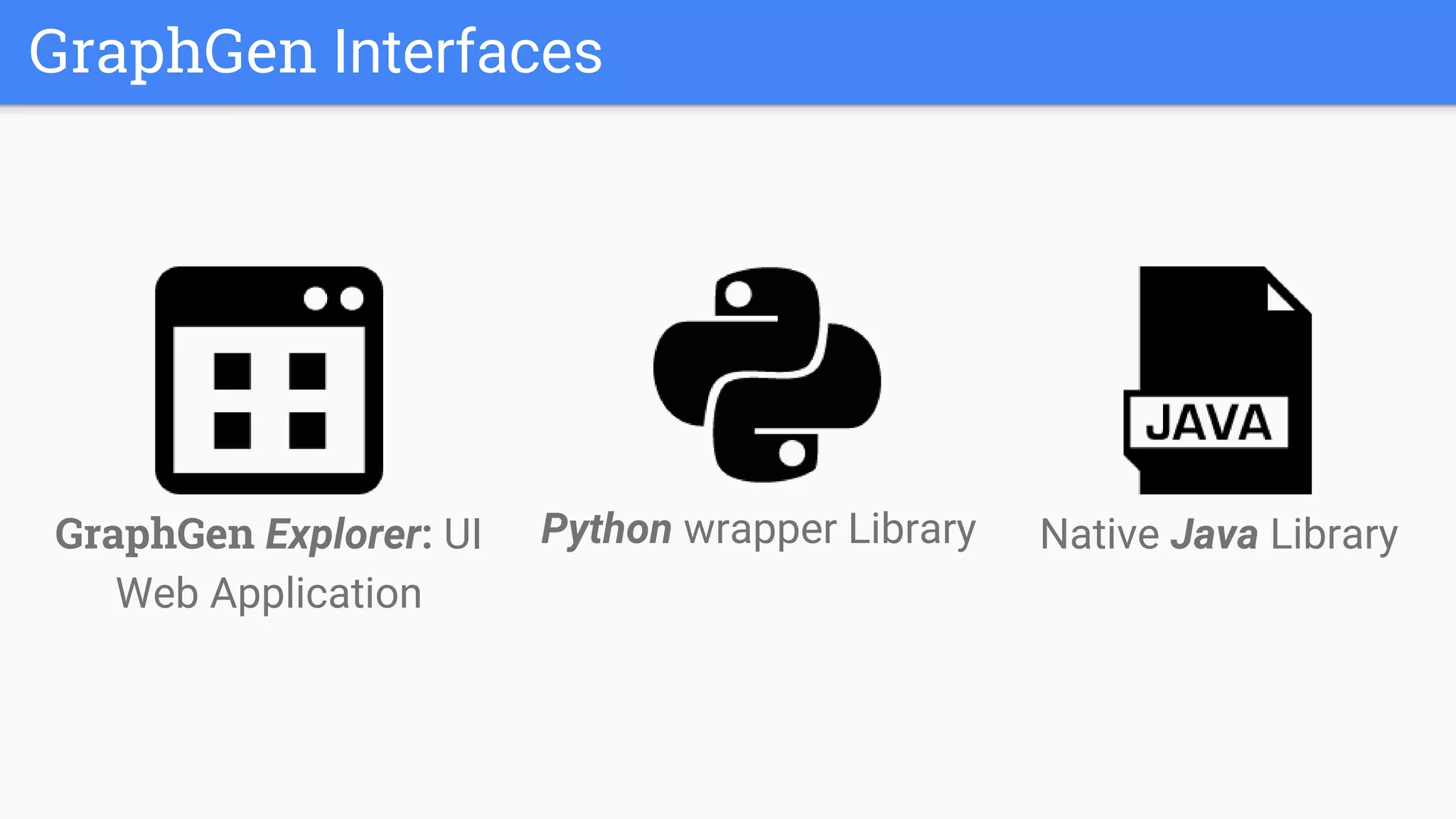
GraphGen Interfaces
Native Java LibraryPython wrapper LibraryGraphGen Explorer: UI
Web Application
Graphgen Explorer Web App
● Exploration of database schema to detect
different types of hidden graphs.
● Allows users to visually explore potential
graphs.
● Simple statistic and on-the-fly analysis
Not all graphs will be useful!
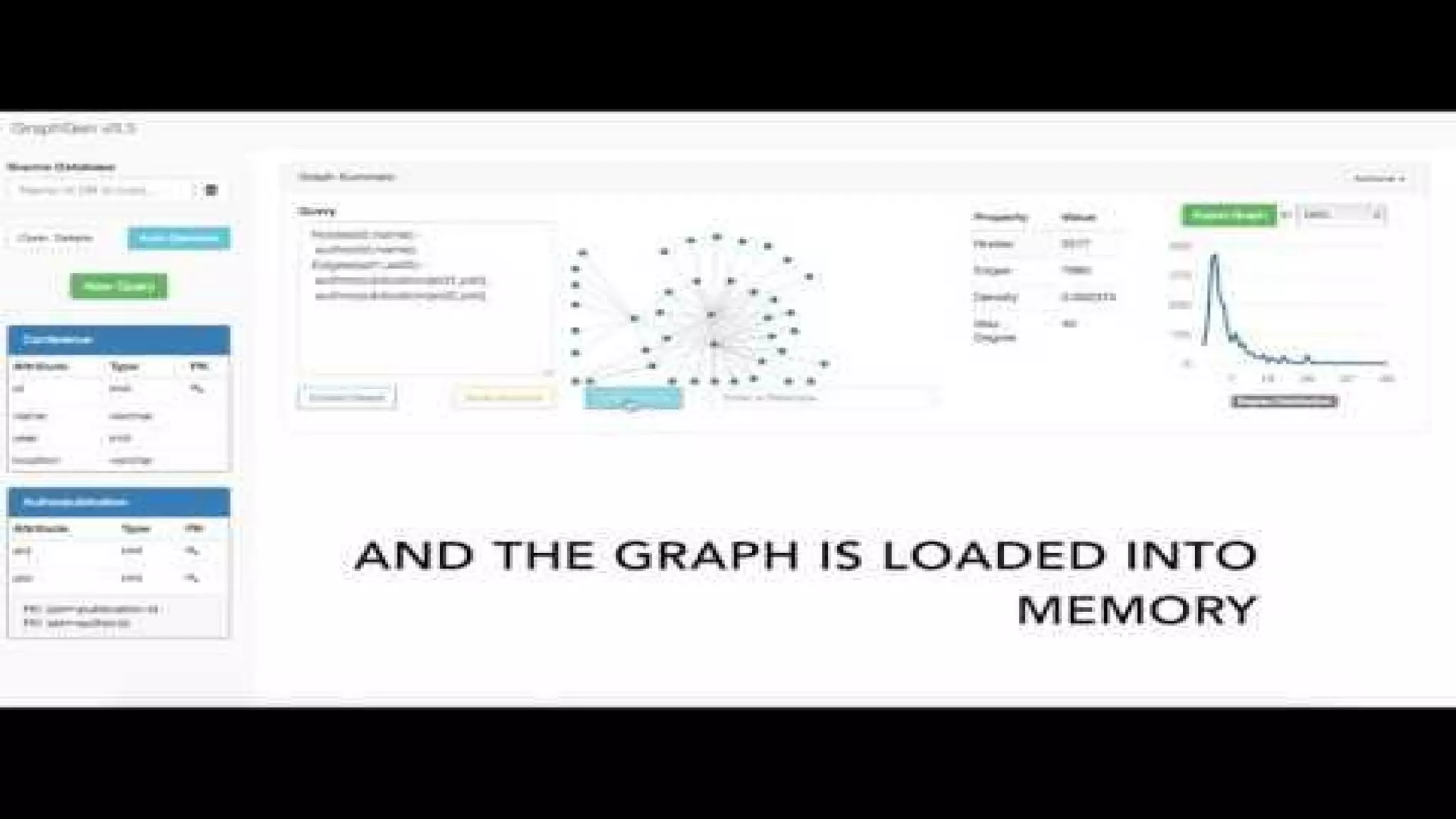
GraphGen Explorer Web App
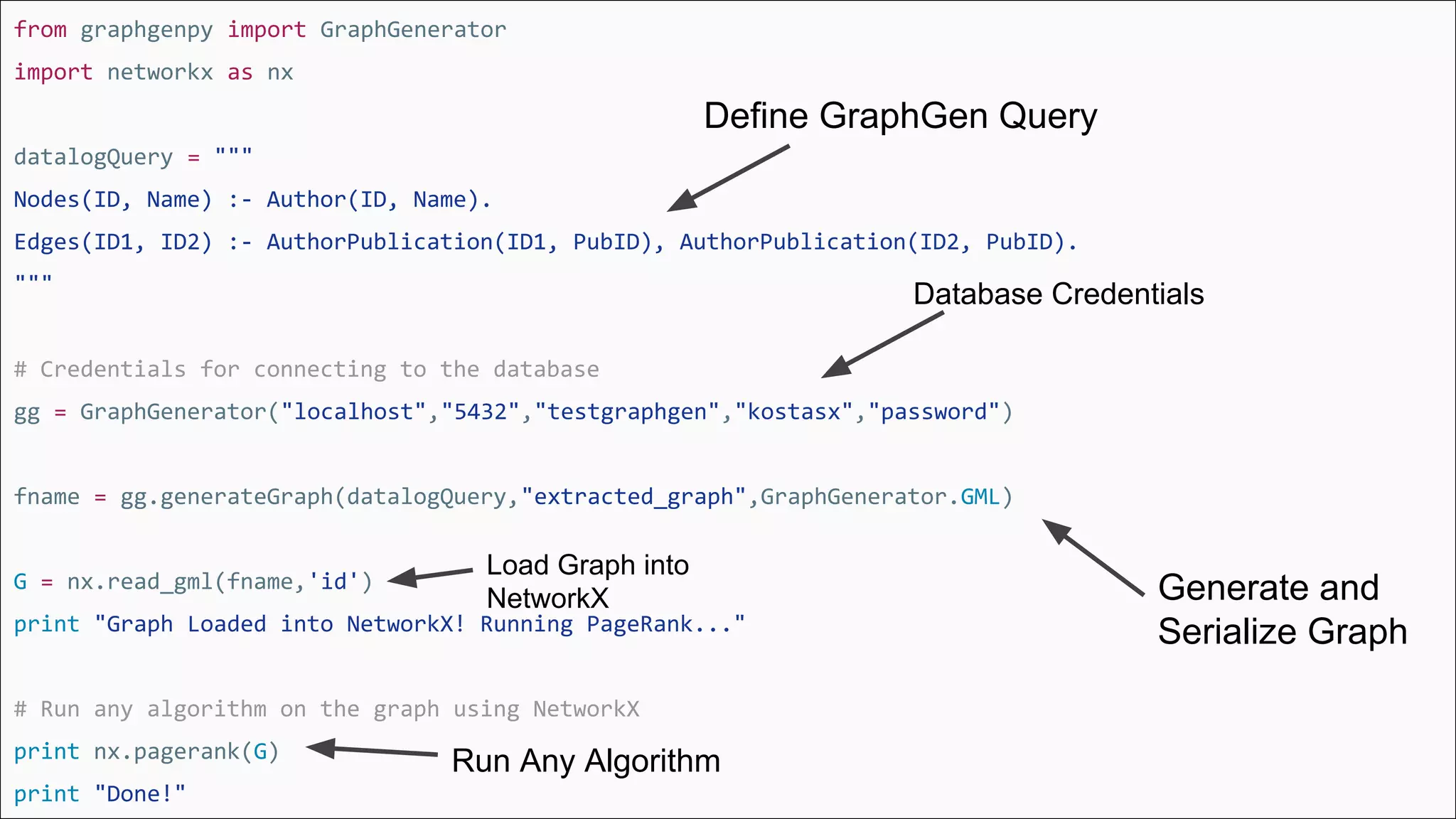
GraphgenPy in Python
from graphgenpy import GraphGenerator
import networkx as nx
datalogQuery = """
Nodes(ID, Name) :- Author(ID, Name).
Edges(ID1, ID2) :- AuthorPublication(ID1, PubID), AuthorPublication(ID2, PubID).
"""
# Credentials for connecting to the database
gg = GraphGenerator("localhost","5432","testgraphgen","kostasx","password")
fname = gg.generateGraph(datalogQuery,"extracted_graph",GraphGenerator.GML)
G = nx.read_gml(fname,'id')
print "Graph Loaded into NetworkX! Running PageRank..."
# Run any algorithm on the graph using NetworkX
print nx.pagerank(G)
print "Done!"
Define GraphGen Query
Database Credentials
Generate and
Serialize Graph
Load Graph into
NetworkX
Run Any Algorithm
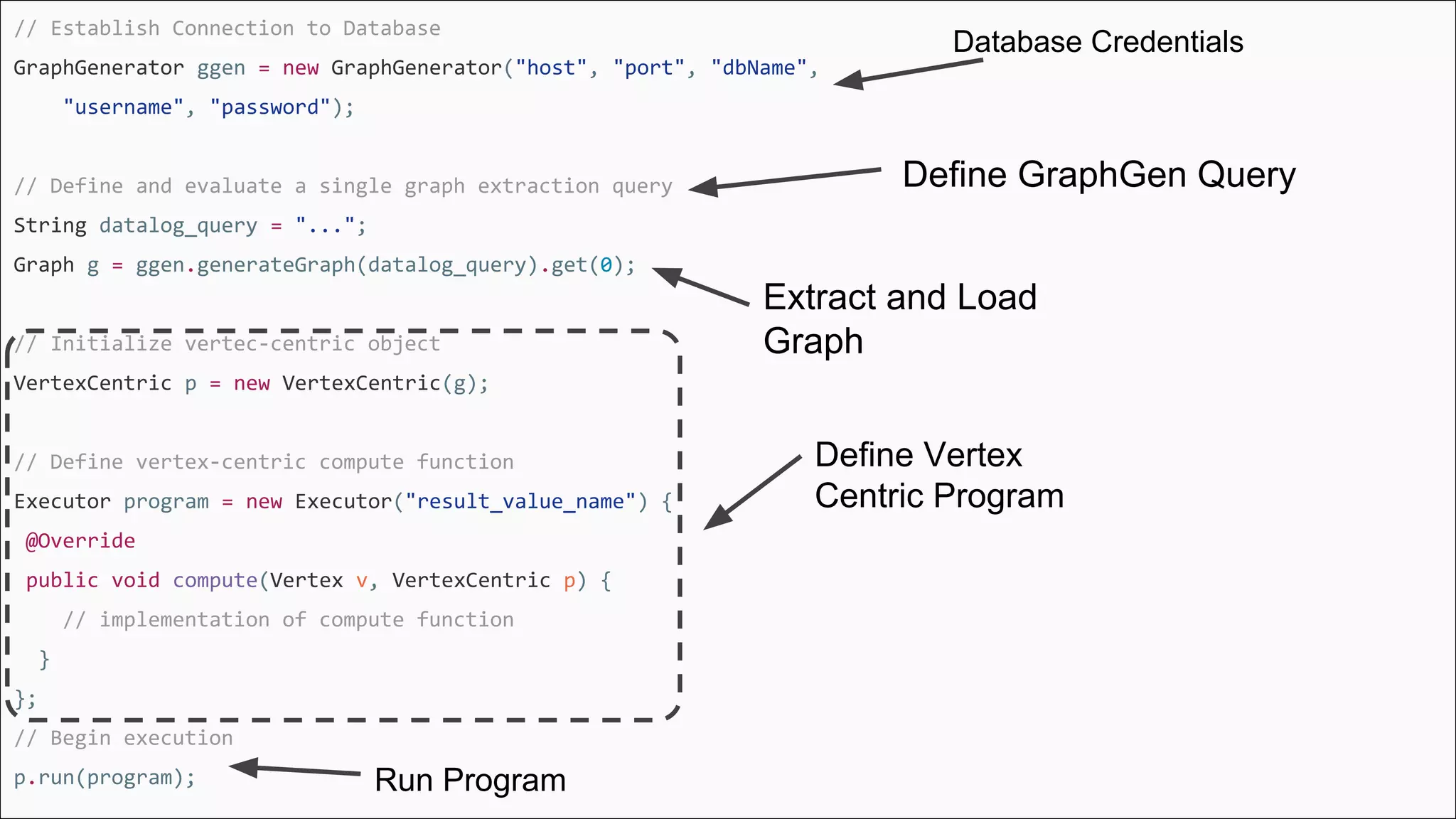
Native GraphGen in Java
// Establish Connection to Database
GraphGenerator ggen = new GraphGenerator("host", "port", "dbName",
"username", "password");
// Define and evaluate a single graph extraction query
String datalog_query = "...";
Graph g = ggen.generateGraph(datalog_query).get(0);
// Initialize vertec-centric object
VertexCentric p = new VertexCentric(g);
// Define vertex-centric compute function
Executor program = new Executor("result_value_name") {
@Override
public void compute(Vertex v, VertexCentric p) {
// implementation of compute function
}
};
// Begin execution
p.run(program);
Define GraphGen Query
Database Credentials
Extract and Load
Graph
Define Vertex
Centric Program
Run Program
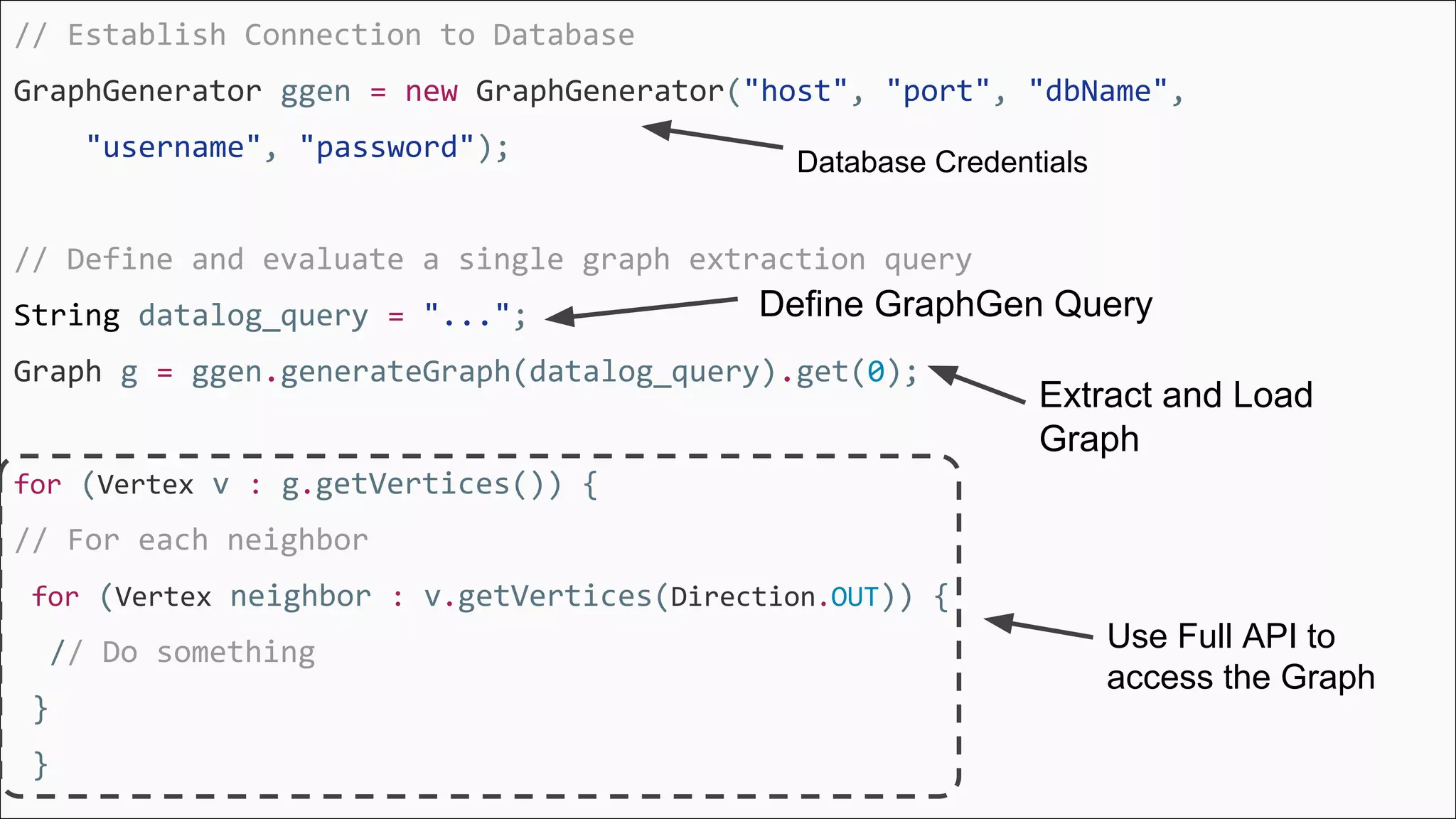
// Establish Connection to Database
GraphGenerator ggen = new GraphGenerator("host", "port", "dbName",
"username", "password");
// Define and evaluate a single graph extraction query
String datalog_query = "...";
Graph g = ggen.generateGraph(datalog_query).get(0);
for (Vertex v : g.getVertices()) {
// For each neighbor
for (Vertex neighbor : v.getVertices(Direction.OUT)) {
// Do something
}
}
Define GraphGen Query
Database Credentials
Extract and Load
Graph
Use Full API to
access the Graph
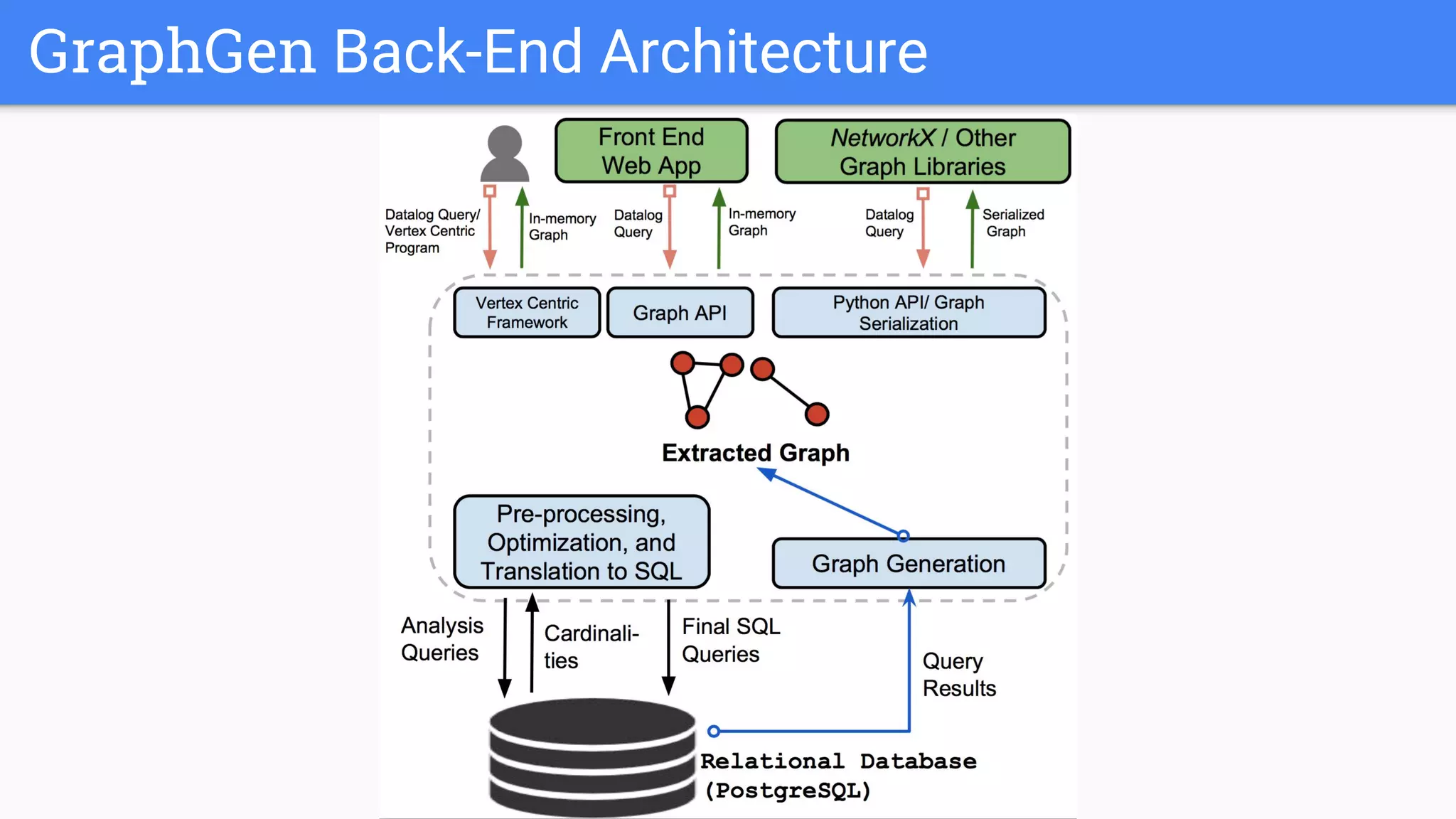
GraphGen Back-End Architecture
1) Why graph analytics?
2) How are graph analytics done currently?
3) What are most people dealing with?
4) Bolt-on graph analytics with GraphGen
5) The GraphGen Language
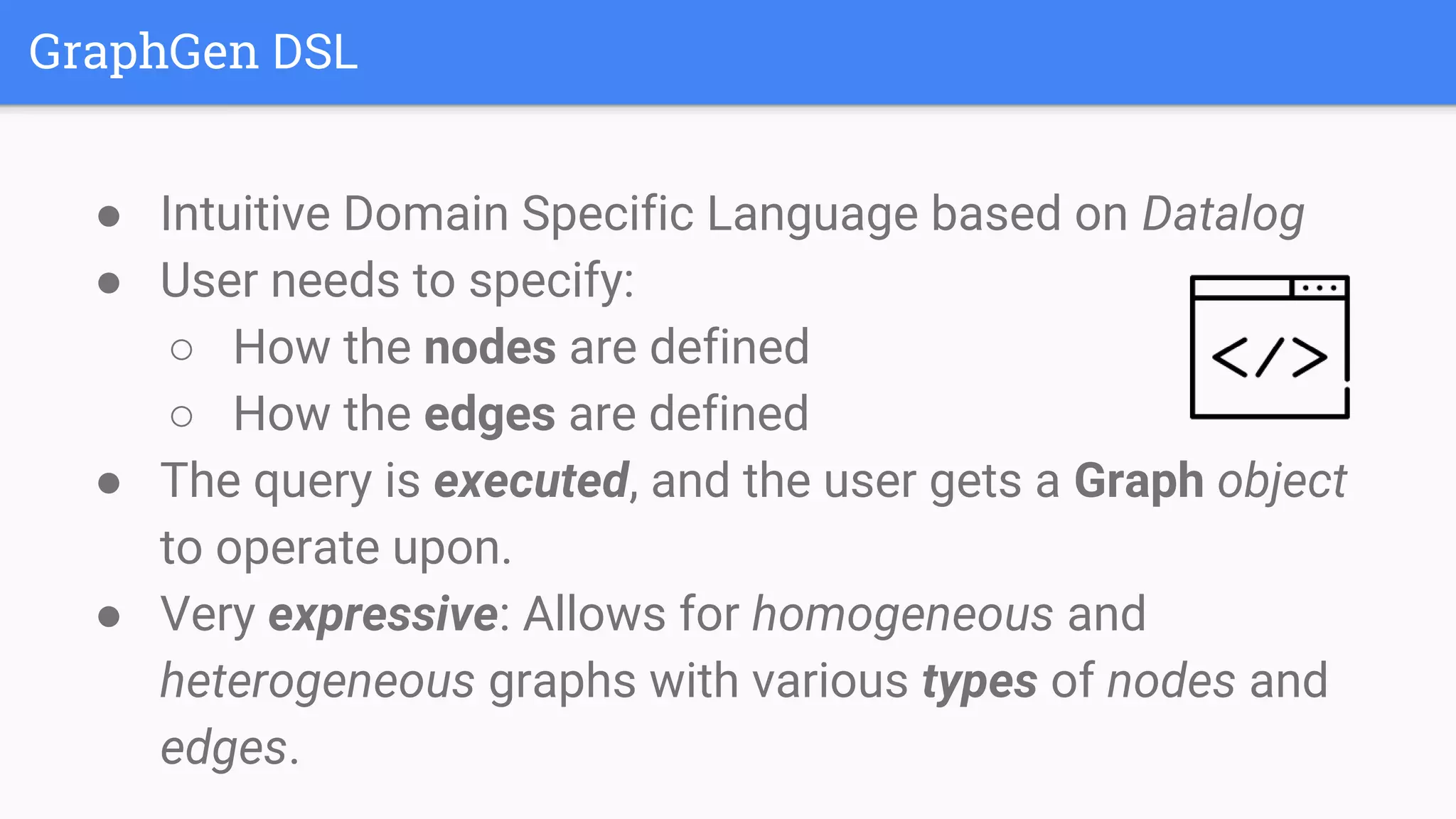
GraphGen DSL
● Intuitive Domain Specific Language based on Datalog
● User needs to specify:
○ How the nodes are defined
○ How the edges are defined
● The query is executed, and the user gets a Graph object
to operate upon.
● Very expressive: Allows for homogeneous and
heterogeneous graphs with various types of nodes and
edges.
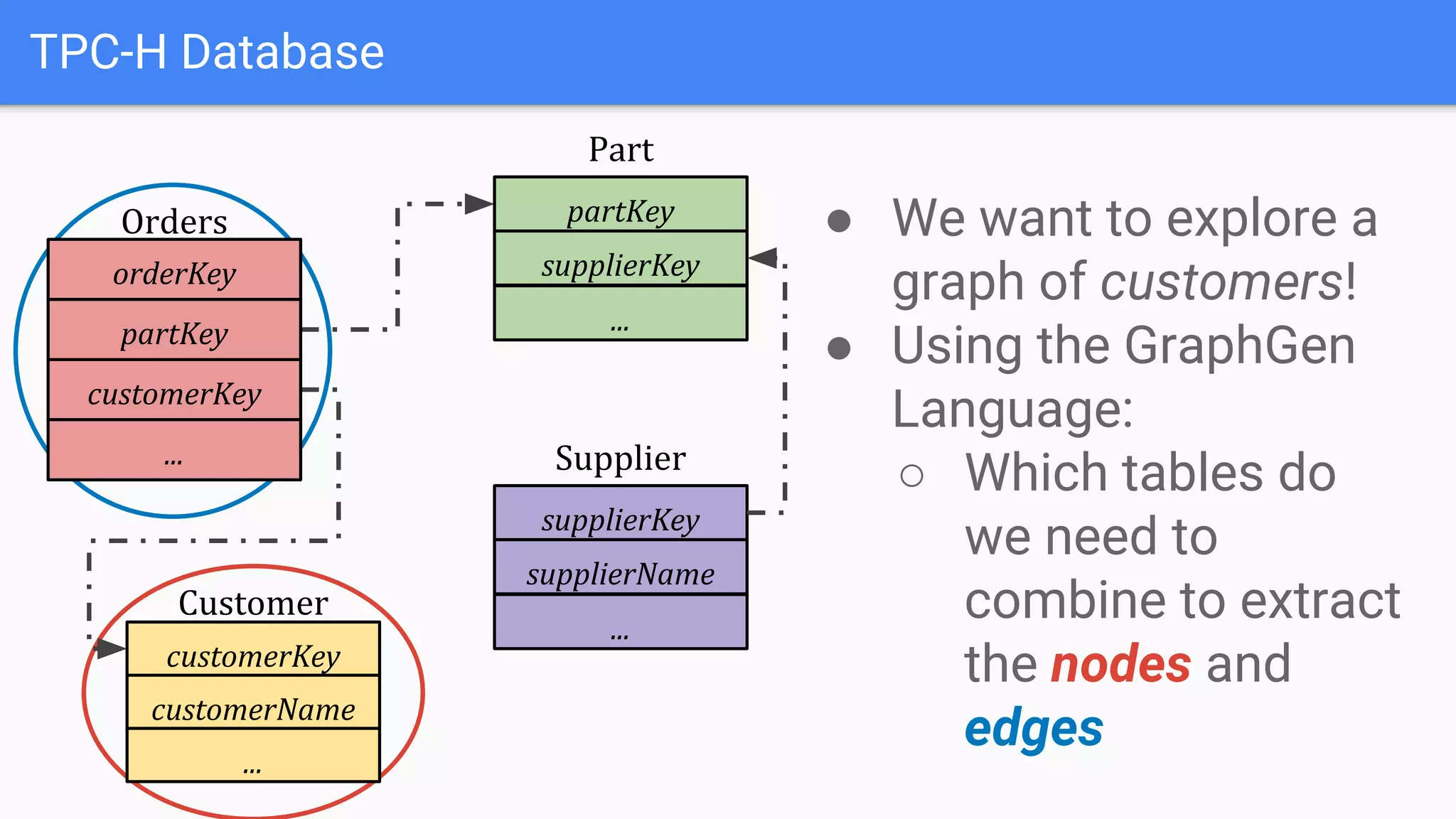
TPC-H Database
partKey
Part
supplierKey
...
customerKey
Customer
customerName
...
● We want to explore a
graph of customers!
● Using the GraphGen
Language:
○ Which tables do
we need to
combine to extract
the nodes and
edges
orderKey
Orders
partKey
customerKey
...
supplierKey
Supplier
supplierName
...
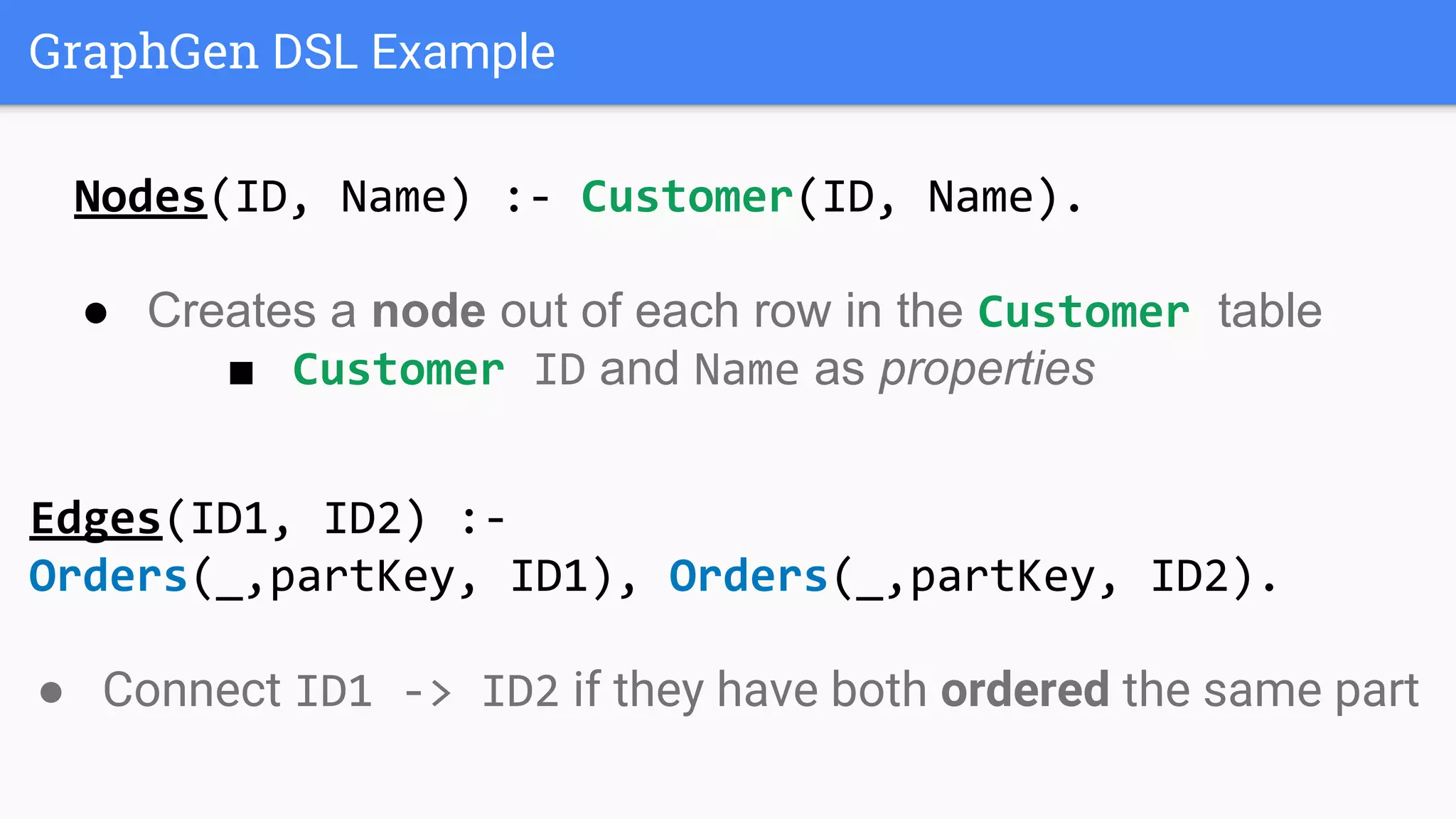
GraphGen DSL Example
Nodes(ID, Name) :- Customer(ID, Name).
● Creates a node out of each row in the Customer table
■ Customer ID and Name as properties
Edges(ID1, ID2) :-
Orders(_,partKey, ID1), Orders(_,partKey, ID2).
● Connect ID1 -> ID2 if they have both ordered the same part
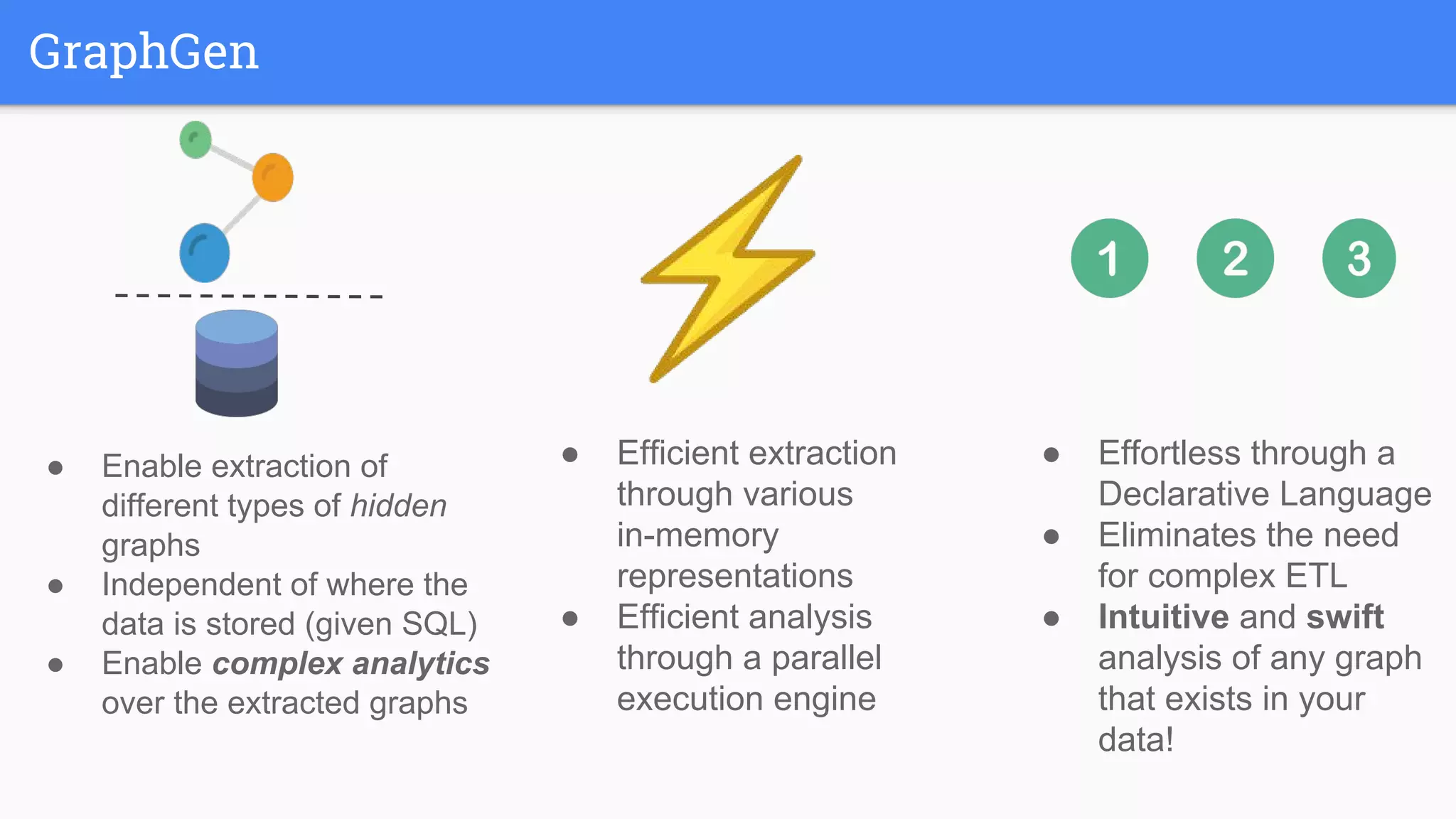
GraphGen
● Enable extraction of
different types of hidden
graphs
● Independent of where the
data is stored (given SQL)
● Enable complex analytics
over the extracted graphs
● Efficient extraction
through various
in-memory
representations
● Efficient analysis
through a parallel
execution engine
● Effortless through a
Declarative Language
● Eliminates the need
for complex ETL
● Intuitive and swift
analysis of any graph
that exists in your
data!
Download GraphGen at:
konstantinosx.github.io/graphgen-project/
DDL Blog Post at:
blog.districtdatalabs.com/graph-analytics-over-relational-datasets
Email: kostasx@cs.umd.edu
Twitter: @kxirog
Download GraphGen at:
konstantinosx.github.io/graphgen-project/
Thank you!

GraphGen: Conducting Graph Analytics over Relational Databases

  • 1.
    GraphGen: Conducting Graph Analyticsover Relational Databases Konstantinos Xirogiannopoulos Amol Deshpande
  • 2.
    collaborated Name: Konstantinos Name: Amol Name: University ofMarylandName: PyData DC Year: 2016 gave_talk works_at works_at
  • 3.
    Graph Analytics: (Network Science) Leveragingof connections between entities in a network towards gaining insight about said entities and/or the network via the use of graph algorithms.
  • 4.
    1) Why graphanalytics? 2) How are graph analytics done currently? 3) What are most people dealing with? 4) Bolt-on graph analytics with GraphGen 5) The GraphGen Language
  • 5.
    Graphs Across Domains Protein-protein interactionnetworks Financial transaction networks Stock Trading Networks Social Networks Federal Funds Networks Knowledge Graph World Wide Web Communication Networks Citation Networks …... http://go.umd.edu/graphs
  • 6.
    Example Use cases ●Financial crimes (e.g. money laundering) ● Fraudulent transactions ● Cybercrime ● Counterterrorism ● Key players in a network ● Ranking entities (web pages, PageRank) ● Providing connection recommendations to users ● Optimizing transportation routes ● Identifying weaknesses in power grids, water grids etc. ● Computer networks ● Medical Research ● Disease pathology ● DNA Sequencing
  • 7.
    1) Why graphanalytics? 2) How are graph analytics done currently? 3) What are most people dealing with? 4) Bolt-on graph analytics with GraphGen 5) The GraphGen Language
  • 8.
    Types of GraphAnalytics ● Graph “queries”: Subgraph pattern matching, shortest paths, temporal queries ● Real Time Analytics: Anomaly/Event detection, online prediction ● Batch Analytics (Network Science): Centrality analysis, community detection, network evolution ● Machine Learning: Matrix factorization, logistic regression modeled as message passing in specially structured graphs. http://go.umd.edu/graphs
  • 9.
    State of theart ● Graph Analytics tasks are too widely varied http://go.umd.edu/graphs ● There is no one-size-fits-all solution ○ RDBMS/Hadoop/Spark have their tradeoffs ● Fragmented area with little consensus ❖ Specialized graph databases (Neo4j, Titan, Blazegraph, Cayley,Dgraph) ❖ RDF stores (Allegrograph, Jena) ❖ Bolt-on solutions (Teradata SQL-Graph, SAP Graph Engine, Oracle) ❖ Distributed batch processing systems (Giraph, GraphX, GraphLab) Lots of ETL required! ❖ Many more research prototypes...
  • 10.
    Different Analytics Flows OtherSystemsGraph Databases Bolt-On Solutions
  • 11.
    What should Iuse then?? ● What fraction of the overall workload is graph-oriented? ● How often are some sort of graph analytics required to run? ● Do you need to do graph updates? ● What types of analytics are required? ● How large would the graphs be? ● Are you starting from scratch or do you have an already deployed DBMS?
  • 12.
    1) Why graphanalytics? 2) How are graph analytics done currently? 3) What are most people dealing with? 4) Bolt-on graph analytics with GraphGen 5) The GraphGen Language
  • 13.
    ● Most businessanalytics (querying, reporting, OLAP) happen in SQL ● Organizations typically model their data according to their needs ● Graph databases if you have strictly graph-centric workloads Where’s the Data?
  • 14.
    Where’s the Data? ●Most likely organized in some type of database schema ● Collection of tables related to each-other through common attributes, or primary, foreign-key constraints. We need to extract connections between entities
  • 15.
  • 16.
    Lots of “hidden”graphs ● Let’s take TPC-H. part_key Part supplier_key ... customer_key Customer customer_name ... order_key Orders part_key customer_key ... supplier_key Supplier supplier_name ... ● We could create edges between two customers if they’ve: ○ Bought the same item ○ Bought the same item on the same day ○ Bought from the same supplier ○ Etc.
  • 17.
    State of theart ● Graph Analytics tasks are too widely varied http://go.umd.edu/graphs ● There is no one-size-fits-all solution ○ RDBMS/Hadoop/Spark have their tradeoffs ● Fragmented area with little consensus ❖ Specialized graph databases (Neo4j, Titan, Blazegraph, Cayley,Dgraph) ❖ RDF stores (Allegrograph, Jena) ❖ Bolt-on solutions (Teradata SQL-Graph, SAP Graph Engine, Oracle) ❖ Distributed batch processing systems (Giraph, GraphX, GraphLab) Lots of ETL required! ❖ Many more research prototypes...
  • 18.
    State of theart ● Graph Analytics tasks are too widely varied http://go.umd.edu/graphs ● There is no one-size-fits-all solution ○ RDBMS/Hadoop/Spark have their tradeoffs ● Fragmented area with little consensus ❖ Specialized graph databases (Neo4j, Titan, Blazegraph, Cayley,Dgraph) ❖ RDF stores (Allegrograph, Jena) ❖ Bolt-on solutions (Teradata SQL-Graph, SAP Graph Engine, Oracle) ❖ Distributed batch processing systems (Giraph, GraphX, GraphLab) Lots of ETL required! ❖ Many more research prototypes...
  • 19.
    1) Why graphanalytics? 2) How are graph analytics done currently? 3) What are most people dealing with? 4) Bolt-on graph analytics with GraphGen 5) The GraphGen Language
  • 20.
    GraphGen Extract and analyze manydifferent kinds of graphs Simple, Intuitive, Declarative Language, No ETL required Full Graph API & Vertex Centric Framework
  • 21.
    GraphGen Interfaces Native JavaLibraryPython wrapper LibraryGraphGen Explorer: UI Web Application
  • 22.
  • 23.
    ● Exploration ofdatabase schema to detect different types of hidden graphs. ● Allows users to visually explore potential graphs. ● Simple statistic and on-the-fly analysis Not all graphs will be useful! GraphGen Explorer Web App
  • 25.
  • 26.
    from graphgenpy importGraphGenerator import networkx as nx datalogQuery = """ Nodes(ID, Name) :- Author(ID, Name). Edges(ID1, ID2) :- AuthorPublication(ID1, PubID), AuthorPublication(ID2, PubID). """ # Credentials for connecting to the database gg = GraphGenerator("localhost","5432","testgraphgen","kostasx","password") fname = gg.generateGraph(datalogQuery,"extracted_graph",GraphGenerator.GML) G = nx.read_gml(fname,'id') print "Graph Loaded into NetworkX! Running PageRank..." # Run any algorithm on the graph using NetworkX print nx.pagerank(G) print "Done!" Define GraphGen Query Database Credentials Generate and Serialize Graph Load Graph into NetworkX Run Any Algorithm
  • 27.
  • 28.
    // Establish Connectionto Database GraphGenerator ggen = new GraphGenerator("host", "port", "dbName", "username", "password"); // Define and evaluate a single graph extraction query String datalog_query = "..."; Graph g = ggen.generateGraph(datalog_query).get(0); // Initialize vertec-centric object VertexCentric p = new VertexCentric(g); // Define vertex-centric compute function Executor program = new Executor("result_value_name") { @Override public void compute(Vertex v, VertexCentric p) { // implementation of compute function } }; // Begin execution p.run(program); Define GraphGen Query Database Credentials Extract and Load Graph Define Vertex Centric Program Run Program
  • 29.
    // Establish Connectionto Database GraphGenerator ggen = new GraphGenerator("host", "port", "dbName", "username", "password"); // Define and evaluate a single graph extraction query String datalog_query = "..."; Graph g = ggen.generateGraph(datalog_query).get(0); for (Vertex v : g.getVertices()) { // For each neighbor for (Vertex neighbor : v.getVertices(Direction.OUT)) { // Do something } } Define GraphGen Query Database Credentials Extract and Load Graph Use Full API to access the Graph
  • 30.
  • 31.
    1) Why graphanalytics? 2) How are graph analytics done currently? 3) What are most people dealing with? 4) Bolt-on graph analytics with GraphGen 5) The GraphGen Language
  • 32.
    GraphGen DSL ● IntuitiveDomain Specific Language based on Datalog ● User needs to specify: ○ How the nodes are defined ○ How the edges are defined ● The query is executed, and the user gets a Graph object to operate upon. ● Very expressive: Allows for homogeneous and heterogeneous graphs with various types of nodes and edges.
  • 33.
    TPC-H Database partKey Part supplierKey ... customerKey Customer customerName ... ● Wewant to explore a graph of customers! ● Using the GraphGen Language: ○ Which tables do we need to combine to extract the nodes and edges orderKey Orders partKey customerKey ... supplierKey Supplier supplierName ...
  • 34.
    GraphGen DSL Example Nodes(ID,Name) :- Customer(ID, Name). ● Creates a node out of each row in the Customer table ■ Customer ID and Name as properties Edges(ID1, ID2) :- Orders(_,partKey, ID1), Orders(_,partKey, ID2). ● Connect ID1 -> ID2 if they have both ordered the same part
  • 35.
    GraphGen ● Enable extractionof different types of hidden graphs ● Independent of where the data is stored (given SQL) ● Enable complex analytics over the extracted graphs ● Efficient extraction through various in-memory representations ● Efficient analysis through a parallel execution engine ● Effortless through a Declarative Language ● Eliminates the need for complex ETL ● Intuitive and swift analysis of any graph that exists in your data!
  • 36.
    Download GraphGen at: konstantinosx.github.io/graphgen-project/ DDLBlog Post at: blog.districtdatalabs.com/graph-analytics-over-relational-datasets
  • 37.
    Email: kostasx@cs.umd.edu Twitter: @kxirog DownloadGraphGen at: konstantinosx.github.io/graphgen-project/ Thank you!