PHONETICS
Prepared by Juan Miguel Alcantara
SED 101
-”Phonetics is the study of speech sounds
and their physiological production and
their acoustic qualities” (Ladefoged,
2019).
-branch of linguistic that studies the
sounds of speech and how they are
produced, combined, described, and
interpreted through written symbols
(ThoughtCo, 2019).
WHAT IS PHONETICS?
-Phonetics deal with the study of
linguistic sounds.
-Phones are the speech sound. They are
represented with symbols depending
upon pronunciation.
-Phonology is the study of how these
sounds are systematically arranged to
distinguish the words from each other.
PHONETICS, PHONES, AND PHONOLOGY
1. The sound system is the basis for the
spelling system.
2. To teach English pronunciation to
students who are not native speakers of
English.
3. They may have to teach poetry which
requires them to teach poetic devices
that manipulate sounds ( rhyme,
alliteration, assonance, etc.)
WHY DO FUTURE EDUCATORS NEED TO STUDY
PHONETICS AND PHONOLOGY?
4. To understand different varieties of
language and accents.
5. Provides a corrective because we tend
to “hear” the sounds of our language
through its spelling system.
6. Provides systematic and well-founded
understandings of the sound patterns of
English.
WHY DO FUTURE EDUCATORS NEED TO STUDY
PHONETICS AND PHONOLOGY?
THREE BRANCHES
OF PHONETICS
-focuses on the
physical properties of
the sounds in
language.
ACOUSTIC PHONETICS
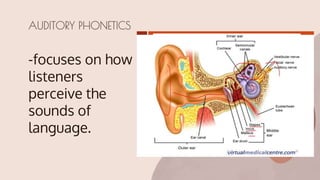
-focuses on how
listeners
perceive the
sounds of
language.
AUDITORY PHONETICS
-focuses on how the
vocal tract produces
the sounds of the
language.
ARTICULATORY PHONETICS
THE PHONETIC
ALPHABET
-International Phonetic Alphabet (IPA)
-was developed in the 1888
-consists of 20 vowels and 24 consonants
-provides a unique symbol for each
distinctive sound in a language.
WHAT IS THE PHONETIC ALPHABET?
-if we want to indicate that a letter is
interpreted as a phonetic symbol, we
enclose them in a square brackets [ ]
-if we want to indicate that a letter is
interpreted as letters from an ordinary
spelling system, we enclosed them in an
angled brackets < >
WHAT IS THE PHONETIC ALPHABET?
-Diacritics are marks that
are added to basic letters
to identify their distinction
in pronunciations
THE PHONETIC ALPHABET
-The orthography
(spelling) does not
consistently represent
the sounds of a
language.
WHY IS PHONETIC ALPHABET INVENTED?
1. The same sound may be represented by
a combination of two or more letters.
People Key
PROBLEMS ENCOUNTERED IN ORTHOGRAPHY
2. The same letter may represent a variety of
sounds.
Father Badly Many
PROBLEMS ENCOUNTERED IN ORTHOGRAPHY
3. A combination of letters may represent a
single sound.
Church Sheet Thanks
PROBLEMS ENCOUNTERED IN ORTHOGRAPHY
4. A single letter may represent a
combination of sounds.
Xerox
PROBLEMS ENCOUNTERED IN ORTHOGRAPHY
5. Some letters in a word may not be pronounced
at all.
Psychology Corps Knot
PROBLEMS ENCOUNTERED IN ORTHOGRAPHY
6. There may be no letter to represent a sound
that occurs in a word
Cute Use
PROBLEMS ENCOUNTERED IN ORTHOGRAPHY
ARTICULATORY
PHONETICS
-It is the study of how
our vocal organs work
to modify the airflow
from our lungs.
ARTICULATORY PHONETICS
-to produce a sound, air must flow from the lungs
through the vocal tract.
-the vocal tract includes the vocal folds (vocal
cords)
-air goes through the nose (nasal cavity), and the
mouth (oral cavity).
ARTICULATORY PHONETICS
-Glottis is the opening between the vocal cords.
-Larynx is also known as the “voice box”
-Pharynx is the tubular part above the larynx
-Nasal Cavity is the nose
-Oral Cavity is the mouth
ARTICULATORY PHONETICS
- <p, b, t, d, m, n, f, v, s, z, l, r, h, etc.>
- Produced by almost completely
stopping the airstream coming from
the lungs.
CONSONANTS
-voicing
-manner of articulation
-place of articulation
CLASSIFICATION IN PRONOUNCING CONSONANTS
-Voiced sounds are made when the
vocal folds are together, thus creating
vibrations as air passes.
-Voiceless sounds are produced
when there are little to no vibrations
in the vocal folds.
VOICING
VOICED SOUNDS VOICELESS SOUNDS
By [b] Pie [p]
Die [d] Tie [t]
The [ð] voiced dental fricative Thigh [θ] voiceless dental fricative
My [m]
Nigh [n]
Vie [v] Fie [f]
Zip [z] Sip [s]
Lie [l]
Rye [r]
PLACE AND MANNER
OF ARTICULATION
-where is the restriction of airflow is
made.
-an automatic speech recognition that
depends on the anatomy of the body
on where is the airflow restricted.
PLACE OF ARTICULATION
-Bilabial
-Labiodental
-Interdental
-Alveolar
-(Alveo-)Palatal
-Velar
-Glottal
PLACES OF ARTICULATION
-the airflow is restricted on the lips.
-the lips are pressed together to restrict airflow.
-[p] [b] [m]
Pie By My
PLACE OF ARTICULATION: BILABIAL
-the air is restricted by touching the bottom
of the lip to the upper teeth.
-[f] [v]
Feel Ravel
PLACE OF ARTICULATION: LABIODENTAL
-the air is restricted by placing the tip of the
tongue between upper and lower teeth.
-[θ] [ð]
Thigh Thy
PLACE OF ARTICULATION: INTERDENTAL
-the air is restricted by raising
the tongue to the alveolar ridge.
However, there are different
place of articulation for
alveolar.
-[t] [d] [n] [s] [z] [l] [r]
PLACE OF ARTICULATION:ALVEOLAR
-[t] [d] [n]
-the air is restricted by placing the tip of the
tongue on the alveolar ridge.
Tub Dub Knit
PLACE OF ARTICULATION: ALVEOLAR
-[s] [z]
-sound is made through the sides of the front
of the tongue but lowering the tip to let air
escape.
Sip Zip
PLACE OF ARTICULATION: ALVEOLAR
-[l]
-sound is made through the side of the mouth
by while the tip of the tongue is raised but the
rest is lowered.
-the sound is called lateral sound.
Lie
PLACE OF ARTICULATION: ALVEOLAR
-[r]
-the tip of the tongue is curled back behind the
alveolar ridge, or the top of the tongue is bunched
up behind the alveolar ridge.
-the sound is called central sound.
Rip
PLACE OF ARTICULATION: ALVEOLAR
-sound is restricted by raising
the front part of the tongue to
the hard palate.
-[ʃ] [ʒ] [ʧ] [ʤ] [ʝ]
Sure Genre
Chin Gin
PLACE OF ARTICULATION: (ALVEO-) PALATALS
-air is restricted by bringing
back the top of the tongue to
the velum (soft palate).
-[k] [g] [ŋ]
Could Tug
Tongue
PLACE OF ARTICULATION: VELAR
-air is restricted by narrowing
the vocal folds to create a
fricative or closing the glottis to
create a stop.
-[h] [Ɂ]
Hat Butter
PLACE OF ARTICULATION: GLOTTAL
-defines how the restriction of airflow
is made.
-A complete stoppage of air or only a
partial blockage.
MANNER OF ARTICULATION
-Oral sounds are sounds that
are produced with the velum
raised to prevent air from
escaping out the nose.
-Nasal sounds are sounds
that are produced with the
velum lowered to allow air to
escape from the nose.
ORAL AND NASAL SOUNDS
-Plosive
-Fricative
-Affricate
-Nasal
-Approximants
-Tap and Flap
-Clicks
TYPES OF MANNER OF ARTICULATION
-also known as stops.
-the airflow is stopped for a short
amount of time and released quickly.
-the period of blockage is called
closure.
-the explosion of air after the closure
is called release.
-[p] [b] [m] [t] [d] [n] [k] [g] [ŋ] [ʧ] [ʤ]
[Ɂ]
-Pat Bat
MANNER OF ARTICULATION: PLOSIVES
-air flow is released gradually.
-airflow is constricted, but not cut off
properly.
-produces little friction sound (hissing
sound) in the mouth.
-[f] [v] [θ] [ð] [s] [z] [ʃ] [ʒ] [x] [ɣ] [h]
-Fun Sun
MANNER OF ARTICULATION: FRICATIVES
-the airflow is stopped and released
gradually.
-a combination of stop and fricative.
-produced with a full stoppage of air
followed by an immediate restriction
of air.
-[ʧ] [ʤ]
-Choose Just
MANNER OF ARTICULATION: AFFRICATE
-air flow is channeled through the
nasal cavity.
-air is allowed to the nose by
lowering the velum (soft palate).
-[n] [m] [ŋ]
-Mat Clingy
MANNER OF ARTICULATION: NASAL
-two articulators are close together but not close
enough to cause turbulent airflow
-articulators approximate a frictional closeness,
but do not actually cause a friction.
-[w] [j] [r] [l]
APPROXIMANTS: CENTRAL, LATERAL, GLIDES
-Central approximants let air flows
along the center of the tongue. [r]
-Rock
-Lateral approximants let air flows on
the sides of the tongue. [l]
-Lack
-Glide approximants produce little
obstruction of the airstream and always
followed with a vowel. [j] [w]
-Yellow Wood
APPROXIMANTS: CENTRAL, LATERAL, GLIDES
-Taps are produced by rapidly vibrating an articulator. [r]
-Grrrr
-Flaps are produced by a flick of the tongue to let air escape.
-Flop
MANNER OF ARTICULATION: TAP AND FLAP
-produced by moving air in the mouth between
various articulators
-air is moved from one articulator to another,
so on and so forth.
-Tsk
MANNER OF ARTICULATION: CLICKS
-<a, e, i, o, u>
-produced with a smooth, unobstructed
airflow through the oral tract.
-Vowel qualities are determined by
height of the tongue in the mouth,
part of the tongue raised,
configuration of lips, and tension of
muscles of the oral tract.
VOWELS
-classified by how high or low the
tongue is on the mouth.
-classified into three: high, mid, and
low.
-High vowels: [i] [ɪ] [u] [ʊ]
-Mid vowels: [e] [ɛ] [o] [ə] [ʌ] [ɔ]
-Low vowels: [æ] [a]
VOWELS: TONGUE OF HEIGHT
-Front vowels meant that the
tongue is in the front of the mouth.
-[i] [ɪ] [e] [ɛ] [æ]
-Central vowels meant that the
tongue is in the center of the mouth.
-[ə] [ʌ]
-Back vowels meant that the
tongue is further back in the mouth.
-[u] [ɔ] [o] [æ] [a]
VOWELS: FRONT, CENTRAL, BACK VOWELS
TONGUE AND PLACEMENT OF TONGUE
-Rounded vowels are vowels that
are made by rounding the lips.
-Unrounded vowels (neutral or
spread) are vowels that makes the
lip in its natural form.
VOWELS: CONFIGURATION OF LIPS
-Tense vowels are produced
with greater tension in the
tongue.
-Lax vowels are produced
with less tongue tension.
VOWELS: TENSE AND LAX
-Monophthongs are
pronounced with a
single sound from
beginning to end.
-Diphthongs are
pronounced with a
glide of combination of
vowel from beginning
to end.
MONOPHTHONGS AND DIPHTHONGS
MAJOR PHONETIC
CLASSES
-Non-continuants
-Continuants
-Obstruents
-Sonorants
-Syllabic Sounds
-Consonantals
MAJOR PHONETIC CLASSES
-Non-continuants mean that the air stream is
blocked off in the oral cavity.
(Stops and Affricates.)
-Continuants mean that the air flow is
continuously released from the oral cavity.
(All other consonants and vowels).
-Obstruents mean that the air stream has little
to full obstruction.
(Non-nasal stops, fricatives, and affricates)
MAJOR PHONETIC CLASSES
-Sonorants mean that the air resonates in the
oral and nasal cavity.
(Vowels, Nasal stops, Approximants, and Glides).
-Syllabic Sounds mean that the sound can
function as the core of the syllable.
(Vowels, Approximants, and Nasals)
-Consonantals mean that there is some
restriction of airflow during articulations.
(All consonantals except glides).
MAJOR PHONETIC CLASSES
-Labials are articulated with the lips.
[p][b][m][f][v][w][ʍ]
-Coronals are articulated by raising
the tongue blade.
[θ][ð][t][d][n][s][z][ʃ][ʒ][ʧ][ʤ][l][r]
-Anteriors are articulated in the front
part of the mouth (from the alveolar
area forward).
[p][b][m][f][v][θ][ð][t][d][n][s][z]
-Sibilants are articulated with a lot of
friction that causes hissing sounds.
[s][z][ʃ][ʒ][ʧ][ʤ]
MAJOR PHONETIC CLASSES: CONSONANTALS
PROSODIC/
SUPRASEGMENTAL
FEATURES
-Length of a consonant or vowel can change the
meaning of the word. As an example, the
Japanese language.
Biru [biru] “building” Biiru [biːru] “beer”
-Stress gives emphasize to a sound in a word. It
usually has a higher pitch.
REcord (noun) reCORD (verb)
PROSODIC FEATURES
-Tone languages use pitch to contrast the
meaning of words. As an example, the Thai
language.
TONE AND INTONATION
-Intonation languages have different pitches on
a sentence to determine its meaning. However,
the pitch is not used to determine a word.
“She is here” when said in a falling intonation
indicates a statement
“She is here” when said in a rising intonation
indicates a question.
TONE AND INTONATION
4 Phonetics and Phonology key concepts. (n.d.).
https://wac.colostate.edu/docs/books/sound/chapter4.pdf
Admin. (2021, May 10). Monophthongs - Examples of 12 Pure Vowel
Sounds - EnglishBix. EnglishBix.
https://www.englishbix.com/monophthongs-pure-vowels-examples/
Fall, O. (2009). Phonetics and Phonology. Http://People.umass.edu/.
http://people.umass.edu/moiry/phonology.pdf
https://www.facebook.com/thoughtcodotcom. (2019). What Is
Phonetics? ThoughtCo. https://www.thoughtco.com/phonetics-
definition-1691622
REFERENCES
International Phonetic Alphabet | Definition, Uses, & Chart | Britannica.
(2021). In Encyclopædia Britannica.
https://www.britannica.com/topic/International-Phonetic-Alphabet
Ladefoged, P. (2019). Phonetics | linguistics | Britannica. In Encyclopædia
Britannica. https://www.britannica.com/science/phonetics
Ladefoged, P., & Johnson, K. (2011). A course in phonetics.
Wadsworth/Cengage Learning.
Pearson Education, Inc. (2007, September 19). Phonetics.
Cs.columbia.edu. http://www.cs.columbia.edu/~julia/courses/CS6998-
2019/%5B07%5D%20Phonetics.pdf
REFERENCES
Phonetics, Phonology, and Phonics. (n.d.). Retrieved October 18, 2021,
from http://www.csun.edu/~sk36711/WWW2/engl302/phon.pdf
Szczegielniak, A. (n.d.). Phonetics: The Sounds of Language Introduction
to Linguistic Theory.
https://scholar.harvard.edu/files/adam/files/phonetics.ppt.pdf
REFERENCES

PHONETICS.pptx

  • 1.
    PHONETICS Prepared by JuanMiguel Alcantara SED 101
  • 2.
    -”Phonetics is thestudy of speech sounds and their physiological production and their acoustic qualities” (Ladefoged, 2019). -branch of linguistic that studies the sounds of speech and how they are produced, combined, described, and interpreted through written symbols (ThoughtCo, 2019). WHAT IS PHONETICS?
  • 3.
    -Phonetics deal withthe study of linguistic sounds. -Phones are the speech sound. They are represented with symbols depending upon pronunciation. -Phonology is the study of how these sounds are systematically arranged to distinguish the words from each other. PHONETICS, PHONES, AND PHONOLOGY
  • 4.
    1. The soundsystem is the basis for the spelling system. 2. To teach English pronunciation to students who are not native speakers of English. 3. They may have to teach poetry which requires them to teach poetic devices that manipulate sounds ( rhyme, alliteration, assonance, etc.) WHY DO FUTURE EDUCATORS NEED TO STUDY PHONETICS AND PHONOLOGY?
  • 5.
    4. To understanddifferent varieties of language and accents. 5. Provides a corrective because we tend to “hear” the sounds of our language through its spelling system. 6. Provides systematic and well-founded understandings of the sound patterns of English. WHY DO FUTURE EDUCATORS NEED TO STUDY PHONETICS AND PHONOLOGY?
  • 6.
  • 7.
    -focuses on the physicalproperties of the sounds in language. ACOUSTIC PHONETICS
  • 8.
    -focuses on how listeners perceivethe sounds of language. AUDITORY PHONETICS
  • 9.
    -focuses on howthe vocal tract produces the sounds of the language. ARTICULATORY PHONETICS
  • 10.
  • 11.
    -International Phonetic Alphabet(IPA) -was developed in the 1888 -consists of 20 vowels and 24 consonants -provides a unique symbol for each distinctive sound in a language. WHAT IS THE PHONETIC ALPHABET?
  • 13.
    -if we wantto indicate that a letter is interpreted as a phonetic symbol, we enclose them in a square brackets [ ] -if we want to indicate that a letter is interpreted as letters from an ordinary spelling system, we enclosed them in an angled brackets < > WHAT IS THE PHONETIC ALPHABET?
  • 14.
    -Diacritics are marksthat are added to basic letters to identify their distinction in pronunciations THE PHONETIC ALPHABET
  • 16.
    -The orthography (spelling) doesnot consistently represent the sounds of a language. WHY IS PHONETIC ALPHABET INVENTED?
  • 17.
    1. The samesound may be represented by a combination of two or more letters. People Key PROBLEMS ENCOUNTERED IN ORTHOGRAPHY
  • 18.
    2. The sameletter may represent a variety of sounds. Father Badly Many PROBLEMS ENCOUNTERED IN ORTHOGRAPHY
  • 19.
    3. A combinationof letters may represent a single sound. Church Sheet Thanks PROBLEMS ENCOUNTERED IN ORTHOGRAPHY
  • 20.
    4. A singleletter may represent a combination of sounds. Xerox PROBLEMS ENCOUNTERED IN ORTHOGRAPHY
  • 21.
    5. Some lettersin a word may not be pronounced at all. Psychology Corps Knot PROBLEMS ENCOUNTERED IN ORTHOGRAPHY
  • 22.
    6. There maybe no letter to represent a sound that occurs in a word Cute Use PROBLEMS ENCOUNTERED IN ORTHOGRAPHY
  • 23.
  • 24.
    -It is thestudy of how our vocal organs work to modify the airflow from our lungs. ARTICULATORY PHONETICS
  • 25.
    -to produce asound, air must flow from the lungs through the vocal tract. -the vocal tract includes the vocal folds (vocal cords) -air goes through the nose (nasal cavity), and the mouth (oral cavity). ARTICULATORY PHONETICS
  • 26.
    -Glottis is theopening between the vocal cords. -Larynx is also known as the “voice box” -Pharynx is the tubular part above the larynx -Nasal Cavity is the nose -Oral Cavity is the mouth ARTICULATORY PHONETICS
  • 28.
    - <p, b,t, d, m, n, f, v, s, z, l, r, h, etc.> - Produced by almost completely stopping the airstream coming from the lungs. CONSONANTS
  • 29.
    -voicing -manner of articulation -placeof articulation CLASSIFICATION IN PRONOUNCING CONSONANTS
  • 30.
    -Voiced sounds aremade when the vocal folds are together, thus creating vibrations as air passes. -Voiceless sounds are produced when there are little to no vibrations in the vocal folds. VOICING
  • 31.
    VOICED SOUNDS VOICELESSSOUNDS By [b] Pie [p] Die [d] Tie [t] The [ð] voiced dental fricative Thigh [θ] voiceless dental fricative My [m] Nigh [n] Vie [v] Fie [f] Zip [z] Sip [s] Lie [l] Rye [r]
  • 32.
    PLACE AND MANNER OFARTICULATION
  • 34.
    -where is therestriction of airflow is made. -an automatic speech recognition that depends on the anatomy of the body on where is the airflow restricted. PLACE OF ARTICULATION
  • 35.
  • 36.
    -the airflow isrestricted on the lips. -the lips are pressed together to restrict airflow. -[p] [b] [m] Pie By My PLACE OF ARTICULATION: BILABIAL
  • 37.
    -the air isrestricted by touching the bottom of the lip to the upper teeth. -[f] [v] Feel Ravel PLACE OF ARTICULATION: LABIODENTAL
  • 38.
    -the air isrestricted by placing the tip of the tongue between upper and lower teeth. -[θ] [ð] Thigh Thy PLACE OF ARTICULATION: INTERDENTAL
  • 39.
    -the air isrestricted by raising the tongue to the alveolar ridge. However, there are different place of articulation for alveolar. -[t] [d] [n] [s] [z] [l] [r] PLACE OF ARTICULATION:ALVEOLAR
  • 40.
    -[t] [d] [n] -theair is restricted by placing the tip of the tongue on the alveolar ridge. Tub Dub Knit PLACE OF ARTICULATION: ALVEOLAR
  • 41.
    -[s] [z] -sound ismade through the sides of the front of the tongue but lowering the tip to let air escape. Sip Zip PLACE OF ARTICULATION: ALVEOLAR
  • 42.
    -[l] -sound is madethrough the side of the mouth by while the tip of the tongue is raised but the rest is lowered. -the sound is called lateral sound. Lie PLACE OF ARTICULATION: ALVEOLAR
  • 43.
    -[r] -the tip ofthe tongue is curled back behind the alveolar ridge, or the top of the tongue is bunched up behind the alveolar ridge. -the sound is called central sound. Rip PLACE OF ARTICULATION: ALVEOLAR
  • 44.
    -sound is restrictedby raising the front part of the tongue to the hard palate. -[ʃ] [ʒ] [ʧ] [ʤ] [ʝ] Sure Genre Chin Gin PLACE OF ARTICULATION: (ALVEO-) PALATALS
  • 45.
    -air is restrictedby bringing back the top of the tongue to the velum (soft palate). -[k] [g] [ŋ] Could Tug Tongue PLACE OF ARTICULATION: VELAR
  • 46.
    -air is restrictedby narrowing the vocal folds to create a fricative or closing the glottis to create a stop. -[h] [Ɂ] Hat Butter PLACE OF ARTICULATION: GLOTTAL
  • 47.
    -defines how therestriction of airflow is made. -A complete stoppage of air or only a partial blockage. MANNER OF ARTICULATION
  • 48.
    -Oral sounds aresounds that are produced with the velum raised to prevent air from escaping out the nose. -Nasal sounds are sounds that are produced with the velum lowered to allow air to escape from the nose. ORAL AND NASAL SOUNDS
  • 49.
  • 50.
    -also known asstops. -the airflow is stopped for a short amount of time and released quickly. -the period of blockage is called closure. -the explosion of air after the closure is called release. -[p] [b] [m] [t] [d] [n] [k] [g] [ŋ] [ʧ] [ʤ] [Ɂ] -Pat Bat MANNER OF ARTICULATION: PLOSIVES
  • 51.
    -air flow isreleased gradually. -airflow is constricted, but not cut off properly. -produces little friction sound (hissing sound) in the mouth. -[f] [v] [θ] [ð] [s] [z] [ʃ] [ʒ] [x] [ɣ] [h] -Fun Sun MANNER OF ARTICULATION: FRICATIVES
  • 52.
    -the airflow isstopped and released gradually. -a combination of stop and fricative. -produced with a full stoppage of air followed by an immediate restriction of air. -[ʧ] [ʤ] -Choose Just MANNER OF ARTICULATION: AFFRICATE
  • 53.
    -air flow ischanneled through the nasal cavity. -air is allowed to the nose by lowering the velum (soft palate). -[n] [m] [ŋ] -Mat Clingy MANNER OF ARTICULATION: NASAL
  • 54.
    -two articulators areclose together but not close enough to cause turbulent airflow -articulators approximate a frictional closeness, but do not actually cause a friction. -[w] [j] [r] [l] APPROXIMANTS: CENTRAL, LATERAL, GLIDES
  • 55.
    -Central approximants letair flows along the center of the tongue. [r] -Rock -Lateral approximants let air flows on the sides of the tongue. [l] -Lack -Glide approximants produce little obstruction of the airstream and always followed with a vowel. [j] [w] -Yellow Wood APPROXIMANTS: CENTRAL, LATERAL, GLIDES
  • 56.
    -Taps are producedby rapidly vibrating an articulator. [r] -Grrrr -Flaps are produced by a flick of the tongue to let air escape. -Flop MANNER OF ARTICULATION: TAP AND FLAP
  • 57.
    -produced by movingair in the mouth between various articulators -air is moved from one articulator to another, so on and so forth. -Tsk MANNER OF ARTICULATION: CLICKS
  • 58.
    -<a, e, i,o, u> -produced with a smooth, unobstructed airflow through the oral tract. -Vowel qualities are determined by height of the tongue in the mouth, part of the tongue raised, configuration of lips, and tension of muscles of the oral tract. VOWELS
  • 59.
    -classified by howhigh or low the tongue is on the mouth. -classified into three: high, mid, and low. -High vowels: [i] [ɪ] [u] [ʊ] -Mid vowels: [e] [ɛ] [o] [ə] [ʌ] [ɔ] -Low vowels: [æ] [a] VOWELS: TONGUE OF HEIGHT
  • 60.
    -Front vowels meantthat the tongue is in the front of the mouth. -[i] [ɪ] [e] [ɛ] [æ] -Central vowels meant that the tongue is in the center of the mouth. -[ə] [ʌ] -Back vowels meant that the tongue is further back in the mouth. -[u] [ɔ] [o] [æ] [a] VOWELS: FRONT, CENTRAL, BACK VOWELS
  • 62.
  • 63.
    -Rounded vowels arevowels that are made by rounding the lips. -Unrounded vowels (neutral or spread) are vowels that makes the lip in its natural form. VOWELS: CONFIGURATION OF LIPS
  • 64.
    -Tense vowels areproduced with greater tension in the tongue. -Lax vowels are produced with less tongue tension. VOWELS: TENSE AND LAX
  • 65.
    -Monophthongs are pronounced witha single sound from beginning to end. -Diphthongs are pronounced with a glide of combination of vowel from beginning to end. MONOPHTHONGS AND DIPHTHONGS
  • 67.
  • 68.
  • 69.
    -Non-continuants mean thatthe air stream is blocked off in the oral cavity. (Stops and Affricates.) -Continuants mean that the air flow is continuously released from the oral cavity. (All other consonants and vowels). -Obstruents mean that the air stream has little to full obstruction. (Non-nasal stops, fricatives, and affricates) MAJOR PHONETIC CLASSES
  • 70.
    -Sonorants mean thatthe air resonates in the oral and nasal cavity. (Vowels, Nasal stops, Approximants, and Glides). -Syllabic Sounds mean that the sound can function as the core of the syllable. (Vowels, Approximants, and Nasals) -Consonantals mean that there is some restriction of airflow during articulations. (All consonantals except glides). MAJOR PHONETIC CLASSES
  • 71.
    -Labials are articulatedwith the lips. [p][b][m][f][v][w][ʍ] -Coronals are articulated by raising the tongue blade. [θ][ð][t][d][n][s][z][ʃ][ʒ][ʧ][ʤ][l][r] -Anteriors are articulated in the front part of the mouth (from the alveolar area forward). [p][b][m][f][v][θ][ð][t][d][n][s][z] -Sibilants are articulated with a lot of friction that causes hissing sounds. [s][z][ʃ][ʒ][ʧ][ʤ] MAJOR PHONETIC CLASSES: CONSONANTALS
  • 72.
  • 73.
    -Length of aconsonant or vowel can change the meaning of the word. As an example, the Japanese language. Biru [biru] “building” Biiru [biːru] “beer” -Stress gives emphasize to a sound in a word. It usually has a higher pitch. REcord (noun) reCORD (verb) PROSODIC FEATURES
  • 74.
    -Tone languages usepitch to contrast the meaning of words. As an example, the Thai language. TONE AND INTONATION
  • 76.
    -Intonation languages havedifferent pitches on a sentence to determine its meaning. However, the pitch is not used to determine a word. “She is here” when said in a falling intonation indicates a statement “She is here” when said in a rising intonation indicates a question. TONE AND INTONATION
  • 77.
    4 Phonetics andPhonology key concepts. (n.d.). https://wac.colostate.edu/docs/books/sound/chapter4.pdf Admin. (2021, May 10). Monophthongs - Examples of 12 Pure Vowel Sounds - EnglishBix. EnglishBix. https://www.englishbix.com/monophthongs-pure-vowels-examples/ Fall, O. (2009). Phonetics and Phonology. Http://People.umass.edu/. http://people.umass.edu/moiry/phonology.pdf https://www.facebook.com/thoughtcodotcom. (2019). What Is Phonetics? ThoughtCo. https://www.thoughtco.com/phonetics- definition-1691622 REFERENCES
  • 78.
    International Phonetic Alphabet| Definition, Uses, & Chart | Britannica. (2021). In Encyclopædia Britannica. https://www.britannica.com/topic/International-Phonetic-Alphabet Ladefoged, P. (2019). Phonetics | linguistics | Britannica. In Encyclopædia Britannica. https://www.britannica.com/science/phonetics Ladefoged, P., & Johnson, K. (2011). A course in phonetics. Wadsworth/Cengage Learning. Pearson Education, Inc. (2007, September 19). Phonetics. Cs.columbia.edu. http://www.cs.columbia.edu/~julia/courses/CS6998- 2019/%5B07%5D%20Phonetics.pdf REFERENCES
  • 79.
    Phonetics, Phonology, andPhonics. (n.d.). Retrieved October 18, 2021, from http://www.csun.edu/~sk36711/WWW2/engl302/phon.pdf Szczegielniak, A. (n.d.). Phonetics: The Sounds of Language Introduction to Linguistic Theory. https://scholar.harvard.edu/files/adam/files/phonetics.ppt.pdf REFERENCES