Security Framework
Predict – Preempt – Protect
Karthikeyan Dhayalan
Definitions
• Framework
• Provide guidance on how to build Individual architectures that will be
useful to a diverse set of individuals
• Architecture
• Conceptual Construct
• Tool to help individuals understand complex items
• It expresses enterprise structure (form) and behaviour (function)
• Security Program
• It is a framework made of many entities working together to provide a
protection level for an environment
• A security program should work in layers
• Security via obscurity is not a healthy protective mechanism
ISO27000 Security Program
• Outlines how an information security management system should be
built and maintained
• Provides guidance to design, implement and maintain policies,
procedures, and technologies to manage risks to the sensitive
information assets of an organization
• Its based on PDCA model
• Some key ISO27000 standards
• ISO27001 – ISMS requirements
• ISO27002 – Code of practice for ISMS
• ISO27005 – Risk Management
• ISO27031 – Business continuity
Enterprise Architecture
• Two important key aspects of an Enterprise Architecture
• Identifying the stakeholders
• people who will be looking at it and using it
• Developing Views
• How the information that is most important to different stake holders will be
illustrated in the most useful manner
• Architecture allows not only to understand the business from different views, but
also understand how a change takes place at one level will affect items at all other
levels
Keep building a House as a reference when understanding this
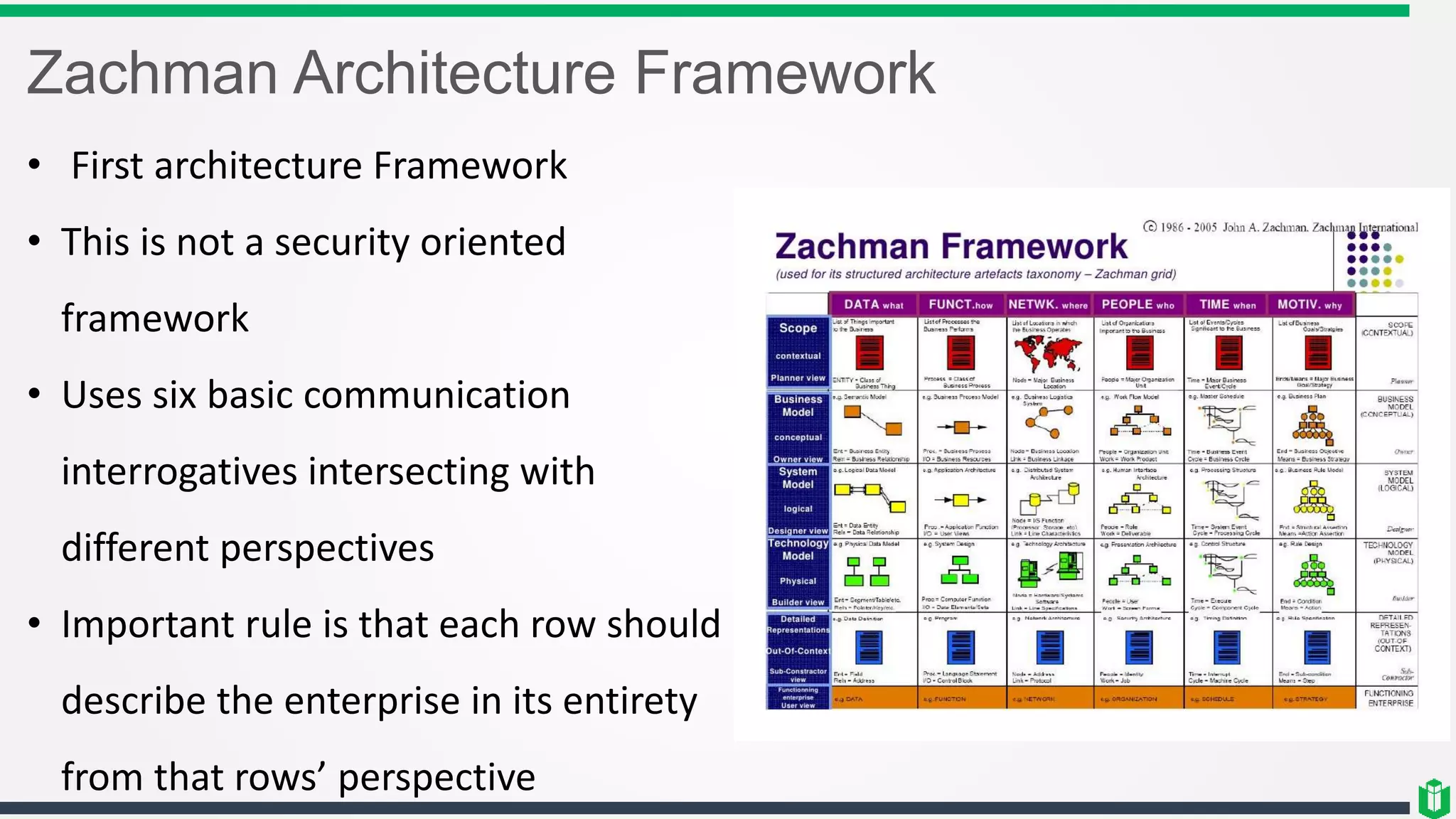
Zachman Architecture Framework
• First architecture Framework
• This is not a security oriented
framework
• Uses six basic communication
interrogatives intersecting with
different perspectives
• Important rule is that each row should
describe the enterprise in its entirety
from that rows’ perspective
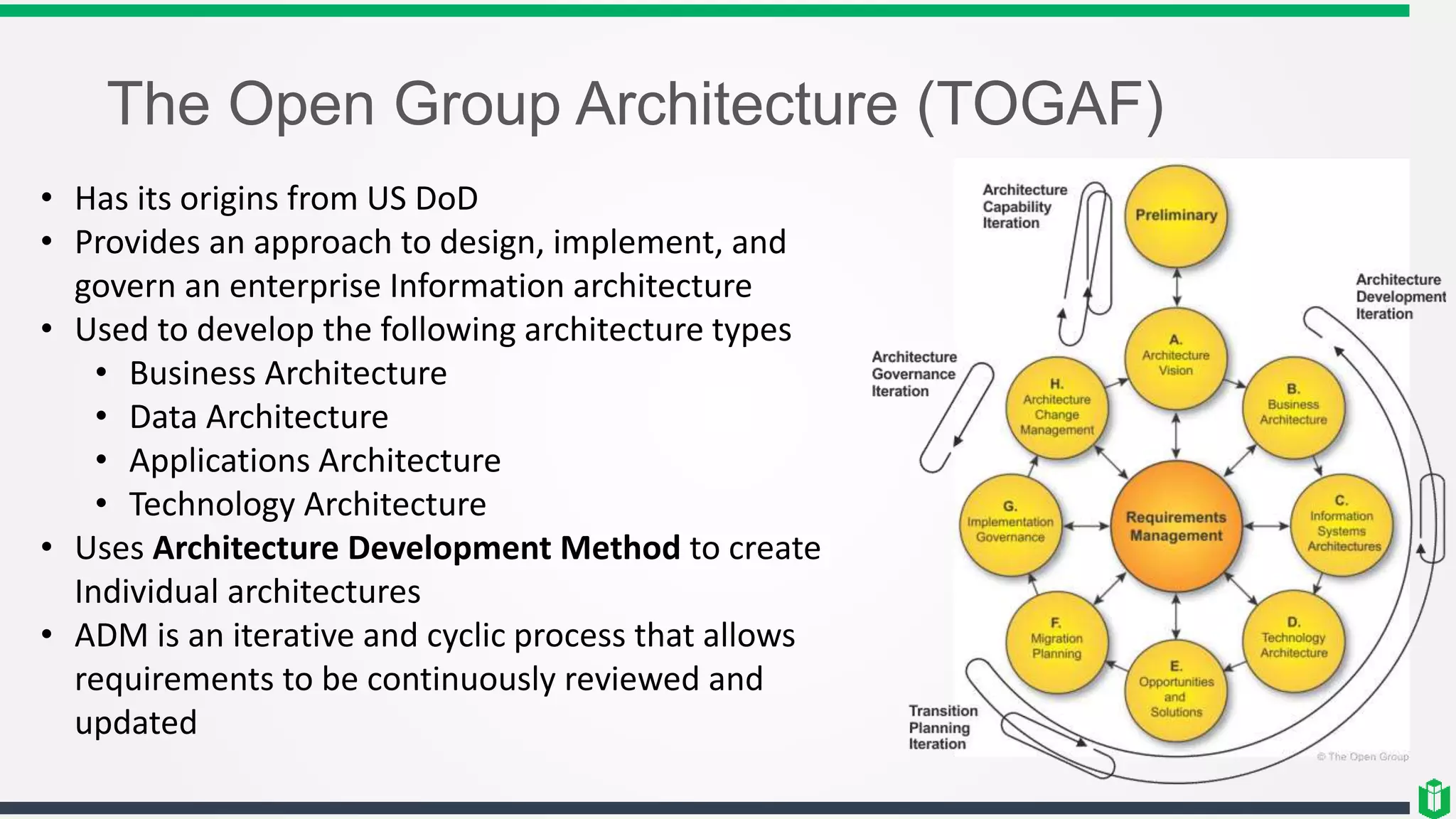
The Open Group Architecture (TOGAF)
• Has its origins from US DoD
• Provides an approach to design, implement, and
govern an enterprise Information architecture
• Used to develop the following architecture types
• Business Architecture
• Data Architecture
• Applications Architecture
• Technology Architecture
• Uses Architecture Development Method to create
Individual architectures
• ADM is an iterative and cyclic process that allows
requirements to be continuously reviewed and
updated
Enterprise Security Architecture
• Subset of Enterprise Architecture
• Defines information security strategy that consists of layers of
solutions, process, and procedures
• It ensures that security efforts align with business practices in a
standardized and cost-effective manner
• For a successful ESA the following must be understood and followed
• Strategic alignment
• Business enablement
• Process enhancement
• Security effectiveness
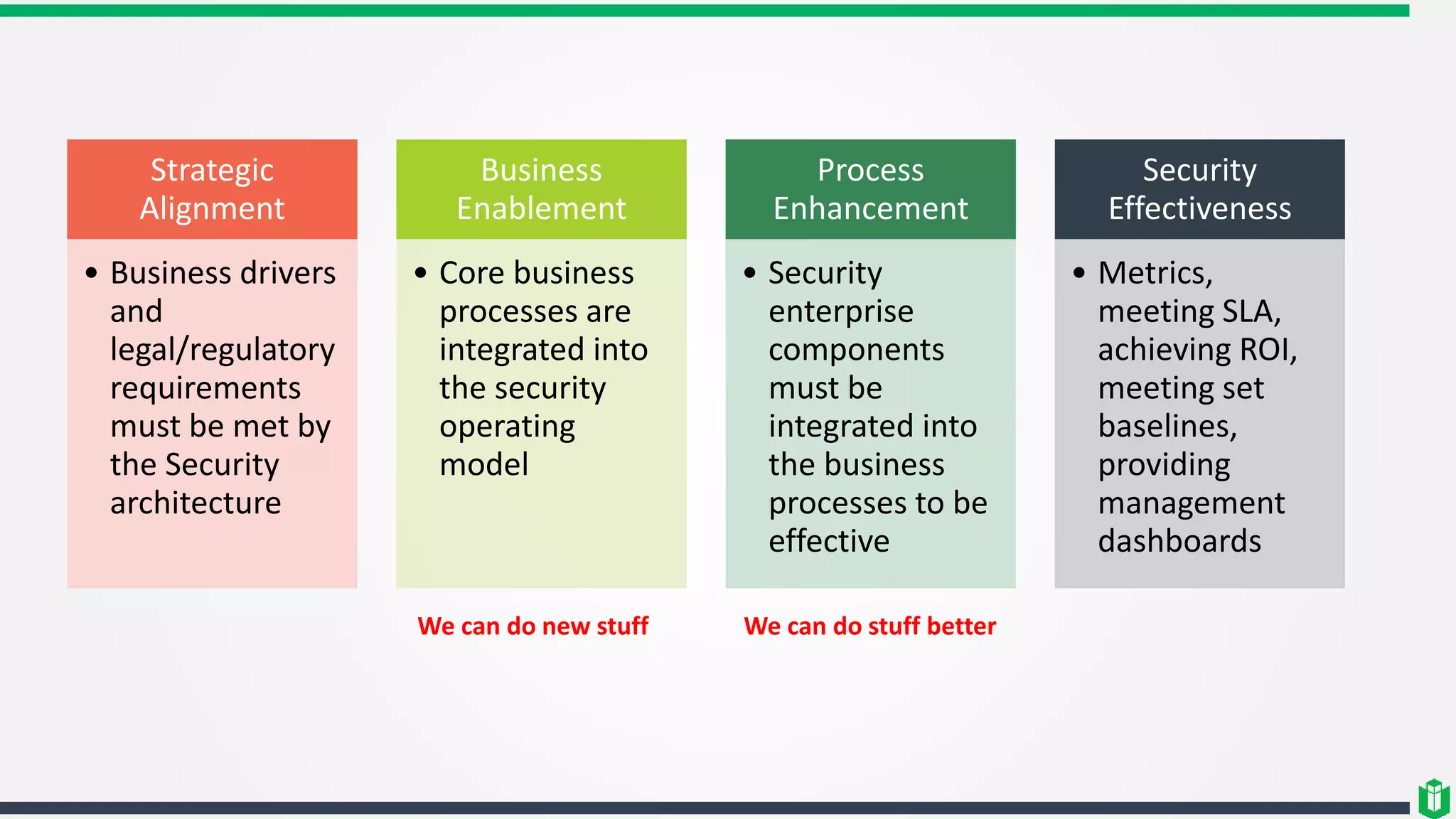
Strategic
Alignment
• Business drivers
and
legal/regulatory
requirements
must be met by
the Security
architecture
Business
Enablement
• Core business
processes are
integrated into
the security
operating
model
Process
Enhancement
• Security
enterprise
components
must be
integrated into
the business
processes to be
effective
Security
Effectiveness
• Metrics,
meeting SLA,
achieving ROI,
meeting set
baselines,
providing
management
dashboards
We can do new stuff We can do stuff better
COBIT
• It’s a model for IT Governance
• Is a framework for governance and management developed by ISACA
• It’s a holistic approach based on 5 key principles
• Meeting stakeholder needs
• Covering the enterprise end to end
• Applying a single integrated framework
• Enabling a holistic approach
• Separating governance from management
• Its ultimately linked to the stakeholders
• It deals at the operational level
• It specifies 17 enterprise and 17 IT specific goals
• Majority of security compliance audit practices are based on COBIT
NIST 800-53
• Developed by NIST
• Outlines the controls that (US) agencies need to put into place to be
compliant with the FISMA Act
• There are many control categories addressed by this
• They are management, operational, technical controls prescribed for
an information system to protect CIA
• As COBIT is for Private compliance needs, NIST is for US Government
compliance needs
COSO Internal Control
• It is a model for corporate governance
• It deals at the strategic level
• It was formed to provide sponsorship for an organization that studied
deceptive financial reports and what elements lead to them
• SOX is derived from COSO
ITIL
• De facto standard on best practices for IT service management
• Customizable framework
• It provides the goals, the general activities necessary to achieve the
goals, and the input/output values for each process required to meet
the goals
• It focuses more towards internal SLA between the IT department and
the customer it serves (predominantly Internal functions)
Six Sigma / CMMI
• It is a process improvement methodology
• Six sigma – improves process by using statistical methods of
measuring operational efficiency and reducing variations, defects
and waste.
• CMMI – develop structured steps that can be followed for an
organization can evolve from one level to the next and constantly
improve its processes and security posture.
Karthikeyan Dhayalan

Chapter 1 Security Framework

  • 1.
    Security Framework Predict –Preempt – Protect Karthikeyan Dhayalan
  • 2.
    Definitions • Framework • Provideguidance on how to build Individual architectures that will be useful to a diverse set of individuals • Architecture • Conceptual Construct • Tool to help individuals understand complex items • It expresses enterprise structure (form) and behaviour (function) • Security Program • It is a framework made of many entities working together to provide a protection level for an environment • A security program should work in layers • Security via obscurity is not a healthy protective mechanism
  • 3.
    ISO27000 Security Program •Outlines how an information security management system should be built and maintained • Provides guidance to design, implement and maintain policies, procedures, and technologies to manage risks to the sensitive information assets of an organization • Its based on PDCA model • Some key ISO27000 standards • ISO27001 – ISMS requirements • ISO27002 – Code of practice for ISMS • ISO27005 – Risk Management • ISO27031 – Business continuity
  • 4.
    Enterprise Architecture • Twoimportant key aspects of an Enterprise Architecture • Identifying the stakeholders • people who will be looking at it and using it • Developing Views • How the information that is most important to different stake holders will be illustrated in the most useful manner • Architecture allows not only to understand the business from different views, but also understand how a change takes place at one level will affect items at all other levels Keep building a House as a reference when understanding this
  • 5.
    Zachman Architecture Framework •First architecture Framework • This is not a security oriented framework • Uses six basic communication interrogatives intersecting with different perspectives • Important rule is that each row should describe the enterprise in its entirety from that rows’ perspective
  • 6.
    The Open GroupArchitecture (TOGAF) • Has its origins from US DoD • Provides an approach to design, implement, and govern an enterprise Information architecture • Used to develop the following architecture types • Business Architecture • Data Architecture • Applications Architecture • Technology Architecture • Uses Architecture Development Method to create Individual architectures • ADM is an iterative and cyclic process that allows requirements to be continuously reviewed and updated
  • 7.
    Enterprise Security Architecture •Subset of Enterprise Architecture • Defines information security strategy that consists of layers of solutions, process, and procedures • It ensures that security efforts align with business practices in a standardized and cost-effective manner • For a successful ESA the following must be understood and followed • Strategic alignment • Business enablement • Process enhancement • Security effectiveness
  • 8.
    Strategic Alignment • Business drivers and legal/regulatory requirements mustbe met by the Security architecture Business Enablement • Core business processes are integrated into the security operating model Process Enhancement • Security enterprise components must be integrated into the business processes to be effective Security Effectiveness • Metrics, meeting SLA, achieving ROI, meeting set baselines, providing management dashboards We can do new stuff We can do stuff better
  • 9.
    COBIT • It’s amodel for IT Governance • Is a framework for governance and management developed by ISACA • It’s a holistic approach based on 5 key principles • Meeting stakeholder needs • Covering the enterprise end to end • Applying a single integrated framework • Enabling a holistic approach • Separating governance from management • Its ultimately linked to the stakeholders • It deals at the operational level • It specifies 17 enterprise and 17 IT specific goals • Majority of security compliance audit practices are based on COBIT
  • 10.
    NIST 800-53 • Developedby NIST • Outlines the controls that (US) agencies need to put into place to be compliant with the FISMA Act • There are many control categories addressed by this • They are management, operational, technical controls prescribed for an information system to protect CIA • As COBIT is for Private compliance needs, NIST is for US Government compliance needs
  • 11.
    COSO Internal Control •It is a model for corporate governance • It deals at the strategic level • It was formed to provide sponsorship for an organization that studied deceptive financial reports and what elements lead to them • SOX is derived from COSO
  • 12.
    ITIL • De factostandard on best practices for IT service management • Customizable framework • It provides the goals, the general activities necessary to achieve the goals, and the input/output values for each process required to meet the goals • It focuses more towards internal SLA between the IT department and the customer it serves (predominantly Internal functions)
  • 13.
    Six Sigma /CMMI • It is a process improvement methodology • Six sigma – improves process by using statistical methods of measuring operational efficiency and reducing variations, defects and waste. • CMMI – develop structured steps that can be followed for an organization can evolve from one level to the next and constantly improve its processes and security posture.
  • 14.