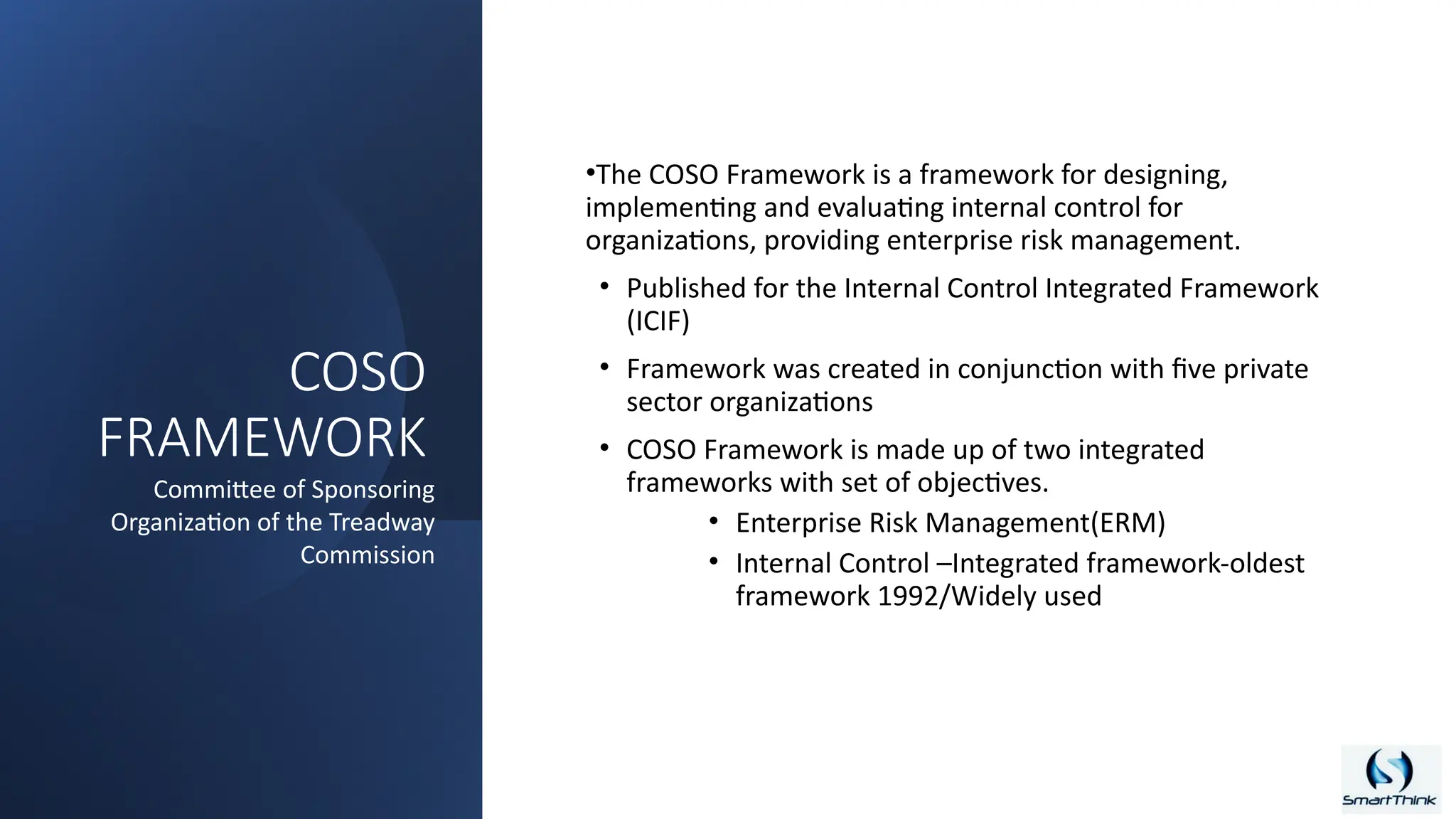
Similar to The COSO Framework is a framework for designing, implementing and evaluating internal control for organizations, providing enterprise risk management.
The COSO Framework is a framework for designing, implementing and evaluating internal control for organizations, providing enterprise risk management.
1.
COSO
FRAMEWORK
•The COSO Frameworkis a framework for designing,
implementing and evaluating internal control for
organizations, providing enterprise risk management.
• Published for the Internal Control Integrated Framework
(ICIF)
• Framework was created in conjunction with five private
sector organizations
• COSO Framework is made up of two integrated
frameworks with set of objectives.
• Enterprise Risk Management(ERM)
• Internal Control –Integrated framework-oldest
framework 1992/Widely used
Committee of Sponsoring
Organization of the Treadway
Commission
2.
COSO Framework Objectives
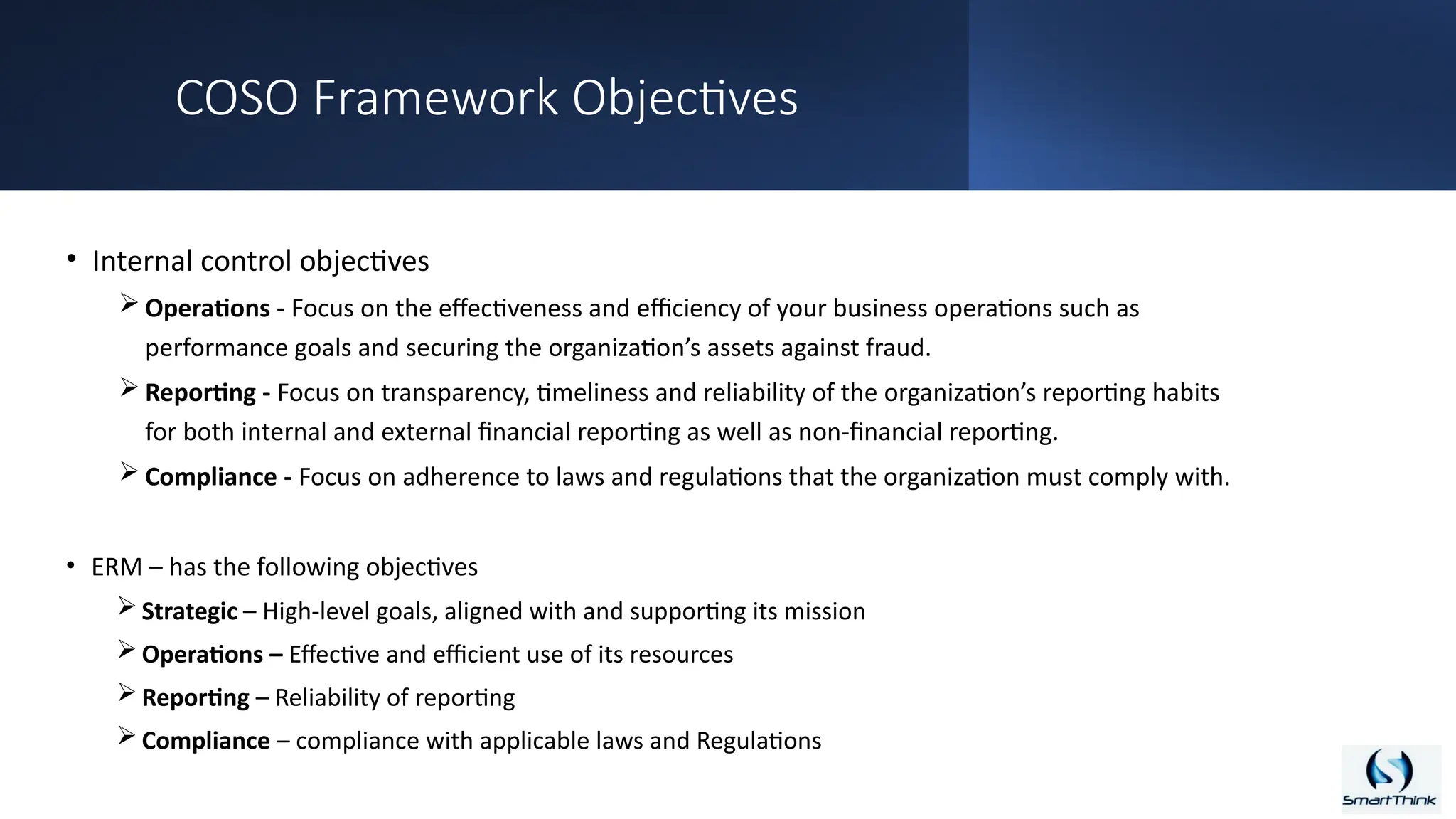
•Internal control objectives
Operations - Focus on the effectiveness and efficiency of your business operations such as
performance goals and securing the organization’s assets against fraud.
Reporting - Focus on transparency, timeliness and reliability of the organization’s reporting habits
for both internal and external financial reporting as well as non-financial reporting.
Compliance - Focus on adherence to laws and regulations that the organization must comply with.
• ERM – has the following objectives
Strategic – High-level goals, aligned with and supporting its mission
Operations – Effective and efficient use of its resources
Reporting – Reliability of reporting
Compliance – compliance with applicable laws and Regulations
3.
INTERNAL CONTROL-
INTEGRATED FRAMEWORK
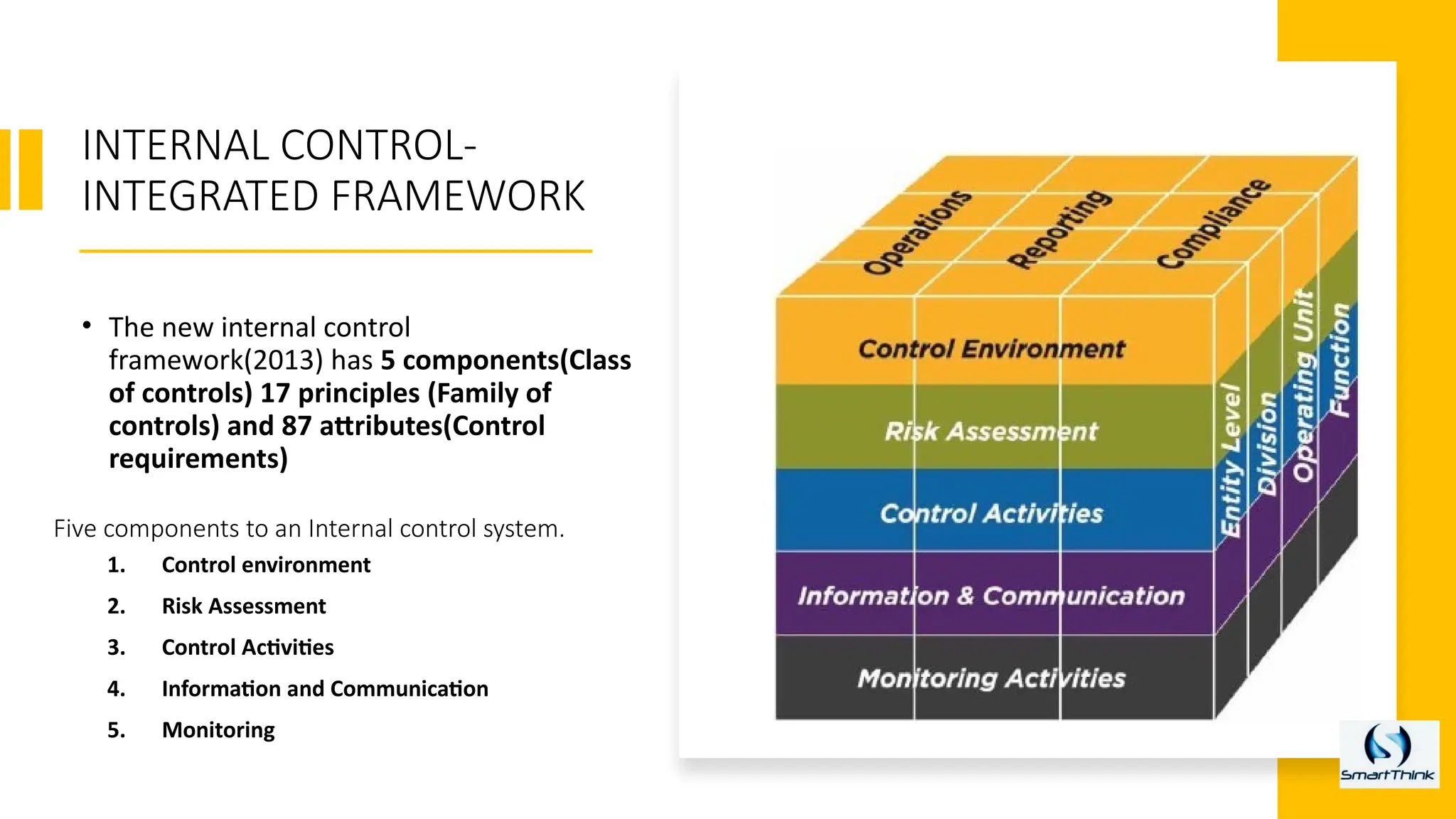
•The new internal control
framework(2013) has 5 components(Class
of controls) 17 principles (Family of
controls) and 87 attributes(Control
requirements)
1. Control environment
2. Risk Assessment
3. Control Activities
4. Information and Communication
5. Monitoring
Five components to an Internal control system.
4.
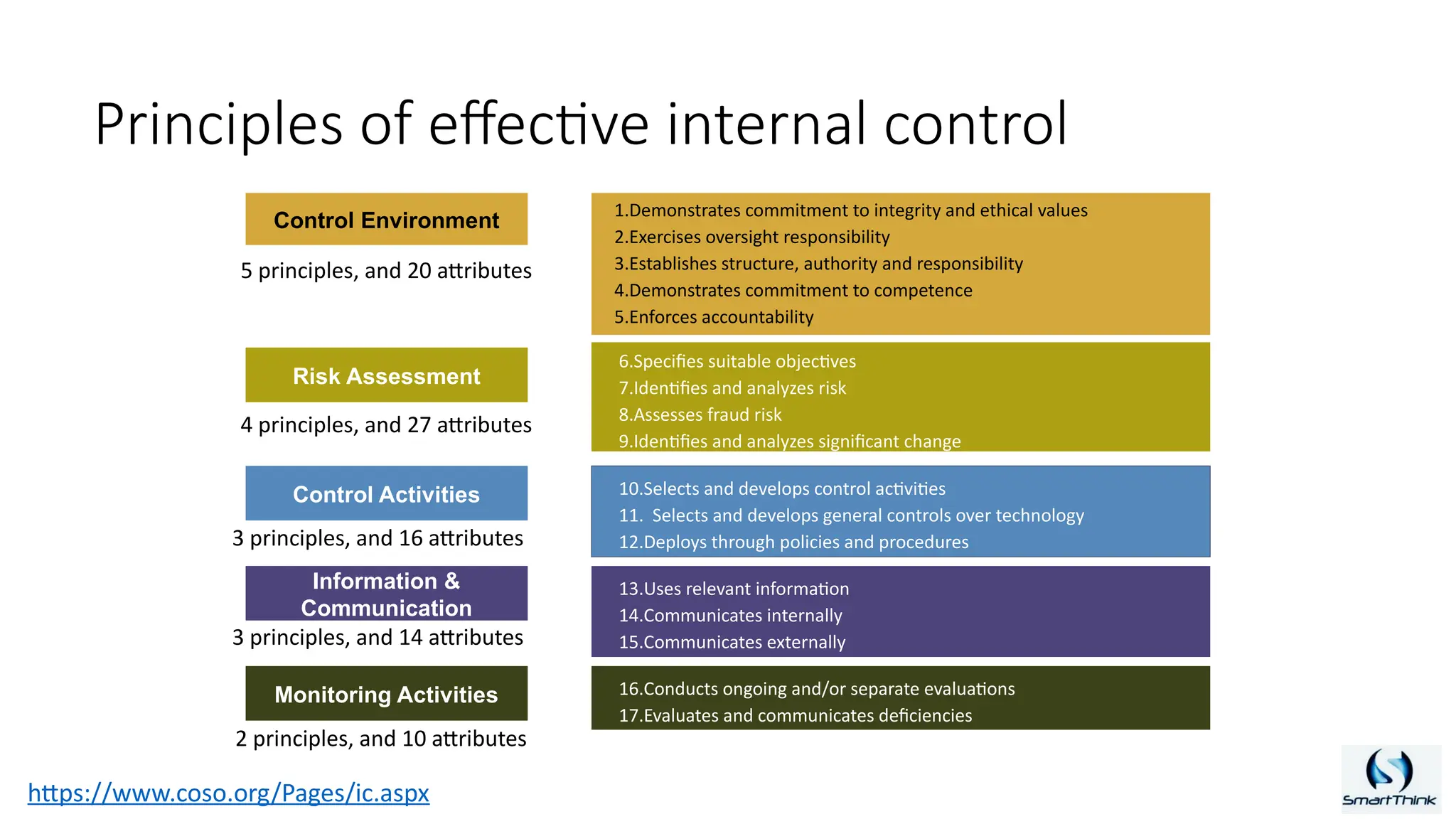
Control Environment
Risk Assessment
ControlActivities
Information &
Communication
Monitoring Activities
Principles of effective internal control
1.Demonstrates commitment to integrity and ethical values
2.Exercises oversight responsibility
3.Establishes structure, authority and responsibility
4.Demonstrates commitment to competence
5.Enforces accountability
6.Specifies suitable objectives
7.Identifies and analyzes risk
8.Assesses fraud risk
9.Identifies and analyzes significant change
10.Selects and develops control activities
11. Selects and develops general controls over technology
12.Deploys through policies and procedures
13.Uses relevant information
14.Communicates internally
15.Communicates externally
16.Conducts ongoing and/or separate evaluations
17.Evaluates and communicates deficiencies
5 principles, and 20 attributes
4 principles, and 27 attributes
3 principles, and 16 attributes
3 principles, and 14 attributes
2 principles, and 10 attributes
https://www.coso.org/Pages/ic.aspx
5.
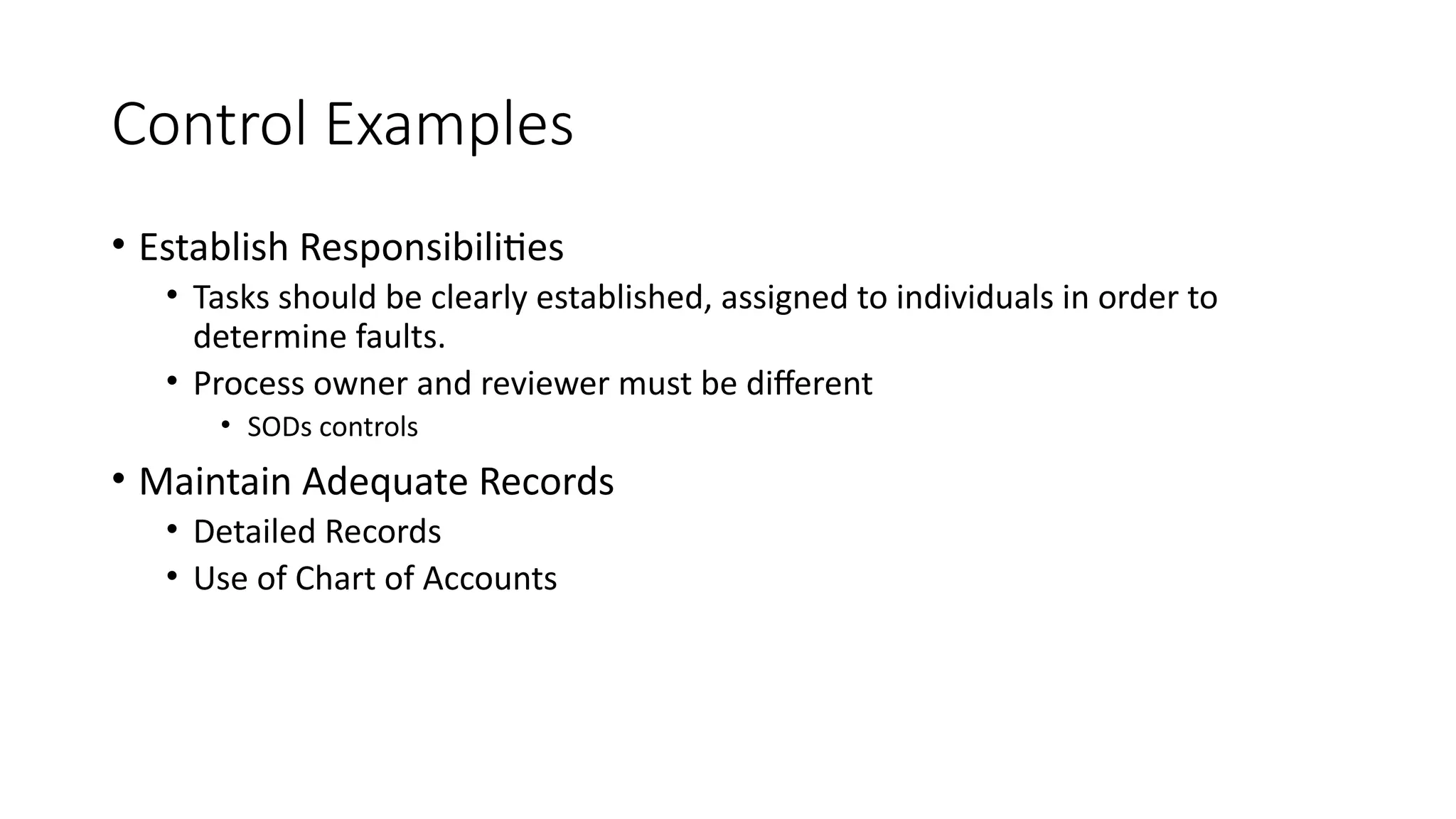
Control Examples
• EstablishResponsibilities
• Tasks should be clearly established, assigned to individuals in order to
determine faults.
• Process owner and reviewer must be different
• SODs controls
• Maintain Adequate Records
• Detailed Records
• Use of Chart of Accounts
6.
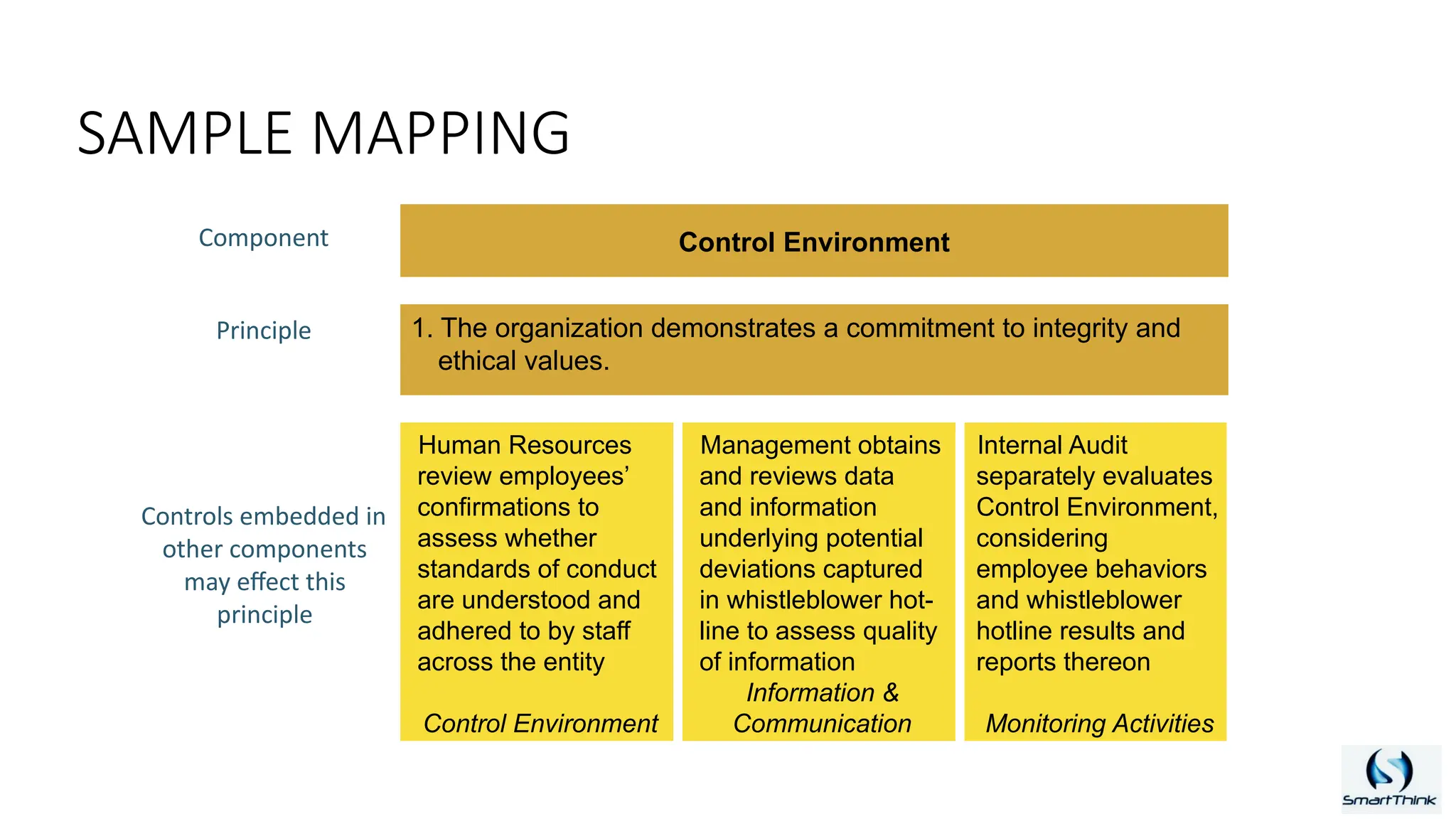
SAMPLE MAPPING
Control Environment
1.The organization demonstrates a commitment to integrity and
ethical values.
Component
Principle
Controls embedded in
other components
may effect this
principle
Human Resources
review employees’
confirmations to
assess whether
standards of conduct
are understood and
adhered to by staff
across the entity
Control Environment
Management obtains
and reviews data
and information
underlying potential
deviations captured
in whistleblower hot-
line to assess quality
of information
Information &
Communication
Internal Audit
separately evaluates
Control Environment,
considering
employee behaviors
and whistleblower
hotline results and
reports thereon
Monitoring Activities
7.
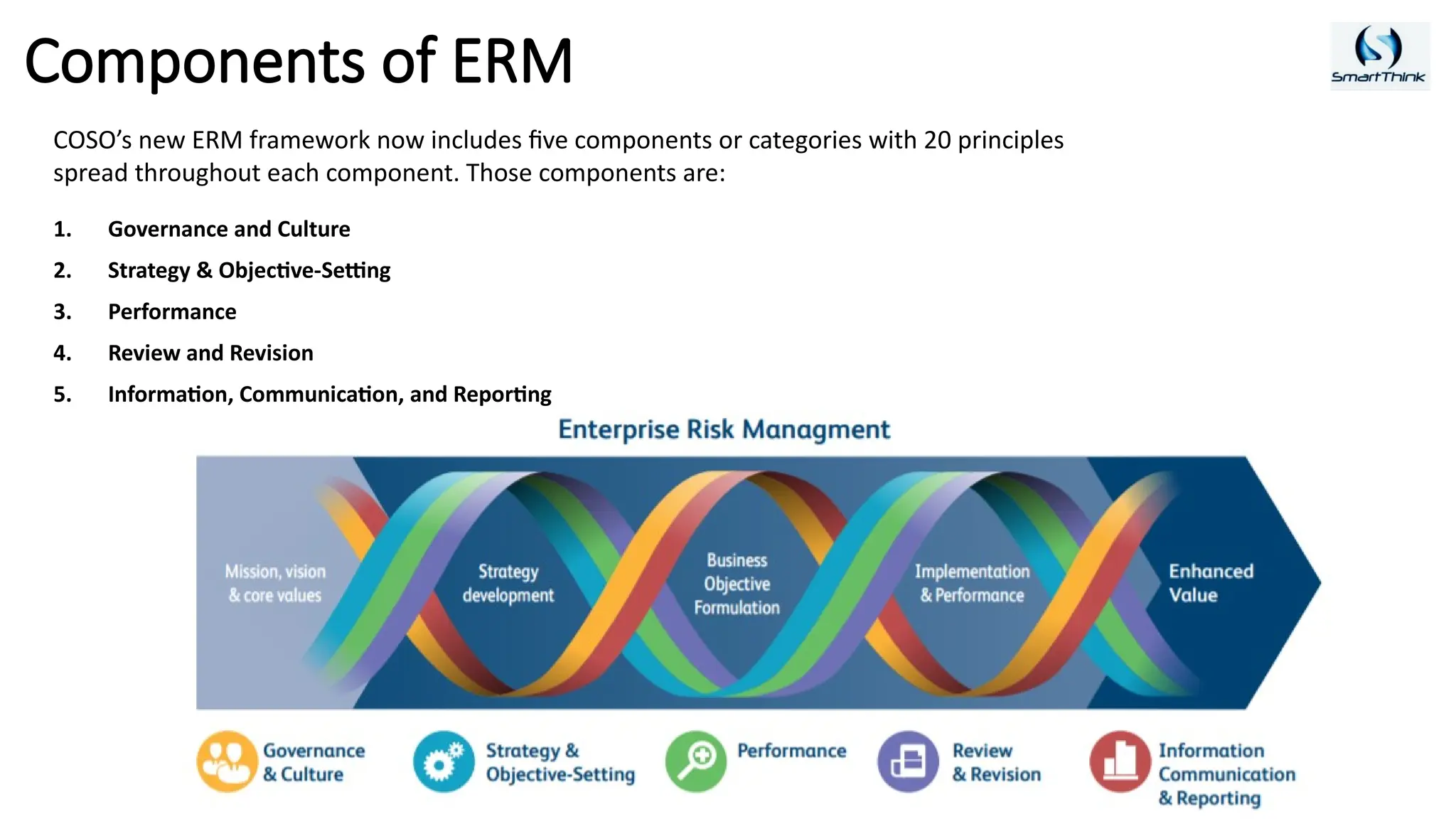
Components of ERM
COSO’snew ERM framework now includes five components or categories with 20 principles
spread throughout each component. Those components are:
1. Governance and Culture
2. Strategy & Objective-Setting
3. Performance
4. Review and Revision
5. Information, Communication, and Reporting
8.
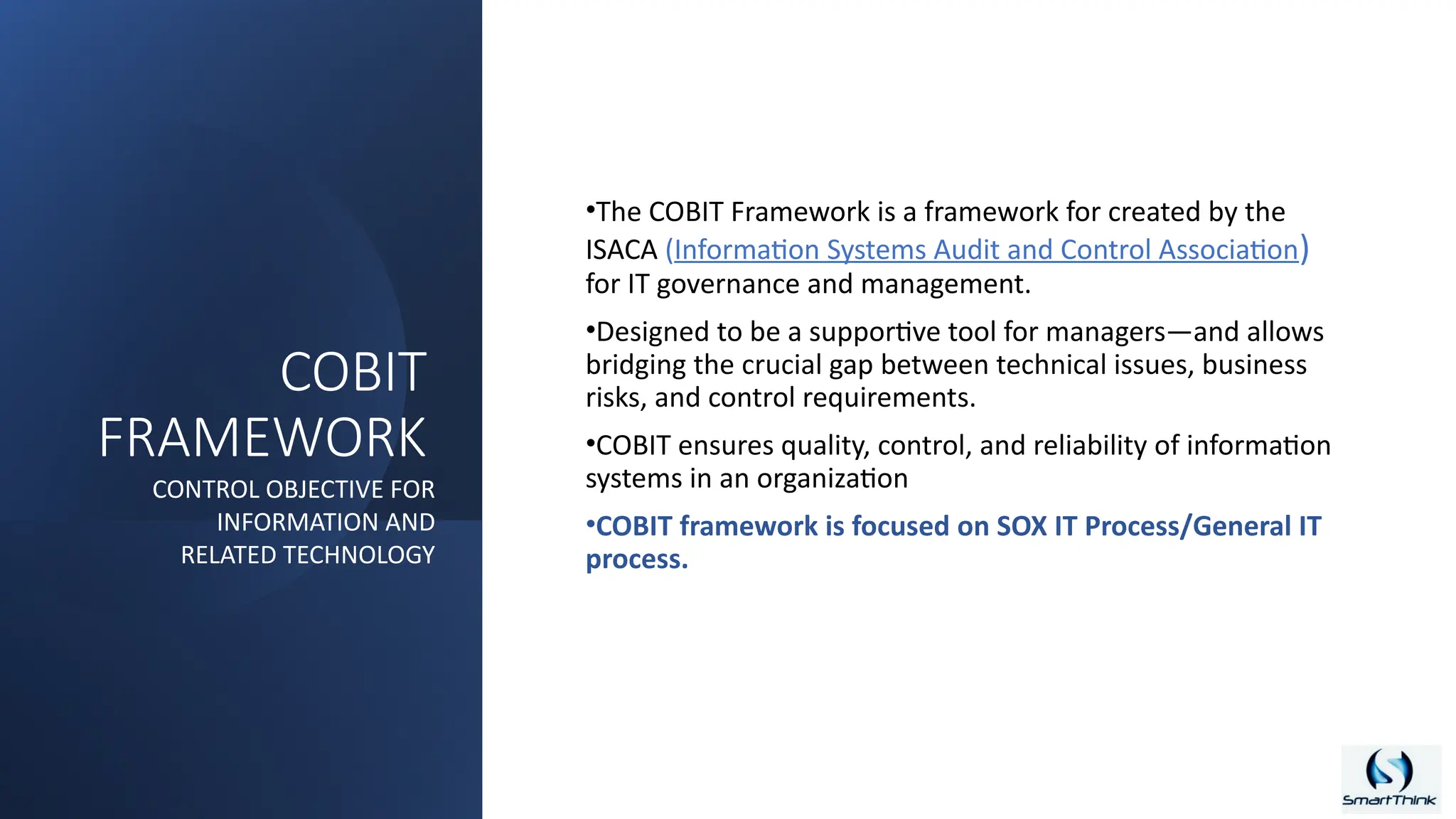
COBIT
FRAMEWORK
•The COBIT Frameworkis a framework for created by the
ISACA (Information Systems Audit and Control Association)
for IT governance and management.
•Designed to be a supportive tool for managers—and allows
bridging the crucial gap between technical issues, business
risks, and control requirements.
•COBIT ensures quality, control, and reliability of information
systems in an organization
•COBIT framework is focused on SOX IT Process/General IT
process.
CONTROL OBJECTIVE FOR
INFORMATION AND
RELATED TECHNOLOGY
9.
•Objectives - COBIT2019 lays out ‘Governance Objectives’ and ‘Management Objectives’, with a total of 40
as part of its ‘Core Model’. Practitioners prioritize these objectives based on the needs of customers,
stakeholders, users, and so on, allowing them to create comprehensive and bespoke IT strategies and
frameworks
•Domains - Every COBIT objective fits within a specific ‘Domain’. Management Objectives are contained
within ‘Deliver, Service and Support (DSS)’, ‘Monitor, Evaluate and Assess (MEA)’, ‘Build Acquire and
Implement (BAI)’, and ‘Align, Plan and Organize (APO)’. Governance Objectives are found under ‘Evaluate,
Direct and Monitor (EDM)’
•Goals Cascade - This tool is used to demonstrate how drivers create needs, and subsequently create more
clearly defined ‘goals’. In COBIT 2019, these are known as ‘Alignment Goals’, as opposed to the ‘IT Goals’
from COBIT 5
•Components - Formerly known as ‘Enablers’, Components are generic elements that influence IT. They
include ‘Information Flows’, ‘Skills’, ‘Infrastructure’, ‘Processes’, ‘Policies and Procedures’, and
‘Organizational Structures’. COBIT 2019 also introduced ‘variants of generic’, with which Components can
be examined and amended based on a ‘Focus Area’, such as a specific piece of legislation like the GDPR
•Design Factors - These factors help define the needs of an organization and how they must be addressed
in a framework. Contextual factors, such as corporate and threat landscapes, are beyond the organization’s
control. Strategic factors reflect decisions by the organization, such as the direction of enterprise strategy
and the prioritization of different IT elements. Tactical factors focus on implementation choices regarding
technology (such as cloud data), methods (such as DevOps, ITIL 4, or Agile), and outsourcing models
10.
CONTROL OBJECTIVE FORINFORMATION AND RELATED
TECHNOLOGY (COBIT)
• The COBIT framework makes a clear distinction between governance and management. These two disciplines
encompass different activities, require different organizational structures and serve different purposes.
• Governance of Enterprise IT - Evaluate, Direct and Monitor (EDM) – 5 processes
Stakeholder needs, conditions and options are evaluated to determine balanced, agreed-on
enterprise objectives.
Direction is set through prioritization and decision making.
Performance and compliance are monitored against agreed-on direction and objectives.
• Management of Enterprise IT
Align, Plan and Organize (APO) – 13 processes
Build, Acquire and Implement (BAI) – 10 processes
Deliver, Service and Support (DSS) – 6 processes
Monitor, Evaluate and Assess (MEA) - 3 processes


![Vibe Coding vs. Spec-Driven Development [Free Meetup]](https://cdn.slidesharecdn.com/ss_thumbnails/vibecodingvsspecdrivendevelopment-251209105622-43f455e7-thumbnail.jpg?width=640&height=640&fit=bounds)


