Bighead is Airbnb's machine learning infrastructure that was created to:
1) Standardize and simplify the ML development workflow;
2) Reduce the time and effort to build ML models from weeks/months to days/weeks; and
3) Enable more teams at Airbnb to utilize ML.
It provides services for data management, model training/scoring, production deployment, and model management to make the ML process more efficient and consistent across teams. Bighead is built on open source technologies like Spark, TensorFlow, and Kubernetes but addresses gaps to fully support the end-to-end ML pipeline.
Overview of the presentation on Airbnb’s end-to-end machine learning infrastructure.
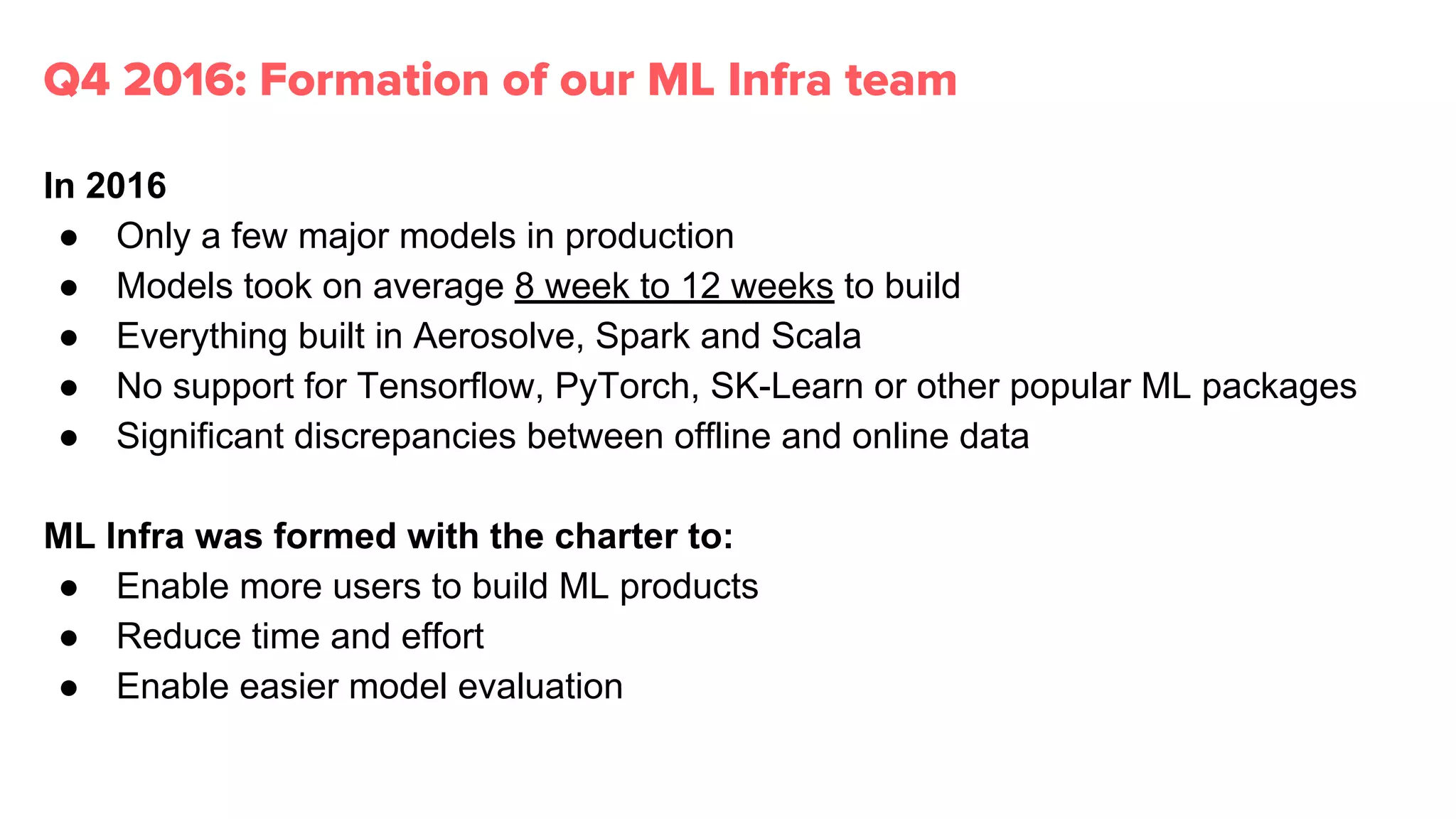
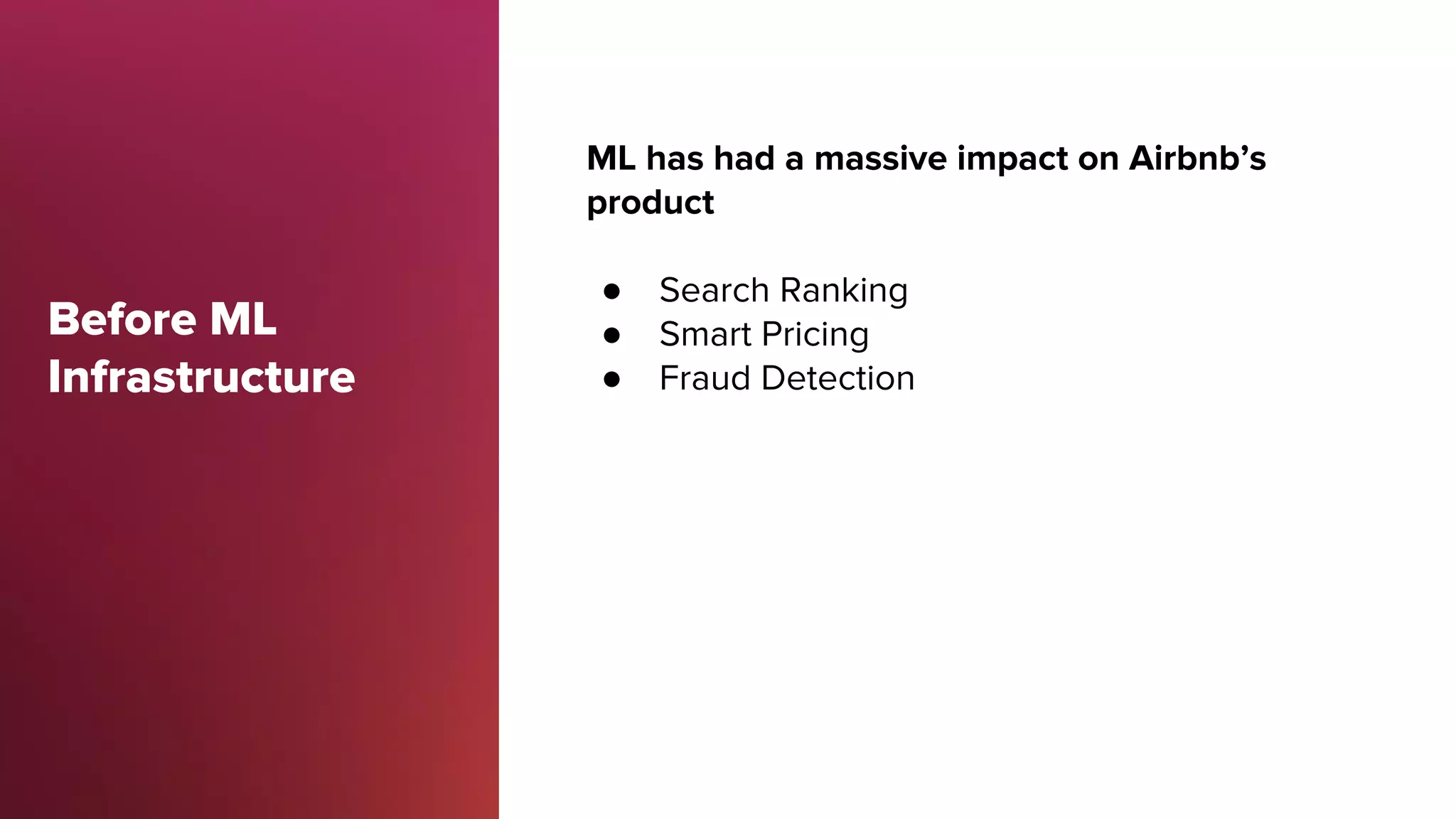
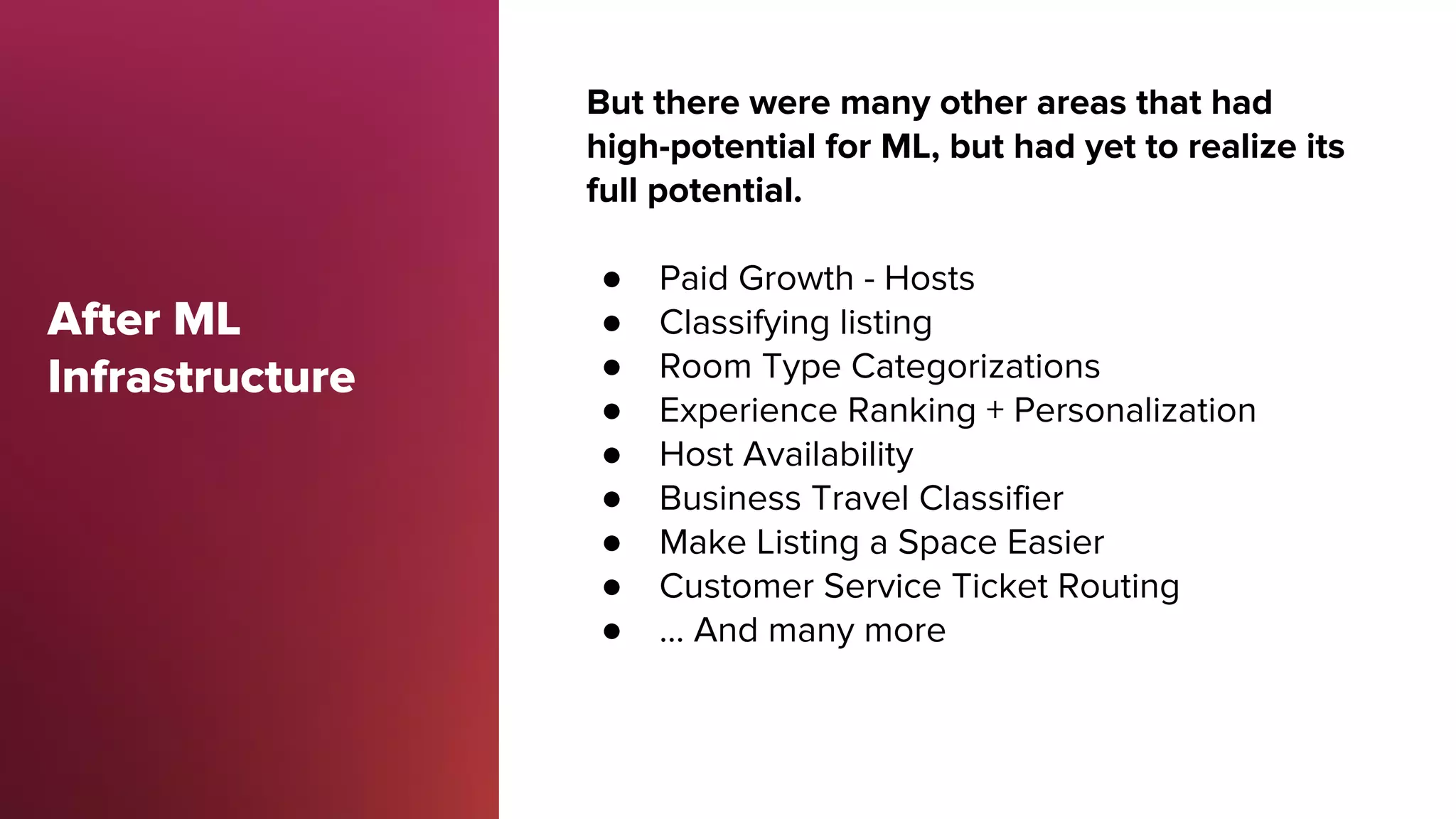
In 2016, challenges included slow model building and few models in production; ML was impactful yet underutilized in various areas.
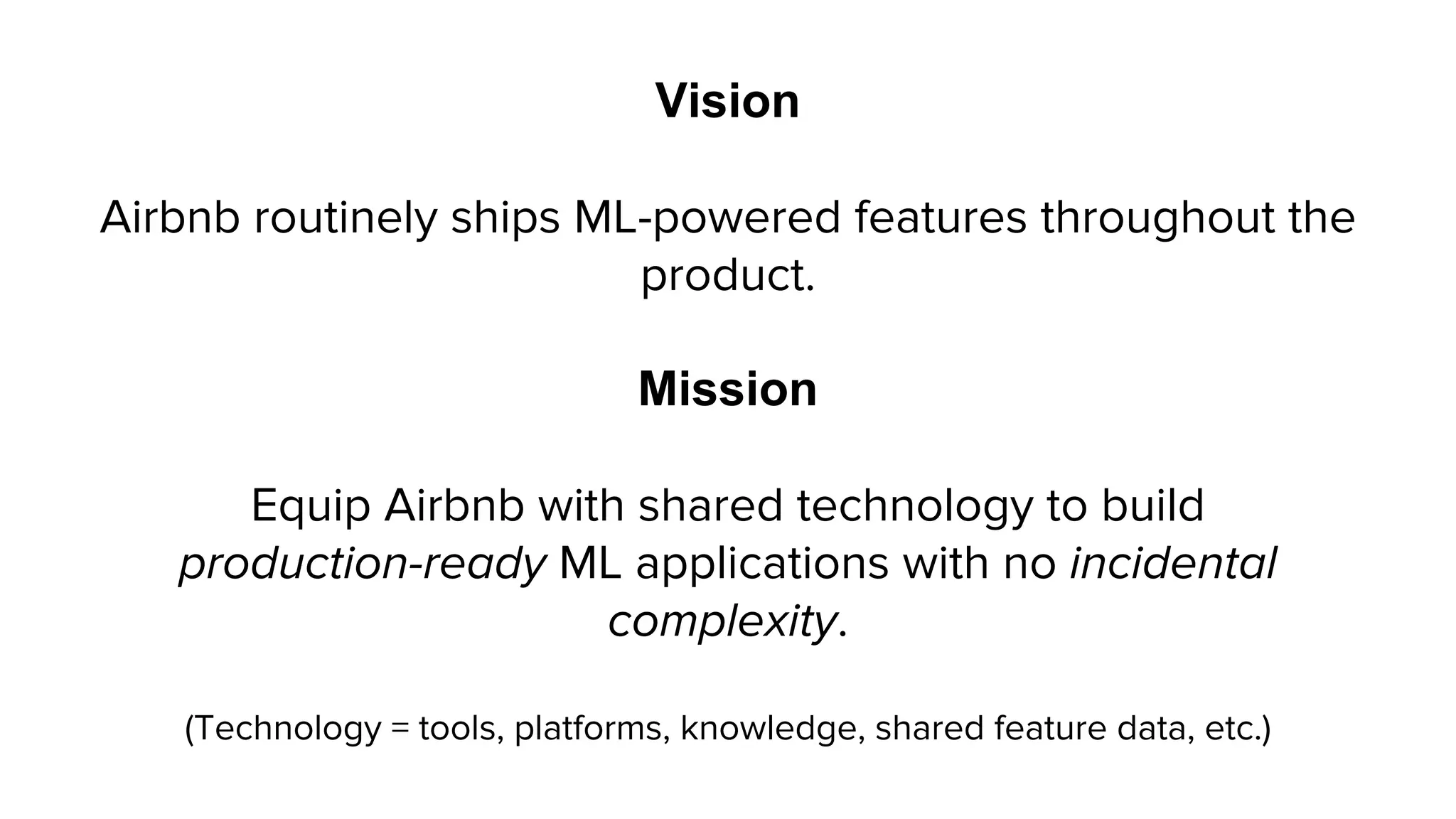
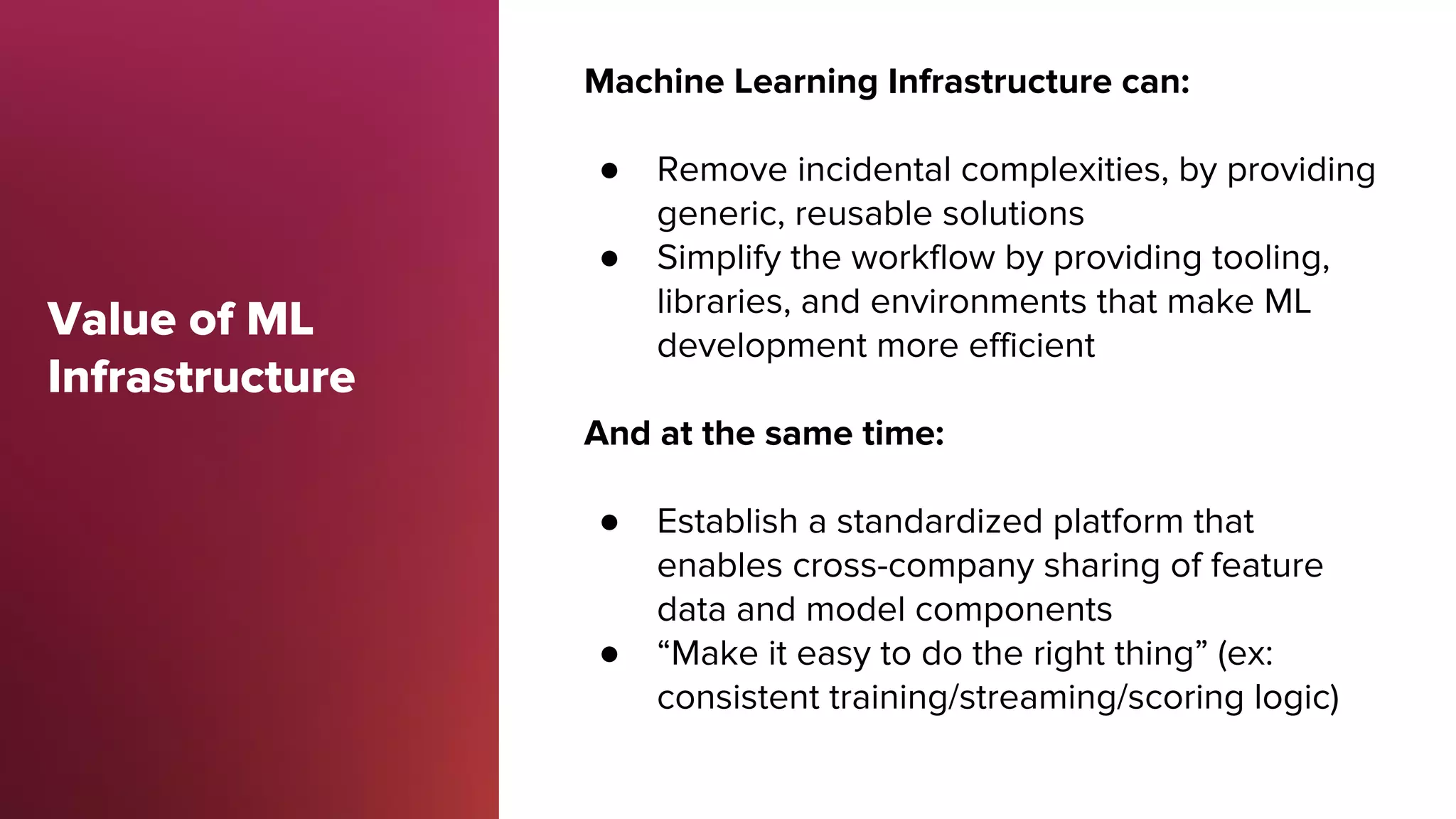
Vision: build ML apps with shared resources. Value: simplifies workflow, supports cross-company sharing, and reduces complexity.
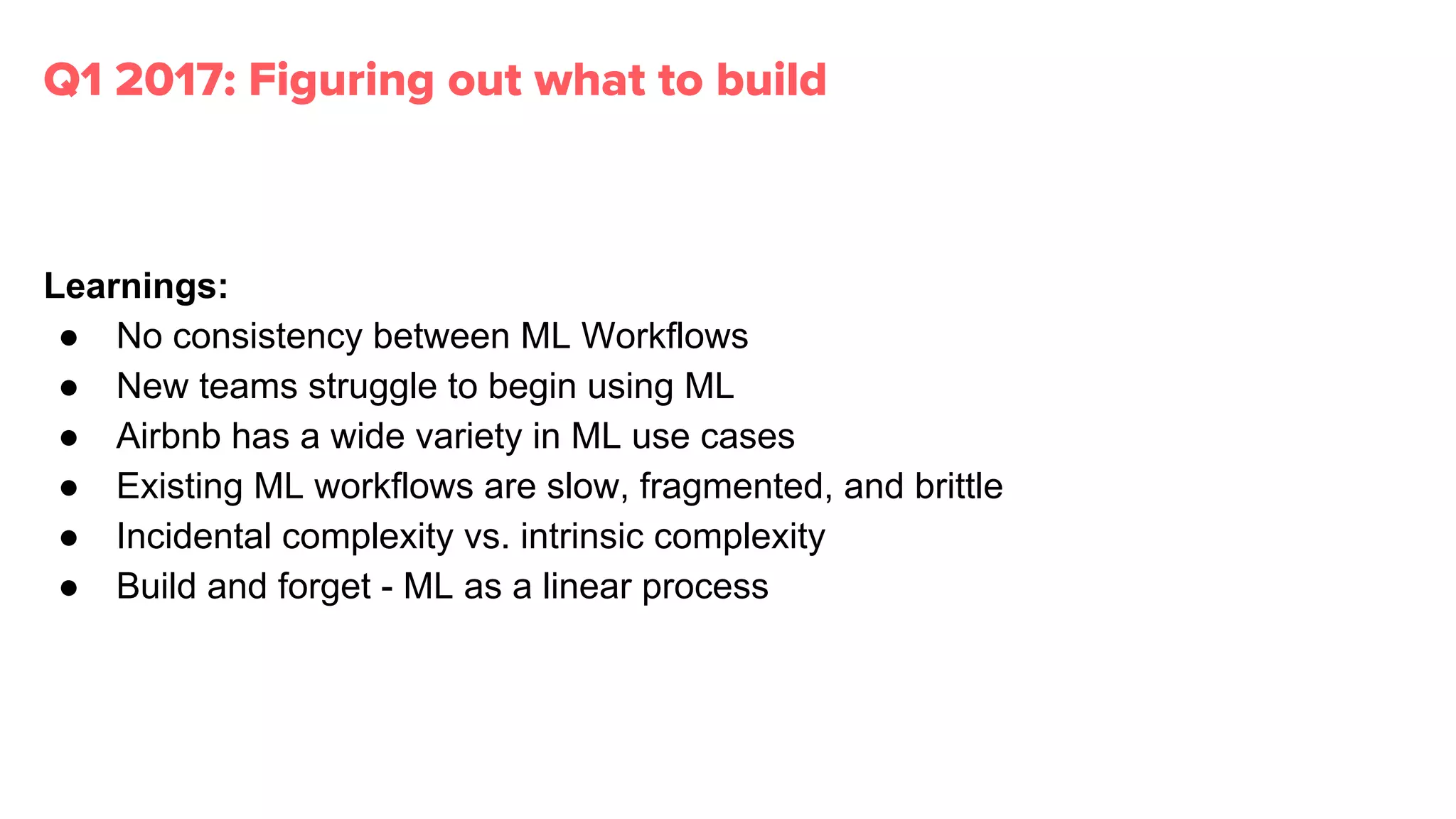
Motivations for developing Bighead included fragmentation in ML workflows and the challenge to initiate ML work.
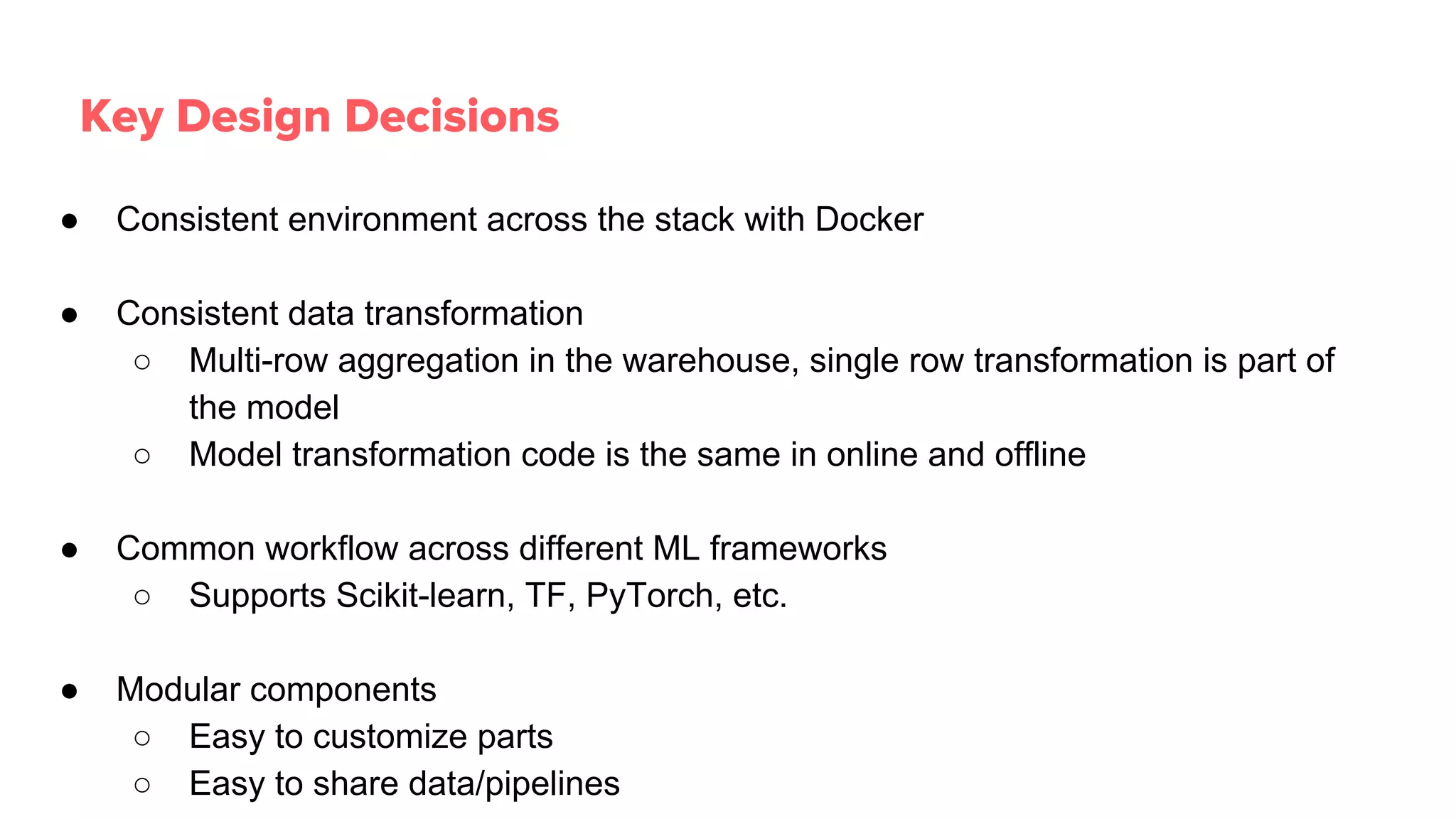
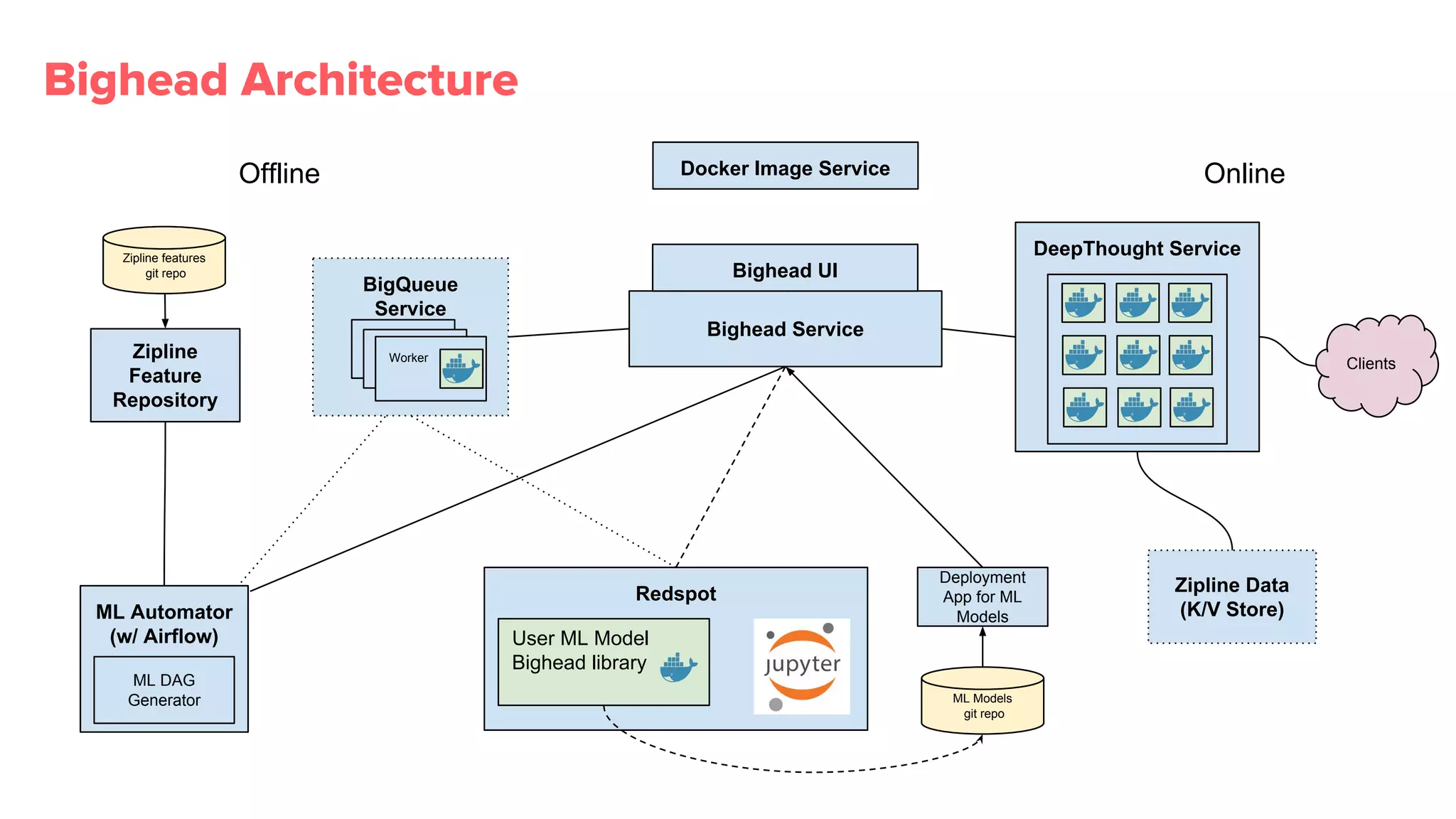
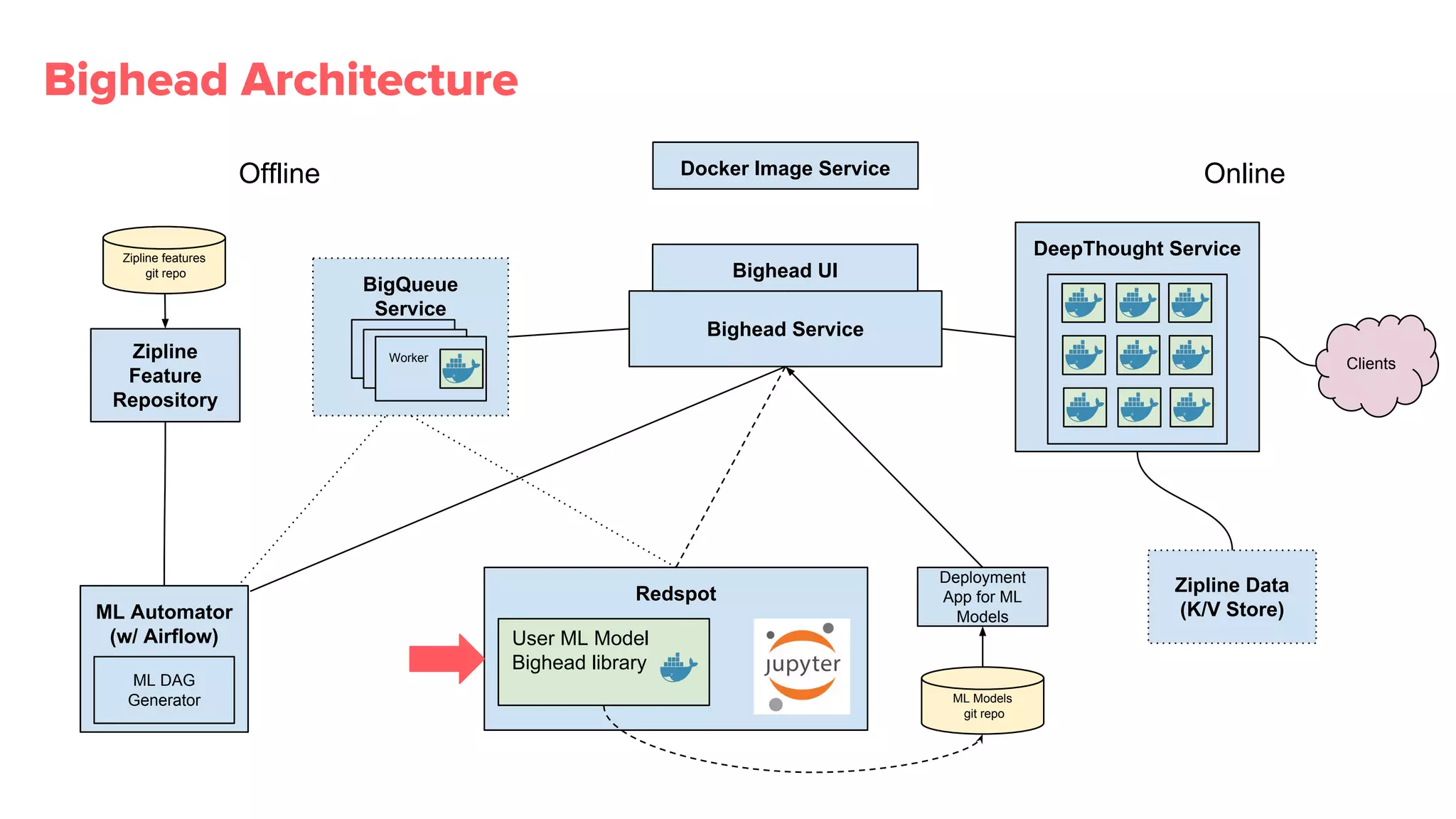
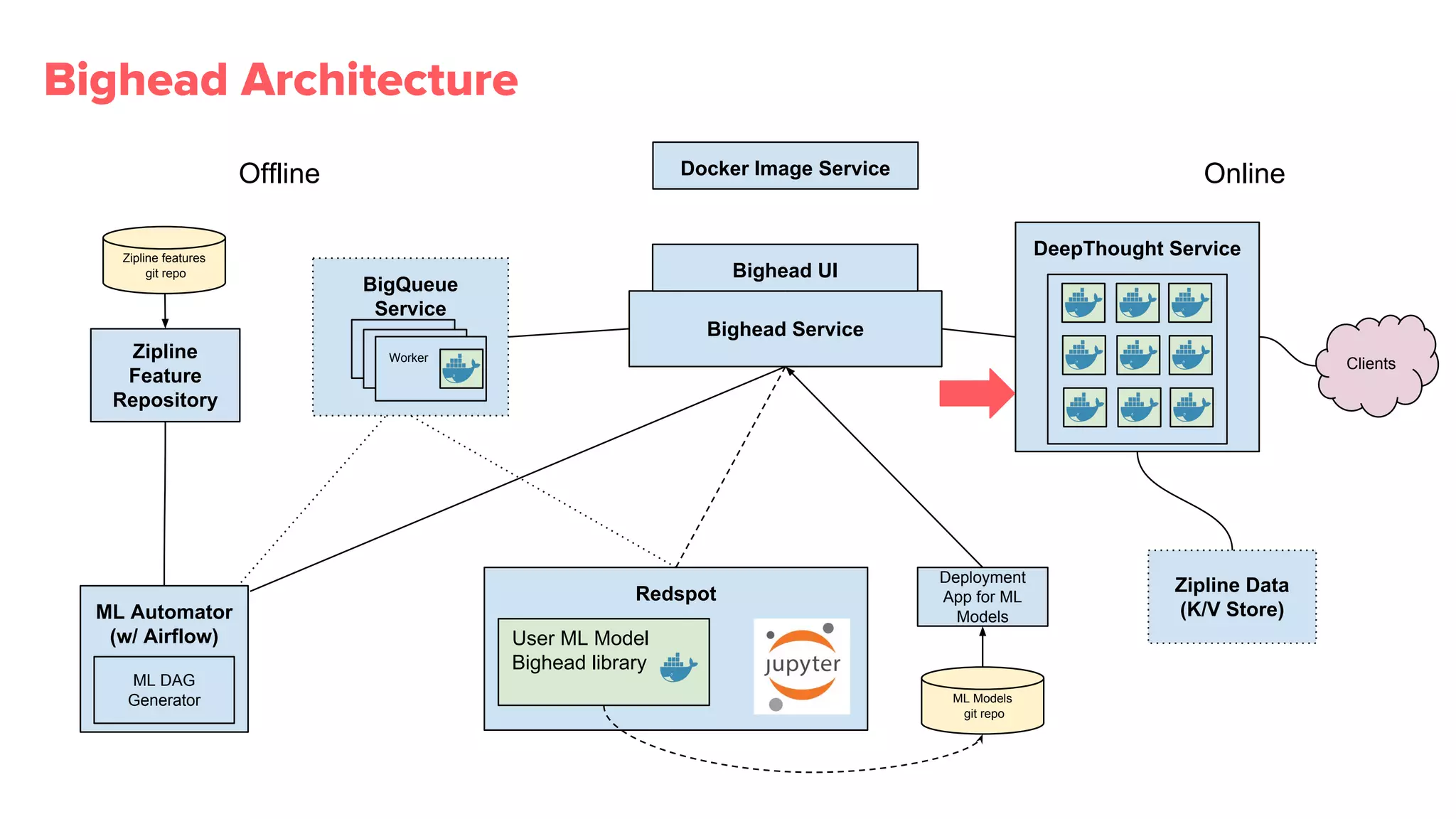
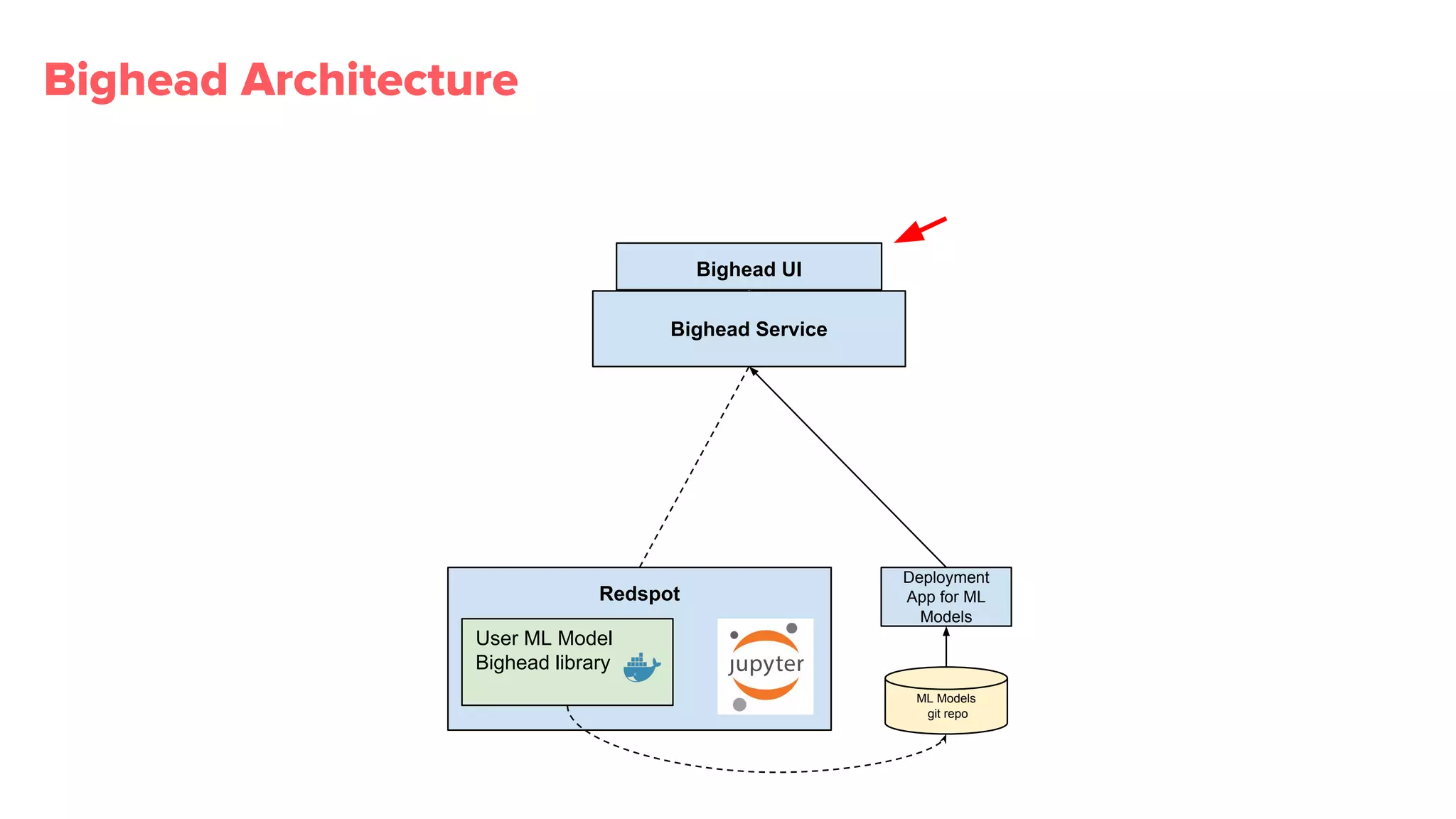
Overview of Bighead architecture including components like Docker, data management, and modular frameworks.Zipline addresses data quality checks and feature sharing, with inefficient existing processes in ML data management.
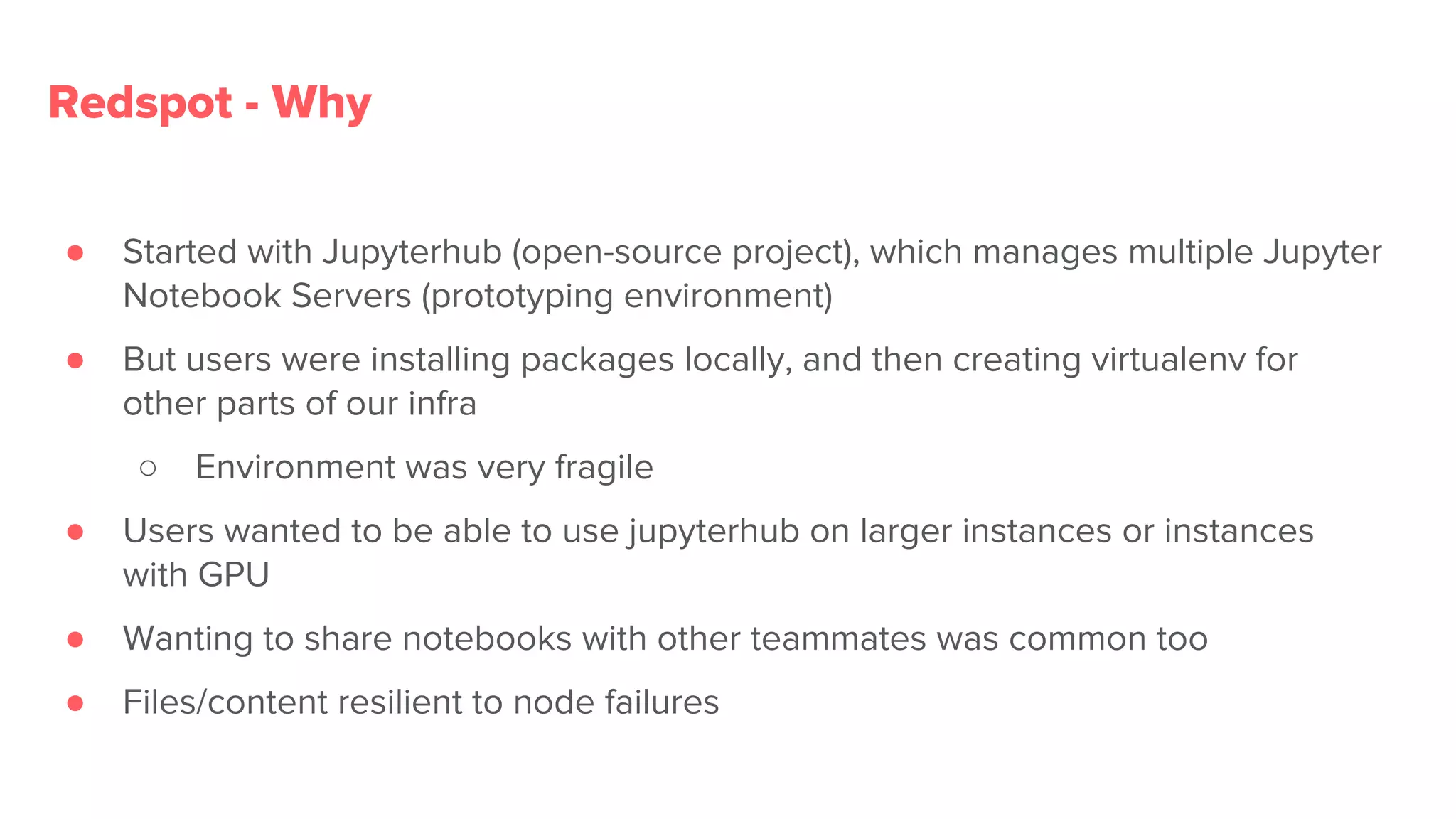
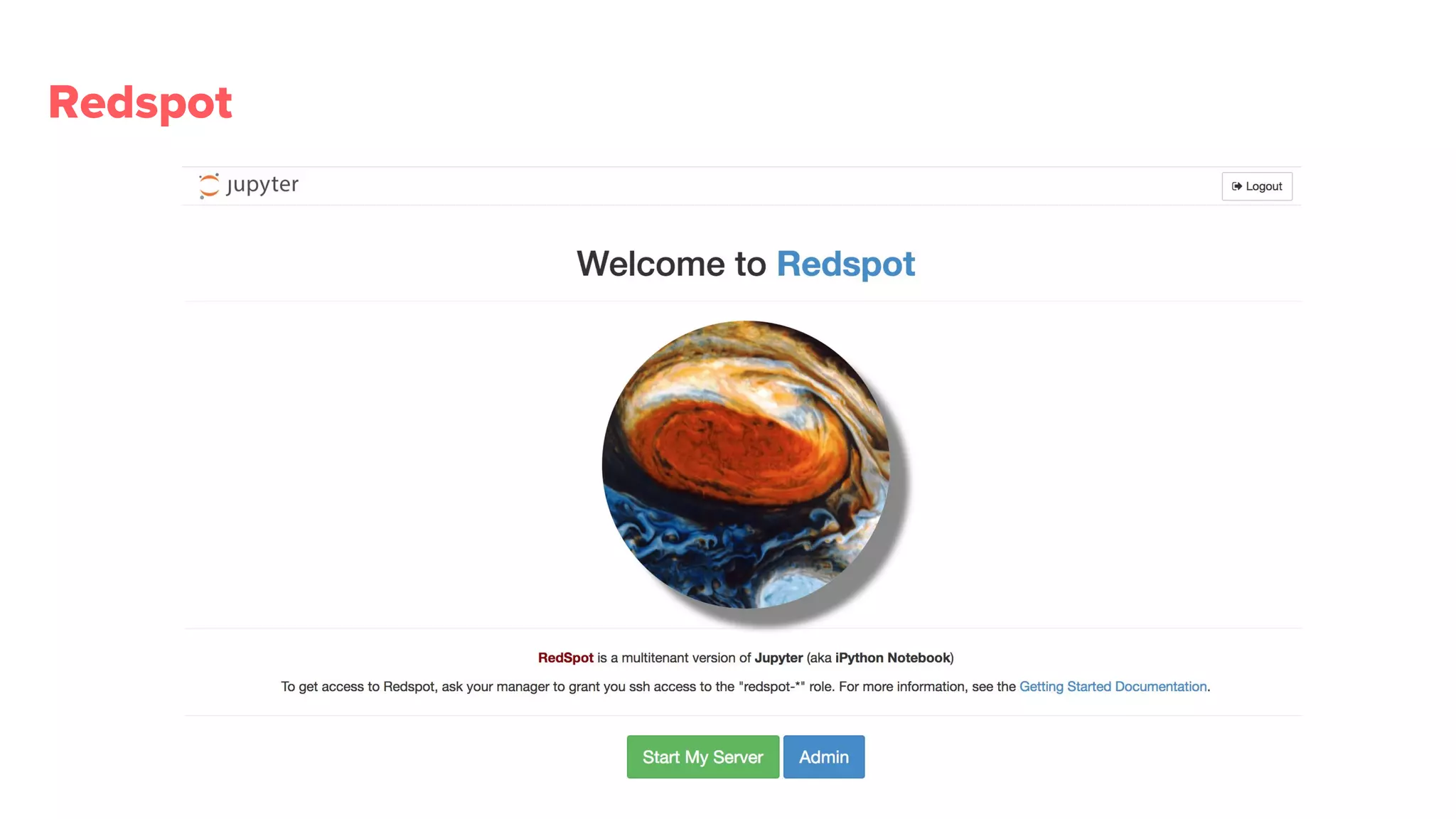
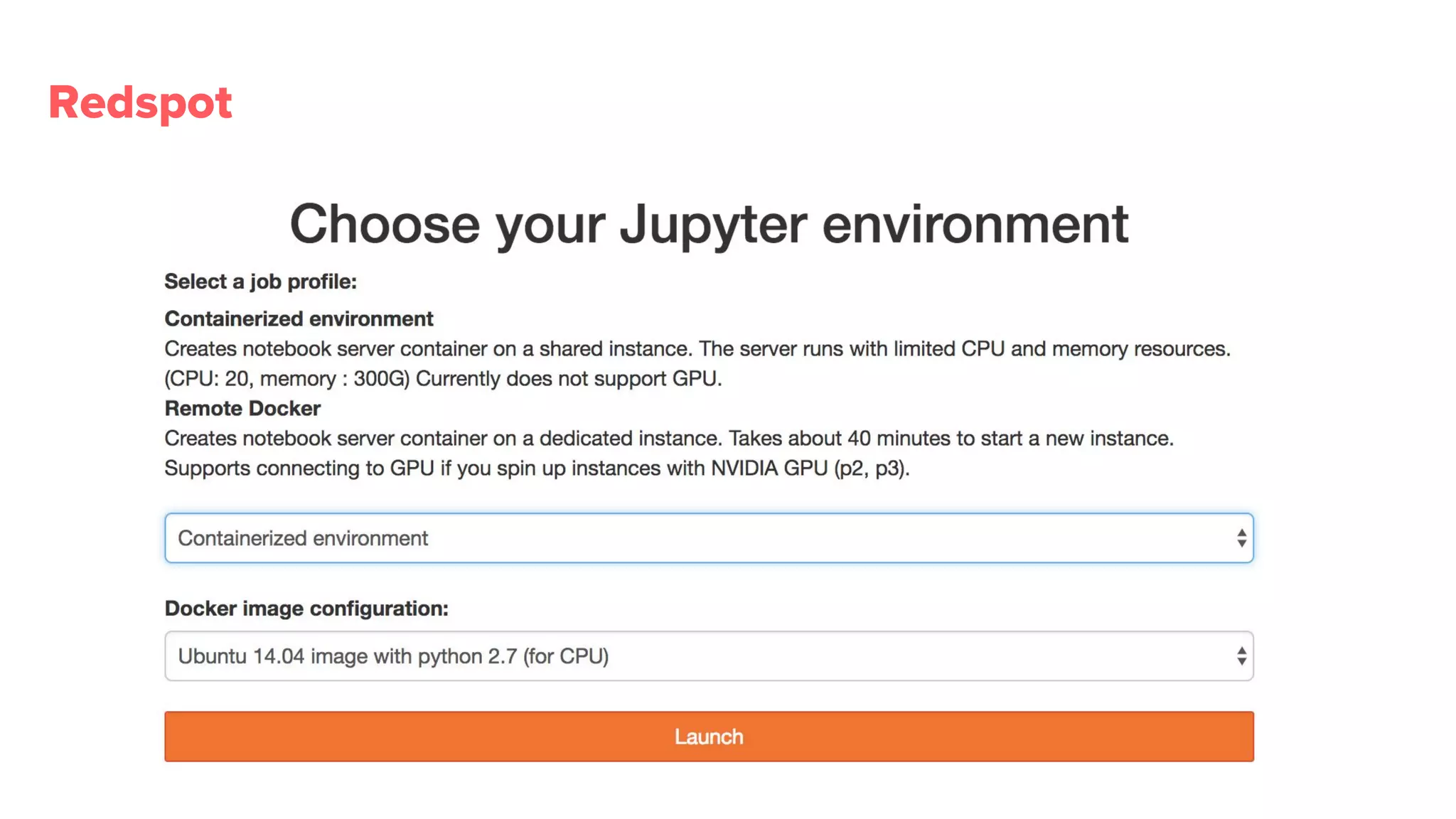
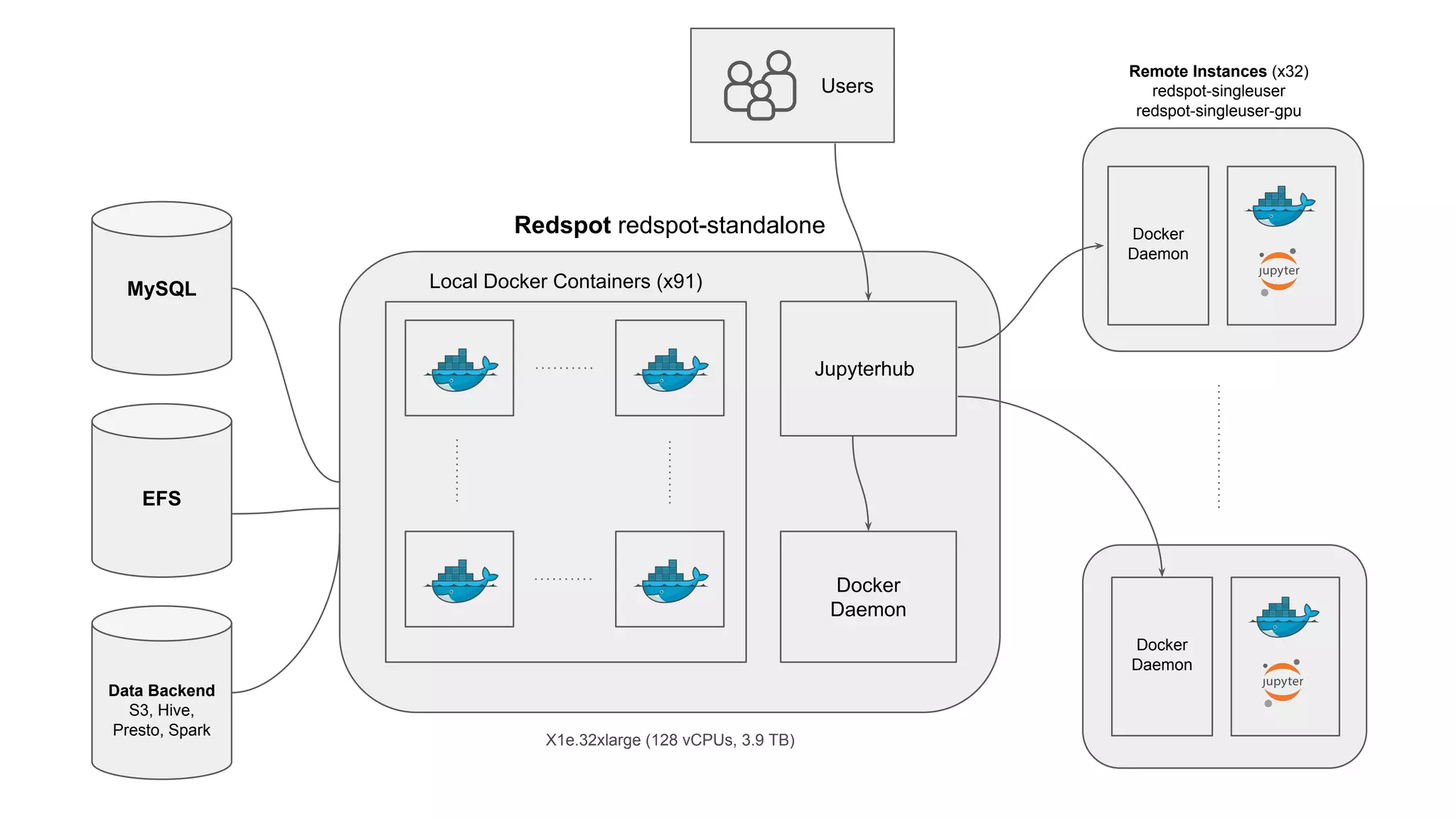
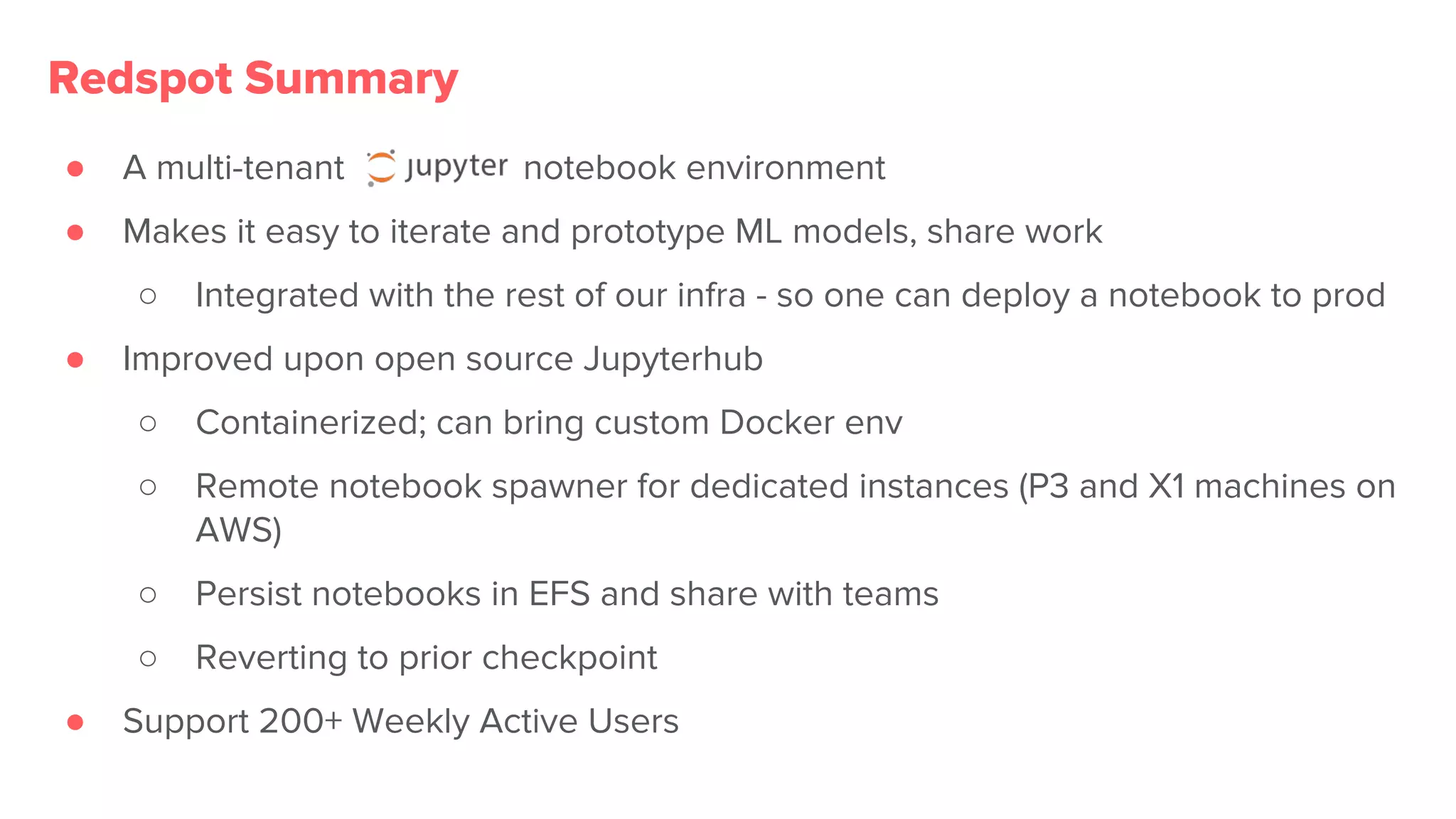
Redspot provides a containerized Jupyter environment for better reproducibility, sharing, and management of ML experiments.
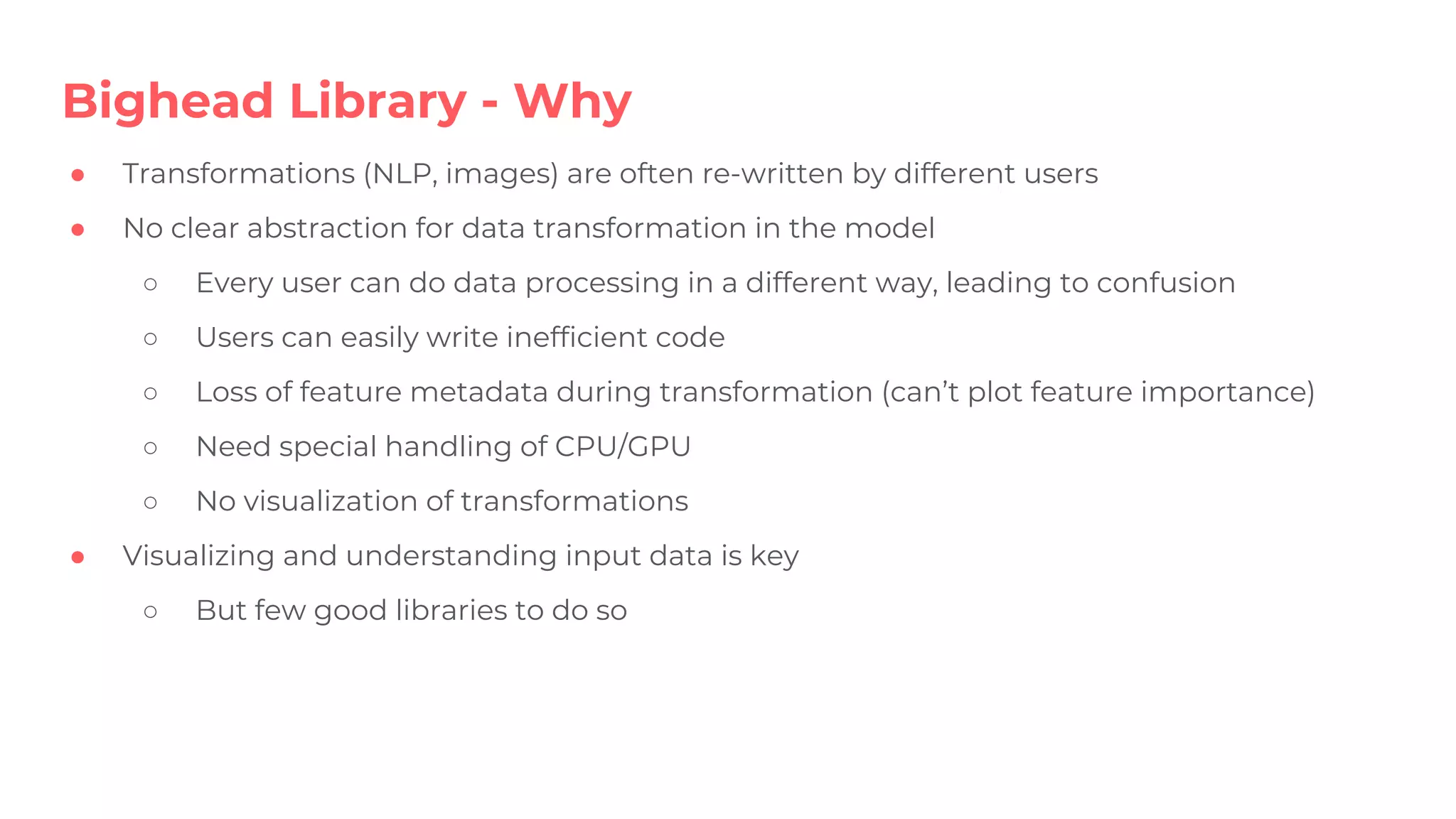
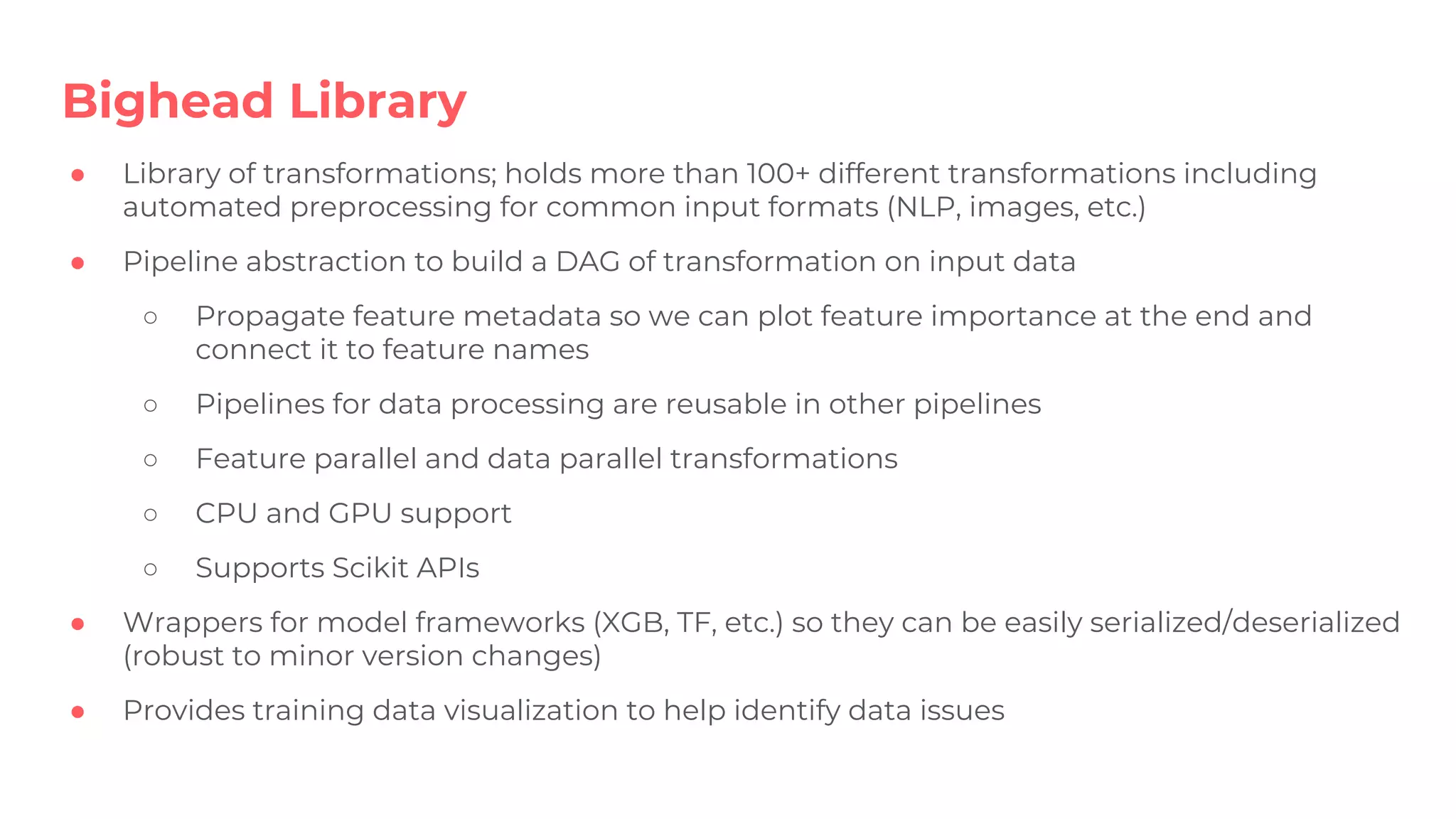
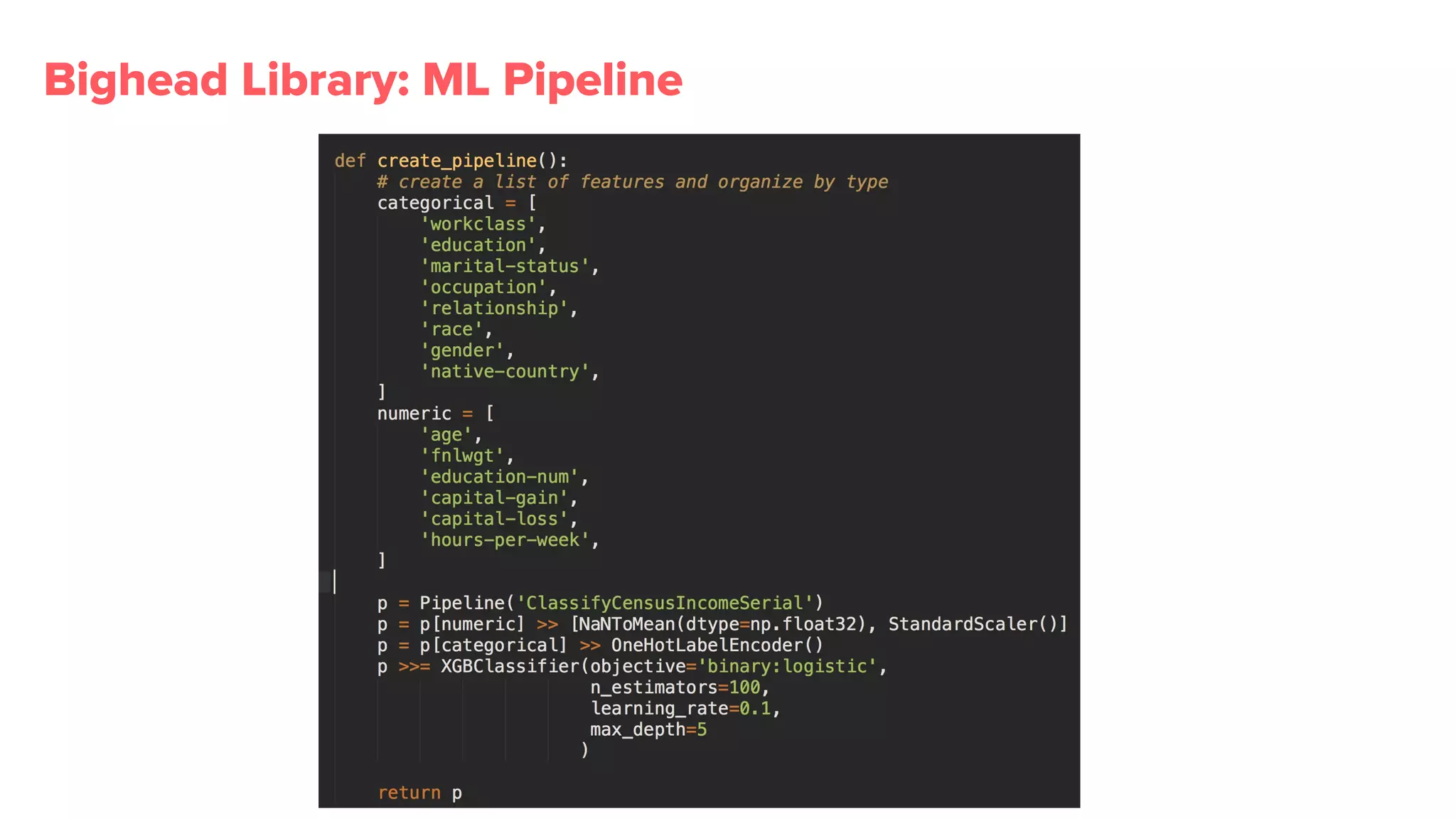
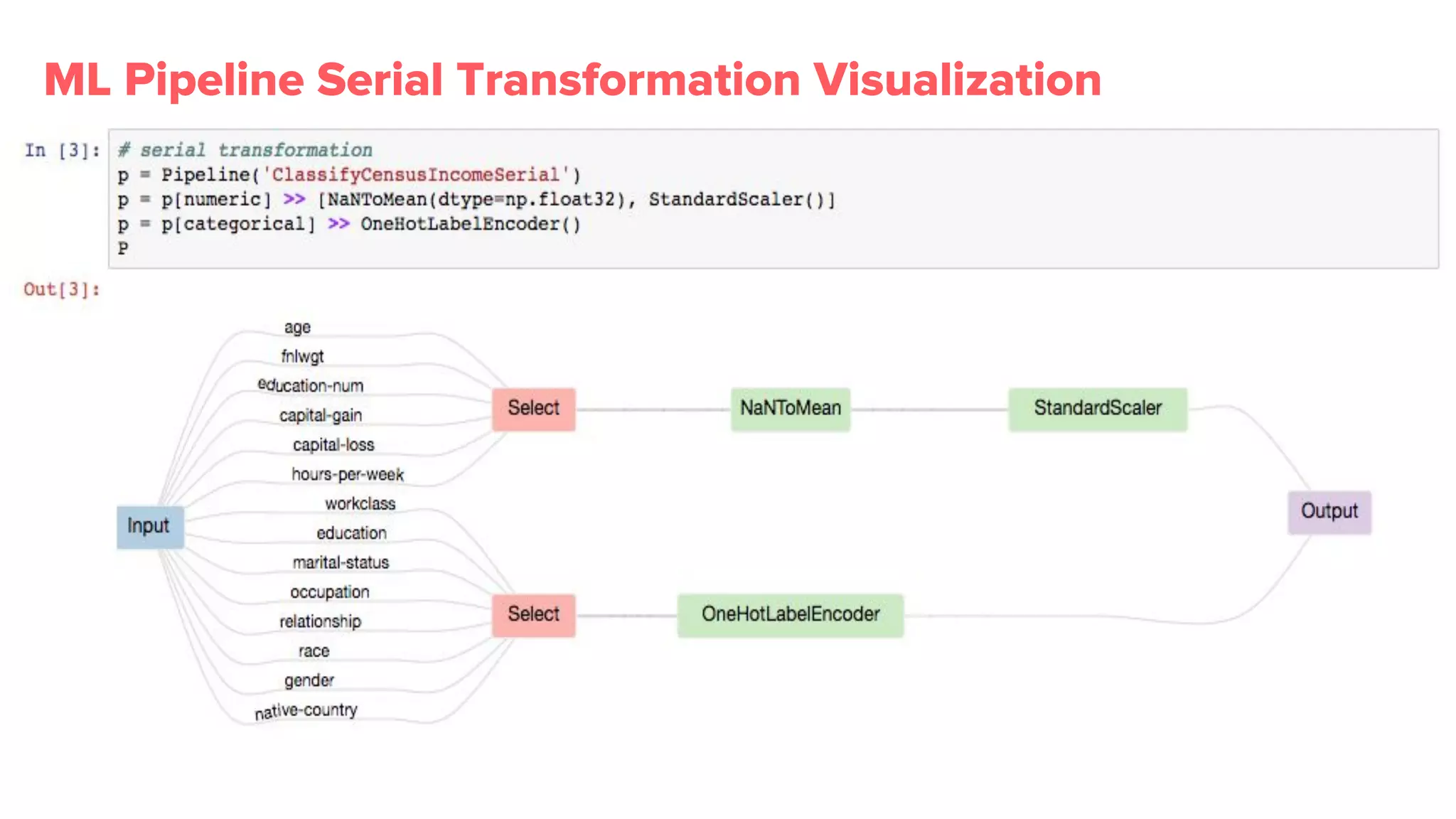
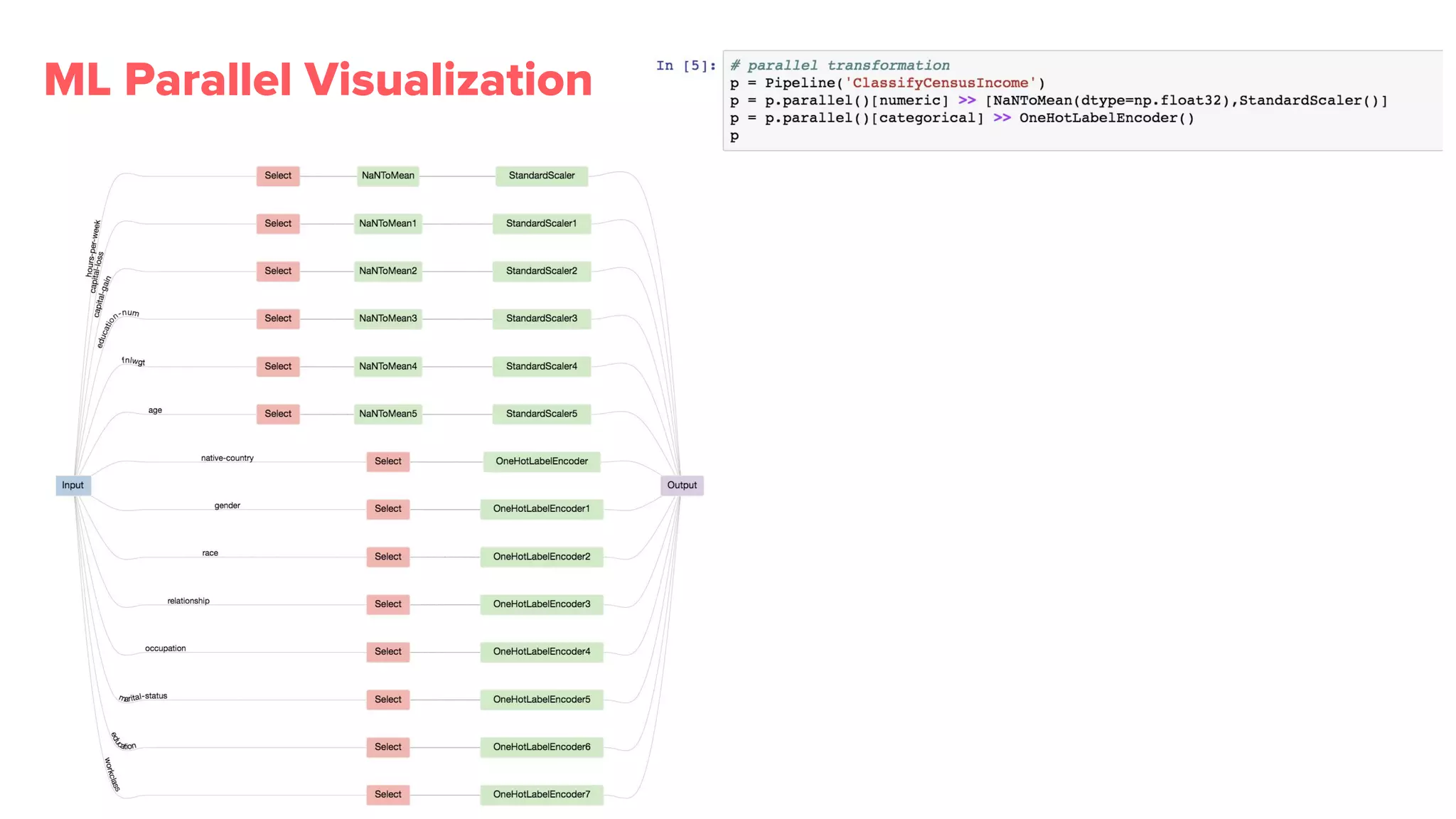
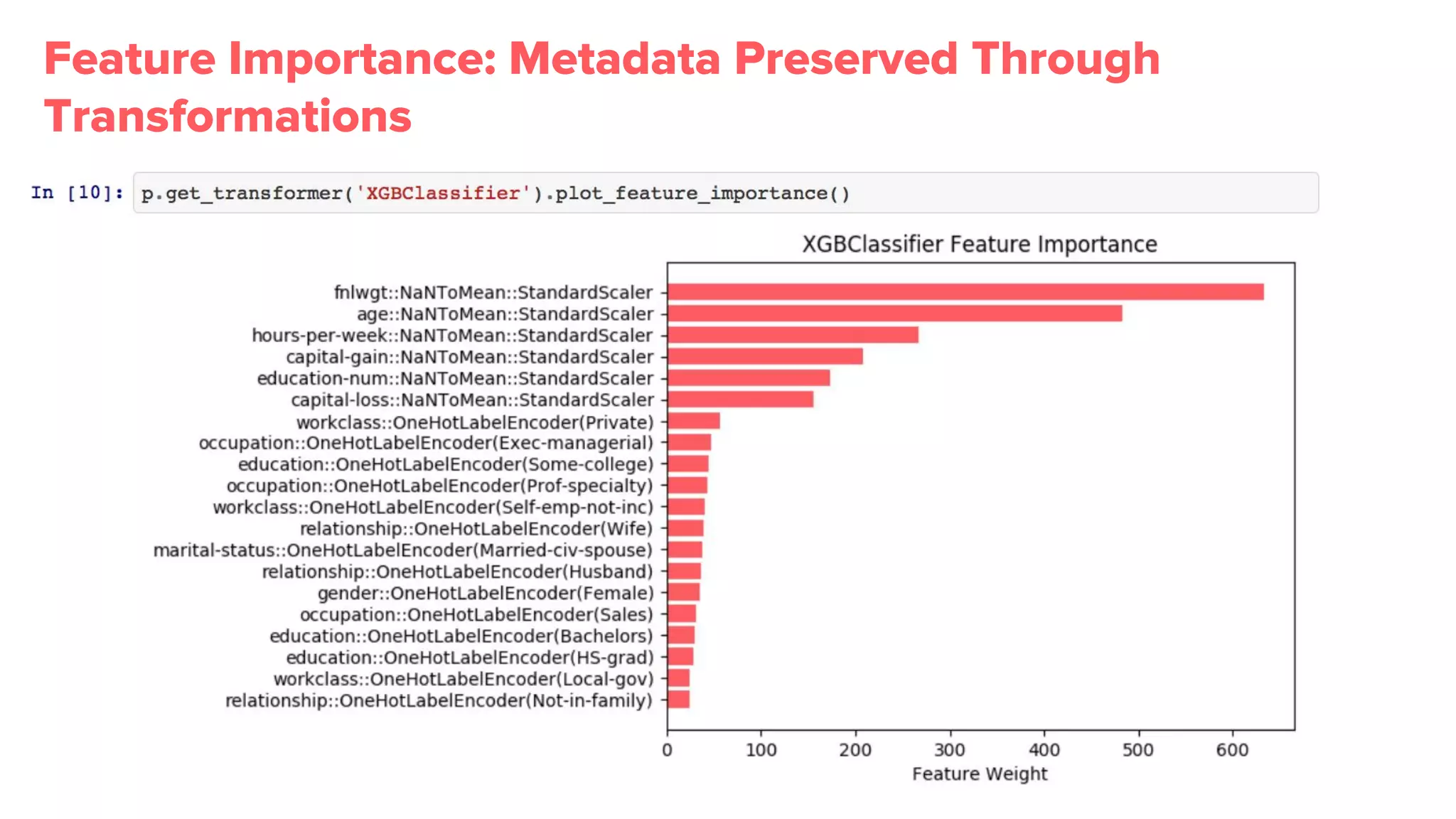
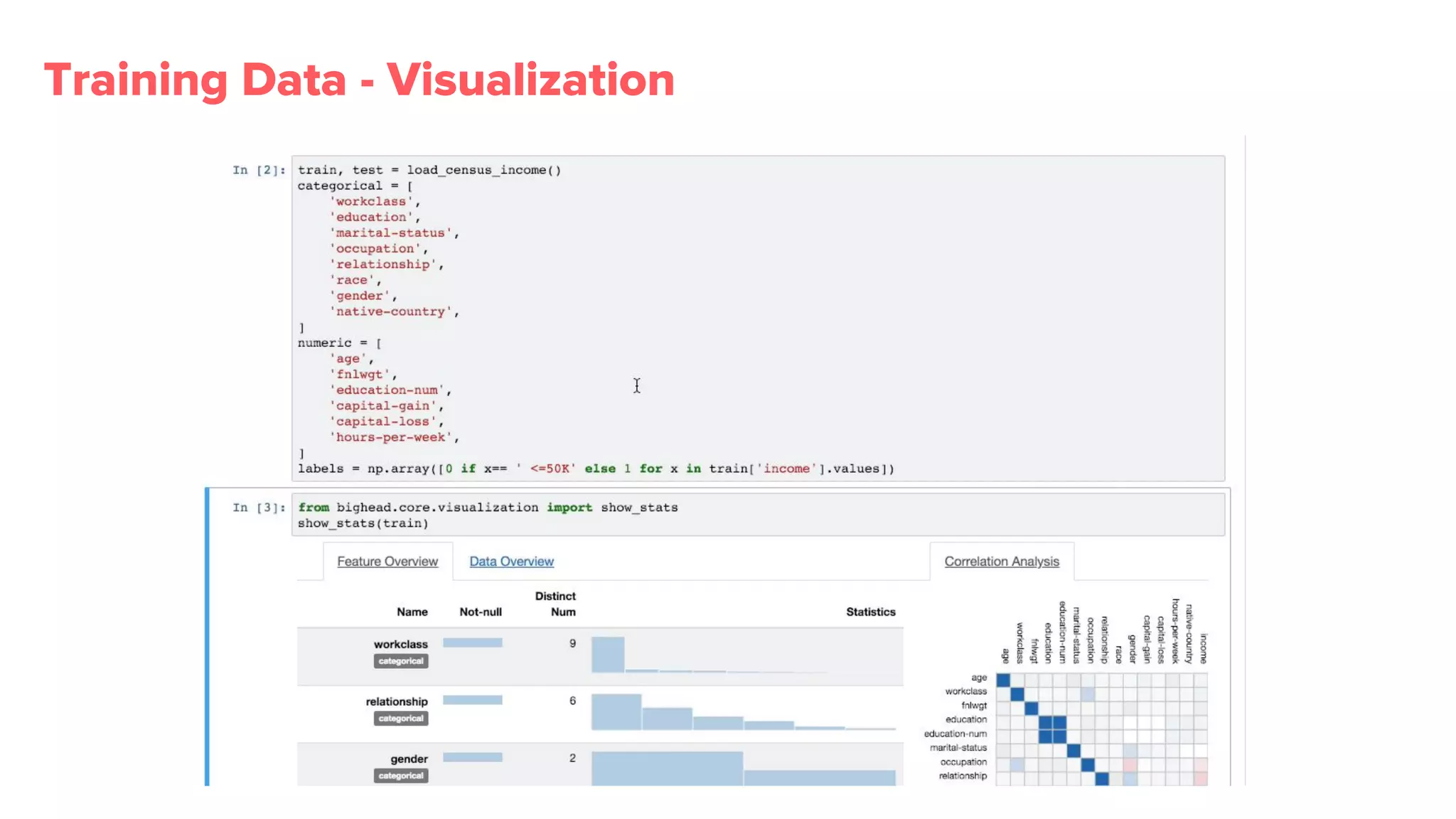
Bighead library provides more than 100 transformations, promotes metadata retention, and visualizations essential for effective pipeline management.
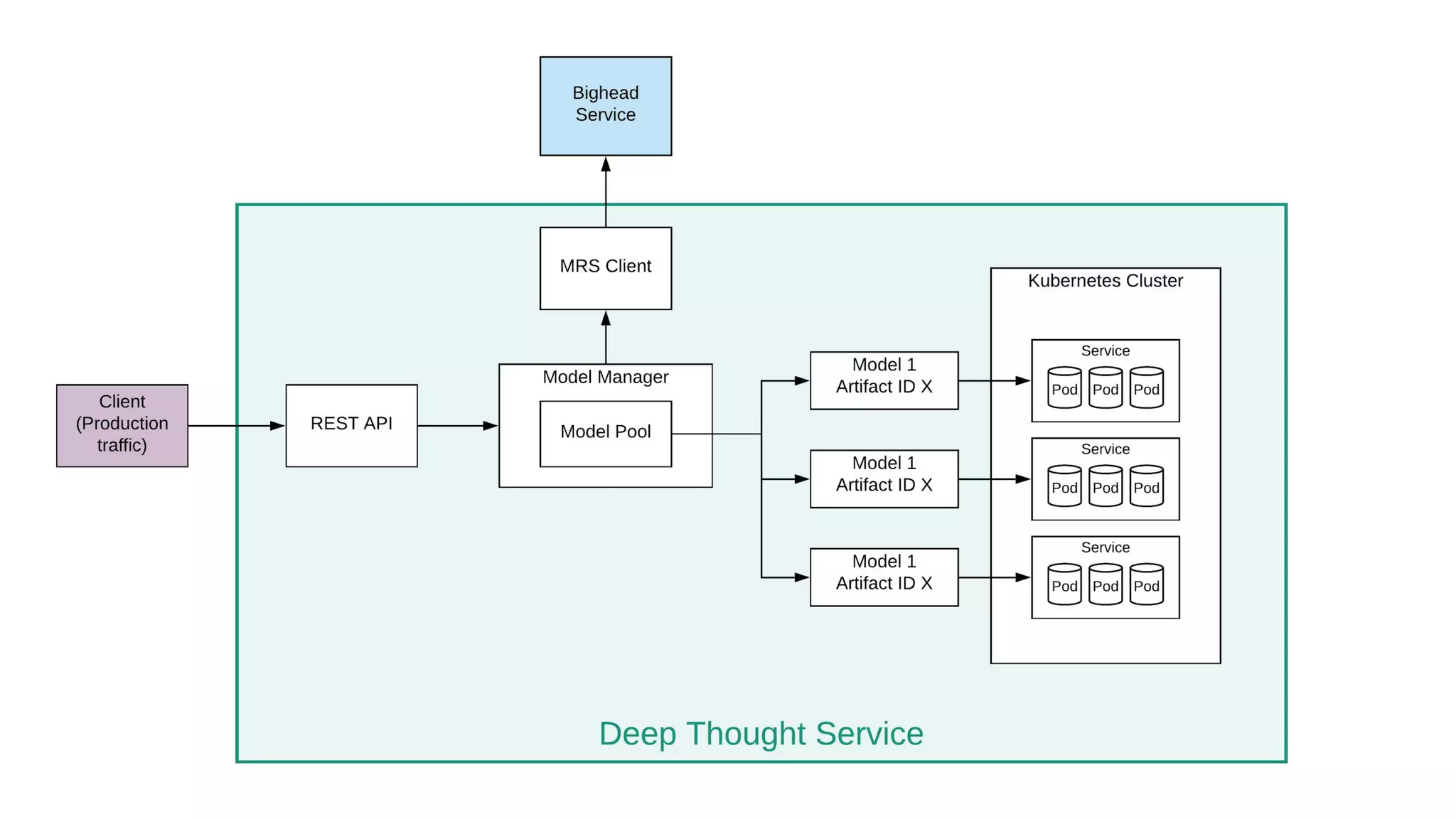
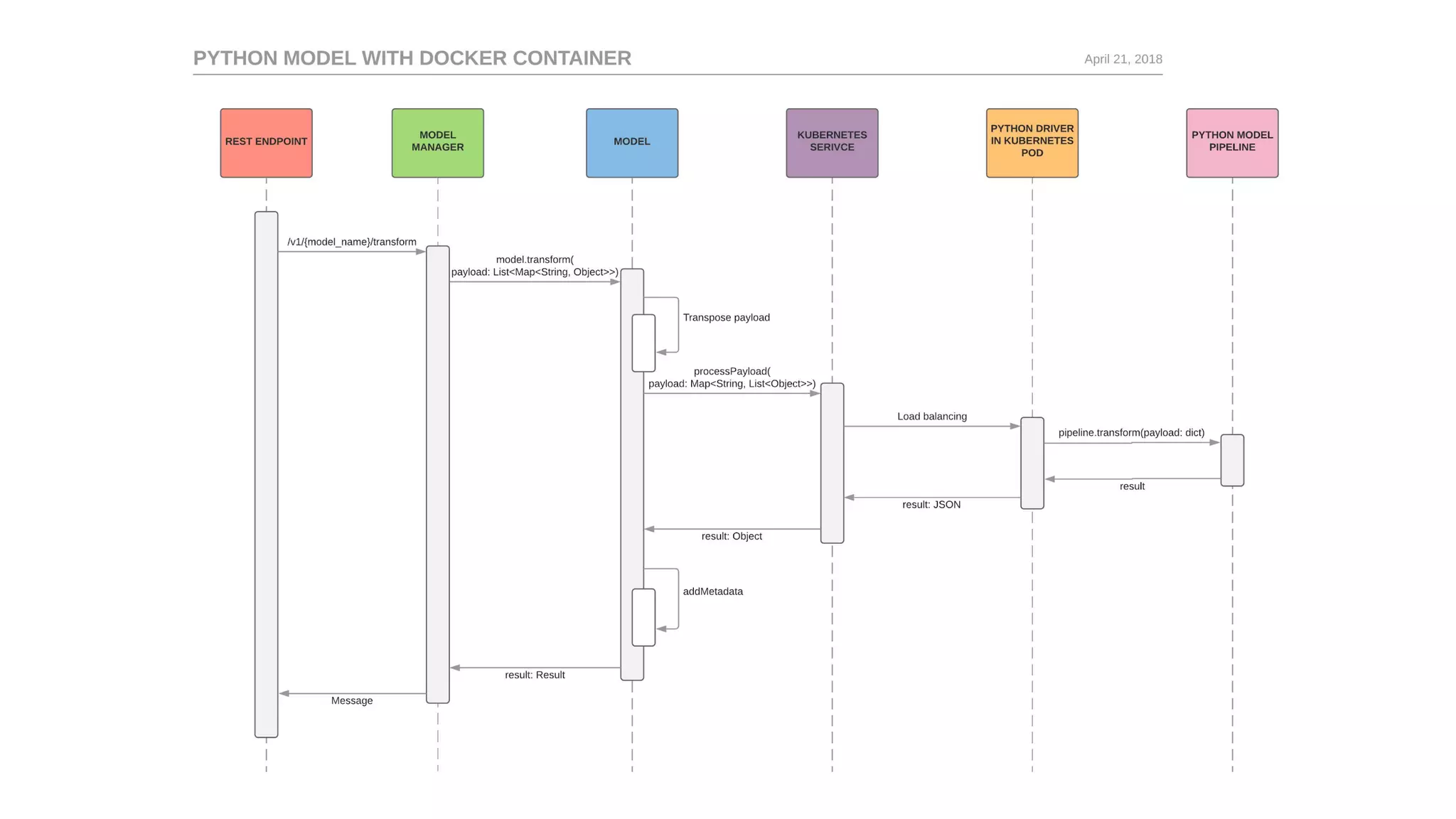
Deep Thought shared service aids online model inference; simplifies new model deployments and ensures consistency in model evaluation.ML Automator automates periodic training and assessment tasks seamlessly via Airflow for efficient resource management.
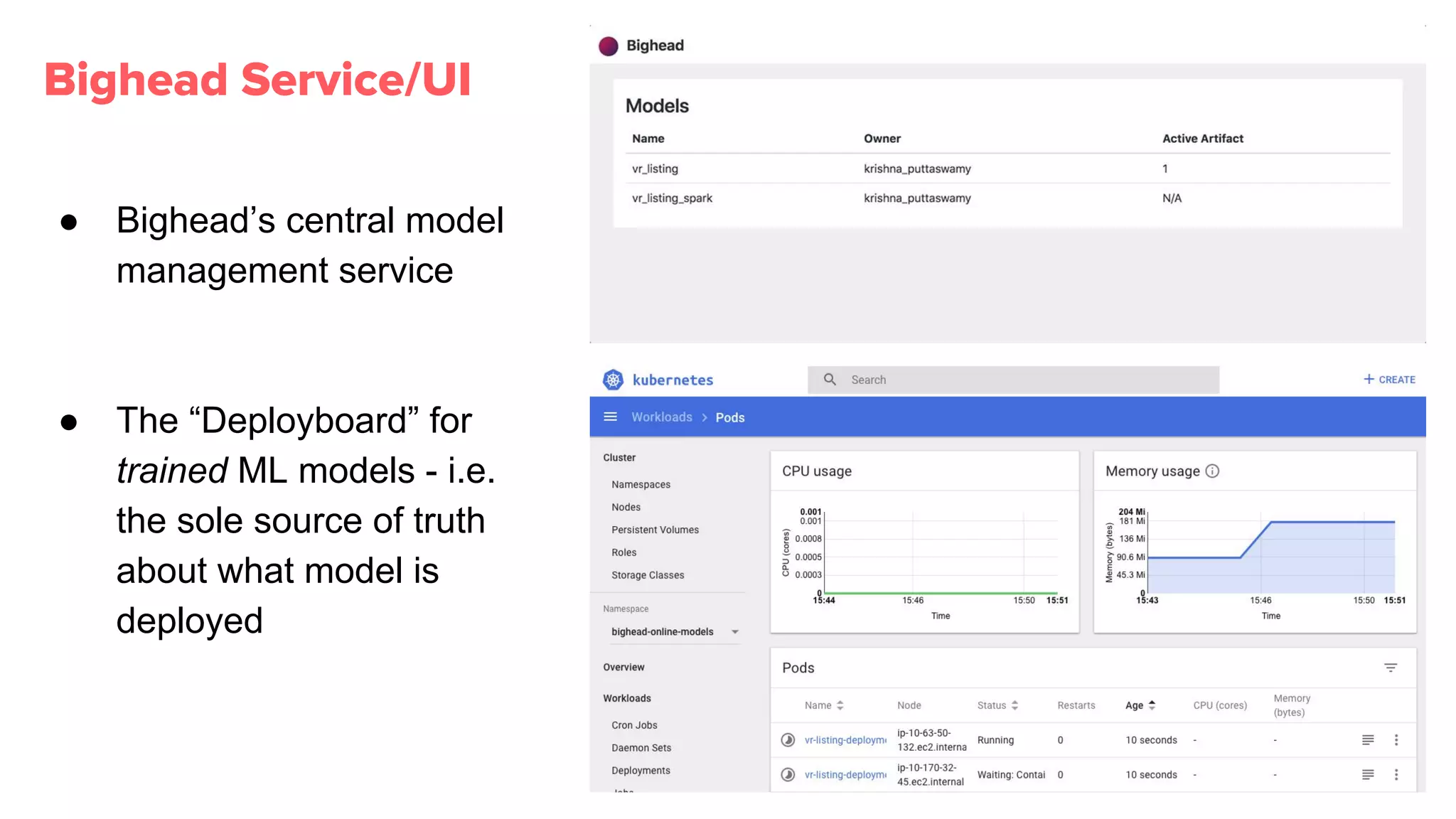
Bighead service manages ML models' life cycles, ensuring proper version control, reproducibility, and holistic health monitoring.
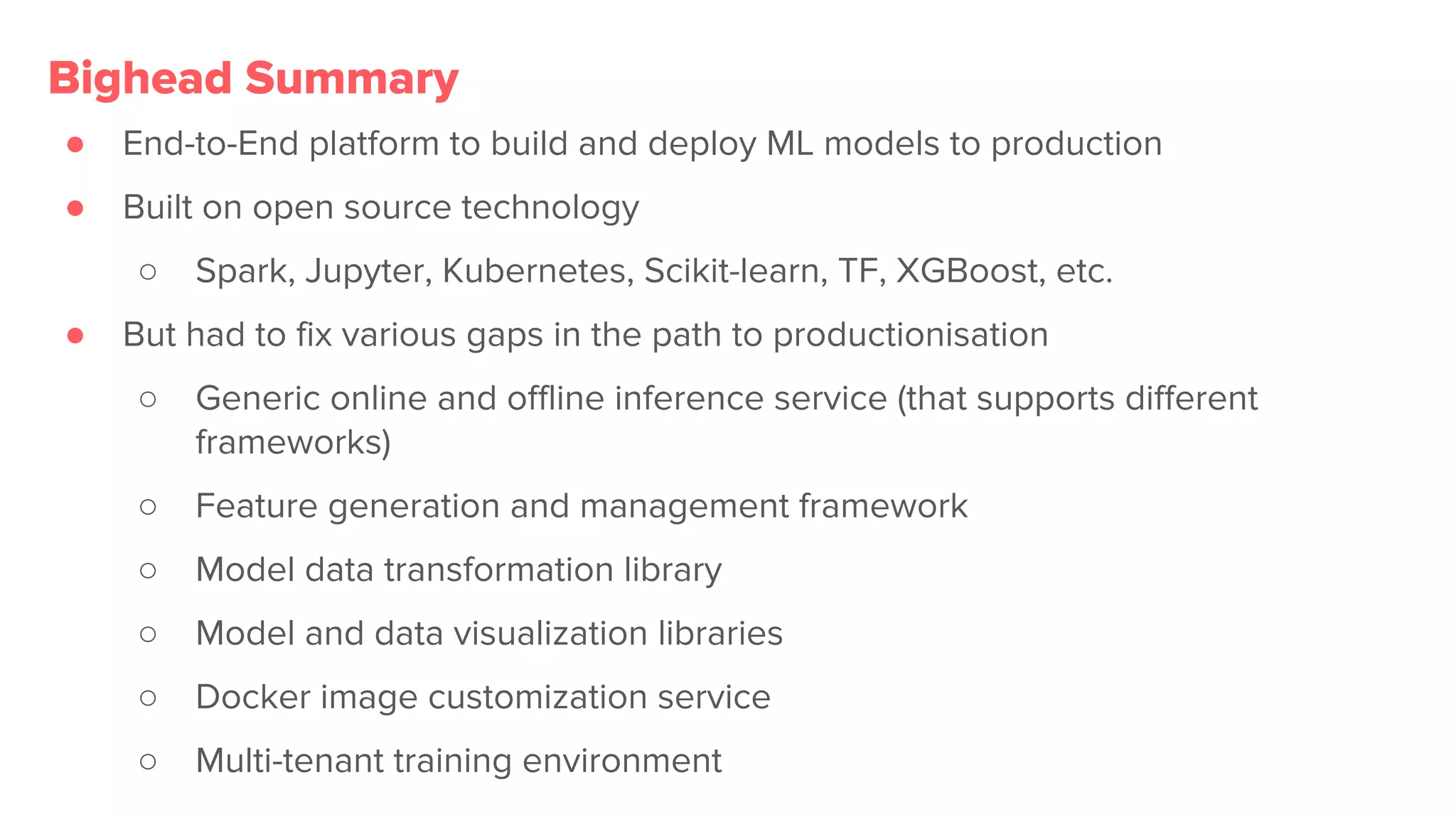
Summary of end-to-end ML model management platform and plans to open source the technology for broader collaboration.
In 2016
● Onlya few major models in production
● Models took on average 8 week to 12 weeks to build
● Everything built in Aerosolve, Spark and Scala
● No support for Tensorflow, PyTorch, SK-Learn or other popular ML packages
● Significant discrepancies between offline and online data
ML Infra was formed with the charter to:
● Enable more users to build ML products
● Reduce time and effort
● Enable easier model evaluation
Q4 2016: Formation of our ML Infra team
After ML
Infrastructure
But therewere many other areas that had
high-potential for ML, but had yet to realize its
full potential.
● Paid Growth - Hosts
● Classifying listing
● Room Type Categorizations
● Experience Ranking + Personalization
● Host Availability
● Business Travel Classifier
● Make Listing a Space Easier
● Customer Service Ticket Routing
● … And many more
5.
Vision
Airbnb routinely shipsML-powered features throughout the
product.
Mission
Equip Airbnb with shared technology to build
production-ready ML applications with no incidental
complexity.
(Technology = tools, platforms, knowledge, shared feature data, etc.)
6.
Value of ML
Infrastructure
MachineLearning Infrastructure can:
● Remove incidental complexities, by providing
generic, reusable solutions
● Simplify the workflow by providing tooling,
libraries, and environments that make ML
development more efficient
And at the same time:
● Establish a standardized platform that
enables cross-company sharing of feature
data and model components
● “Make it easy to do the right thing” (ex:
consistent training/streaming/scoring logic)
Learnings:
● No consistencybetween ML Workflows
● New teams struggle to begin using ML
● Airbnb has a wide variety in ML use cases
● Existing ML workflows are slow, fragmented, and brittle
● Incidental complexity vs. intrinsic complexity
● Build and forget - ML as a linear process
Q1 2017: Figuring out what to build
● Consistent environmentacross the stack with Docker
● Consistent data transformation
○ Multi-row aggregation in the warehouse, single row transformation is part of
the model
○ Model transformation code is the same in online and offline
● Common workflow across different ML frameworks
○ Supports Scikit-learn, TF, PyTorch, etc.
● Modular components
○ Easy to customize parts
○ Easy to share data/pipelines
Key Design Decisions
12.
Bighead Architecture
DeepThought Service
Deployment
Appfor ML
Models
ML Models
git repo
Redspot
ML Automator
(w/ Airflow)
ML DAG
Generator
Zipline Data
(K/V Store)
Clients
Offline Online
Bighead Service
Docker Image Service
Zipline
Feature
Repository
User ML Model
Bighead library
BigQueue
Service
Worker
Bighead UI
Zipline features
git repo
13.
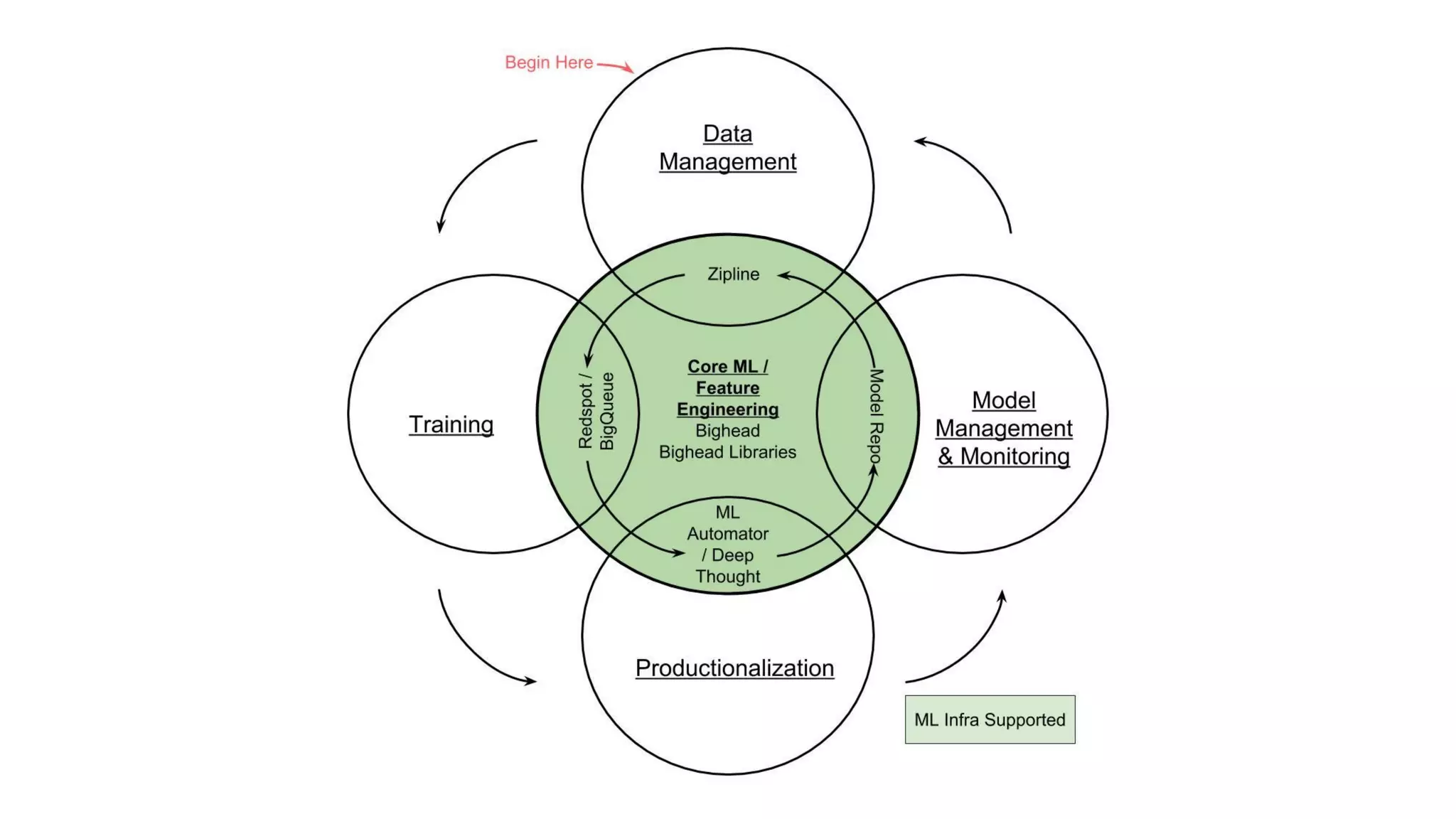
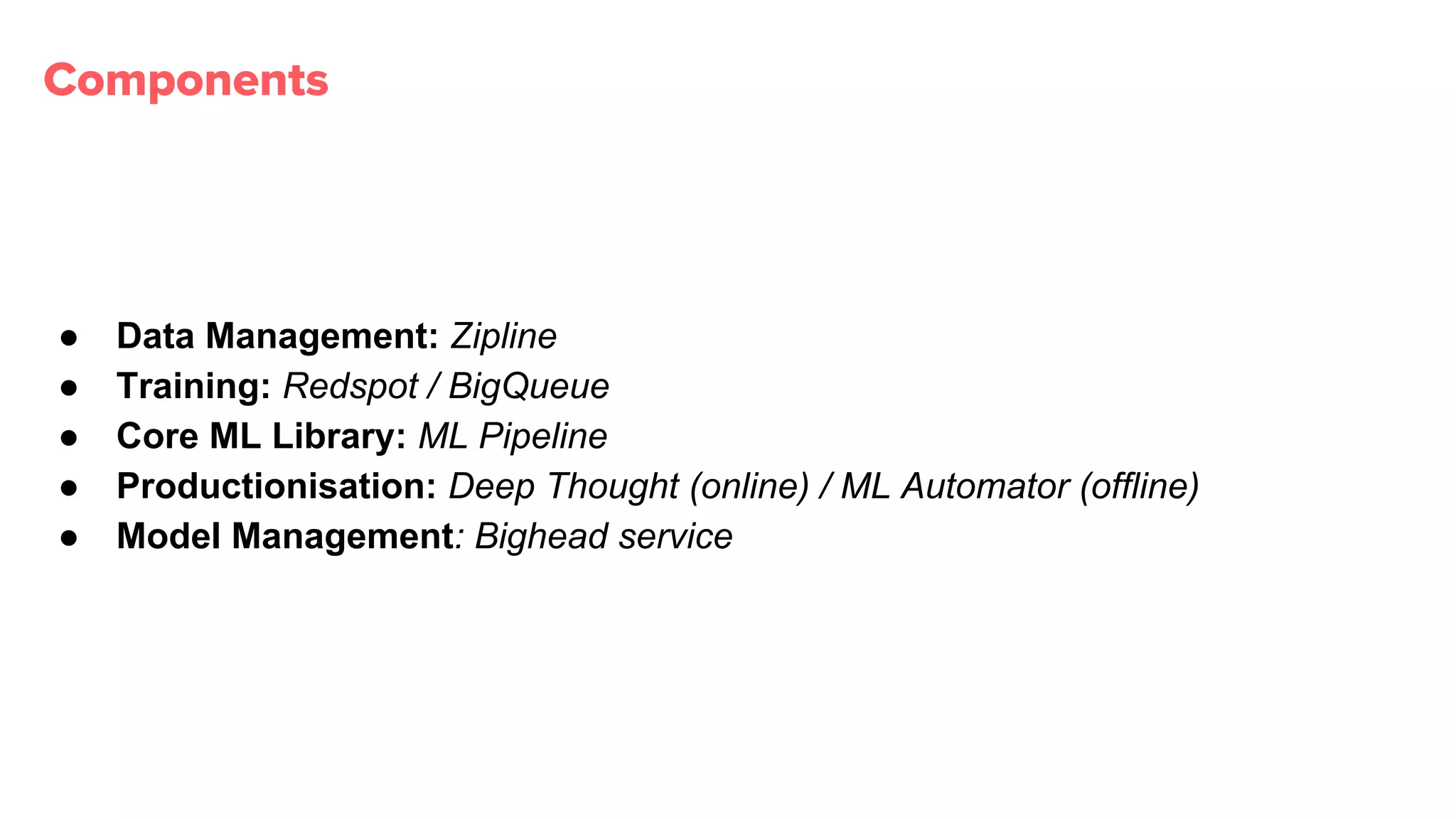
Components
● Data Management:Zipline
● Training: Redspot / BigQueue
● Core ML Library: ML Pipeline
● Productionisation: Deep Thought (online) / ML Automator (offline)
● Model Management: Bighead service
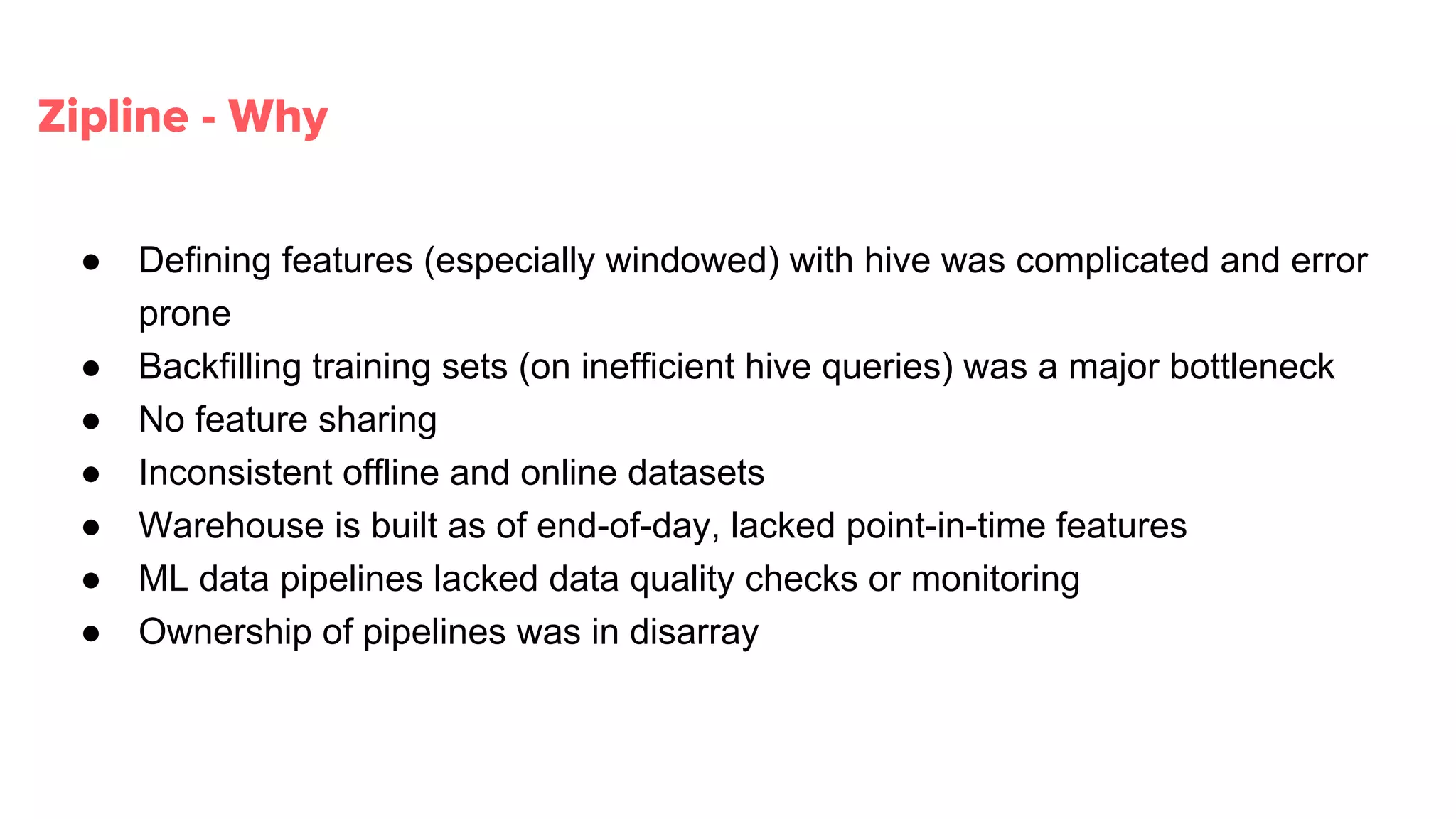
Zipline - Why
●Defining features (especially windowed) with hive was complicated and error
prone
● Backfilling training sets (on inefficient hive queries) was a major bottleneck
● No feature sharing
● Inconsistent offline and online datasets
● Warehouse is built as of end-of-day, lacked point-in-time features
● ML data pipelines lacked data quality checks or monitoring
● Ownership of pipelines was in disarray
16.
For information onZipline, please watch the recording of our other
Spark Summit session:
Zipline: Airbnb’s Machine Learning Data
Management Platform
Bighead Architecture
DeepThought Service
Deployment
Appfor ML
Models
ML Models
git repo
Redspot
ML Automator
(w/ Airflow)
ML DAG
Generator
Zipline Data
(K/V Store)
Clients
Offline Online
Bighead Service
Docker Image Service
Zipline
Feature
Repository
User ML Model
Bighead library
BigQueue
Service
Worker
Bighead UI
Zipline features
git repo
19.
● Started withJupyterhub (open-source project), which manages multiple Jupyter
Notebook Servers (prototyping environment)
● But users were installing packages locally, and then creating virtualenv for
other parts of our infra
○ Environment was very fragile
● Users wanted to be able to use jupyterhub on larger instances or instances
with GPU
● Wanting to share notebooks with other teammates was common too
● Files/content resilient to node failures
Redspot - Why
20.
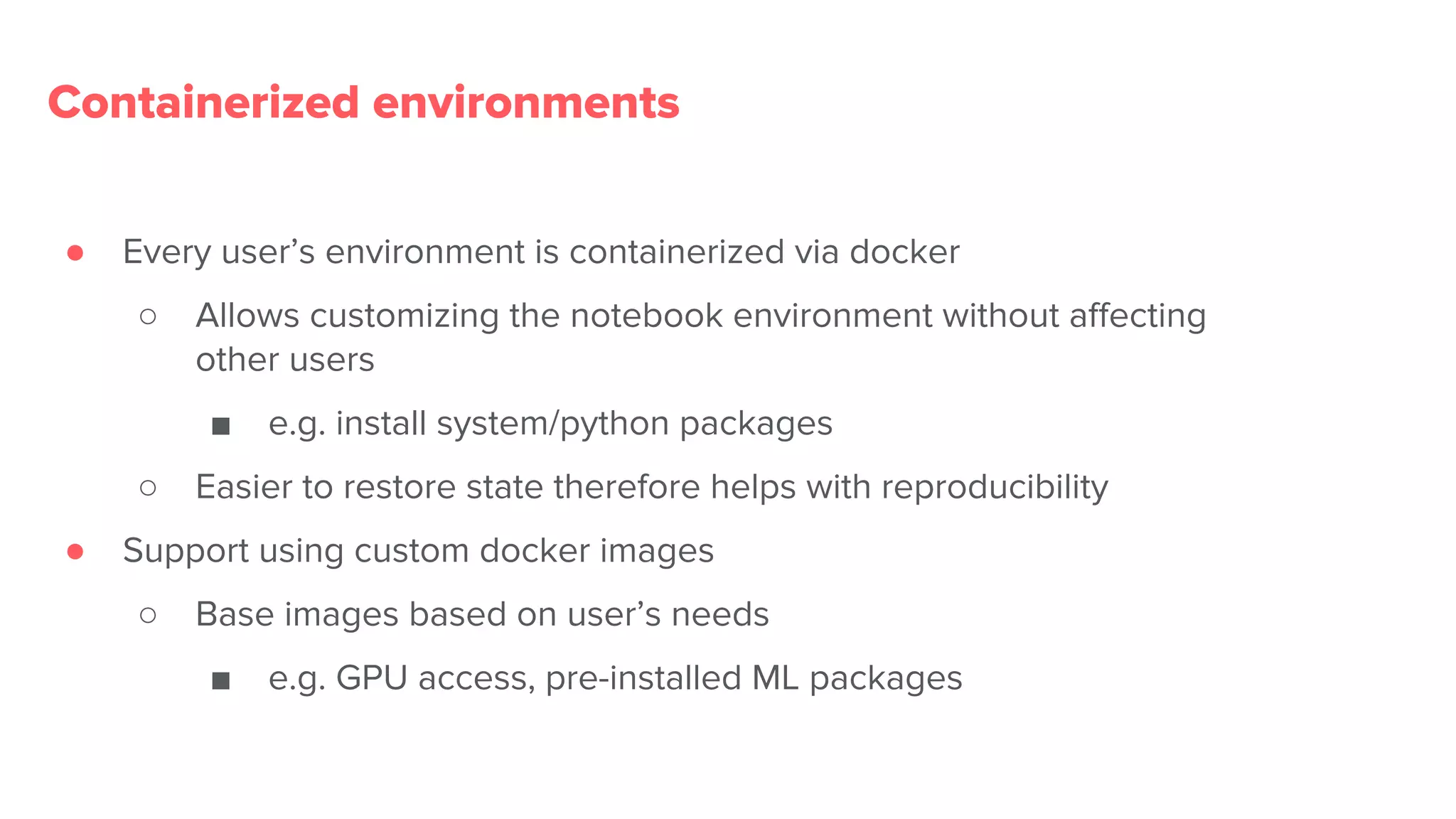
Containerized environments
● Everyuser’s environment is containerized via docker
○ Allows customizing the notebook environment without affecting
other users
■ e.g. install system/python packages
○ Easier to restore state therefore helps with reproducibility
● Support using custom docker images
○ Base images based on user’s needs
■ e.g. GPU access, pre-installed ML packages
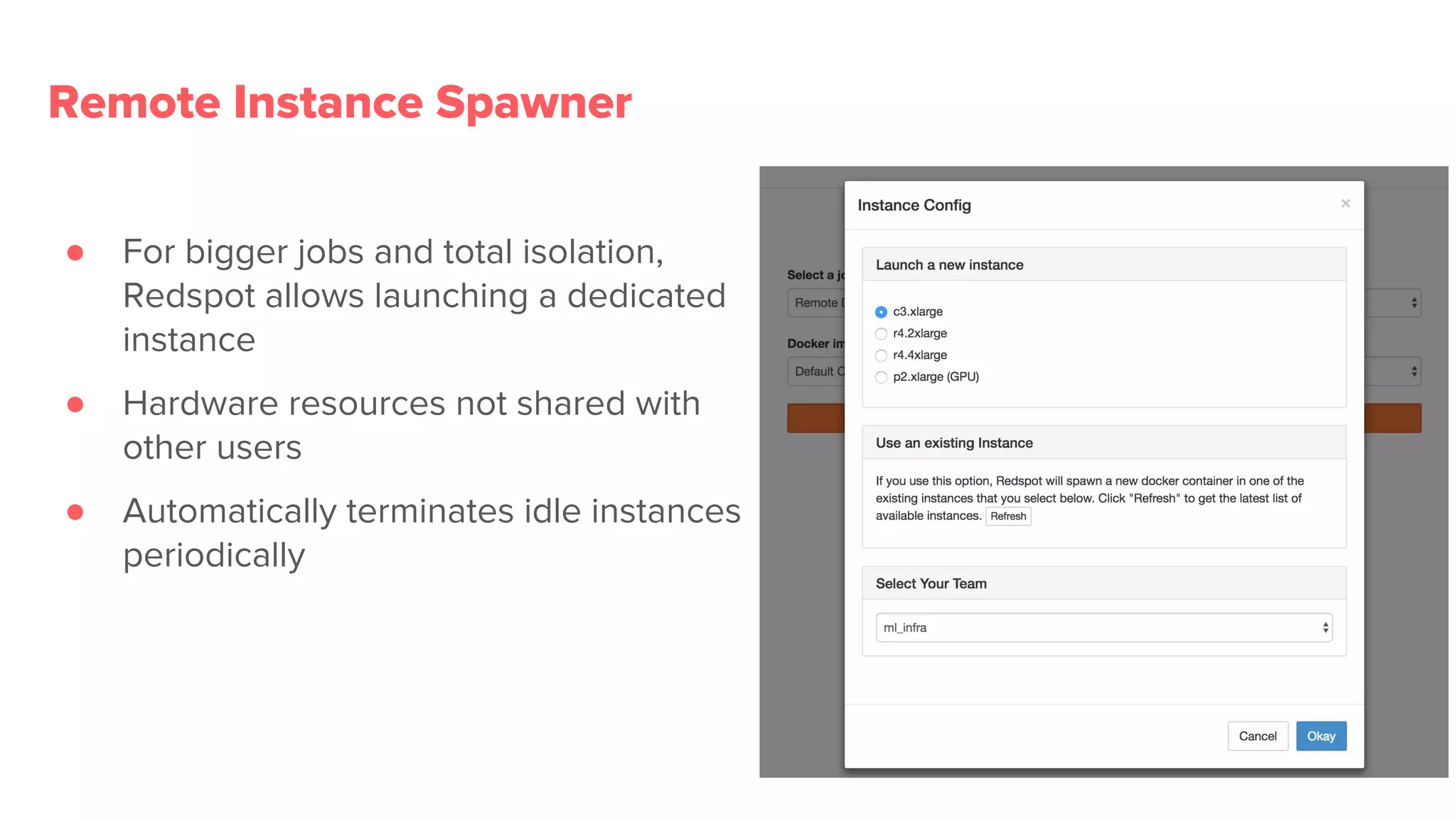
Remote Instance Spawner
●For bigger jobs and total isolation,
Redspot allows launching a dedicated
instance
● Hardware resources not shared with
other users
● Automatically terminates idle instances
periodically
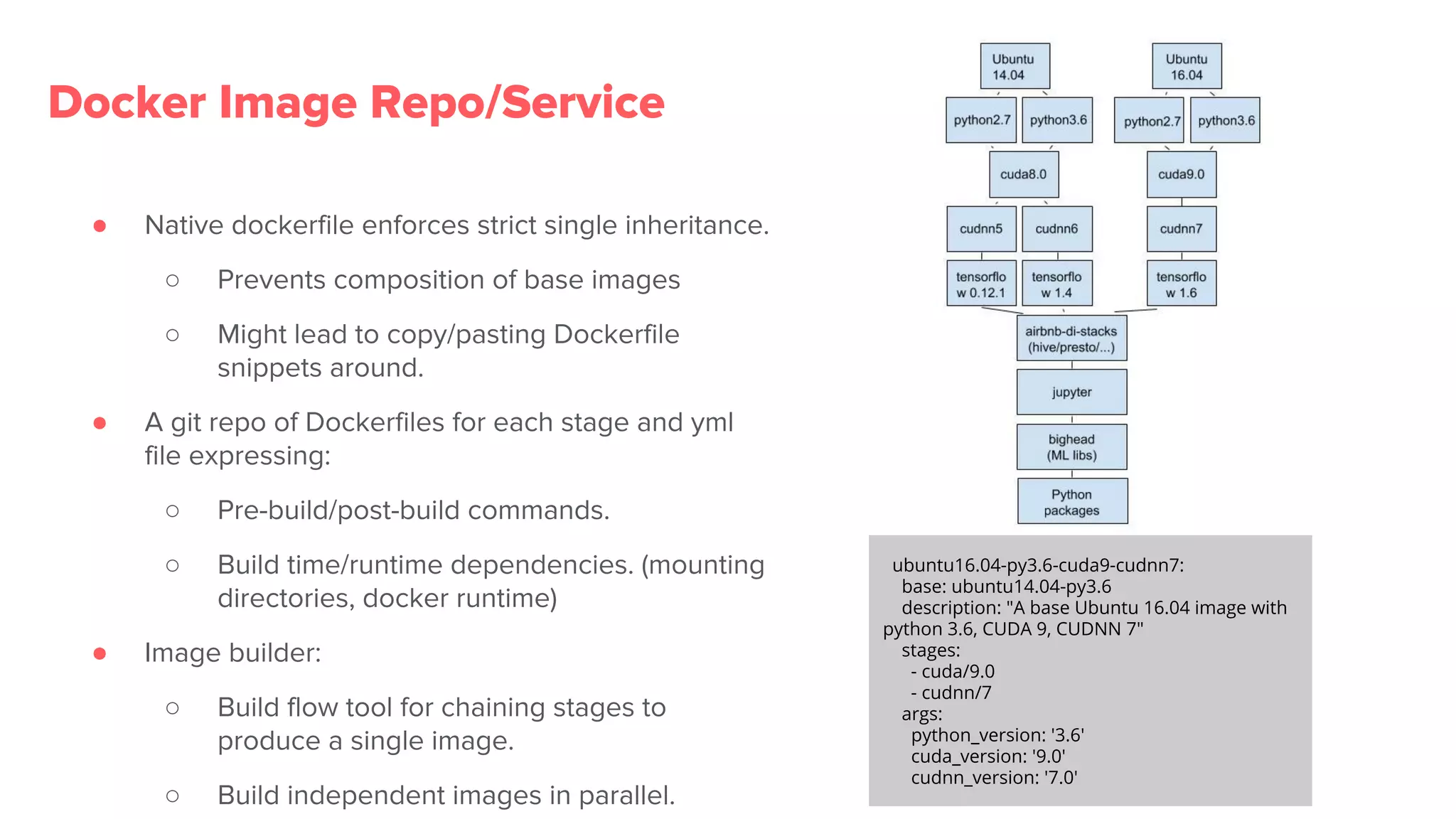
● Native dockerfileenforces strict single inheritance.
○ Prevents composition of base images
○ Might lead to copy/pasting Dockerfile
snippets around.
● A git repo of Dockerfiles for each stage and yml
file expressing:
○ Pre-build/post-build commands.
○ Build time/runtime dependencies. (mounting
directories, docker runtime)
● Image builder:
○ Build flow tool for chaining stages to
produce a single image.
○ Build independent images in parallel.
Docker Image Repo/Service
ubuntu16.04-py3.6-cuda9-cudnn7:
base: ubuntu14.04-py3.6
description: "A base Ubuntu 16.04 image with
python 3.6, CUDA 9, CUDNN 7"
stages:
- cuda/9.0
- cudnn/7
args:
python_version: '3.6'
cuda_version: '9.0'
cudnn_version: '7.0'
26.
● A multi-tenantnotebook environment
● Makes it easy to iterate and prototype ML models, share work
○ Integrated with the rest of our infra - so one can deploy a notebook to prod
● Improved upon open source Jupyterhub
○ Containerized; can bring custom Docker env
○ Remote notebook spawner for dedicated instances (P3 and X1 machines on
AWS)
○ Persist notebooks in EFS and share with teams
○ Reverting to prior checkpoint
● Support 200+ Weekly Active Users
Redspot Summary
Bighead Library -Why
● Transformations (NLP, images) are often re-written by different users
● No clear abstraction for data transformation in the model
○ Every user can do data processing in a different way, leading to confusion
○ Users can easily write inefficient code
○ Loss of feature metadata during transformation (can’t plot feature importance)
○ Need special handling of CPU/GPU
○ No visualization of transformations
● Visualizing and understanding input data is key
○ But few good libraries to do so
29.
● Library oftransformations; holds more than 100+ different transformations including
automated preprocessing for common input formats (NLP, images, etc.)
● Pipeline abstraction to build a DAG of transformation on input data
○ Propagate feature metadata so we can plot feature importance at the end and
connect it to feature names
○ Pipelines for data processing are reusable in other pipelines
○ Feature parallel and data parallel transformations
○ CPU and GPU support
○ Supports Scikit APIs
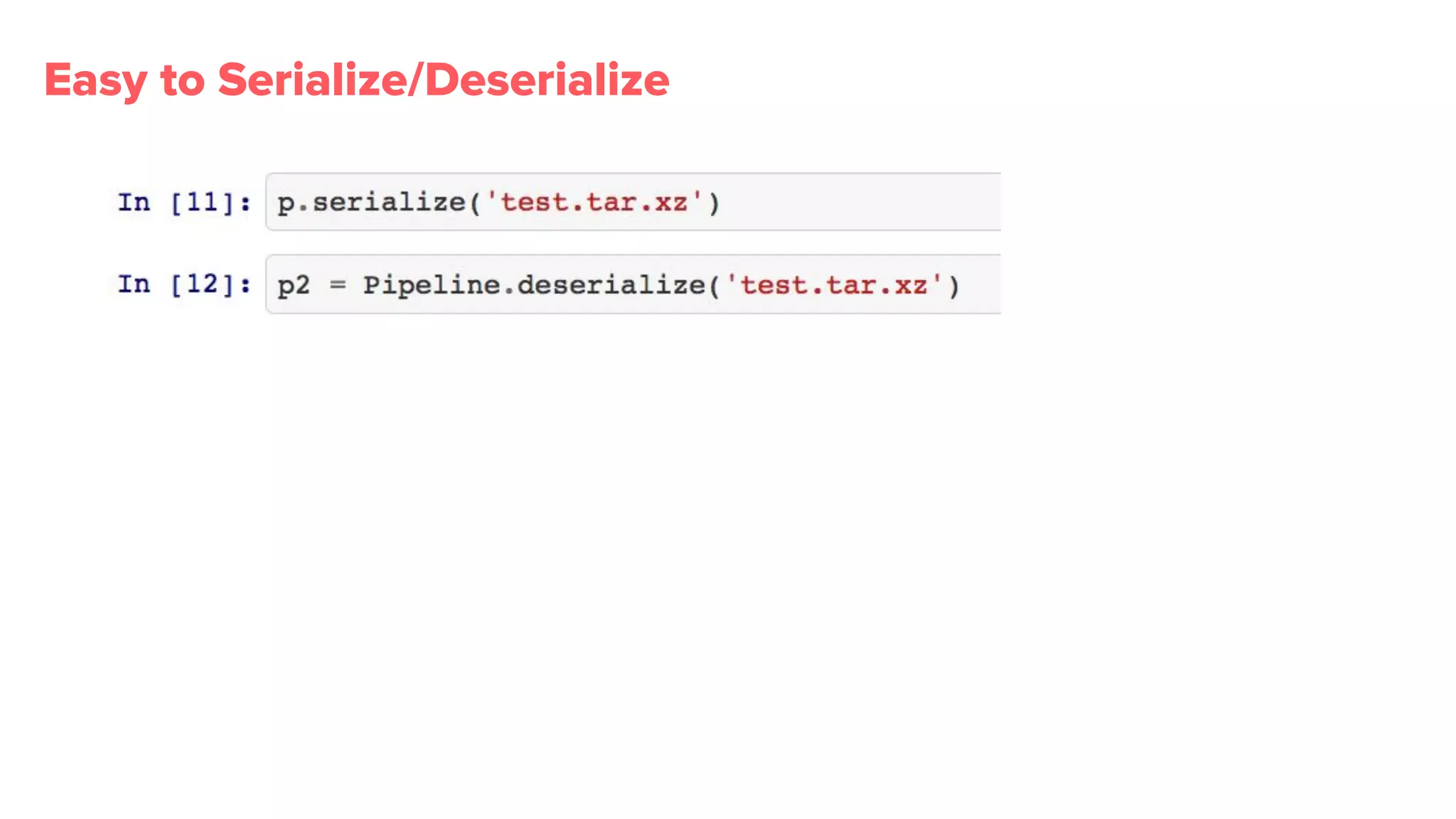
● Wrappers for model frameworks (XGB, TF, etc.) so they can be easily serialized/deserialized
(robust to minor version changes)
● Provides training data visualization to help identify data issues
Bighead Library
Bighead Architecture
DeepThought Service
Deployment
Appfor ML
Models
ML Models
git repo
Redspot
ML Automator
(w/ Airflow)
ML DAG
Generator
Zipline Data
(K/V Store)
Clients
Offline Online
Bighead Service
Docker Image Service
Zipline
Feature
Repository
User ML Model
Bighead library
BigQueue
Service
Worker
Bighead UI
Zipline features
git repo
38.
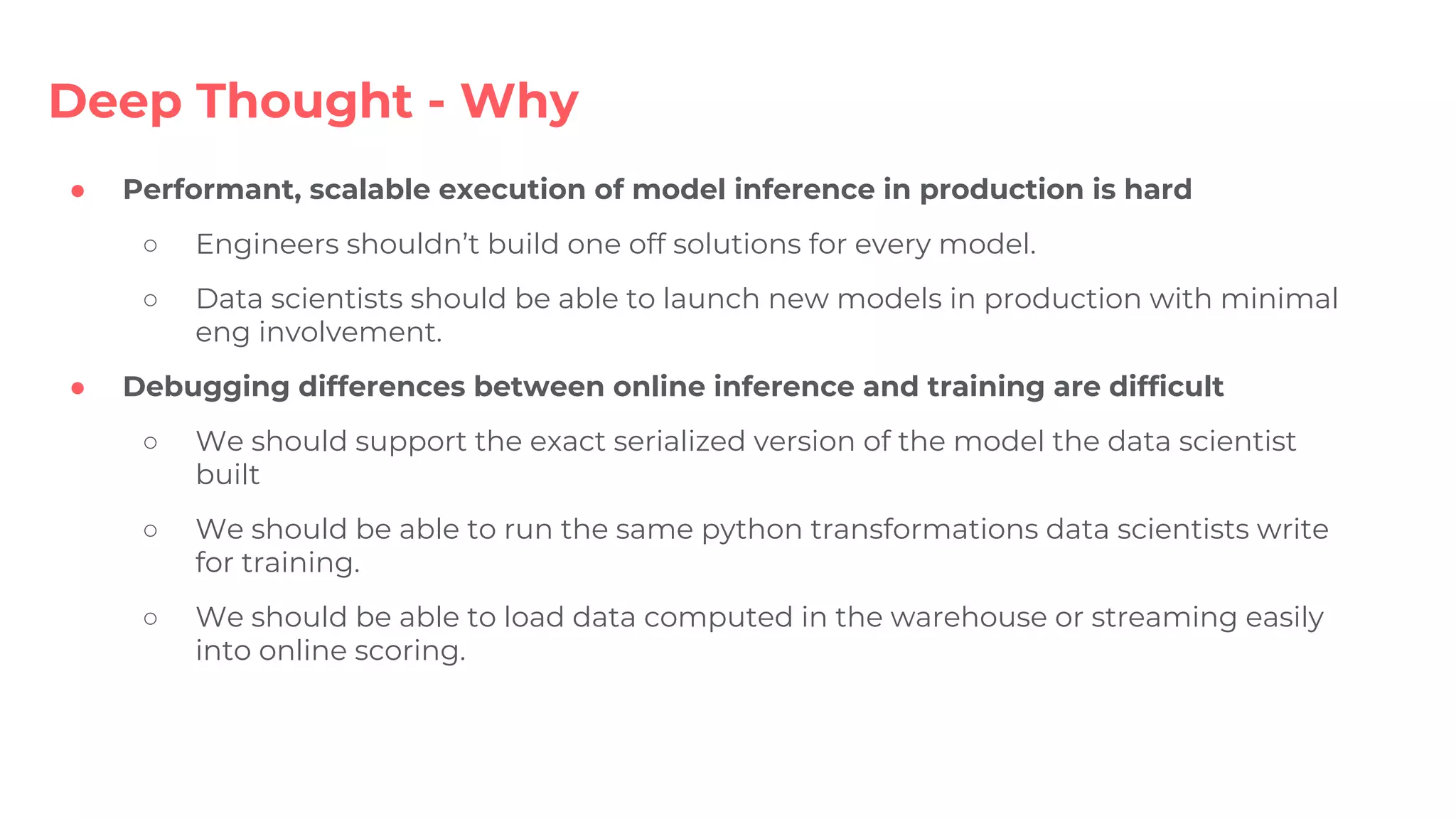
● Performant, scalableexecution of model inference in production is hard
○ Engineers shouldn’t build one off solutions for every model.
○ Data scientists should be able to launch new models in production with minimal
eng involvement.
● Debugging differences between online inference and training are difficult
○ We should support the exact serialized version of the model the data scientist
built
○ We should be able to run the same python transformations data scientists write
for training.
○ We should be able to load data computed in the warehouse or streaming easily
into online scoring.
Deep Thought - Why
39.
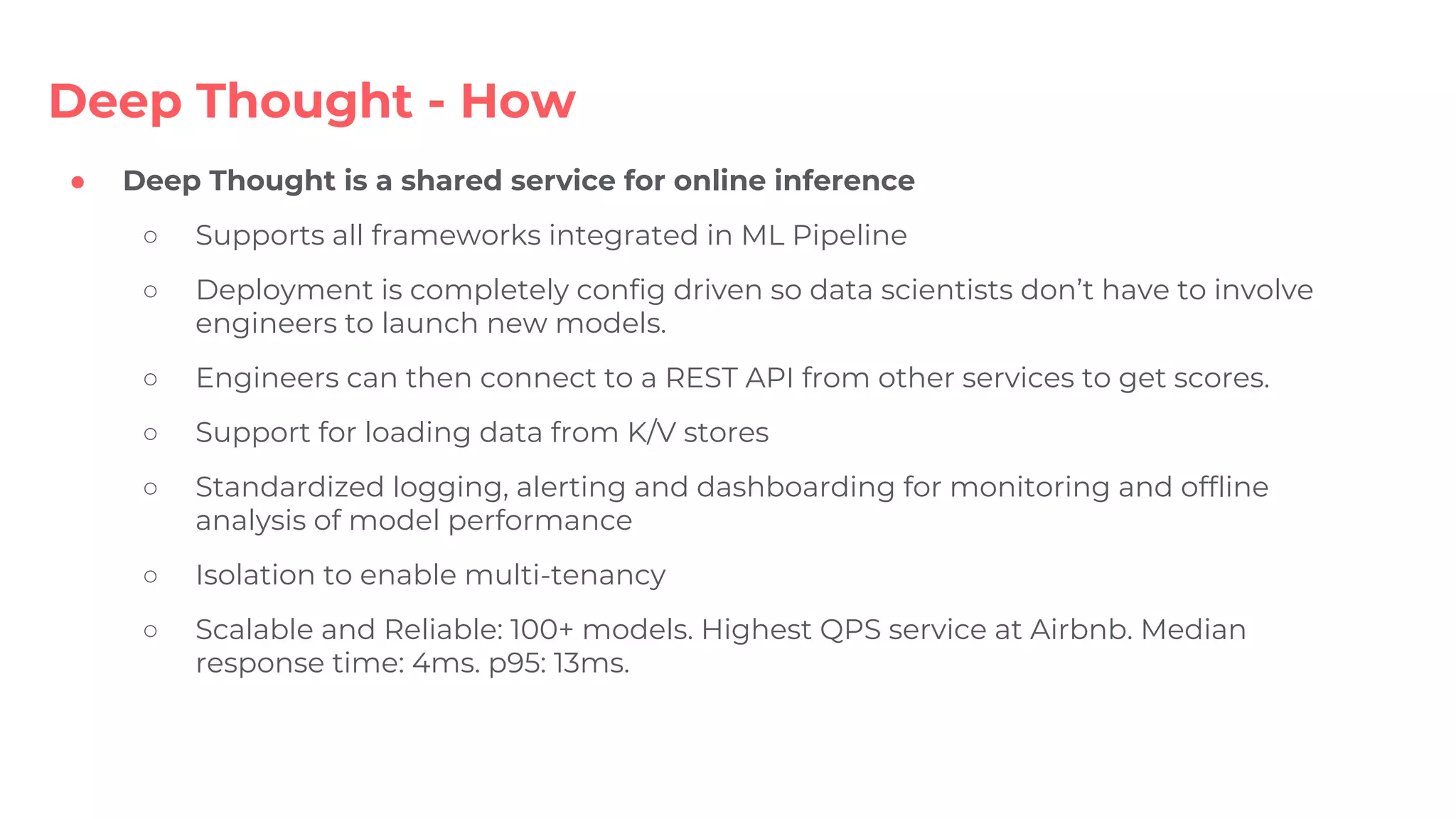
● Deep Thoughtis a shared service for online inference
○ Supports all frameworks integrated in ML Pipeline
○ Deployment is completely config driven so data scientists don’t have to involve
engineers to launch new models.
○ Engineers can then connect to a REST API from other services to get scores.
○ Support for loading data from K/V stores
○ Standardized logging, alerting and dashboarding for monitoring and offline
analysis of model performance
○ Isolation to enable multi-tenancy
○ Scalable and Reliable: 100+ models. Highest QPS service at Airbnb. Median
response time: 4ms. p95: 13ms.
Deep Thought - How
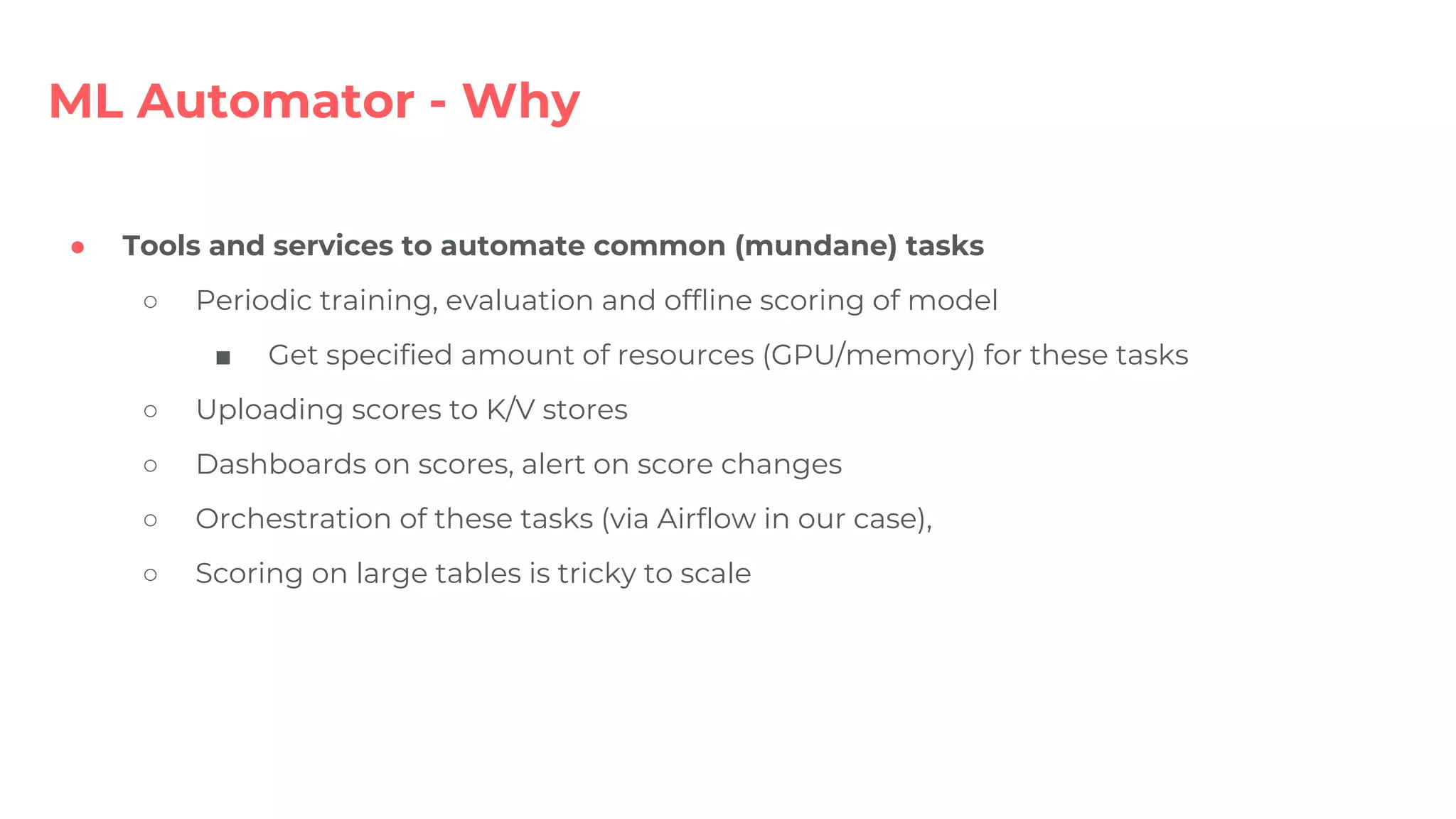
● Tools andservices to automate common (mundane) tasks
○ Periodic training, evaluation and offline scoring of model
■ Get specified amount of resources (GPU/memory) for these tasks
○ Uploading scores to K/V stores
○ Dashboards on scores, alert on score changes
○ Orchestration of these tasks (via Airflow in our case),
○ Scoring on large tables is tricky to scale
ML Automator - Why
44.
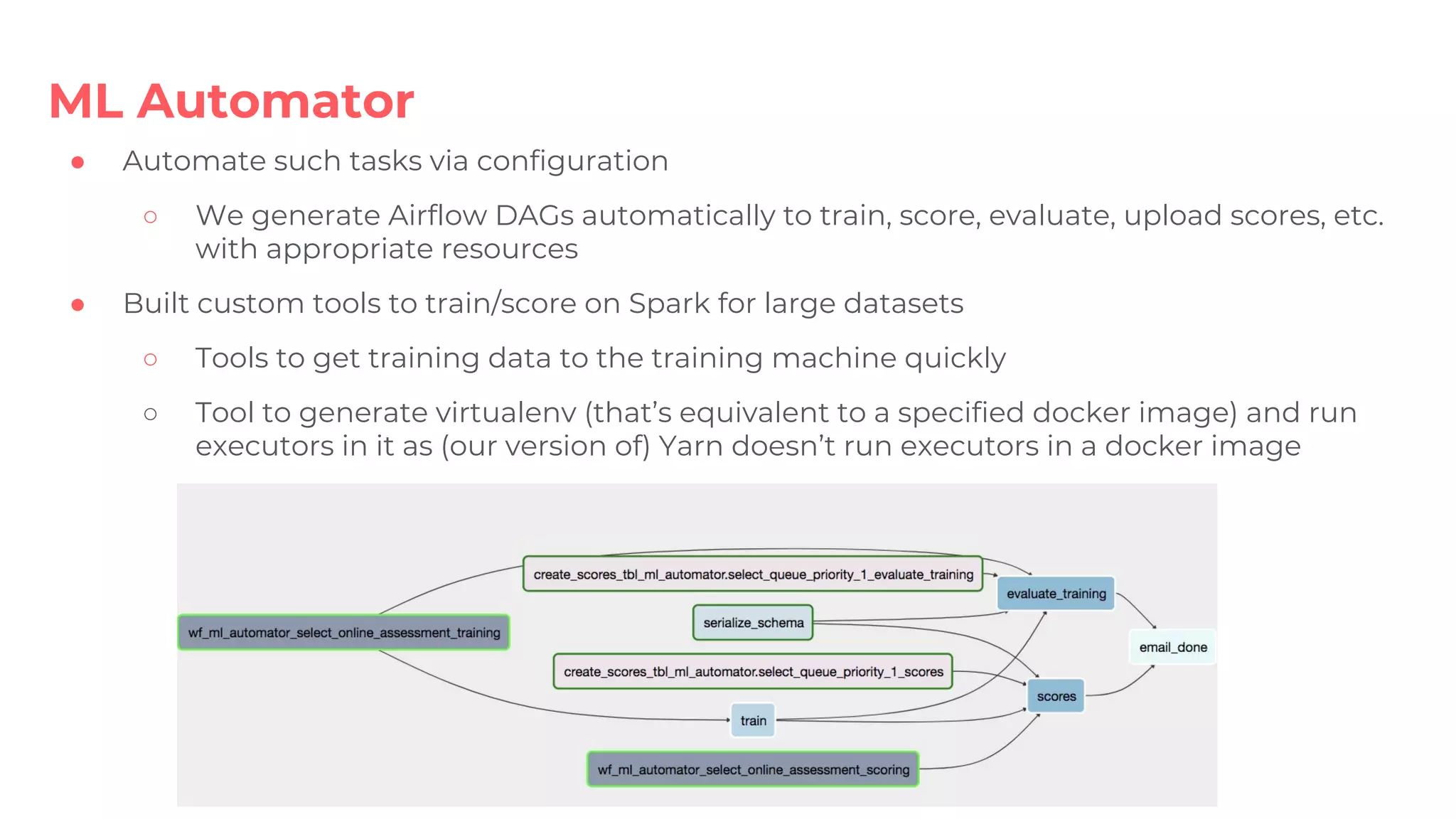
● Automate suchtasks via configuration
○ We generate Airflow DAGs automatically to train, score, evaluate, upload scores, etc.
with appropriate resources
● Built custom tools to train/score on Spark for large datasets
○ Tools to get training data to the training machine quickly
○ Tool to generate virtualenv (that’s equivalent to a specified docker image) and run
executors in it as (our version of) Yarn doesn’t run executors in a docker image
ML Automator
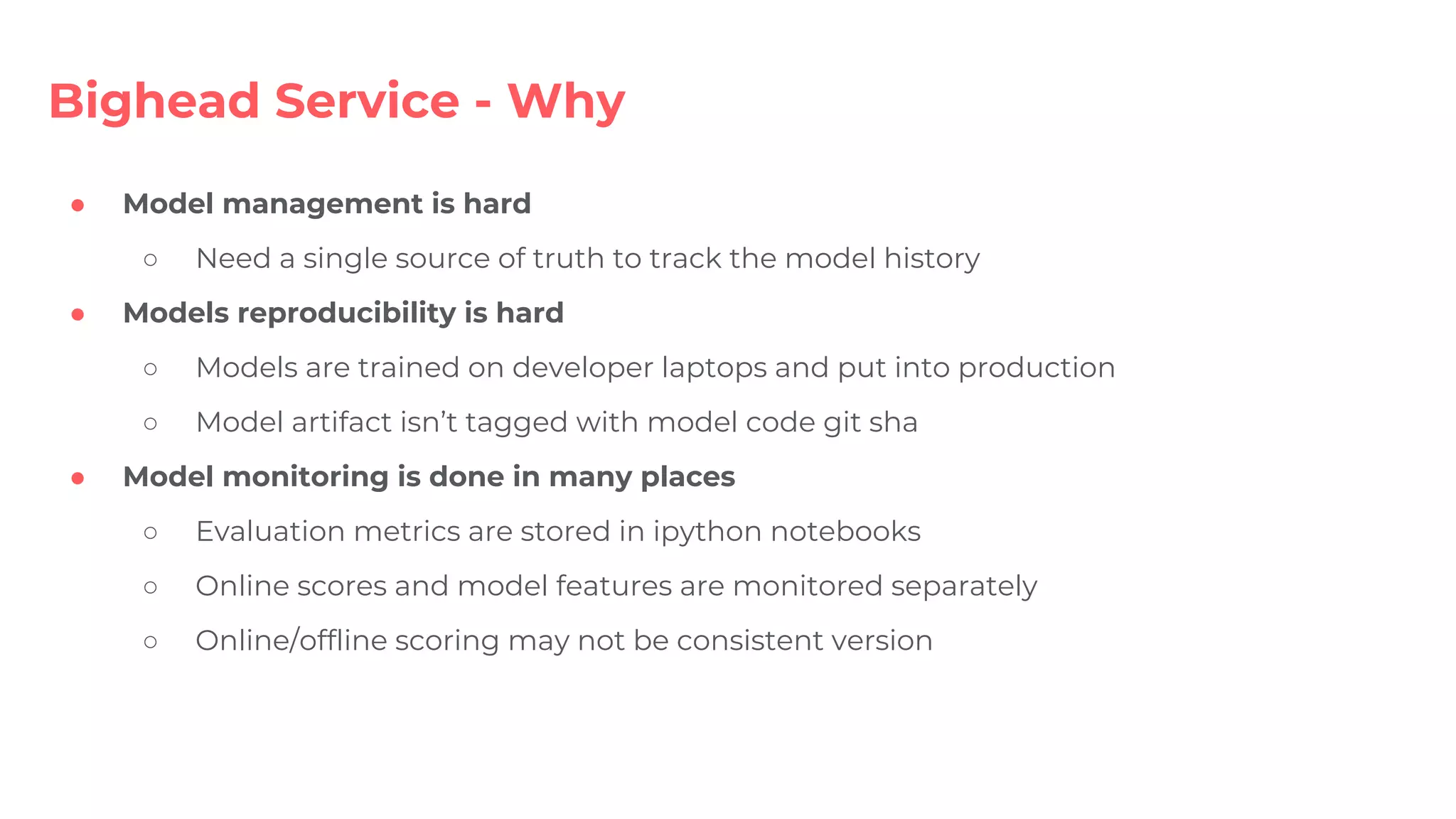
● Model managementis hard
○ Need a single source of truth to track the model history
● Models reproducibility is hard
○ Models are trained on developer laptops and put into production
○ Model artifact isn’t tagged with model code git sha
● Model monitoring is done in many places
○ Evaluation metrics are stored in ipython notebooks
○ Online scores and model features are monitored separately
○ Online/offline scoring may not be consistent version
Bighead Service - Why
47.
Bighead
Service
Overview
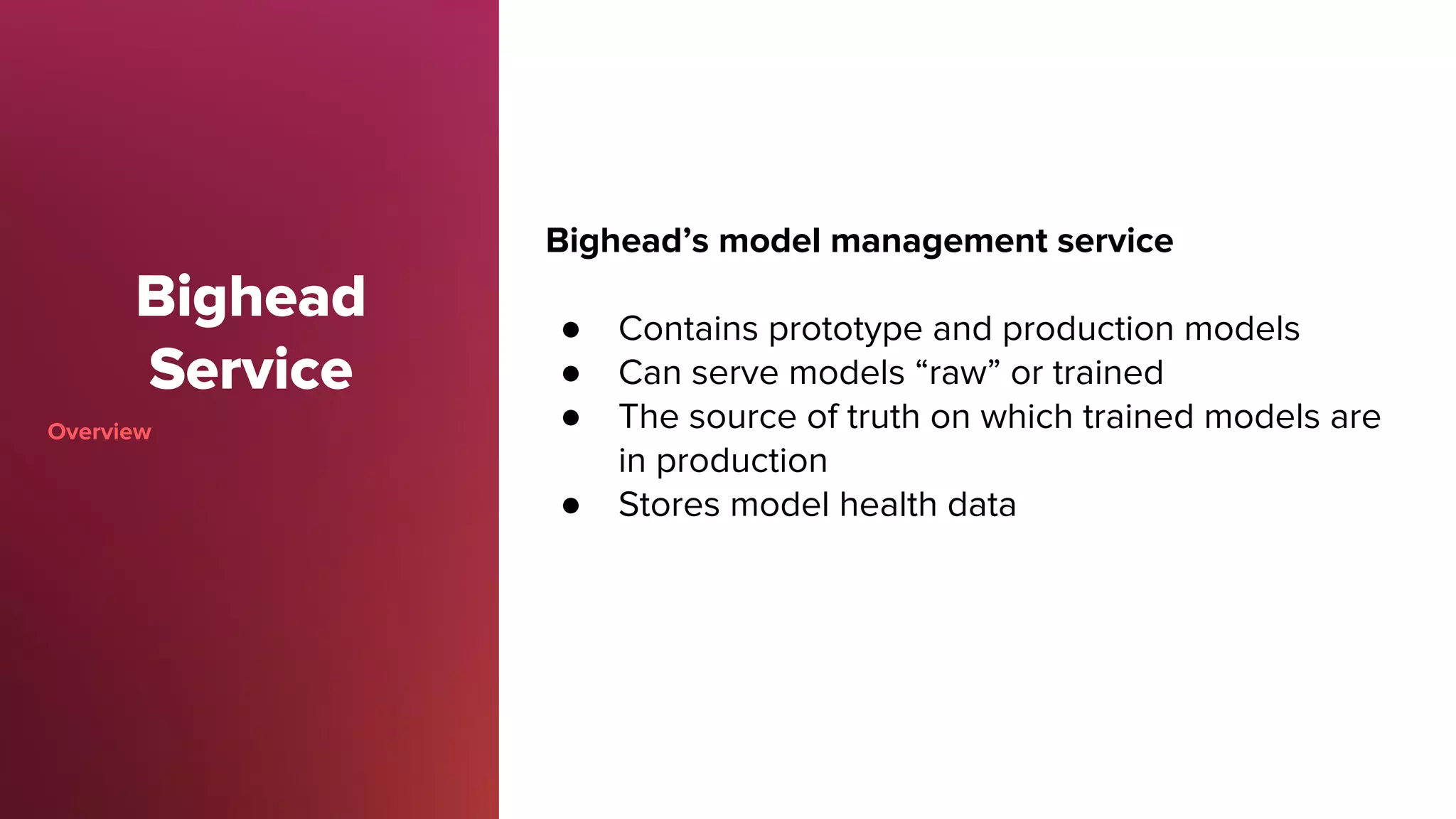
Bighead’s model managementservice
● Contains prototype and production models
● Can serve models “raw” or trained
● The source of truth on which trained models are
in production
● Stores model health data
48.
Bighead
Service
Internals
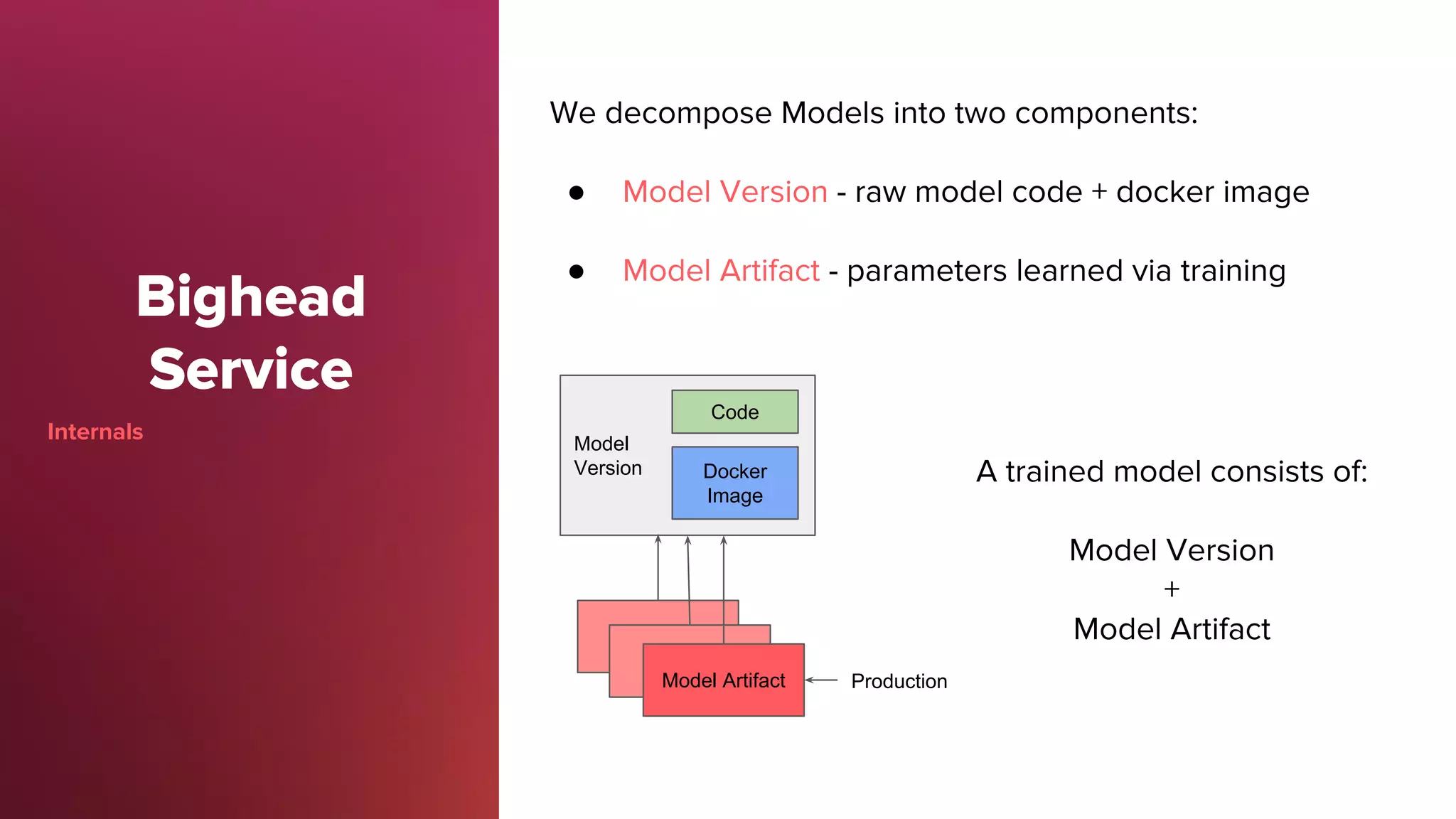
We decompose Modelsinto two components:
● Model Version - raw model code + docker image
● Model Artifact - parameters learned via training
Model
Version
Model Artifact
Code
Docker
Image
A trained model consists of:
Model Version
+
Model Artifact
Production
49.
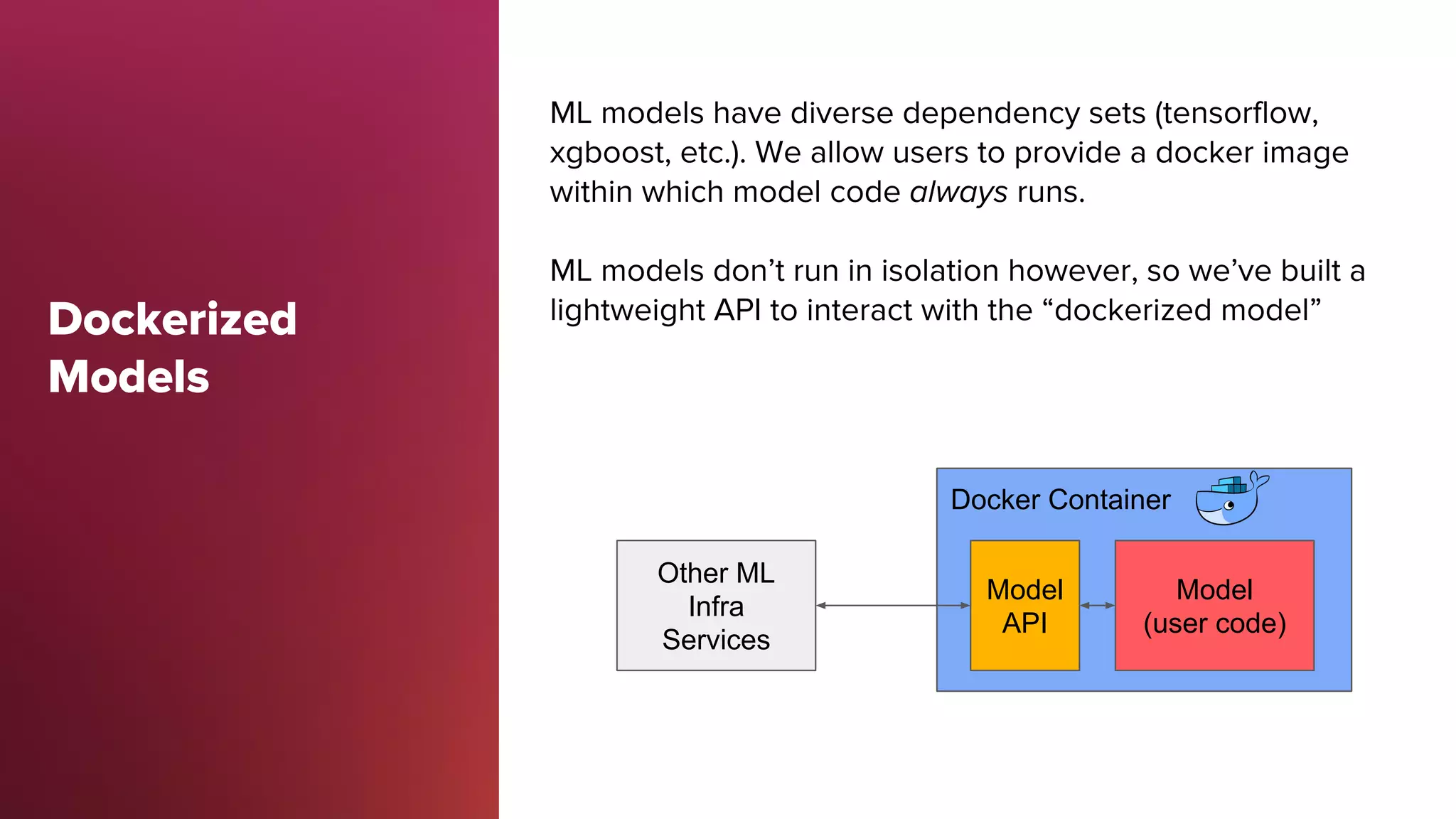
ML models havediverse dependency sets (tensorflow,
xgboost, etc.). We allow users to provide a docker image
within which model code always runs.
ML models don’t run in isolation however, so we’ve built a
lightweight API to interact with the “dockerized model”
Docker Container
Model
(user code)
Other ML
Infra
Services
Model
API
Dockerized
Models
50.
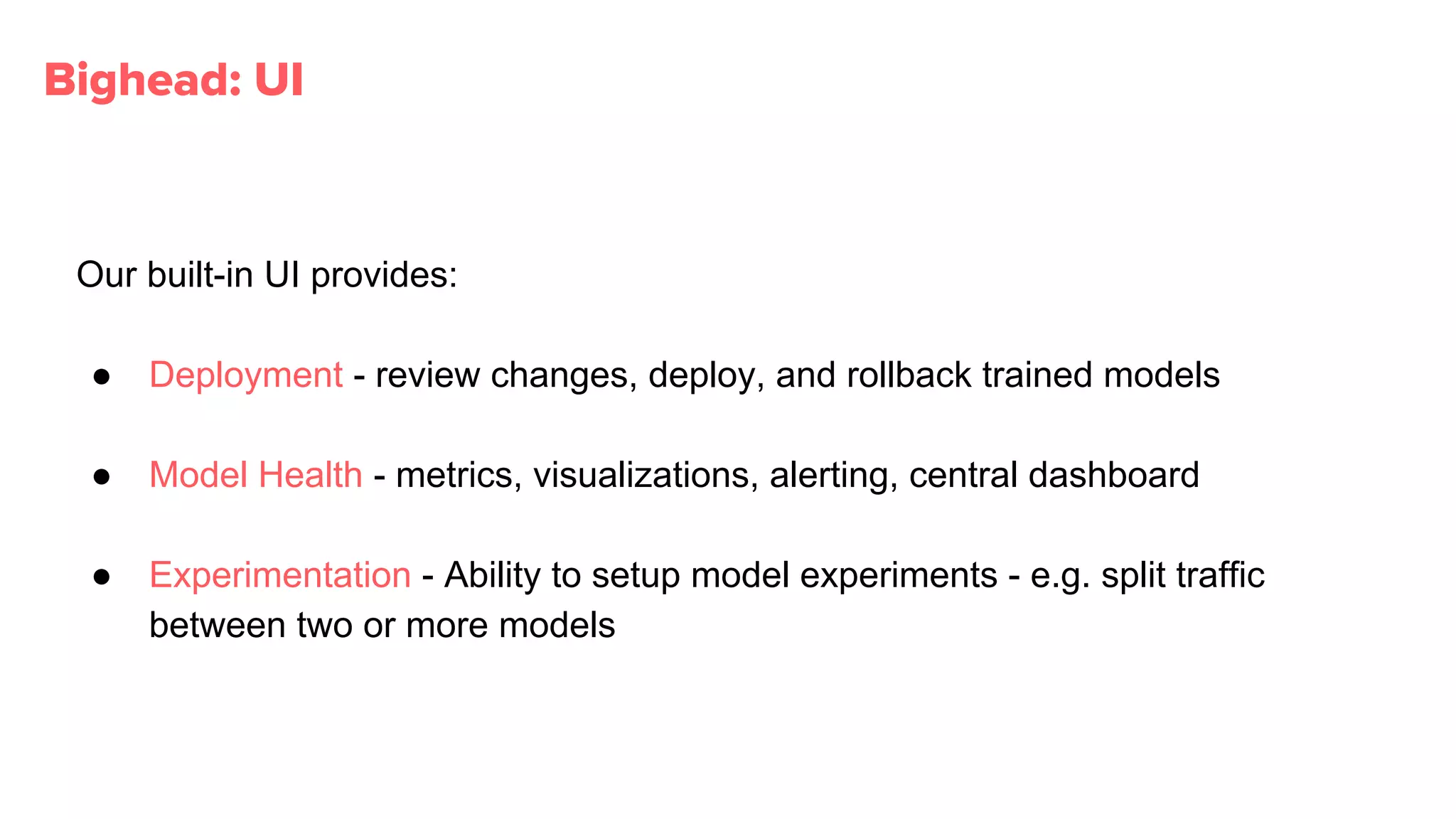
Our built-in UIprovides:
● Deployment - review changes, deploy, and rollback trained models
● Model Health - metrics, visualizations, alerting, central dashboard
● Experimentation - Ability to setup model experiments - e.g. split traffic
between two or more models
Bighead: UI
Bighead Service/UI
● Bighead’scentral model
management service
● The “Deployboard” for
trained ML models - i.e.
the sole source of truth
about what model is
deployed
53.
● End-to-End platformto build and deploy ML models to production
● Built on open source technology
○ Spark, Jupyter, Kubernetes, Scikit-learn, TF, XGBoost, etc.
● But had to fix various gaps in the path to productionisation
○ Generic online and offline inference service (that supports different
frameworks)
○ Feature generation and management framework
○ Model data transformation library
○ Model and data visualization libraries
○ Docker image customization service
○ Multi-tenant training environment
Bighead Summary
54.
Plan to OpenSource Soon
If you want to collaborate come talk to
andrew.hoh@airbnb.com