Developing Machine Learning Models
Kevin Tsai
GOTO Chicago 2018
Developing Machine Learning Models
Kevin Tsai, Google
Agenda
Machine Learning with tf.estimator
Performance pipelines with TFRecords and tf.data
Distributed Training with GPUs and TPUs
Machine Learning with tf.estimator
Model Serving
Training Pipeline
Inference Pipeline
Predictions
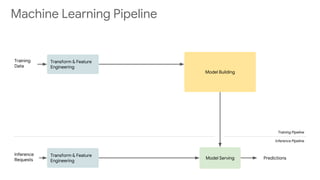
Model Building
Machine Learning Pipeline
Transform & Feature
Engineering
Transform & Feature
Engineering
Training
Data
Inference
Requests
Model Serving
Training Pipeline
Inference Pipeline
Predictions
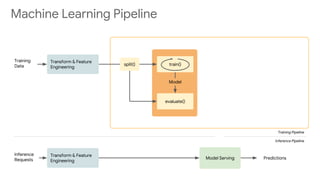
Machine Learning Pipeline
train()
evaluate()
Model
split()
Transform & Feature
Engineering
Transform & Feature
Engineering
Training
Data
Inference
Requests
Model Serving
Training Pipeline
Inference Pipeline
Predictions
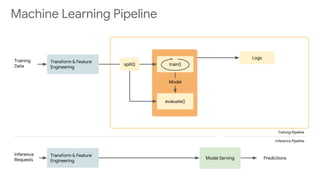
Machine Learning Pipeline
train()
evaluate()
Model
split()
Logs
Transform & Feature
Engineering
Transform & Feature
Engineering
Training
Data
Inference
Requests
Model Serving
Training Pipeline
Inference Pipeline
Predictions
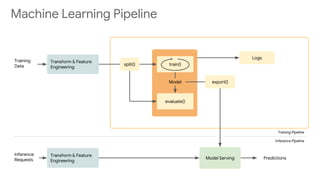
Machine Learning Pipeline
train()
export()
evaluate()
Model
split()
Logs
Transform & Feature
Engineering
Transform & Feature
Engineering
Training
Data
Inference
Requests
tf.estimator
estimator
model_fn
Model Serving
Training Pipeline
Inference Pipeline
Transform & Feature
Engineering
Transform & Feature
Engineering
Predictions
Training
Data
Inference
Requests
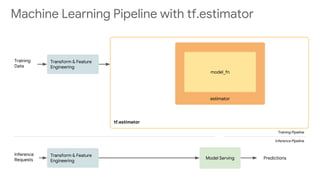
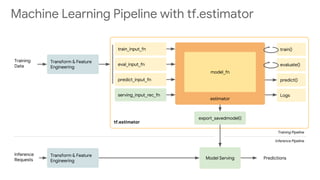
Machine Learning Pipeline with tf.estimator
tf.estimator
estimator
model_fn
train()
evaluate()
predict()
Model Serving
Training Pipeline
Inference Pipeline
Transform & Feature
Engineering
Transform & Feature
Engineering
Predictions
Training
Data
Inference
Requests
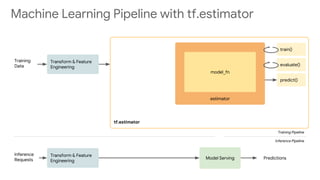
Machine Learning Pipeline with tf.estimator
tf.estimator
estimator
model_fn
train_input_fn
eval_input_fn
predict_input_fn
train()
evaluate()
predict()
Model Serving
Training Pipeline
Inference Pipeline
Transform & Feature
Engineering
Transform & Feature
Engineering
Predictions
Training
Data
Inference
Requests
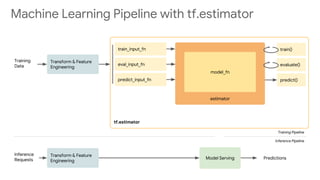
Machine Learning Pipeline with tf.estimator
tf.estimator
estimator
model_fn
train_input_fn
eval_input_fn
predict_input_fn
train()
evaluate()
predict()
Model Serving
Training Pipeline
Inference Pipeline
Transform & Feature
Engineering
Transform & Feature
Engineering
Predictions
Logs
Training
Data
Inference
Requests
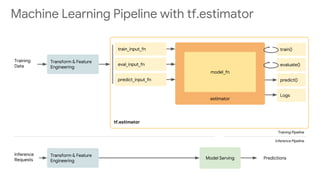
Machine Learning Pipeline with tf.estimator
tf.estimator
estimator
model_fn
train_input_fn
eval_input_fn
predict_input_fn
train()
evaluate()
predict()
serving_input_rec_fn
export_savedmodel()
Model Serving
Training Pipeline
Inference Pipeline
Transform & Feature
Engineering
Transform & Feature
Engineering
Predictions
Logs
Training
Data
Inference
Requests
Machine Learning Pipeline with tf.estimator
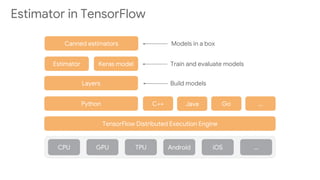
Estimator in TensorFlow
TensorFlow Distributed Execution Engine
Python
Layers
Canned estimators
Estimator Keras model
Models in a box
Train and evaluate models
Build models
C++ Java Go ...
CPU GPU TPU Android iOS ...
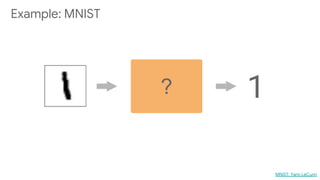
Example: MNIST
? 1
MNIST: Yann LeCunn
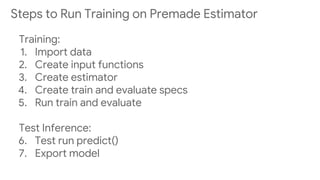
Training:
1. Import data
2. Create input functions
3. Create estimator
4. Create train and evaluate specs
5. Run train and evaluate
Test Inference:
6. Test run predict()
7. Export model
Steps to Run Training on Premade Estimator
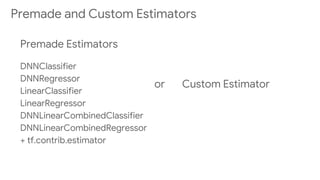
Premade Estimators
DNNClassifier
DNNRegressor
LinearClassifier
LinearRegressor
DNNLinearCombinedClassifier
DNNLinearCombinedRegressor
+ tf.contrib.estimator
Premade and Custom Estimators
or Custom Estimator
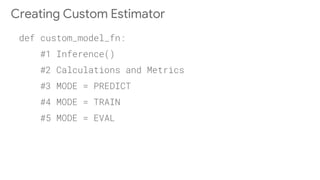
Creating Custom Estimator
(-1,784)
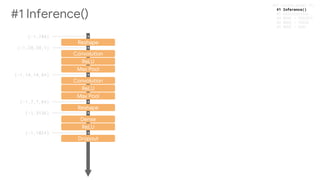
#1 Inference()
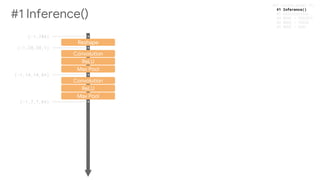
#1 Inference()
Reshape
Convolution
ReLU
Max Pool
Convolution
ReLU
Max Pool
(-1,784)
(-1,28,28,1)
(-1,14,14,64)
(-1,7,7,64)
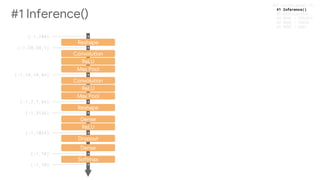
#1 Inference()
#1 Inference()
Reshape
Convolution
ReLU
Max Pool
Reshape
Dense
ReLU
Convolution
ReLU
Max Pool
(-1,784)
(-1,28,28,1)
(-1,14,14,64)
(-1,7,7,64)
(-1,1024)
(-1,3136)
#1 Inference()
Dropout
#1 Inference()
Reshape
Convolution
ReLU
Max Pool
Reshape
Dense
ReLU
Softmax
Convolution
ReLU
Max Pool
(-1,784)
(-1,28,28,1)
(-1,14,14,64)
(-1,7,7,64)
(-1,1024)
(-1,10)
(-1,3136)
(-1,10)
#1 Inference()
Dropout
Dense
#1 Inference()
Reshape
Convolution
ReLU
Max Pool
Reshape
Dense
ReLU
Softmax
Convolution
ReLU
Max Pool
(-1,784)
(-1,28,28,1)
(-1,14,14,64)
(-1,7,7,64)
(-1,1024)
(-1,10)
(-1,3136)
(-1,10)
log
tf.name_scope
tf.nn.conv2d
tf.nn.relu
tf.nn.max_pool
tf.summary.histogram(
tf.summary.histogram
log relu=False
tf.name_scope
tf.add tf.matmul
tf.nn.relu
tf.summary.histogram
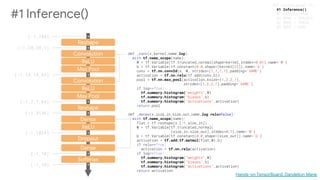
#1 Inference()
Dropout
Dense
Hands-on TensorBoard: Dandelion Mane
#1 Inference()
#### 1 INFERENCE MODEL
input_layer = tf.reshape(features["x"], [-1, 28, 28, 1])
conv1 = _conv(input_layer,kernel=[5,5,1,64],name='conv1',log=params['log'])
conv2 = _conv(conv1,kernel=[5,5,64,64],name='conv2',log=params['log'])
dense = _dense(conv2,size_in=7*7*64,size_out=params['dense_units'],
name='Dense',relu=True,log=params['log'])
if mode==tf.estimator.ModeKeys.TRAIN:
dense = tf.nn.dropout(dense,params['drop_out'])
logits = _dense(dense,size_in=params['dense_units'],
size_out=10,name='Output',relu=False,log=params['log'])
#1 Inference() and #2 Calculations and Metrics
#1 Inference()
#### 2 CALCULATIONS AND METRICS
predictions = {"classes": tf.argmax(input=logits,axis=1),
"logits": logits,
"probabilities": tf.nn.softmax(logits,name='softmax')}
export_outputs = {'predictions': tf.estimator.export.PredictOutput(predictions)}
if (mode==tf.estimator.ModeKeys.TRAIN or mode==tf.estimator.ModeKeys.EVAL):
loss = tf.losses.sparse_softmax_cross_entropy(labels=labels,logits=logits)
accuracy = tf.metrics.accuracy(
labels=labels, predictions=tf.argmax(logits,axis=1))
metrics = {'accuracy':accuracy}
tf.summary.scalar('accuracy',accuracy[1])
#1 Inference() and #2 Calculations and Metrics #2 Calculations
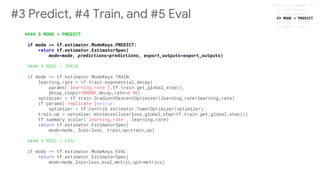
#### 3 MODE = PREDICT
if mode == tf.estimator.ModeKeys.PREDICT:
return tf.estimator.EstimatorSpec(
mode=mode, predictions=predictions, export_outputs=export_outputs)
#3 Predict, #4 Train, and #5 Eval #3 MODE = PREDICT
#### 4 MODE = TRAIN
if mode == tf.estimator.ModeKeys.TRAIN:
learning_rate = tf.train.exponential_decay(
params['learning_rate'],tf.train.get_global_step(),
decay_steps=100000,decay_rate=0.96)
optimizer = tf.train.GradientDescentOptimizer(learning_rate=learning_rate)
if params['replicate']==True:
optimizer = tf.contrib.estimator.TowerOptimizer(optimizer)
train_op = optimizer.minimize(loss=loss,global_step=tf.train.get_global_step())
tf.summary.scalar('learning_rate', learning_rate)
return tf.estimator.EstimatorSpec(
mode=mode, loss=loss, train_op=train_op)
#3 Predict, #4 Train, and #5 Eval #4 MODE = TRAIN
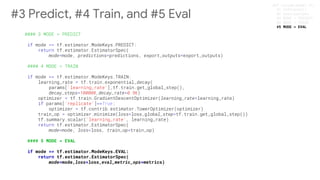
#### 5 MODE = EVAL
if mode == tf.estimator.ModeKeys.EVAL:
return tf.estimator.EstimatorSpec(
mode=mode,loss=loss,eval_metric_ops=metrics)
#3 Predict, #4 Train, and #5 Eval
#5 MODE = EVAL
TFRecords and tf.data
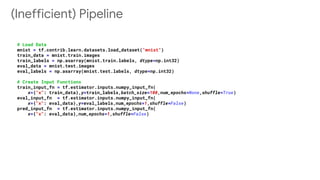
(Inefficient) Pipeline
# Load Data
mnist = tf.contrib.learn.datasets.load_dataset("mnist")
train_data = mnist.train.images
train_labels = np.asarray(mnist.train.labels, dtype=np.int32)
eval_data = mnist.test.images
eval_labels = np.asarray(mnist.test.labels, dtype=np.int32)
# Create Input Functions
train_input_fn = tf.estimator.inputs.numpy_input_fn(
x={"x": train_data},y=train_labels,batch_size=100,num_epochs=None,shuffle=True)
eval_input_fn = tf.estimator.inputs.numpy_input_fn(
x={"x": eval_data},y=eval_labels,num_epochs=1,shuffle=False)
pred_input_fn = tf.estimator.inputs.numpy_input_fn(
x={"x": eval_data},num_epochs=1,shuffle=False)
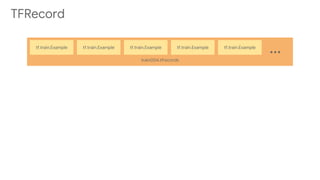
TFRecord
train004.tfrecords
tf.train.Example tf.train.Example tf.train.Example tf.train.Example tf.train.Example
...
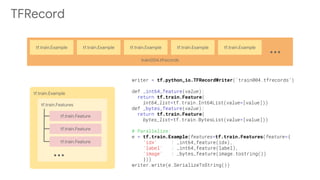
train004.tfrecords
tf.train.Example tf.train.Example tf.train.Example tf.train.Example tf.train.Example
...
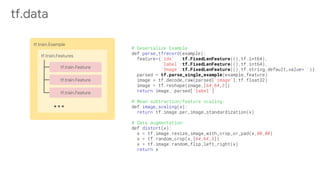
tf.train.Example
tf.train.Features
tf.train.Feature
tf.train.Feature
tf.train.Feature
...
tf.python_io.TFRecordWriter
tf.train.Feature
tf.train.Feature
tf.train.Example tf.train.Features
TFRecord
tf.data
tf.train.Example
tf.train.Features
tf.train.Feature
tf.train.Feature
tf.train.Feature
...
tf.FixedLenFeature
tf.FixedLenFeature
tf.FixedLenFeature
tf.parse_single_example
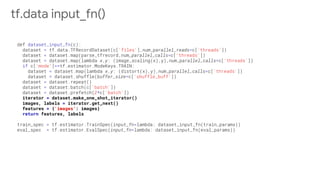
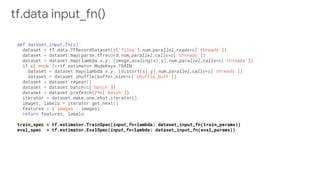
dataset = tf.data.TFRecordDataset(c['files'],num_parallel_reads=c['threads'])
tf.data input_fn()
dataset = dataset.map(parse_tfrecord,num_parallel_calls=c['threads'])
dataset = dataset.map(lambda x,y: (image_scaling(x),y),num_parallel_calls=c['threads'])
tf.data input_fn()
if c['mode']==tf.estimator.ModeKeys.TRAIN:
dataset = dataset.map(lambda x,y: (distort(x),y),num_parallel_calls=c['threads'])
dataset = dataset.shuffle(buffer_size=c['shuffle_buff'])
tf.data input_fn()
dataset = dataset.repeat()
dataset = dataset.batch(c['batch'])
dataset = dataset.prefetch(2*c['batch'])
tf.data input_fn()
iterator = dataset.make_one_shot_iterator()
images, labels = iterator.get_next()
features = {'images': images}
return features, labels
tf.data input_fn()
train_spec = tf.estimator.TrainSpec(input_fn=lambda: dataset_input_fn(train_params))
eval_spec = tf.estimator.EvalSpec(input_fn=lambda: dataset_input_fn(eval_params))
tf.data input_fn()
Distributed Training
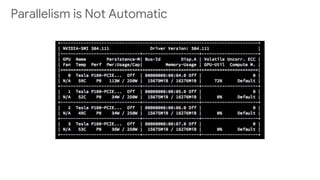
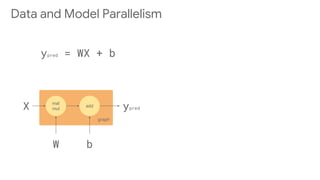
Parallelism is Not Automatic
graph
mat
mul
add
X
ypred = WX + b
W b
ypred
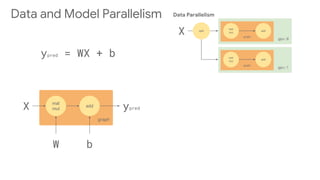
Data and Model Parallelism
gpu:0
graph
mat
mul
add
X
ypred = WX + b
W b
ypred
graph
mat
mul
add
gpu:1
graph
mat
mul
add
X
Data Parallelism
split
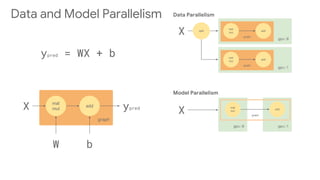
Data and Model Parallelism
gpu:1
gpu:0
graph
mat
mul
add
X
ypred = WX + b
W b
ypred
graph
mat
mul
add
gpu:1
graph
mat
mul
add
gpu:0
graph
mat
mul
add
X
Data Parallelism
Model Parallelism
X
split
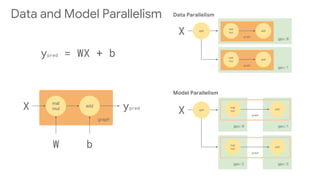
Data and Model Parallelism
gpu:1
gpu:0
graph
mat
mul
add
X
ypred = WX + b
W b
ypred
graph
mat
mul
add
gpu:1
graph
mat
mul
add
gpu:0
graph
mat
mul
add
X
Data Parallelism
Model Parallelism
X
gpu:3gpu:2
graph
mat
mul
add
split
split
Data and Model Parallelism
gpu:0
Output Reduction
graph
mat
mul
add
gpu:1
graph
mat
mul
add
X split
[ grad(gpu:0) , ypred(gpu:0) , loss(gpu:0) ]
[ grad(gpu:1) , ypred(gpu:1) , loss(gpu:1) ]
gpu:0
Output Reduction
graph
mat
mul
add
gpu:1
graph
mat
mul
add
X split
[ grad(gpu:0) , ypred(gpu:0) , loss(gpu:0) ]
[ grad(gpu:1) , ypred(gpu:1) , loss(gpu:1) ]
avg
con-
cat
sum
[ grad(model) , ypred(model) , loss(model) ]
Update
Model
Params
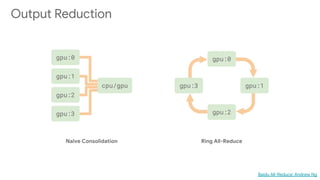
Output Reduction
gpu:3 gpu:1
gpu:0
gpu:2gpu:3
gpu:1
gpu:0
gpu:2
cpu/gpu
Naive Consolidation Ring All-Reduce
Baidu All-Reduce: Andrew Ng
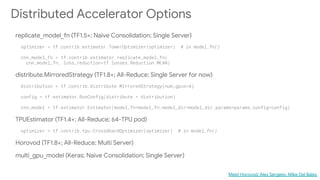
Distributed Accelerator Options
replicate_model_fn (TF1.5+; Naive Consolidation; Single Server)
distribute.MirroredStrategy (TF1.8+; All-Reduce; Single Server for now)
TPUEstimator (TF1.4+; All-Reduce; 64-TPU pod)
Horovod (TF1.8+; All-Reduce; Multi Server)
multi_gpu_model (Keras; Naive Consolidation; Single Server)
Meet Horovod: Alex Sergeev, Mike Del Balso
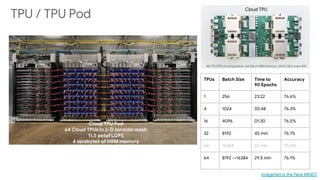
TPU / TPU Pod
TPUs Batch Size Time to
90 Epochs
Accuracy
1 256 23:22 76.6%
4 1024 05:48 76.3%
16 4096 01:30 76.5%
32 8192 45 min 76.1%
64 16384 22 min 75.0%
64 8192 ->16384 29.5 min 76.1%
ImageNet is the New MNIST
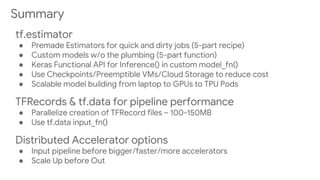
Summary
tf.estimator
● Premade Estimators for quick and dirty jobs (5-part recipe)
● Custom models w/o the plumbing (5-part function)
● Keras Functional API for Inference() in custom model_fn()
● Use Checkpoints/Preemptible VMs/Cloud Storage to reduce cost
● Scalable model building from laptop to GPUs to TPU Pods
TFRecords & tf.data for pipeline performance
● Parallelize creation of TFRecord files ~ 100-150MB
● Use tf.data input_fn()
Distributed Accelerator options
● Input pipeline before bigger/faster/more accelerators
● Scale Up before Out
Thank you.
Developing a ML model using TF Estimator

Developing a ML model using TF Estimator