Copyright Progressive Business Publications
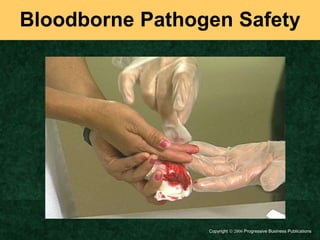
Bloodborne Pathogen Safety
Copyright Progressive Business Publications
Bloodborne Pathogen Standard
 Required by OSHA (29 CFR 1910.1030)
 EPA Worker Protection Standards mirror
OSHA and cover ALL government agencies.
 Applies to employees in all industries who
may be exposed to blood or other potentially
infectious materials
Copyright Progressive Business Publications
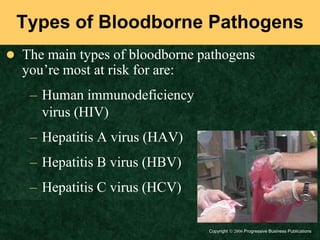
Types of Bloodborne Pathogens
 The main types of bloodborne pathogens
you’re most at risk for are:
– Human immunodeficiency
virus (HIV)
– Hepatitis A virus (HAV)
– Hepatitis B virus (HBV)
– Hepatitis C virus (HCV)
Copyright Progressive Business Publications
Human Immunodeficiency Virus
(HIV)
 The virus which causes AIDS
 Devastates the body’s immune system
 ~1 million persons living with HIV/AIDS in
U.S.; 45,000 new cases in 2000
 Symptoms: flu like illness, weakness,
diarrhea, weight loss.
 Signs of illness may not be present for years
 AIDS is chronic and fatal
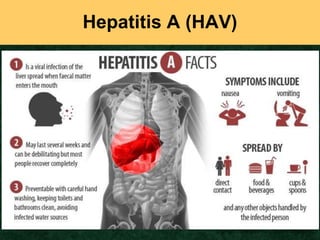
Hepatitis A (HAV)
Copyright Progressive Business Publications
Copyright Progressive Business Publications
Hepatitis B (HBV)
 Attacks the liver
 Survives in dried blood for up to 1 week at
room temperature
 300,000 new infections annually; 1.4% result
in death
 Symptoms: fatigue, nausea, vomiting,
abdominal pain, anorexia
 Can be chronic and fatal
Copyright Progressive Business Publications
Hepatitis C (HCV)
 Can lead to chronic hepatitis, cirrhosis and
liver cancer
 4 million infected in U.S.
– Only 25% diagnosed
 Can be chronic and fatal
 8,000-10,000 deaths annually
 No effective vaccine exists
Copyright Progressive Business Publications
Infectious Materials
 Blood
 Semen
 Vaginal secretions
 Cerebrospinal, synovial, pericardial, pleural,
peritoneal or amniotic fluids
 Saliva
 Any body fluid contaminated with blood
 Sewage carries other biohazards (E.coli)
Copyright Progressive Business Publications
Common On-the-Job Exposures
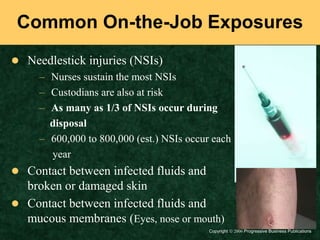
 Needlestick injuries (NSIs)
– Nurses sustain the most NSIs
– Custodians are also at risk
– As many as 1/3 of NSIs occur during
disposal
– 600,000 to 800,000 (est.) NSIs occur each
year
 Contact between infected fluids and
broken or damaged skin
 Contact between infected fluids and
mucous membranes (Eyes, nose or mouth)
Copyright Progressive Business Publications
Possible Exposure Incidents
 During an industrial
accident
 While administering
First Aid
 During post-accident
clean-up
 When performing routine maintenance or
janitorial work
Copyright Progressive Business Publications
Exposure Control Plan
 Universal precautions – everything is
contaminated
 Engineering controls – handwash facilities,
biohazard waste containers, sharps stations
 Work practice controls – PPE, spill clean-up,
waste disposal, exposure response
 Post-exposure follow-up
Copyright Progressive Business Publications
Personal Protective Equipment
 First line of defense
 Examples and uses
 Limitations – not stick proof!
 Rules:
– Remove before leaving
work area
– Wash hands after removing
– Properly dispose of contaminated PPE
Copyright Progressive Business Publications
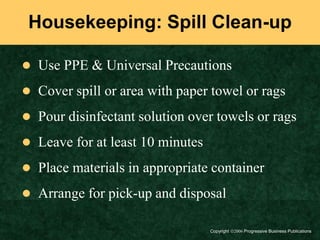
Housekeeping: Spill Clean-up
 Use PPE & Universal Precautions
 Cover spill or area with paper towel or rags
 Pour disinfectant solution over towels or rags
 Leave for at least 10 minutes
 Place materials in appropriate container
 Arrange for pick-up and disposal
Copyright Progressive Business Publications
Housekeeping: Waste Disposal
 Use PPE when handling
 Leak-proof containers
 Proper labeling
– Labels
– Red Bags or Containers
 Drop-off sites
Copyright Progressive Business Publications
What to Do if You’re Exposed?
 Contact with skin: wash exposed areas with
antibacterial soap and running water
 Contact with eyes or mucous membranes:
flush affected area with running water for at
least 15 minutes
 Contact with clothing: remove contaminated
clothing, wash underlying skin
 Report exposure to supervisor immediately
 Seek medical attention right away
Copyright Progressive Business Publications
Post-exposure Evaluation
 Following an exposure
incident, a medical
evaluation must be done
 Must follow procedures
specified by OSHA
 Must include lab tests
 Free to employee
 Diagnoses are confidential
Copyright Progressive Business Publications
Post-exposure Vaccination
If workers are exposed to infectious materials,
Hepatitis A/B vaccinations will be made
available
– Within 10 days
– At no cost to employee
– Under a healthcare professional’s
supervision
Copyright Progressive Business Publications
Follow-up Evaluation
Subsequent follow-up should include:
– Medical evaluation
– Testing of source person (if possible)
– Blood test
– Post-exposure prophylaxis
– Counseling
– Evaluation of illness
Copyright Progressive Business Publications
Our Obligations to You
 We must provide hand washing facilities
 We must provide you with personal
protective equipment
– Gloves
– Goggles
– Face shields
– Aprons
– Other appropriate PPE
Copyright Progressive Business Publications
Hazard Information
 We must inform you of bloodborne pathogen
hazards through:
– Warning labels with orange or orange/red
biohazard symbol
• Labels must be on
– Infectious waste containers
– Refrigerators and freezers
holding infectious materials
– Signs on restricted areas
Copyright Progressive Business Publications
Medical Records of Exposure
 For each exposed worker, medical records must be
kept for duration of employment plus 30 years
 Records must be confidential
 Must include:
– HVB vaccination status
– Exam results
– Medical testing and follow-up records
– Written opinions
– Info provided to healthcare professionals
Copyright Progressive Business Publications
Privacy of Medical Records
Private medical records of bloodborne
pathogen exposure:
– Must be accessible to
• Infected employees
• Anyone with the employee’s written consent
• OSHA
• NIOSH
– Aren’t accessible to us (your employer)
– Must be disposed of in accordance with
HIPAA privacy regulations
Copyright Progressive Business Publications
Training Records
 Records of your training for bloodborne
pathogen safety must be kept for three years
 The records must document:
– Dates of training
– Content of training
– Your trainer’s name and qualifications
– Names and titles of everyone who attended
the training
Copyright Progressive Business Publications
Summary
 Contact with infectious body fluids can expose you to
bloodborne pathogens.
 HIV and Hepatitis are commonly transmitted via
needlestick injuries, or contact between infected fluids
and skin or mucous membranes.
 If exposed to bloodborne pathogens, you must wash your
hands and eyes, report the incident, seek medical
attention, be vaccinated and undergo testing.
 As your employer, we’re responsible for providing an
exposure control plan, cleaning facilities, PPE and
hazard information.

Bloodborne Pathogen Safety

  • 1.
    Copyright Progressive BusinessPublications Bloodborne Pathogen Safety
  • 2.
    Copyright Progressive BusinessPublications Bloodborne Pathogen Standard  Required by OSHA (29 CFR 1910.1030)  EPA Worker Protection Standards mirror OSHA and cover ALL government agencies.  Applies to employees in all industries who may be exposed to blood or other potentially infectious materials
  • 3.
    Copyright Progressive BusinessPublications Types of Bloodborne Pathogens  The main types of bloodborne pathogens you’re most at risk for are: – Human immunodeficiency virus (HIV) – Hepatitis A virus (HAV) – Hepatitis B virus (HBV) – Hepatitis C virus (HCV)
  • 4.
    Copyright Progressive BusinessPublications Human Immunodeficiency Virus (HIV)  The virus which causes AIDS  Devastates the body’s immune system  ~1 million persons living with HIV/AIDS in U.S.; 45,000 new cases in 2000  Symptoms: flu like illness, weakness, diarrhea, weight loss.  Signs of illness may not be present for years  AIDS is chronic and fatal
  • 5.
    Hepatitis A (HAV) CopyrightProgressive Business Publications
  • 6.
    Copyright Progressive BusinessPublications Hepatitis B (HBV)  Attacks the liver  Survives in dried blood for up to 1 week at room temperature  300,000 new infections annually; 1.4% result in death  Symptoms: fatigue, nausea, vomiting, abdominal pain, anorexia  Can be chronic and fatal
  • 7.
    Copyright Progressive BusinessPublications Hepatitis C (HCV)  Can lead to chronic hepatitis, cirrhosis and liver cancer  4 million infected in U.S. – Only 25% diagnosed  Can be chronic and fatal  8,000-10,000 deaths annually  No effective vaccine exists
  • 8.
    Copyright Progressive BusinessPublications Infectious Materials  Blood  Semen  Vaginal secretions  Cerebrospinal, synovial, pericardial, pleural, peritoneal or amniotic fluids  Saliva  Any body fluid contaminated with blood  Sewage carries other biohazards (E.coli)
  • 9.
    Copyright Progressive BusinessPublications Common On-the-Job Exposures  Needlestick injuries (NSIs) – Nurses sustain the most NSIs – Custodians are also at risk – As many as 1/3 of NSIs occur during disposal – 600,000 to 800,000 (est.) NSIs occur each year  Contact between infected fluids and broken or damaged skin  Contact between infected fluids and mucous membranes (Eyes, nose or mouth)
  • 10.
    Copyright Progressive BusinessPublications Possible Exposure Incidents  During an industrial accident  While administering First Aid  During post-accident clean-up  When performing routine maintenance or janitorial work
  • 11.
    Copyright Progressive BusinessPublications Exposure Control Plan  Universal precautions – everything is contaminated  Engineering controls – handwash facilities, biohazard waste containers, sharps stations  Work practice controls – PPE, spill clean-up, waste disposal, exposure response  Post-exposure follow-up
  • 12.
    Copyright Progressive BusinessPublications Personal Protective Equipment  First line of defense  Examples and uses  Limitations – not stick proof!  Rules: – Remove before leaving work area – Wash hands after removing – Properly dispose of contaminated PPE
  • 13.
    Copyright Progressive BusinessPublications Housekeeping: Spill Clean-up  Use PPE & Universal Precautions  Cover spill or area with paper towel or rags  Pour disinfectant solution over towels or rags  Leave for at least 10 minutes  Place materials in appropriate container  Arrange for pick-up and disposal
  • 14.
    Copyright Progressive BusinessPublications Housekeeping: Waste Disposal  Use PPE when handling  Leak-proof containers  Proper labeling – Labels – Red Bags or Containers  Drop-off sites
  • 15.
    Copyright Progressive BusinessPublications What to Do if You’re Exposed?  Contact with skin: wash exposed areas with antibacterial soap and running water  Contact with eyes or mucous membranes: flush affected area with running water for at least 15 minutes  Contact with clothing: remove contaminated clothing, wash underlying skin  Report exposure to supervisor immediately  Seek medical attention right away
  • 16.
    Copyright Progressive BusinessPublications Post-exposure Evaluation  Following an exposure incident, a medical evaluation must be done  Must follow procedures specified by OSHA  Must include lab tests  Free to employee  Diagnoses are confidential
  • 17.
    Copyright Progressive BusinessPublications Post-exposure Vaccination If workers are exposed to infectious materials, Hepatitis A/B vaccinations will be made available – Within 10 days – At no cost to employee – Under a healthcare professional’s supervision
  • 18.
    Copyright Progressive BusinessPublications Follow-up Evaluation Subsequent follow-up should include: – Medical evaluation – Testing of source person (if possible) – Blood test – Post-exposure prophylaxis – Counseling – Evaluation of illness
  • 19.
    Copyright Progressive BusinessPublications Our Obligations to You  We must provide hand washing facilities  We must provide you with personal protective equipment – Gloves – Goggles – Face shields – Aprons – Other appropriate PPE
  • 20.
    Copyright Progressive BusinessPublications Hazard Information  We must inform you of bloodborne pathogen hazards through: – Warning labels with orange or orange/red biohazard symbol • Labels must be on – Infectious waste containers – Refrigerators and freezers holding infectious materials – Signs on restricted areas
  • 21.
    Copyright Progressive BusinessPublications Medical Records of Exposure  For each exposed worker, medical records must be kept for duration of employment plus 30 years  Records must be confidential  Must include: – HVB vaccination status – Exam results – Medical testing and follow-up records – Written opinions – Info provided to healthcare professionals
  • 22.
    Copyright Progressive BusinessPublications Privacy of Medical Records Private medical records of bloodborne pathogen exposure: – Must be accessible to • Infected employees • Anyone with the employee’s written consent • OSHA • NIOSH – Aren’t accessible to us (your employer) – Must be disposed of in accordance with HIPAA privacy regulations
  • 23.
    Copyright Progressive BusinessPublications Training Records  Records of your training for bloodborne pathogen safety must be kept for three years  The records must document: – Dates of training – Content of training – Your trainer’s name and qualifications – Names and titles of everyone who attended the training
  • 24.
    Copyright Progressive BusinessPublications Summary  Contact with infectious body fluids can expose you to bloodborne pathogens.  HIV and Hepatitis are commonly transmitted via needlestick injuries, or contact between infected fluids and skin or mucous membranes.  If exposed to bloodborne pathogens, you must wash your hands and eyes, report the incident, seek medical attention, be vaccinated and undergo testing.  As your employer, we’re responsible for providing an exposure control plan, cleaning facilities, PPE and hazard information.