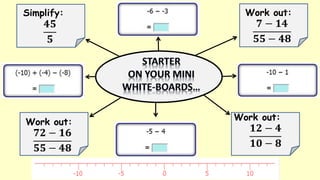
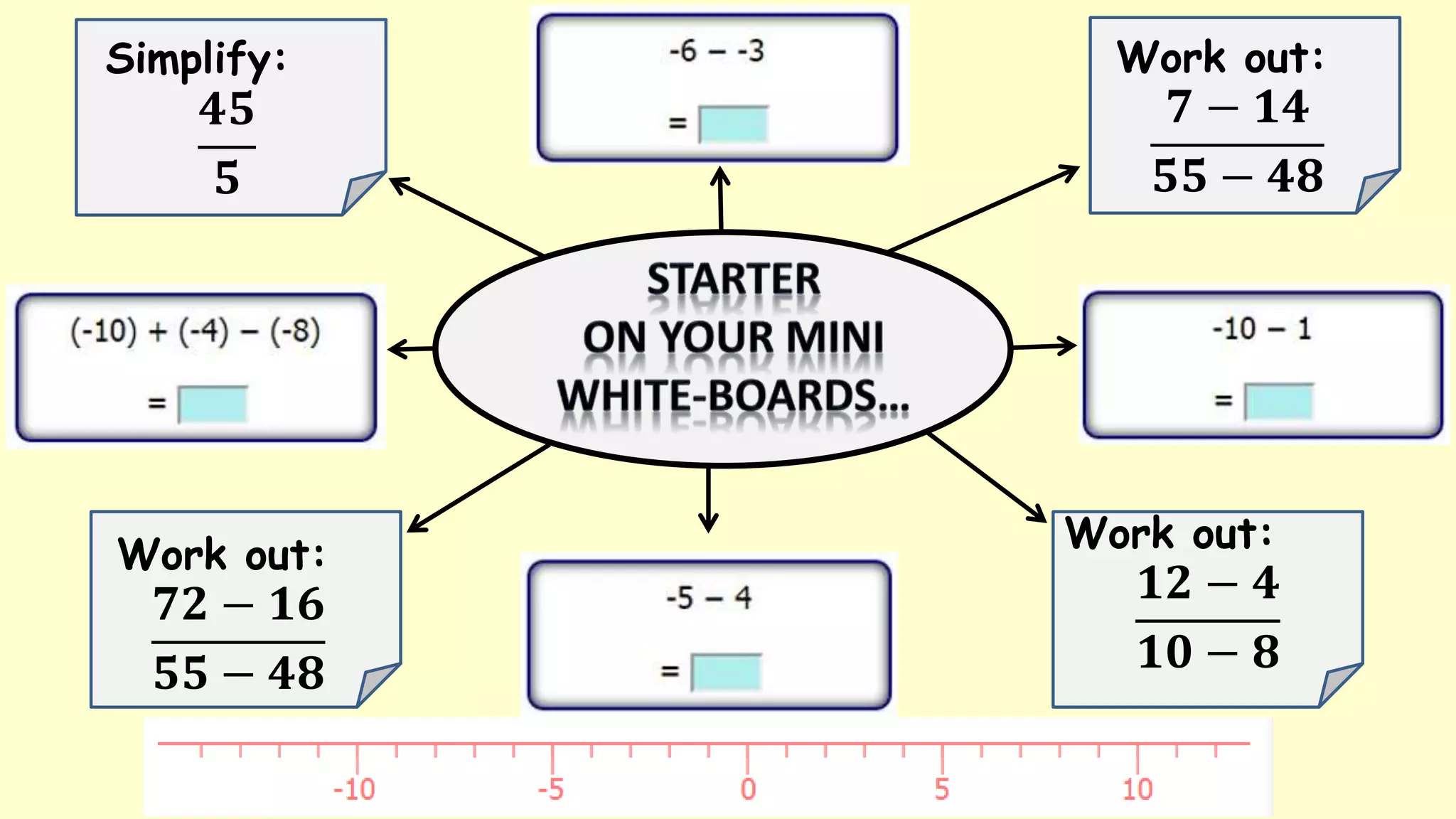
Work out:
𝟕𝟐 − 𝟏𝟔
𝟓𝟓 − 𝟒𝟖
Work out:
𝟏𝟐 − 𝟒
𝟏𝟎 − 𝟖
Simplify:
𝟒𝟓
𝟓
Work out:
𝟕 − 𝟏𝟒
𝟓𝟓 − 𝟒𝟖
LO: Investigate how to find the gradient of a
line given two coordinates
To be able to plot
coordinates in all
four quadrants
To be able to find
the gradient of a
line from a graph
To be able to find
the gradient given
only two
coordinates
GRADIENTS
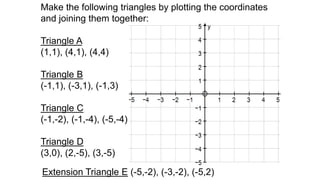
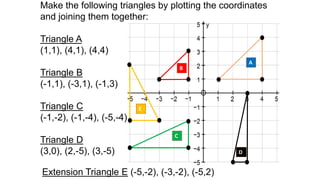
Make the following triangles by plotting the coordinates
and joining them together:
Triangle A
(1,1), (4,1), (4,4)
Triangle B
(-1,1), (-3,1), (-1,3)
Triangle C
(-1,-2), (-1,-4), (-5,-4)
Triangle D
(3,0), (2,-5), (3,-5)
Extension Triangle E (-5,-2), (-3,-2), (-5,2)
Make the following triangles by plotting the coordinates
and joining them together:
Triangle A
(1,1), (4,1), (4,4)
Triangle B
(-1,1), (-3,1), (-1,3)
Triangle C
(-1,-2), (-1,-4), (-5,-4)
Triangle D
(3,0), (2,-5), (3,-5)
Extension Triangle E (-5,-2), (-3,-2), (-5,2)
A
D
C
B
E
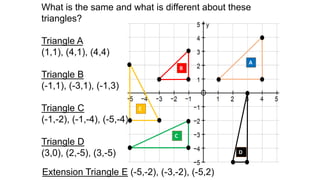
What is the same and what is different about these
triangles?
Triangle A
(1,1), (4,1), (4,4)
Triangle B
(-1,1), (-3,1), (-1,3)
Triangle C
(-1,-2), (-1,-4), (-5,-4)
Triangle D
(3,0), (2,-5), (3,-5)
Extension Triangle E (-5,-2), (-3,-2), (-5,2)
A
D
C
B
E
What is the same and what is different about these
triangles?
Triangle A
Triangle B
Triangle C
Triangle D
Extension Triangle E
A
D
C
B
E
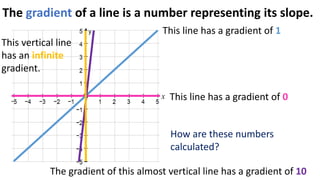
The gradient of a line is a number representing its slope.
x This line has a gradient of 0
This line has a gradient of 1
The gradient of this almost vertical line has a gradient of 10
How are these numbers
calculated?
This vertical line
has an infinite
gradient.
x
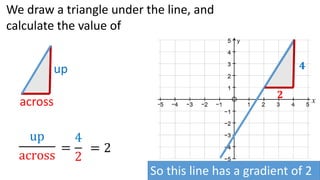
We draw a triangle under the line, and
calculate the value of
up
across
up
across
=
4
2
= 2
𝟒
𝟐
So this line has a gradient of 2
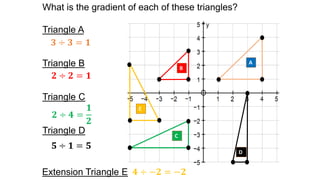
What is the gradient of each of these triangles?
Triangle A
Triangle B
Triangle C
Triangle D
Extension Triangle E
A
D
C
B
E
𝟑 ÷ 𝟑 = 𝟏
𝟐 ÷ 𝟐 = 𝟏
𝟐 ÷ 𝟒 =
𝟏
𝟐
𝟓 ÷ 𝟏 = 𝟓
𝟒 ÷ −𝟐 = −𝟐
x
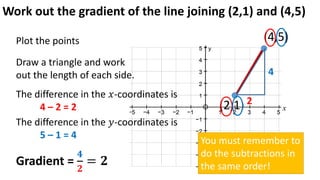
Work out the gradient of the line joining (2,1) and (4,5)
Plot the points
(2,1)
(4,5)
Draw a triangle and work
out the length of each side.
The difference in the 𝑥-coordinates is
4 – 2 = 2
The difference in the 𝑦-coordinates is
5 – 1 = 4
You must remember to
do the subtractions in
the same order!
2
4
Gradient =
𝟒
𝟐
= 𝟐
x
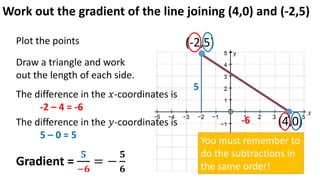
Work out the gradient of the line joining (4,0) and (-2,5)
Plot the points (-2,5)
(4,0)
Draw a triangle and work
out the length of each side.
The difference in the 𝑥-coordinates is
-2 – 4 = -6
The difference in the 𝑦-coordinates is
5 – 0 = 5
You must remember to
do the subtractions in
the same order!
-6
5
Gradient =
𝟓
−𝟔
= −
𝟓
𝟔
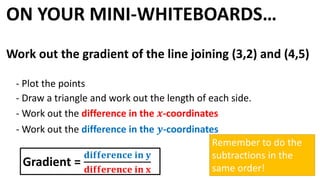
ON YOUR MINI-WHITEBOARDS…
Work out the gradient of the line joining (3,2) and (4,5)
- Plot the points
- Draw a triangle and work out the length of each side.
- Work out the difference in the 𝒙-coordinates
- Work out the difference in the 𝒚-coordinates
Gradient =
𝐝𝐢𝐟𝐟𝐞𝐫𝐞𝐧𝐜𝐞 𝐢𝐧 𝐲
𝐝𝐢𝐟𝐟𝐞𝐫𝐞𝐧𝐜𝐞 𝐢𝐧 𝐱
Remember to do the
subtractions in the
same order!
x
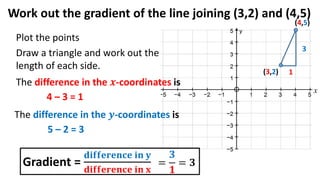
Work out the gradient of the line joining (3,2) and (4,5)
Plot the points
Draw a triangle and work out the
length of each side.
The difference in the 𝒙-coordinates is
The difference in the 𝒚-coordinates is
Gradient =
𝐝𝐢𝐟𝐟𝐞𝐫𝐞𝐧𝐜𝐞 𝐢𝐧 𝐲
𝐝𝐢𝐟𝐟𝐞𝐫𝐞𝐧𝐜𝐞 𝐢𝐧 𝐱
(3,2)
(4,5)
4 – 3 = 1
1
5 – 2 = 3
3
=
𝟑
𝟏
= 𝟑
ON YOUR MINI-WHITEBOARDS…
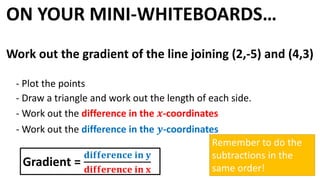
Work out the gradient of the line joining (2,-5) and (4,3)
- Plot the points
- Draw a triangle and work out the length of each side.
- Work out the difference in the 𝒙-coordinates
- Work out the difference in the 𝒚-coordinates
Gradient =
𝐝𝐢𝐟𝐟𝐞𝐫𝐞𝐧𝐜𝐞 𝐢𝐧 𝐲
𝐝𝐢𝐟𝐟𝐞𝐫𝐞𝐧𝐜𝐞 𝐢𝐧 𝐱
Remember to do the
subtractions in the
same order!
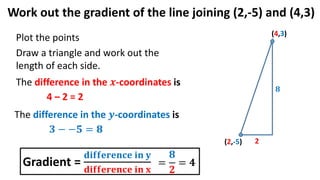
Work out the gradient of the line joining (2,-5) and (4,3)
Plot the points
Draw a triangle and work out the
length of each side.
The difference in the 𝒙-coordinates is
The difference in the 𝒚-coordinates is
Gradient =
𝐝𝐢𝐟𝐟𝐞𝐫𝐞𝐧𝐜𝐞 𝐢𝐧 𝐲
𝐝𝐢𝐟𝐟𝐞𝐫𝐞𝐧𝐜𝐞 𝐢𝐧 𝐱
4 – 2 = 2
𝟑 − −𝟓 = 𝟖
=
𝟖
𝟐
= 𝟒
(2,-5)
(4,3)
2
𝟖
End
Easy
Medium
Hard
What have we learnt…
To be able to plot
coordinates in all
four quadrants
To be able to find
the gradient of a
line from a graph
To be able to find
the gradient given
only two
coordinates
x
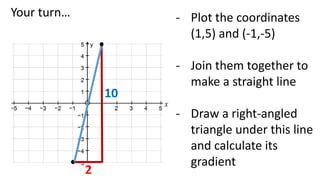
Your turn… - Plot the coordinates
(1,5) and (-1,-5)
- Join them together to
make a straight line
- Draw a right-angled
triangle under this line
and calculate its
gradient
10
2
x
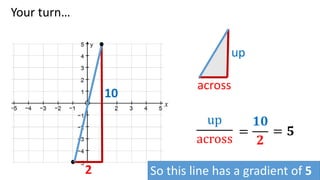
Your turn…
10
2
up
across
up
across
=
𝟏𝟎
𝟐
= 𝟓
So this line has a gradient of 5
x
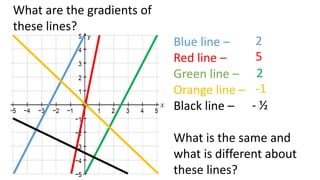
What are the gradients of
these lines?
Blue line –
Red line –
Green line –
Orange line –
Black line –
What is the same and
what is different about
these lines?
2
5
2
-1
- ½
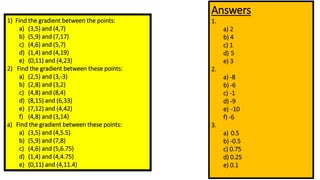
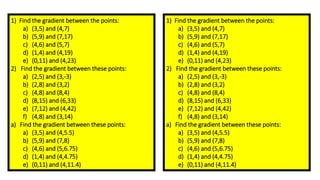
1) Find the gradient between the points:
a) (3,5) and (4,7)
b) (5,9) and (7,17)
c) (4,6) and (5,7)
d) (1,4) and (4,19)
e) (0,11) and (4,23)
2) Find the gradient between these points:
a) (2,5) and (3,-3)
b) (2,8) and (3,2)
c) (4,8) and (8,4)
d) (8,15) and (6,33)
e) (7,12) and (4,42)
f) (4,8) and (3,14)
a) Find the gradient between these points:
a) (3,5) and (4,5.5)
b) (5,9) and (7,8)
c) (4,6) and (5,6.75)
d) (1,4) and (4,4.75)
e) (0,11) and (4,11.4)
Answers
1.
a) 2
b) 4
c) 1
d) 5
e) 3
2.
a) -8
b) -6
c) -1
d) -9
e) -10
f) -6
3.
a) 0.5
b) -0.5
c) 0.75
d) 0.25
e) 0.1
x
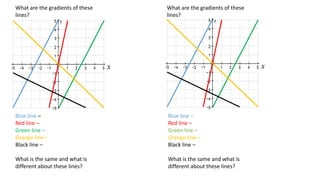
What are the gradients of these
lines?
Blue line –
Red line –
Green line –
Orange line –
Black line –
What is the same and what is
different about these lines?
x
What are the gradients of these
lines?
Blue line –
Red line –
Green line –
Orange line –
Black line –
What is the same and what is
different about these lines?
1) Find the gradient between the points:
a) (3,5) and (4,7)
b) (5,9) and (7,17)
c) (4,6) and (5,7)
d) (1,4) and (4,19)
e) (0,11) and (4,23)
2) Find the gradient between these points:
a) (2,5) and (3,-3)
b) (2,8) and (3,2)
c) (4,8) and (8,4)
d) (8,15) and (6,33)
e) (7,12) and (4,42)
f) (4,8) and (3,14)
a) Find the gradient between these points:
a) (3,5) and (4,5.5)
b) (5,9) and (7,8)
c) (4,6) and (5,6.75)
d) (1,4) and (4,4.75)
e) (0,11) and (4,11.4)
1) Find the gradient between the points:
a) (3,5) and (4,7)
b) (5,9) and (7,17)
c) (4,6) and (5,7)
d) (1,4) and (4,19)
e) (0,11) and (4,23)
2) Find the gradient between these points:
a) (2,5) and (3,-3)
b) (2,8) and (3,2)
c) (4,8) and (8,4)
d) (8,15) and (6,33)
e) (7,12) and (4,42)
f) (4,8) and (3,14)
a) Find the gradient between these points:
a) (3,5) and (4,5.5)
b) (5,9) and (7,8)
c) (4,6) and (5,6.75)
d) (1,4) and (4,4.75)
e) (0,11) and (4,11.4)
x

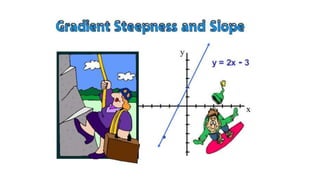
Gradient of a line

  • 1.
    Work out: 𝟕𝟐 −𝟏𝟔 𝟓𝟓 − 𝟒𝟖 Work out: 𝟏𝟐 − 𝟒 𝟏𝟎 − 𝟖 Simplify: 𝟒𝟓 𝟓 Work out: 𝟕 − 𝟏𝟒 𝟓𝟓 − 𝟒𝟖
  • 2.
    LO: Investigate howto find the gradient of a line given two coordinates To be able to plot coordinates in all four quadrants To be able to find the gradient of a line from a graph To be able to find the gradient given only two coordinates GRADIENTS
  • 3.
    Make the followingtriangles by plotting the coordinates and joining them together: Triangle A (1,1), (4,1), (4,4) Triangle B (-1,1), (-3,1), (-1,3) Triangle C (-1,-2), (-1,-4), (-5,-4) Triangle D (3,0), (2,-5), (3,-5) Extension Triangle E (-5,-2), (-3,-2), (-5,2)
  • 4.
    Make the followingtriangles by plotting the coordinates and joining them together: Triangle A (1,1), (4,1), (4,4) Triangle B (-1,1), (-3,1), (-1,3) Triangle C (-1,-2), (-1,-4), (-5,-4) Triangle D (3,0), (2,-5), (3,-5) Extension Triangle E (-5,-2), (-3,-2), (-5,2) A D C B E
  • 5.
    What is thesame and what is different about these triangles? Triangle A (1,1), (4,1), (4,4) Triangle B (-1,1), (-3,1), (-1,3) Triangle C (-1,-2), (-1,-4), (-5,-4) Triangle D (3,0), (2,-5), (3,-5) Extension Triangle E (-5,-2), (-3,-2), (-5,2) A D C B E
  • 6.
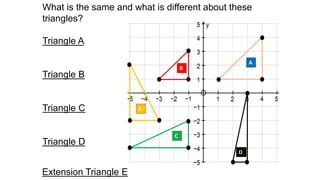
    What is thesame and what is different about these triangles? Triangle A Triangle B Triangle C Triangle D Extension Triangle E A D C B E
  • 10.
    The gradient ofa line is a number representing its slope. x This line has a gradient of 0 This line has a gradient of 1 The gradient of this almost vertical line has a gradient of 10 How are these numbers calculated? This vertical line has an infinite gradient.
  • 11.
    x We draw atriangle under the line, and calculate the value of up across up across = 4 2 = 2 𝟒 𝟐 So this line has a gradient of 2
  • 12.
    What is thegradient of each of these triangles? Triangle A Triangle B Triangle C Triangle D Extension Triangle E A D C B E 𝟑 ÷ 𝟑 = 𝟏 𝟐 ÷ 𝟐 = 𝟏 𝟐 ÷ 𝟒 = 𝟏 𝟐 𝟓 ÷ 𝟏 = 𝟓 𝟒 ÷ −𝟐 = −𝟐
  • 13.
    x Work out thegradient of the line joining (2,1) and (4,5) Plot the points (2,1) (4,5) Draw a triangle and work out the length of each side. The difference in the 𝑥-coordinates is 4 – 2 = 2 The difference in the 𝑦-coordinates is 5 – 1 = 4 You must remember to do the subtractions in the same order! 2 4 Gradient = 𝟒 𝟐 = 𝟐
  • 14.
    x Work out thegradient of the line joining (4,0) and (-2,5) Plot the points (-2,5) (4,0) Draw a triangle and work out the length of each side. The difference in the 𝑥-coordinates is -2 – 4 = -6 The difference in the 𝑦-coordinates is 5 – 0 = 5 You must remember to do the subtractions in the same order! -6 5 Gradient = 𝟓 −𝟔 = − 𝟓 𝟔
  • 15.
    ON YOUR MINI-WHITEBOARDS… Workout the gradient of the line joining (3,2) and (4,5) - Plot the points - Draw a triangle and work out the length of each side. - Work out the difference in the 𝒙-coordinates - Work out the difference in the 𝒚-coordinates Gradient = 𝐝𝐢𝐟𝐟𝐞𝐫𝐞𝐧𝐜𝐞 𝐢𝐧 𝐲 𝐝𝐢𝐟𝐟𝐞𝐫𝐞𝐧𝐜𝐞 𝐢𝐧 𝐱 Remember to do the subtractions in the same order!
  • 16.
    x Work out thegradient of the line joining (3,2) and (4,5) Plot the points Draw a triangle and work out the length of each side. The difference in the 𝒙-coordinates is The difference in the 𝒚-coordinates is Gradient = 𝐝𝐢𝐟𝐟𝐞𝐫𝐞𝐧𝐜𝐞 𝐢𝐧 𝐲 𝐝𝐢𝐟𝐟𝐞𝐫𝐞𝐧𝐜𝐞 𝐢𝐧 𝐱 (3,2) (4,5) 4 – 3 = 1 1 5 – 2 = 3 3 = 𝟑 𝟏 = 𝟑
  • 17.
    ON YOUR MINI-WHITEBOARDS… Workout the gradient of the line joining (2,-5) and (4,3) - Plot the points - Draw a triangle and work out the length of each side. - Work out the difference in the 𝒙-coordinates - Work out the difference in the 𝒚-coordinates Gradient = 𝐝𝐢𝐟𝐟𝐞𝐫𝐞𝐧𝐜𝐞 𝐢𝐧 𝐲 𝐝𝐢𝐟𝐟𝐞𝐫𝐞𝐧𝐜𝐞 𝐢𝐧 𝐱 Remember to do the subtractions in the same order!
  • 18.
    Work out thegradient of the line joining (2,-5) and (4,3) Plot the points Draw a triangle and work out the length of each side. The difference in the 𝒙-coordinates is The difference in the 𝒚-coordinates is Gradient = 𝐝𝐢𝐟𝐟𝐞𝐫𝐞𝐧𝐜𝐞 𝐢𝐧 𝐲 𝐝𝐢𝐟𝐟𝐞𝐫𝐞𝐧𝐜𝐞 𝐢𝐧 𝐱 4 – 2 = 2 𝟑 − −𝟓 = 𝟖 = 𝟖 𝟐 = 𝟒 (2,-5) (4,3) 2 𝟖
  • 19.
  • 20.
    What have welearnt… To be able to plot coordinates in all four quadrants To be able to find the gradient of a line from a graph To be able to find the gradient given only two coordinates
  • 21.
    x Your turn… -Plot the coordinates (1,5) and (-1,-5) - Join them together to make a straight line - Draw a right-angled triangle under this line and calculate its gradient 10 2
  • 22.
  • 23.
    x What are thegradients of these lines? Blue line – Red line – Green line – Orange line – Black line – What is the same and what is different about these lines? 2 5 2 -1 - ½
  • 25.
    1) Find thegradient between the points: a) (3,5) and (4,7) b) (5,9) and (7,17) c) (4,6) and (5,7) d) (1,4) and (4,19) e) (0,11) and (4,23) 2) Find the gradient between these points: a) (2,5) and (3,-3) b) (2,8) and (3,2) c) (4,8) and (8,4) d) (8,15) and (6,33) e) (7,12) and (4,42) f) (4,8) and (3,14) a) Find the gradient between these points: a) (3,5) and (4,5.5) b) (5,9) and (7,8) c) (4,6) and (5,6.75) d) (1,4) and (4,4.75) e) (0,11) and (4,11.4) Answers 1. a) 2 b) 4 c) 1 d) 5 e) 3 2. a) -8 b) -6 c) -1 d) -9 e) -10 f) -6 3. a) 0.5 b) -0.5 c) 0.75 d) 0.25 e) 0.1
  • 26.
    x What are thegradients of these lines? Blue line – Red line – Green line – Orange line – Black line – What is the same and what is different about these lines? x What are the gradients of these lines? Blue line – Red line – Green line – Orange line – Black line – What is the same and what is different about these lines?
  • 27.
    1) Find thegradient between the points: a) (3,5) and (4,7) b) (5,9) and (7,17) c) (4,6) and (5,7) d) (1,4) and (4,19) e) (0,11) and (4,23) 2) Find the gradient between these points: a) (2,5) and (3,-3) b) (2,8) and (3,2) c) (4,8) and (8,4) d) (8,15) and (6,33) e) (7,12) and (4,42) f) (4,8) and (3,14) a) Find the gradient between these points: a) (3,5) and (4,5.5) b) (5,9) and (7,8) c) (4,6) and (5,6.75) d) (1,4) and (4,4.75) e) (0,11) and (4,11.4) 1) Find the gradient between the points: a) (3,5) and (4,7) b) (5,9) and (7,17) c) (4,6) and (5,7) d) (1,4) and (4,19) e) (0,11) and (4,23) 2) Find the gradient between these points: a) (2,5) and (3,-3) b) (2,8) and (3,2) c) (4,8) and (8,4) d) (8,15) and (6,33) e) (7,12) and (4,42) f) (4,8) and (3,14) a) Find the gradient between these points: a) (3,5) and (4,5.5) b) (5,9) and (7,8) c) (4,6) and (5,6.75) d) (1,4) and (4,4.75) e) (0,11) and (4,11.4)
  • 28.