Resources for FLOSS Projects By Jon “The Nice Guy” Spriggs Presented first at OggCamp '10
Who am I? I'm known as JonTheNiceGuy
I'm a Firewall Engineer by day
I write mediocre PHP projects by night
I've started around 10 Open Source Projects
You're likely not to have ever used any of them
Except one – perhaps!
3^h 4 reasons why you are here You're a FLOSS developer who's about to start a new project
You're a FLOSS developer who's started a project before and wants to know what else is out there
You've heard of me (Hi mum!) and want to hear me talk!
You're bored and there are no other talks more interesting (no-one expects the spanish inquisition!) All good reasons. Thanks for being here!
Why am I talking about this? I've been involved in Free Software since 1999, when I first started actively pushing Linux solutions on people around me.
I first started contributing to Free Software in 2001 when I released some re-written code for PHP-Nuke on my personal website.
Sometimes it's not clear what sites and services bring what value, and why you should use them. I should know!
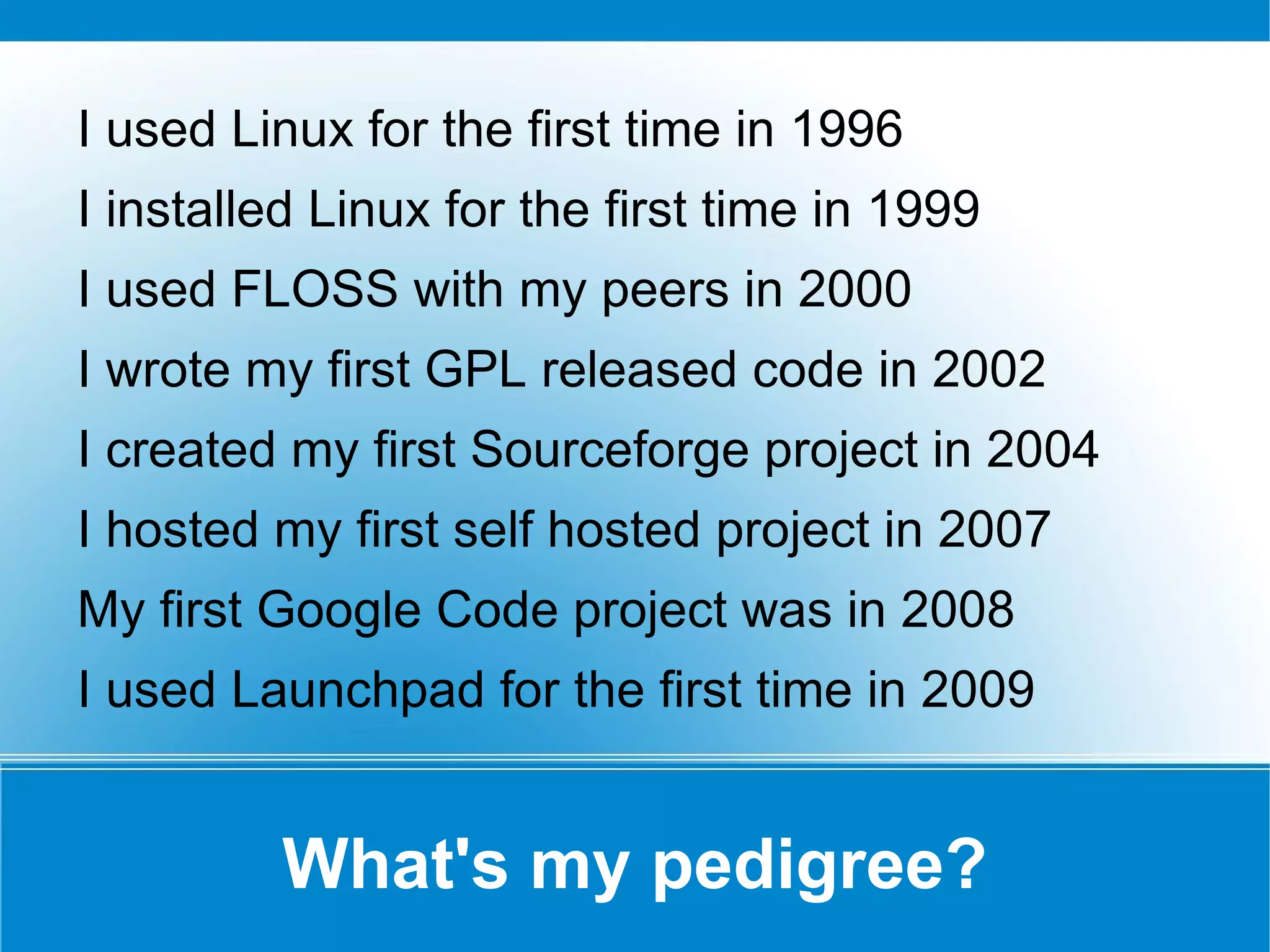
What's my pedigree? I used Linux for the first time in 1996
I installed Linux for the first time in 1999
I used FLOSS with my peers in 2000
I wrote my first GPL released code in 2002
I created my first Sourceforge project in 2004
I hosted my first self hosted project in 2007
My first Google Code project was in 2008
I used Launchpad for the first time in 2009
Getting Started Have you checked no-one's done this before?
Pick a license
Select your hosting method
Pick your tools
Advertise
…
Profit?

Resources For Floss Projects

  • 1.
    Resources for FLOSSProjects By Jon “The Nice Guy” Spriggs Presented first at OggCamp '10
  • 2.
    Who am I?I'm known as JonTheNiceGuy
  • 3.
    I'm a FirewallEngineer by day
  • 4.
    I write mediocrePHP projects by night
  • 5.
    I've started around10 Open Source Projects
  • 6.
    You're likely notto have ever used any of them
  • 7.
  • 8.
    3^h 4 reasonswhy you are here You're a FLOSS developer who's about to start a new project
  • 9.
    You're a FLOSSdeveloper who's started a project before and wants to know what else is out there
  • 10.
    You've heard ofme (Hi mum!) and want to hear me talk!
  • 11.
    You're bored andthere are no other talks more interesting (no-one expects the spanish inquisition!) All good reasons. Thanks for being here!
  • 12.
    Why am Italking about this? I've been involved in Free Software since 1999, when I first started actively pushing Linux solutions on people around me.
  • 13.
    I first startedcontributing to Free Software in 2001 when I released some re-written code for PHP-Nuke on my personal website.
  • 14.
    Sometimes it's notclear what sites and services bring what value, and why you should use them. I should know!
  • 15.
    What's my pedigree?I used Linux for the first time in 1996
  • 16.
    I installed Linuxfor the first time in 1999
  • 17.
    I used FLOSSwith my peers in 2000
  • 18.
    I wrote myfirst GPL released code in 2002
  • 19.
    I created myfirst Sourceforge project in 2004
  • 20.
    I hosted myfirst self hosted project in 2007
  • 21.
    My first GoogleCode project was in 2008
  • 22.
    I used Launchpadfor the first time in 2009
  • 23.
    Getting Started Haveyou checked no-one's done this before?
  • 24.
  • 25.
  • 26.
  • 27.
  • 28.
  • 29.
  • 30.
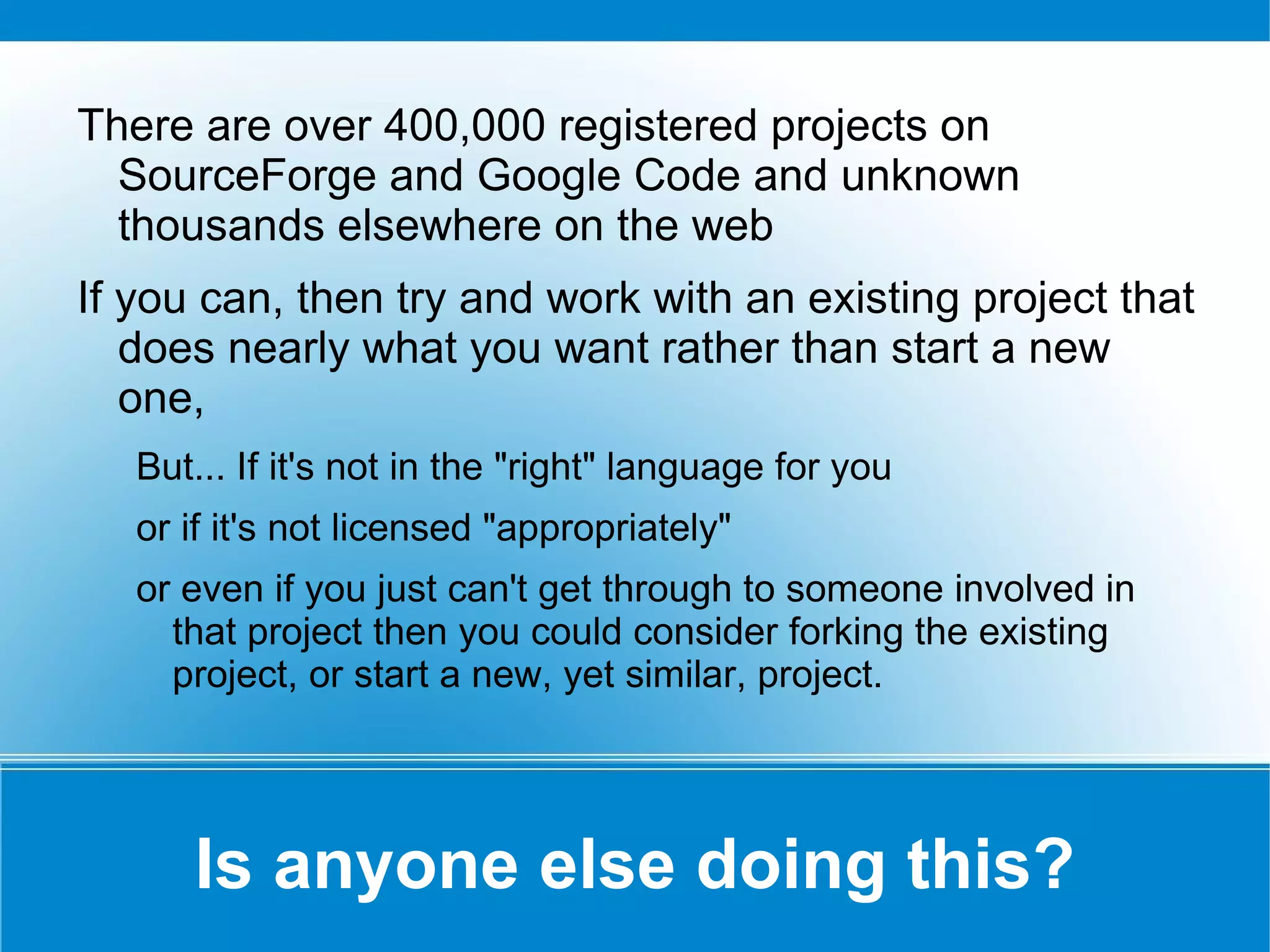
    Is anyone elsedoing this? There are over 400,000 registered projects on SourceForge and Google Code and unknown thousands elsewhere on the web
  • 31.
    If you can,then try and work with an existing project that does nearly what you want rather than start a new one, But... If it's not in the "right" language for you
  • 32.
    or if it'snot licensed "appropriately"
  • 33.
    or even ifyou just can't get through to someone involved in that project then you could consider forking the existing project, or start a new, yet similar, project.
  • 34.
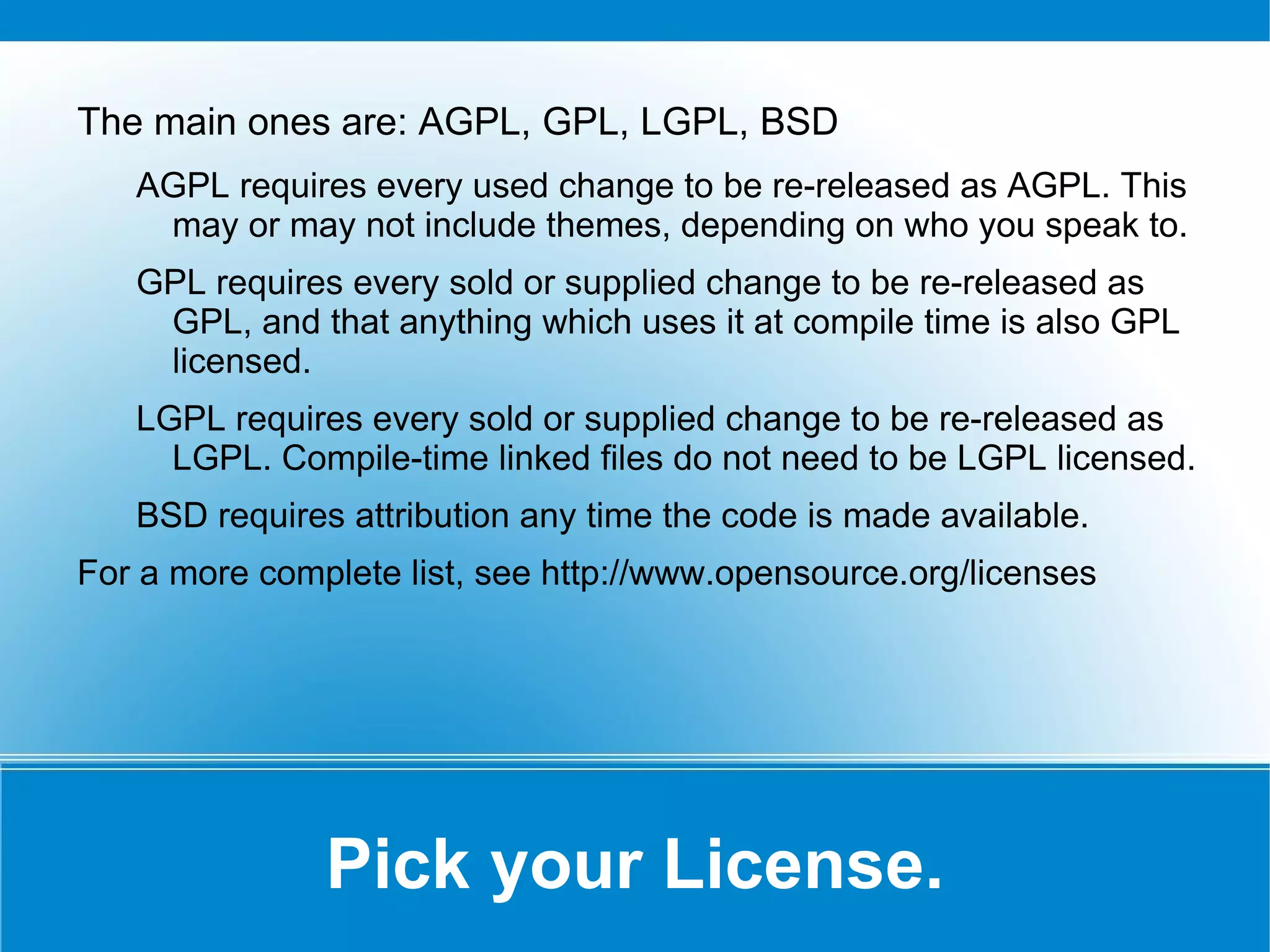
    Pick your License.The main ones are: AGPL, GPL, LGPL, BSD AGPL requires every used change to be re-released as AGPL. This may or may not include themes, depending on who you speak to.
  • 35.
    GPL requires everysold or supplied change to be re-released as GPL, and that anything which uses it at compile time is also GPL licensed.
  • 36.
    LGPL requires everysold or supplied change to be re-released as LGPL. Compile-time linked files do not need to be LGPL licensed.
  • 37.
    BSD requires attributionany time the code is made available. For a more complete list, see http://www.opensource.org/licenses
  • 38.
    Pick your hostingWill you be self-hosting or using a hosted service?
  • 39.
    Self hosting isbetter for larger projects, or for non-public development.
  • 40.
    Hosted services makesit easier at the beginning of a project to just concentrate on the coding. BUT many hosted services have an overwhelming array of options.
  • 41.
    Your choice ofhosting and the software driving that will define your Version Control Software. This will be the main area I'm focusing on in this talk!
  • 42.
    Host Externally orLocally? Going the hosted route?
  • 43.
    Your main choicesare: Sourceforge, Launchpad, Google Code, Github, Gitorious
  • 44.
    For more options,see http://en.wikipedia.org/wiki/Comparison_of_open_source_software_hosting_facilities
  • 45.
  • 46.
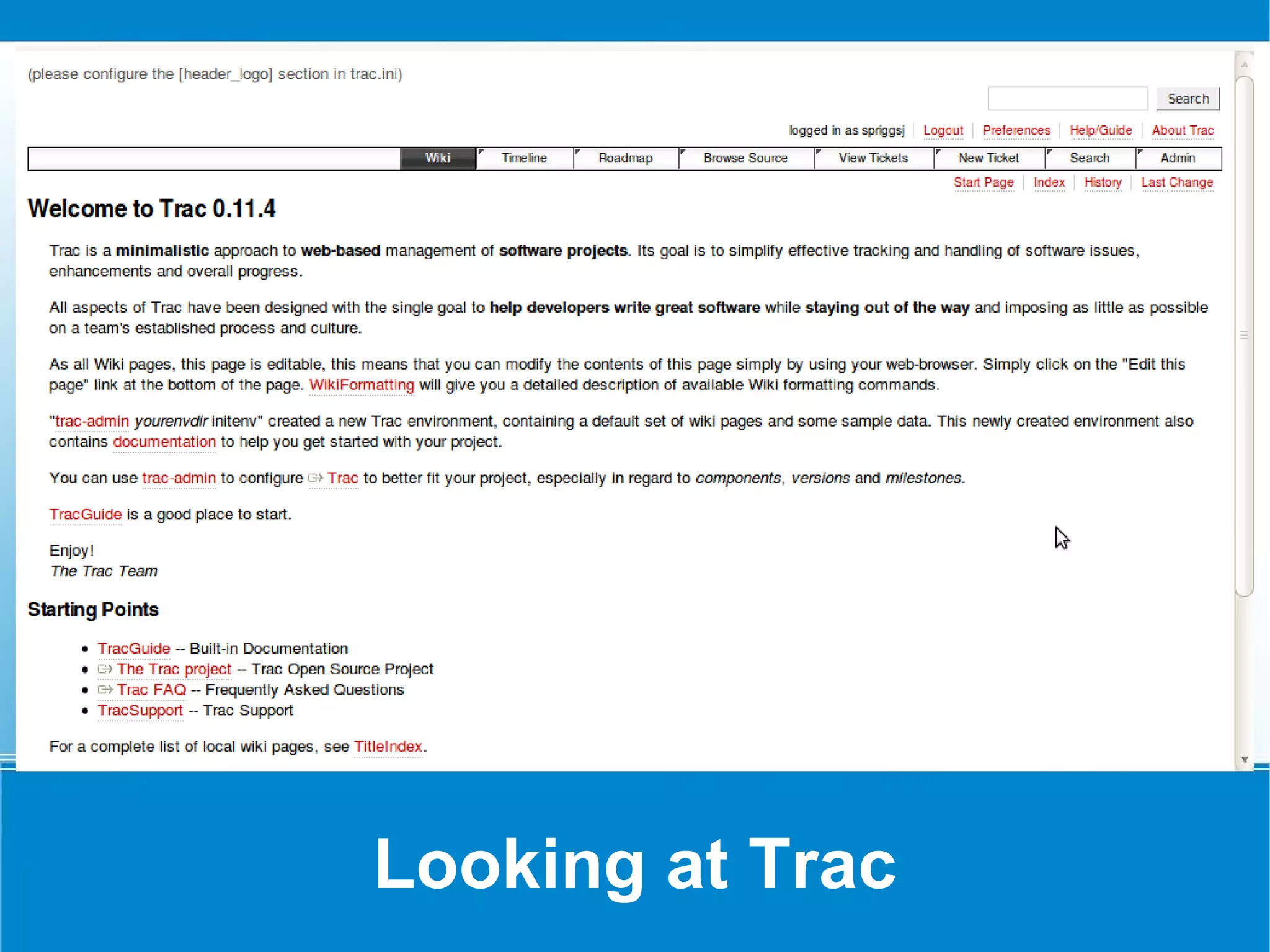
    Your main choicesare: Trac, Savane or Horde Chora+Whups+Wicked.
  • 47.
    For more optionssee http://en.wikipedia.org/wiki/Forge_(software)
  • 48.
  • 49.
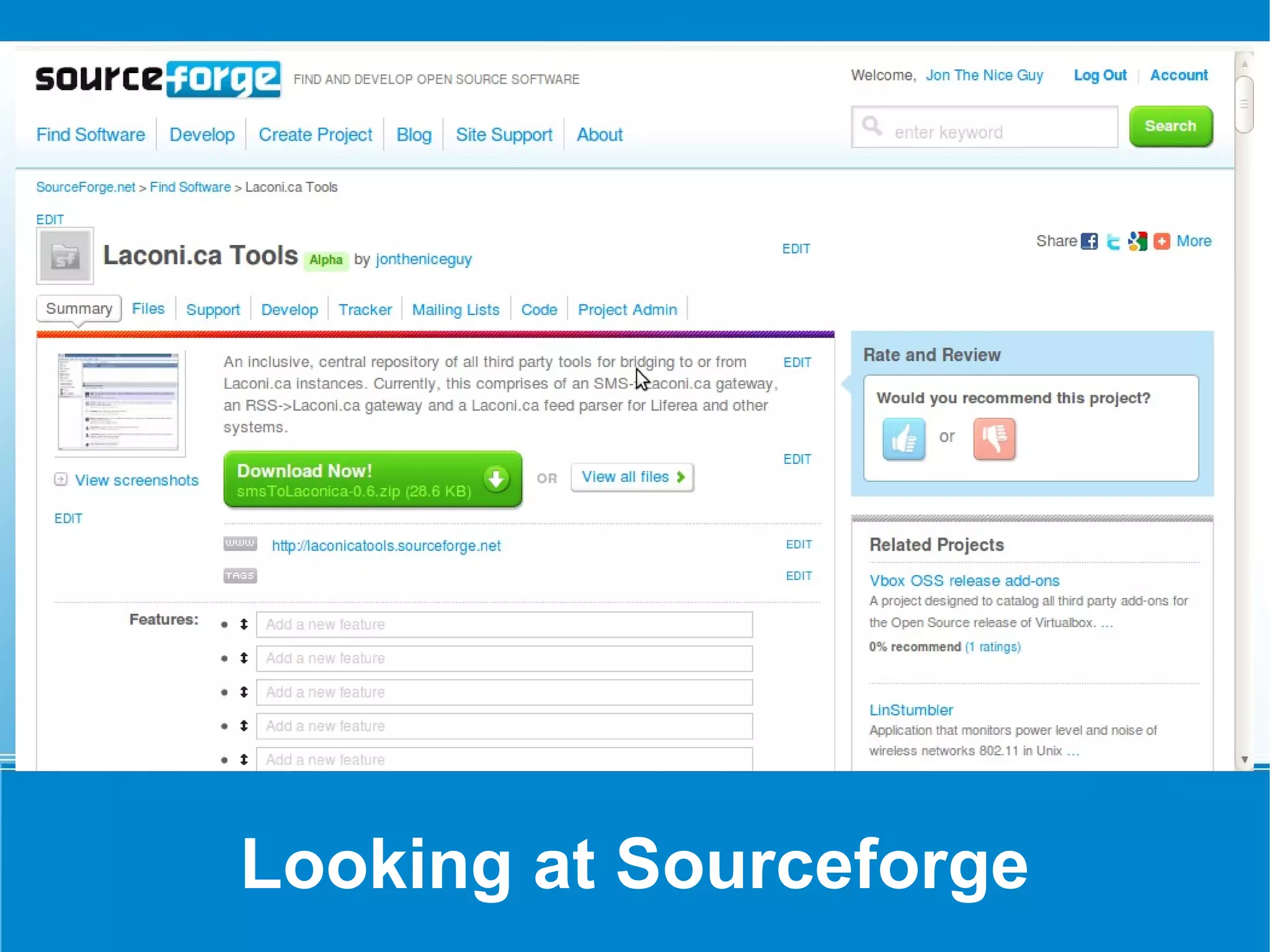
    Sourceforge Sourceforge isconsidered to be the original “forge” resource for Open Source developers
  • 50.
    For various reasons,many developers and projects mistrust Sourceforge. There are concerns that it's source code was Closed, then Free Software, then Closed again. It provides mailing lists, ticket trackers, forums, and a wide range of other support tools.
  • 51.
    It hosts CVS,SVN, Bazaar, Git and Hg services
  • 52.
    Some say thereare too many options!
  • 53.
  • 54.
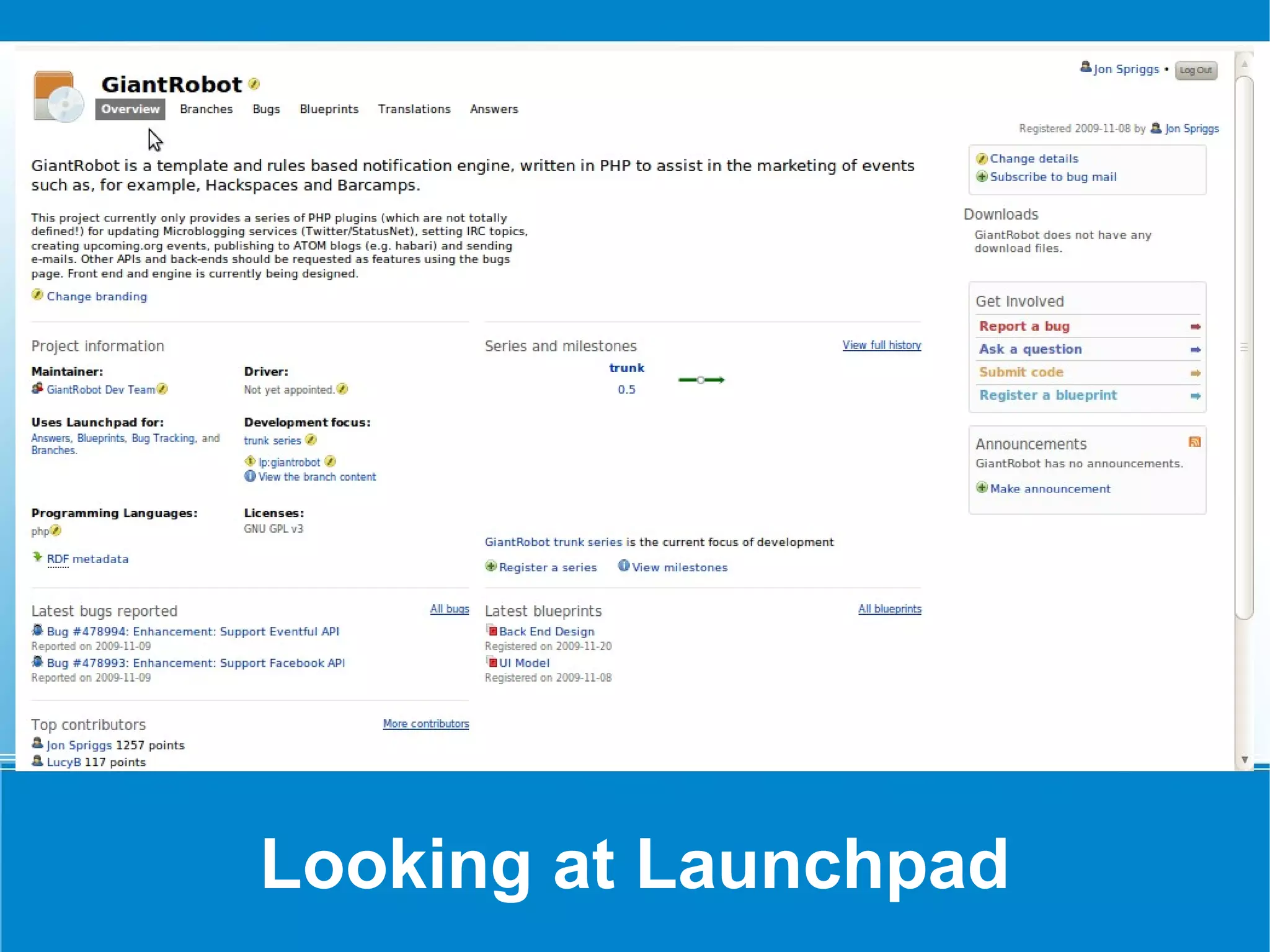
    Launchpad Launchpad isprimarily used by Canonical for the Ubuntu project
  • 55.
    It was initiallyclosed source, but was opened up a while ago.
  • 56.
    It offers tickettrackers (including upstream linking), blueprints, FAQ pages and translations
  • 57.
    It offers onlyBazaar version control software.
  • 58.
    I consider itto be the most complex and enterprise focused of all of these services.
  • 59.
  • 60.
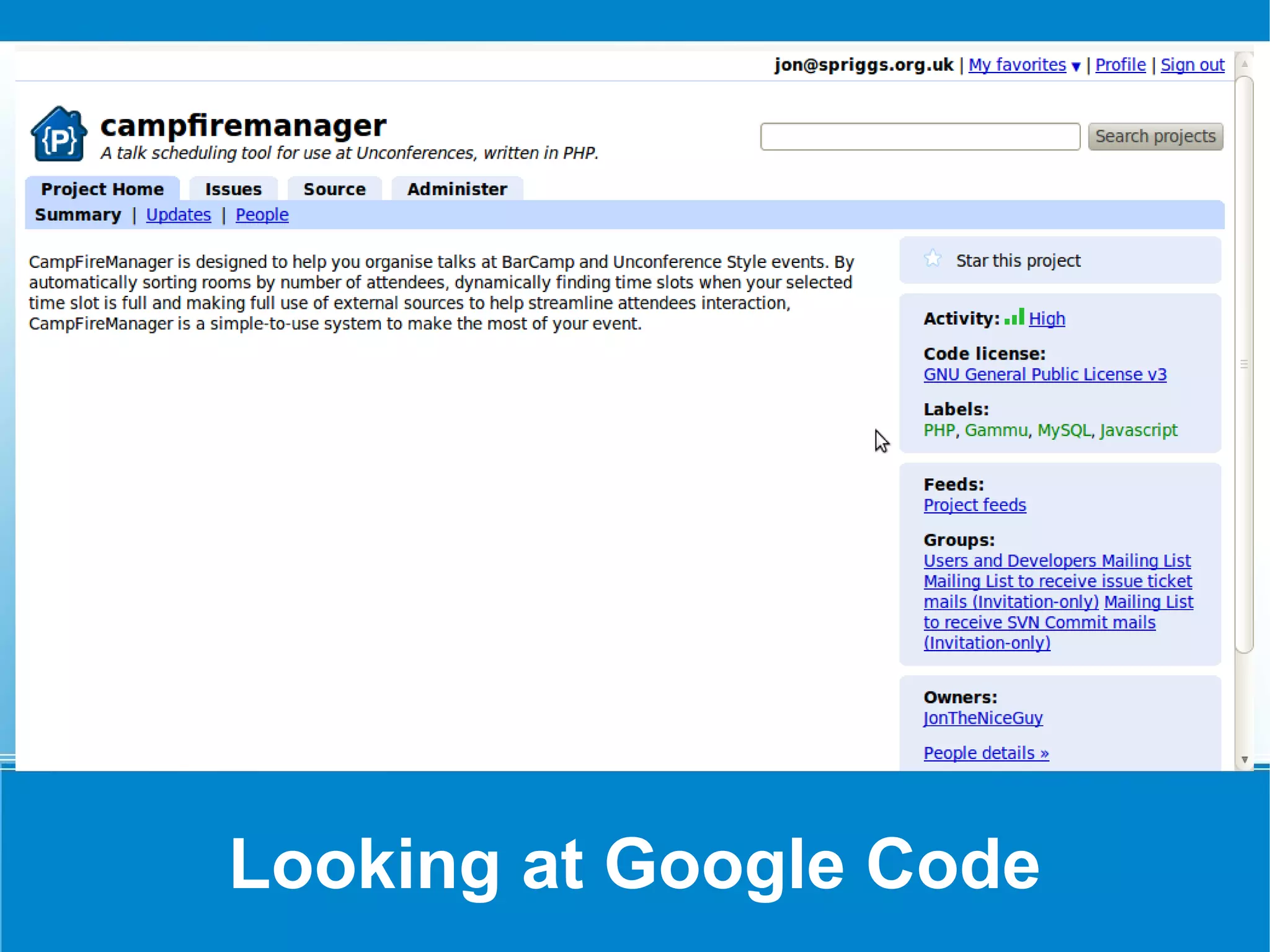
    Google Code GoogleCode was released by Google and now hosts all of their Open Source code... which doesn't include the code for Google Code!
  • 61.
    It offers nativeticket tracking, limited (admin-only) access wiki and downloads.
  • 62.
    It provides easylinks to other Google products – Groups, Blogger, Analytics
  • 63.
    It offers Subversionand Mercurial Version Control Software
  • 64.
    I believe itto be the least complex hosted service.
  • 65.
  • 66.
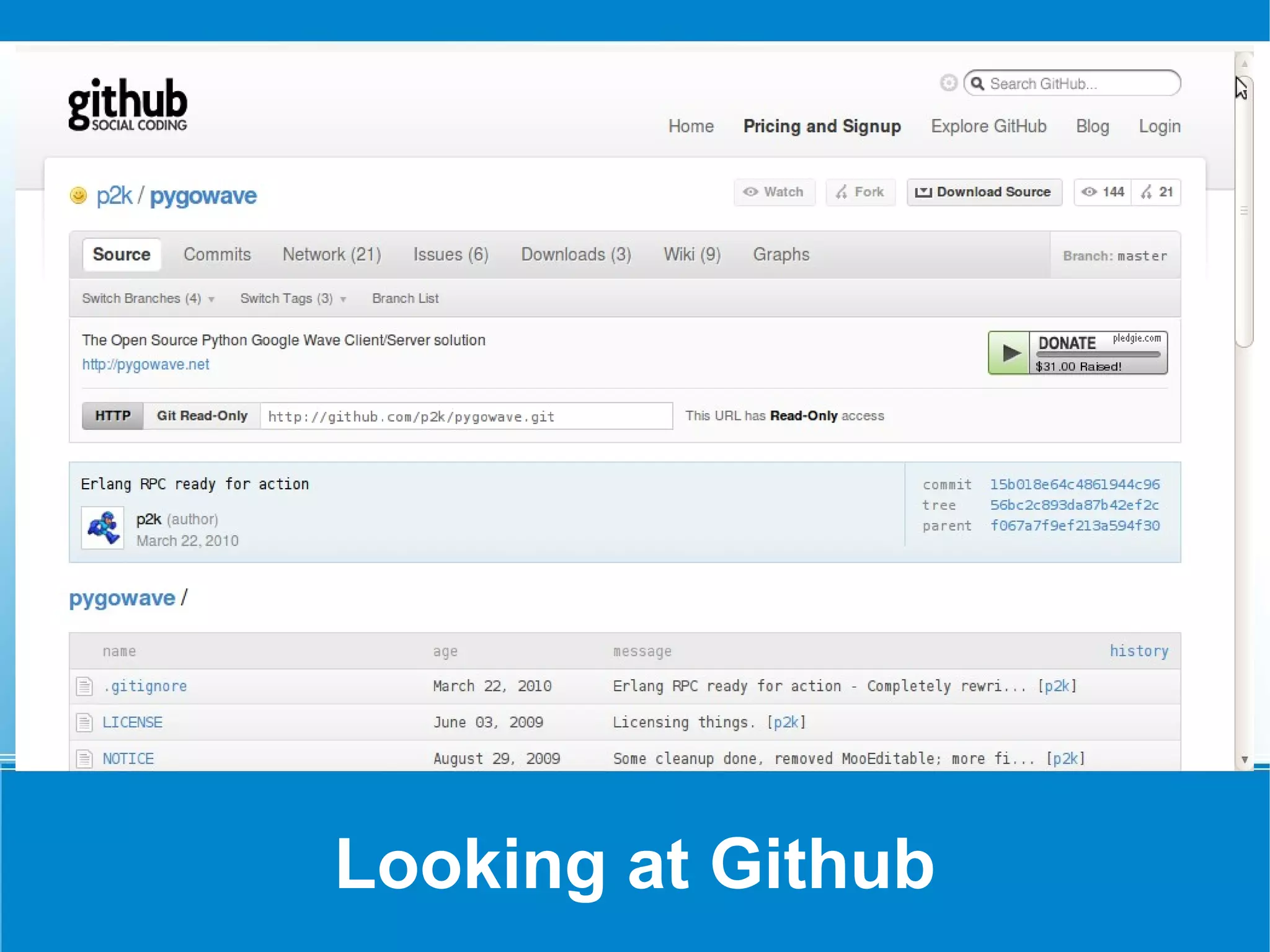
    Github Github isa service offering paid and free hosting for Git based repositories.
  • 67.
    It offers aticket tracker, a download service and a wiki.
  • 68.
    It only providesaccess to Git Version Control systems.
  • 69.
    I have notused this service for any of my projects, but many developers outside the Free Software world strongly recommend it.
  • 70.
  • 71.
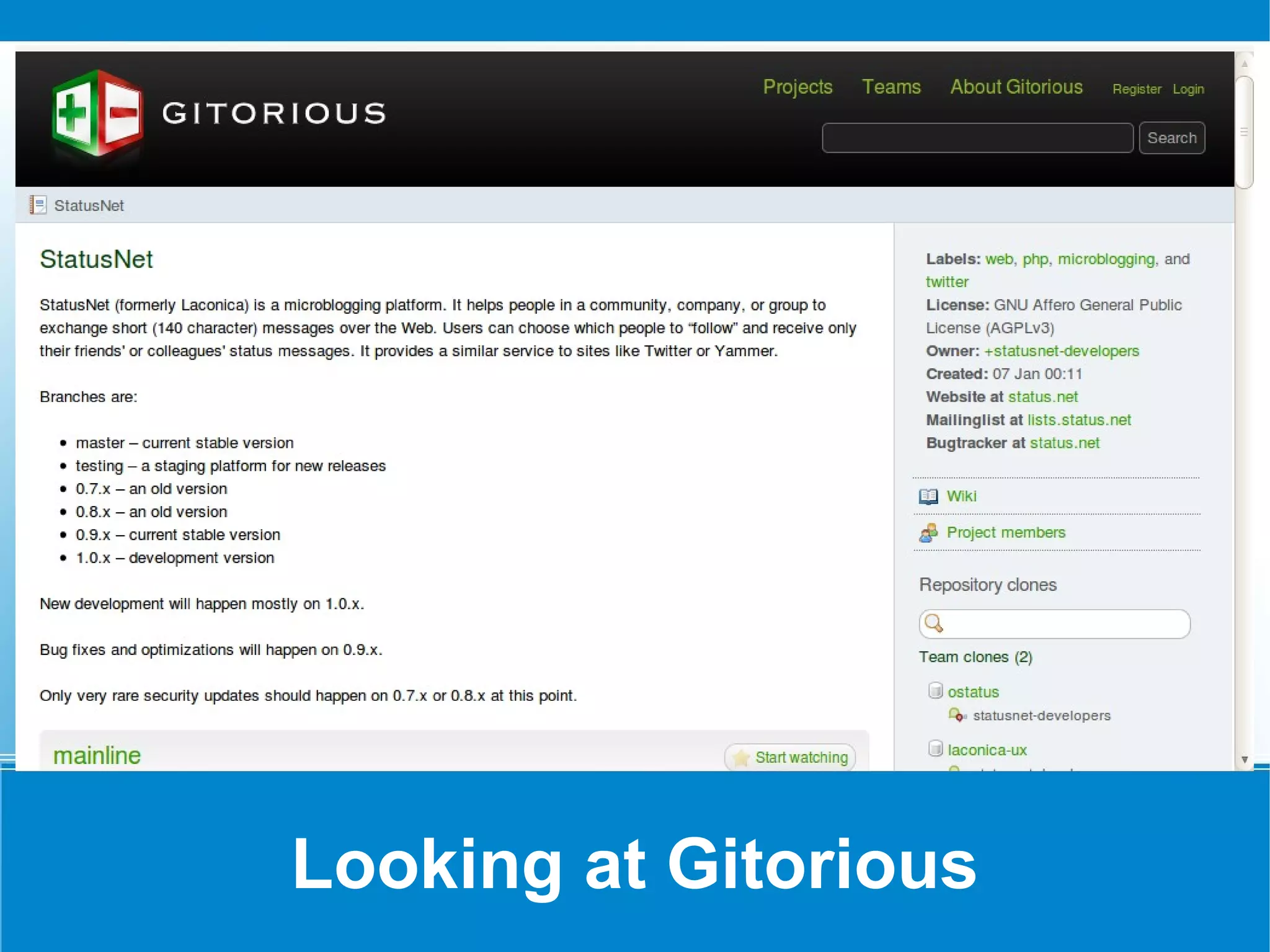
    Gitorious Much likeGitHub, Gitorious provides services strongly tied to the Git version control system.
  • 72.
    Unlike all ofthese other services, it doesn't appear to offer any ticket tracking services, or, infact, anything but a wiki.
  • 73.
    It is anopen source service, released under the AGPL.
  • 74.
  • 75.
    Trac Trac isnot available as a hosted solution.
  • 76.
    It's based onthe Python language, and originally was designed to provide a friendly front-end to Subversion.
  • 77.
    Over the years,it now supports many of the common version control systems.
  • 78.
    It has verymany plugins which allow it to be extended very easily.
  • 79.
    For many years,this was my only method of hosting code I wrote and released!
  • 80.
    Horde Chora +Whups + Wicked Horde is more well known as a webmail or groupware suite.
  • 81.
    To support theHorde development process, the Horde developers wrote a series of Horde modules for project management Chora provides access to CVS, Subversion and Git version control systems
  • 82.
    Whups is theticket tracking system for Horde
  • 83.
    Wicked is theWiki system. Horde is a PHP framework, but these modules don't currently integrate well together.
  • 84.
    Savane Savane wasoriginally called “Savannah” and was the code which drove Sourceforge, before it became Closed Source.
  • 85.
    Savane is nowa GNU project and drives the GNU Savannah web service.
  • 86.
    It is verysimilar to the Sourceforge website.
  • 87.
    It offers accessto CVS, Subversion and Arch version control systems.
  • 88.
    Again, I havenever used this service.
  • 89.
    Version Control SoftwareI just wanted to briefly touch on Version Control Software.
  • 90.
    If you aredeveloping anything collaboratively, then you should use some form of Version Control Software – whether it's centrally stored, such as CVS, Visual Source Safe or Subversion, or if it's distributed, like Bazaar, Git, Mercurial (Hg) or svk.
  • 91.
    Even if you'redeveloping something in isolation, Version Control Software can help you recover from disasters in your code and help you to document thought processes.
  • 92.
    Centrally Managed VCSVisual Source Safe is the tool built for Visual Studio. It's very hated. With many good reasons.
  • 93.
    CVS is thesuccessor to the single-system RCS. Both of these have been phased out by MOST projects. It's very easy to get in a tangle with CVS.
  • 94.
    SVN is whatmost people use for centrally managed Version Control. Most of the Distributed Version Control systems will integrate with SVN because of it's popularity.
  • 95.
    Distributed Version ControlA distributed Version Control system will allow many developers to work off-line from each other or the central store.
  • 96.
    By developing againsta locally held version of the repository, small incremental changes can be rapidly committed, reversed and patched before finally making those changes available to all the other developers.
  • 97.
    Most developers stillwork on-line, even though they are able to work off-line and will store their finished changes on a central server.
  • 98.
    I find itmore logical to work with a distributed VCS now than a central VCS.
  • 99.
    My last twoprojects were totally managed using a distributed VCS.
  • 100.
    Configuration? I hadalso planned to provide some configuration guidelines for your projects... but this got FAR too big for that! However, whatever you're using, turn off the modules or sections you aren't yet using! It's too confusing, for you, your developers and users! You can always turn them on again later!
  • 101.
    Whatever is leftafter that, make sure all the configuration makes sense to you! There's nothing worse than trying to submit a ticket about a web application, and trying to decide whether the issue is due to it being a Linux, Windows or Mac box! Likewise, if you're not using version numbers, don't ask your users to include the release version they're using!
  • 102.
    Make any dataabout your project as open as possible – use mailing lists for code commits, new tickets and wiki changes.
  • 103.
    If you cancope with the workload – blog, tweet or dent about it at every RELEVANT opportunity! Software houses do, why shouldn't you?
  • 104.
    Any Questions? Obviouslythis talk was pretty high level, and I've not used everything I've shown you, but I hope I've given you something to use the next time you're creating a new text editor, a new microblogging service, or simply have developed an improved way of putting pictures of your cat online.
  • 105.
    Please feel freeto ask any questions now, elsewhere today, or on email, Google Talk (XMPP) or MSN to jon@spriggs.org.uk