PROJECT 1B:
CASE STUDY: ESSAY
JALAN PUDU
Asian Architecture (ARC60403)
Tutor: Mr. Koh Jing Hao
Group Members:
Chong Jia Yi 0320869
Ee Yun Shan 0319990
Lee Ning 0320125
Lee Wan Xuan 0325273
Lee Zi Ying 0320435
Lim Zia Huei 0321031
Ong Shi Hui 0320303
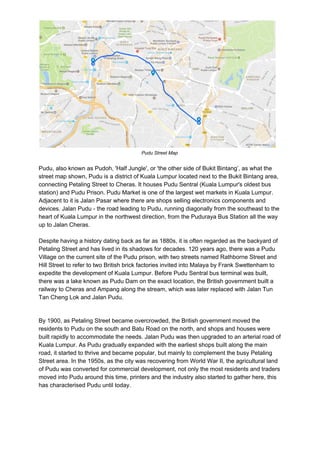
Pudu Street Map
Pudu, also known as Pudoh, 'Half Jungle', or 'the other side of Bukit Bintang’, as what the
street map shown, Pudu is a district of Kuala Lumpur located next to the Bukit Bintang area,
connecting Petaling Street to Cheras. It houses Pudu Sentral (Kuala Lumpur's oldest bus
station) and Pudu Prison. Pudu Market is one of the largest wet markets in Kuala Lumpur.
Adjacent to it is Jalan Pasar where there are shops selling electronics components and
devices. Jalan Pudu - the road leading to Pudu, running diagonally from the southeast to the
heart of Kuala Lumpur in the northwest direction, from the Puduraya Bus Station all the way
up to Jalan Cheras.
Despite having a history dating back as far as 1880s, it is often regarded as the backyard of
Petaling Street and has lived in its shadows for decades. 120 years ago, there was a Pudu
Village on the current site of the Pudu prison, with two streets named Rathborne Street and
Hill Street to refer to two British brick factories invited into Malaya by Frank Swettenham to
expedite the development of Kuala Lumpur. Before Pudu Sentral bus terminal was built,
there was a lake known as Pudu Dam on the exact location, the British government built a
railway to Cheras and Ampang along the stream, which was later replaced with Jalan Tun
Tan Cheng Lok and Jalan Pudu.
By 1900, as Petaling Street became overcrowded, the British government moved the
residents to Pudu on the south and Batu Road on the north, and shops and houses were
built rapidly to accommodate the needs. Jalan Pudu was then upgraded to an arterial road of
Kuala Lumpur. As Pudu gradually expanded with the earliest shops built along the main
road, it started to thrive and became popular, but mainly to complement the busy Petaling
Street area. In the 1950s, as the city was recovering from World War II, the agricultural land
of Pudu was converted for commercial development, not only the most residents and traders
moved into Pudu around this time, printers and the industry also started to gather here, this
has characterised Pudu until today.
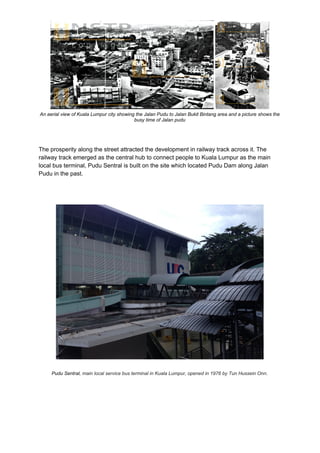
An aerial view of Kuala Lumpur city showing the Jalan Pudu to Jalan Bukit Bintang area and a picture ​shows the
busy time of Jalan pudu
The prosperity along the street attracted the development in railway track across it. The
railway track emerged as the central hub to connect people to Kuala Lumpur as the main
local bus terminal, Pudu Sentral is built on the site which located Pudu Dam along Jalan
Pudu in the past.
Pudu Sentral, ​main local service bus terminal in Kuala Lumpur, opened in 1976 by Tun Hussein Onn.
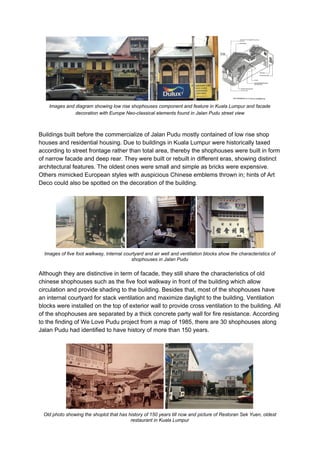
Images and diagram showing low rise shophouses component and feature in Kuala Lumpur and facade
decoration with Europe Neo-classical elements found in Jalan Pudu street view
Buildings built before the commercialize of Jalan Pudu mostly contained of low rise shop
houses and residential housing. Due to buildings in Kuala Lumpur were historically taxed
according to street frontage rather than total area, thereby the shophouses were built in form
of narrow facade and deep rear. They were built or rebuilt in different eras, showing distinct
architectural features. The oldest ones were small and simple as bricks were expensive.
Others mimicked European styles with auspicious Chinese emblems thrown in; hints of Art
Deco could also be spotted on the decoration of the building.
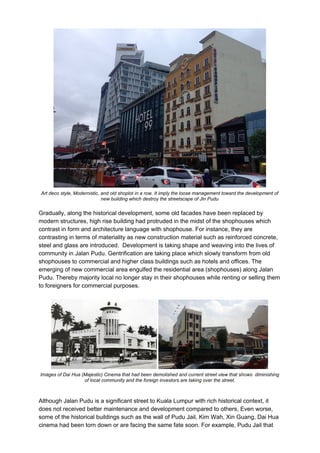
Images of five foot walkway, internal courtyard and air well and ventilation blocks show the characteristics of
shophouses in Jalan Pudu
Although they are distinctive in term of facade, they still share the characteristics of old
chinese shophouses such as the five foot walkway in front of the building which allow
circulation and provide shading to the building. Besides that, most of the shophouses have
an internal courtyard for stack ventilation and maximize daylight to the building. Ventilation
blocks were installed on the top of exterior wall to provide cross ventilation to the building. All
of the shophouses are separated by a thick concrete party wall for fire resistance. According
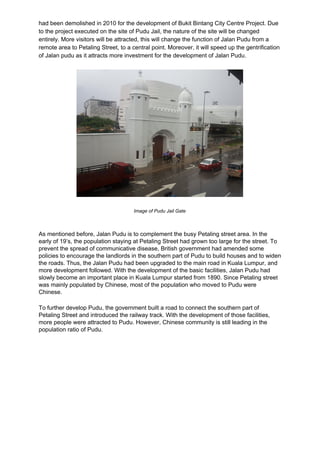
to the finding of We Love Pudu project from a map of 1985, there are 30 shophouses along
Jalan Pudu had identified to have history of more than 150 years.
Old photo showing the shoplot that has history of 150 years till now and picture of Restoran Sek Yuen, oldest
restaurant in Kuala Lumpur
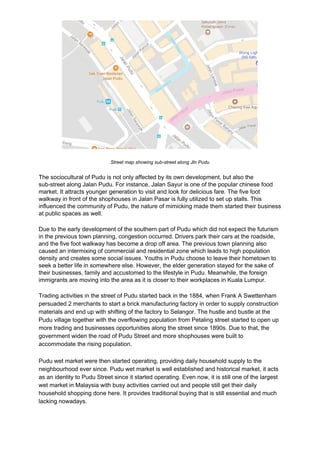
Art deco style, Modernistic, and old shoplot in a row. It imply the loose management toward the development of
new building which destroy the streetscape of Jln Pudu
Gradually, along the historical development, some old facades have been replaced by
modern structures, high rise building had protruded in the midst of the shophouses which
contrast in form and architecture language with shophouse. For instance, they are
contrasting in terms of materiality as new construction material such as reinforced concrete,
steel and glass are introduced. Development is taking shape and weaving into the lives of
community in Jalan Pudu. Gentrification are taking place which slowly transform from old
shophouses to commercial and higher class buildings such as hotels and offices. The
emerging of new commercial area engulfed the residential area (shophouses) along Jalan
Pudu. Thereby majority local no longer stay in their shophouses while renting or selling them
to foreigners for commercial purposes.
Images of Dai Hua (Majestic) Cinema that had been demolished and current street view that shows diminishing
of local community and the foreign investors are taking over the street.
Although Jalan Pudu is a significant street to Kuala Lumpur with rich historical context, it
does not received better maintenance and development compared to others, Even worse,
some of the historical buildings such as the wall of Pudu Jail, Kim Wah, Xin Guang, Dai Hua
cinema had been torn down or are facing the same fate soon. For example, Pudu Jail that
had been demolished in 2010 for the development of Bukit Bintang City Centre Project. Due
to the project executed on the site of Pudu Jail, the nature of the site will be changed
entirely. More visitors will be attracted, this will change the function of Jalan Pudu from a
remote area to Petaling Street, to a central point. Moreover, it will speed up the gentrification
of Jalan pudu as it attracts more investment for the development of Jalan Pudu.
Image of Pudu Jail Gate
As mentioned before, Jalan Pudu is to complement the busy Petaling street area. In the
early of 19’s, the population staying at Petaling Street had grown too large for the street. To
prevent the spread of communicative disease, British government had amended some
policies to encourage the landlords in the southern part of Pudu to build houses and to widen
the roads. Thus, the Jalan Pudu had been upgraded to the main road in Kuala Lumpur, and
more development followed. With the development of the basic facilities, Jalan Pudu had
slowly become an important place in Kuala Lumpur started from 1890. Since Petaling street
was mainly populated by Chinese, most of the population who moved to Pudu were
Chinese.
To further develop Pudu, the government built a road to connect the southern part of
Petaling Street and introduced the railway track. With the development of those facilities,
more people were attracted to Pudu. However, Chinese community is still leading in the
population ratio of Pudu.
Street map showing sub-street along Jln Pudu
The sociocultural of Pudu is not only affected by its own development, but also the
sub-street along Jalan Pudu. For instance, Jalan Sayur is one of the popular chinese food
market. It attracts younger generation to visit and look for delicious fare. The five foot
walkway in front of the shophouses in Jalan Pasar is fully utilized to set up stalls. This
influenced the community of Pudu, the nature of mimicking made them started their business
at public spaces as well.
Due to the early development of the southern part of Pudu which did not expect the futurism
in the previous town planning, congestion occurred. Drivers park their cars at the roadside,
and the five foot walkway has become a drop off area. The previous town planning also
caused an intermixing of commercial and residential zone which leads to high population
density and creates some social issues. Youths in Pudu choose to leave their hometown to
seek a better life in somewhere else. However, the elder generation stayed for the sake of
their businesses, family and accustomed to the lifestyle in Pudu. Meanwhile, the foreign
immigrants are moving into the area as it is closer to their workplaces in Kuala Lumpur.
Trading activities in the street of Pudu started back in the 1884, when Frank A Swettenham
persuaded 2 merchants to start a brick manufacturing factory in order to supply construction
materials and end up with shifting of the factory to Selangor. The hustle and bustle at the
Pudu village together with the overflowing population from Petaling street started to open up
more trading and businesses opportunities along the street since 1890s. Due to that, the
government widen the road of Pudu Street and more shophouses were built to
accommodate the rising population.
Pudu wet market were then started operating, providing daily household supply to the
neighbourhood ever since. Pudu wet market is well established and historical market, it acts
as an identity to Pudu Street since it started operating. Even now, it is still one of the largest
wet market in Malaysia with busy activities carried out and people still get their daily
household shopping done here. It provides traditional buying that is still essential and much
lacking nowadays.
Pudu wet market still remain a strong attraction to the visitors and neighbourhood despite
the existence of contemporary shopping mall like Berjaya Times Square built in the year
1997 along the street of Pudu. The traditional meet and greet together with the price
haggling and personal attention from the buyer and seller is a fresh experience from the
service and paying counter on the modern mall. The traditional wet market and the modern
contemporary mall basically coexist together in Pudu creating a vibrant trading experience to
the neighbourhood and the visitors.
Right opposite of the wet market lies the infamous electronic streets operating for decades
selling wide array of electronics appliances. The Pudu “Electronic Street” started operating
not long after the Pudu wet market were establish. The street is full of electronic and
electrical suppliers providing variety of electronics and electricals equipments to parts where
it is hard to be seen from the electronic department stall inside the mall. Electrical appliances
repairing skill are becoming rare itself, and this can be considered one of the specialty that
can be found in here, the Electronic street of Pudu.
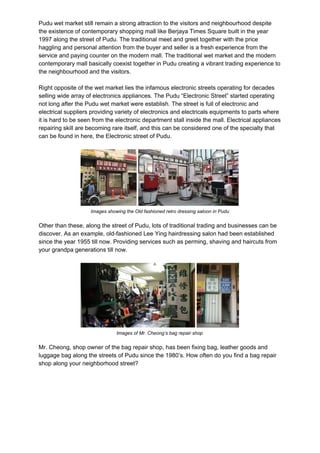
Images showing the Old fashioned retro dressing saloon in Pudu
Other than these, along the street of Pudu, lots of traditional trading and businesses can be
discover. As an example, old-fashioned Lee Ying hairdressing salon had been established
since the year 1955 till now. Providing services such as perming, shaving and haircuts from
your grandpa generations till now.
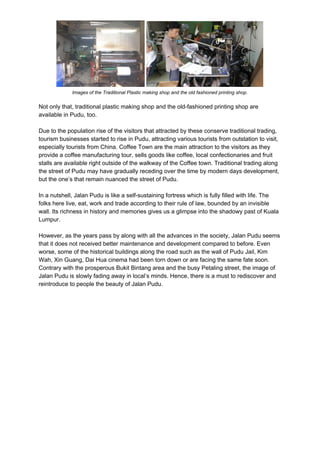
Images of Mr. Cheong’s bag repair shop
Mr. Cheong, shop owner of the bag repair shop, has been fixing bag, leather goods and
luggage bag along the streets of Pudu since the 1980’s. How often do you find a bag repair
shop along your neighborhood street?
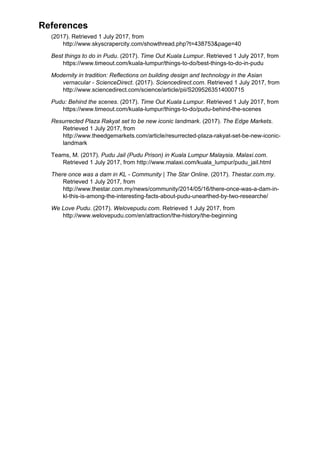
Images of the Traditional Plastic making shop and the old fashioned printing shop.
Not only that, traditional plastic making shop and the old-fashioned printing shop are
available in Pudu, too.
Due to the population rise of the visitors that attracted by these conserve traditional trading,
tourism businesses started to rise in Pudu, attracting various tourists from outstation to visit,
especially tourists from China. Coffee Town are the main attraction to the visitors as they
provide a coffee manufacturing tour, sells goods like coffee, local confectionaries and fruit
stalls are available right outside of the walkway of the Coffee town. Traditional trading along
the street of Pudu may have gradually receding over the time by modern days development,
but the one’s that remain nuanced the street of Pudu.
In a nutshell, Jalan Pudu is like a self-sustaining fortress which is fully filled with life. The
folks here live, eat, work and trade according to their rule of law, bounded by an invisible
wall. Its richness in history and memories gives us a glimpse into the shadowy past of Kuala
Lumpur.
However, as the years pass by along with all the advances in the society, Jalan Pudu seems
that it does not received better maintenance and development compared to before. Even
worse, some of the historical buildings along the road such as the wall of Pudu Jail, Kim
Wah, Xin Guang, Dai Hua cinema had been torn down or are facing the same fate soon.
Contrary with the prosperous Bukit Bintang area and the busy Petaling street, the image of
Jalan Pudu is slowly fading away in local’s minds. Hence, there is a must to rediscover and
reintroduce to people the beauty of Jalan Pudu.
References
(2017). Retrieved 1 July 2017, from
http://www.skyscrapercity.com/showthread.php?t=438753&page=40
Best things to do in Pudu​. (2017). ​Time Out Kuala Lumpur​. Retrieved 1 July 2017, from
https://www.timeout.com/kuala-lumpur/things-to-do/best-things-to-do-in-pudu
Modernity in tradition: Reflections on building design and technology in the Asian
vernacular - ScienceDirect​. (2017). ​Sciencedirect.com​. Retrieved 1 July 2017, from
http://www.sciencedirect.com/science/article/pii/S2095263514000715
Pudu: Behind the scenes​. (2017). ​Time Out Kuala Lumpur​. Retrieved 1 July 2017, from
https://www.timeout.com/kuala-lumpur/things-to-do/pudu-behind-the-scenes
Resurrected Plaza Rakyat set to be new iconic landmark​. (2017). ​The Edge Markets​.
Retrieved 1 July 2017, from
http://www.theedgemarkets.com/article/resurrected-plaza-rakyat-set-be-new-iconic-
landmark
Teams, M. (2017). ​Pudu Jail (Pudu Prison) in Kuala Lumpur Malaysia​. ​Malaxi.com​.
Retrieved 1 July 2017, from http://www.malaxi.com/kuala_lumpur/pudu_jail.html
There once was a dam in KL - Community | The Star Online​. (2017). ​Thestar.com.my​.
Retrieved 1 July 2017, from
http://www.thestar.com.my/news/community/2014/05/16/there-once-was-a-dam-in-
kl-this-is-among-the-interesting-facts-about-pudu-unearthed-by-two-researche/
We Love Pudu​. (2017). ​Welovepudu.com​. Retrieved 1 July 2017, from
http://www.welovepudu.com/en/attraction/the-history/the-beginning

Jalan pudu case study

  • 1.
    PROJECT 1B: CASE STUDY:ESSAY JALAN PUDU Asian Architecture (ARC60403) Tutor: Mr. Koh Jing Hao Group Members: Chong Jia Yi 0320869 Ee Yun Shan 0319990 Lee Ning 0320125 Lee Wan Xuan 0325273 Lee Zi Ying 0320435 Lim Zia Huei 0321031 Ong Shi Hui 0320303
  • 2.
    Pudu Street Map Pudu,also known as Pudoh, 'Half Jungle', or 'the other side of Bukit Bintang’, as what the street map shown, Pudu is a district of Kuala Lumpur located next to the Bukit Bintang area, connecting Petaling Street to Cheras. It houses Pudu Sentral (Kuala Lumpur's oldest bus station) and Pudu Prison. Pudu Market is one of the largest wet markets in Kuala Lumpur. Adjacent to it is Jalan Pasar where there are shops selling electronics components and devices. Jalan Pudu - the road leading to Pudu, running diagonally from the southeast to the heart of Kuala Lumpur in the northwest direction, from the Puduraya Bus Station all the way up to Jalan Cheras. Despite having a history dating back as far as 1880s, it is often regarded as the backyard of Petaling Street and has lived in its shadows for decades. 120 years ago, there was a Pudu Village on the current site of the Pudu prison, with two streets named Rathborne Street and Hill Street to refer to two British brick factories invited into Malaya by Frank Swettenham to expedite the development of Kuala Lumpur. Before Pudu Sentral bus terminal was built, there was a lake known as Pudu Dam on the exact location, the British government built a railway to Cheras and Ampang along the stream, which was later replaced with Jalan Tun Tan Cheng Lok and Jalan Pudu. By 1900, as Petaling Street became overcrowded, the British government moved the residents to Pudu on the south and Batu Road on the north, and shops and houses were built rapidly to accommodate the needs. Jalan Pudu was then upgraded to an arterial road of Kuala Lumpur. As Pudu gradually expanded with the earliest shops built along the main road, it started to thrive and became popular, but mainly to complement the busy Petaling Street area. In the 1950s, as the city was recovering from World War II, the agricultural land of Pudu was converted for commercial development, not only the most residents and traders moved into Pudu around this time, printers and the industry also started to gather here, this has characterised Pudu until today.
  • 3.
    An aerial viewof Kuala Lumpur city showing the Jalan Pudu to Jalan Bukit Bintang area and a picture ​shows the busy time of Jalan pudu The prosperity along the street attracted the development in railway track across it. The railway track emerged as the central hub to connect people to Kuala Lumpur as the main local bus terminal, Pudu Sentral is built on the site which located Pudu Dam along Jalan Pudu in the past. Pudu Sentral, ​main local service bus terminal in Kuala Lumpur, opened in 1976 by Tun Hussein Onn.
  • 4.
    Images and diagramshowing low rise shophouses component and feature in Kuala Lumpur and facade decoration with Europe Neo-classical elements found in Jalan Pudu street view Buildings built before the commercialize of Jalan Pudu mostly contained of low rise shop houses and residential housing. Due to buildings in Kuala Lumpur were historically taxed according to street frontage rather than total area, thereby the shophouses were built in form of narrow facade and deep rear. They were built or rebuilt in different eras, showing distinct architectural features. The oldest ones were small and simple as bricks were expensive. Others mimicked European styles with auspicious Chinese emblems thrown in; hints of Art Deco could also be spotted on the decoration of the building. Images of five foot walkway, internal courtyard and air well and ventilation blocks show the characteristics of shophouses in Jalan Pudu Although they are distinctive in term of facade, they still share the characteristics of old chinese shophouses such as the five foot walkway in front of the building which allow circulation and provide shading to the building. Besides that, most of the shophouses have an internal courtyard for stack ventilation and maximize daylight to the building. Ventilation blocks were installed on the top of exterior wall to provide cross ventilation to the building. All of the shophouses are separated by a thick concrete party wall for fire resistance. According to the finding of We Love Pudu project from a map of 1985, there are 30 shophouses along Jalan Pudu had identified to have history of more than 150 years. Old photo showing the shoplot that has history of 150 years till now and picture of Restoran Sek Yuen, oldest restaurant in Kuala Lumpur
  • 5.
    Art deco style,Modernistic, and old shoplot in a row. It imply the loose management toward the development of new building which destroy the streetscape of Jln Pudu Gradually, along the historical development, some old facades have been replaced by modern structures, high rise building had protruded in the midst of the shophouses which contrast in form and architecture language with shophouse. For instance, they are contrasting in terms of materiality as new construction material such as reinforced concrete, steel and glass are introduced. Development is taking shape and weaving into the lives of community in Jalan Pudu. Gentrification are taking place which slowly transform from old shophouses to commercial and higher class buildings such as hotels and offices. The emerging of new commercial area engulfed the residential area (shophouses) along Jalan Pudu. Thereby majority local no longer stay in their shophouses while renting or selling them to foreigners for commercial purposes. Images of Dai Hua (Majestic) Cinema that had been demolished and current street view that shows diminishing of local community and the foreign investors are taking over the street. Although Jalan Pudu is a significant street to Kuala Lumpur with rich historical context, it does not received better maintenance and development compared to others, Even worse, some of the historical buildings such as the wall of Pudu Jail, Kim Wah, Xin Guang, Dai Hua cinema had been torn down or are facing the same fate soon. For example, Pudu Jail that
  • 6.
    had been demolishedin 2010 for the development of Bukit Bintang City Centre Project. Due to the project executed on the site of Pudu Jail, the nature of the site will be changed entirely. More visitors will be attracted, this will change the function of Jalan Pudu from a remote area to Petaling Street, to a central point. Moreover, it will speed up the gentrification of Jalan pudu as it attracts more investment for the development of Jalan Pudu. Image of Pudu Jail Gate As mentioned before, Jalan Pudu is to complement the busy Petaling street area. In the early of 19’s, the population staying at Petaling Street had grown too large for the street. To prevent the spread of communicative disease, British government had amended some policies to encourage the landlords in the southern part of Pudu to build houses and to widen the roads. Thus, the Jalan Pudu had been upgraded to the main road in Kuala Lumpur, and more development followed. With the development of the basic facilities, Jalan Pudu had slowly become an important place in Kuala Lumpur started from 1890. Since Petaling street was mainly populated by Chinese, most of the population who moved to Pudu were Chinese. To further develop Pudu, the government built a road to connect the southern part of Petaling Street and introduced the railway track. With the development of those facilities, more people were attracted to Pudu. However, Chinese community is still leading in the population ratio of Pudu.
  • 7.
    Street map showingsub-street along Jln Pudu The sociocultural of Pudu is not only affected by its own development, but also the sub-street along Jalan Pudu. For instance, Jalan Sayur is one of the popular chinese food market. It attracts younger generation to visit and look for delicious fare. The five foot walkway in front of the shophouses in Jalan Pasar is fully utilized to set up stalls. This influenced the community of Pudu, the nature of mimicking made them started their business at public spaces as well. Due to the early development of the southern part of Pudu which did not expect the futurism in the previous town planning, congestion occurred. Drivers park their cars at the roadside, and the five foot walkway has become a drop off area. The previous town planning also caused an intermixing of commercial and residential zone which leads to high population density and creates some social issues. Youths in Pudu choose to leave their hometown to seek a better life in somewhere else. However, the elder generation stayed for the sake of their businesses, family and accustomed to the lifestyle in Pudu. Meanwhile, the foreign immigrants are moving into the area as it is closer to their workplaces in Kuala Lumpur. Trading activities in the street of Pudu started back in the 1884, when Frank A Swettenham persuaded 2 merchants to start a brick manufacturing factory in order to supply construction materials and end up with shifting of the factory to Selangor. The hustle and bustle at the Pudu village together with the overflowing population from Petaling street started to open up more trading and businesses opportunities along the street since 1890s. Due to that, the government widen the road of Pudu Street and more shophouses were built to accommodate the rising population. Pudu wet market were then started operating, providing daily household supply to the neighbourhood ever since. Pudu wet market is well established and historical market, it acts as an identity to Pudu Street since it started operating. Even now, it is still one of the largest wet market in Malaysia with busy activities carried out and people still get their daily household shopping done here. It provides traditional buying that is still essential and much lacking nowadays.
  • 8.
    Pudu wet marketstill remain a strong attraction to the visitors and neighbourhood despite the existence of contemporary shopping mall like Berjaya Times Square built in the year 1997 along the street of Pudu. The traditional meet and greet together with the price haggling and personal attention from the buyer and seller is a fresh experience from the service and paying counter on the modern mall. The traditional wet market and the modern contemporary mall basically coexist together in Pudu creating a vibrant trading experience to the neighbourhood and the visitors. Right opposite of the wet market lies the infamous electronic streets operating for decades selling wide array of electronics appliances. The Pudu “Electronic Street” started operating not long after the Pudu wet market were establish. The street is full of electronic and electrical suppliers providing variety of electronics and electricals equipments to parts where it is hard to be seen from the electronic department stall inside the mall. Electrical appliances repairing skill are becoming rare itself, and this can be considered one of the specialty that can be found in here, the Electronic street of Pudu. Images showing the Old fashioned retro dressing saloon in Pudu Other than these, along the street of Pudu, lots of traditional trading and businesses can be discover. As an example, old-fashioned Lee Ying hairdressing salon had been established since the year 1955 till now. Providing services such as perming, shaving and haircuts from your grandpa generations till now. Images of Mr. Cheong’s bag repair shop Mr. Cheong, shop owner of the bag repair shop, has been fixing bag, leather goods and luggage bag along the streets of Pudu since the 1980’s. How often do you find a bag repair shop along your neighborhood street?
  • 9.
    Images of theTraditional Plastic making shop and the old fashioned printing shop. Not only that, traditional plastic making shop and the old-fashioned printing shop are available in Pudu, too. Due to the population rise of the visitors that attracted by these conserve traditional trading, tourism businesses started to rise in Pudu, attracting various tourists from outstation to visit, especially tourists from China. Coffee Town are the main attraction to the visitors as they provide a coffee manufacturing tour, sells goods like coffee, local confectionaries and fruit stalls are available right outside of the walkway of the Coffee town. Traditional trading along the street of Pudu may have gradually receding over the time by modern days development, but the one’s that remain nuanced the street of Pudu. In a nutshell, Jalan Pudu is like a self-sustaining fortress which is fully filled with life. The folks here live, eat, work and trade according to their rule of law, bounded by an invisible wall. Its richness in history and memories gives us a glimpse into the shadowy past of Kuala Lumpur. However, as the years pass by along with all the advances in the society, Jalan Pudu seems that it does not received better maintenance and development compared to before. Even worse, some of the historical buildings along the road such as the wall of Pudu Jail, Kim Wah, Xin Guang, Dai Hua cinema had been torn down or are facing the same fate soon. Contrary with the prosperous Bukit Bintang area and the busy Petaling street, the image of Jalan Pudu is slowly fading away in local’s minds. Hence, there is a must to rediscover and reintroduce to people the beauty of Jalan Pudu.
  • 10.
    References (2017). Retrieved 1July 2017, from http://www.skyscrapercity.com/showthread.php?t=438753&page=40 Best things to do in Pudu​. (2017). ​Time Out Kuala Lumpur​. Retrieved 1 July 2017, from https://www.timeout.com/kuala-lumpur/things-to-do/best-things-to-do-in-pudu Modernity in tradition: Reflections on building design and technology in the Asian vernacular - ScienceDirect​. (2017). ​Sciencedirect.com​. Retrieved 1 July 2017, from http://www.sciencedirect.com/science/article/pii/S2095263514000715 Pudu: Behind the scenes​. (2017). ​Time Out Kuala Lumpur​. Retrieved 1 July 2017, from https://www.timeout.com/kuala-lumpur/things-to-do/pudu-behind-the-scenes Resurrected Plaza Rakyat set to be new iconic landmark​. (2017). ​The Edge Markets​. Retrieved 1 July 2017, from http://www.theedgemarkets.com/article/resurrected-plaza-rakyat-set-be-new-iconic- landmark Teams, M. (2017). ​Pudu Jail (Pudu Prison) in Kuala Lumpur Malaysia​. ​Malaxi.com​. Retrieved 1 July 2017, from http://www.malaxi.com/kuala_lumpur/pudu_jail.html There once was a dam in KL - Community | The Star Online​. (2017). ​Thestar.com.my​. Retrieved 1 July 2017, from http://www.thestar.com.my/news/community/2014/05/16/there-once-was-a-dam-in- kl-this-is-among-the-interesting-facts-about-pudu-unearthed-by-two-researche/ We Love Pudu​. (2017). ​Welovepudu.com​. Retrieved 1 July 2017, from http://www.welovepudu.com/en/attraction/the-history/the-beginning