Data Management in Research 
Open Science and Research Training 
© 2014 The Ministry of Education and Culture’s Open Science and Research Initiative 2014–2017 http://openscience.fi/ 
Licensed under Creative Commons Attribution 4.0 International Public License
"Research data is defined as recorded factual 
material commonly retained by and accepted in 
the scientific community as necessary to validate 
research findings; although the majority of such 
data is created in digital format, all research data 
is included irrespective of the format in which it is 
created.” 
Engineering and Physical Sciences Research 
Council (EPSRC) 
What is research data — University of Leicester 
www2.le.ac.uk/services/research-data/rdm/what-is-rdm/ 
research-data
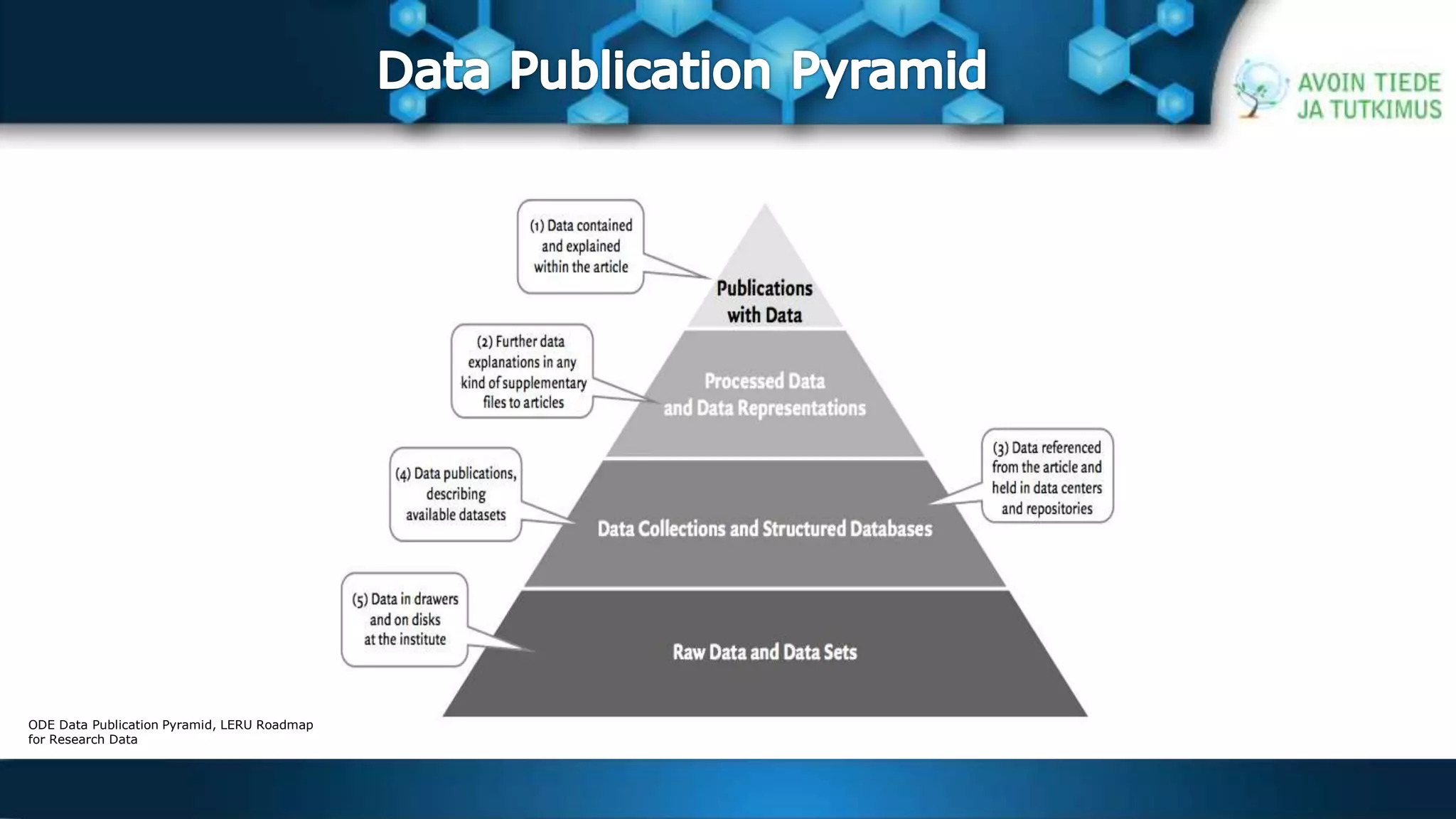
ODE Data Publication Pyramid, LERU Roadmap 
for Research Data
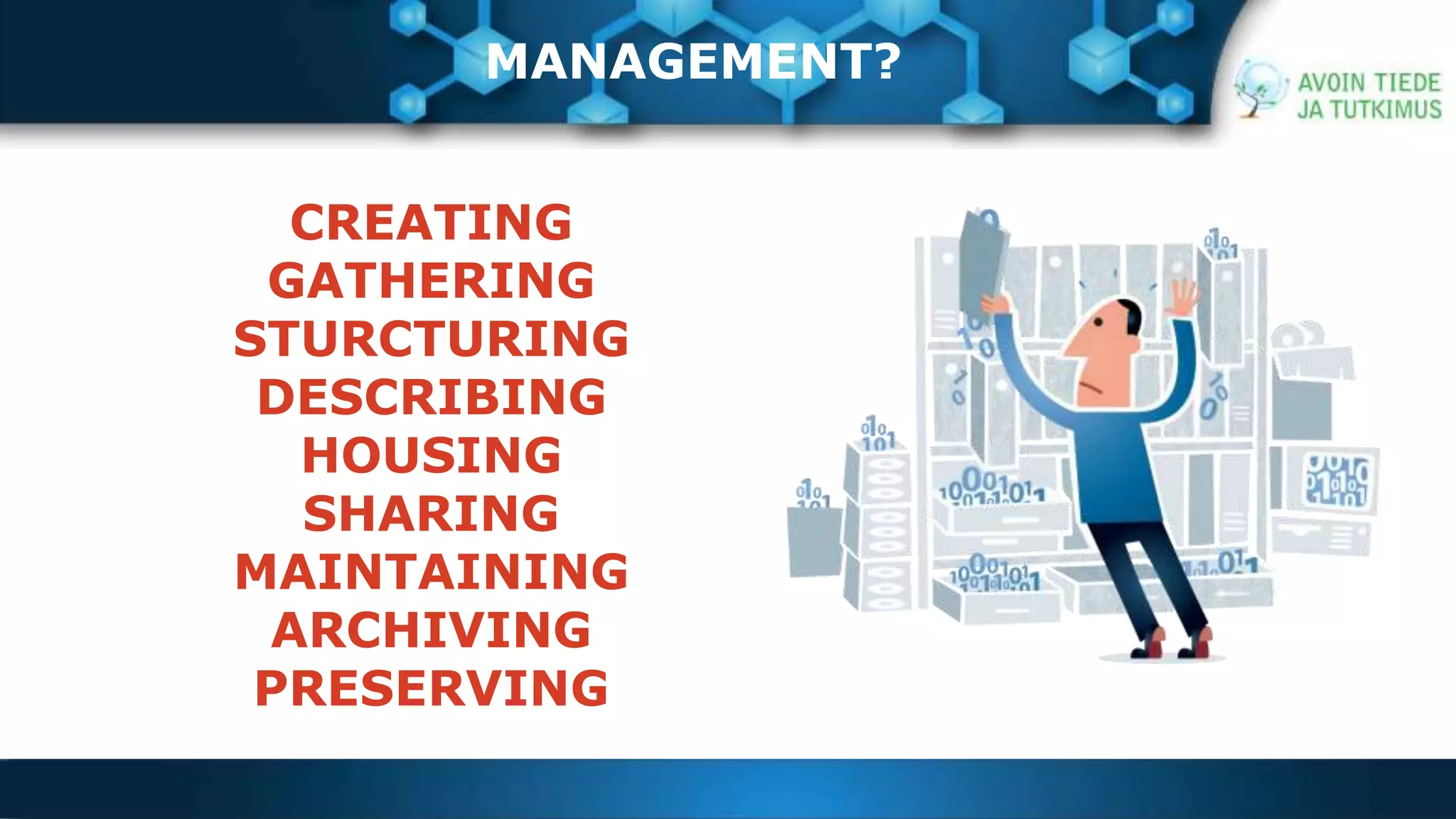
MANAGEMENT? 
CREATING 
GATHERING 
STURCTURING 
DESCRIBING 
HOUSING 
SHARING 
MAINTAINING 
ARCHIVING 
PRESERVING
GOOD DATA MANAGEMENT 
ENSURES 
INTEGRITY AND REPRODUCIBILITY
GOOD DATA MANAGEMENT 
IS AT 
THE HEART OF 
EXCELLENT SCIENCE
Scientific research should be replicable 
 Data and methods should be well documented 
 The data should be intelligible 
 The data should be sustainable
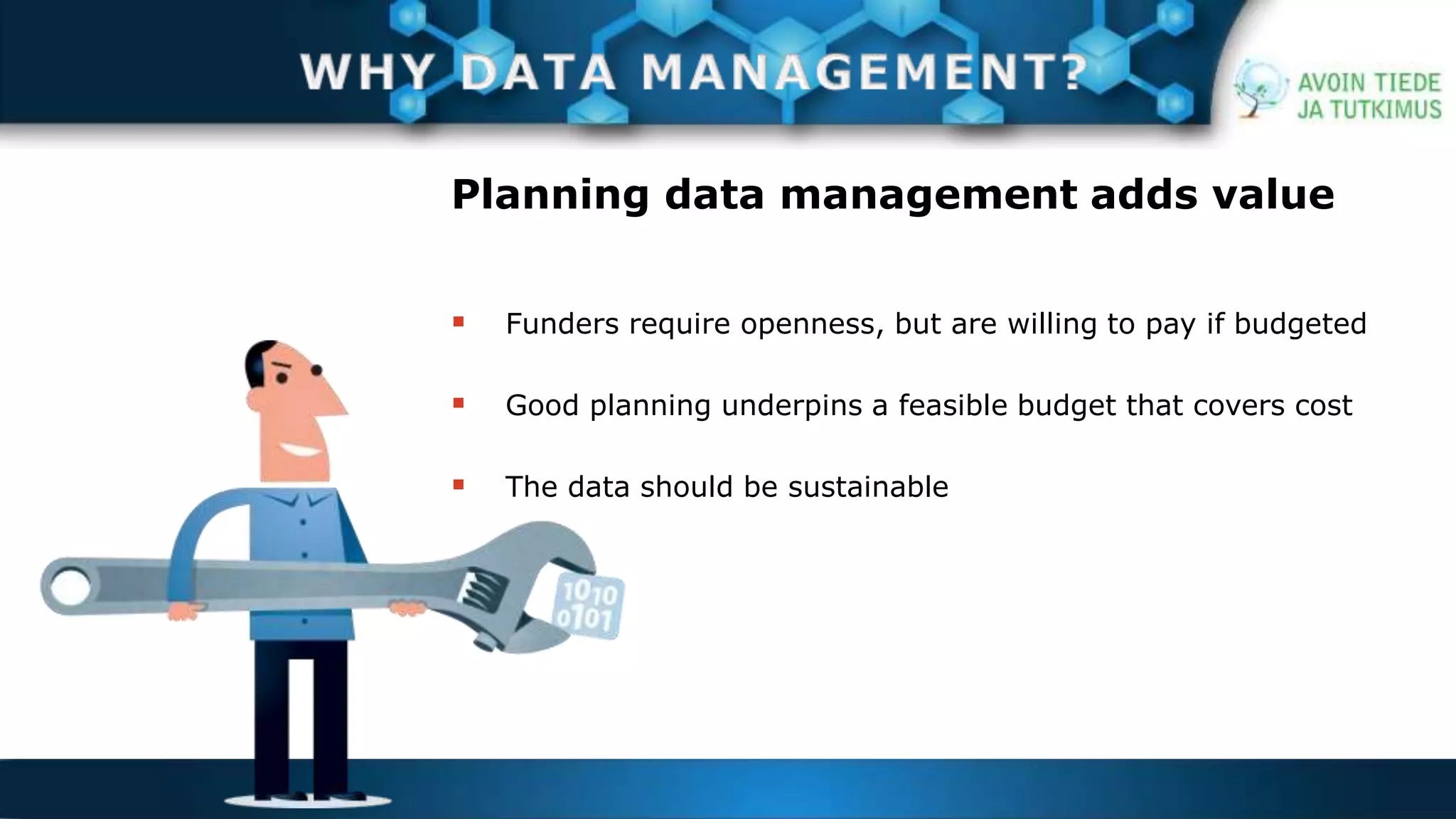
Planning data management adds value 
 Funders require openness, but are willing to pay if budgeted 
 Good planning underpins a feasible budget that covers cost 
 The data should be sustainable
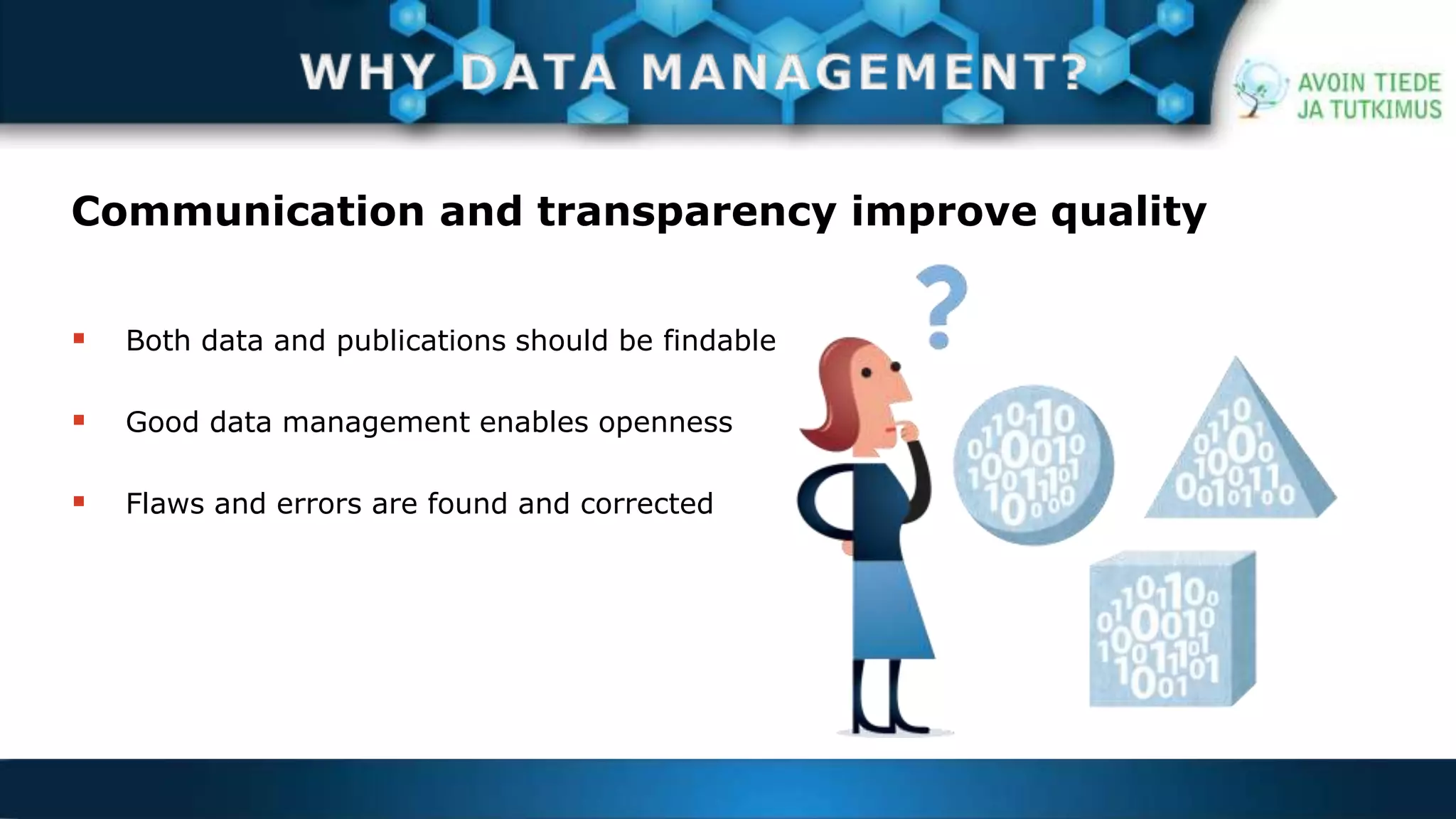
Communication and transparency improve quality 
 Both data and publications should be findable 
 Good data management enables openness 
 Flaws and errors are found and corrected
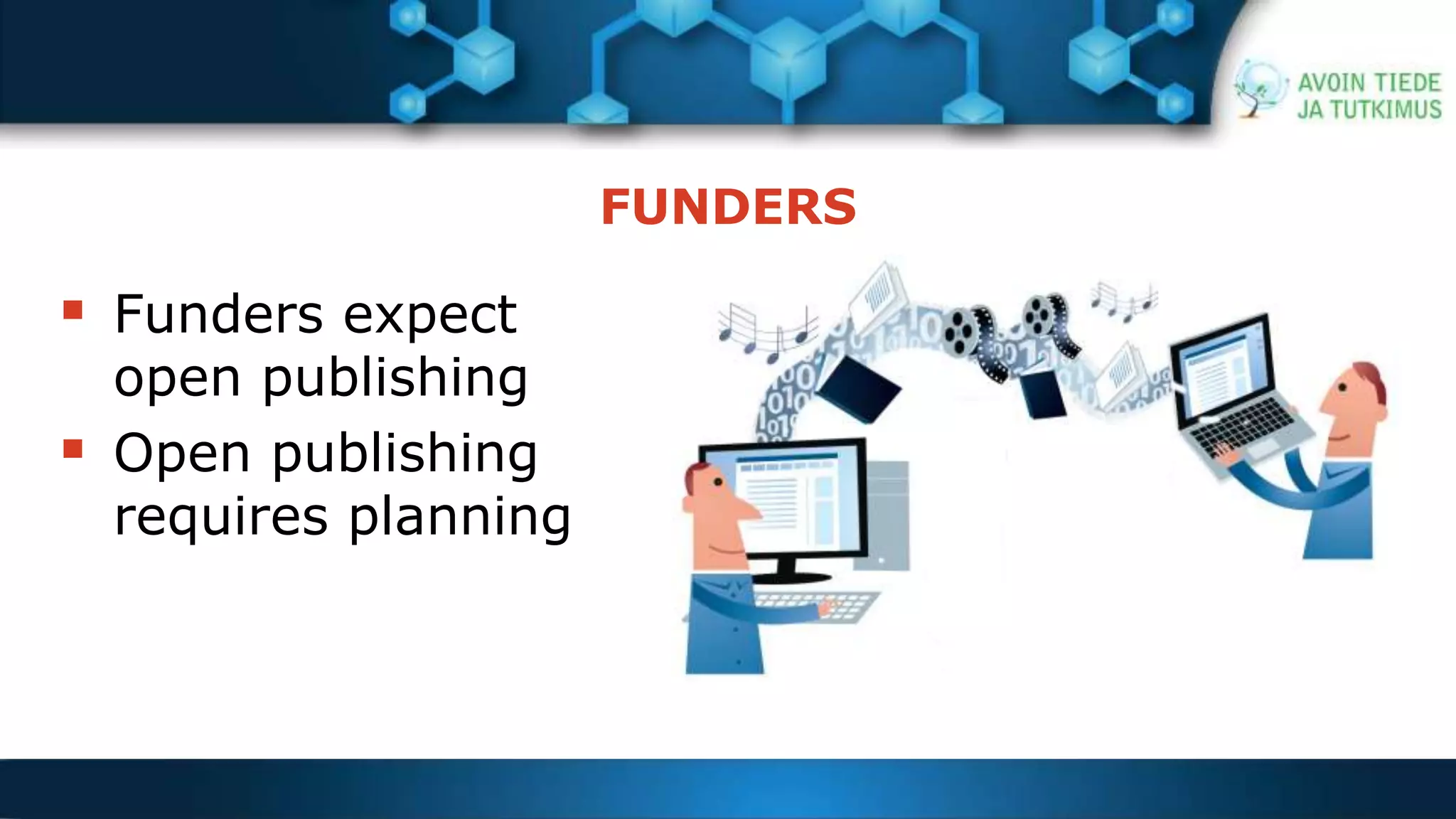
FUNDERS 
 Funders expect 
open publishing 
 Open publishing 
requires planning
European Research Council 
The ERC considers that providing free online access to these materials is the most 
effective way of ensuring that the fruits of the research it funds can be accessed, read 
and used as the basis for further research. 
The ERC therefore supports the principle of open access to the published output of 
research as a fundamental part of its mission. 
Accordingly, the European Research Council: 
 requests that an electronic copy of any research article, monograph or other research 
publication that is supported in whole, or in part, by ERC funding be deposited in a 
suitable repository immediately upon publication. Open access should be provided as 
soon as possible and in any case no later than six months after the official publication 
date. For publications in the Social Sciences and Humanities domain a delay of up to 
twelve months is acceptable.
European Research Council 
 encourages ERC funded researchers to use discipline-specific repositories for 
their publications. A list of recommended repositories is provided in Appendix 1. If 
there is no appropriate discipline specific repository, researchers should make their 
publications available in institutional repositories or in centralized ones, such as 
Zenodo 
 reminds ERC funded researchers that open access fees are eligible costs that can be 
charged against ERC grants, provided they have been incurred during the duration of 
the project. 
Open Access Guidelines for researchers funded by the ERC 
http://erc.europa.eu/sites/default/files/document/file/ERC_Open_Access_Guidelines-revised_2013.pdf
The Academy of Finland advises 
researchers to publish their work 
following the principles of open 
access and open data. 
When applying for funding from the 
Academy, researchers must include in 
their research plans a publication 
plan and a data management plan.
We also require that the research plan includes a data management 
plan, which describes: 
 how the project proposes to obtain and use its research materials 
 the rights of ownership and use pertaining to the material used 
and generated by the project 
 how the materials produced by the project (or through research 
infrastructures) will be stored and subsequently made available to 
other researchers 
 how the materials will be protected if necessary. 
http://www.aka.fi/en-GB/A/Funding-and-guidance/How-to-apply/Guidelines/General-application-guidelines/
The Academy also recommends that researchers make their research data available to other 
researchers. Previously, applicants were asked to include in their research plans information on the 
storage of data. Now, we also want a description of how the data will be made available to others. 
[ … ] 
 As before, the Academy recommends two established databases: the Finnish Social Science Data 
Archive (FSD) and the FIN-CLARIN consortium. Despite its name, the FSD does accept data in the 
fields of medicine and the humanities as well (where possible). FIN-CLARIN, in turn, is based at the 
University of Helsinki and is focused on linguistic data. 
 As of the September 2014 call, two new repositories have been added to the list of recommended 
open data resources. CSC, the IT Center for Science, has opened three services for open data. The 
CSC’s IDA Storage Service offers data storage opportunities for Academy-funded researchers. The 
CSC’s [Etsin] metadata catalogue, in turn, is the preferred storage location for metadata, 
regardless of where the actual research data are stored. Lastly, the CSC’s AVAA open-access 
publishing platform offers applications for the use of open access data. In addition, and 
alternatively, the Academy recommends the Zenodo service as a service for sharing and storing 
research results. 
http://www.aka.fi/en-GB/A/Funding-and-guidance/How-to-apply/Guidelines/General-application-guidelines/
THINGS TO CONSIDER 
LAWS & 
RESTRICTIONS 
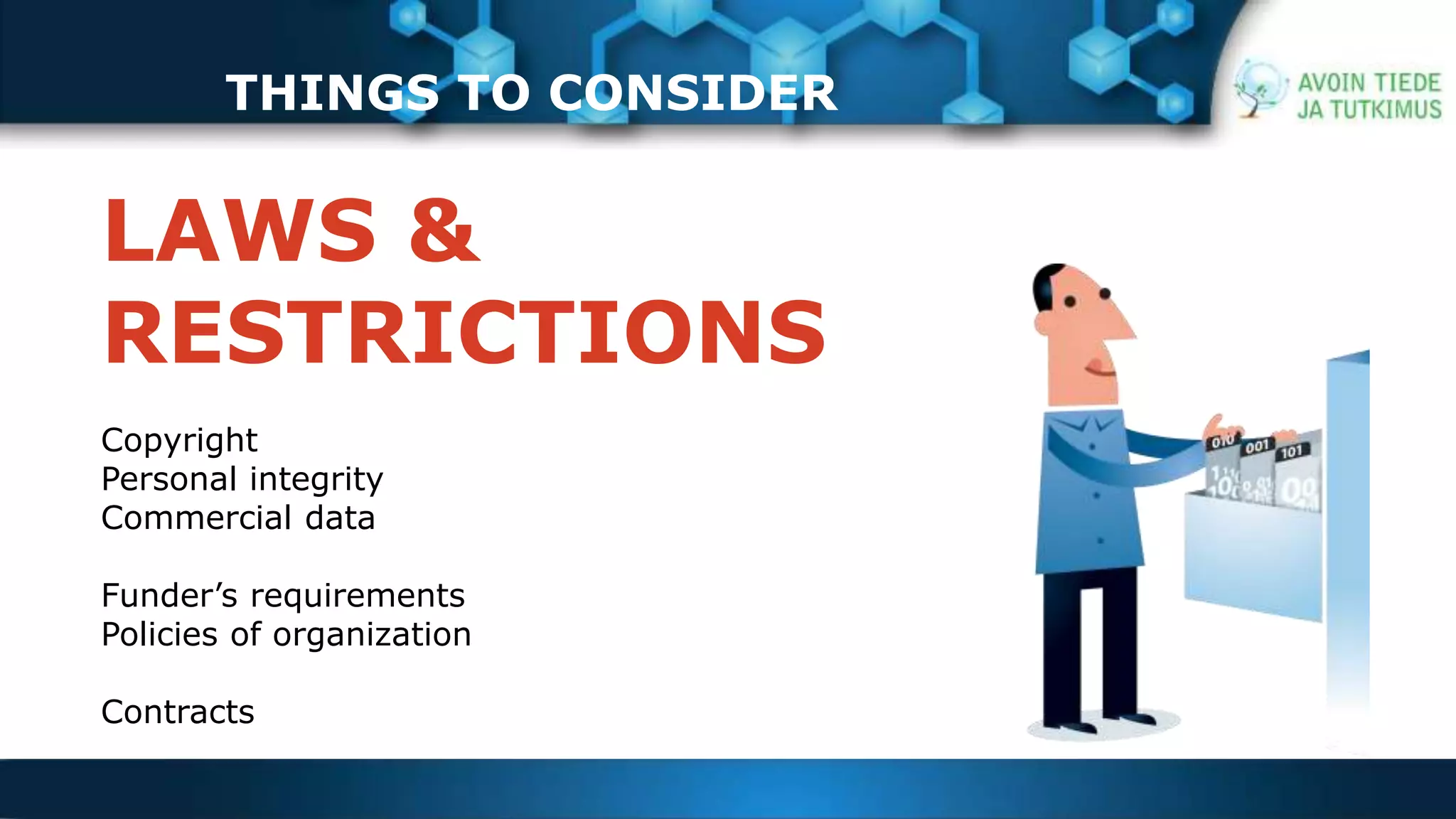
Copyright 
Personal integrity 
Commercial data 
Funder’s requirements 
Policies of organization 
Contracts
THINGS TO CONSIDER 
RESOURCES 
Time and work for cleaning and publishing data as well as 
open access fees should be included from the start to be 
eligible project costs. 
Plan well, consider the costs and get the benefits from open 
science!
THINGS TO CONSIDER 
DATA QUALITY 
THINGS TO CONSIDER 
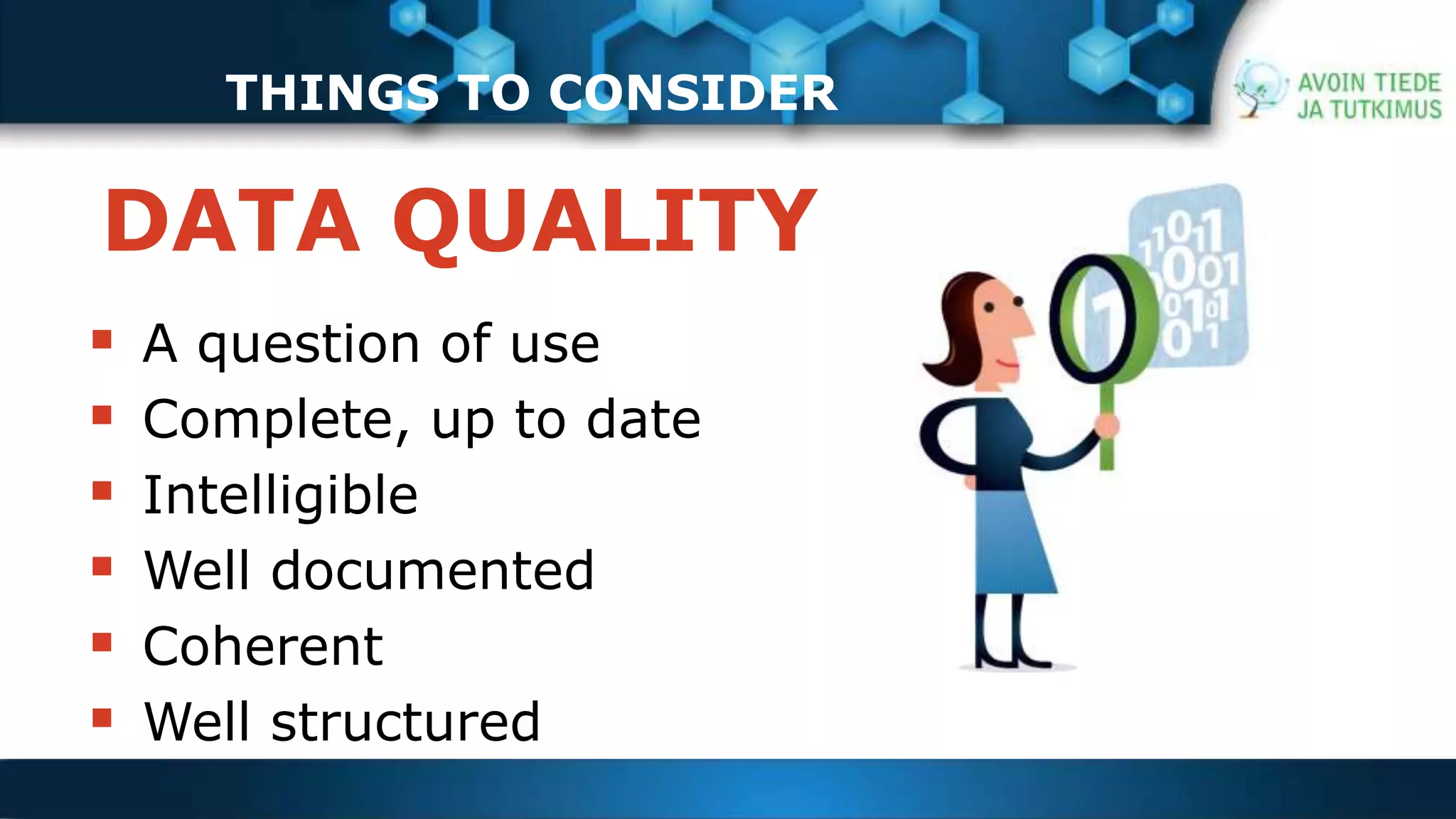
 A question of use 
 Complete, up to date 
 Intelligible 
 Well documented 
 Coherent 
 Well structured
THINGS TO CONSIDER 
DOCUMENTATION 
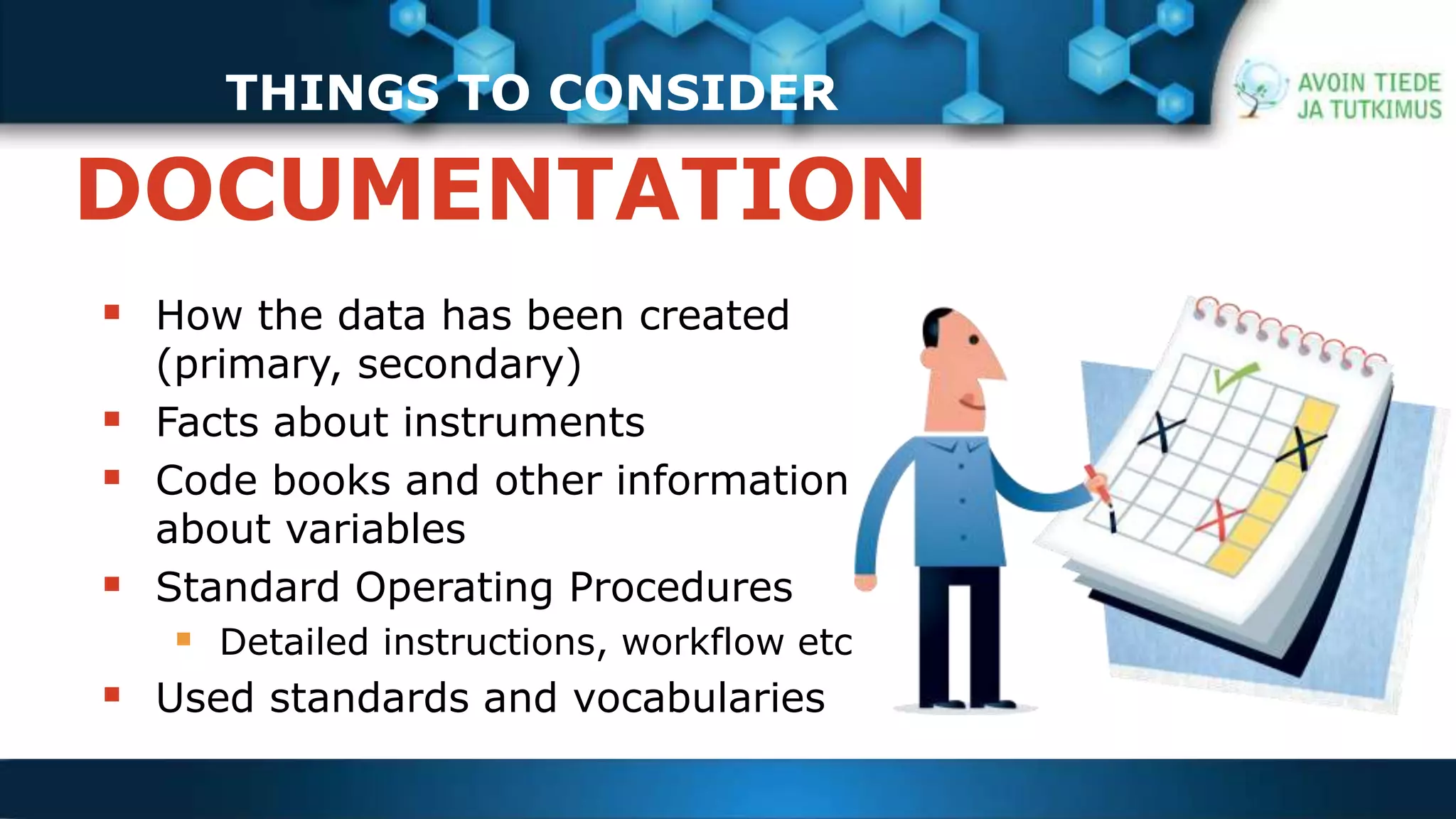
 How the data has been created 
(primary, secondary) 
 Facts about instruments 
 Code books and other information 
about variables 
 Standard Operating Procedures 
 Detailed instructions, workflow etc 
 Used standards and vocabularies
THINGS TO CONSIDER 
METADATA 
THINGS TO CONSIDER 
 What? (title, description, classification, subject, language) 
 Where? (organization, project, country, catalog, format) 
 When? (dateCollected, datePublished, dateChanged) 
 Who? (author, publisher, owner, distributer) 
 How? (method, rights, contact information, identifier, 
citation) 
 Why? (description, publication)
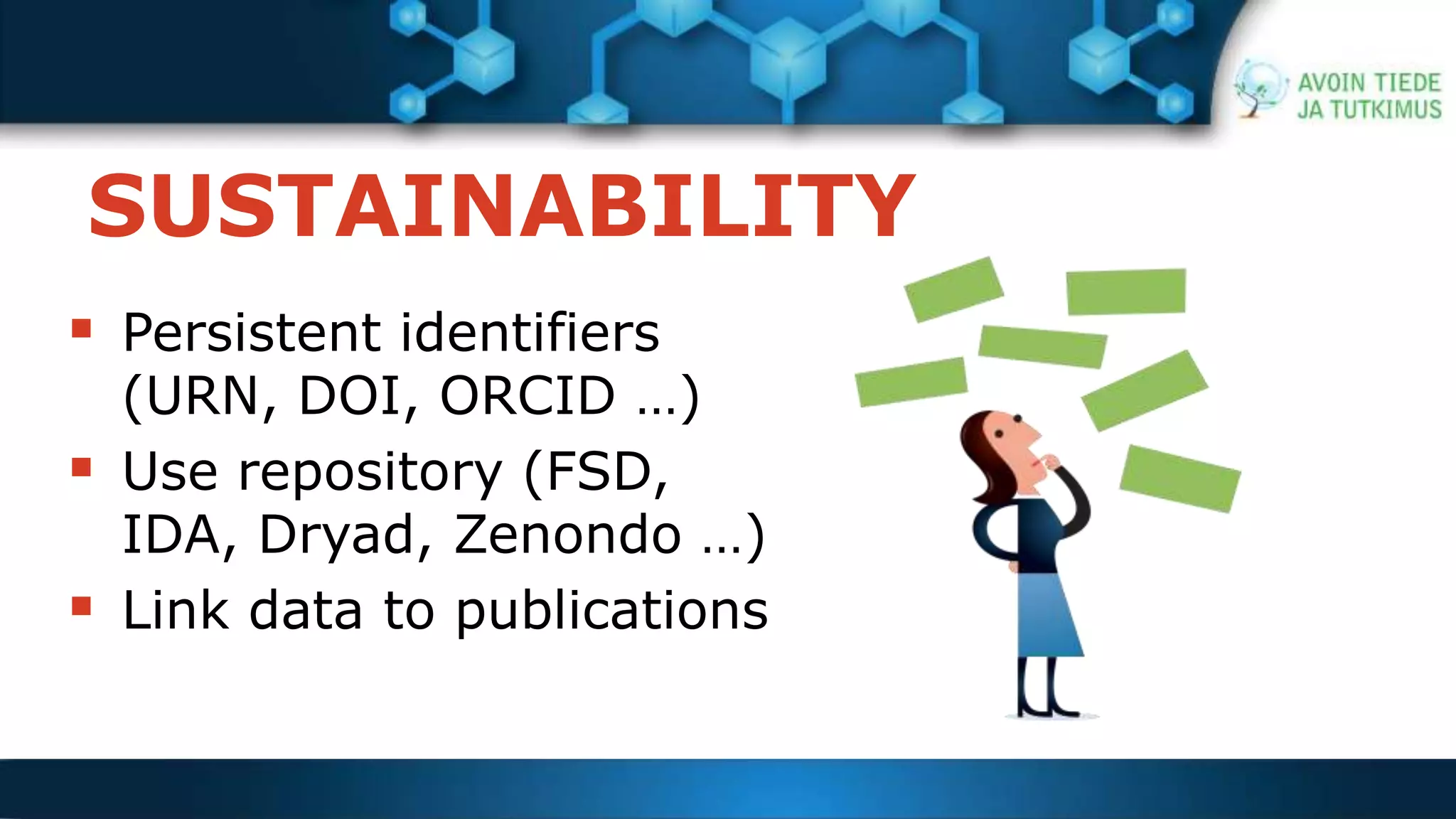
SUSTAINABILITY 
THINGS TO CONSIDER 
 Persistent identifiers 
(URN, DOI, ORCID …) 
 Use repository (FSD, 
IDA, Dryad, Zenondo …) 
 Link data to publications
THINGS TO CONSIDER 
PLANNING 
Finnish Social Science Data Archive 
http://www.fsd.uta.fi/tiedonhallinta/ 
http://www.fsd.uta.fi/en/data_management_planning/ 
Finnish Data Management Guide 
https://www.tdata.fi/tutkimusdatan-hallinta
Checklist 
 https://prezi.com/umyljd3nll2m/checklist-for-openness- 
throughout-the-research-process/
THINGS TO CONSIDER 
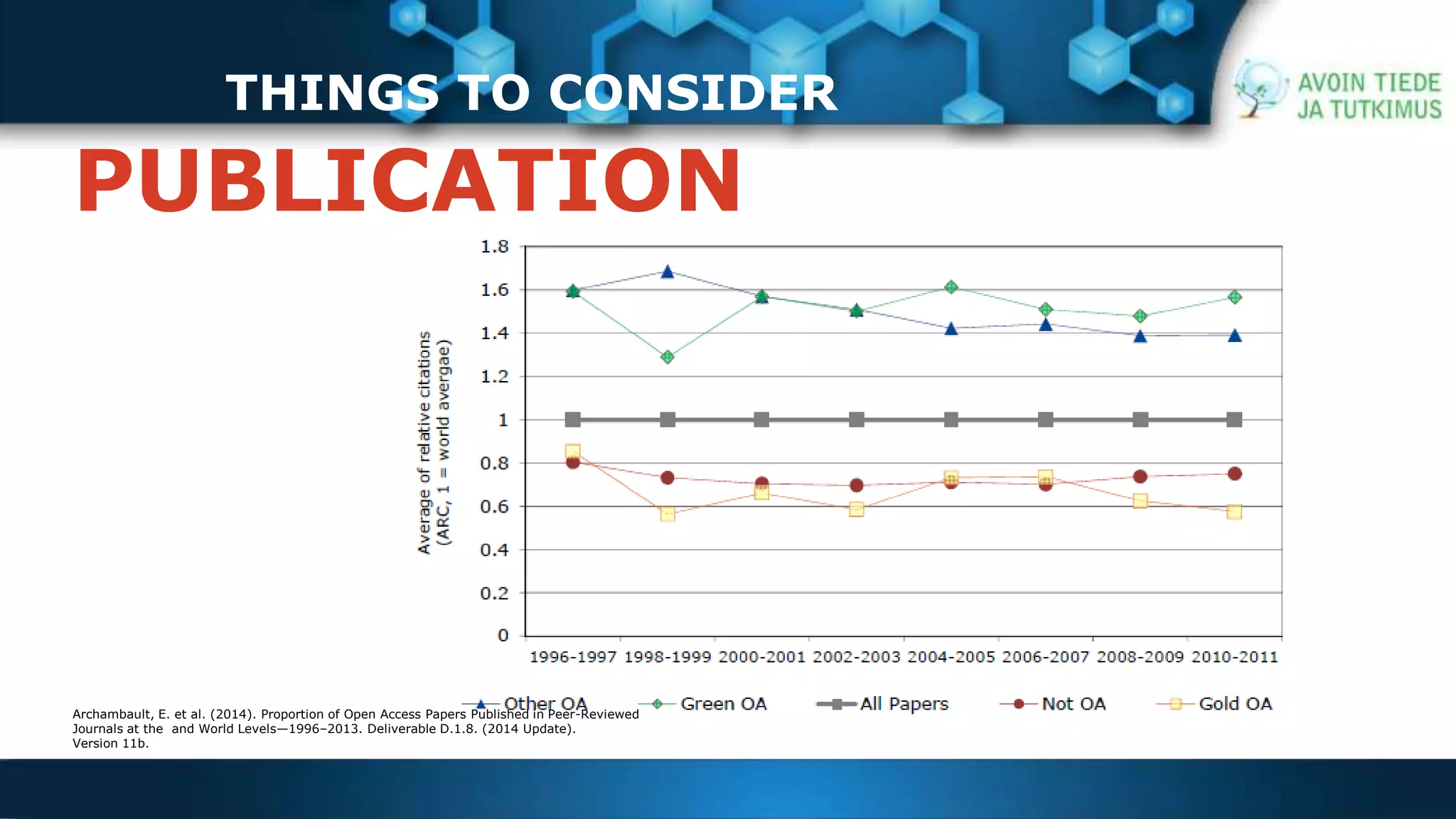
PUBLICATION 
Archambault, E. et al. (2014). Proportion of Open Access Papers Published in Peer-Reviewed 
Journals at the and World Levels—1996–2013. Deliverable D.1.8. (2014 Update). 
Version 11b.
Open Science & Open Access 
 Copyright in Finland applied to all works 
 No one can make copies or develop a work 
unless it’s licensed by all copyright holders 
 Licensing can be used to give different rights 
 For research data CC0 and CC-BY 4.0 are 
recommended in Finland 
 The more you give the further you reach
Berlin Declaration of Open Access 2003 
 Open access contributions must satisfy two conditions: The author(s) and right holder(s) of such 
contributions grant(s) to all users a free, irrevocable, worldwide, right of access to, and a license to 
copy, use, distribute, transmit and display the work publicly and to make and distribute derivative 
works, in any digital medium for any responsible purpose, subject to proper attribution of 
authorship (community standards, will continue to provide the mechanism for enforcement of 
proper attribution and responsible use of the published work, as they do now), as well as the right 
to make small numbers of printed copies for their personal use. 
 A complete version of the work and all supplemental materials, including a copy of the permission 
as stated above, in an appropriate standard electronic format is deposited (and thus published) in 
at least one online repository using suitable technical standards (such as the Open Archive 
definitions) that is supported and maintained by an academic institution, scholarly society, 
government agency, or other well-established organization that seeks to enable open access, 
unrestricted distribution, inter operability, and long-term archiving. 
Signed by the Finnish Council of University Rectors in 2005.
Open Access for publications 
 Green OA: using repositories, embargos may 
apply 
 Golden OA: fees for publishing, free 
distribution 
 Hybrids: “partial gold”
Why Open Access? 
 Better impact 
 More feedback and response 
 Ethics 
 Economy 
 More fun, sharing is caring
OPEN SCIENCE AND RESEARCH INITIATIVE 
Open science and research leads to 
surprising discoveries and creative insights 
Open science and research roadmap 2014–2017
Goals 
 reinforcing the intrinsic nature of science and 
research, so that openness and repeatability 
 increase the reliability and quality of science 
and research.
Goals 
 strengthening openness-related expertise, so 
that those working in the Finnish research 
system know how to harness the 
opportunities afforded by openness to boost 
Finland’s competitive edge.
Goals 
 ensuring a stable foundation for the research 
process, so that good, clear basic structures 
and services enable new opportunities to be 
harnessed at the right time and ensure a 
stable basis for research.
Goals 
 increasing the societal impact of research, so 
that open science creates new opportunities 
for researchers, decision-makers, business, 
public bodies and citizens.
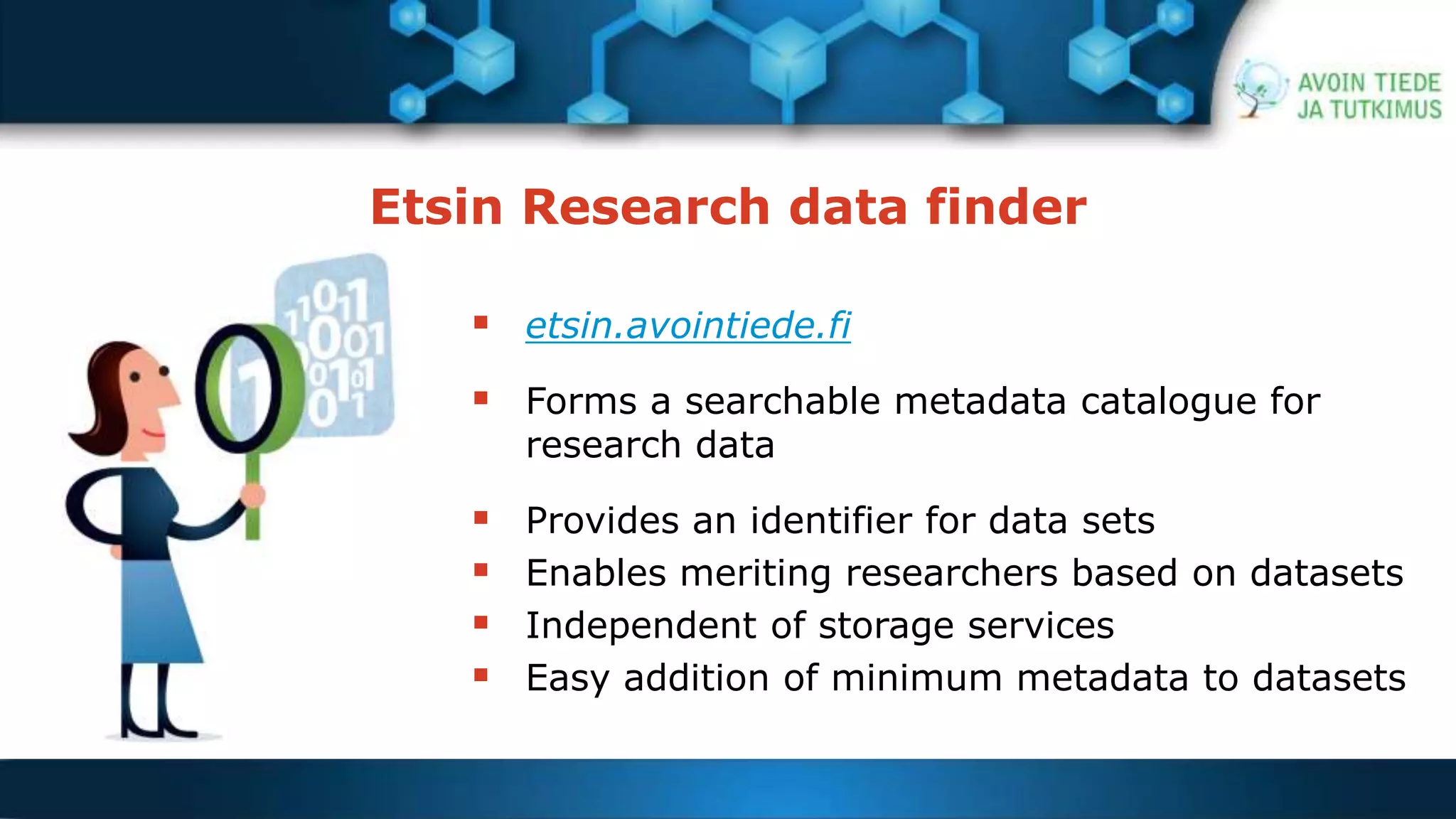
Etsin Research data finder 
 etsin.avointiede.fi 
 Forms a searchable metadata catalogue for 
research data 
 Provides an identifier for data sets 
 Enables meriting researchers based on datasets 
 Independent of storage services 
 Easy addition of minimum metadata to datasets
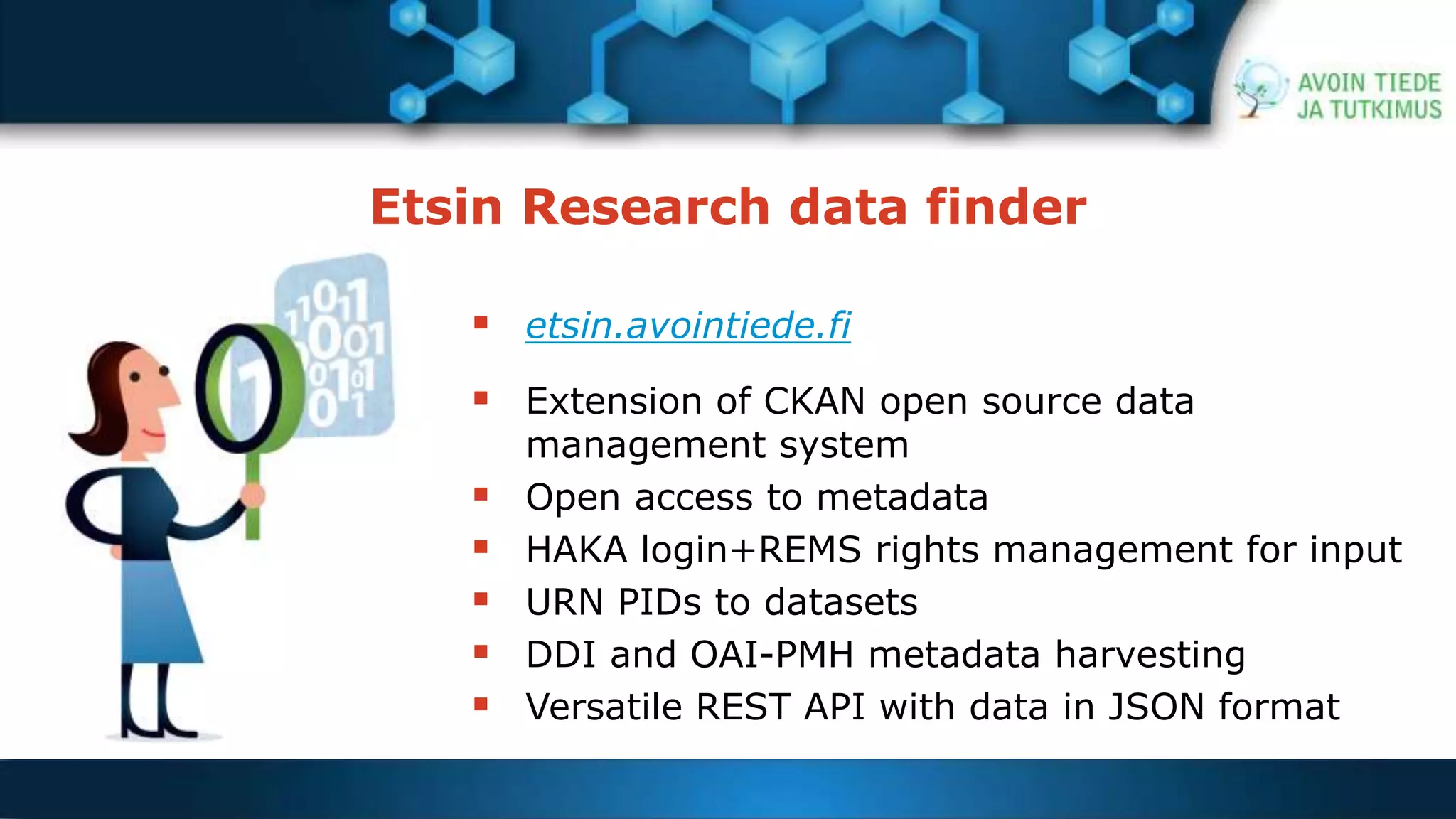
Etsin Research data finder 
 etsin.avointiede.fi 
 Extension of CKAN open source data 
management system 
 Open access to metadata 
 HAKA login+REMS rights management for input 
 URN PIDs to datasets 
 DDI and OAI-PMH metadata harvesting 
 Versatile REST API with data in JSON format
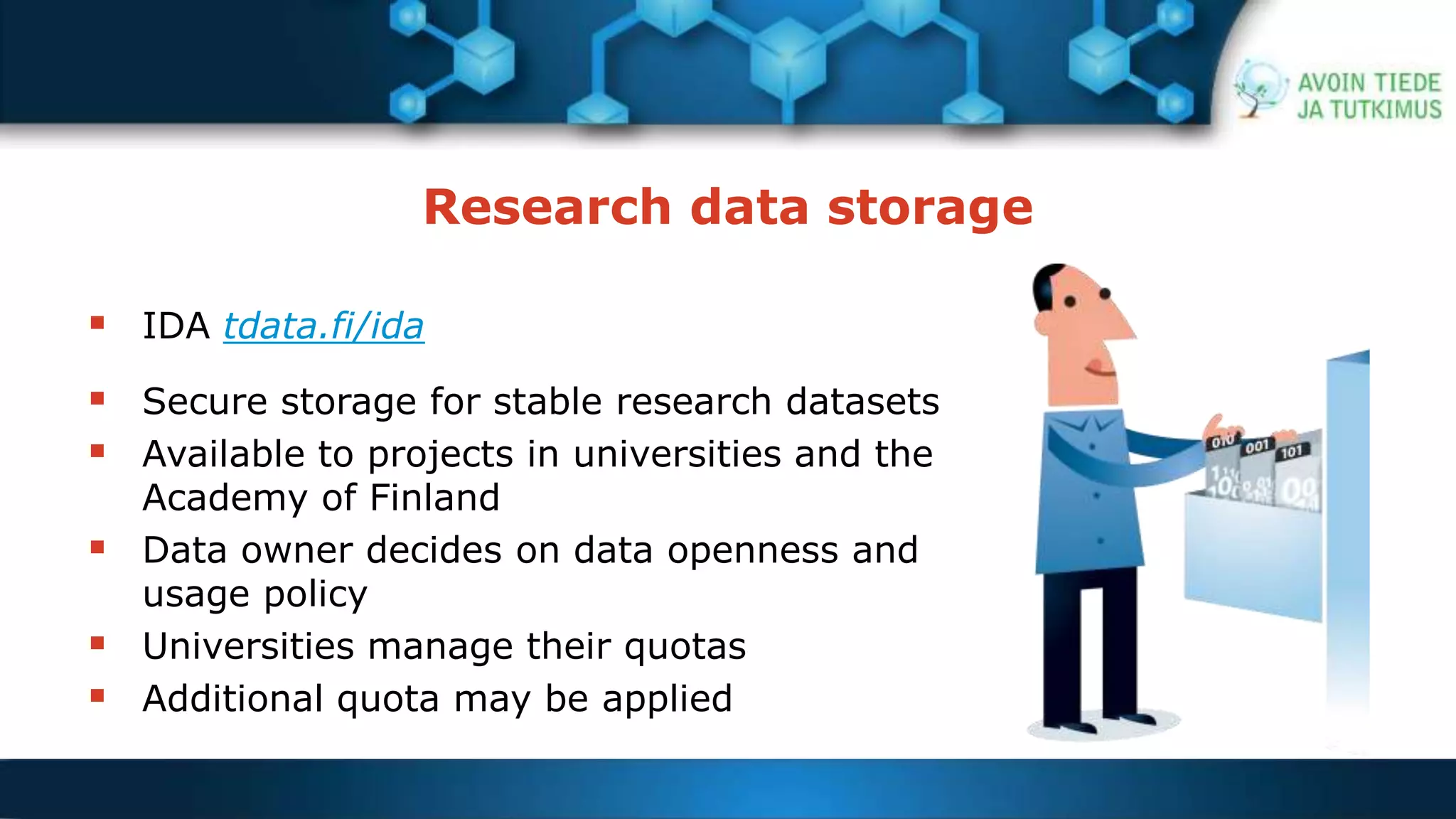
Research data storage 
 IDA tdata.fi/ida 
 Secure storage for stable research datasets 
 Available to projects in universities and the 
Academy of Finland 
 Data owner decides on data openness and 
usage policy 
 Universities manage their quotas 
 Additional quota may be applied
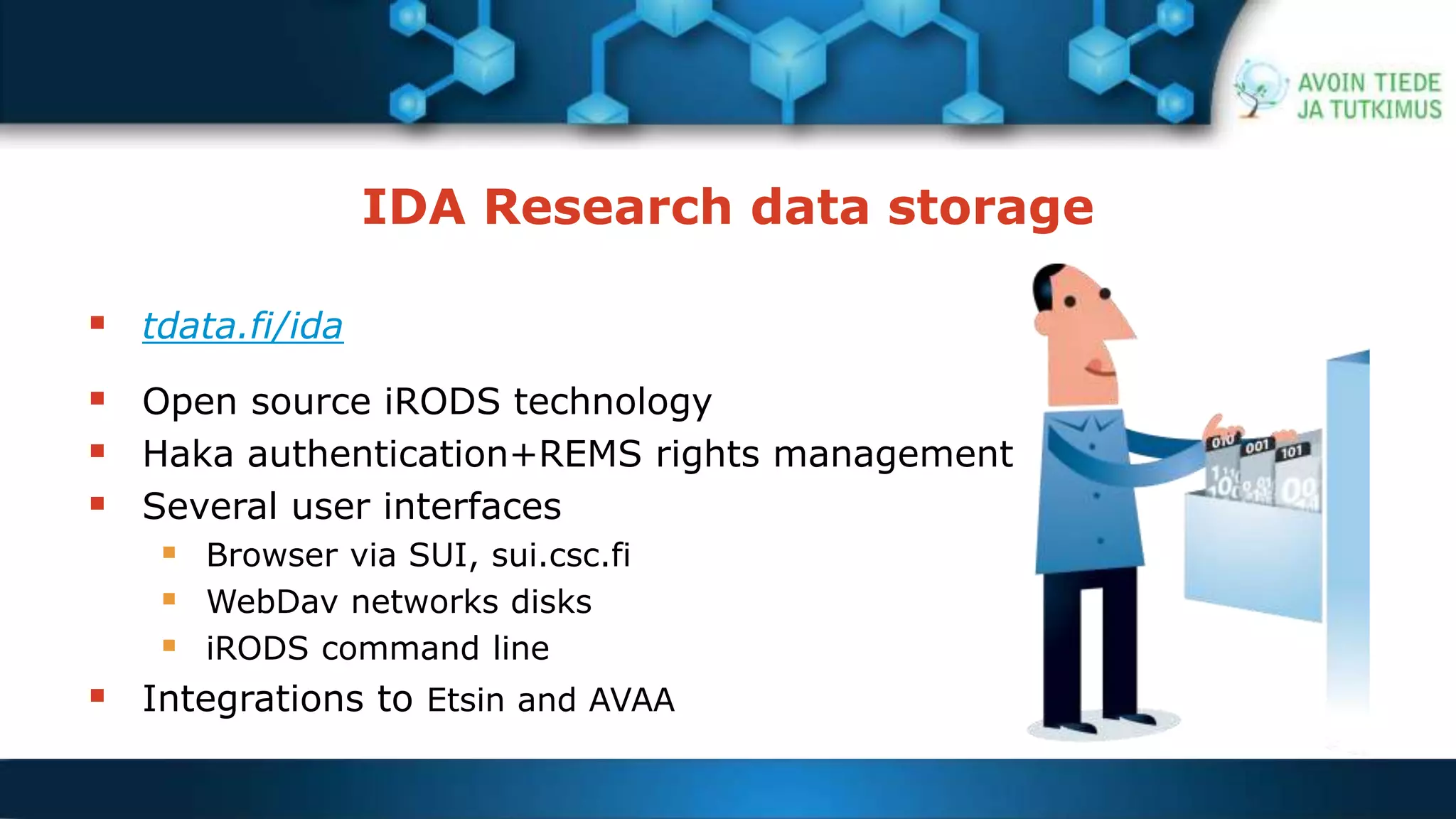
IDA Research data storage 
 tdata.fi/ida 
 Open source iRODS technology 
 Haka authentication+REMS rights management 
 Several user interfaces 
 Browser via SUI, sui.csc.fi 
 WebDav networks disks 
 iRODS command line 
 Integrations to Etsin and AVAA
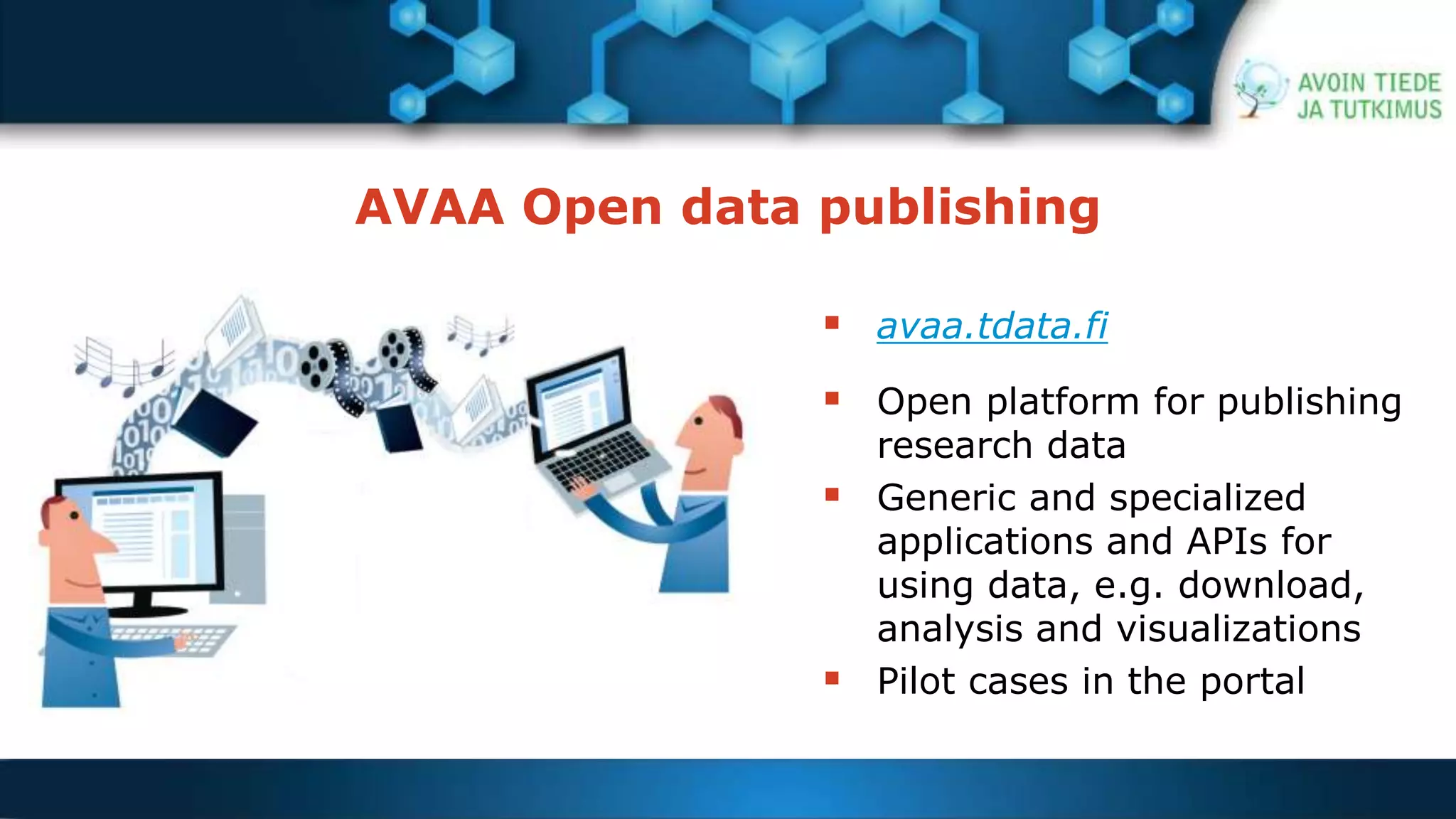
AVAA Open data publishing 
 avaa.tdata.fi 
 Open platform for publishing 
research data 
 Generic and specialized 
applications and APIs for 
using data, e.g. download, 
analysis and visualizations 
 Pilot cases in the portal
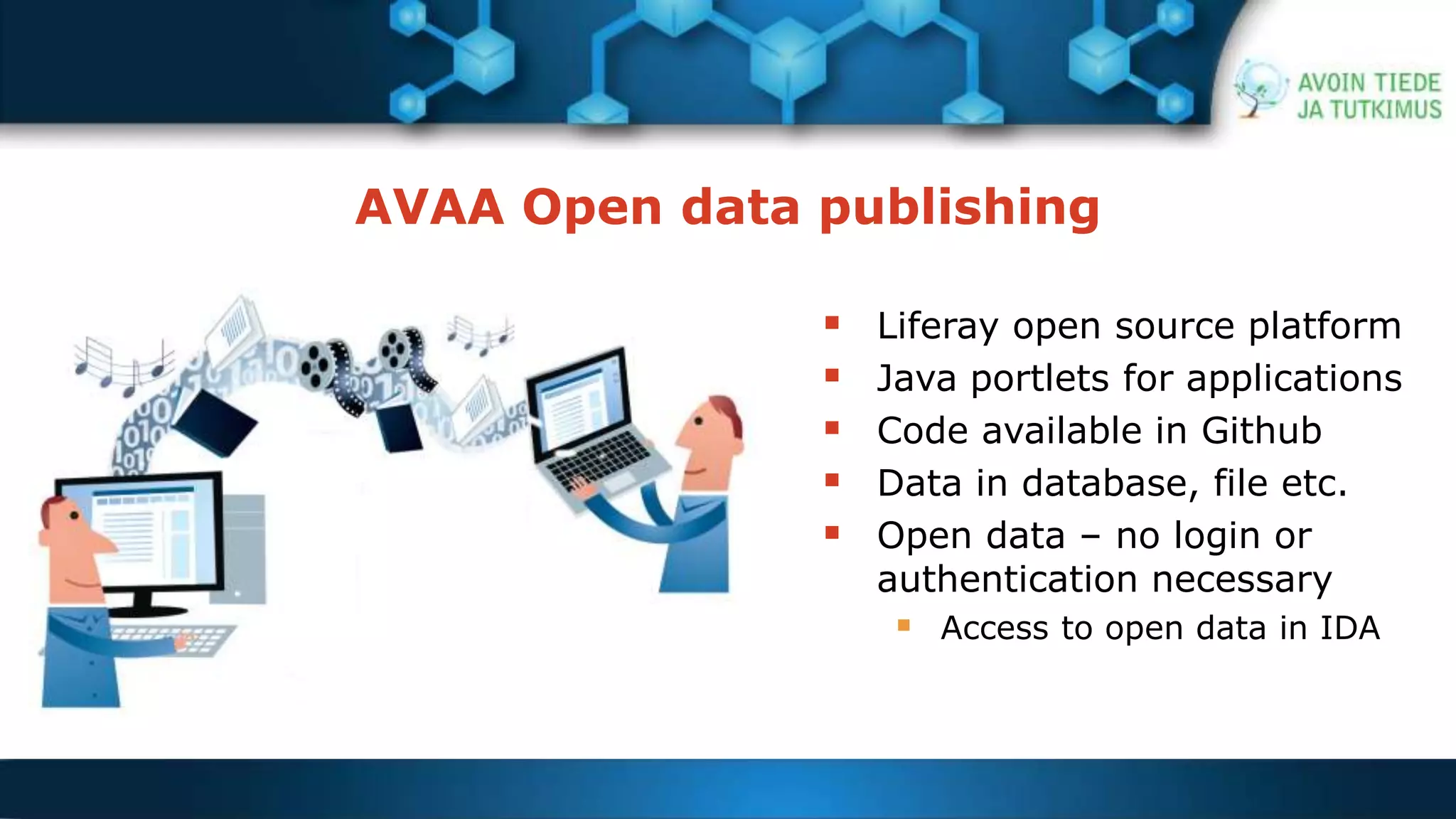
AVAA Open data publishing 
 Liferay open source platform 
 Java portlets for applications 
 Code available in Github 
 Data in database, file etc. 
 Open data – no login or 
authentication necessary 
 Access to open data in IDA
Sensitive data 
 Specialized solutions are needed for 
sensitive data 
 Different degrees of openness need 
to be supported
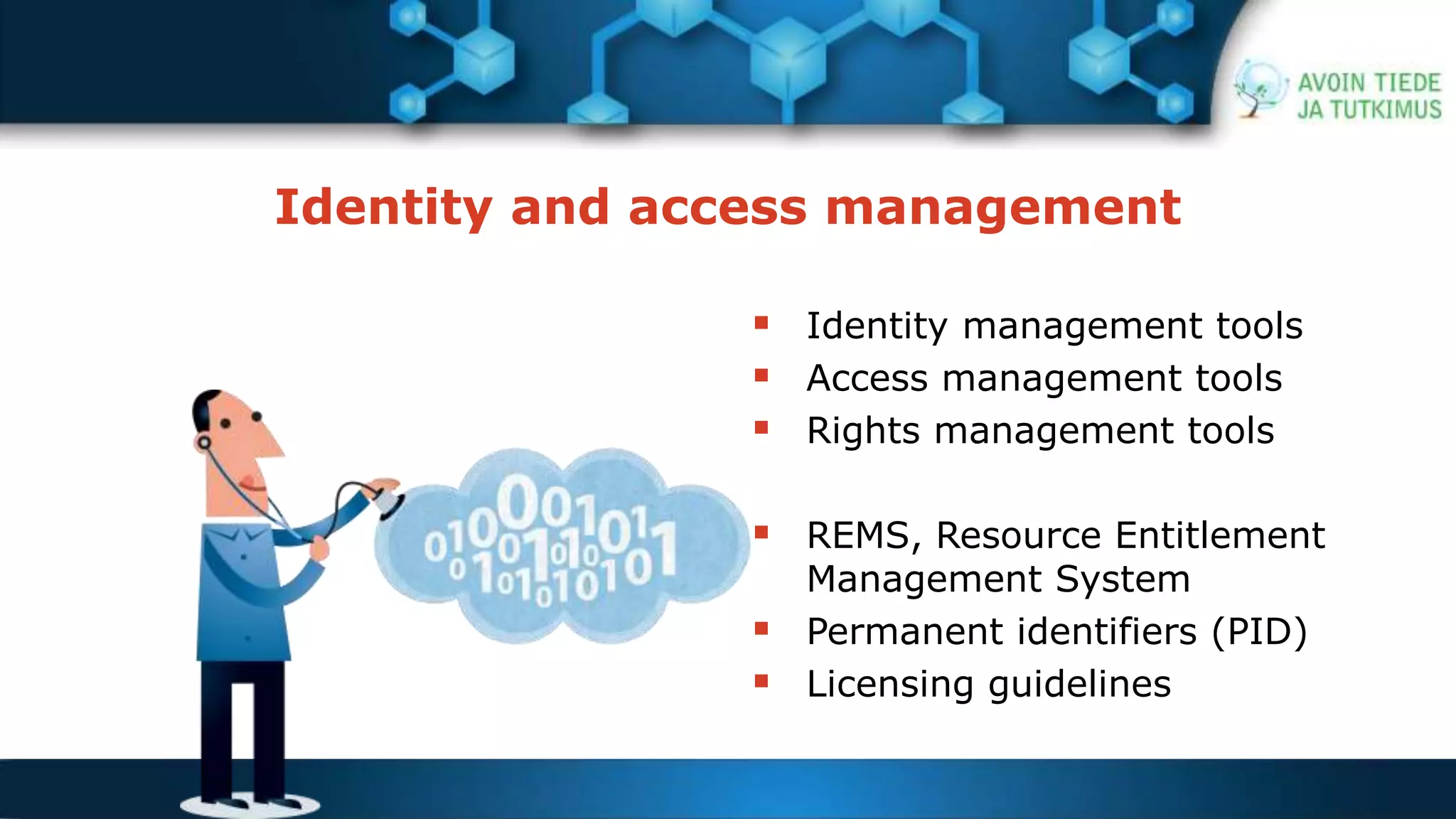
Identity and access management 
 Identity management tools 
 Access management tools 
 Rights management tools 
 REMS, Resource Entitlement 
Management System 
 Permanent identifiers (PID) 
 Licensing guidelines
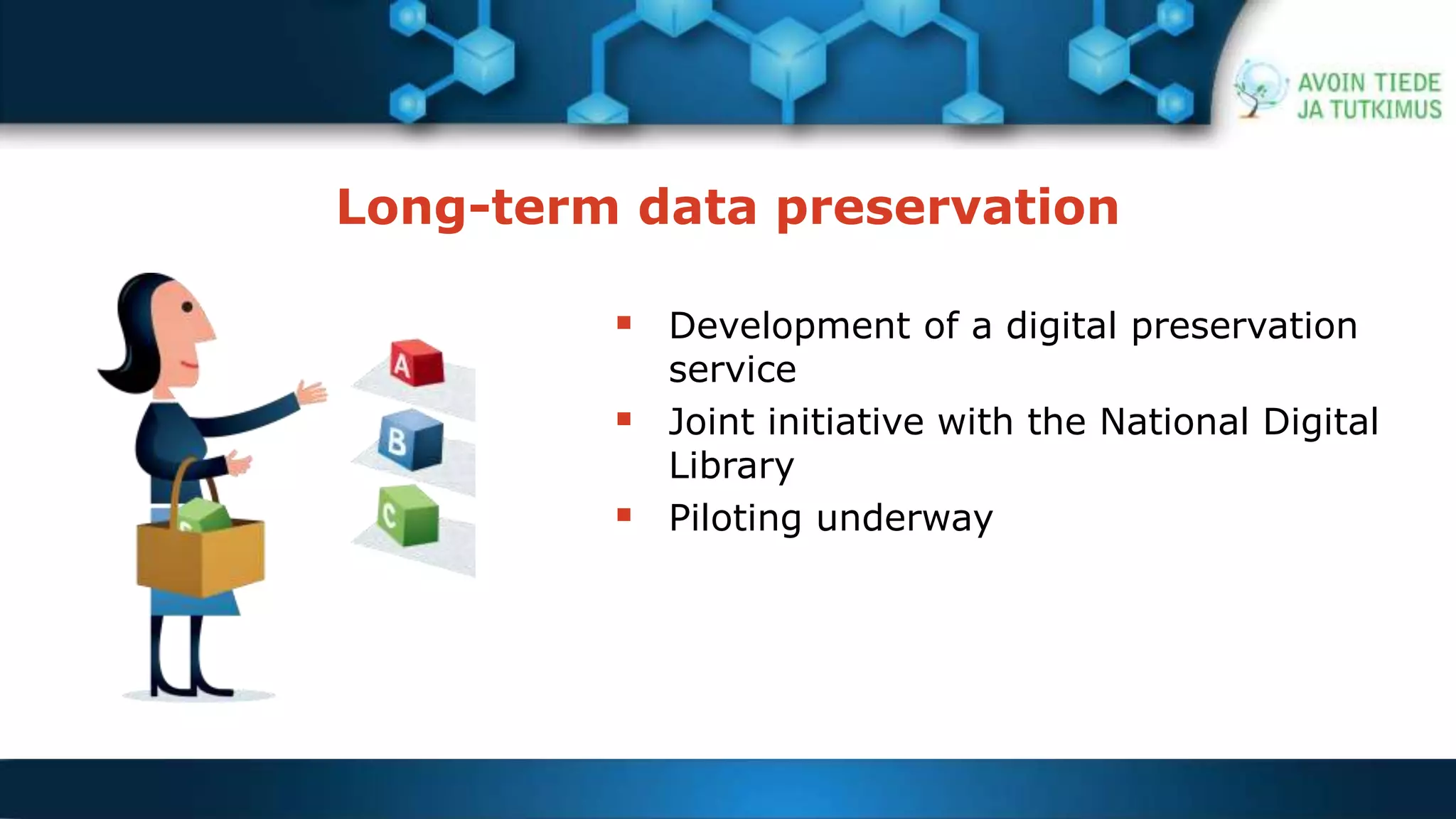
Long-term data preservation 
 Development of a digital preservation 
service 
 Joint initiative with the National Digital 
Library 
 Piloting underway
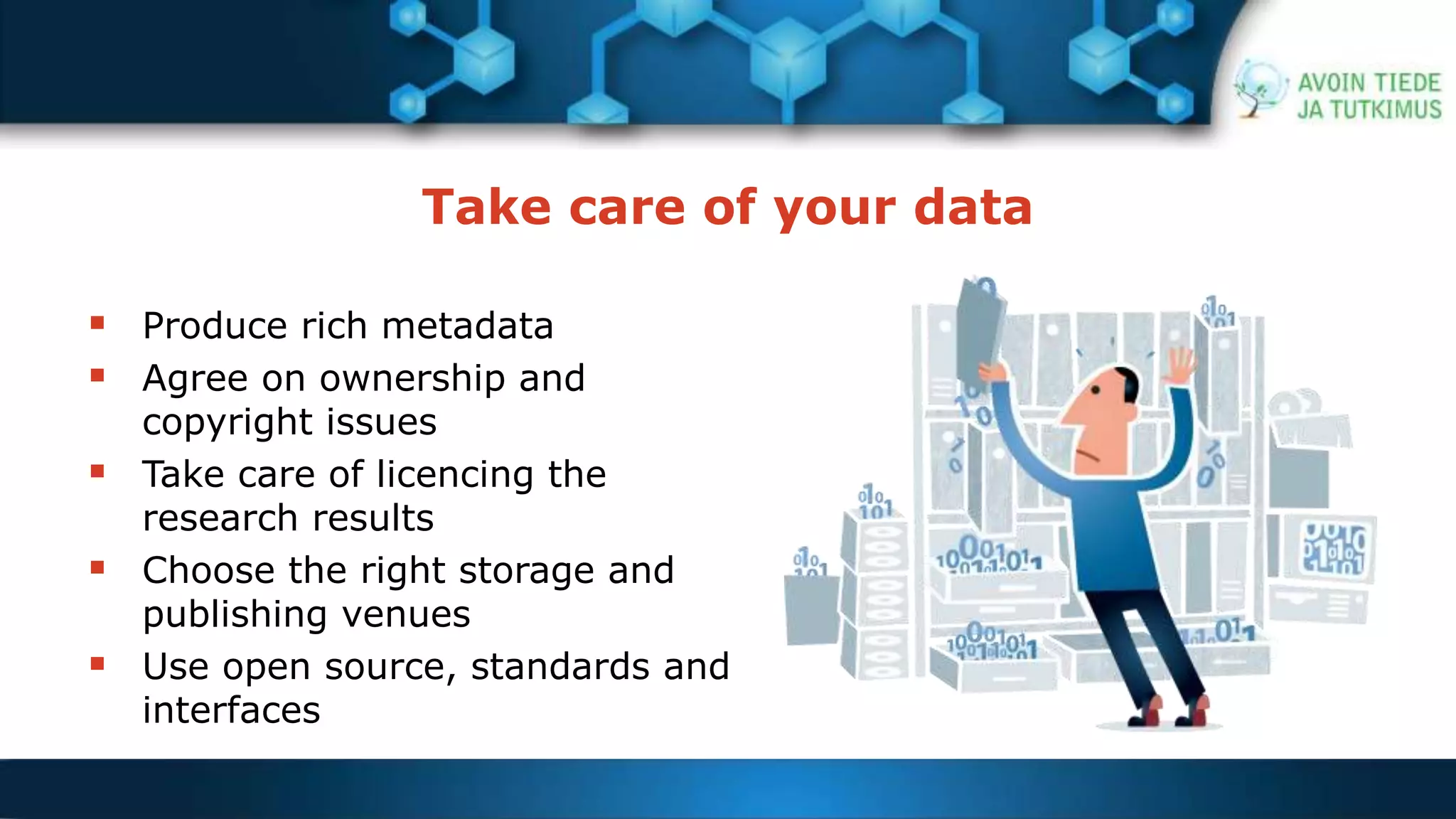
Take care of your data 
 Produce rich metadata 
 Agree on ownership and 
copyright issues 
 Take care of licencing the 
research results 
 Choose the right storage and 
publishing venues 
 Use open source, standards and 
interfaces
Avointiede.fi 
 Open Science Handbook 
http://avointiede.fi/kasikirja 
 Topical articles on Open Science at 
http://avointiede.fi/portti 
 Open Science 
Roadmaphttp://www.minedu.fi/OPM/Julkaisut/2014/Avoi 
men_tieteen_ja_tutkimuksen_tiekartta_2014_2017.html?lan 
g=en
More information 
 avointiede.fi 
 avointiede@postit.csc.fi 
 @AvoinTiede
More information 
 Service websites 
 tdata.fi/ida 
 tdata.fi/avaa 
 etsin.avointiede.fi 
 Scientist’s User Interface (HAKA login) 
 sui.csc.fi 
 CSC Service Desk 
 servicedesk@csc.fi, +358 9 457 2821, 
weekdays 8:30-16:00
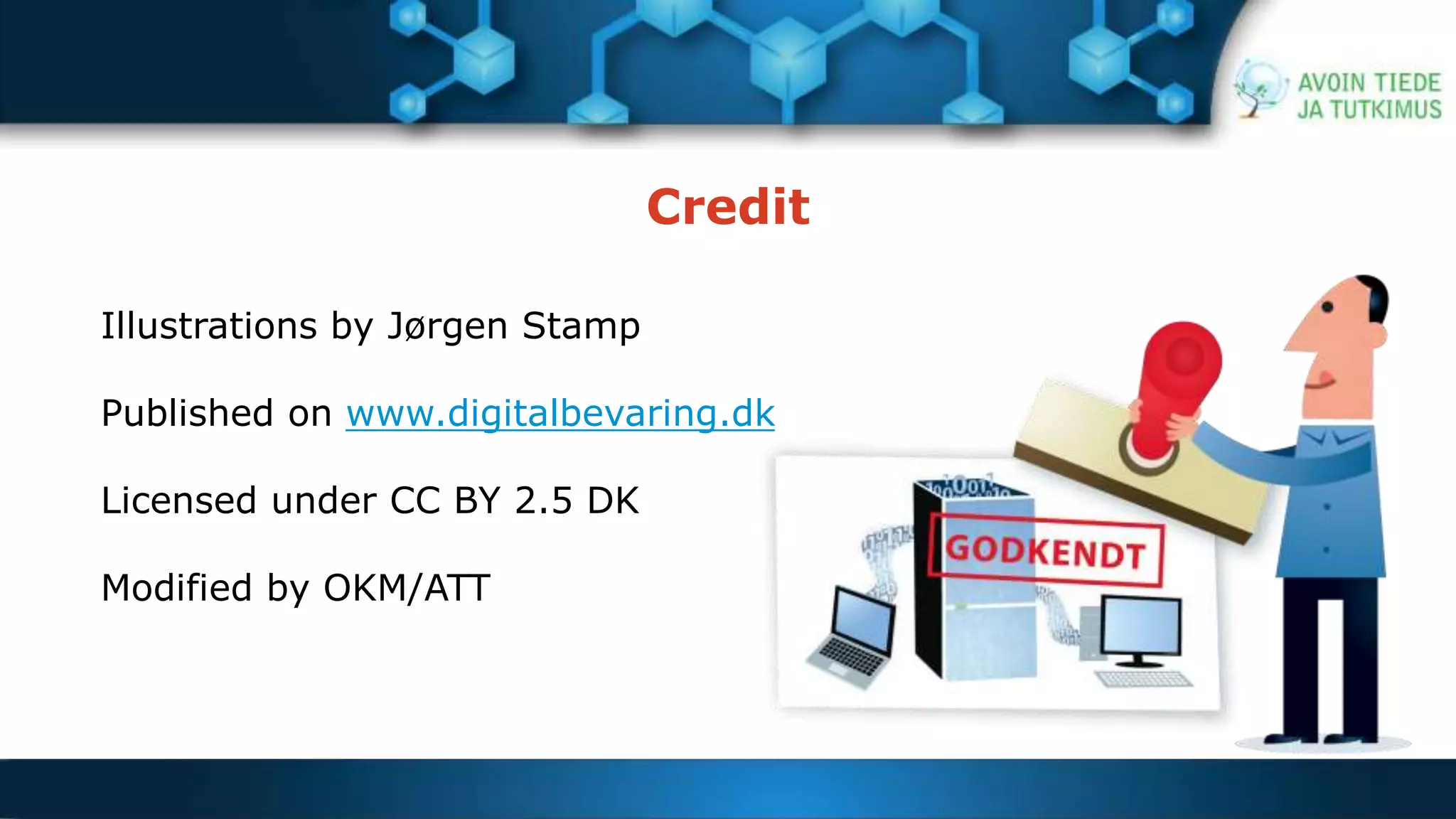
Credit 
Illustrations by Jørgen Stamp 
Published on www.digitalbevaring.dk 
Licensed under CC BY 2.5 DK 
Modified by OKM/ATT

Data Management in Research

  • 1.
    Data Management inResearch Open Science and Research Training © 2014 The Ministry of Education and Culture’s Open Science and Research Initiative 2014–2017 http://openscience.fi/ Licensed under Creative Commons Attribution 4.0 International Public License
  • 2.
    "Research data isdefined as recorded factual material commonly retained by and accepted in the scientific community as necessary to validate research findings; although the majority of such data is created in digital format, all research data is included irrespective of the format in which it is created.” Engineering and Physical Sciences Research Council (EPSRC) What is research data — University of Leicester www2.le.ac.uk/services/research-data/rdm/what-is-rdm/ research-data
  • 3.
    ODE Data PublicationPyramid, LERU Roadmap for Research Data
  • 4.
    MANAGEMENT? CREATING GATHERING STURCTURING DESCRIBING HOUSING SHARING MAINTAINING ARCHIVING PRESERVING
  • 5.
    GOOD DATA MANAGEMENT ENSURES INTEGRITY AND REPRODUCIBILITY
  • 6.
    GOOD DATA MANAGEMENT IS AT THE HEART OF EXCELLENT SCIENCE
  • 7.
    Scientific research shouldbe replicable  Data and methods should be well documented  The data should be intelligible  The data should be sustainable
  • 8.
    Planning data managementadds value  Funders require openness, but are willing to pay if budgeted  Good planning underpins a feasible budget that covers cost  The data should be sustainable
  • 9.
    Communication and transparencyimprove quality  Both data and publications should be findable  Good data management enables openness  Flaws and errors are found and corrected
  • 10.
    FUNDERS  Fundersexpect open publishing  Open publishing requires planning
  • 11.
    European Research Council The ERC considers that providing free online access to these materials is the most effective way of ensuring that the fruits of the research it funds can be accessed, read and used as the basis for further research. The ERC therefore supports the principle of open access to the published output of research as a fundamental part of its mission. Accordingly, the European Research Council:  requests that an electronic copy of any research article, monograph or other research publication that is supported in whole, or in part, by ERC funding be deposited in a suitable repository immediately upon publication. Open access should be provided as soon as possible and in any case no later than six months after the official publication date. For publications in the Social Sciences and Humanities domain a delay of up to twelve months is acceptable.
  • 12.
    European Research Council  encourages ERC funded researchers to use discipline-specific repositories for their publications. A list of recommended repositories is provided in Appendix 1. If there is no appropriate discipline specific repository, researchers should make their publications available in institutional repositories or in centralized ones, such as Zenodo  reminds ERC funded researchers that open access fees are eligible costs that can be charged against ERC grants, provided they have been incurred during the duration of the project. Open Access Guidelines for researchers funded by the ERC http://erc.europa.eu/sites/default/files/document/file/ERC_Open_Access_Guidelines-revised_2013.pdf
  • 13.
    The Academy ofFinland advises researchers to publish their work following the principles of open access and open data. When applying for funding from the Academy, researchers must include in their research plans a publication plan and a data management plan.
  • 14.
    We also requirethat the research plan includes a data management plan, which describes:  how the project proposes to obtain and use its research materials  the rights of ownership and use pertaining to the material used and generated by the project  how the materials produced by the project (or through research infrastructures) will be stored and subsequently made available to other researchers  how the materials will be protected if necessary. http://www.aka.fi/en-GB/A/Funding-and-guidance/How-to-apply/Guidelines/General-application-guidelines/
  • 15.
    The Academy alsorecommends that researchers make their research data available to other researchers. Previously, applicants were asked to include in their research plans information on the storage of data. Now, we also want a description of how the data will be made available to others. [ … ]  As before, the Academy recommends two established databases: the Finnish Social Science Data Archive (FSD) and the FIN-CLARIN consortium. Despite its name, the FSD does accept data in the fields of medicine and the humanities as well (where possible). FIN-CLARIN, in turn, is based at the University of Helsinki and is focused on linguistic data.  As of the September 2014 call, two new repositories have been added to the list of recommended open data resources. CSC, the IT Center for Science, has opened three services for open data. The CSC’s IDA Storage Service offers data storage opportunities for Academy-funded researchers. The CSC’s [Etsin] metadata catalogue, in turn, is the preferred storage location for metadata, regardless of where the actual research data are stored. Lastly, the CSC’s AVAA open-access publishing platform offers applications for the use of open access data. In addition, and alternatively, the Academy recommends the Zenodo service as a service for sharing and storing research results. http://www.aka.fi/en-GB/A/Funding-and-guidance/How-to-apply/Guidelines/General-application-guidelines/
  • 16.
    THINGS TO CONSIDER LAWS & RESTRICTIONS Copyright Personal integrity Commercial data Funder’s requirements Policies of organization Contracts
  • 17.
    THINGS TO CONSIDER RESOURCES Time and work for cleaning and publishing data as well as open access fees should be included from the start to be eligible project costs. Plan well, consider the costs and get the benefits from open science!
  • 18.
    THINGS TO CONSIDER DATA QUALITY THINGS TO CONSIDER  A question of use  Complete, up to date  Intelligible  Well documented  Coherent  Well structured
  • 19.
    THINGS TO CONSIDER DOCUMENTATION  How the data has been created (primary, secondary)  Facts about instruments  Code books and other information about variables  Standard Operating Procedures  Detailed instructions, workflow etc  Used standards and vocabularies
  • 20.
    THINGS TO CONSIDER METADATA THINGS TO CONSIDER  What? (title, description, classification, subject, language)  Where? (organization, project, country, catalog, format)  When? (dateCollected, datePublished, dateChanged)  Who? (author, publisher, owner, distributer)  How? (method, rights, contact information, identifier, citation)  Why? (description, publication)
  • 21.
    SUSTAINABILITY THINGS TOCONSIDER  Persistent identifiers (URN, DOI, ORCID …)  Use repository (FSD, IDA, Dryad, Zenondo …)  Link data to publications
  • 22.
    THINGS TO CONSIDER PLANNING Finnish Social Science Data Archive http://www.fsd.uta.fi/tiedonhallinta/ http://www.fsd.uta.fi/en/data_management_planning/ Finnish Data Management Guide https://www.tdata.fi/tutkimusdatan-hallinta
  • 23.
  • 24.
    THINGS TO CONSIDER PUBLICATION Archambault, E. et al. (2014). Proportion of Open Access Papers Published in Peer-Reviewed Journals at the and World Levels—1996–2013. Deliverable D.1.8. (2014 Update). Version 11b.
  • 25.
    Open Science &Open Access  Copyright in Finland applied to all works  No one can make copies or develop a work unless it’s licensed by all copyright holders  Licensing can be used to give different rights  For research data CC0 and CC-BY 4.0 are recommended in Finland  The more you give the further you reach
  • 26.
    Berlin Declaration ofOpen Access 2003  Open access contributions must satisfy two conditions: The author(s) and right holder(s) of such contributions grant(s) to all users a free, irrevocable, worldwide, right of access to, and a license to copy, use, distribute, transmit and display the work publicly and to make and distribute derivative works, in any digital medium for any responsible purpose, subject to proper attribution of authorship (community standards, will continue to provide the mechanism for enforcement of proper attribution and responsible use of the published work, as they do now), as well as the right to make small numbers of printed copies for their personal use.  A complete version of the work and all supplemental materials, including a copy of the permission as stated above, in an appropriate standard electronic format is deposited (and thus published) in at least one online repository using suitable technical standards (such as the Open Archive definitions) that is supported and maintained by an academic institution, scholarly society, government agency, or other well-established organization that seeks to enable open access, unrestricted distribution, inter operability, and long-term archiving. Signed by the Finnish Council of University Rectors in 2005.
  • 27.
    Open Access forpublications  Green OA: using repositories, embargos may apply  Golden OA: fees for publishing, free distribution  Hybrids: “partial gold”
  • 28.
    Why Open Access?  Better impact  More feedback and response  Ethics  Economy  More fun, sharing is caring
  • 29.
    OPEN SCIENCE ANDRESEARCH INITIATIVE Open science and research leads to surprising discoveries and creative insights Open science and research roadmap 2014–2017
  • 30.
    Goals  reinforcingthe intrinsic nature of science and research, so that openness and repeatability  increase the reliability and quality of science and research.
  • 31.
    Goals  strengtheningopenness-related expertise, so that those working in the Finnish research system know how to harness the opportunities afforded by openness to boost Finland’s competitive edge.
  • 32.
    Goals  ensuringa stable foundation for the research process, so that good, clear basic structures and services enable new opportunities to be harnessed at the right time and ensure a stable basis for research.
  • 33.
    Goals  increasingthe societal impact of research, so that open science creates new opportunities for researchers, decision-makers, business, public bodies and citizens.
  • 34.
    Etsin Research datafinder  etsin.avointiede.fi  Forms a searchable metadata catalogue for research data  Provides an identifier for data sets  Enables meriting researchers based on datasets  Independent of storage services  Easy addition of minimum metadata to datasets
  • 35.
    Etsin Research datafinder  etsin.avointiede.fi  Extension of CKAN open source data management system  Open access to metadata  HAKA login+REMS rights management for input  URN PIDs to datasets  DDI and OAI-PMH metadata harvesting  Versatile REST API with data in JSON format
  • 36.
    Research data storage  IDA tdata.fi/ida  Secure storage for stable research datasets  Available to projects in universities and the Academy of Finland  Data owner decides on data openness and usage policy  Universities manage their quotas  Additional quota may be applied
  • 37.
    IDA Research datastorage  tdata.fi/ida  Open source iRODS technology  Haka authentication+REMS rights management  Several user interfaces  Browser via SUI, sui.csc.fi  WebDav networks disks  iRODS command line  Integrations to Etsin and AVAA
  • 38.
    AVAA Open datapublishing  avaa.tdata.fi  Open platform for publishing research data  Generic and specialized applications and APIs for using data, e.g. download, analysis and visualizations  Pilot cases in the portal
  • 39.
    AVAA Open datapublishing  Liferay open source platform  Java portlets for applications  Code available in Github  Data in database, file etc.  Open data – no login or authentication necessary  Access to open data in IDA
  • 40.
    Sensitive data Specialized solutions are needed for sensitive data  Different degrees of openness need to be supported
  • 41.
    Identity and accessmanagement  Identity management tools  Access management tools  Rights management tools  REMS, Resource Entitlement Management System  Permanent identifiers (PID)  Licensing guidelines
  • 42.
    Long-term data preservation  Development of a digital preservation service  Joint initiative with the National Digital Library  Piloting underway
  • 43.
    Take care ofyour data  Produce rich metadata  Agree on ownership and copyright issues  Take care of licencing the research results  Choose the right storage and publishing venues  Use open source, standards and interfaces
  • 45.
    Avointiede.fi  OpenScience Handbook http://avointiede.fi/kasikirja  Topical articles on Open Science at http://avointiede.fi/portti  Open Science Roadmaphttp://www.minedu.fi/OPM/Julkaisut/2014/Avoi men_tieteen_ja_tutkimuksen_tiekartta_2014_2017.html?lan g=en
  • 46.
    More information avointiede.fi  avointiede@postit.csc.fi  @AvoinTiede
  • 47.
    More information Service websites  tdata.fi/ida  tdata.fi/avaa  etsin.avointiede.fi  Scientist’s User Interface (HAKA login)  sui.csc.fi  CSC Service Desk  servicedesk@csc.fi, +358 9 457 2821, weekdays 8:30-16:00
  • 48.
    Credit Illustrations byJørgen Stamp Published on www.digitalbevaring.dk Licensed under CC BY 2.5 DK Modified by OKM/ATT

Editor's Notes

  • #23 http://datalib.edina.ac.uk/mantra/ https://class.coursera.org/datamanagement-003 http://www.fsd.uta.fi/tiedonhallinta/ https://prezi.com/2dk9d6qv6lei/avoin-tiede-ja-tutkimus/
  • #35 Metadata on research datasets is collected into Etsin Metadata may be searched and browsed openly Adding metadata on a dataset required HAKA identification Minimum requirements for metadata (minimum metadata model) The better a dataset is described, the easier it is for others to find and utilize it Recommendable but not required to open the dataset itself
  • #36 REMS is an open source tool for management of access rights to research resources, such as research datasets. Applicants can use their federated user IDs CKAN (Comprehensive Knowledge Archive Network) is a web-based open source data management system for the storage and distribution of data JSON (JavaScript Object Notation) is a lightweight data-interchange format. It is easy for humans to read and write. It is easy for machines to parse and generate. REST (REpresentational State Transfer) is a simple stateless architecture that generally runs over HTTP, common API style
  • #37 Use quotas assigned to universities and Academy of Finland Division based on Ministry indicators Universities manage their quotas independently University contact person approves applications from projects Usage permits and individual user accounts assigned at CSC Additional quota may be applied for large space needs Additional application rounds roughly twice a year More information from ida-lisaosuus@postit.csc.fi
  • #38 REMS is an open source tool for management of access rights to research resources, such as research datasets. Applicants can use their federated user IDs Integrations Search metadata through Etsin & Share data through AVAA
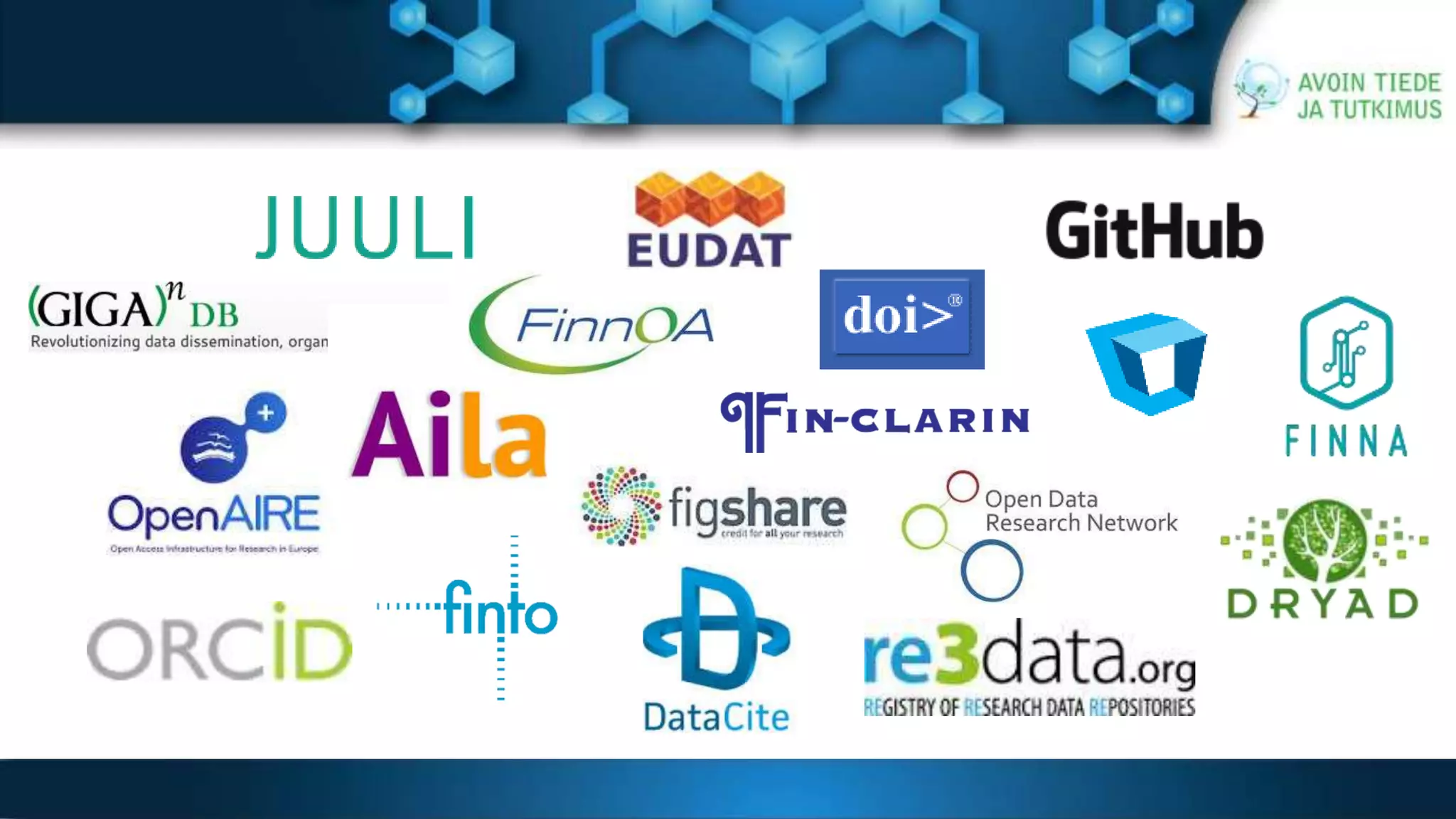
  • #45 Aila DataCite DOI DRYAD is an open repository of both journal articles and associated datasets for evolutionary biology and a growing range of subjects, hosted at the University of North Carolina. EUDAT Figshare is a publisher-funded open repository based in London aimed at the biological sciences but open to all disciplines FINClarin FINNA FINNOA Finto FSD GitHub JUULI OpenAire Open Data Research Network ORCID