Mr. Jeffrey G. Delfin
Senior High School Teacher III
Cabangan National High School
July 23, 2017
 Is about the entire process of: finding
the object to photograph, taking the
photograph, processing the image and
presenting the image.
 Should have a working knowledge of
his outfit – camera, lens, and film;
 Should know a little of art and be
possessed with a notion of contrast ,
angle and shapes;
 Must have a nose for drama, oddity,
rarity, action and for human interest
stories;
 Must be acquainted with the important
as well as with the notorious people
who break into the news often;
 Must have diplomacy and tact when
covering risky assignments like fires,
riots, rallies, and demonstrations; and
 Must be acquainted with the libel laws,
since libel suits can also proceed from
pictures.
 A caption is the text of body type,
accompanying photos or art work or
any pictorial illustration. It is
sometimes called cutline or underline.
The title or explanatory matter above
the illustration is called overline.
 Caption should be closely related to
the picture so that the reader may be
able to take in picture and caption at a
glance. This explains why the caption
should be underneath the picture
when there are other materials on the
page.
 The caption can be at the side when
caption and picture are isolated.
 All rules in news printing apply to
caption writing.
 Captions should be written in short
pithy sentences, say an average of 15
words for a sentence.
 Captions should supplement what is
seen. They are not captions if they
merely tell the reader what he can see.
A caption of a picture showing
President Arroyo speaking should not
say, “President Arroyo Speaking.” See
to it that the caption supplements the
pictorial information briefly.
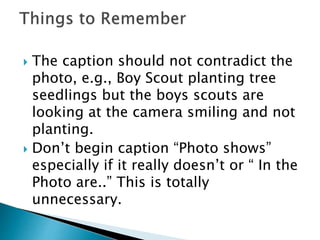
 The caption should not contradict the
photo, e.g., Boy Scout planting tree
seedlings but the boys scouts are
looking at the camera smiling and not
planting.
 Don’t begin caption “Photo shows”
especially if it really doesn’t or “ In the
Photo are..” This is totally
unnecessary.
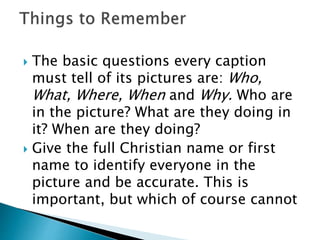
 The basic questions every caption
must tell of its pictures are: Who,
What, Where, When and Why. Who are
in the picture? What are they doing in
it? When are they doing?
 Give the full Christian name or first
name to identify everyone in the
picture and be accurate. This is
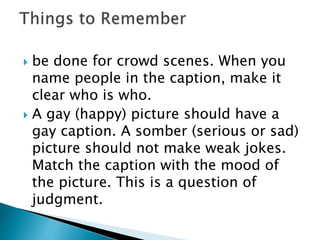
important, but which of course cannot
 be done for crowd scenes. When you
name people in the caption, make it
clear who is who.
 A gay (happy) picture should have a
gay caption. A somber (serious or sad)
picture should not make weak jokes.
Match the caption with the mood of
the picture. This is a question of
judgment.
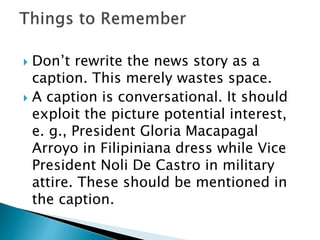
 Don’t rewrite the news story as a
caption. This merely wastes space.
 A caption is conversational. It should
exploit the picture potential interest,
e. g., President Gloria Macapagal
Arroyo in Filipiniana dress while Vice
President Noli De Castro in military
attire. These should be mentioned in
the caption.
 A standard cutline is written as such:
(Noun) (verb) (direct object) during
(proper event name) at (proper noun
location) in (city) on (day of the week),
(month) (date), (year). Why or How.
 Example:
Dallas firefighters (noun) battle
(present-tense verb) a fire (direct
object) at the Fitzhugh Apartments
(proper noun location) near the
intersection of Fitzhugh Avenue and
Monarch Street in Dallas (city) on
Thursday (day of the week), July
(month) 1 (date), 2004 (year).
JEFFREY G. DELFIN
• Gawad Silip Alagad ng Sining Awardee - Visual Arts Photography (2017)
•Top 30 winner (Culture Category) in the “Time Magazine Submit Your
World”-Asia Pacific Video Contest 2015.
•3rd place in Pinoy Lens In Climate Change sponsored by United Nations'
World Food Programme-Philippines (2013)
•2nd Place in Readers' Digest Asia Philippine's Love Photo Contest (2012)

Photojournalism 101

  • 1.
    Mr. Jeffrey G.Delfin Senior High School Teacher III Cabangan National High School July 23, 2017
  • 2.
     Is aboutthe entire process of: finding the object to photograph, taking the photograph, processing the image and presenting the image.
  • 3.
     Should havea working knowledge of his outfit – camera, lens, and film;  Should know a little of art and be possessed with a notion of contrast , angle and shapes;  Must have a nose for drama, oddity, rarity, action and for human interest stories;
  • 4.
     Must beacquainted with the important as well as with the notorious people who break into the news often;  Must have diplomacy and tact when covering risky assignments like fires, riots, rallies, and demonstrations; and  Must be acquainted with the libel laws, since libel suits can also proceed from pictures.
  • 5.
     A captionis the text of body type, accompanying photos or art work or any pictorial illustration. It is sometimes called cutline or underline. The title or explanatory matter above the illustration is called overline.
  • 6.
     Caption shouldbe closely related to the picture so that the reader may be able to take in picture and caption at a glance. This explains why the caption should be underneath the picture when there are other materials on the page.  The caption can be at the side when caption and picture are isolated.
  • 7.
     All rulesin news printing apply to caption writing.  Captions should be written in short pithy sentences, say an average of 15 words for a sentence.
  • 8.
     Captions shouldsupplement what is seen. They are not captions if they merely tell the reader what he can see. A caption of a picture showing President Arroyo speaking should not say, “President Arroyo Speaking.” See to it that the caption supplements the pictorial information briefly.
  • 9.
     The captionshould not contradict the photo, e.g., Boy Scout planting tree seedlings but the boys scouts are looking at the camera smiling and not planting.  Don’t begin caption “Photo shows” especially if it really doesn’t or “ In the Photo are..” This is totally unnecessary.
  • 10.
     The basicquestions every caption must tell of its pictures are: Who, What, Where, When and Why. Who are in the picture? What are they doing in it? When are they doing?  Give the full Christian name or first name to identify everyone in the picture and be accurate. This is important, but which of course cannot
  • 11.
     be donefor crowd scenes. When you name people in the caption, make it clear who is who.  A gay (happy) picture should have a gay caption. A somber (serious or sad) picture should not make weak jokes. Match the caption with the mood of the picture. This is a question of judgment.
  • 12.
     Don’t rewritethe news story as a caption. This merely wastes space.  A caption is conversational. It should exploit the picture potential interest, e. g., President Gloria Macapagal Arroyo in Filipiniana dress while Vice President Noli De Castro in military attire. These should be mentioned in the caption.
  • 13.
     A standardcutline is written as such: (Noun) (verb) (direct object) during (proper event name) at (proper noun location) in (city) on (day of the week), (month) (date), (year). Why or How.
  • 14.
     Example: Dallas firefighters(noun) battle (present-tense verb) a fire (direct object) at the Fitzhugh Apartments (proper noun location) near the intersection of Fitzhugh Avenue and Monarch Street in Dallas (city) on Thursday (day of the week), July (month) 1 (date), 2004 (year).
  • 30.
    JEFFREY G. DELFIN •Gawad Silip Alagad ng Sining Awardee - Visual Arts Photography (2017) •Top 30 winner (Culture Category) in the “Time Magazine Submit Your World”-Asia Pacific Video Contest 2015. •3rd place in Pinoy Lens In Climate Change sponsored by United Nations' World Food Programme-Philippines (2013) •2nd Place in Readers' Digest Asia Philippine's Love Photo Contest (2012)