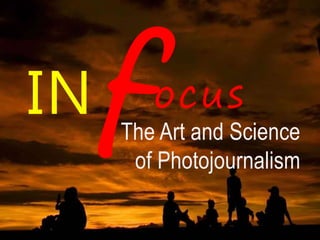
IN ocus
The Art and Science
of Photojournalism
Photojournalism touches
all aspects of the human
existence. They highlight
current issues and have
tremendous power to
communicate.
Some press photos
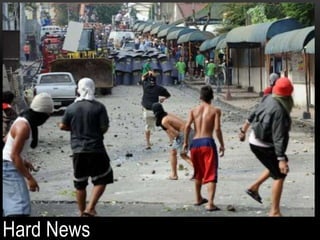
show us “hard news”.
Others show us what is
going on in the worlds of
nature, art and culture,
sports and entertainment
Hard News
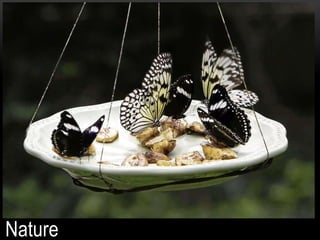
Nature
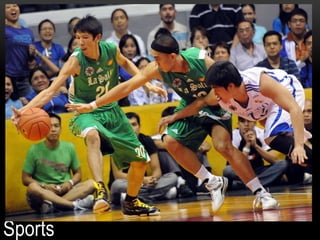
Sports
Showbiz
*Photojournalists document
situations the way they are.
*Photojournalists do not
intervene, interfere, manage or
direct.
*They simply take pictures that
captures a situation.
WHAT IS NEWS?
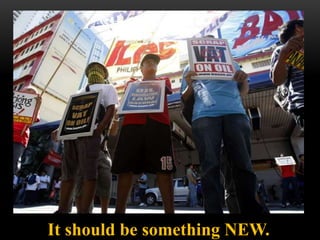
It should be something NEW.
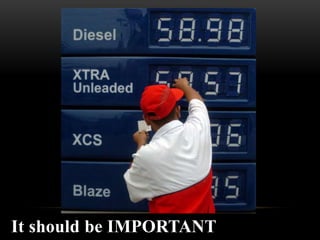
It should be IMPORTANT
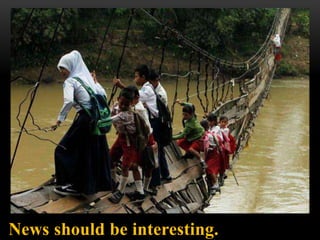
News should be interesting.
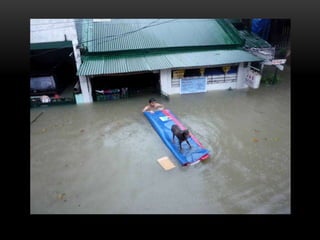
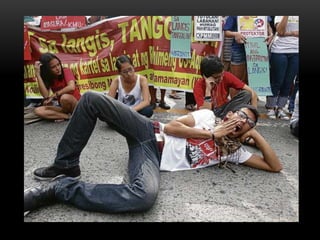
News should be relevant
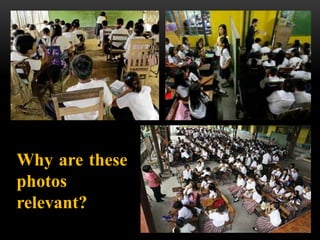
Why are these
photos
relevant?
A well known if somewhat gruesome journalistic
rule of thumb is that:
*the death of 10,000 people on another continent have
the same news value as
*the deaths of 1000 people in a neighboring country or
*the deaths of a 100 people in ones country or
* the deaths of 10 people in your own town or city or
*the death of one celebrity or a famous person.
PHOTOJOURNALISM
Telling a story with a picture,
reporting with a camera,
recording a moment in time, the
fleeting instant when an image
sums up the story. Henri Cartier-
Bresson called it the “decisive
moment.”
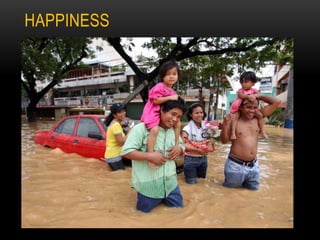
HAPPINESS
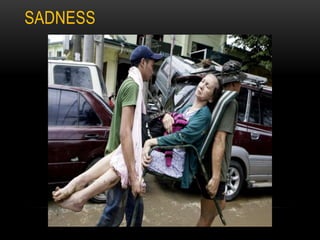
SADNESS
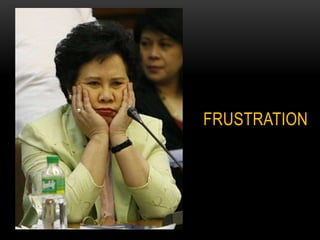
FRUSTRATION
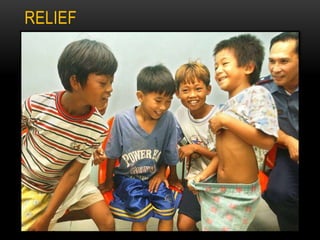
RELIEF
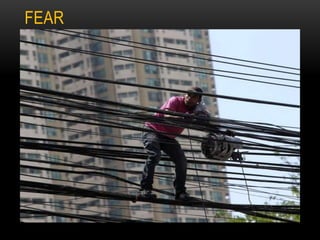
FEAR
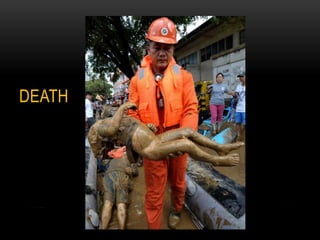
DEATH
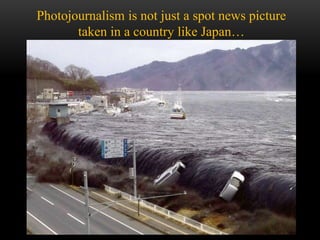
Photojournalism is not just a spot news picture
taken in a country like Japan…
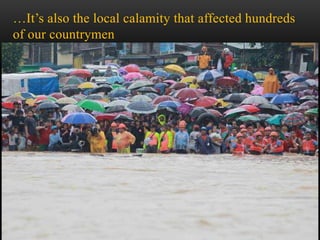
…It’s also the local calamity that affected hundreds
of our countrymen
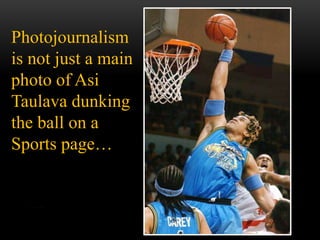
Photojournalism
is not just a main
photo of Asi
Taulava dunking
the ball on a
Sports page…
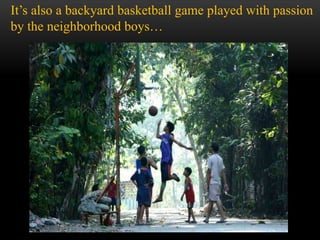
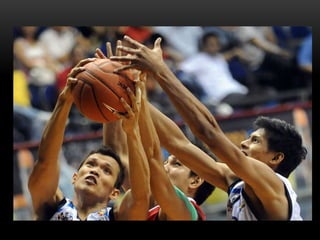
It’s also a backyard basketball game played with passion
by the neighborhood boys…
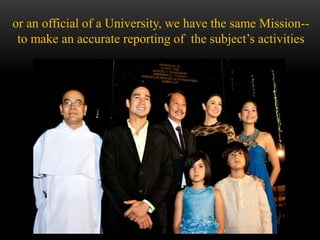
or an official of a University, we have the same Mission--
to make an accurate reporting of the subject’s activities
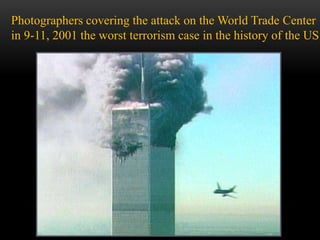
Photographers covering the attack on the World Trade Center
in 9-11, 2001 the worst terrorism case in the history of the US
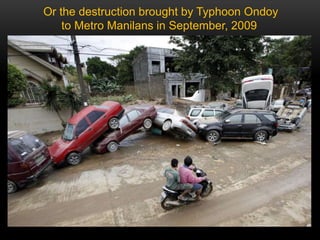
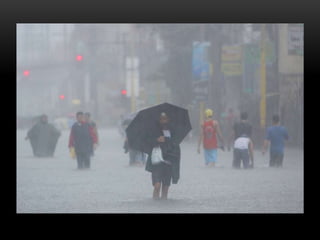
Or the destruction brought by Typhoon Ondoy
to Metro Manilans in September, 2009
“Moments that are part of our history---big and
small. The venues may be different, but the
mission is the same – to inform, to report, to
carry the scene to the reader, whether they are
thousands of miles away, or just down the
street. To show them something they might not
have had a chance to see themselves.
TO GRAB A MOMENT OF HISTORY AND PRESERVE
IT FOR THE FUTURE.”
COMPOSITION
Composition is the
collection of elements in
the picture, and how those
elements compete for
reader’s attention.
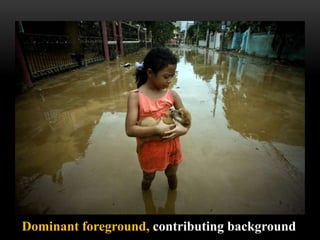
Dominant foreground, contributing background
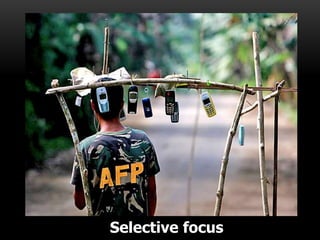
Selective focus
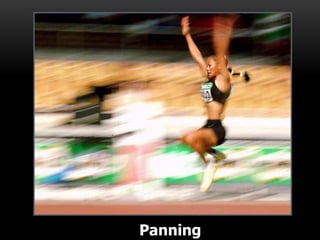
Panning
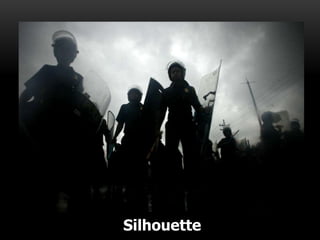
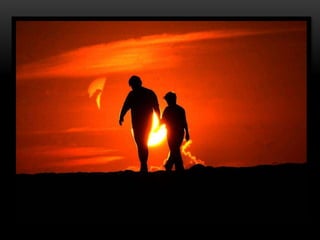
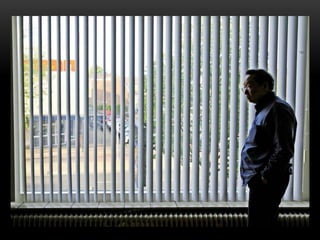
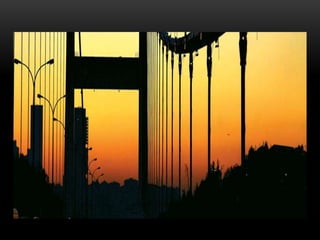
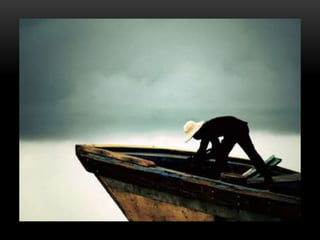
Silhouette
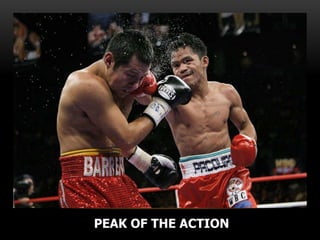
PEAK OF THE ACTION
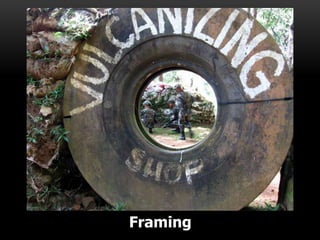
Framing
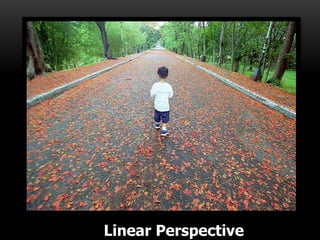
Linear Perspective
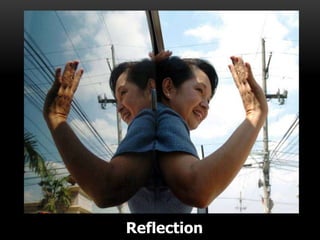
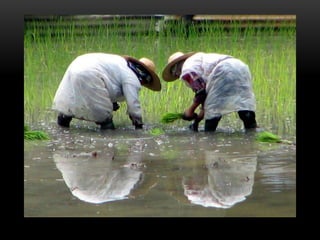
Reflection
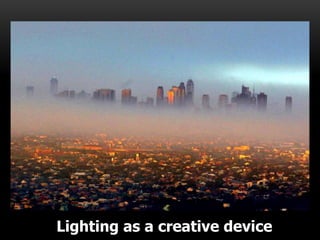
Lighting as a creative device
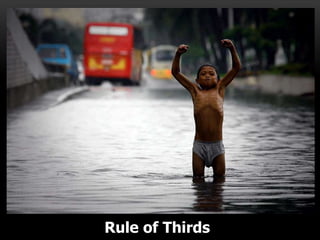
Rule of Thirds
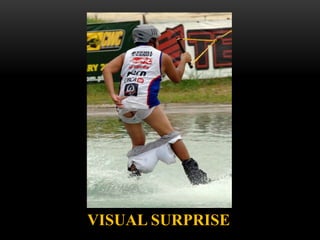
VISUAL SURPRISE
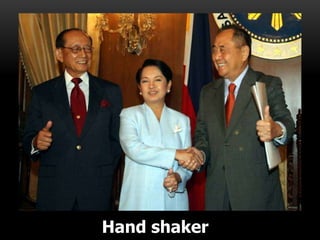
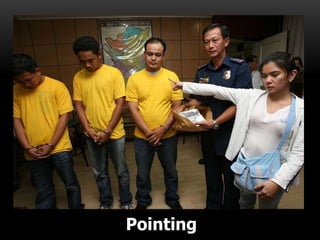
PHOTO CLICHES:
Avoid this Shots
Firing Squad
Hand shaker
Check Passer
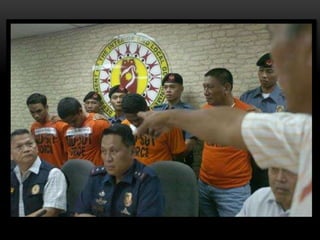
Pointing
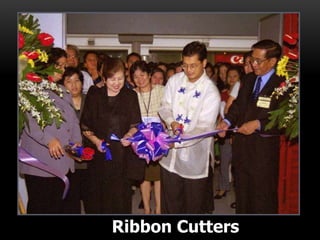
Ribbon Cutters
CAPTION AND CUTLINES
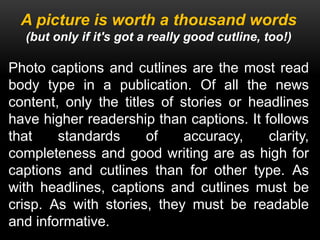
A picture is worth a thousand words
(but only if it's got a really good cutline, too!)
Photo captions and cutlines are the most read
body type in a publication. Of all the news
content, only the titles of stories or headlines
have higher readership than captions. It follows
that standards of accuracy, clarity,
completeness and good writing are as high for
captions and cutlines than for other type. As
with headlines, captions and cutlines must be
crisp. As with stories, they must be readable
and informative.
Note: Captions and cutlines are terms that are
often used interchangeably, particularly at
magazines. For our purposes, we will make the
following distinctions.
Captions: Captions are the little “headlines”
over the “cutlines” (the words describing the
photograph). See example.
Cutlines: Cutlines (at newspapers and
some magazines) are the words (under the
caption, if there is one) describing the
photograph or illustration. See example.
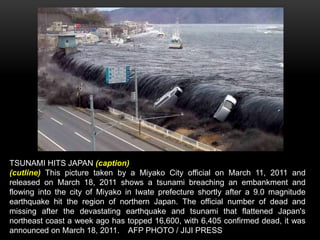
TSUNAMI HITS JAPAN (caption)
(cutline) This picture taken by a Miyako City official on March 11, 2011 and
released on March 18, 2011 shows a tsunami breaching an embankment and
flowing into the city of Miyako in Iwate prefecture shortly after a 9.0 magnitude
earthquake hit the region of northern Japan. The official number of dead and
missing after the devastating earthquake and tsunami that flattened Japan's
northeast coast a week ago has topped 16,600, with 6,405 confirmed dead, it was
announced on March 18, 2011. AFP PHOTO / JIJI PRESS
Required information
The specific information required can vary
from one photo to the next. But for most pictures
a reader wants to know such information as:
* Who is that? (And, in most cases, identify
people from left to right unless the action in the
photograph demands otherwise.)
* Why is this picture in the paper?
* What's going on?
* When and where was this?
* Why does he/she/it/they look that way?
* How did this occur?
Simply stated, cutlines should explain the
picture so that readers are satisfied with their
understanding of the picture. They need not —
and should not — tell what the picture has
made obvious. It should supply vital information
that the picture cannot. For example, a picture
can show a football player leaping to catch a
pass, but it likely does not show that the result
was the winning touchdown. The cutline should
give that information.
Tips and terms: Be concise; be
precise; don't be trite
Cutlines should be as concise as possible, but
they should not sound like telegrams or machine
guns. Unlike headlines (and caption lines), they
should contain all articles and conjunctions, just as
do sentences in news stories. News picture
cutlines should be straightforward and clear.
Trite writing should be avoided. Do not point
out the obvious by using such phrases as “looks
on,” “is shown” and “pictured above.”
Don't editorialize. The cutline writer
should never make assumptions about what
someone in a picture is thinking or try to
interpret the person's feelings from his or her
expression. The reader should be given the
facts and allowed to decide for herself or
himself what the feelings or emotions are.
Avoid the known; explain the unknown.
The cutline writer should avoid characterizing a
picture as beautiful, dramatic, grisly or other such
descriptive terms that should be evident in the
photograph. If it's not evident in the photograph, your
telling the reader won't make it happen. However, the
cutline should explain something about how the
picture was taken if it shows something not normally
observable by the human eye. For example, was a
wide-angle lens used? Or time-lapse photography?
Explanations also are needed for special effects,
such as the use of an inset or a picture sequence.
Reflect the image. Cutline writers should
make sure that the words accurately reflect the
picture. If a picture shows two or more people,
the cutline writer should count the number of
identifiable people in the photo and check the
number and sex of the people identified in the
cutline to make certain that they match. Special
precautions should be taken to make sure that
the cutline does not include someone who has
been cropped out of the original photo.
Always, always, always check
spelling. The cutline writer should check the
spelling of names in the story against the
names that a photographer has provided to see
if there are discrepancies. The editor also
should be sure that names in the cutline are the
same names used in the story. It should not be
John Smith in the cutline, but John P. Smith in
the story.
Shorter is better. Cutline writing triggers
a temptation to use long sentences. Avoid
that temptation. The cutlines that accompany
Associated Press photos are notorious for
their rambling sentences. They need to be
rewritten into clear crisp sentences.
Finally, don't do fiction!
ACKNOWLEDGEMENT
Some Photos are courtesy of The Philippine Daily Inquirer

Photojournalism.pptx

  • 1.
    IN ocus The Artand Science of Photojournalism
  • 2.
    Photojournalism touches all aspectsof the human existence. They highlight current issues and have tremendous power to communicate.
  • 3.
    Some press photos showus “hard news”. Others show us what is going on in the worlds of nature, art and culture, sports and entertainment
  • 4.
  • 5.
  • 6.
  • 7.
  • 8.
    *Photojournalists document situations theway they are. *Photojournalists do not intervene, interfere, manage or direct. *They simply take pictures that captures a situation.
  • 9.
  • 10.
    It should besomething NEW.
  • 11.
    It should beIMPORTANT
  • 12.
    News should beinteresting.
  • 15.
  • 16.
  • 17.
    A well knownif somewhat gruesome journalistic rule of thumb is that: *the death of 10,000 people on another continent have the same news value as *the deaths of 1000 people in a neighboring country or *the deaths of a 100 people in ones country or * the deaths of 10 people in your own town or city or *the death of one celebrity or a famous person.
  • 18.
    PHOTOJOURNALISM Telling a storywith a picture, reporting with a camera, recording a moment in time, the fleeting instant when an image sums up the story. Henri Cartier- Bresson called it the “decisive moment.”
  • 19.
  • 20.
  • 21.
  • 22.
  • 23.
  • 24.
  • 25.
    Photojournalism is notjust a spot news picture taken in a country like Japan…
  • 26.
    …It’s also thelocal calamity that affected hundreds of our countrymen
  • 27.
    Photojournalism is not justa main photo of Asi Taulava dunking the ball on a Sports page…
  • 28.
    It’s also abackyard basketball game played with passion by the neighborhood boys…
  • 29.
    or an officialof a University, we have the same Mission-- to make an accurate reporting of the subject’s activities
  • 30.
    Photographers covering theattack on the World Trade Center in 9-11, 2001 the worst terrorism case in the history of the US
  • 31.
    Or the destructionbrought by Typhoon Ondoy to Metro Manilans in September, 2009
  • 32.
    “Moments that arepart of our history---big and small. The venues may be different, but the mission is the same – to inform, to report, to carry the scene to the reader, whether they are thousands of miles away, or just down the street. To show them something they might not have had a chance to see themselves. TO GRAB A MOMENT OF HISTORY AND PRESERVE IT FOR THE FUTURE.”
  • 33.
    COMPOSITION Composition is the collectionof elements in the picture, and how those elements compete for reader’s attention.
  • 34.
  • 36.
  • 39.
  • 41.
  • 43.
  • 44.
  • 46.
  • 49.
  • 51.
    Lighting as acreative device
  • 54.
  • 57.
  • 60.
  • 61.
  • 62.
  • 64.
  • 65.
  • 67.
  • 68.
  • 69.
    A picture isworth a thousand words (but only if it's got a really good cutline, too!) Photo captions and cutlines are the most read body type in a publication. Of all the news content, only the titles of stories or headlines have higher readership than captions. It follows that standards of accuracy, clarity, completeness and good writing are as high for captions and cutlines than for other type. As with headlines, captions and cutlines must be crisp. As with stories, they must be readable and informative.
  • 70.
    Note: Captions andcutlines are terms that are often used interchangeably, particularly at magazines. For our purposes, we will make the following distinctions. Captions: Captions are the little “headlines” over the “cutlines” (the words describing the photograph). See example. Cutlines: Cutlines (at newspapers and some magazines) are the words (under the caption, if there is one) describing the photograph or illustration. See example.
  • 71.
    TSUNAMI HITS JAPAN(caption) (cutline) This picture taken by a Miyako City official on March 11, 2011 and released on March 18, 2011 shows a tsunami breaching an embankment and flowing into the city of Miyako in Iwate prefecture shortly after a 9.0 magnitude earthquake hit the region of northern Japan. The official number of dead and missing after the devastating earthquake and tsunami that flattened Japan's northeast coast a week ago has topped 16,600, with 6,405 confirmed dead, it was announced on March 18, 2011. AFP PHOTO / JIJI PRESS
  • 72.
    Required information The specificinformation required can vary from one photo to the next. But for most pictures a reader wants to know such information as: * Who is that? (And, in most cases, identify people from left to right unless the action in the photograph demands otherwise.) * Why is this picture in the paper? * What's going on? * When and where was this? * Why does he/she/it/they look that way? * How did this occur?
  • 73.
    Simply stated, cutlinesshould explain the picture so that readers are satisfied with their understanding of the picture. They need not — and should not — tell what the picture has made obvious. It should supply vital information that the picture cannot. For example, a picture can show a football player leaping to catch a pass, but it likely does not show that the result was the winning touchdown. The cutline should give that information.
  • 74.
    Tips and terms:Be concise; be precise; don't be trite Cutlines should be as concise as possible, but they should not sound like telegrams or machine guns. Unlike headlines (and caption lines), they should contain all articles and conjunctions, just as do sentences in news stories. News picture cutlines should be straightforward and clear. Trite writing should be avoided. Do not point out the obvious by using such phrases as “looks on,” “is shown” and “pictured above.”
  • 75.
    Don't editorialize. Thecutline writer should never make assumptions about what someone in a picture is thinking or try to interpret the person's feelings from his or her expression. The reader should be given the facts and allowed to decide for herself or himself what the feelings or emotions are.
  • 76.
    Avoid the known;explain the unknown. The cutline writer should avoid characterizing a picture as beautiful, dramatic, grisly or other such descriptive terms that should be evident in the photograph. If it's not evident in the photograph, your telling the reader won't make it happen. However, the cutline should explain something about how the picture was taken if it shows something not normally observable by the human eye. For example, was a wide-angle lens used? Or time-lapse photography? Explanations also are needed for special effects, such as the use of an inset or a picture sequence.
  • 77.
    Reflect the image.Cutline writers should make sure that the words accurately reflect the picture. If a picture shows two or more people, the cutline writer should count the number of identifiable people in the photo and check the number and sex of the people identified in the cutline to make certain that they match. Special precautions should be taken to make sure that the cutline does not include someone who has been cropped out of the original photo.
  • 78.
    Always, always, alwayscheck spelling. The cutline writer should check the spelling of names in the story against the names that a photographer has provided to see if there are discrepancies. The editor also should be sure that names in the cutline are the same names used in the story. It should not be John Smith in the cutline, but John P. Smith in the story.
  • 79.
    Shorter is better.Cutline writing triggers a temptation to use long sentences. Avoid that temptation. The cutlines that accompany Associated Press photos are notorious for their rambling sentences. They need to be rewritten into clear crisp sentences.
  • 80.
  • 81.
    ACKNOWLEDGEMENT Some Photos arecourtesy of The Philippine Daily Inquirer