Dorsal Anatomic Plantar Plate Repair (DAPPR)Presenter:Wenjay Sung, DPM
Lowell Weil, Jr., DPM, MBA
Lowell Scott Weil, Sr., DPMDisclosuresFull disclosure can be found in the Final AOFAS Program Book and the AAOS website for all authors.I have no potential conflicts with this presentation.LWJ is a consultant for Arthrex Inc.
DAPPRWe report the results of our case series of dorsal anatomic plantar plate repair  in conjunction with a Weil osteotomy approach. EBM Level of evidence:  IV, therapeutic, retrospective case series
DAPPRBackgroundAttrition often results in metatarsalgia, plantar swelling, hammertoe deformity and lesser toe subluxation1-4. The plantar plate ligament is the principle stabilizer of the MTP joint It is firmly attached to the base of the proximal phalanx and more loosely attached to the metatarsal neck15,16.The integrity is essential to stabilize the proximal phalanx of the lesser toes.
MethodsWe retrospectively identified consecutive adult patients who were diagnosed with 2nd MTP instability from January 2007 to December 2009 and treated with dorsal anatomic plantar plate repair29 patients (32 cases) Post-operative follow-up of >12 months
MethodsAssessmentVisual analog scale (VAS)AOFAS LMI clinical rating scale6Statistical AnalysisA paired student t-test was used to determine significance with p < 0.01.
ProcedureWeil L, Jr., Sung W, Weil LS, and Glover JS. Correction of  Second MTP Joint instability using a Weil  Osteotomy and Dorsal approach Plantar Plate Repair. Tech Foot Ankle Surg. 10(1):33-39, March 2011Video at www.youtube.com/weil4feet
ProcedureDorsal incisionIncision between EDB & EDL tendonsMcGlamry elevator was used to free soft tissue attachments plantar to the metatarsal head
Procedure
Procedure
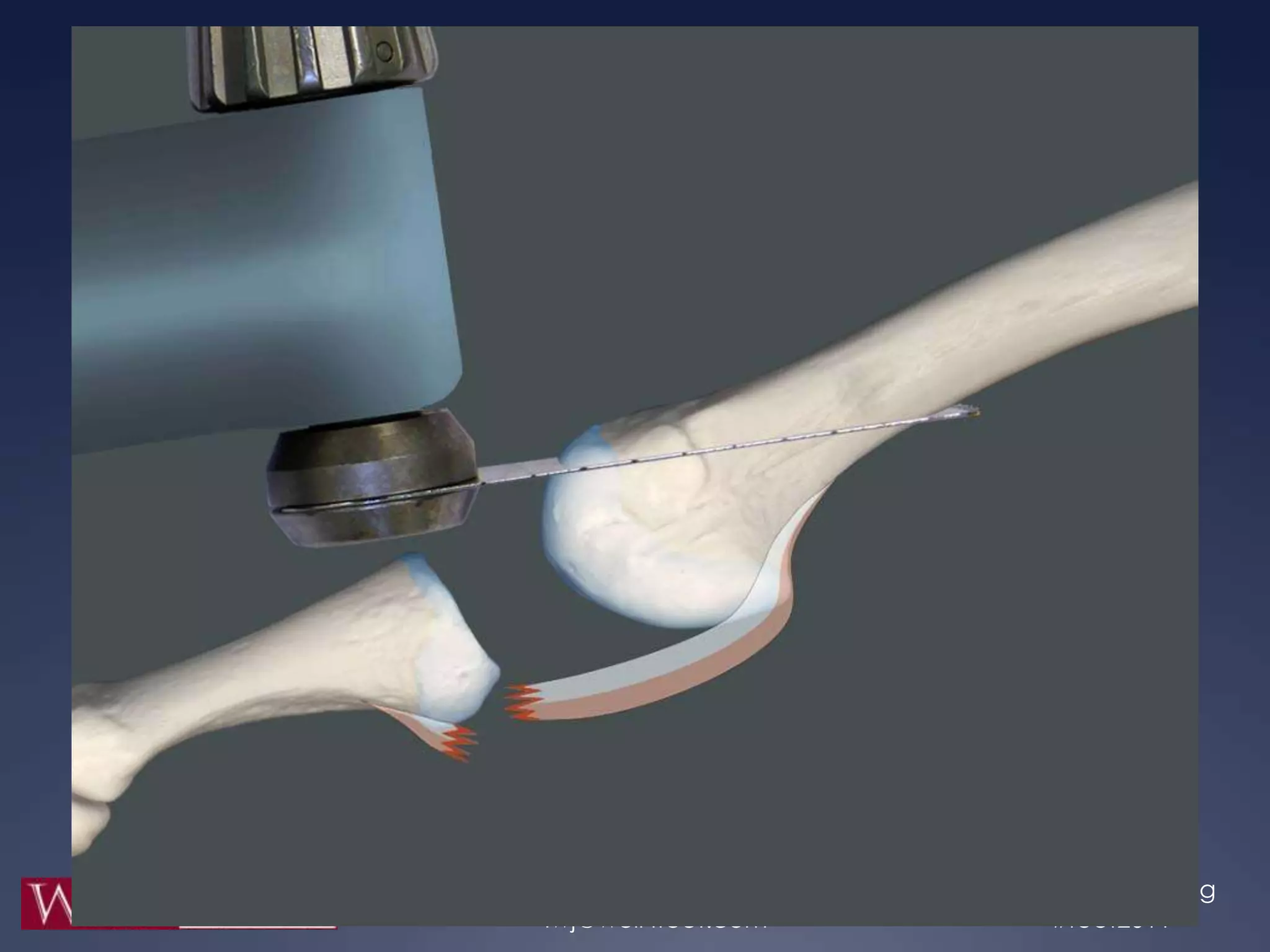
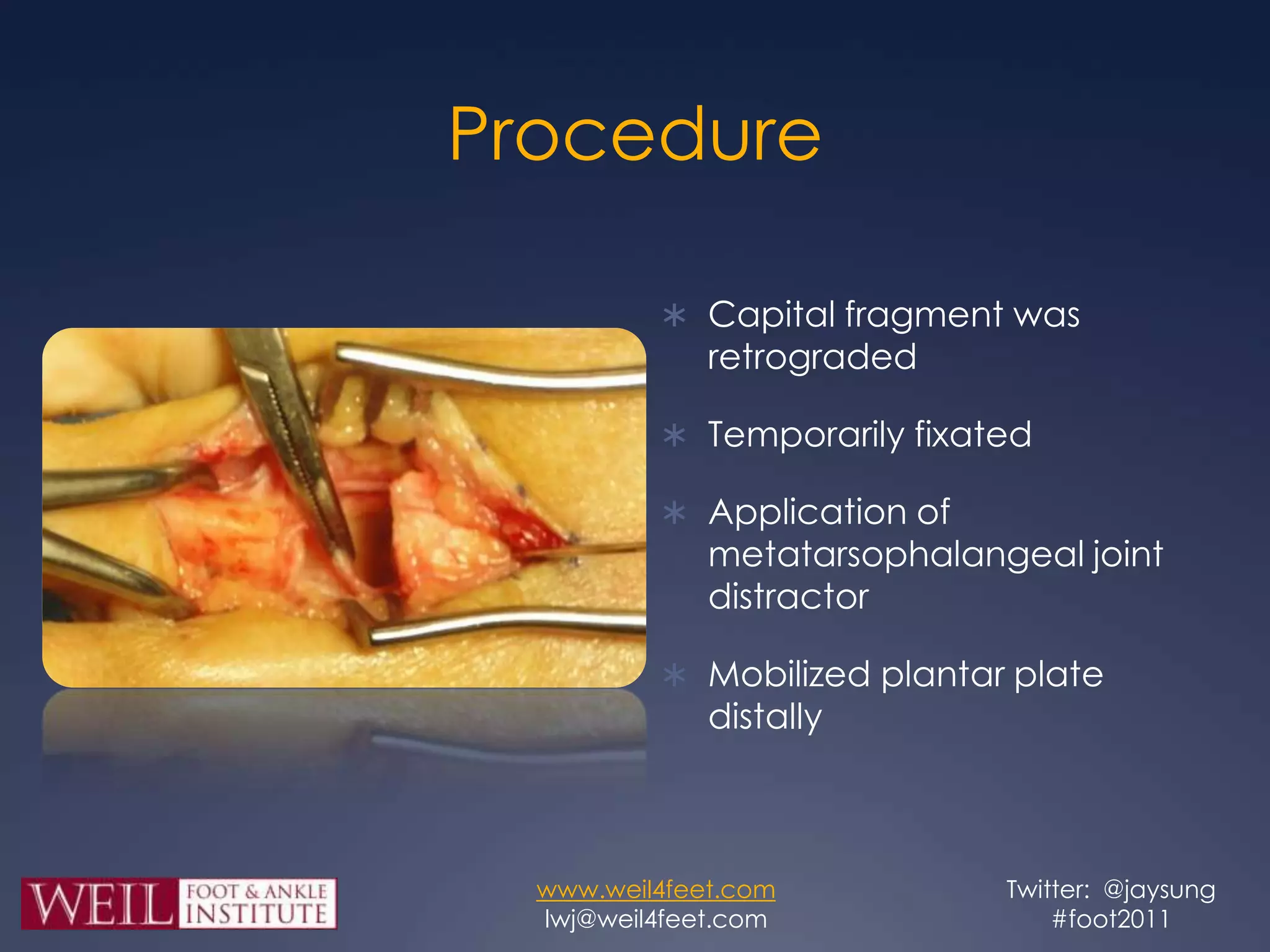
ProcedureCapital fragment was retrogradedTemporarily fixatedApplication of metatarsophalangeal joint distractorMobilized plantar plate distally
Procedure
Procedure
ProcedurePlantar plate grasped proximally (#0 fiberwire)Mattress stitchCreated two crossing bone tunnels in proximal phalanxPassed ends of mattress stitch through bone tunnelsTied suture ends with toe in plantarflexion
Procedure
ProcedureCapital fragment was aligned to anatomic contourFixated with 2.5mm headless screw
Post-OperativeAllowed immediate, guarded weight bearing in  surgical shoeAfter one week, bandages were removedPlaced into athletic shoePhysical therapyMaintain therapeutic splintage
ResultsDemographics29 patients/32 second MTP jointsAverage age 56.4 years (35 – 71)Average follow-up 22.6 M       (12 – 40)Average number of concurrent procedures was 2.2 per case.BunionectomyHammertoe correctionLesser metatarsal osteotomy
ResultsAverage VASPre-operative7.3 SD = 1.7; 95%CI = 6.7 to 7.9 Post-operative1.5 SD = 1.8; 95%CI = 0.8 to 2.2  This was significantly different (P < 0.01). Average AOFAS LMISPost-operative AOFAS LMIS87.3 out of 100SD = 10.8; 95%CI = 83.3 to 91.3
ResultsPlantar Plate TearsCompletely torn transversely (greater than 50% tear)Partially torn transversely at the distal proximal phalanx attachment (less than 50% tear)Partially torn longitudinally (“button-holed”) at the weight-bearing point of the metatarsal head.
ResultsComplicationsSeven cases reported peri-operative complicationsPainful 2nd MTP stiffness (3)Painful hardware (3) Painful scar (1)There were NO cases of floating toesThere were no cases of wound dehiscence, nonunion, malunion, floating toes, avascular necrosis, or recurrence of MTP subluxationRevision surgeriesThree (9%) with painful 2nd MTP stiffness underwent manipulation under sedationThree (9%) had painful hardware removalOne (3%) had painful scar revisionRevisional interventions were performed at an average of 17 months post-surgical reconstruction
DiscussionVarious techniques have been proposed to repair a torn plantar plate1,2,10,14,17Only one other technique described a dorsal approach to repairing plantar plate14Average AOFAS score 88.9 post-operatively in 23 patients (35 plantar plates)Two painful hardwareOne transfer lesionThree floating toes
DiscussionCooper et al (2011)Dorsal exposure of the 2nd MTP joint in 8 specimens using MTP joint distractorFound that the Weil metatarsal osteotomy allowed greatest visualization
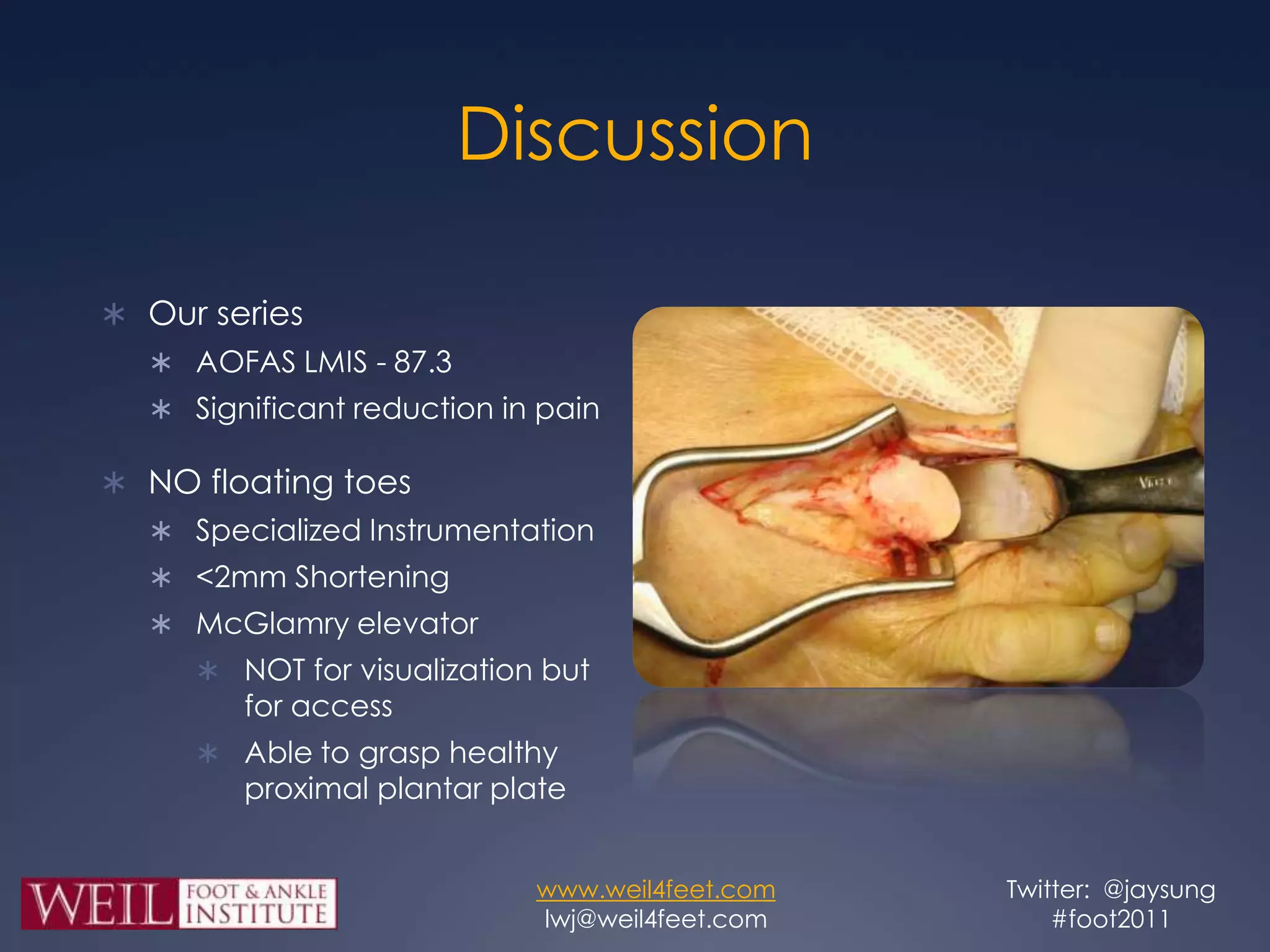
DiscussionOur series	AOFAS LMIS - 87.3Significant reduction in painNO floating toesSpecialized Instrumentation<2mm ShorteningMcGlamry elevatorNOT for visualization but for accessAble to grasp healthy proximal plantar plate
DiscussionThe authors opine that plantar plate injuries may be subtle and undiagnosed by foot and ankle surgeons treating intractable metatarsalgia especially those associated with hammertoe deformity and sub-metatarsal head swelling.
ConclusionsDAPPR Enhances visualization and ease in repair while decreasing the chance of plantar tissue trauma as compared to a plantar approach.  Other advantages include immediate guarded weight bearing of patients postoperatively. Demonstrates favorable results with regards to patient pain and clinical outcome scores.
Thank You

Dorsal Anatomic Plantar Plate Repair

  • 1.
    Dorsal Anatomic PlantarPlate Repair (DAPPR)Presenter:Wenjay Sung, DPM
  • 2.
  • 3.
    Lowell Scott Weil,Sr., DPMDisclosuresFull disclosure can be found in the Final AOFAS Program Book and the AAOS website for all authors.I have no potential conflicts with this presentation.LWJ is a consultant for Arthrex Inc.
  • 4.
    DAPPRWe report theresults of our case series of dorsal anatomic plantar plate repair in conjunction with a Weil osteotomy approach. EBM Level of evidence: IV, therapeutic, retrospective case series
  • 5.
    DAPPRBackgroundAttrition often resultsin metatarsalgia, plantar swelling, hammertoe deformity and lesser toe subluxation1-4. The plantar plate ligament is the principle stabilizer of the MTP joint It is firmly attached to the base of the proximal phalanx and more loosely attached to the metatarsal neck15,16.The integrity is essential to stabilize the proximal phalanx of the lesser toes.
  • 6.
    MethodsWe retrospectively identifiedconsecutive adult patients who were diagnosed with 2nd MTP instability from January 2007 to December 2009 and treated with dorsal anatomic plantar plate repair29 patients (32 cases) Post-operative follow-up of >12 months
  • 7.
    MethodsAssessmentVisual analog scale(VAS)AOFAS LMI clinical rating scale6Statistical AnalysisA paired student t-test was used to determine significance with p < 0.01.
  • 8.
    ProcedureWeil L, Jr.,Sung W, Weil LS, and Glover JS. Correction of Second MTP Joint instability using a Weil Osteotomy and Dorsal approach Plantar Plate Repair. Tech Foot Ankle Surg. 10(1):33-39, March 2011Video at www.youtube.com/weil4feet
  • 9.
    ProcedureDorsal incisionIncision betweenEDB & EDL tendonsMcGlamry elevator was used to free soft tissue attachments plantar to the metatarsal head
  • 10.
  • 11.
  • 13.
    ProcedureCapital fragment wasretrogradedTemporarily fixatedApplication of metatarsophalangeal joint distractorMobilized plantar plate distally
  • 14.
  • 15.
  • 17.
    ProcedurePlantar plate graspedproximally (#0 fiberwire)Mattress stitchCreated two crossing bone tunnels in proximal phalanxPassed ends of mattress stitch through bone tunnelsTied suture ends with toe in plantarflexion
  • 18.
  • 19.
    ProcedureCapital fragment wasaligned to anatomic contourFixated with 2.5mm headless screw
  • 20.
    Post-OperativeAllowed immediate, guardedweight bearing in surgical shoeAfter one week, bandages were removedPlaced into athletic shoePhysical therapyMaintain therapeutic splintage
  • 21.
    ResultsDemographics29 patients/32 secondMTP jointsAverage age 56.4 years (35 – 71)Average follow-up 22.6 M (12 – 40)Average number of concurrent procedures was 2.2 per case.BunionectomyHammertoe correctionLesser metatarsal osteotomy
  • 22.
    ResultsAverage VASPre-operative7.3 SD= 1.7; 95%CI = 6.7 to 7.9 Post-operative1.5 SD = 1.8; 95%CI = 0.8 to 2.2 This was significantly different (P < 0.01). Average AOFAS LMISPost-operative AOFAS LMIS87.3 out of 100SD = 10.8; 95%CI = 83.3 to 91.3
  • 23.
    ResultsPlantar Plate TearsCompletelytorn transversely (greater than 50% tear)Partially torn transversely at the distal proximal phalanx attachment (less than 50% tear)Partially torn longitudinally (“button-holed”) at the weight-bearing point of the metatarsal head.
  • 24.
    ResultsComplicationsSeven cases reportedperi-operative complicationsPainful 2nd MTP stiffness (3)Painful hardware (3) Painful scar (1)There were NO cases of floating toesThere were no cases of wound dehiscence, nonunion, malunion, floating toes, avascular necrosis, or recurrence of MTP subluxationRevision surgeriesThree (9%) with painful 2nd MTP stiffness underwent manipulation under sedationThree (9%) had painful hardware removalOne (3%) had painful scar revisionRevisional interventions were performed at an average of 17 months post-surgical reconstruction
  • 25.
    DiscussionVarious techniques havebeen proposed to repair a torn plantar plate1,2,10,14,17Only one other technique described a dorsal approach to repairing plantar plate14Average AOFAS score 88.9 post-operatively in 23 patients (35 plantar plates)Two painful hardwareOne transfer lesionThree floating toes
  • 26.
    DiscussionCooper et al(2011)Dorsal exposure of the 2nd MTP joint in 8 specimens using MTP joint distractorFound that the Weil metatarsal osteotomy allowed greatest visualization
  • 27.
    DiscussionOur series AOFAS LMIS- 87.3Significant reduction in painNO floating toesSpecialized Instrumentation<2mm ShorteningMcGlamry elevatorNOT for visualization but for accessAble to grasp healthy proximal plantar plate
  • 28.
    DiscussionThe authors opinethat plantar plate injuries may be subtle and undiagnosed by foot and ankle surgeons treating intractable metatarsalgia especially those associated with hammertoe deformity and sub-metatarsal head swelling.
  • 29.
    ConclusionsDAPPR Enhances visualizationand ease in repair while decreasing the chance of plantar tissue trauma as compared to a plantar approach. Other advantages include immediate guarded weight bearing of patients postoperatively. Demonstrates favorable results with regards to patient pain and clinical outcome scores.
  • 30.
  • 31.
    ReferencesCoughlin MJ. Subluxationand dislocation of the second metatarsophalangeal joint. OrthopClin North Am. 1989;20:535-551.Blitz NM, Ford LA, Christensen JC. Second metatarsophalangeal joint arthrography: a cadaveric correlation study. J Foot Ankle Surg. 2004;43:231-240.Coughlin MJ. Lesser toe abnormalities. Instr Course Lect. 2003;52:421-444.Yu GV, Judge MS, Hudson JR, et al. Predislocation syndrome. Progressive subluxation/dislocation of the lesser metatarsophalangeal joint. J Am Podiatr Med Assoc. 2002;92:182-199.Coughlin MJ. Crossover second toe deformity. Foot Ankle. 1987;8:29-39.Kitaoka HB et al. Clinical rating systems for the ankle-hindfoot, midfoot, hallux, and lesser toes. Foot Ankle Int. 15:349–353, 1994.Ware J et al. A 12-Item Short-Form Health Survey: construction of scales and preliminary tests of reliability and validity. Med Care. 1996 Mar; 34(3); 220-33. Weil Jr L, Sung W, Weil Sr LS, et al. Tech Foot Ankl Surg. 2011, 10(1):33-39.Bouche RT, Heit EJ. Combined plantar plate and hammertoe repair with flexor digitorumlongus tendon transfer for chronic, severe sagittal plane instability of the lesser metatarsophalangeal joints: preliminary observations. J Foot Ankle Surg. 2008;47:125-137.Blitz NM, Ford LA, Christensen JC. Plantar plate repair of the second metatarsophalangeal joint: technique and tips. J Foot Ankle Surg. 2004;43:266-270.Thompson FM, Hamilton WG. Problems of the second metatarsophalangeal joint. Orthopedics. 1987;10:83-89.Haddad SL, Sabbagh RC, Resch S, et al. Results of flexor-to-extensor and extensor brevis tendon transfer for correction of the crossover second toe deformity. Foot Ankle Int. 1999;20:781-788.Powless SH, Elze ME. Metatarsophalangeal joint capsule tears: an analysis by arthrography, a new classification system and surgical management. J Foot Ankle Surg. 2001;40:374-389.Gregg et al. Plantar plate repair and Weil osteotomy for metatarsophalangeal joint instability. Foot Ankle Surg. 2007; 13 (116-121).Deland, JT; Sung, IH: The medial crosssover toe: A cadaveric dissection.FootAnkleInt.21(5):375 – 8,2000.Johnston, RB, 3rd; Smith, J; Daniels, T: The plantar plate of the lesser toes: An anatomical study in human cadavers. Foot Ankle Int. 15(5):276–82, 1994.Ford, LA; Collins, KB; Christensen, JC: Stabilization of the subluxed second metatarsophalangeal joint: Flexor tendon transfer versus primary repairoftheplantarplate.JFootAnkleSurg.37(3):217 – 22,1998