
Decision Support Systems
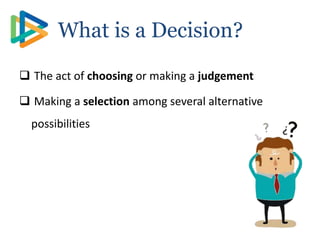
 The act of choosing or making a judgement
 Making a selection among several alternative
possibilities
What is a Decision?
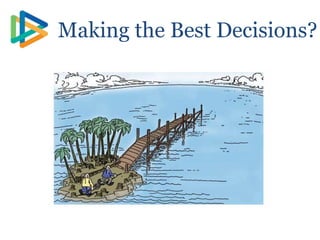
Making the Best Decisions?
Act
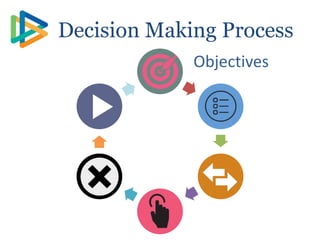
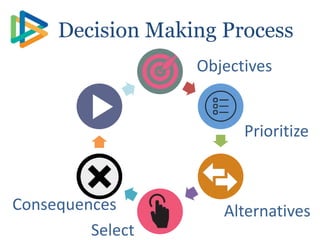
Decision Making Process
Objectives
Act
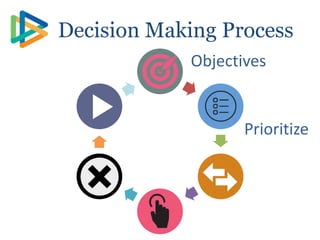
Decision Making Process
Objectives
Prioritize
Act
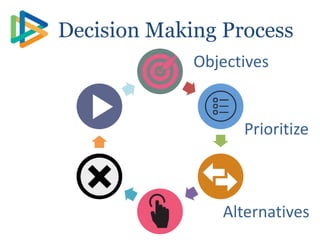
Decision Making Process
Objectives
Prioritize
Alternatives
Act
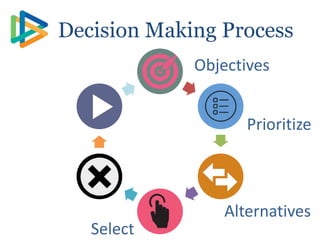
Decision Making Process
Objectives
Prioritize
Alternatives
Select
Act
Decision Making Process
Objectives
Prioritize
Alternatives
Select
Consequences
Act
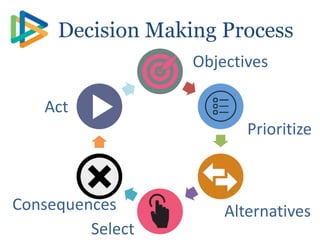
Decision Making Process
Objectives
Prioritize
Act
Alternatives
Select
Consequences
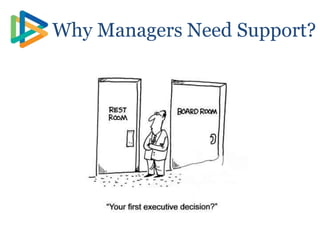
Why Managers Need Support?
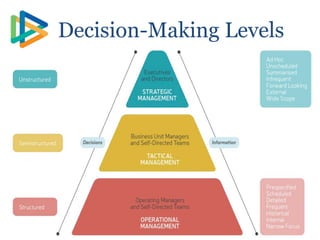
Decision-Making Levels
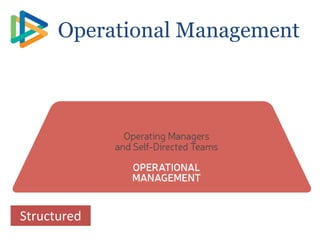
Structured
Operational Management
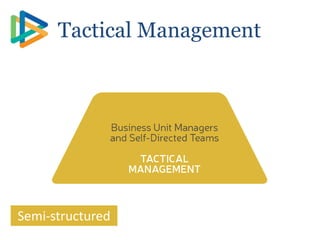
Semi-structured
Tactical Management
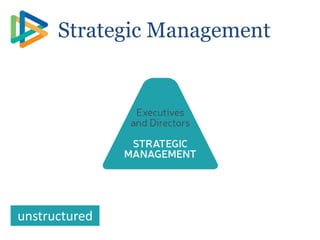
unstructured
Strategic Management
computer
program
application
Analysis of
business
data
Presentation
of business
data
Making
business
decisions
easier
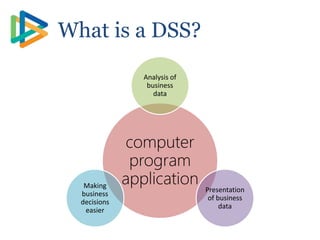
What is a DSS?
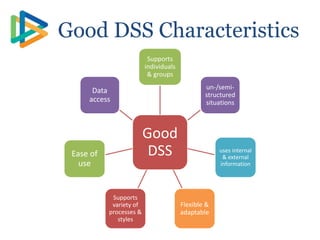
Good
DSS
Supports
individuals
& groups
un-/semi-
structured
situations
uses internal
& external
information
Flexible &
adaptable
Supports
variety of
processes &
styles
Ease of
use
Data
access
Good DSS Characteristics
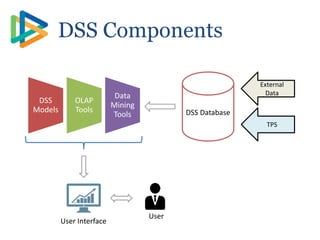
DSS Components
DSS Database
External
Data
DSS
Models
OLAP
Tools
Data
Mining
Tools
TPS
User
User Interface
Types of DSS Models
Statistical
Types of DSS Models
Optimization
Types of DSS Models
Forecasting
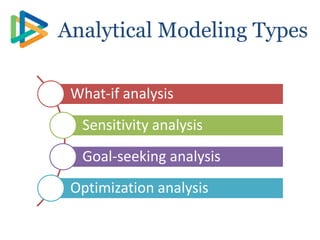
What-if analysis
Sensitivity analysis
Goal-seeking analysis
Optimization analysis
Analytical Modeling Types
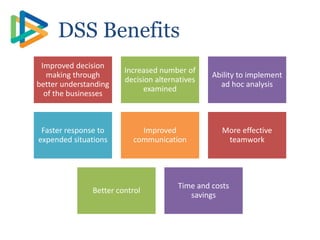
Improved decision
making through
better understanding
of the businesses
Increased number of
decision alternatives
examined
Ability to implement
ad hoc analysis
Faster response to
expended situations
Improved
communication
More effective
teamwork
Better control
Time and costs
savings
DSS Benefits
Thank you!
Hussein AlShkhir

Decision Support Systems DSS

Editor's Notes

  • #3 The act or process of Deciding; determination, as of a question or doubt, by making a judgment. the act of or need for making up one's mind
  • #4 Decision-making is the process of identifying and choosing alternatives based on the values and preferences of the decision-maker.
  • #5 Objectives must first be established Objectives must be classified and placed in order of importance Alternative actions must be developed The alternatives must be evaluated against all the objectives The alternative that is able to achieve all the objectives is the tentative decision The tentative decision is evaluated for more possible consequences The decisive actions are taken, and additional actions are taken to prevent any adverse consequences from becoming problems and starting both systems (problem analysis and decision-making) all over again
  • #6 Objectives must first be established Objectives must be classified and placed in order of importance Alternative actions must be developed The alternatives must be evaluated against all the objectives The alternative that is able to achieve all the objectives is the tentative decision The tentative decision is evaluated for more possible consequences The decisive actions are taken, and additional actions are taken to prevent any adverse consequences from becoming problems and starting both systems (problem analysis and decision-making) all over again
  • #7 Objectives must first be established Objectives must be classified and placed in order of importance Alternative actions must be developed The alternatives must be evaluated against all the objectives The alternative that is able to achieve all the objectives is the tentative decision The tentative decision is evaluated for more possible consequences The decisive actions are taken, and additional actions are taken to prevent any adverse consequences from becoming problems and starting both systems (problem analysis and decision-making) all over again
  • #8 Objectives must first be established Objectives must be classified and placed in order of importance Alternative actions must be developed The alternatives must be evaluated against all the objectives The alternative that is able to achieve all the objectives is the tentative decision The tentative decision is evaluated for more possible consequences The decisive actions are taken, and additional actions are taken to prevent any adverse consequences from becoming problems and starting both systems (problem analysis and decision-making) all over again
  • #9 Objectives must first be established Objectives must be classified and placed in order of importance Alternative actions must be developed The alternatives must be evaluated against all the objectives The alternative that is able to achieve all the objectives is the tentative decision The tentative decision is evaluated for more possible consequences The decisive actions are taken, and additional actions are taken to prevent any adverse consequences from becoming problems and starting both systems (problem analysis and decision-making) all over again
  • #10 Objectives must first be established Objectives must be classified and placed in order of importance Alternative actions must be developed The alternatives must be evaluated against all the objectives The alternative that is able to achieve all the objectives is the tentative decision The tentative decision is evaluated for more possible consequences The decisive actions are taken, and additional actions are taken to prevent any adverse consequences from becoming problems and starting both systems (problem analysis and decision-making) all over again
  • #11 Increasing number of alternatives decisions made under time pressure. uncertainty in the decision environment, it is frequently necessary to conduct a sophisticated analysis. It is often necessary to rapidly access remote information.
  • #12 Information systems can support decision-making levels. These include the three levels of management activity. Strategic management, tactical management, and operational management. The types of decisions are Structured decisions , Semi-structured decisions, Unstructured decisions.
  • #13 Operating managers deal with day-to-day operations of an organization, such as assigning employees to tasks, or placing or purchase an order. Decisions made at the operational management level tend to be more structured. Structured decisions are repetitive and routine problems for which standard solutions exist. Ex: finding an appropriate inventory level, finding an optimal investment strategy. MIS primarily analyzes structured problems.
  • #14 Mid-level mangers deal with middle level management activities such as short-term planning, medium range plans and control. Decisions made at the tactical management level tend to be semi-structured. Semi-structured problems fall between structured and unstructured problems. Only some of the phases are structured in semi-structured problems. It requires a combination of standard procedures and individual judgment. Ex: annual evaluation of employees, trading bonds, setting marketing budgets for consumer products.
  • #15 A board of directors and an executive committee of the CEO develop long-range planning. Decisions made at the strategic level tend to be unstructured. Unstructured problems are novel and non-routine, complex. For unstructured problems we cannot specify some procedures to make a decision. Ex: expanding the business, moving operations to foreign countries. IS must provide a wide range of information products to support these types of decisions at all levels of the organization.
  • #16 A decision support system (DSS) is a computer program application that analyzes business data and presents it so that users can make business decisions more easily. It combines models and data in an attempt to solve semi-structured and unstructured problems with user involvement.
  • #17 Support for decision makers, mainly in semi-structured and unstructured situations, by bringing together human judgment and computerized information Support for all managerial levels, ranging from top executives to line managers Support for individuals as well as groups Although DSS uses internal information from TPS and MIS, it also uses external sources, such as current stock prices or product prices of competitors. Support for interdependent and/or sequential decisions Support in all phases of the decision-making process Support for a variety of decision-making processes and styles DSS are flexible, so users can add, delete, combine, change, or rearrange basic elements; DSS can be readily modified to solve other, similar problems User-friendliness, strong graphical capabilities, and a natural language interactive human–machine interface can greatly increase the effectiveness of DSS Improved effectiveness of decision making The decision maker has complete control over all steps of the decision-making process in solving a problem End users are able to develop and modify simple systems by themselves Models are generally utilized to analyze decision-making situations Access is provided to a variety of data sources, formats, and types Can be employed as a standalone tool used by an individual decision maker in one location or distributed throughout an organization and in several organizations along the supply chain Can be integrated with other DSS and/or applications, and it can be distributed internally and externally, using networking and Web technologies
  • #18 DSS relies on model bases and databases. A model (in decision making) is a simplified representation of reality. Simplified because reality is too complex to copy exactly and much of the processes complexity is irrelevant to a specific problem. A DSS model base is a software component that contains all the models used to develop applications to run the system. DSS uses models to manipulate data. Ex: If you have some historic sales data, you can use many different types of models to create a forecast of future sales.
  • #19 Statistical modeling software can be used to help establish relationships such as relating product sales to differences in age, income or other factors between communities. Optimization models often using Linear Programming (LP) determine the proper mix of products within a given market to maximize profit. The user of this type of model might supply a range of historical data to project future conditions and sales that might result from those conditions. Companies often use this software to predict the action of competitors.
  • #20 Statistical modeling software can be used to help establish relationships such as relating product sales to differences in age, income or other factors between communities. Optimization models often using Linear Programming (LP) determine the proper mix of products within a given market to maximize profit. The user of this type of model might supply a range of historical data to project future conditions and sales that might result from those conditions. Companies often use this software to predict the action of competitors.
  • #21 Statistical modeling software can be used to help establish relationships such as relating product sales to differences in age, income or other factors between communities. Optimization models often using Linear Programming (LP) determine the proper mix of products within a given market to maximize profit. The user of this type of model might supply a range of historical data to project future conditions and sales that might result from those conditions. Companies often use this software to predict the action of competitors.
  • #22 An end user makes predictions and assumptions regarding the input data, many of which are based on the assessment of uncertain futures. When the model is solved, the results depend on these assumptions. What-if analysis attempts to check the impact of a change in the assumptions on the proposed solution. Ex: what will happen to the total inventory cost if the originally assumed cost of carrying inventories is not 10 percent but 12 percent? Or, what will be the market share if the initially assumed advertising budget is overspent by 5 percent? In a well designed DSS, managers themselves can interactively ask the computer these types of questions as many times as needed. Investigation of the effect that changes in one or more parts of a model have on other parts of the model. Usually we check the impact that changes in input variables on output variables. It is a special case of what-if analysis. Attempts to find the value of the inputs necessary to achieve a desired level of outputs. Ex: let us say that a DSS solution yielded a profit of $ 2 million. Management wants to know that what sales volume and additional advertising would be necessary to generate a profit of $2.7 million. This is a goal-seeking problem. Often uses Linear Programming. Determines optimal resource allocation to max or minimize specified variable such as cost, profit, revenue, or risk. A classic use of optimization analysis is to determine the proper mix products within a given market to maximize profits.