OTOSCLEROSIS
Mrs. Manisha Samudre
Assistant Professor
Department of Medical-Surgical Nursing
D.Y Patil College of Nursing
Kadamwadi Kolhapur
ANATOMY OVERVIEW
LOCATION OF OTIC LABYRINTH
The bony labyrinth (also osseous labyrinth or otic
capsule) is the rigid, bony outer wall of the inner ear in
the temporal bone.
It consists of three parts: the vestibule, semicircular
canals, and cochlea.
These are cavities hollowed out of the substance of
the bone, and lined by periosteum.
They contain a clear fluid, the perilymph, in which
the membranous labyrinth is situated.
OTIC CAPSULE CONSISTS OF THREE LAYERS
Endosteal is a innermost layer line with bony
labyrinth
Enchondral is develops from the cartilage and later
ossifies into bone, in this layer some island of
cartilage are left unossified that later gave rise to
otosclerosis
Periosteal covers the bony labriynth
MEANING
Otosclerosis is a term derived from oto, meaning “of
the ear,” and sclerosis, meaning “abnormal hardening of
body tissue.” The condition is caused by abnormal bone
remodeling in the middle ear. Bone remodeling is a
lifelong process in which bone tissue renews itself by
replacing old tissue with new.
In otosclerosis, abnormal remodeling disrupts the
ability of sound to travel from the middle ear to the
inner ear.
DEFINITION
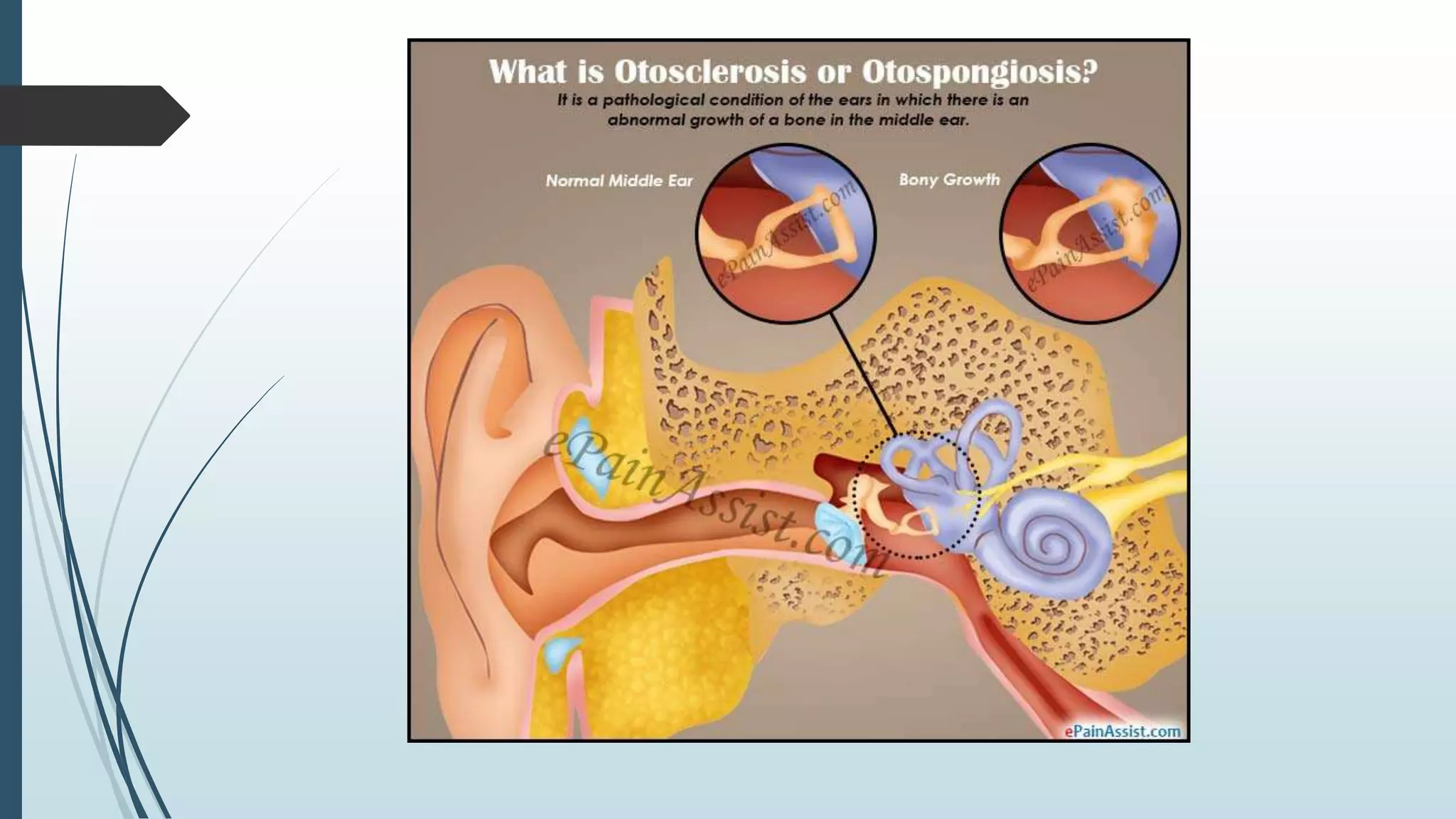
Otosclerosis is also named as otospongiosis, a
pathological condition of bony labyrinth in which un-
ossified spongy bone replace with a dense part as mostly
involves stapes region leading to conductive deafness and
neuro-sensory loss
Otosclerosis is most often caused when one of the bones
in the middle ear, the stapes, becomes stuck in place.
When this bone is unable to vibrate, sound is unable to
travel through the ear and hearing becomes impaired
AETIOLOGY
The exact cause is unknown
Anatomical basis – due to certain non specific factors are
activated to for, new spongy bone which may lie in front of
oval window of stapes to cause stapedial type of
otospongiosis
Hereditary – About 50 percent of otosclerosis have positive
family history i.e an autosomal disorder
Race – White races are often affected than Negros,
common in India rare in Chinese and Japanese
Sex – Females are more affected than male
Age of onset – Deafness usually starts between 20 to 30
years of age
Viral infections – Studies shown that it can be caused due
to measles virus and most commonest in Paget disease
TYPES
Stapedial Otosclerosis – It causes by fixation and conductive
deafness as lesion starts just in front of the oval window
called anterior focus and lesion starts behind the oval window
called posterior focus and if starts around margin of stapes
called circumferential and sometimes it may covers the
whole oval window
Cochlear otosclerosis – It involves region of round window
or other areas in the otic capsule and may cause sensor neural
hearing loss probably due to liberation of toxic material with
inner ear fluid
Histologic otosclerosis – This type remains asymptomatic
causes neither conductive nor sensorineural hearing loss
PATHOLOGY
Due to etiological factor - grossly otosclerotic lesion
appears to be white grayish or yellow due to rapid
progression and increase vascularity
Enchondral is develops from the cartilage and later ossifies
into bone, in this layer some island of cartilage are left
unossified that later gave rise to otosclerosis
And later form a cement substance of osteoblasts and
osteoclasts which stains blue & also less vascularity and
laying of more bony substance than cementum (connective
tissue) and is stained red called schwartze sign
SYMPTOMS
Hearing loss – Usually starts at twenties it is painless and
progresses with insidious onset
Paracusis willisii – An condition patient hears better in
noisy than quiet surroundings, as it because normal persons
will raise his voice in noisy surroundings
Tinnitus – due to cochlar otosclerosis there will be ringing
sound
Vertigo – uncommon symptom
Speech – Patient has an well monotonous modulated soft
speech
DIAGNOSIS
Otosclerosis is diagnosed by health care providers who
specialize in hearing. These include an otolaryngologist
(commonly called an ENT
 The first step in a diagnosis is to rule out other diseases or
health problems that can cause the same symptoms as
otosclerosis. Next steps include hearing tests that measure
hearing sensitivity (audiogram) and middle-ear sound
conduction (tympanogram). Sometimes, imaging tests such as
a CT scan are also used to diagnose otosclerosis.
SURGICAL MANAGMENT
Stapedectomy – Replacement wit han prothessis
wher fixed otosclerotic stapes is removed and
prosthesis placed between inxcus and the oval
window.
Otosclerosis

Otosclerosis

  • 1.
    OTOSCLEROSIS Mrs. Manisha Samudre AssistantProfessor Department of Medical-Surgical Nursing D.Y Patil College of Nursing Kadamwadi Kolhapur
  • 2.
    ANATOMY OVERVIEW LOCATION OFOTIC LABYRINTH The bony labyrinth (also osseous labyrinth or otic capsule) is the rigid, bony outer wall of the inner ear in the temporal bone. It consists of three parts: the vestibule, semicircular canals, and cochlea. These are cavities hollowed out of the substance of the bone, and lined by periosteum. They contain a clear fluid, the perilymph, in which the membranous labyrinth is situated.
  • 4.
    OTIC CAPSULE CONSISTSOF THREE LAYERS Endosteal is a innermost layer line with bony labyrinth Enchondral is develops from the cartilage and later ossifies into bone, in this layer some island of cartilage are left unossified that later gave rise to otosclerosis Periosteal covers the bony labriynth
  • 5.
    MEANING Otosclerosis is aterm derived from oto, meaning “of the ear,” and sclerosis, meaning “abnormal hardening of body tissue.” The condition is caused by abnormal bone remodeling in the middle ear. Bone remodeling is a lifelong process in which bone tissue renews itself by replacing old tissue with new. In otosclerosis, abnormal remodeling disrupts the ability of sound to travel from the middle ear to the inner ear.
  • 6.
    DEFINITION Otosclerosis is alsonamed as otospongiosis, a pathological condition of bony labyrinth in which un- ossified spongy bone replace with a dense part as mostly involves stapes region leading to conductive deafness and neuro-sensory loss Otosclerosis is most often caused when one of the bones in the middle ear, the stapes, becomes stuck in place. When this bone is unable to vibrate, sound is unable to travel through the ear and hearing becomes impaired
  • 8.
    AETIOLOGY The exact causeis unknown Anatomical basis – due to certain non specific factors are activated to for, new spongy bone which may lie in front of oval window of stapes to cause stapedial type of otospongiosis Hereditary – About 50 percent of otosclerosis have positive family history i.e an autosomal disorder
  • 9.
    Race – Whiteraces are often affected than Negros, common in India rare in Chinese and Japanese Sex – Females are more affected than male Age of onset – Deafness usually starts between 20 to 30 years of age Viral infections – Studies shown that it can be caused due to measles virus and most commonest in Paget disease
  • 10.
    TYPES Stapedial Otosclerosis –It causes by fixation and conductive deafness as lesion starts just in front of the oval window called anterior focus and lesion starts behind the oval window called posterior focus and if starts around margin of stapes called circumferential and sometimes it may covers the whole oval window Cochlear otosclerosis – It involves region of round window or other areas in the otic capsule and may cause sensor neural hearing loss probably due to liberation of toxic material with inner ear fluid
  • 12.
    Histologic otosclerosis –This type remains asymptomatic causes neither conductive nor sensorineural hearing loss
  • 13.
    PATHOLOGY Due to etiologicalfactor - grossly otosclerotic lesion appears to be white grayish or yellow due to rapid progression and increase vascularity Enchondral is develops from the cartilage and later ossifies into bone, in this layer some island of cartilage are left unossified that later gave rise to otosclerosis And later form a cement substance of osteoblasts and osteoclasts which stains blue & also less vascularity and laying of more bony substance than cementum (connective tissue) and is stained red called schwartze sign
  • 14.
    SYMPTOMS Hearing loss –Usually starts at twenties it is painless and progresses with insidious onset Paracusis willisii – An condition patient hears better in noisy than quiet surroundings, as it because normal persons will raise his voice in noisy surroundings Tinnitus – due to cochlar otosclerosis there will be ringing sound Vertigo – uncommon symptom Speech – Patient has an well monotonous modulated soft speech
  • 15.
    DIAGNOSIS Otosclerosis is diagnosedby health care providers who specialize in hearing. These include an otolaryngologist (commonly called an ENT  The first step in a diagnosis is to rule out other diseases or health problems that can cause the same symptoms as otosclerosis. Next steps include hearing tests that measure hearing sensitivity (audiogram) and middle-ear sound conduction (tympanogram). Sometimes, imaging tests such as a CT scan are also used to diagnose otosclerosis.
  • 16.
    SURGICAL MANAGMENT Stapedectomy –Replacement wit han prothessis wher fixed otosclerotic stapes is removed and prosthesis placed between inxcus and the oval window.