5th CamTESOL Conference on
               English Language Teaching


        Pham Tien Hung
Foundation Studies Department
              Hanoi University
                  February 2009
     Email: hung.pt@hanu.edu.vn


                                           1
   What is debate?
   Why debate?
   What skills are needed?
   How to design a syllabus that suits your
    students?


                                               2
   A formal method of presenting arguments in
    support and against a given issue in which
    debaters present reasons and evidence to
    persuade an audience or a group of judges

   Governed by some explicit rules


                                                 3
   A game or mental gymnastics: participants
    sharpen their thinking and speaking skills,
    find best way to win
   A lab: one team tests its arguments against
    the ones of another
   A way of finding truth: winning arguments
    should be truest arguments


                                                  4
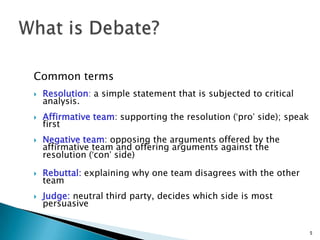
Common terms
   Resolution: a simple statement that is subjected to critical
    analysis.
   Affirmative team: supporting the resolution („pro‟ side); speak
    first
   Negative team: opposing the arguments offered by the
    affirmative team and offering arguments against the
    resolution („con‟ side)

   Rebuttal: explaining why one team disagrees with the other
    team
   Judge: neutral third party, decides which side is most
    persuasive


                                                                      5
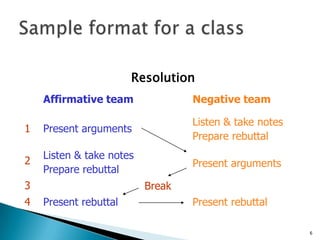
Resolution
    Affirmative team              Negative team

                                  Listen & take notes
1   Present arguments
                                  Prepare rebuttal
    Listen & take notes
2                                 Present arguments
    Prepare rebuttal
3                         Break
4   Present rebuttal              Present rebuttal

                                                        6
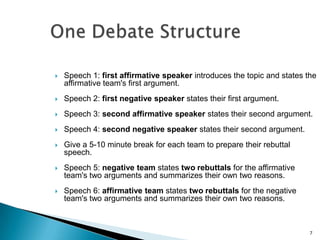
   Speech 1: first affirmative speaker introduces the topic and states the
    affirmative team's first argument.
   Speech 2: first negative speaker states their first argument.
   Speech 3: second affirmative speaker states their second argument.
   Speech 4: second negative speaker states their second argument.
   Give a 5-10 minute break for each team to prepare their rebuttal
    speech.
   Speech 5: negative team states two rebuttals for the affirmative
    team's two arguments and summarizes their own two reasons.
   Speech 6: affirmative team states two rebuttals for the negative
    team's two arguments and summarizes their own two reasons.


                                                                         7
   Do your best to argue your side of the
    debate, rather than relying on your personal
    opinions

-> Sometimes argue something that is against
 your personal views


                                                   8
   “Honest disagreement is often a good
    sign of progress”
                           Mahatma Gandhi


                                            9
   To provide meaningful listening, speaking,
    writing practice
   To develop argumentation skills for
    persuasive speech and writing
   To increase social skills and conflict
    resolution abilities
   To enhance self-esteem and academic
    confidence
   To lead to competitive success in the future


                                                   10
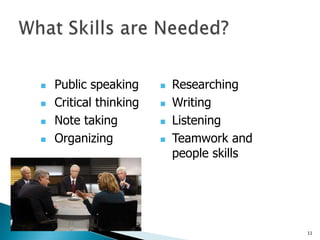
   Public speaking        Researching
   Critical thinking      Writing
   Note taking            Listening
   Organizing             Teamwork and
                            people skills


                                            11
   Identify goals, length of the course
   Determine needed skills
   Compile input materials
   Select resolutions, suggested ideas for both
    sides
   Brainstorm classroom activities
   Design test and assessment criteria


                                                   12
Support consists of evidence. There‟re four
  kinds of evidence
 Examples
 Common sense
 Expert opinions
 Statistics


                                              13
   Repeat the argument you‟re going to
    refute

   Refute – explain what is wrong with
    other team‟s argument

   Replace the argument with your
    argument


                                          14
   thinking about how you think

   process of asking, answering questions
    and trying to understand how and why
    you come to the conclusions

   in debate: plan what to say, anticipate
    other team‟s response, think of an
    argument to counter other team‟s
    arguments
                                              15
   Compare viewpoints of other people to your
    own ones
   Find ways to ask questions that apply to
    many perspectives
   Understand why some statements are
    correct, others are not
   Understand how problem solving works
   Establish criteria for making judgments
   Present arguments in a constructive way…


                                                 16
   Select a topic
   Choose a side: affirmative >< negative
   Discuss in your team:
      arguments,
      possible counter-arguments
      and find a way to refute them
   Start the debate
      Listen to the other team‟s arguments
      Take notes
      Prepare to refute their arguments


                                              17
   http://idebate.org

   http://wiki.idebate.org

   http://www.conservapedia.com/Debate_topics

   ttp://iteslj.org/Techniques/Krieger-
    Debate.html

   http://teachingdebate.typepad.com

   http://www.educationworld.com/

                                                 18
   Rybold, G (2006). Speaking, Listening and Understanding
    Debate. International Debate Education Association.

   Ziegelmuellerm, G., Harris, S., & Bloomingdale, D. (1995).
    Advancing in Debates – Skills and Concepts. Clark
    Publishing Company.

   Ruth Sunda, “Debate and Persuasive Writing”

   http://thepeoplespeak.org

   http://www.aracorporation.org/files/ARA_debates_Handboo
    k.pdf


                                                                 19
20
Contact me: hung.pt@hanu.edu.vn
                                  21

Teaching debate skills

  • 1.
    5th CamTESOL Conferenceon English Language Teaching Pham Tien Hung Foundation Studies Department Hanoi University February 2009 Email: hung.pt@hanu.edu.vn 1
  • 2.
    What is debate?  Why debate?  What skills are needed?  How to design a syllabus that suits your students? 2
  • 3.
    A formal method of presenting arguments in support and against a given issue in which debaters present reasons and evidence to persuade an audience or a group of judges  Governed by some explicit rules 3
  • 4.
    A game or mental gymnastics: participants sharpen their thinking and speaking skills, find best way to win  A lab: one team tests its arguments against the ones of another  A way of finding truth: winning arguments should be truest arguments 4
  • 5.
    Common terms  Resolution: a simple statement that is subjected to critical analysis.  Affirmative team: supporting the resolution („pro‟ side); speak first  Negative team: opposing the arguments offered by the affirmative team and offering arguments against the resolution („con‟ side)  Rebuttal: explaining why one team disagrees with the other team  Judge: neutral third party, decides which side is most persuasive 5
  • 6.
    Resolution Affirmative team Negative team Listen & take notes 1 Present arguments Prepare rebuttal Listen & take notes 2 Present arguments Prepare rebuttal 3 Break 4 Present rebuttal Present rebuttal 6
  • 7.
    Speech 1: first affirmative speaker introduces the topic and states the affirmative team's first argument.  Speech 2: first negative speaker states their first argument.  Speech 3: second affirmative speaker states their second argument.  Speech 4: second negative speaker states their second argument.  Give a 5-10 minute break for each team to prepare their rebuttal speech.  Speech 5: negative team states two rebuttals for the affirmative team's two arguments and summarizes their own two reasons.  Speech 6: affirmative team states two rebuttals for the negative team's two arguments and summarizes their own two reasons. 7
  • 8.
    Do your best to argue your side of the debate, rather than relying on your personal opinions -> Sometimes argue something that is against your personal views 8
  • 9.
    “Honest disagreement is often a good sign of progress” Mahatma Gandhi 9
  • 10.
    To provide meaningful listening, speaking, writing practice  To develop argumentation skills for persuasive speech and writing  To increase social skills and conflict resolution abilities  To enhance self-esteem and academic confidence  To lead to competitive success in the future 10
  • 11.
    Public speaking  Researching  Critical thinking  Writing  Note taking  Listening  Organizing  Teamwork and people skills 11
  • 12.
    Identify goals, length of the course  Determine needed skills  Compile input materials  Select resolutions, suggested ideas for both sides  Brainstorm classroom activities  Design test and assessment criteria 12
  • 13.
    Support consists ofevidence. There‟re four kinds of evidence  Examples  Common sense  Expert opinions  Statistics 13
  • 14.
    Repeat the argument you‟re going to refute  Refute – explain what is wrong with other team‟s argument  Replace the argument with your argument 14
  • 15.
    thinking about how you think  process of asking, answering questions and trying to understand how and why you come to the conclusions  in debate: plan what to say, anticipate other team‟s response, think of an argument to counter other team‟s arguments 15
  • 16.
    Compare viewpoints of other people to your own ones  Find ways to ask questions that apply to many perspectives  Understand why some statements are correct, others are not  Understand how problem solving works  Establish criteria for making judgments  Present arguments in a constructive way… 16
  • 17.
    Select a topic  Choose a side: affirmative >< negative  Discuss in your team:  arguments,  possible counter-arguments  and find a way to refute them  Start the debate  Listen to the other team‟s arguments  Take notes  Prepare to refute their arguments 17
  • 18.
    http://idebate.org  http://wiki.idebate.org  http://www.conservapedia.com/Debate_topics  ttp://iteslj.org/Techniques/Krieger- Debate.html  http://teachingdebate.typepad.com  http://www.educationworld.com/ 18
  • 19.
    Rybold, G (2006). Speaking, Listening and Understanding Debate. International Debate Education Association.  Ziegelmuellerm, G., Harris, S., & Bloomingdale, D. (1995). Advancing in Debates – Skills and Concepts. Clark Publishing Company.  Ruth Sunda, “Debate and Persuasive Writing”  http://thepeoplespeak.org  http://www.aracorporation.org/files/ARA_debates_Handboo k.pdf 19
  • 20.
  • 21.