Special Theory of Relativity
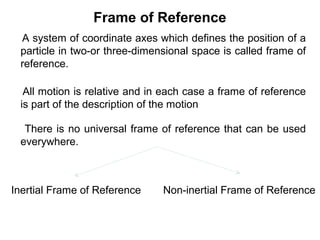
Frame of Reference
A system of coordinate axes which defines the position of a
particle in two-or three-dimensional space is called frame of
reference.
Inertial Frame of Reference Non-inertial Frame of Reference
All motion is relative and in each case a frame of reference
is part of the description of the motion
There is no universal frame of reference that can be used
everywhere.
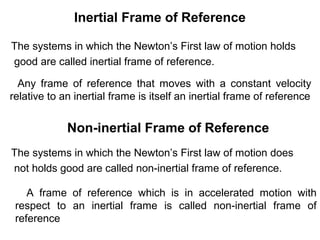
Inertial Frame of Reference
Non-inertial Frame of Reference
Any frame of reference that moves with a constant velocity
relative to an inertial frame is itself an inertial frame of reference
The systems in which the Newton’s First law of motion holds
good are called inertial frame of reference.
The systems in which the Newton’s First law of motion does
not holds good are called non-inertial frame of reference.
A frame of reference which is in accelerated motion with
respect to an inertial frame is called non-inertial frame of
reference
Galilean Transformation
x x´
y´y
v
x´ = x – vt
y´ = y
z´ = z
t´ = tTime is absolute
K K´
O´O
vt x´
x
EVENT
Z Z´
´
The Need for Ether
The wave nature of light seemed to require a propagation
medium. It was called ether.
Ether had to have such a low density that the planets could
move through it without loss of energy.
It had to have an elasticity to support the high velocity of
light waves.
And somehow, it could not support longitudinal waves.
And (it goes without saying…) light waves in the ether
obeyed the Galilean transformation for moving frames.
Michelson-Morley Experiment
The mirrors M1 and M2 are so placed that PM1 = PM2 = l
M1
M2
P
S
T
Beam I
Beam II
In time t2
’
the mirror M1 shifts to M1
’
and travels a distance vt2
’
M1 M1’
P
B
P’
B’
Michelson-Morley Experiment
If light requires a medium, then its velocity depends on
the velocity of the medium. Velocity vectors add.
Parallel
velocities
Anti-parallel
velocities
lightv

etherv

totalv

etherv

totalv

lightv

etherlighttotal vvv +=
etherlighttotal vvv −=
Postulates of Special Theory of Relativity
All the fundamental laws of physics retain the same form in all
the inertial frame of reference
The velocity of light in free space is constant and is
independent of the relative motion of the source and the
observer
Lorentz Transformation
x x´
y´y
v
F F´
O´O
Z Z´
´
P (x,y,z,t)
(x´,y´,z´,t´)
Let a pulse of light be generated at t = 0 from the origin and
spreads out in space and at the same time frame F’ starts moving
with constant velocity v along +ve x direction relative to frame F.
The transformation equations of x and x’ can be written as
)(' vtxkx −=
where k is a constant of proportionality and is independent of x
and t.
The inverse relation can be written as
)''( vtxkx += (ii)
(i)
Here . Putting value of x’ from (i) in (ii)'tt ≠
]')([ vtvtxkkx +−=
'vtkvtkx
k
x
+−=
kt
v
kx
kv
x
t +−=' 





−−= 2
1
1'
kv
kx
kttor (iii)
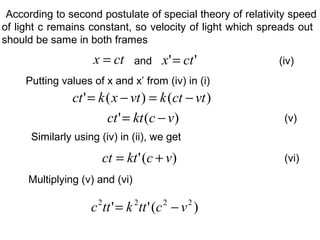
According to second postulate of special theory of relativity speed
of light c remains constant, so velocity of light which spreads out
should be same in both frames
Putting values of x and x’ from (iv) in (i)
ctx = (iv)and '' ctx =
)()(' vtctkvtxkct −=−=
)(' vcktct −=
Similarly using (iv) in (ii), we get
)(' vcktct +=
(v)
(vi)
Multiplying (v) and (vi)
)('' 2222
vcttkttc −=
Using (viii) in (i), we get
(viii)
)( 22
2
2
vc
c
k
−
=
22
1
1
cv
k
−
±=
22
1
)(
'
cv
vtx
x
−
−
=
Using (vii) in (iii), we get
(vii)





 −
−−= 2
22
1'
c
vc
v
kx
ktt
and






−= 2
2
'
c
v
v
kx
ktt






−= 2
'
c
xv
tkt
22
2
1
'
cv
c
xv
t
t
−






−
=
yy =' zz ='
These equations are known as Lorentz transformation equations
and
22
2
1
'
'
cv
c
vx
t
t
−






+
=
'yy = 'zz =
If the frame F is moving with velocity v along the –ve direction of
X-axis relative to frame F’, then the transformation equations
22
''
1
)(
cv
vtx
x
−
+
=
These equations are known as inverse Lorentz transformation
equations
If speed of moving frame is much smaller than the velocity of
light then the Lorentz transformation reduces to Galilean
transformation equations
Length Contraction
x
x´
y´y
v
F F´
O´O
Z Z´
´
x1
x2
x’1
x’2
BA
'
1
'
2 xxLo −=
22
1'
1
1 cv
vtx
x
−
−
=
Let L be the length of the rod measured by an observer O in
stationary frame F.
12 xxL −=
As per Lorentz transformation
22
2'
2
1 cv
vtx
x
−
−
=
(i)
(ii)
Let Lo be the length of the rod in Frame F’ measured by O’ at any
instant. This length Lo is called the proper length.
Subtracting (i) from (ii), we get
22
12'
1
'
2
1 cv
xx
xx
−
−
=−
22
1 cv
L
Lo
−
=
2
2
1
c
v
LL o −=
Thus the length of the rod is reduced in the ratio
as measured by the observer moving with velocity v with
respect to the rod.
1:1 22
cv−
oLL <⇒
Time Dilation
x
x´
y´y
v
F F´
O´O
Z Z´
´
P (x´,y´,z´)
Imagine a gun is placed at point P in the frame F’
Suppose the gun fires two shots at time intervals t’
1 and t’
2
measured by observer O’ in the frame F’
The time interval ( t’
2 - t’
1 ) of two shots measured by the clock
at rest in moving frame F’ is called proper time interval and is
given by
ottt =− '
1
'
2
In the frame F, the observer O, which is at rest, observes these
shots at different times t1 and t2 The time interval is given by
ttt =− 12
As the motion is relative, we can assume that F is moving with
velocity –v along positive x-axis relative to F’
From inverse Lorentz transformation equations
22
2'
1
1
1
/'
cv
cvxt
t
−
+
= (i)
22
2'
2
2
1
/'
cv
cvxt
t
−
+
= (ii)
Using (i) and (ii)
ttt =− 12
22
'
1
'
2
1 cv
tt
t
−
−
= 22
1 cv
t
t o
−
=
ott >⇒
or
Thus the time interval appears to be lengthened by a factor
which is observed by the observer O in22
11 cv−
frame F. This is called time dilation.
Velocities Addition
x
x´
y´y
v
F F´
O´O
Z Z´
´
P (x´,y´,z´)
Let u and u’ be the velocities of the particle measured in
frames F and F’
The velocity components are given as
dt
dx
ux =
dt
dz
uz =
dt
dy
uy =
'
'
'
dt
dx
ux = '
'
'
dt
dz
uz ='
'
'
dt
dy
uy =
} (i)
22
2
1
'
'
cv
c
vx
t
t
−






+
=
'yy = 'zz =
22
1
)''(
cv
vtx
x
−
+
=
From inverse Lorentz transformation
} (ii)
Differentiating equation (ii), we get
22
2
1
'
'
cv
c
vdx
dt
dt
−
+
=
'dydy = 'dzdz =22
1
''
cv
vdtdx
dx
−
+
=
}(iii)
From (i) and (iii), we have
2
'
'
''
c
vdx
dt
vdtdx
dt
dx
ux
+
+
==
'
'
1
'
'
2
dtc
vdx
v
dt
dx
+
+
=
'
2
'
1 x
x
u
c
v
vu
+
+
=
Similarly
'
2
22'
1
1
x
y
y
u
c
v
cvu
u
+
−
= and
'
2
22'
1
1
x
z
z
u
c
v
cvu
u
+
−
=
Here the expressions for and represent the relativistic
laws of addition of velocities
yx uu ,
zu
If i.e. if the light is emitted in the moving frame F’
along its direction of motion relative to F, then
cux ='
'
2
'
1 x
x
x
u
c
v
vu
u
+
+
=
2
1
c
vc
vc
+
+
= c
vc
vcc
=
+
+
=
)(
From above expression it is clear that the speed of light is
same in all inertial frames
Variation of mass with velocity
x
x´
y´y
v
F F´
O´O
Z Z´
´
B1
Mass of the two elastic balls (B1 and B2) in frame F’ is m.
B2
u -u
The elastic balls (B1 and B2) collide with each other in such a
way that they coalesce into one body
By applying the law of conservation of linear momentum
Momentum (B1) + Momentum (B2) = Momentum of coalesced body
0)()( =−+ mumu
Thus the coalesced body must be at rest in Frame F’.
Let u1 and u2 be the velocities of the two elastic balls in frame F
According to Lorentz velocity transformation
21
1 cuv
vu
u
+
+
= (i)
22
1 cuv
vu
u
−
+−
= (ii)
After collision the coalesced body moves with the velocity of
Frame F’. Thus v is the observed velocity in frame F.
Let m1 and m2 be the masses of the balls B1 and B2 in frame F
Using equations (i) and (ii) in (iii)
vmm
cuv
vu
m
cuv
vu
m )(
11
212221 +=





−
+−
+





+
+
(iii)
By applying the law of conservation of linear momentum
vmmumum )( 212211 +=+






−
+−
−=





−
+
+
2221
11 cuv
vu
vmv
cuv
vu
m






−
−
=





+
−
2
22
22
22
1
1
)1(
1
)1(
cuv
cvu
m
cuv
cvu
m
From equation (i)
(v)
[ ]
22
2
2
2
1
)1(
/)(
11
cuv
cvu
c
u
+
+
−=−
2
2
2
1
1
1
cuv
cuv
m
m
−
+
=
22
2222
)1(
)1)(1(
cuv
cvcu
+
−−
=
Similarly from equation (ii)
=− 2
2
2
1
c
u
22
2222
)1(
)1)(1(
cuv
cvcu
−
−−
(vi)
Dividing equation (vi) by (v)
22
22
22
1
22
2
)1(
)1(
1
1
cuv
cuv
cu
cu
−
+
=
−
−
(vii)
From equation (iv) and (vii)
From (viii), it is clear that LHS and RHS are independent of
each other. This is true when each equal to a constant.
)1(
)1(
1
1
2
2
22
1
22
2
cuv
cuv
cu
cu
−
+
=
−
−
22
1
22
2
2
1
1
1
cu
cu
m
m
−
−
=
[ ] [ ]22
22
22
11 11 cumcum −=− (viii)
[ ] [ ] omcumcum =−=− 22
22
22
11 11
where is the rest mass of the bodyom
From above equations it can be concluded that if be the rest
mass of the body then its mass m when it moves at speed v will
appear as
22
1
0
1
1 cu
m
m
−
=
Thus
and
22
2
0
2
1 cu
m
m
−
=
om
22
0
1 cv
m
m
−
=
This is the relativistic formula for the variation of mass with
velocity
If we substitute v = c then m becomes (i.e. infinite mass).
Thus no material particle can have a velocity equal or greater
than the velocity of light.
∞
Einstein’s Mass Energy relation
Let a body of rest mass mo is moving with velocity then its
mass can be given by
If the particle is displaced by a distance dx by the application
of force F, the work done Fdx is stored as kinetic energy (EK)
in the body.
22
0
1 cv
m
m
−
=
According to Newton’s second law of motion, the rate of
change of momentum of the particle is equal to the force
applied on it.
dt
mvd
F
)(
=
(i)
(ii)
FdxdEdW K == (iii)
(iv)
From equation (ii) and (iii)
But
dx
dt
mvd
dEK
)(
=
)(mvd
dt
dx
dEK =
)( mdvvdmvdEK +=
mvdvdmvdEK += 2
22
0
1 cv
m
m
−
=
222222
cmvmcm o=− (v)
(vi)
Differentiating equation (v)
mvdvdmvdmc += 22
0222 222
=−− vdvmmdmvmdmc
(vii)
Comparing equation (v) and (vi)
2
dmcdEK =
( and c are constants)om
From equation (vii), we find that change in kinetic energy is
directly proportional to the change in mass.
If the body is at rest, its velocity will be zero and hence the
change in kinetic energy will be zero i.e. mass will be mo
If the body moves with velocity v, then its mass becomes m
and its K.E. becomes EK.
(viii)
Integrating equation (vii)
2
0
2
0
2
][ cmmcmmcEK −=−=
∫∫ =
m
m
E
K dmcdE
K
0
2
0
2
0
2
cmEmc K +=
From equation (viii), we find that is the total energy. It is
the sum of kinetic and rest mass energy
2
mc
2
mcE =
This relation is called Einstein’s mass energy relation.
Energy Momentum relation
Let a particle of rest mass mo is moving with velocity, v then
the energy associated with it is given by
22
2
02
1 cv
cm
mcE
−
==
Momentum of the particle is
mvp = or mpv =
)(1 222
2
0
cmp
cm
E
−
=
)(1 4222
2
0
cmcp
cm
E
−
=
)(1 222
2
0
Ecp
cm
E
−
=
)(1 222
42
02
Ecp
cm
E
−
=
42
0
2222
])(1[ cmEcpE =−
42
0
222
cmcpE =−
2242
0
2
cpcmE +=
2242
0 cpcmE +=
2
0
2242
0 cmcpcmEK −+=
Kinetic Energy is given by
2
0cmEEK −=








−







+= 11
2/1
22
0
2
2
0
cm
p
cmEK
(i)
22
0
2
2/1
22
0
2
2
1
11
cm
p
cm
p
+=







+
But
)( cv <
Equation (i) now becomes
0
2
22
0
2
2
0
2
1
2
1
1
m
p
cm
p
cmEK =





−+=
When then we have)( cv << 0mm =
m
p
EK
2
2
=
Thus in limit of small velocities, the relativistic relation between
kinetic energy and momentum tends to the classical relation

Relativity

  • 1.
  • 2.
    Frame of Reference Asystem of coordinate axes which defines the position of a particle in two-or three-dimensional space is called frame of reference. Inertial Frame of Reference Non-inertial Frame of Reference All motion is relative and in each case a frame of reference is part of the description of the motion There is no universal frame of reference that can be used everywhere.
  • 3.
    Inertial Frame ofReference Non-inertial Frame of Reference Any frame of reference that moves with a constant velocity relative to an inertial frame is itself an inertial frame of reference The systems in which the Newton’s First law of motion holds good are called inertial frame of reference. The systems in which the Newton’s First law of motion does not holds good are called non-inertial frame of reference. A frame of reference which is in accelerated motion with respect to an inertial frame is called non-inertial frame of reference
  • 4.
    Galilean Transformation x x´ y´y v x´= x – vt y´ = y z´ = z t´ = tTime is absolute K K´ O´O vt x´ x EVENT Z Z´ ´
  • 5.
    The Need forEther The wave nature of light seemed to require a propagation medium. It was called ether. Ether had to have such a low density that the planets could move through it without loss of energy. It had to have an elasticity to support the high velocity of light waves. And somehow, it could not support longitudinal waves. And (it goes without saying…) light waves in the ether obeyed the Galilean transformation for moving frames.
  • 6.
    Michelson-Morley Experiment The mirrorsM1 and M2 are so placed that PM1 = PM2 = l M1 M2 P S T Beam I Beam II
  • 7.
    In time t2 ’ themirror M1 shifts to M1 ’ and travels a distance vt2 ’ M1 M1’ P B P’ B’
  • 8.
    Michelson-Morley Experiment If lightrequires a medium, then its velocity depends on the velocity of the medium. Velocity vectors add. Parallel velocities Anti-parallel velocities lightv  etherv  totalv  etherv  totalv  lightv  etherlighttotal vvv += etherlighttotal vvv −=
  • 9.
    Postulates of SpecialTheory of Relativity All the fundamental laws of physics retain the same form in all the inertial frame of reference The velocity of light in free space is constant and is independent of the relative motion of the source and the observer
  • 10.
    Lorentz Transformation x x´ y´y v FF´ O´O Z Z´ ´ P (x,y,z,t) (x´,y´,z´,t´) Let a pulse of light be generated at t = 0 from the origin and spreads out in space and at the same time frame F’ starts moving with constant velocity v along +ve x direction relative to frame F.
  • 11.
    The transformation equationsof x and x’ can be written as )(' vtxkx −= where k is a constant of proportionality and is independent of x and t. The inverse relation can be written as )''( vtxkx += (ii) (i) Here . Putting value of x’ from (i) in (ii)'tt ≠ ]')([ vtvtxkkx +−= 'vtkvtkx k x +−= kt v kx kv x t +−='       −−= 2 1 1' kv kx kttor (iii)
  • 12.
    According to secondpostulate of special theory of relativity speed of light c remains constant, so velocity of light which spreads out should be same in both frames Putting values of x and x’ from (iv) in (i) ctx = (iv)and '' ctx = )()(' vtctkvtxkct −=−= )(' vcktct −= Similarly using (iv) in (ii), we get )(' vcktct += (v) (vi) Multiplying (v) and (vi) )('' 2222 vcttkttc −=
  • 13.
    Using (viii) in(i), we get (viii) )( 22 2 2 vc c k − = 22 1 1 cv k − ±= 22 1 )( ' cv vtx x − − = Using (vii) in (iii), we get (vii)       − −−= 2 22 1' c vc v kx ktt
  • 14.
  • 15.
    and 22 2 1 ' ' cv c vx t t −       + = 'yy = 'zz= If the frame F is moving with velocity v along the –ve direction of X-axis relative to frame F’, then the transformation equations 22 '' 1 )( cv vtx x − + = These equations are known as inverse Lorentz transformation equations If speed of moving frame is much smaller than the velocity of light then the Lorentz transformation reduces to Galilean transformation equations
  • 16.
  • 17.
    ' 1 ' 2 xxLo −= 22 1' 1 1cv vtx x − − = Let L be the length of the rod measured by an observer O in stationary frame F. 12 xxL −= As per Lorentz transformation 22 2' 2 1 cv vtx x − − = (i) (ii) Let Lo be the length of the rod in Frame F’ measured by O’ at any instant. This length Lo is called the proper length.
  • 18.
    Subtracting (i) from(ii), we get 22 12' 1 ' 2 1 cv xx xx − − =− 22 1 cv L Lo − = 2 2 1 c v LL o −= Thus the length of the rod is reduced in the ratio as measured by the observer moving with velocity v with respect to the rod. 1:1 22 cv− oLL <⇒
  • 19.
    Time Dilation x x´ y´y v F F´ O´O ZZ´ ´ P (x´,y´,z´) Imagine a gun is placed at point P in the frame F’ Suppose the gun fires two shots at time intervals t’ 1 and t’ 2 measured by observer O’ in the frame F’
  • 20.
    The time interval( t’ 2 - t’ 1 ) of two shots measured by the clock at rest in moving frame F’ is called proper time interval and is given by ottt =− ' 1 ' 2 In the frame F, the observer O, which is at rest, observes these shots at different times t1 and t2 The time interval is given by ttt =− 12 As the motion is relative, we can assume that F is moving with velocity –v along positive x-axis relative to F’ From inverse Lorentz transformation equations 22 2' 1 1 1 /' cv cvxt t − + = (i)
  • 21.
    22 2' 2 2 1 /' cv cvxt t − + = (ii) Using (i)and (ii) ttt =− 12 22 ' 1 ' 2 1 cv tt t − − = 22 1 cv t t o − = ott >⇒ or Thus the time interval appears to be lengthened by a factor which is observed by the observer O in22 11 cv− frame F. This is called time dilation.
  • 22.
    Velocities Addition x x´ y´y v F F´ O´O ZZ´ ´ P (x´,y´,z´) Let u and u’ be the velocities of the particle measured in frames F and F’
  • 23.
    The velocity componentsare given as dt dx ux = dt dz uz = dt dy uy = ' ' ' dt dx ux = ' ' ' dt dz uz =' ' ' dt dy uy = } (i) 22 2 1 ' ' cv c vx t t −       + = 'yy = 'zz = 22 1 )''( cv vtx x − + = From inverse Lorentz transformation } (ii)
  • 24.
    Differentiating equation (ii),we get 22 2 1 ' ' cv c vdx dt dt − + = 'dydy = 'dzdz =22 1 '' cv vdtdx dx − + = }(iii) From (i) and (iii), we have 2 ' ' '' c vdx dt vdtdx dt dx ux + + == ' ' 1 ' ' 2 dtc vdx v dt dx + + = ' 2 ' 1 x x u c v vu + + =
  • 25.
    Similarly ' 2 22' 1 1 x y y u c v cvu u + − = and ' 2 22' 1 1 x z z u c v cvu u + − = Here theexpressions for and represent the relativistic laws of addition of velocities yx uu , zu If i.e. if the light is emitted in the moving frame F’ along its direction of motion relative to F, then cux =' ' 2 ' 1 x x x u c v vu u + + = 2 1 c vc vc + + = c vc vcc = + + = )( From above expression it is clear that the speed of light is same in all inertial frames
  • 26.
    Variation of masswith velocity x x´ y´y v F F´ O´O Z Z´ ´ B1 Mass of the two elastic balls (B1 and B2) in frame F’ is m. B2 u -u The elastic balls (B1 and B2) collide with each other in such a way that they coalesce into one body
  • 27.
    By applying thelaw of conservation of linear momentum Momentum (B1) + Momentum (B2) = Momentum of coalesced body 0)()( =−+ mumu Thus the coalesced body must be at rest in Frame F’. Let u1 and u2 be the velocities of the two elastic balls in frame F According to Lorentz velocity transformation 21 1 cuv vu u + + = (i) 22 1 cuv vu u − +− = (ii) After collision the coalesced body moves with the velocity of Frame F’. Thus v is the observed velocity in frame F.
  • 28.
    Let m1 andm2 be the masses of the balls B1 and B2 in frame F Using equations (i) and (ii) in (iii) vmm cuv vu m cuv vu m )( 11 212221 +=      − +− +      + + (iii) By applying the law of conservation of linear momentum vmmumum )( 212211 +=+       − +− −=      − + + 2221 11 cuv vu vmv cuv vu m       − − =      + − 2 22 22 22 1 1 )1( 1 )1( cuv cvu m cuv cvu m
  • 29.
    From equation (i) (v) [] 22 2 2 2 1 )1( /)( 11 cuv cvu c u + + −=− 2 2 2 1 1 1 cuv cuv m m − + = 22 2222 )1( )1)(1( cuv cvcu + −− = Similarly from equation (ii) =− 2 2 2 1 c u 22 2222 )1( )1)(1( cuv cvcu − −− (vi) Dividing equation (vi) by (v) 22 22 22 1 22 2 )1( )1( 1 1 cuv cuv cu cu − + = − −
  • 30.
    (vii) From equation (iv)and (vii) From (viii), it is clear that LHS and RHS are independent of each other. This is true when each equal to a constant. )1( )1( 1 1 2 2 22 1 22 2 cuv cuv cu cu − + = − − 22 1 22 2 2 1 1 1 cu cu m m − − = [ ] [ ]22 22 22 11 11 cumcum −=− (viii) [ ] [ ] omcumcum =−=− 22 22 22 11 11 where is the rest mass of the bodyom
  • 31.
    From above equationsit can be concluded that if be the rest mass of the body then its mass m when it moves at speed v will appear as 22 1 0 1 1 cu m m − = Thus and 22 2 0 2 1 cu m m − = om 22 0 1 cv m m − = This is the relativistic formula for the variation of mass with velocity If we substitute v = c then m becomes (i.e. infinite mass). Thus no material particle can have a velocity equal or greater than the velocity of light. ∞
  • 32.
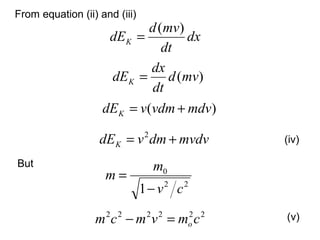
    Einstein’s Mass Energyrelation Let a body of rest mass mo is moving with velocity then its mass can be given by If the particle is displaced by a distance dx by the application of force F, the work done Fdx is stored as kinetic energy (EK) in the body. 22 0 1 cv m m − = According to Newton’s second law of motion, the rate of change of momentum of the particle is equal to the force applied on it. dt mvd F )( = (i) (ii) FdxdEdW K == (iii)
  • 33.
    (iv) From equation (ii)and (iii) But dx dt mvd dEK )( = )(mvd dt dx dEK = )( mdvvdmvdEK += mvdvdmvdEK += 2 22 0 1 cv m m − = 222222 cmvmcm o=− (v)
  • 34.
    (vi) Differentiating equation (v) mvdvdmvdmc+= 22 0222 222 =−− vdvmmdmvmdmc (vii) Comparing equation (v) and (vi) 2 dmcdEK = ( and c are constants)om From equation (vii), we find that change in kinetic energy is directly proportional to the change in mass. If the body is at rest, its velocity will be zero and hence the change in kinetic energy will be zero i.e. mass will be mo If the body moves with velocity v, then its mass becomes m and its K.E. becomes EK.
  • 35.
    (viii) Integrating equation (vii) 2 0 2 0 2 ][cmmcmmcEK −=−= ∫∫ = m m E K dmcdE K 0 2 0 2 0 2 cmEmc K += From equation (viii), we find that is the total energy. It is the sum of kinetic and rest mass energy 2 mc 2 mcE = This relation is called Einstein’s mass energy relation.
  • 36.
    Energy Momentum relation Leta particle of rest mass mo is moving with velocity, v then the energy associated with it is given by 22 2 02 1 cv cm mcE − == Momentum of the particle is mvp = or mpv = )(1 222 2 0 cmp cm E − = )(1 4222 2 0 cmcp cm E − =
  • 37.
    )(1 222 2 0 Ecp cm E − = )(1 222 42 02 Ecp cm E − = 42 0 2222 ])(1[cmEcpE =− 42 0 222 cmcpE =− 2242 0 2 cpcmE += 2242 0 cpcmE +=
  • 38.
    2 0 2242 0 cmcpcmEK −+= KineticEnergy is given by 2 0cmEEK −=         −        += 11 2/1 22 0 2 2 0 cm p cmEK (i) 22 0 2 2/1 22 0 2 2 1 11 cm p cm p +=        + But )( cv <
  • 39.
    Equation (i) nowbecomes 0 2 22 0 2 2 0 2 1 2 1 1 m p cm p cmEK =      −+= When then we have)( cv << 0mm = m p EK 2 2 = Thus in limit of small velocities, the relativistic relation between kinetic energy and momentum tends to the classical relation

Editor's Notes

  • #9 Pictures from http://www.drphysics.com/syllabus/M_M/M_M.html Expt explanation from http://hyperphysics.phy-astr.gsu.edu/hbase/relativ/morley.html Photograph of lab from http://www.juliantrubin.com/bigten/michelsonmorley.html After the development of Maxwell&amp;apos;s theory of electromagnetism, several experiments were performed to prove the existence of ether and its motion relative to the Earth. The most famous and successful was the one now known as the Michelson-Morley experiment, performed by Albert Michelson (1852-1931) and Edward Morley (1838-1923) in 1887. Michelson and Morley built a Michelson interferometer, which essentially consists of a light source, a half-silvered glass plate, two mirrors, and a telescope. The mirrors are placed at right angles to each other and at equal distance from the glass plate, which is obliquely oriented at an angle of 45° relative to the two mirrors. In the original device, the mirrors were mounted on a rigid base that rotates freely on a basin filled with liquid mercury in order to reduce friction. Prevailing theories held that ether formed an absolute reference frame with respect to which the rest of the universe was stationary. It would therefore follow that it should appear to be moving from the perspective of an observer on the sun-orbiting Earth. As a result, light would sometimes travel in the same direction of the ether, and others times in the opposite direction. Thus, the idea was to measure the speed of light in different directions in order to measure speed of the ether relative to Earth, thus establishing its existence. Michelson and Morley were able to measure the speed of light by looking for interference fringes between the light which had passed through the two perpendicular arms of their apparatus. These would occur since the light would travel faster along an arm if oriented in the &amp;quot;same&amp;quot; direction as the ether was moving, and slower if oriented in the opposite direction. Since the two arms were perpendicular, the only way that light would travel at the same speed in both arms and therefore arrive simultaneous at the telescope would be if the instrument were motionless with respect to the ether. If not, the crests and troughs of the light waves in the two arms would arrive and interfere slightly out of synchronization, producing a diminution of intensity. (Of course, the same effect would be achieved if the arms of the interferometer were not of the same length, but these could be adjusted accurately by looking for the intensity peak as one arm was moved. Changing the orientation of the instrument should then show fringes.) Although Michelson and Morley were expecting measuring different speeds of light in each direction, they found no discernible fringes indicating a different speed in any orientation or at any position of the Earth in its annual orbit around the Sun. In 1895, Lorentz concluded that the &amp;quot;null&amp;quot; result obtained by Michelson and Morley was caused by a effect of contraction made by the ether on their apparatus and introduced the length contraction equation where L is the contracted length, is the rest length, v is the velocity of the frame of reference, and c is the speed of light. Although the main interpretation of Lorentz for this equation was rejected later, the equation is still correct and was the first of a sequence of new equations developed by Poincaré, Lorentz, and others, resulting in a new branch of physics ultimately brought to fruition by Albert Einstein in special relativity. Einstein&amp;apos;s idea of space-time contraction replaced Lorentz&amp;apos;s interpretation of the contraction equation, and once and for all relegated ether to the history books. http://scienceworld.wolfram.com/physics/Michelson-MorleyExperiment.html