Ageing, disability and development  Disability Mainstreaming Forum  DFID 3 rd  March 2009 Sylvia Beales  HelpAge International  [email_address]
Context and Definitions  Life expectancy is extending worldwide, fertility rates are falling, and demographic ageing is accelerating – fastest  in the developing world  Disabilities is an umbrella term, covering impairments, activity limitations, and participation restrictions. An impairment is a problem in body function or structure; an activity limitation is a difficulty encountered by an individual in executing a task or action; while a participation restriction is a problem experienced by an individual in involvement in life situations.  Thus disability is a complex phenomenon, reflecting an interaction between features of a person’s body and features of the society in which he or she lives. (World Health Organisation 2009)
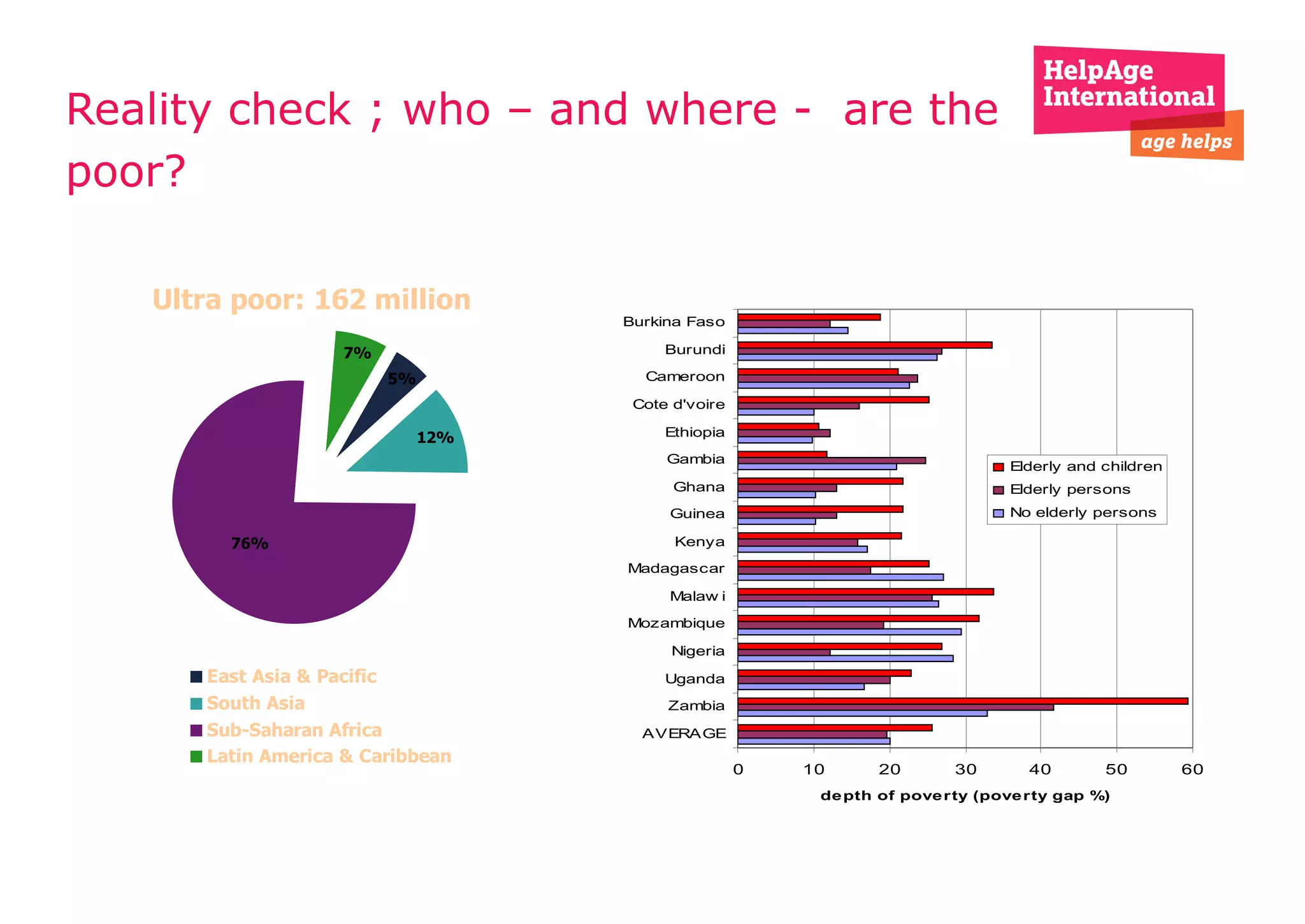
Reality check ; who – and where -  are the poor?
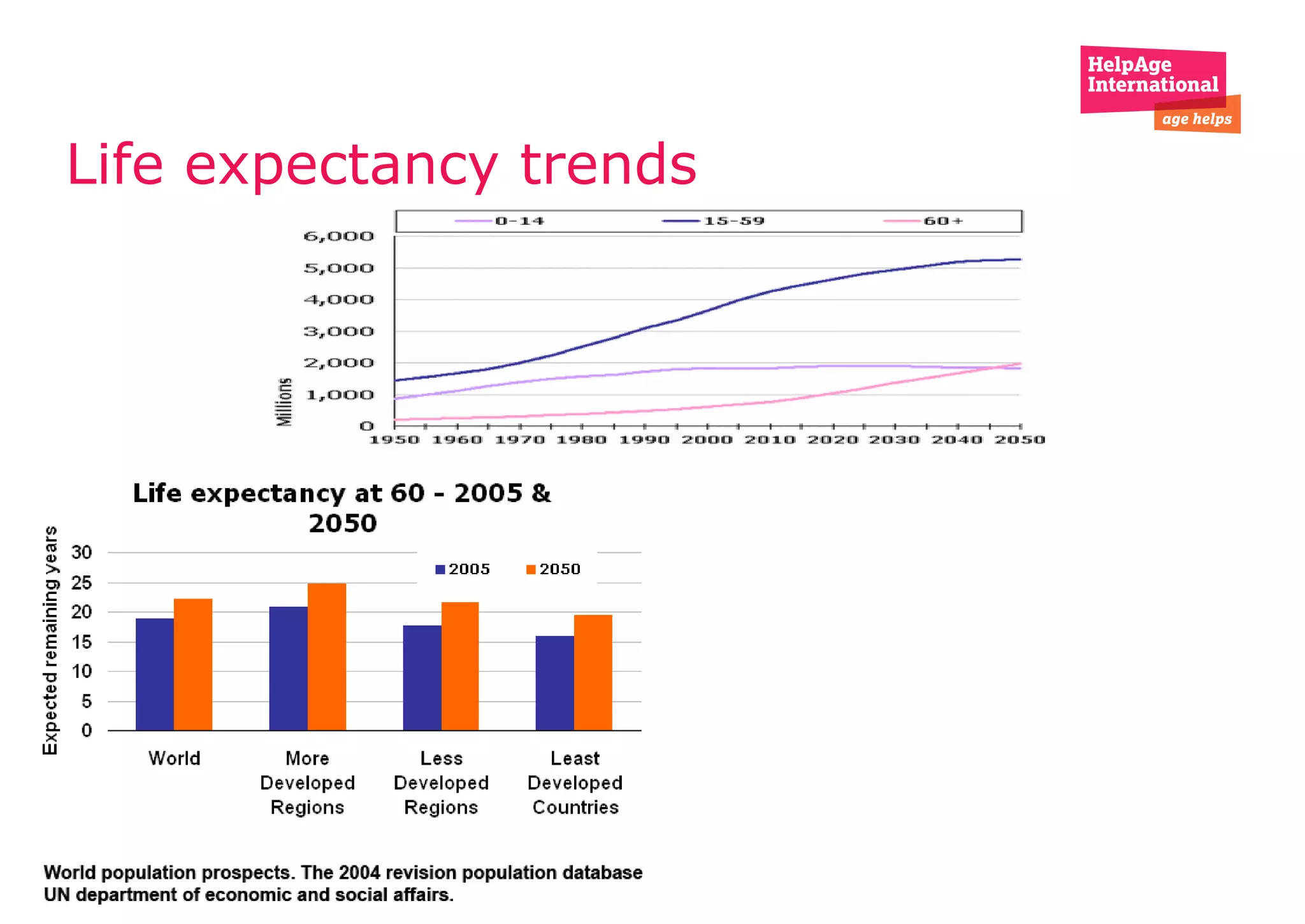
Life expectancy trends
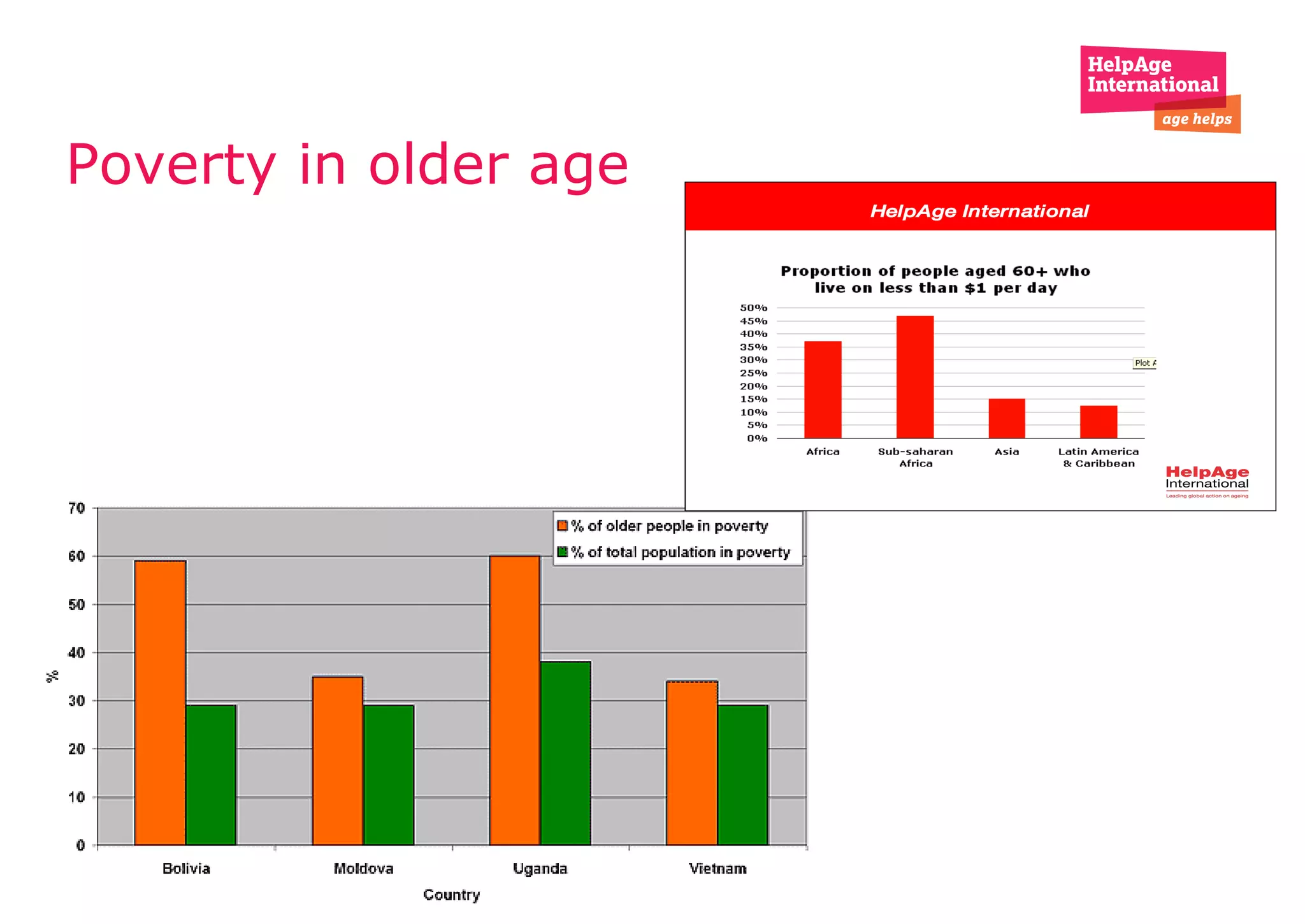
Poverty in older age
Ageing and disability  Hearing loss, vision problems and mental disorders are the most common causes of disability and loss of livelihood – 82 % of blind persons are over 50  Depression and Alzheimer's are among the 20 leading causes of disability worldwide. Alzheimer's affects 1 in 20 over the age of 65 and in in 5 over the age of 80 Fewer than 25% of those affected have access to adequate treatment and health care Chronic limiting disorders are treatable at low cost (e.g. hearing loss; cataracts; stress; WHO wants extra mental health spend of US$ 2 per person per year in low-income countries  High overall rates underline the need for focus on  these conditions and wider access to interventions that help people live productively
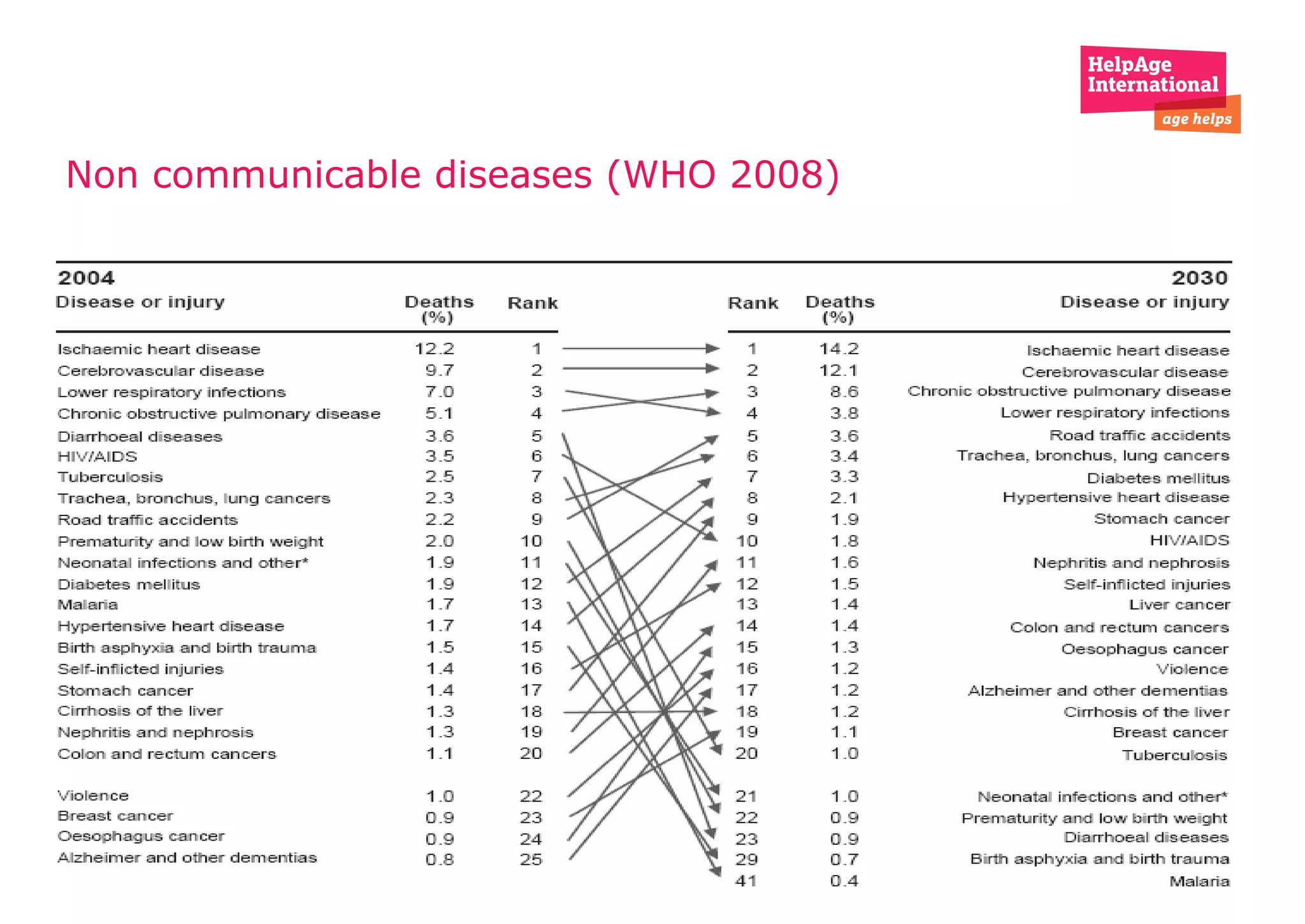
Non communicable diseases (WHO 2008)
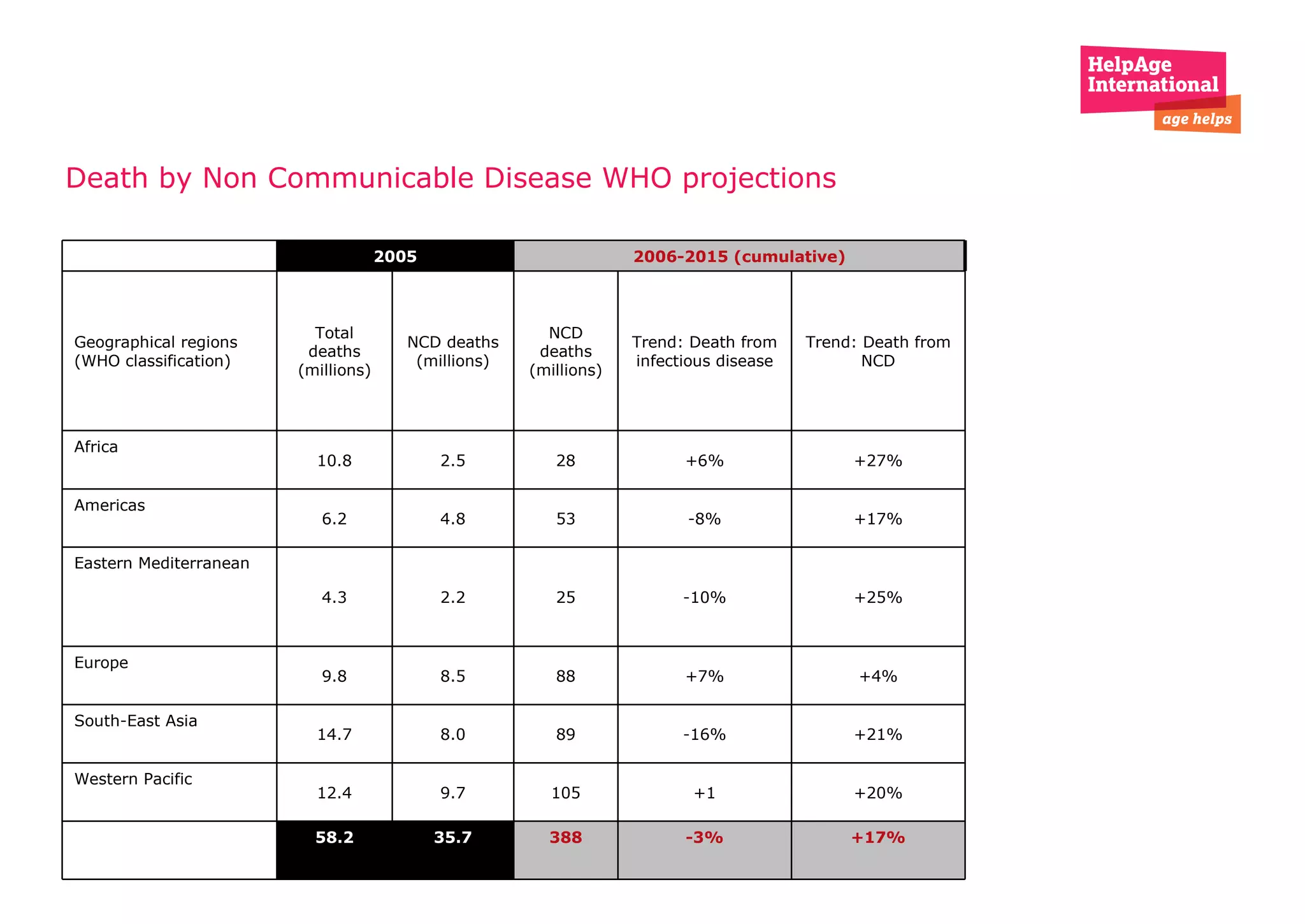
Death by Non Communicable Disease WHO projections   +17% -3% 388 35.7 58.2 Total +20% +1 105 9.7 12.4 Western Pacific +21% -16% 89 8.0 14.7 South-East Asia +4% +7% 88 8.5 9.8 Europe +25% -10% 25 2.2 4.3 Eastern Mediterranean +17% -8% 53 4.8 6.2 Americas +27% +6% 28 2.5 10.8 Africa Trend: Death from NCD Trend: Death from infectious disease NCD deaths (millions) NCD deaths (millions) Total deaths (millions) Geographical regions (WHO classification) 2006-2015 (cumulative) 2005
Age helps  Older people make critical contributions to the welfare of their families and thus to the development of their communities and societies Older people are caregivers, breadwinners  Older people are carers even when disabled and struggling to access health and other basic services  In the context of the HIV/AIDS, older women frequently act as the sole carers of their children dying of the disease and their grandchildren left orphaned… Older people have the same rights as other age groups
Approaches to work to support older people   Grassroots work that directly supports older people and their families  Supporting and strengthening organisations that are working in practical ways to improve the lives of older people and their dependents  Demonstrating contributions and building connections and coalitions across generations and across sectors Supporting older people to be influencers on ageing, to gain access to services, to social protection and development benefits  Strengthening the capacity and reach of organisations working with older people  Connecting  grassroots experience with government thinking and policymaking
Way forward for partnerships Recognise and act on impact of chronic limiting illness for older people and their dependents  Ensure age desegregation in MDG, poverty, hunger and disability data  Acknowledge intergenerational interdependence  Ensure age friendly health access and delivery – focus on accessibility, non communicable diseases and cost effective responses  Social Protection;  universal basic income and equitable access to health – ‘minimum package’  Rights promotion – equal treatment equal rights  Awareness of and prevention of discrimination and abuse  HIV/Aids programmes that support older carers and access to treatment for all  Empowerment; voice, dignity and participation in old age  Inclusion of older people in humanitarian programmes Age and disability awareness training, linked to service assessment, access monitoring and recorded age and disability outputs

Presentation ageing and disability

  • 1.
    Ageing, disability anddevelopment Disability Mainstreaming Forum DFID 3 rd March 2009 Sylvia Beales HelpAge International [email_address]
  • 2.
    Context and Definitions Life expectancy is extending worldwide, fertility rates are falling, and demographic ageing is accelerating – fastest in the developing world Disabilities is an umbrella term, covering impairments, activity limitations, and participation restrictions. An impairment is a problem in body function or structure; an activity limitation is a difficulty encountered by an individual in executing a task or action; while a participation restriction is a problem experienced by an individual in involvement in life situations. Thus disability is a complex phenomenon, reflecting an interaction between features of a person’s body and features of the society in which he or she lives. (World Health Organisation 2009)
  • 3.
    Reality check ;who – and where - are the poor?
  • 4.
  • 5.
  • 6.
    Ageing and disability Hearing loss, vision problems and mental disorders are the most common causes of disability and loss of livelihood – 82 % of blind persons are over 50 Depression and Alzheimer's are among the 20 leading causes of disability worldwide. Alzheimer's affects 1 in 20 over the age of 65 and in in 5 over the age of 80 Fewer than 25% of those affected have access to adequate treatment and health care Chronic limiting disorders are treatable at low cost (e.g. hearing loss; cataracts; stress; WHO wants extra mental health spend of US$ 2 per person per year in low-income countries High overall rates underline the need for focus on these conditions and wider access to interventions that help people live productively
  • 7.
  • 8.
    Death by NonCommunicable Disease WHO projections +17% -3% 388 35.7 58.2 Total +20% +1 105 9.7 12.4 Western Pacific +21% -16% 89 8.0 14.7 South-East Asia +4% +7% 88 8.5 9.8 Europe +25% -10% 25 2.2 4.3 Eastern Mediterranean +17% -8% 53 4.8 6.2 Americas +27% +6% 28 2.5 10.8 Africa Trend: Death from NCD Trend: Death from infectious disease NCD deaths (millions) NCD deaths (millions) Total deaths (millions) Geographical regions (WHO classification) 2006-2015 (cumulative) 2005
  • 9.
    Age helps Older people make critical contributions to the welfare of their families and thus to the development of their communities and societies Older people are caregivers, breadwinners Older people are carers even when disabled and struggling to access health and other basic services In the context of the HIV/AIDS, older women frequently act as the sole carers of their children dying of the disease and their grandchildren left orphaned… Older people have the same rights as other age groups
  • 10.
    Approaches to workto support older people Grassroots work that directly supports older people and their families Supporting and strengthening organisations that are working in practical ways to improve the lives of older people and their dependents Demonstrating contributions and building connections and coalitions across generations and across sectors Supporting older people to be influencers on ageing, to gain access to services, to social protection and development benefits Strengthening the capacity and reach of organisations working with older people Connecting grassroots experience with government thinking and policymaking
  • 11.
    Way forward forpartnerships Recognise and act on impact of chronic limiting illness for older people and their dependents Ensure age desegregation in MDG, poverty, hunger and disability data Acknowledge intergenerational interdependence Ensure age friendly health access and delivery – focus on accessibility, non communicable diseases and cost effective responses Social Protection; universal basic income and equitable access to health – ‘minimum package’ Rights promotion – equal treatment equal rights Awareness of and prevention of discrimination and abuse HIV/Aids programmes that support older carers and access to treatment for all Empowerment; voice, dignity and participation in old age Inclusion of older people in humanitarian programmes Age and disability awareness training, linked to service assessment, access monitoring and recorded age and disability outputs