Needs: are we moving
towards a new health
    paradigm ?
Alain FRANCO – franco.a@chu-nice.fr
  Professor of Internal Medicine and Geriatrics (Nice)
                  President of the ISG
         President of the CNRSDA (France)
Supply
• Technology & Services
 •   ICT,
 •   Gerontechnology,
 •   Domotics,
 •   Telemedicine,
 •   ISG matrices
Gerontechnology
matrices
J.E.M.H. van Bronswijk et al.
Gerontechnology 2009;8(1):3-10
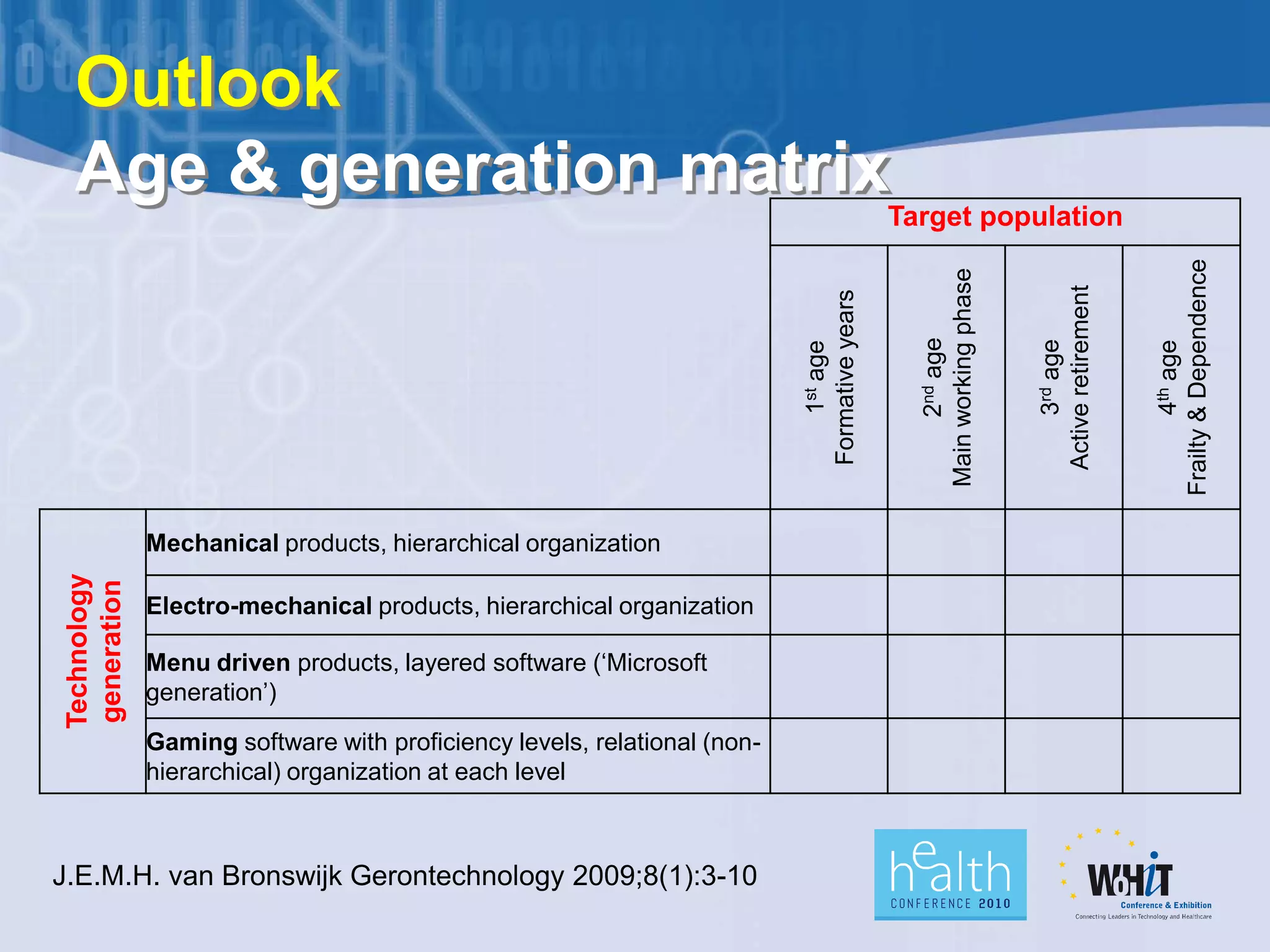
Outlook
  Age & generation matrix                                                                   Target population


                                                                                                                                       Frailty & Dependence
                                                                                              Main working phase


                                                                                                                   Active retirement
                                                                          Formative years


                                                                                                    2nd age


                                                                                                                        3rd age


                                                                                                                                               4th age
                                                                              1st age
              Mechanical products, hierarchical organization
 Technology
 generation


              Electro-mechanical products, hierarchical organization

              Menu driven products, layered software (‘Microsoft
              generation’)

              Gaming software with proficiency levels, relational (non-
              hierarchical) organization at each level


J.E.M.H. van Bronswijk Gerontechnology 2009;8(1):3-10
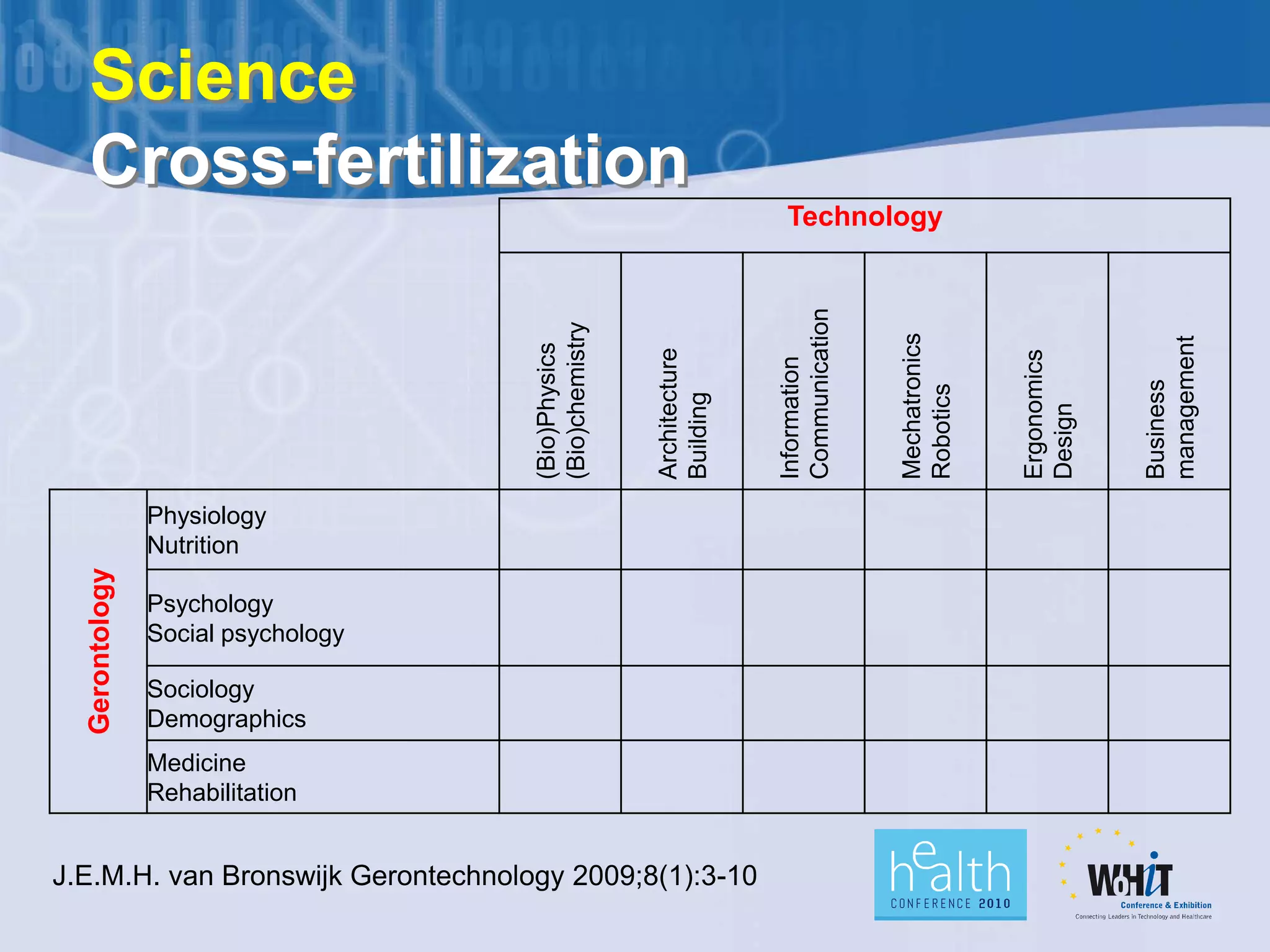
Science
  Cross-fertilization
                                                                     Technology


                                                                    Communication
                                    (Bio)chemistry


                                                                                    Mechatronics


                                                                                                                management
                                    (Bio)Physics


                                                     Architecture


                                                                                                   Ergonomics
                                                                    Information


                                                                                                                Business
                                                                                    Robotics
                                                     Building


                                                                                                   Design
                Physiology
                Nutrition
  Gerontology


                Psychology
                Social psychology

                Sociology
                Demographics
                Medicine
                Rehabilitation


J.E.M.H. van Bronswijk Gerontechnology 2009;8(1):3-10
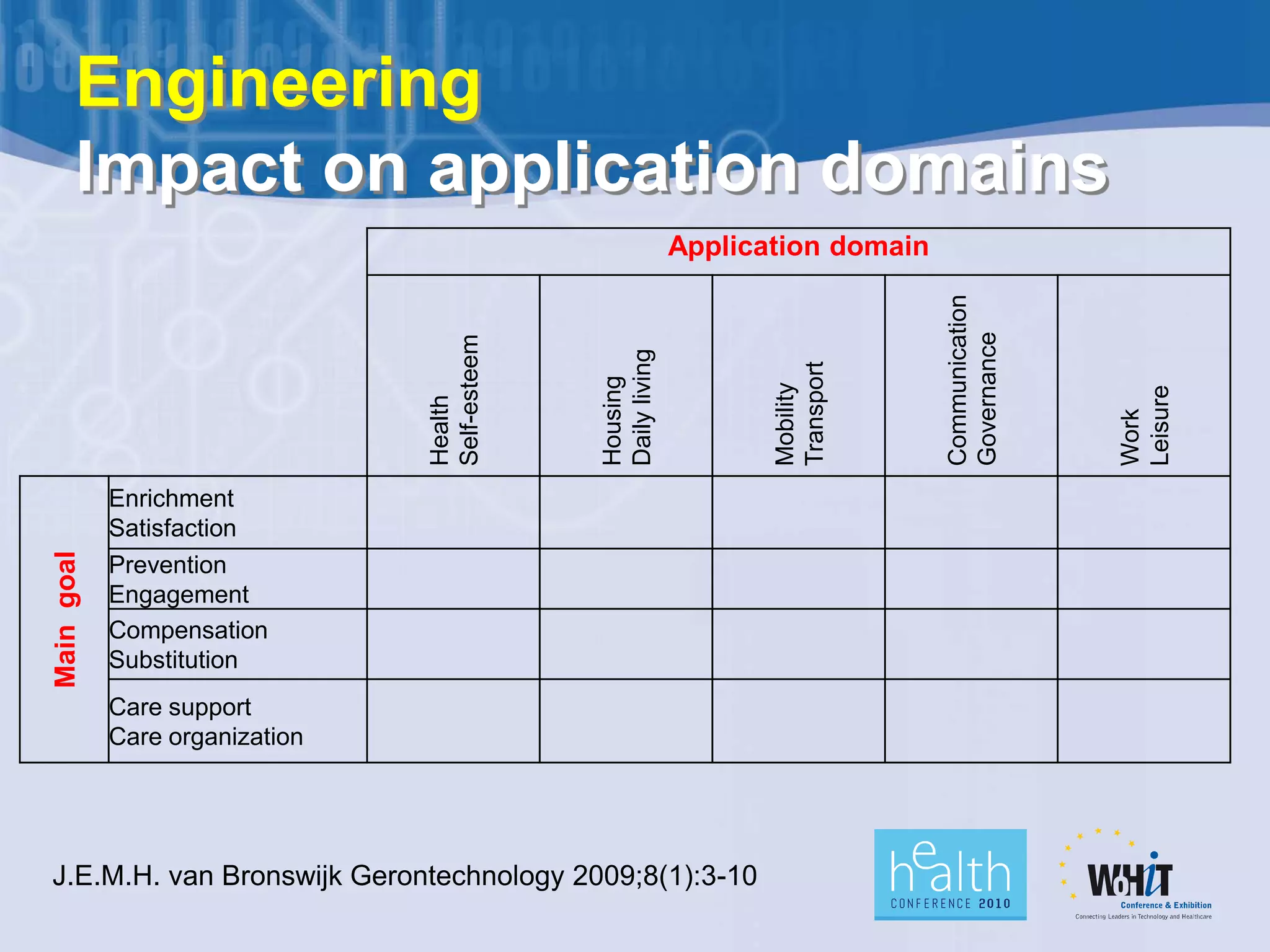
Engineering
       Impact on application domains
                                                             Application domain


                                                                                  Communication
                                                                                  Governance
                                Self-esteem


                                              Daily living


                                                                    Transport
                                              Housing


                                                                    Mobility


                                                                                                  Leisure
                                Health


                                                                                                  Work
            Enrichment
            Satisfaction
Main goal


            Prevention
            Engagement
            Compensation
            Substitution
            Care support
            Care organization


J.E.M.H. van Bronswijk Gerontechnology 2009;8(1):3-10
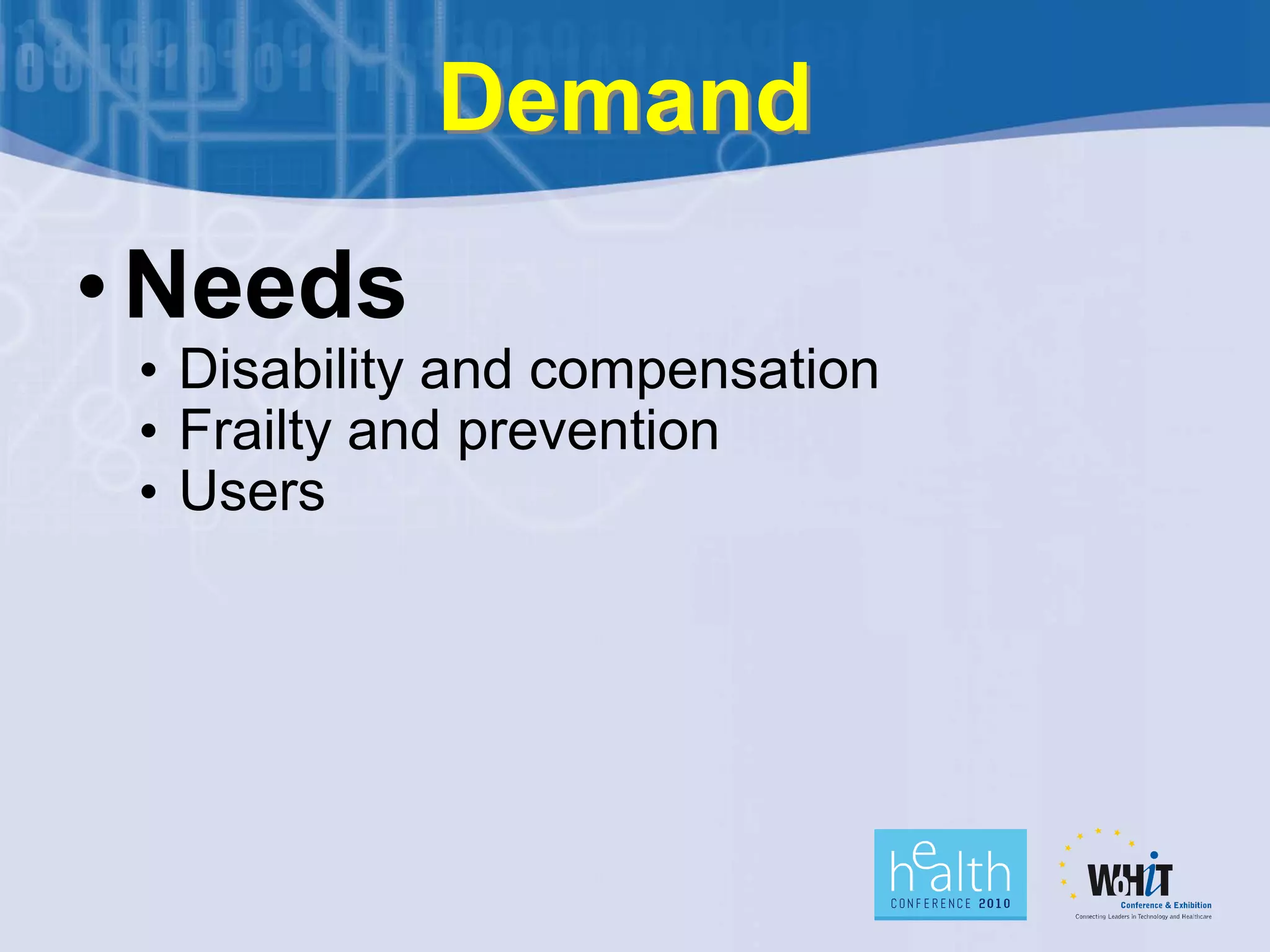
Demand
• Needs
 • Disability and compensation
 • Frailty and prevention
 • Users
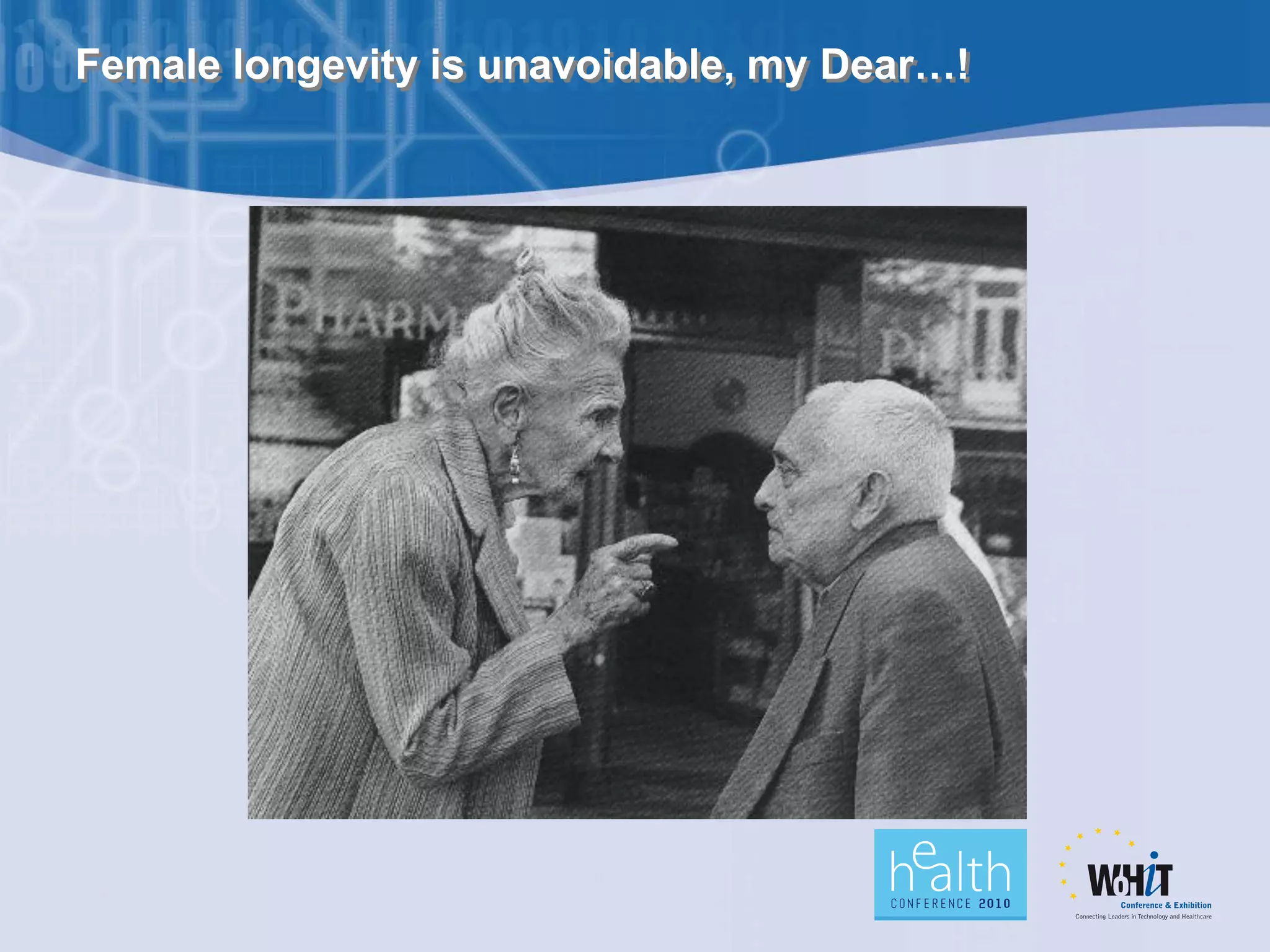
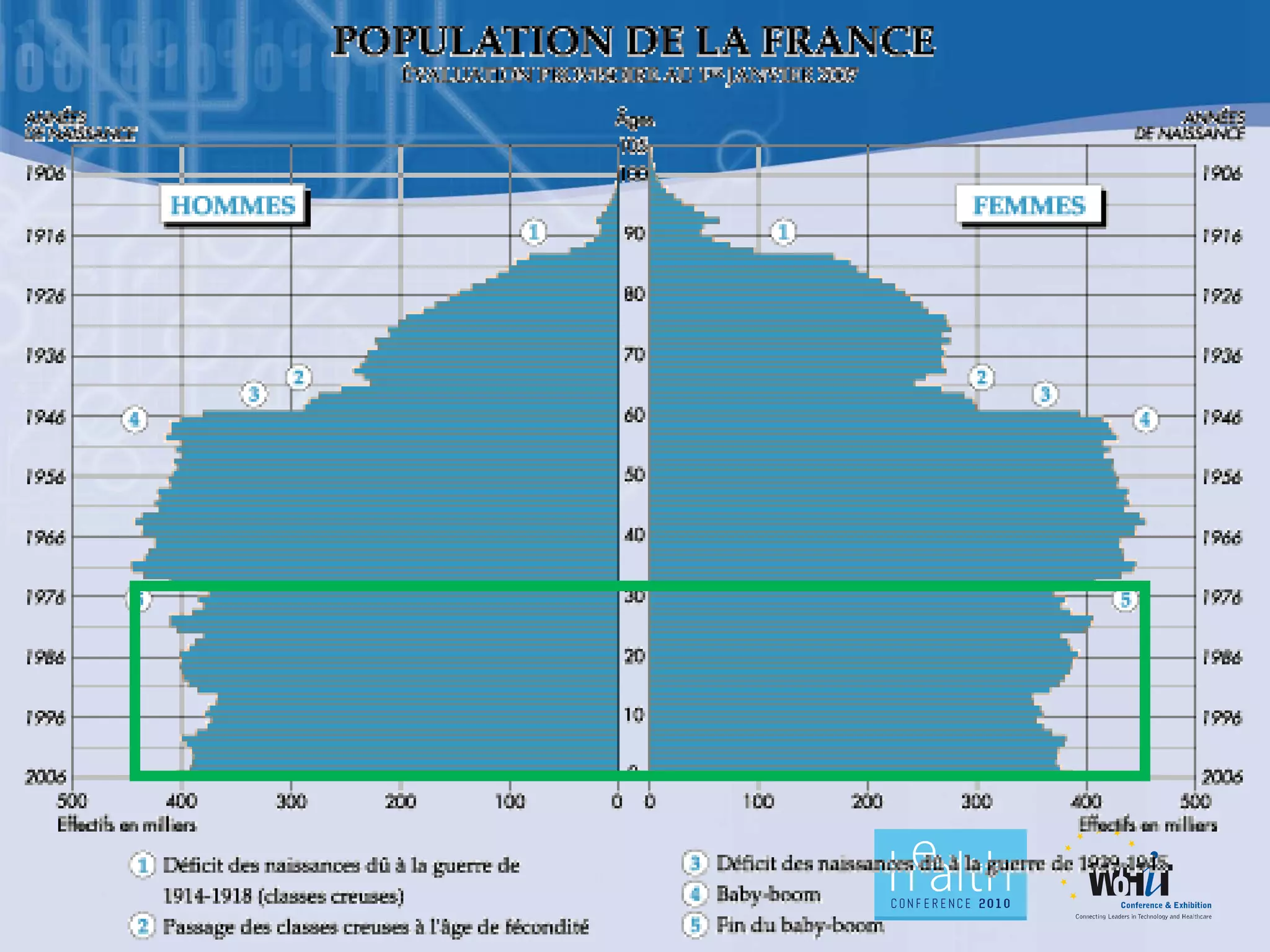
Female longevity is unavoidable, my Dear…!
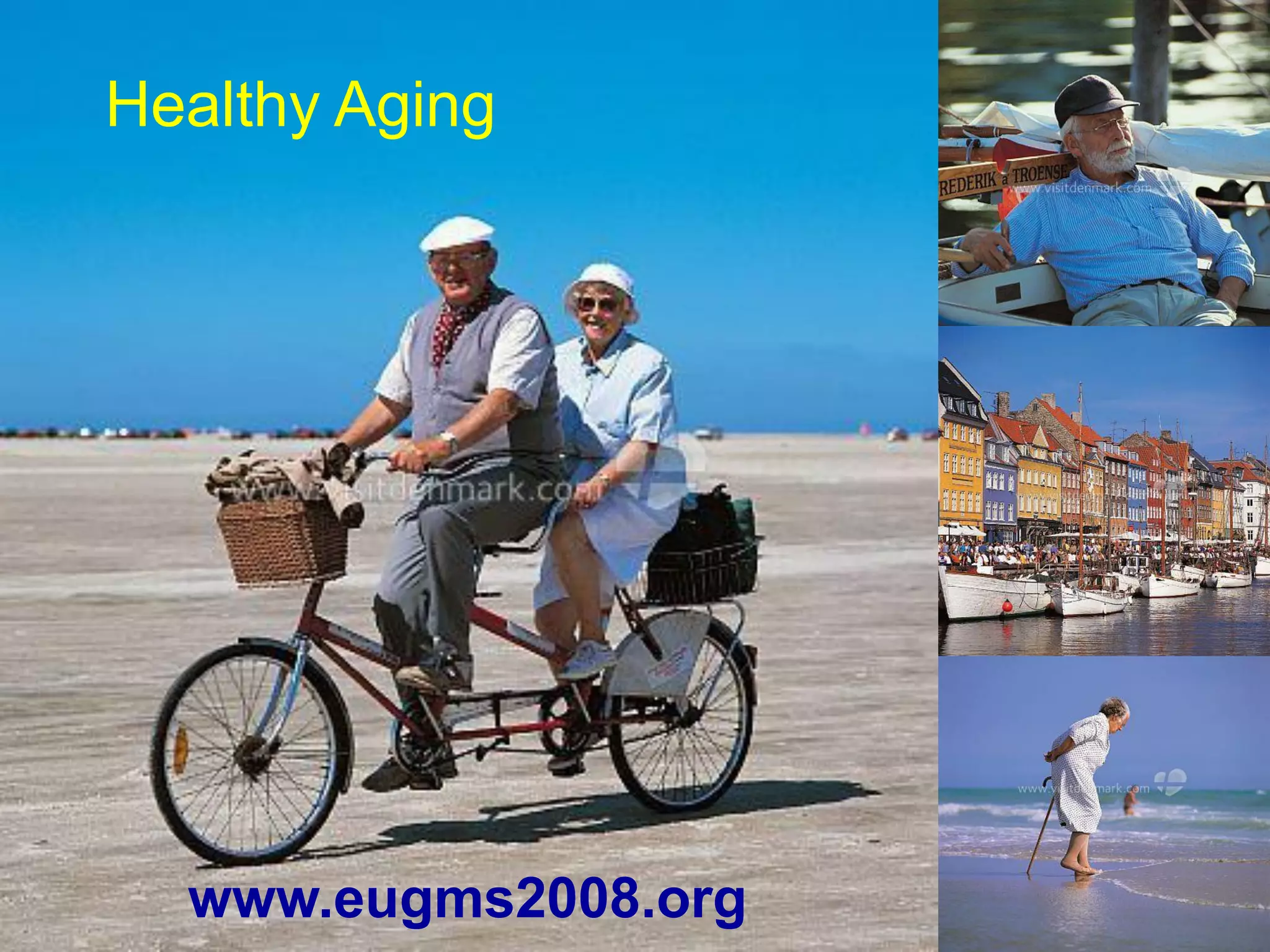
Healthy Aging


  www.eugms2008.org
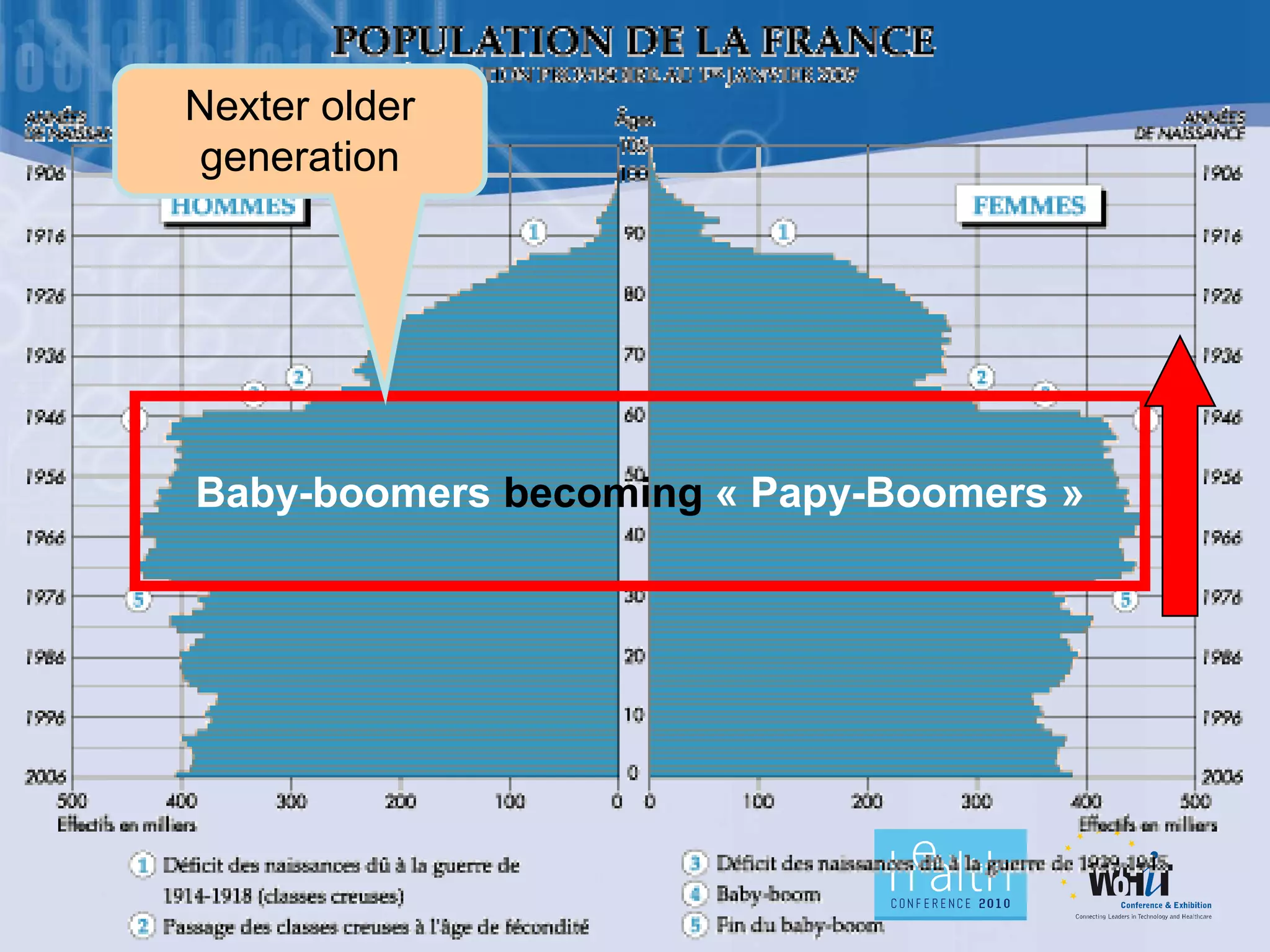
Nexter older
generation


Baby-boomers becoming « Papy-Boomers »
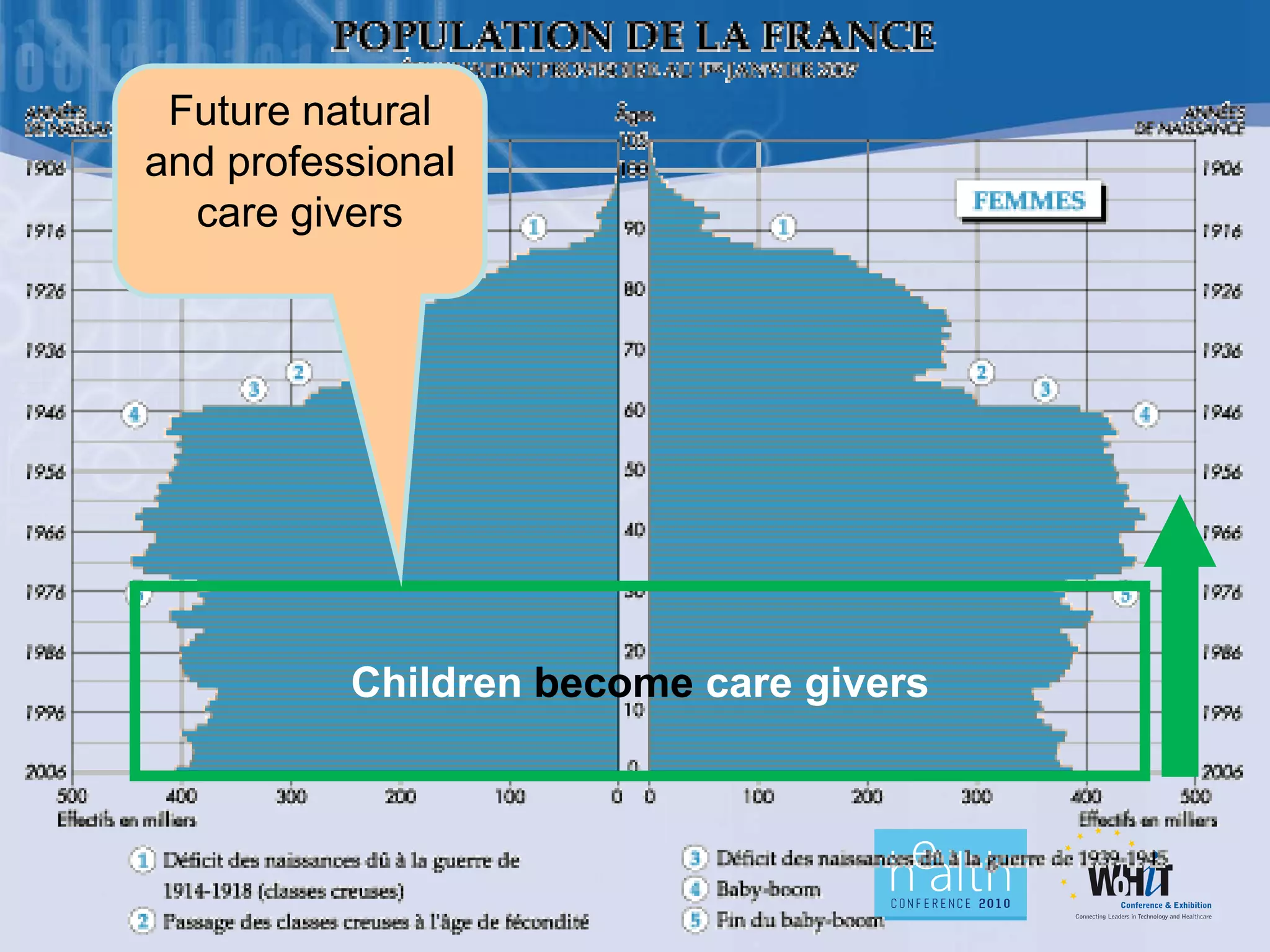
Future natural
and professional
  care givers


          Children become care givers
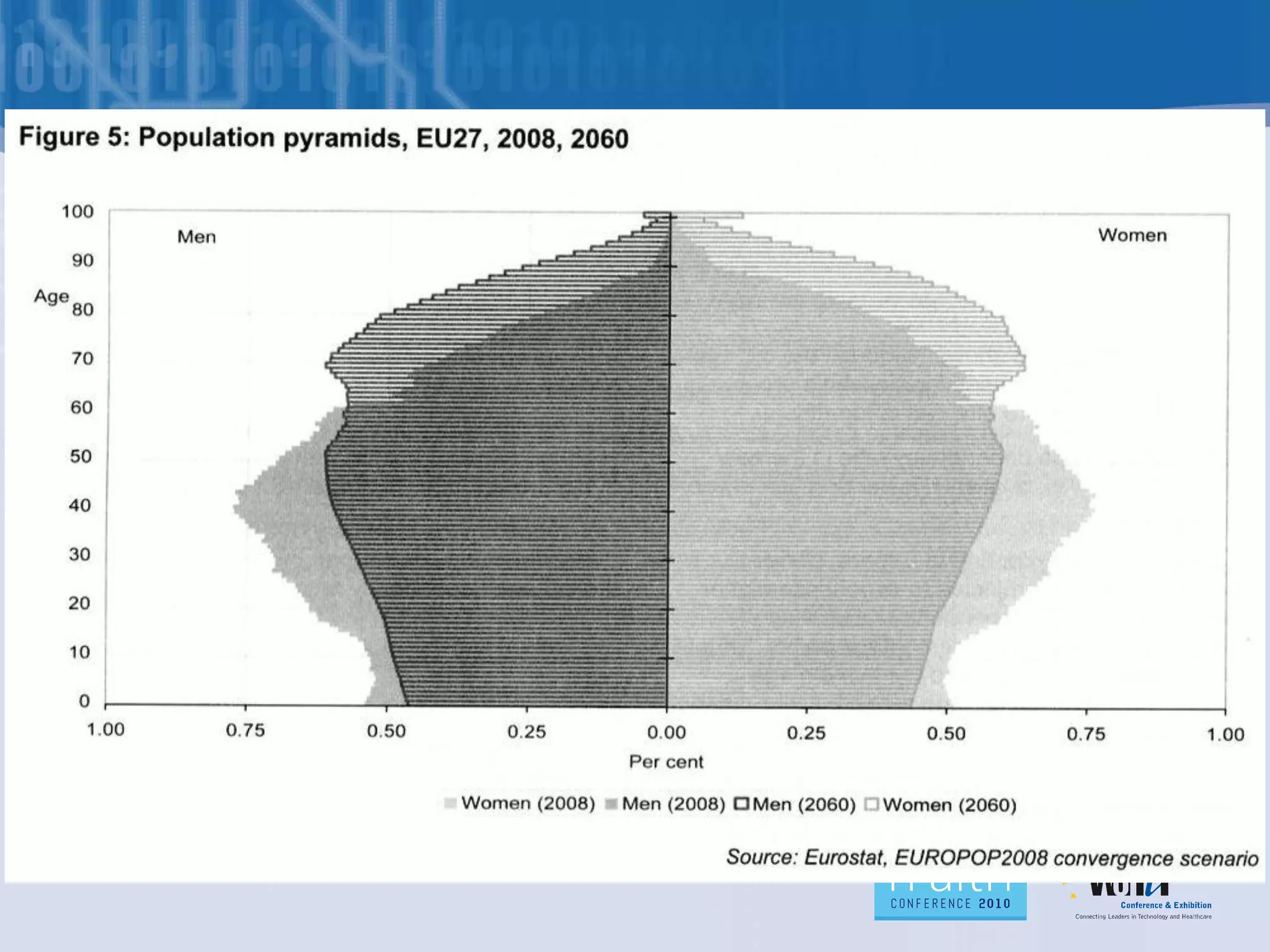
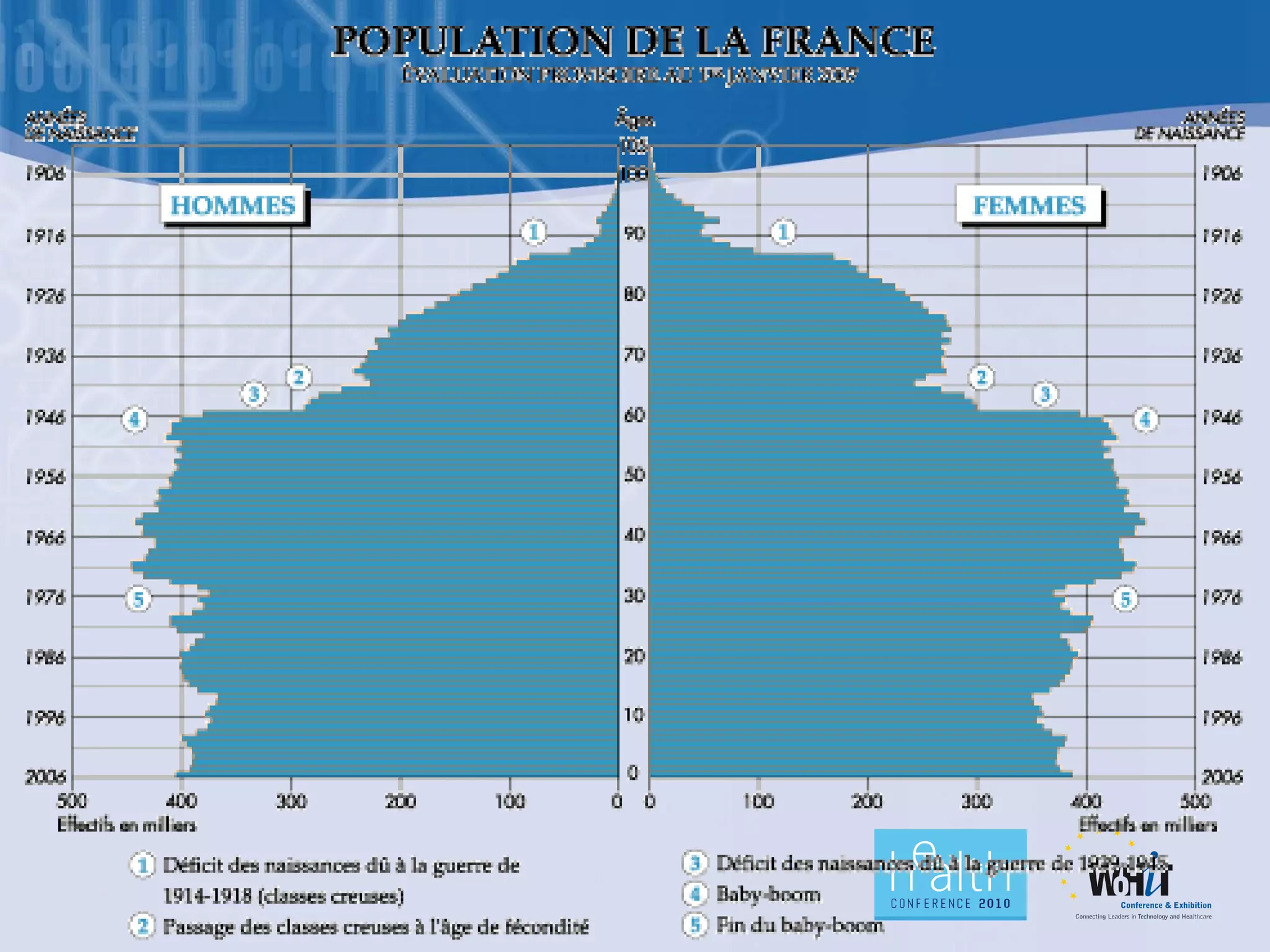
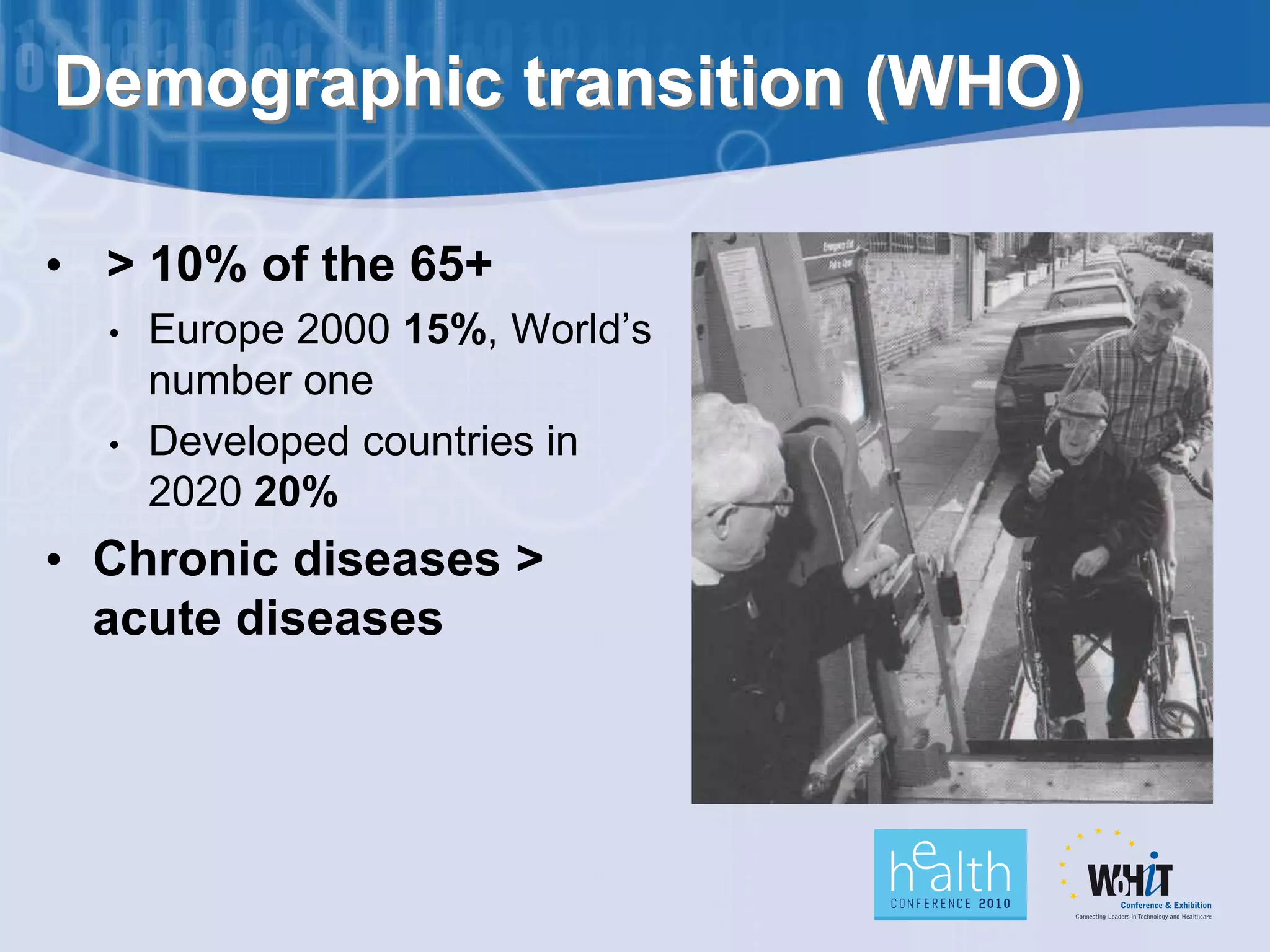
Demographic transition (WHO)

• > 10% of the 65+
  •   Europe 2000 15%, World’s
      number one
  •   Developed countries in
      2020 20%
• Chronic diseases >
  acute diseases
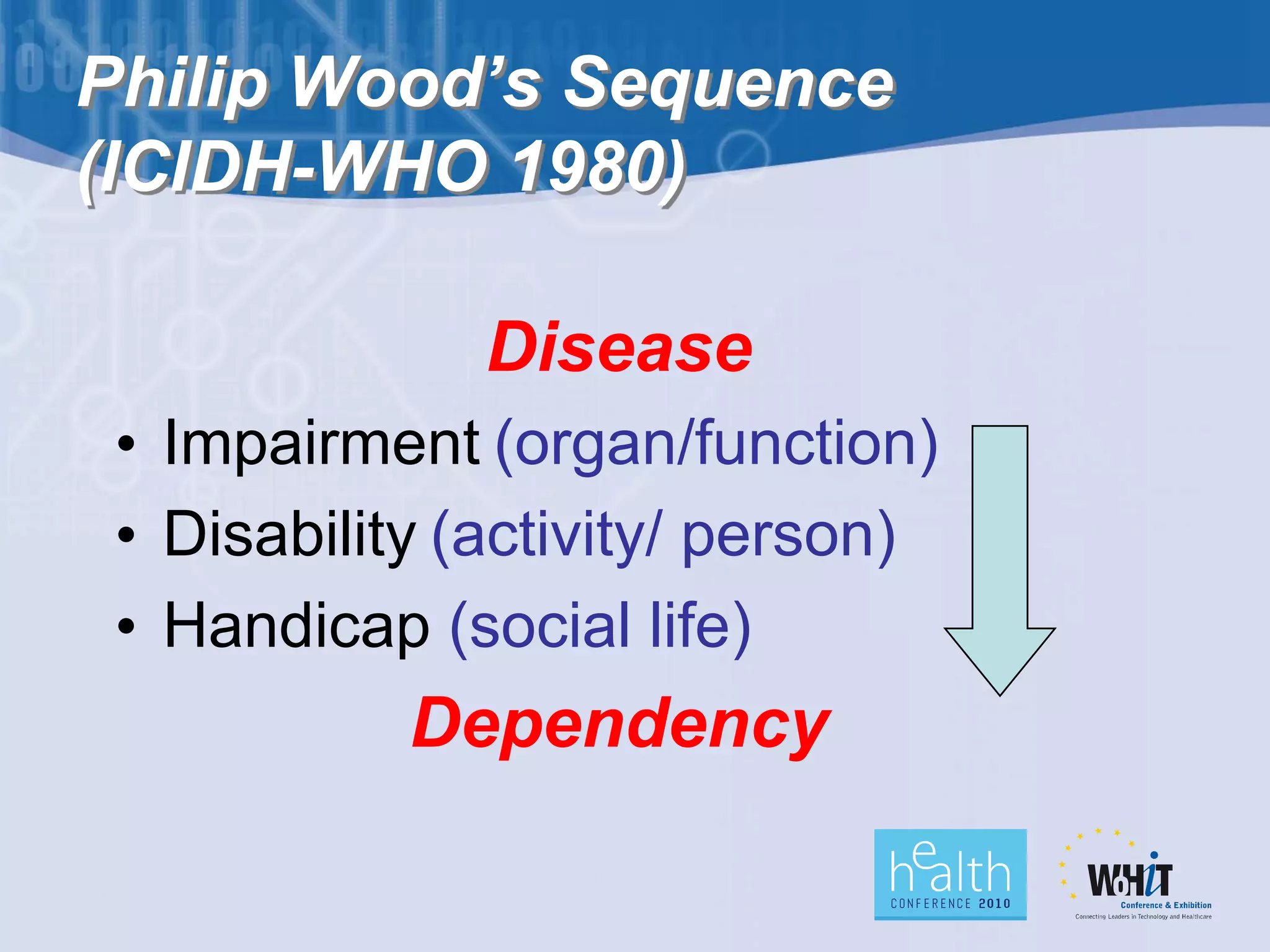
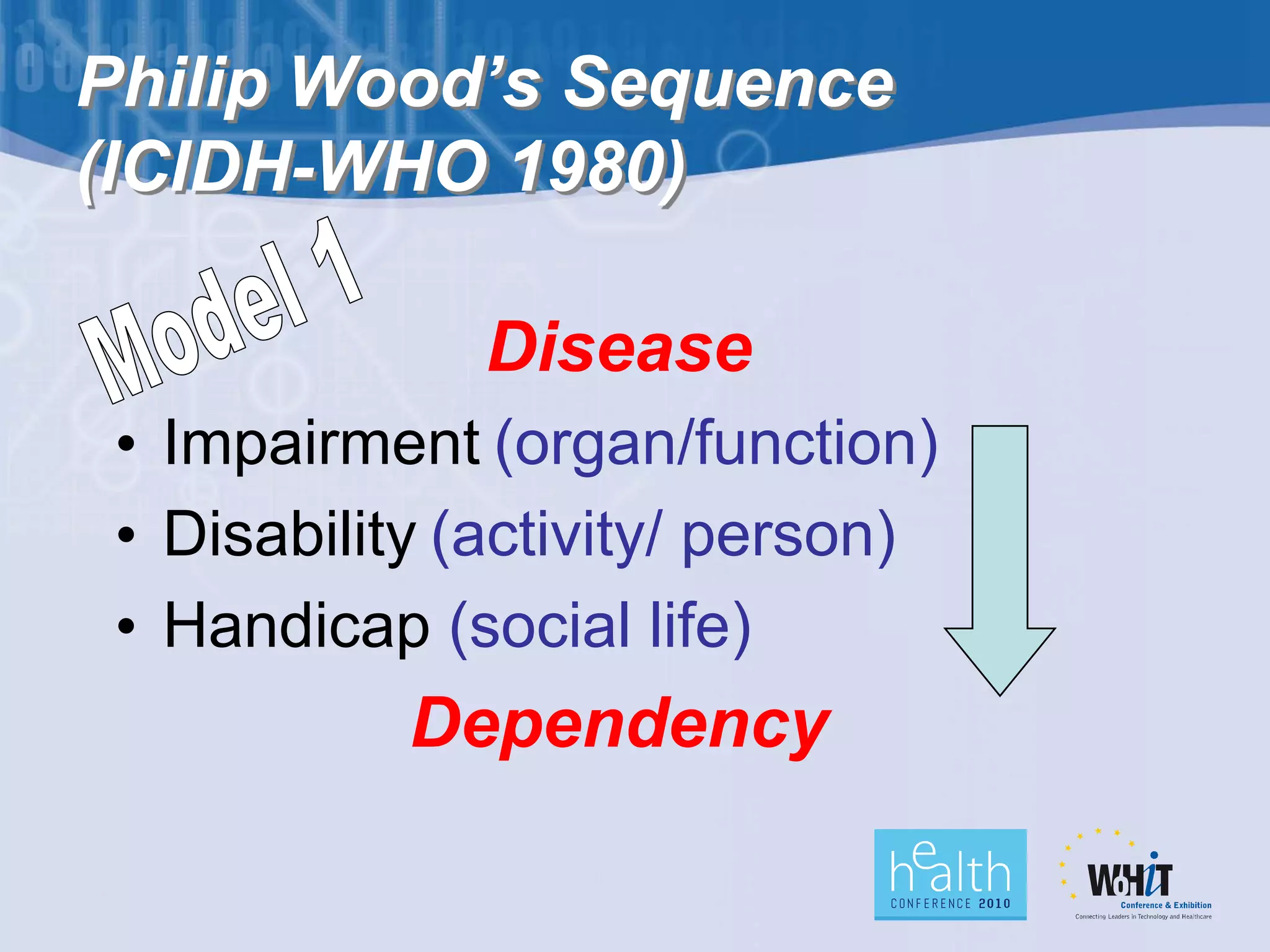
Philip Wood’s Sequence
(ICIDH-WHO 1980)

              Disease
 • Impairment (organ/function)
 • Disability (activity/ person)
 • Handicap (social life)
            Dependency
Philip Wood’s Sequence
(ICIDH-WHO 1980)

              Disease
 • Impairment (organ/function)
 • Disability (activity/ person)
 • Handicap (social life)
            Dependency
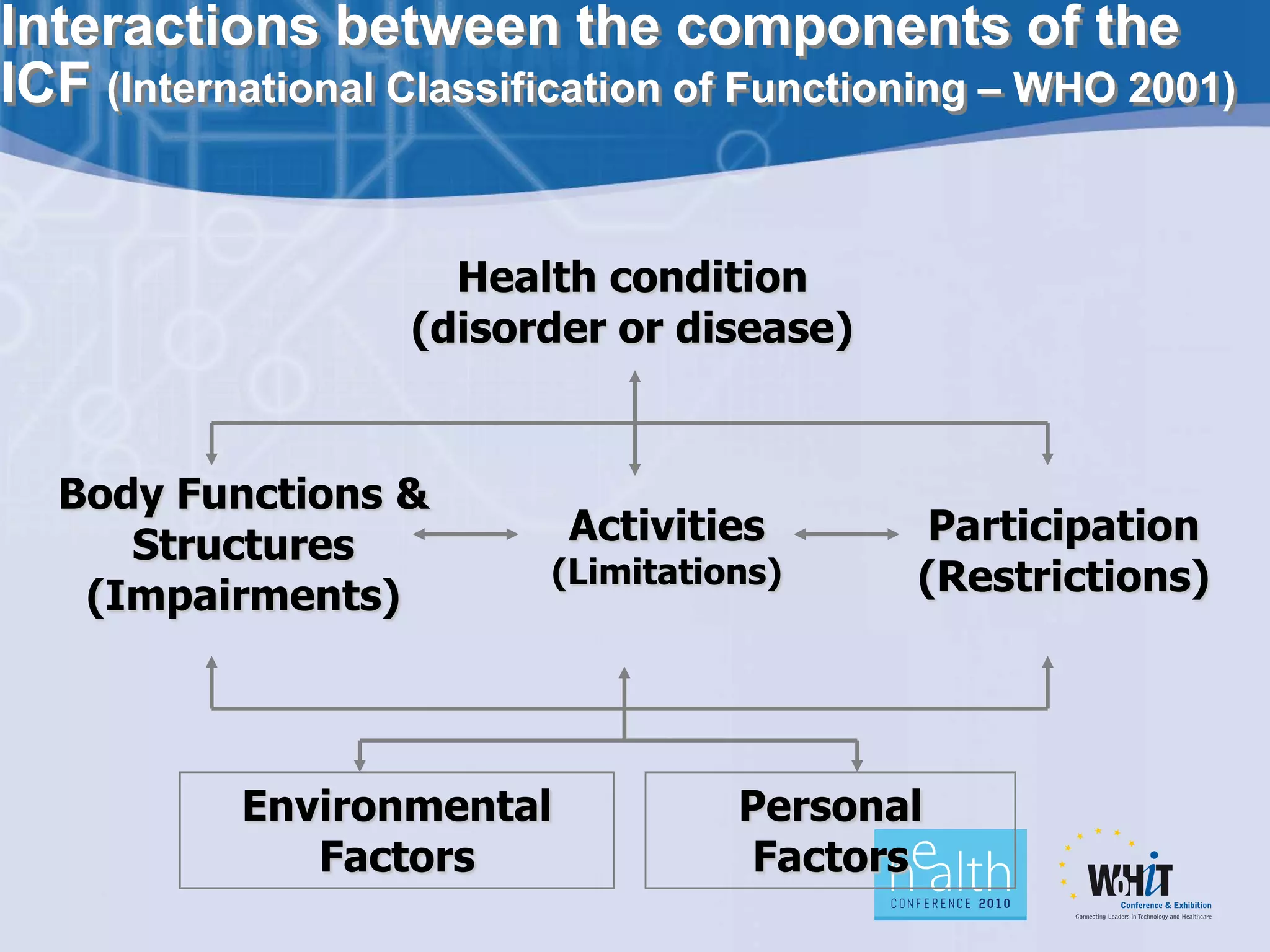
Interactions between the components of the
ICF (International Classification of Functioning – WHO 2001)


                     Health condition
                   (disorder or disease)


  Body Functions &
     Structures            Activities        Participation
                          (Limitations)     (Restrictions)
   (Impairments)


           Environmental            Personal
              Factors                Factors
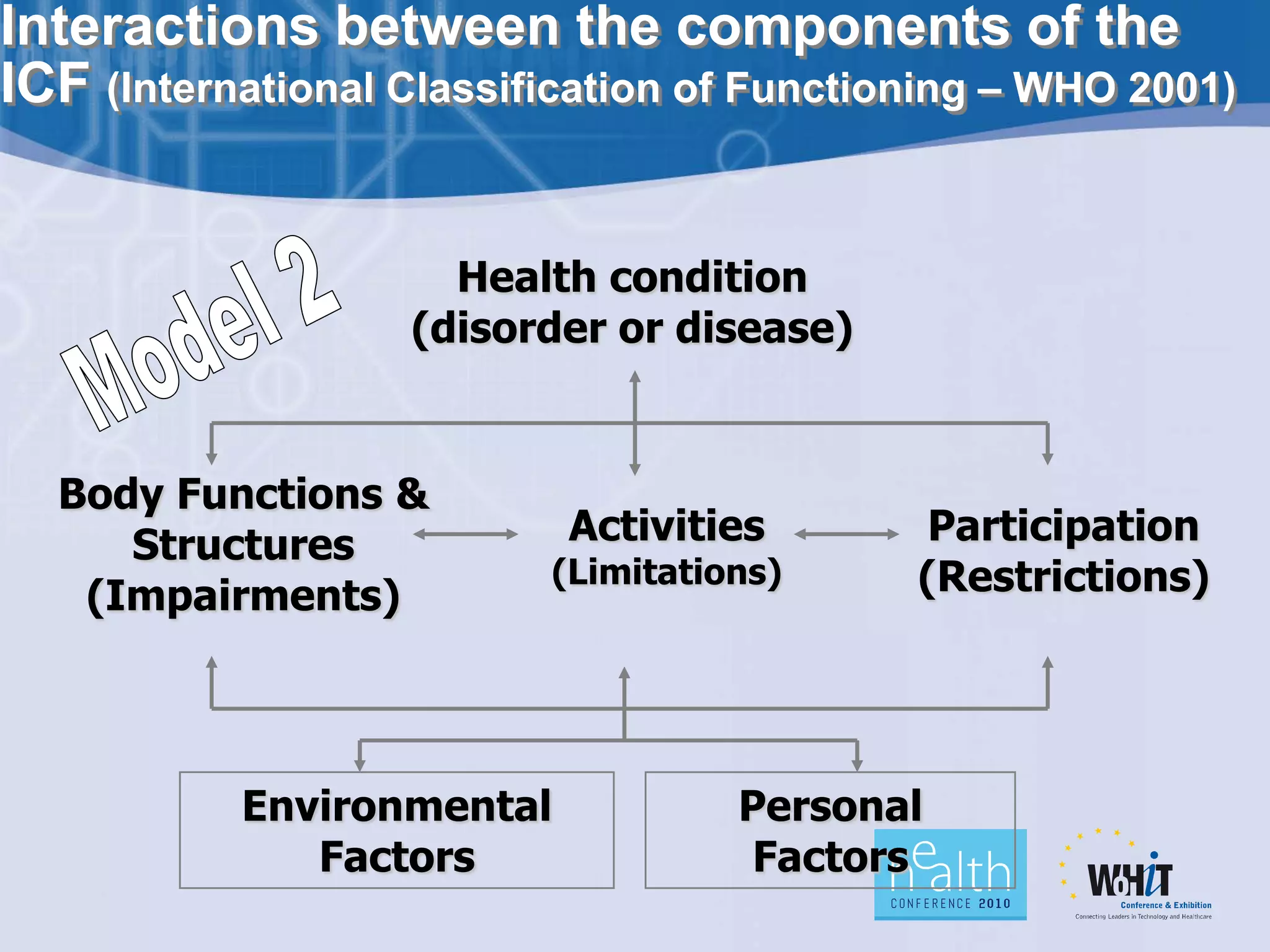
Interactions between the components of the
ICF (International Classification of Functioning – WHO 2001)


                     Health condition
                   (disorder or disease)


  Body Functions &
     Structures            Activities        Participation
                          (Limitations)     (Restrictions)
   (Impairments)


           Environmental            Personal
              Factors                Factors
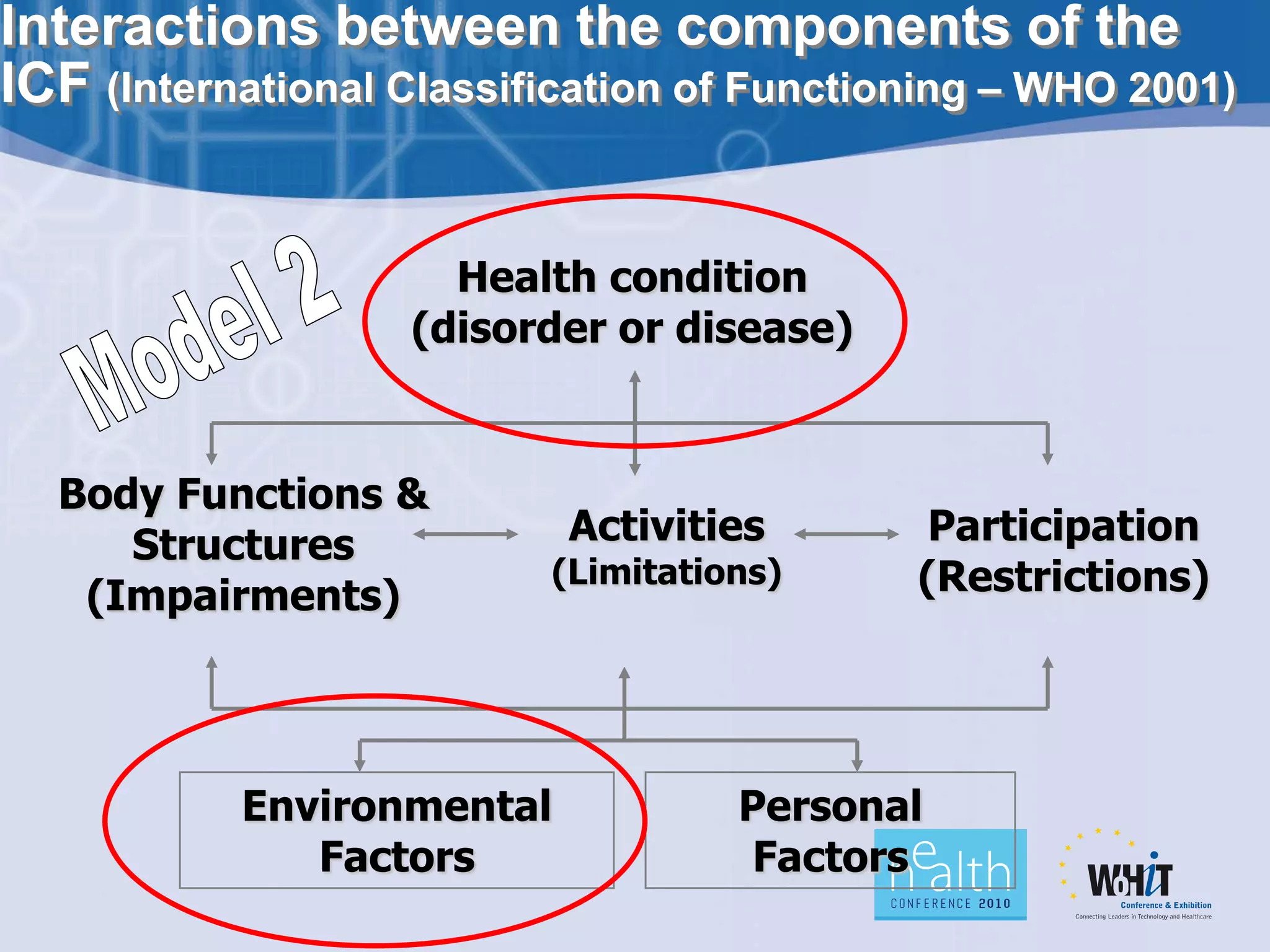
Interactions between the components of the
ICF (International Classification of Functioning – WHO 2001)


                     Health condition
                   (disorder or disease)


  Body Functions &
     Structures            Activities        Participation
                          (Limitations)     (Restrictions)
   (Impairments)


           Environmental            Personal
              Factors                Factors
•Functioning &
 handicap
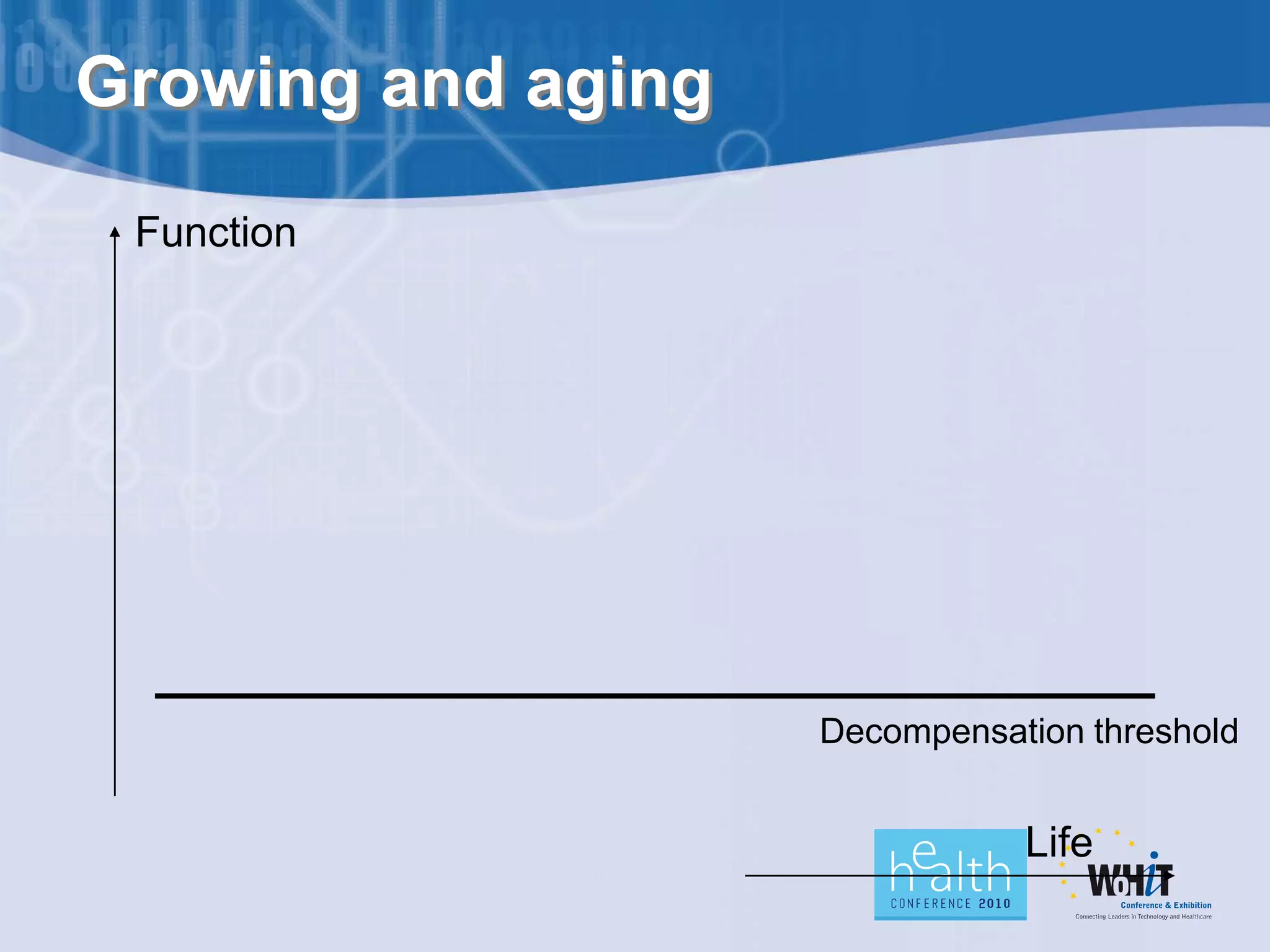
Growing and aging
 Function


                    Decompensation threshold


                               Life
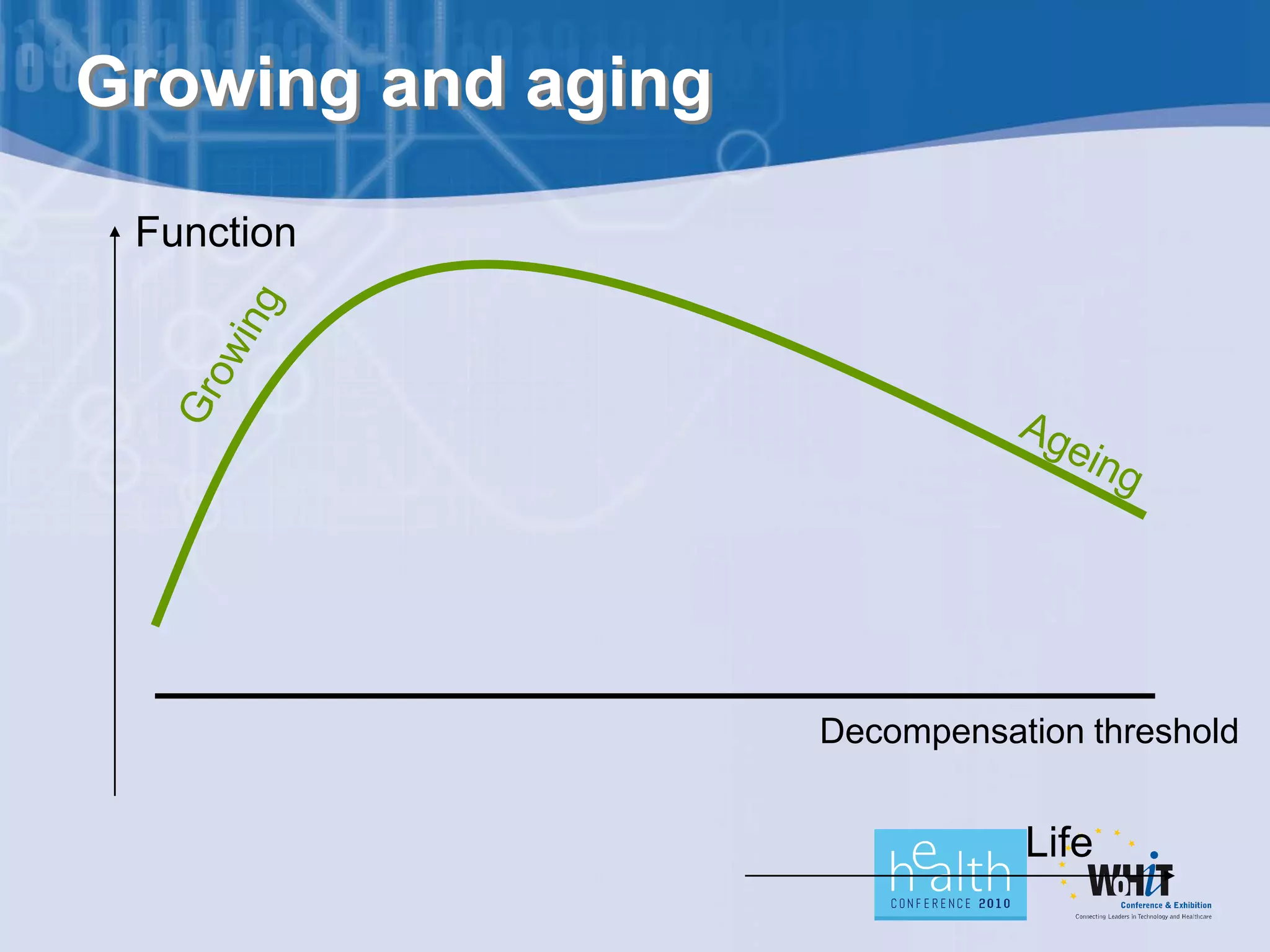
Growing and aging
 Function


                    Decompensation threshold


                               Life
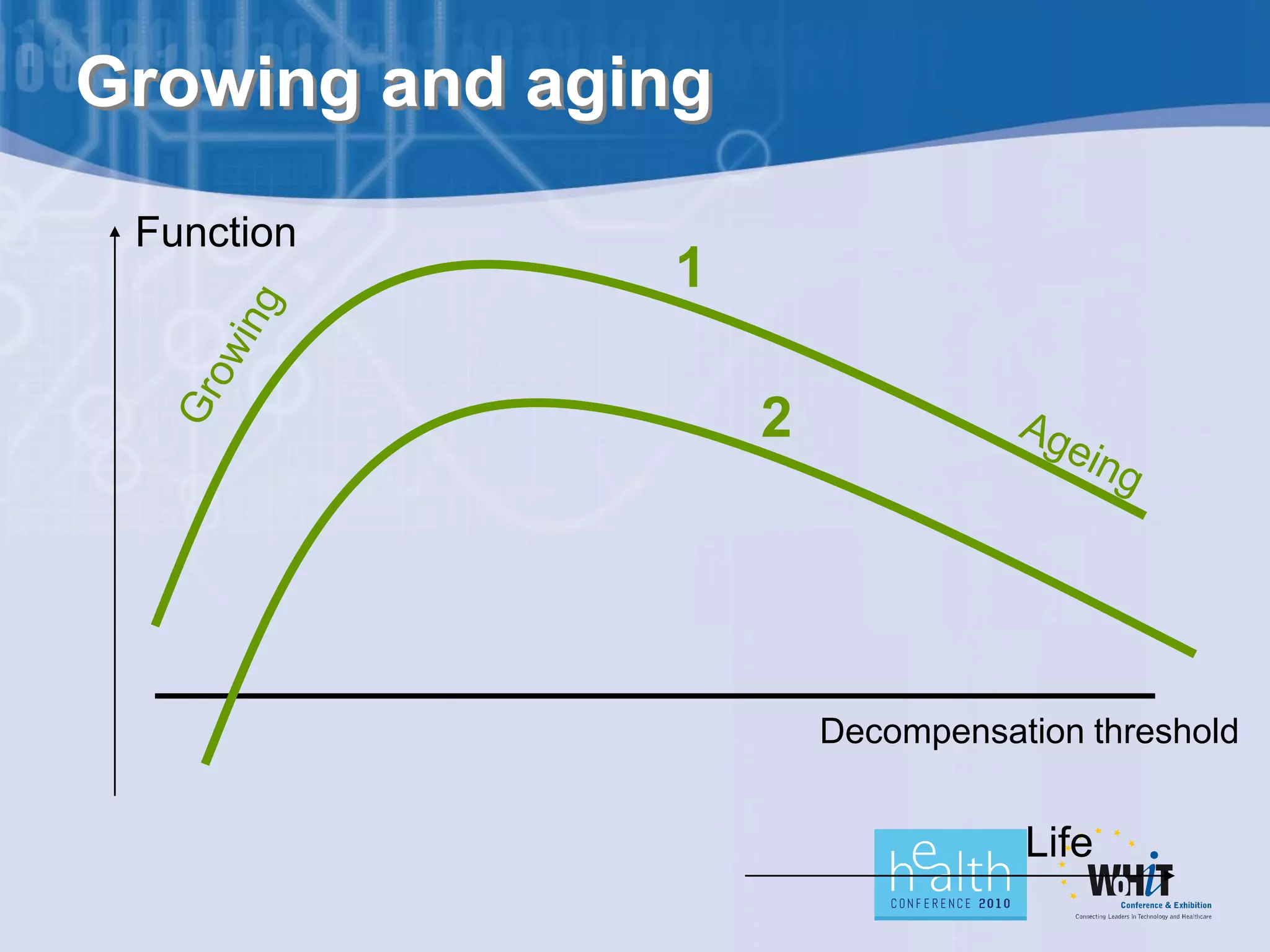
Growing and aging
 Function
               1

                    2


                        Decompensation threshold


                                   Life
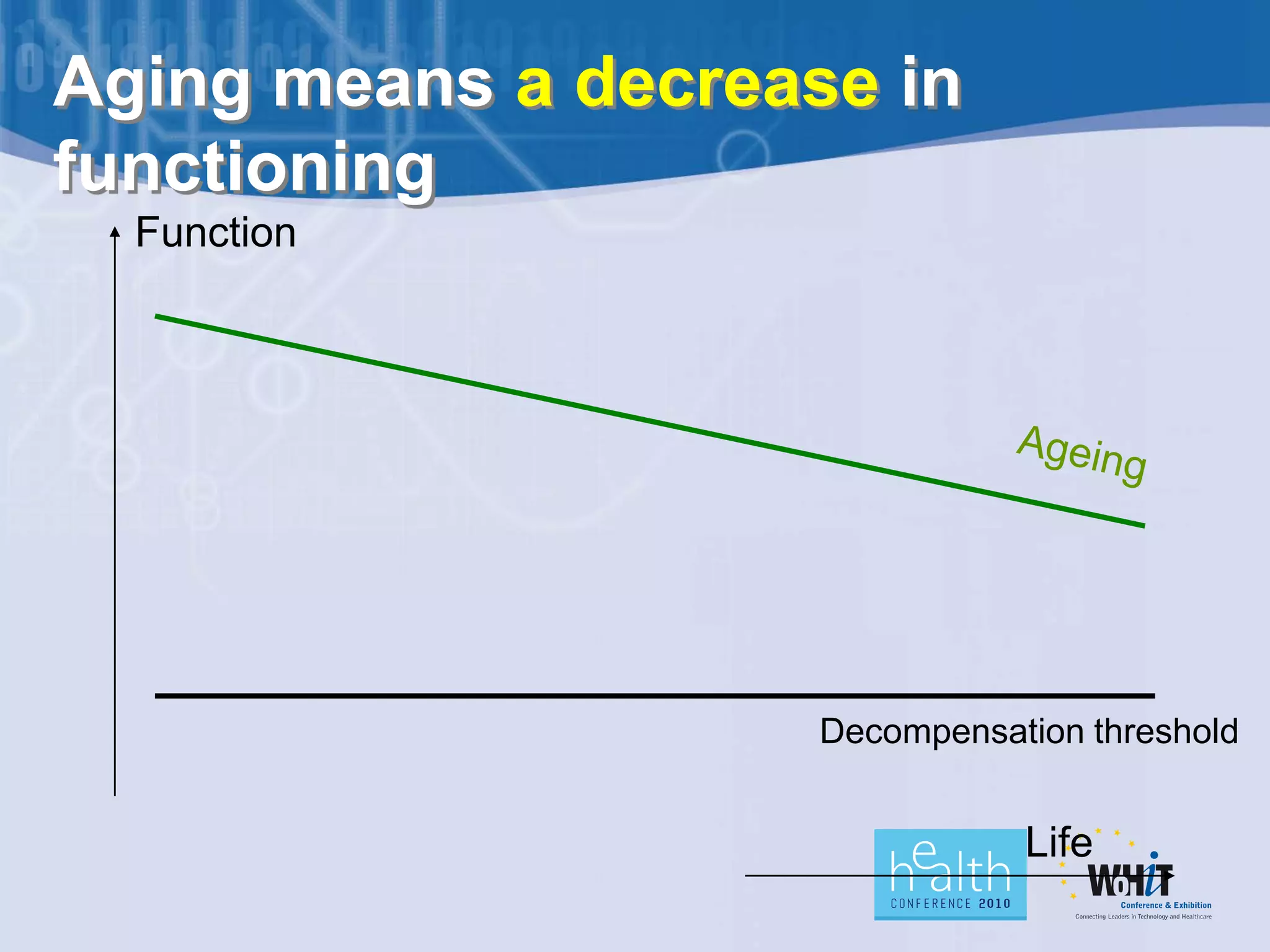
Aging means a decrease in
functioning
  Function


                     Decompensation threshold


                                Life
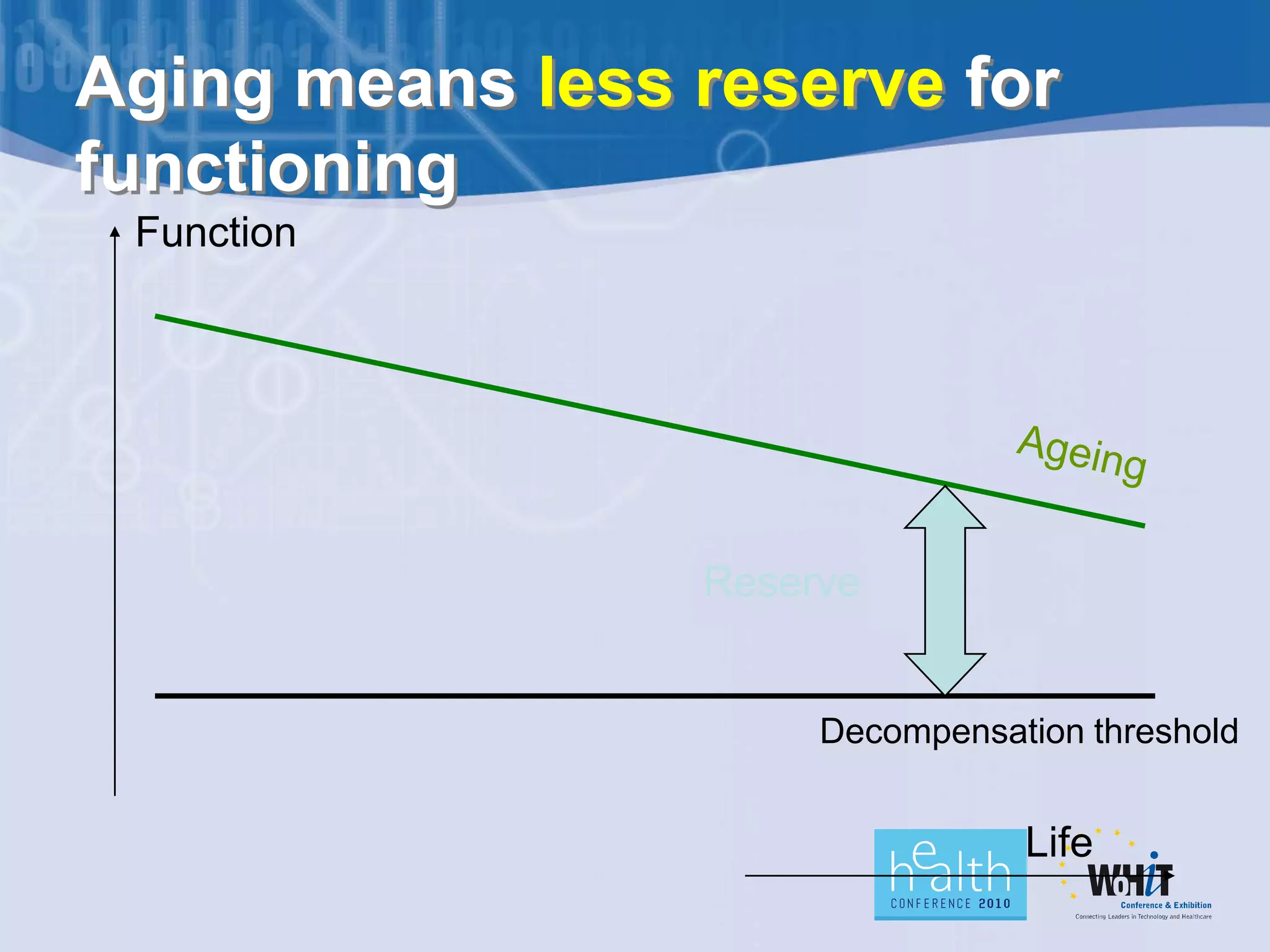
Aging means less reserve for
functioning
 Function


                 Reserve


                      Decompensation threshold


                                 Life
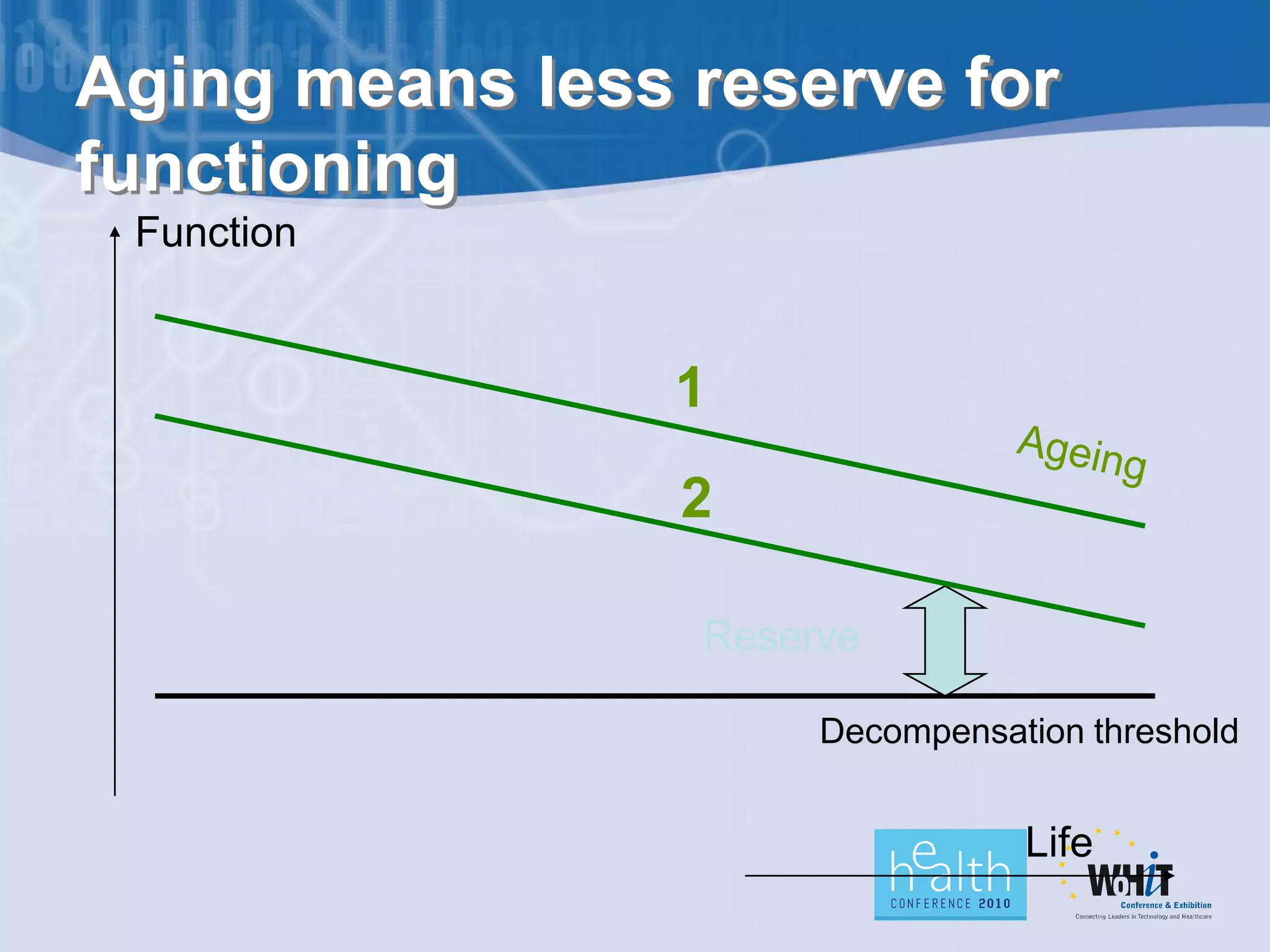
Aging means less reserve for
functioning
 Function


                 1
                 2

                 Reserve

                      Decompensation threshold


                                 Life
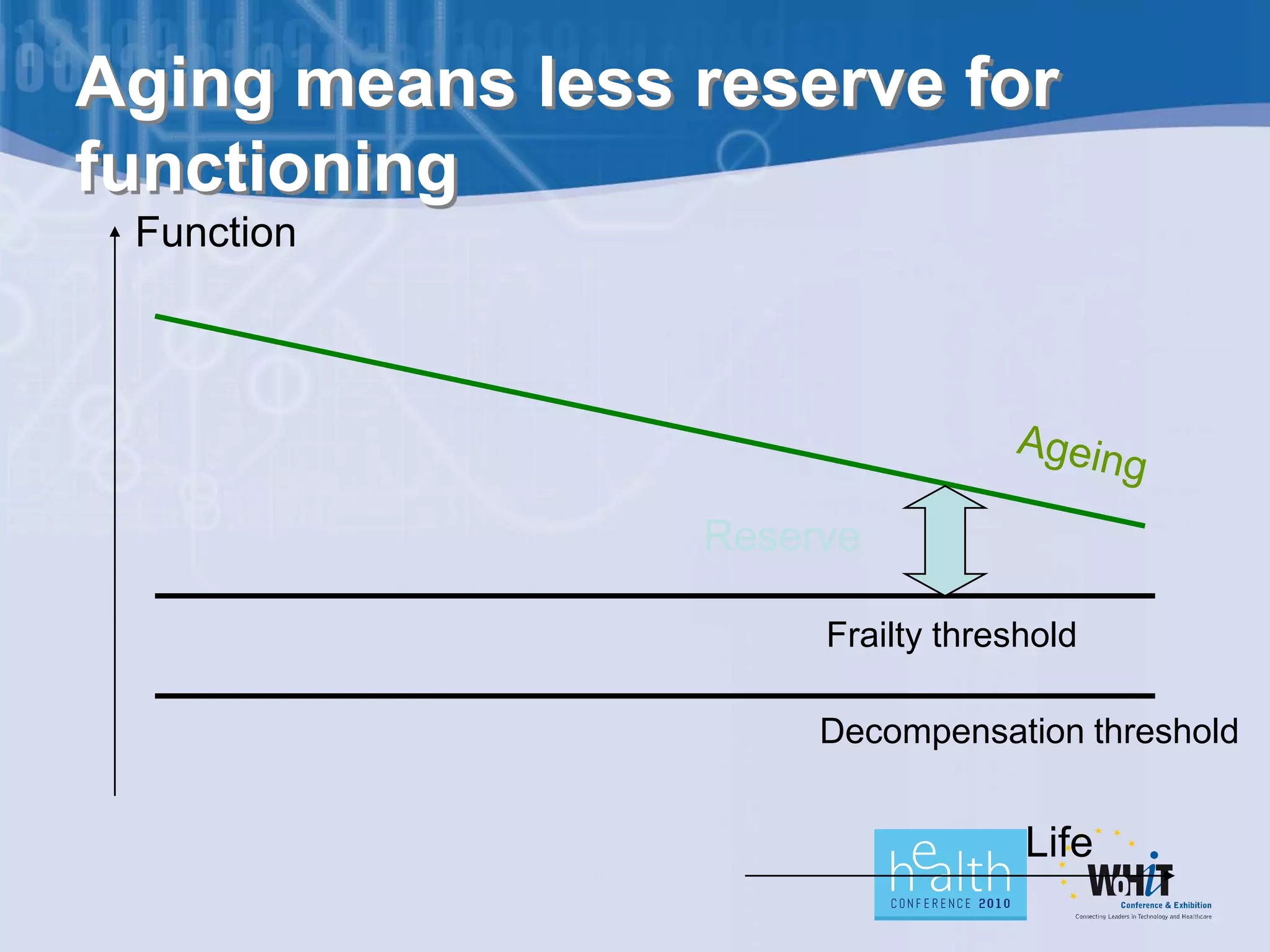
Aging means less reserve for
functioning
 Function


                 Reserve

                      Frailty threshold

                      Decompensation threshold


                                   Life
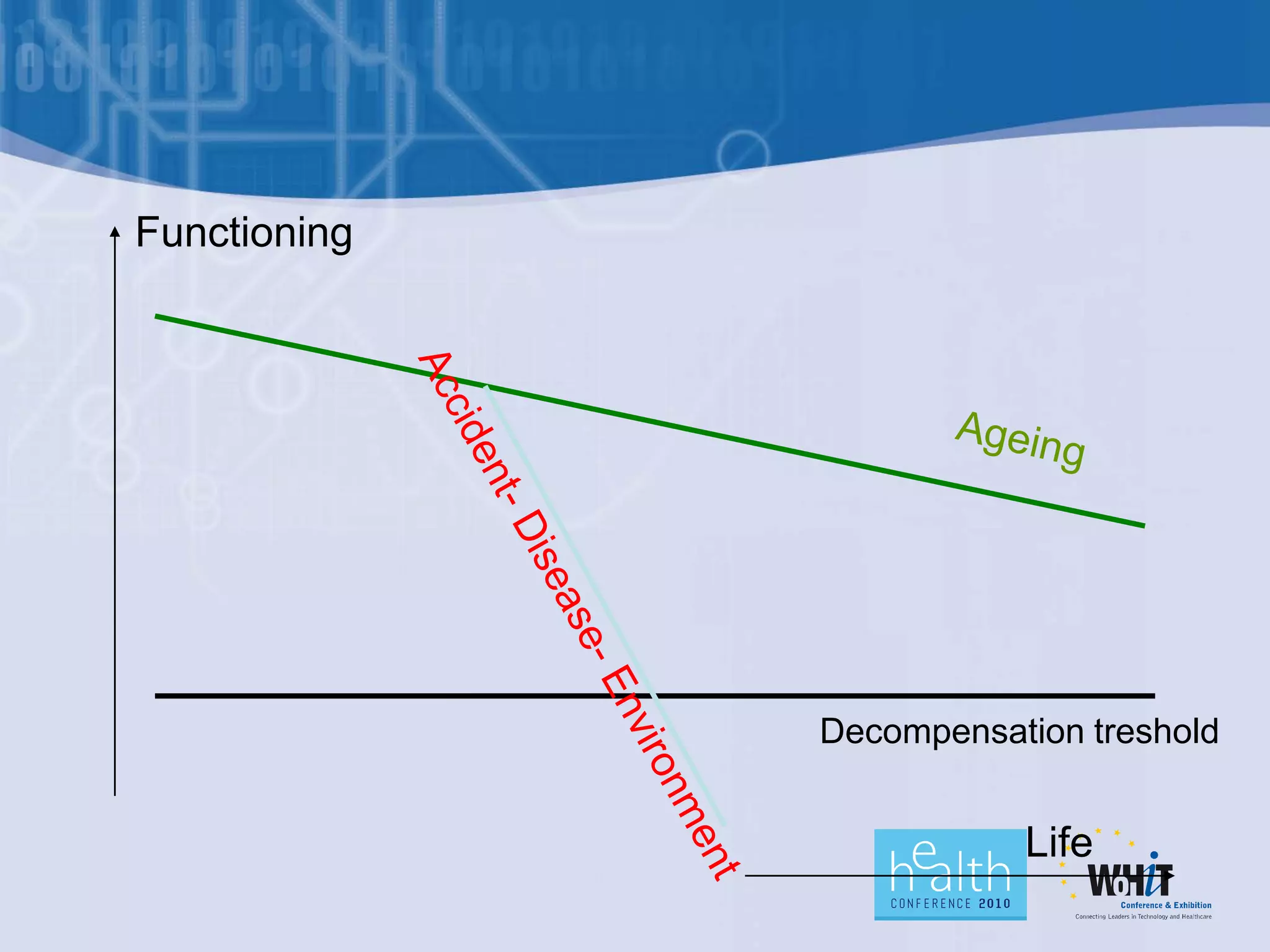
Functioning


              Decompensation treshold


                         Life
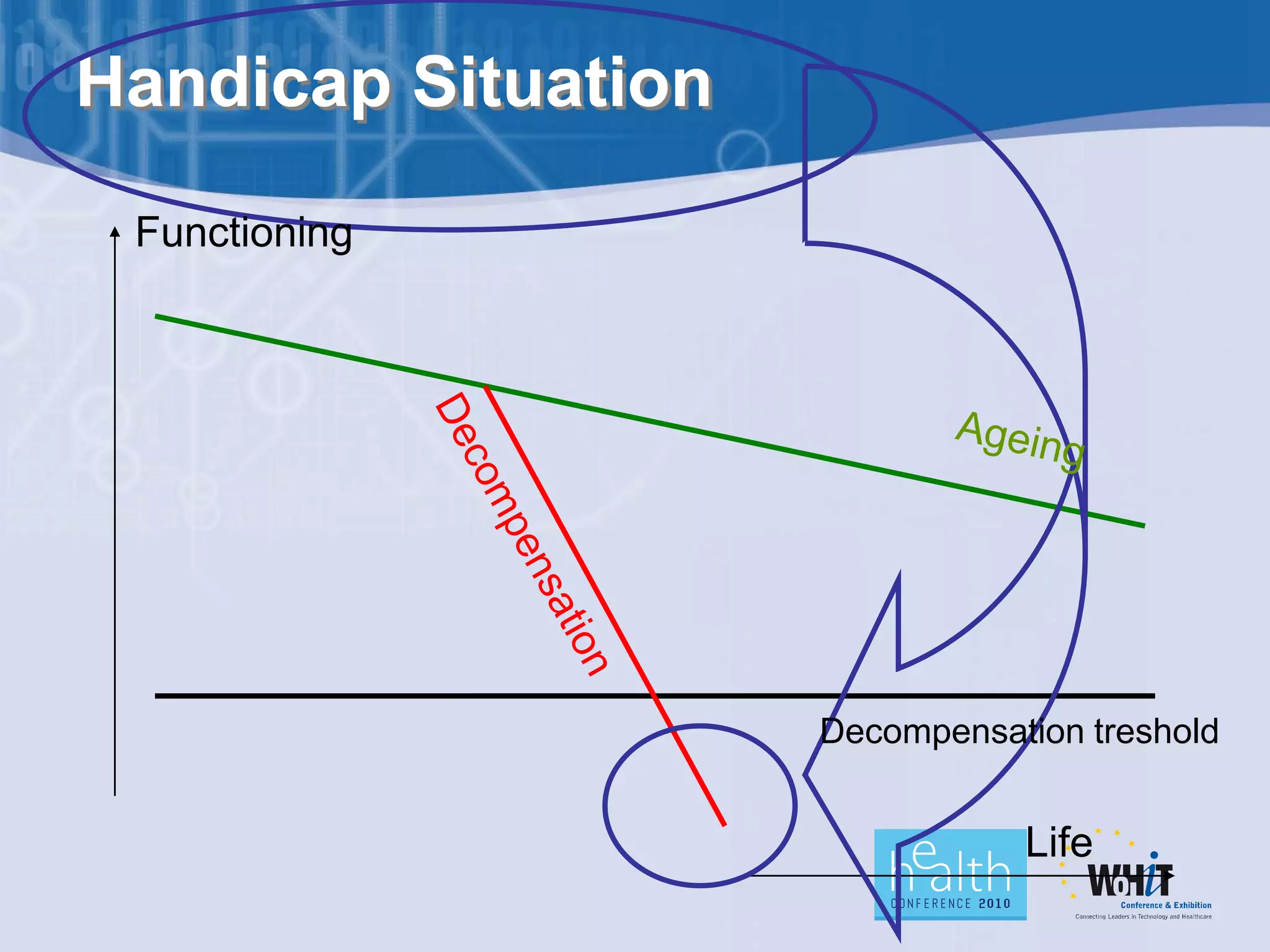
Handicap Situation
 Functioning


                     Decompensation treshold


                                Life
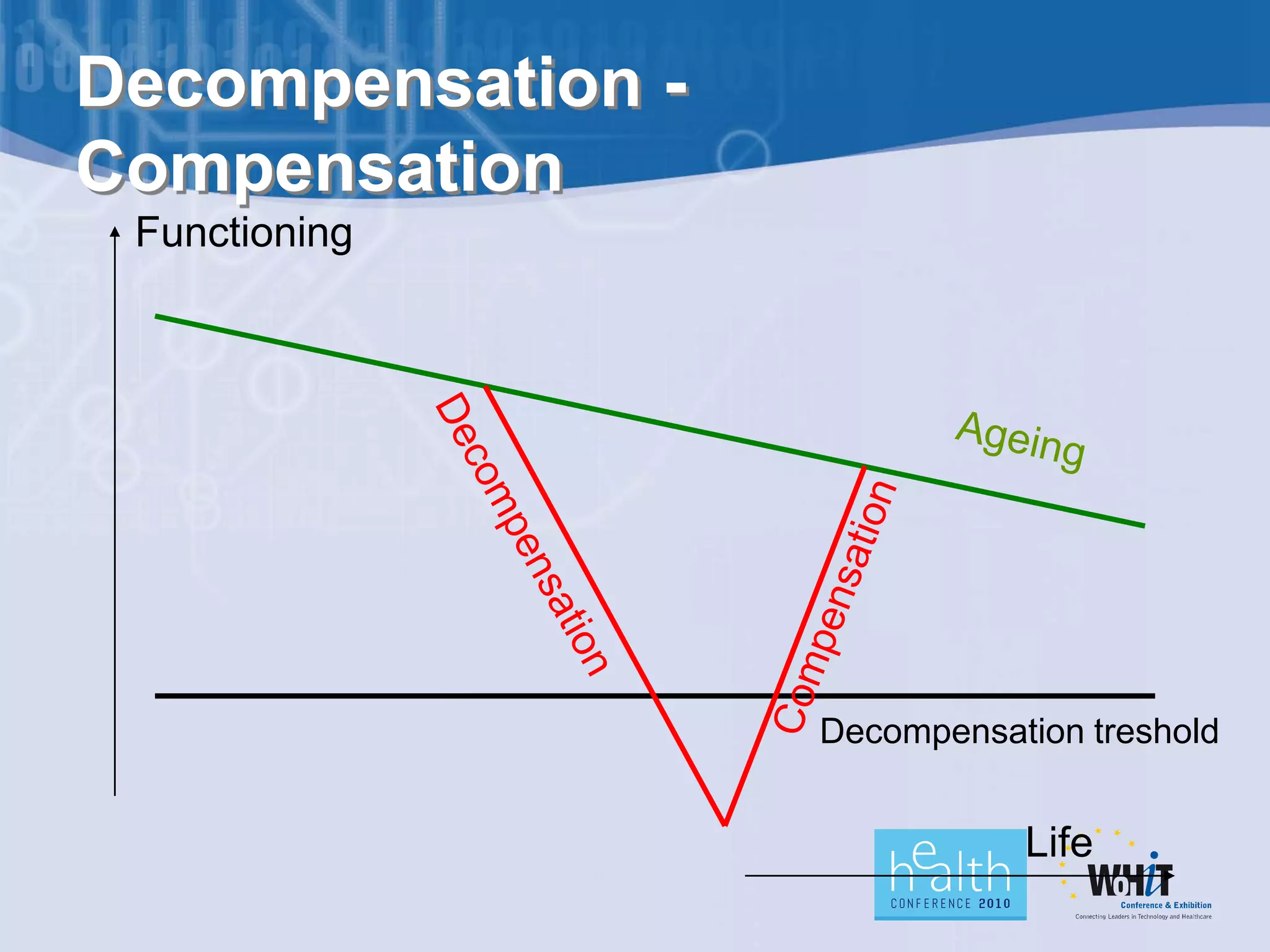
Decompensation -
Compensation
 Functioning


                   Decompensation treshold


                              Life
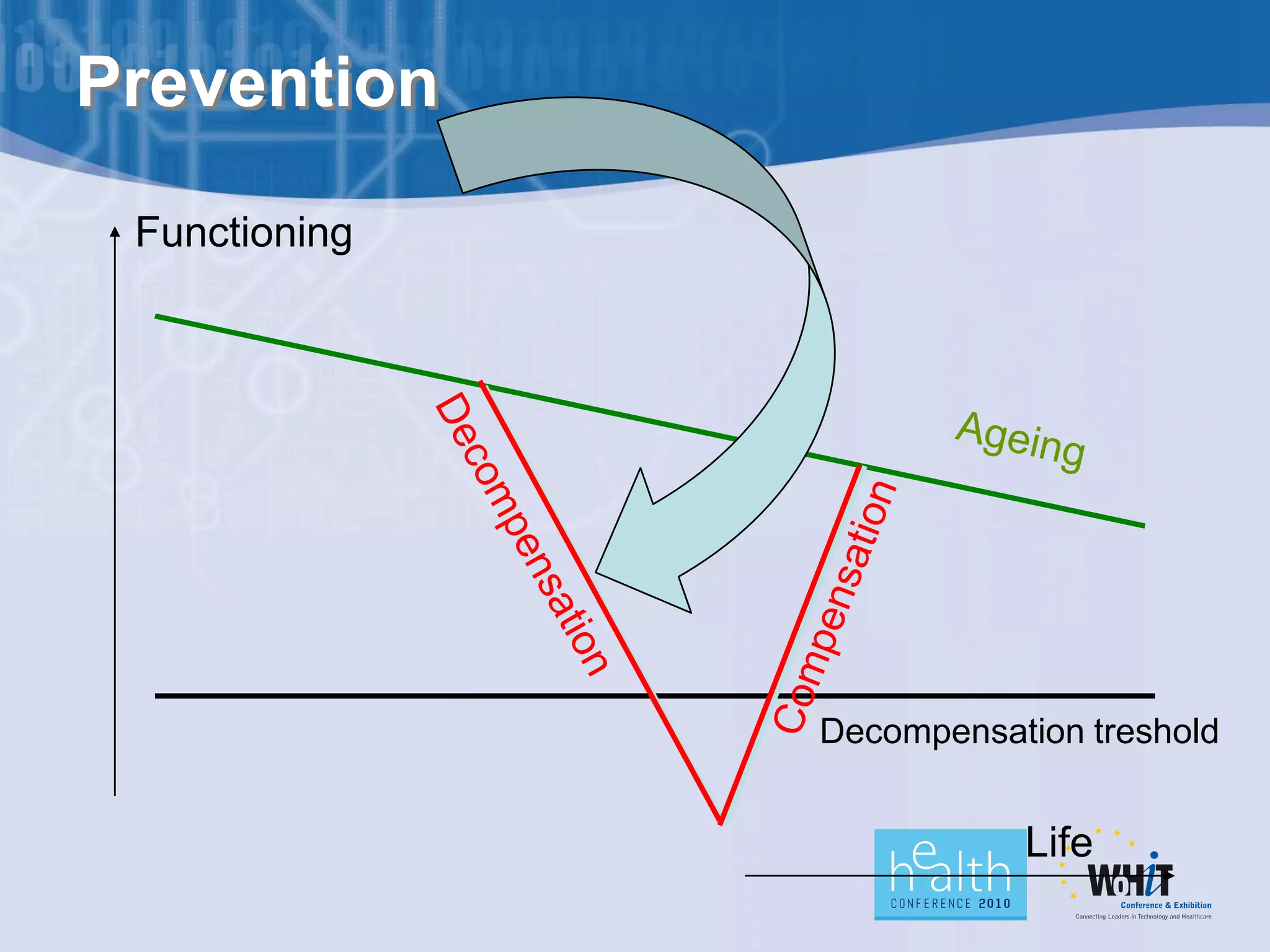
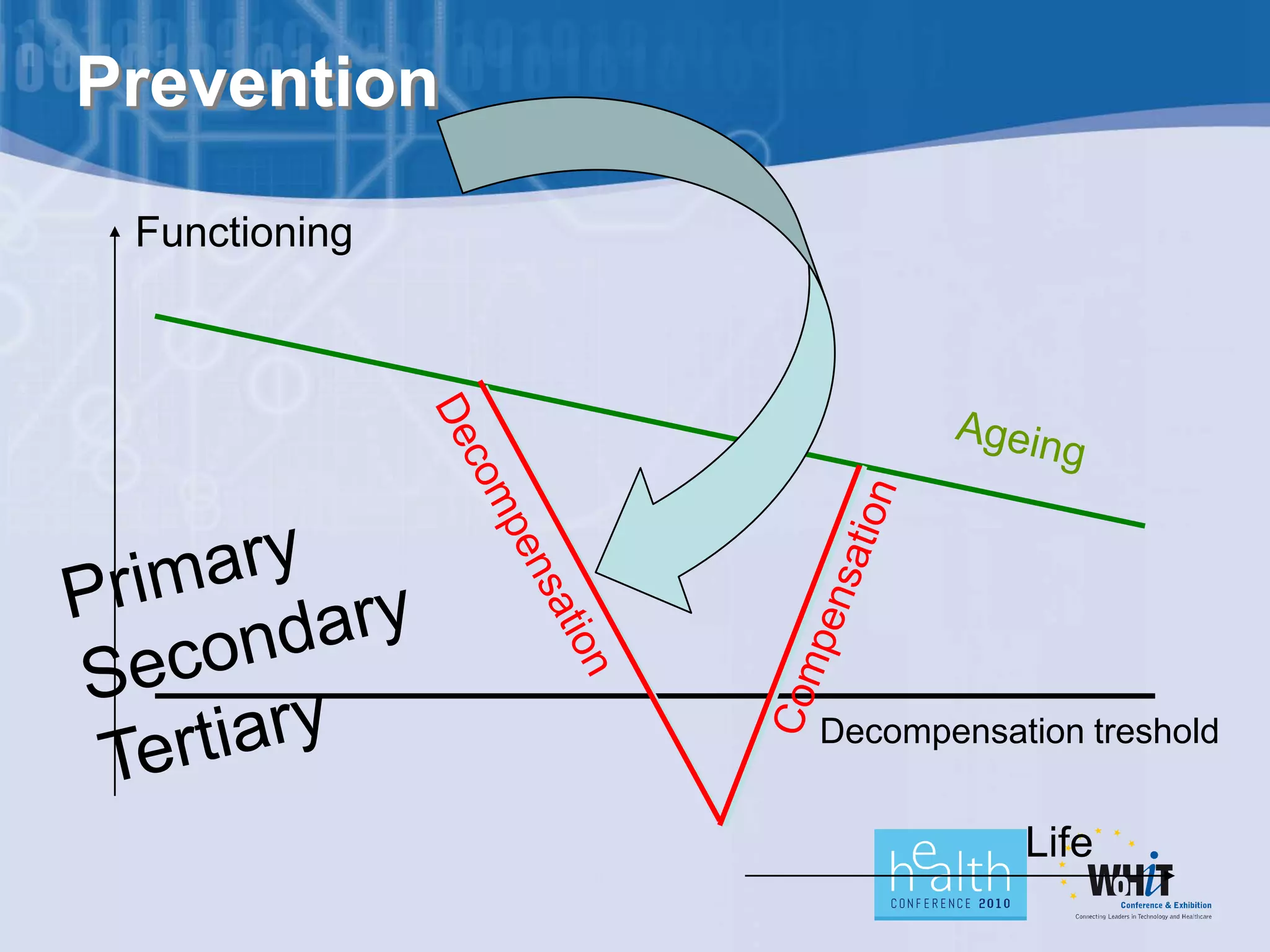
Prevention
 Functioning


               Decompensation treshold


                          Life
Prevention
 Functioning


               Decompensation treshold


                          Life
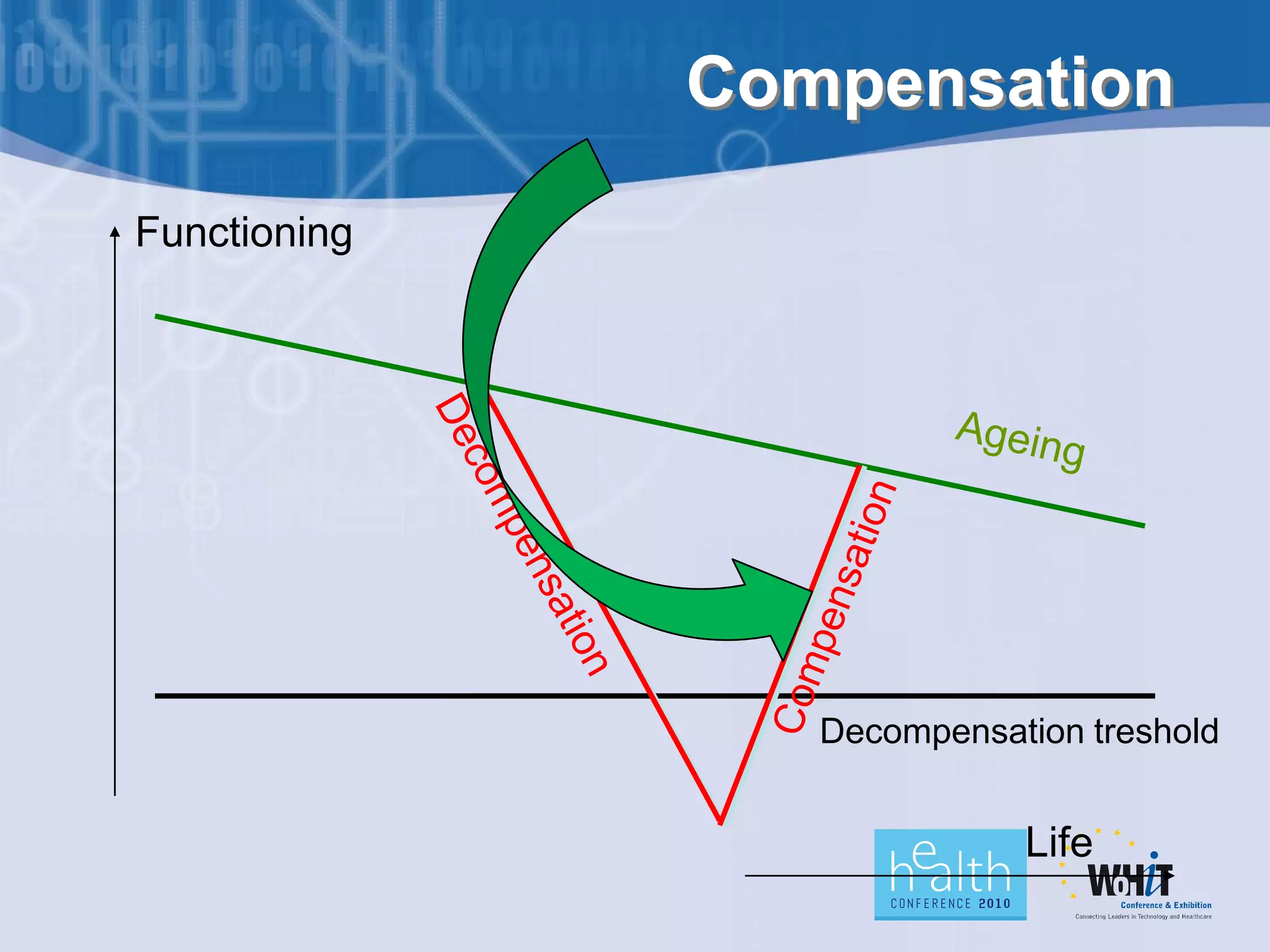
Compensation
Functioning


                 Decompensation treshold


                            Life
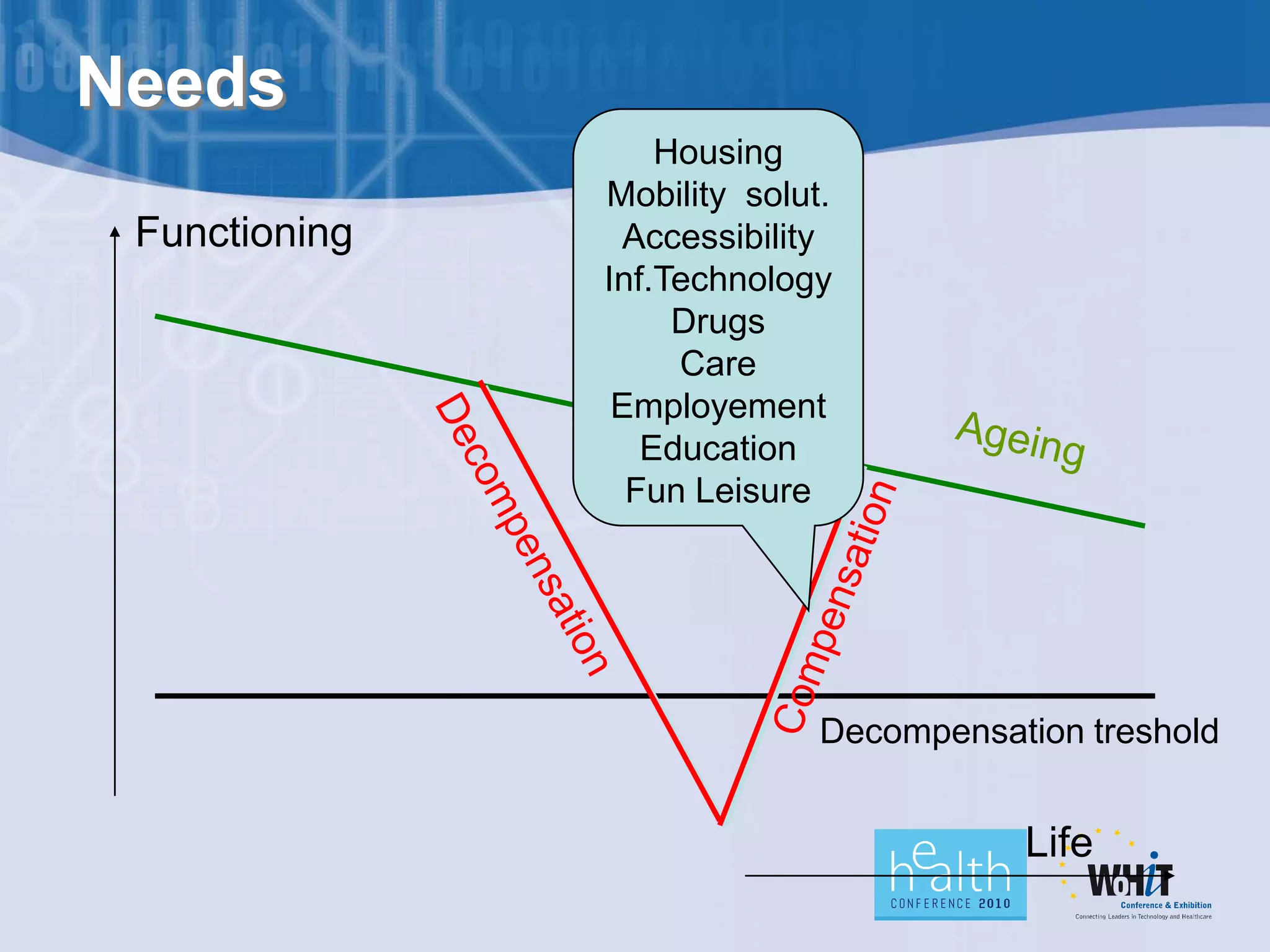
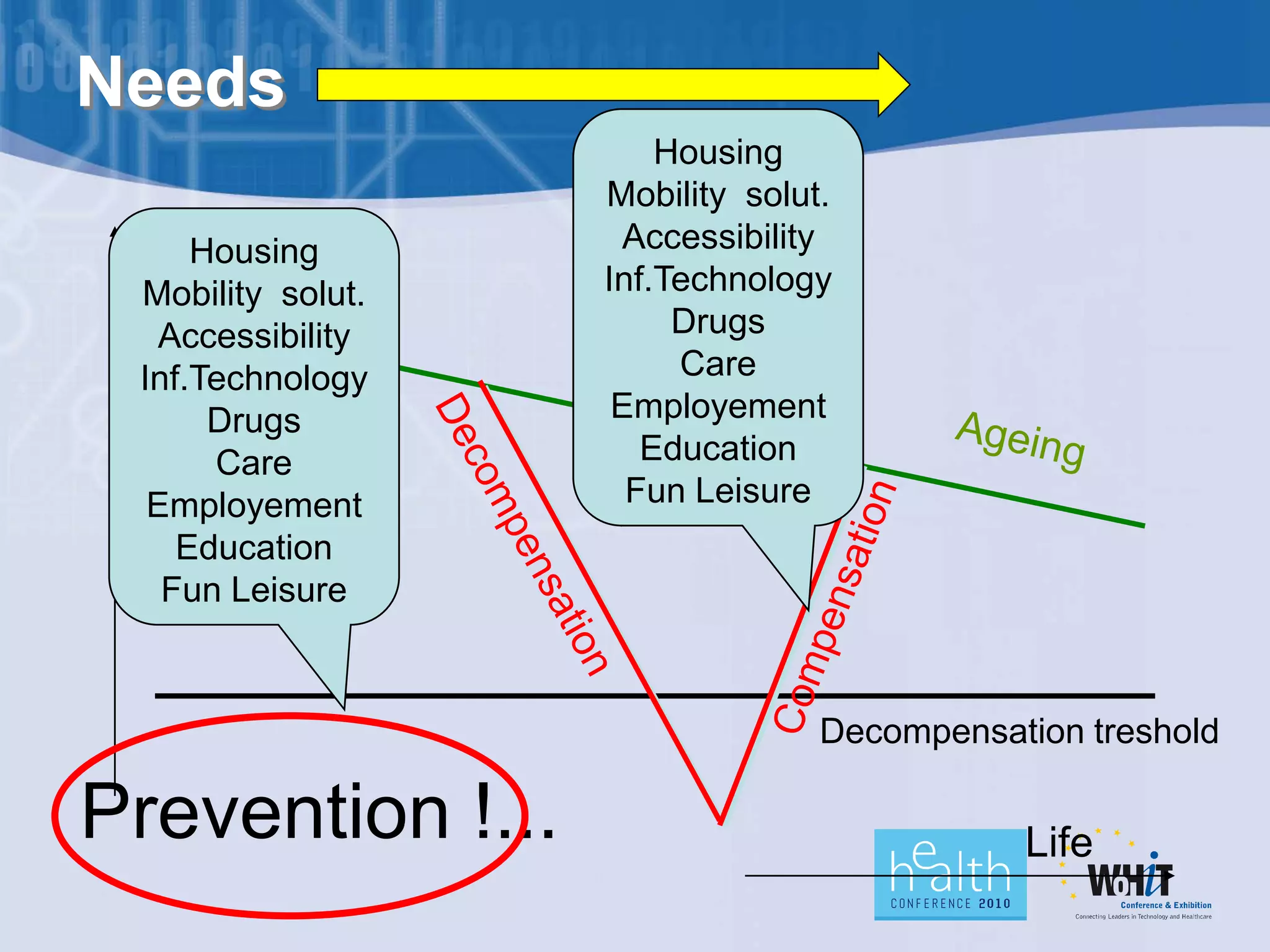
Needs
                   Housing
               Mobility solut.
 Functioning    Accessibility
               Inf.Technology
                    Drugs
                    Care
                Employement
                  Education
                 Fun Leisure


                             Decompensation treshold


                                        Life
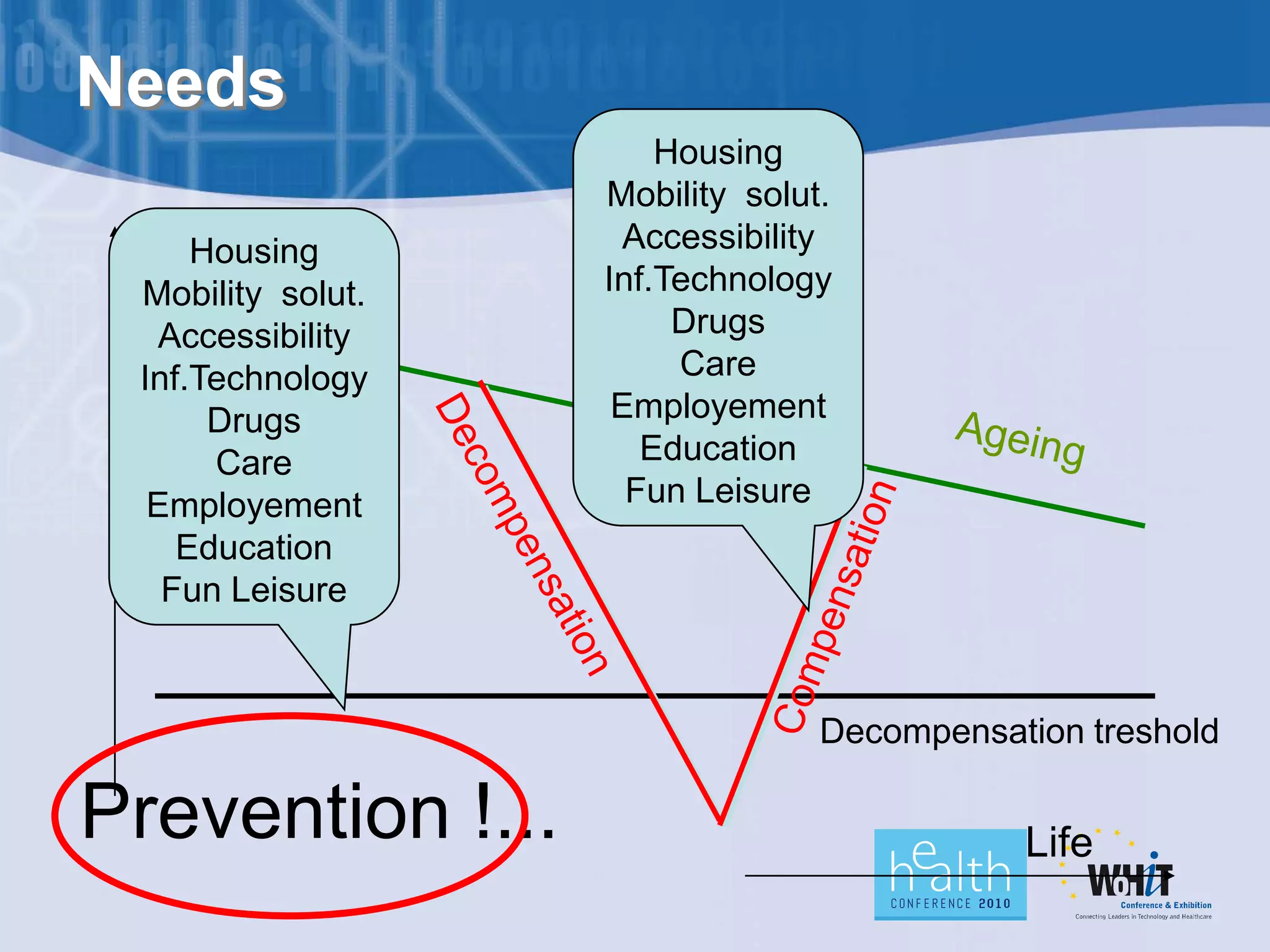
Needs
                       Housing
                   Mobility solut.
 Functioning
   Housing          Accessibility
 Mobility solut.   Inf.Technology
  Accessibility         Drugs
 Inf.Technology         Care
      Drugs         Employement
      Care            Education
  Employement        Fun Leisure
    Education
   Fun Leisure


                                 Decompensation treshold

Prevention !...                             Life
Needs
                       Housing
                   Mobility solut.
 Functioning
   Housing          Accessibility
 Mobility solut.   Inf.Technology
  Accessibility         Drugs
 Inf.Technology         Care
      Drugs         Employement
      Care            Education
  Employement        Fun Leisure
    Education
   Fun Leisure


                                 Decompensation treshold

Prevention !...                             Life
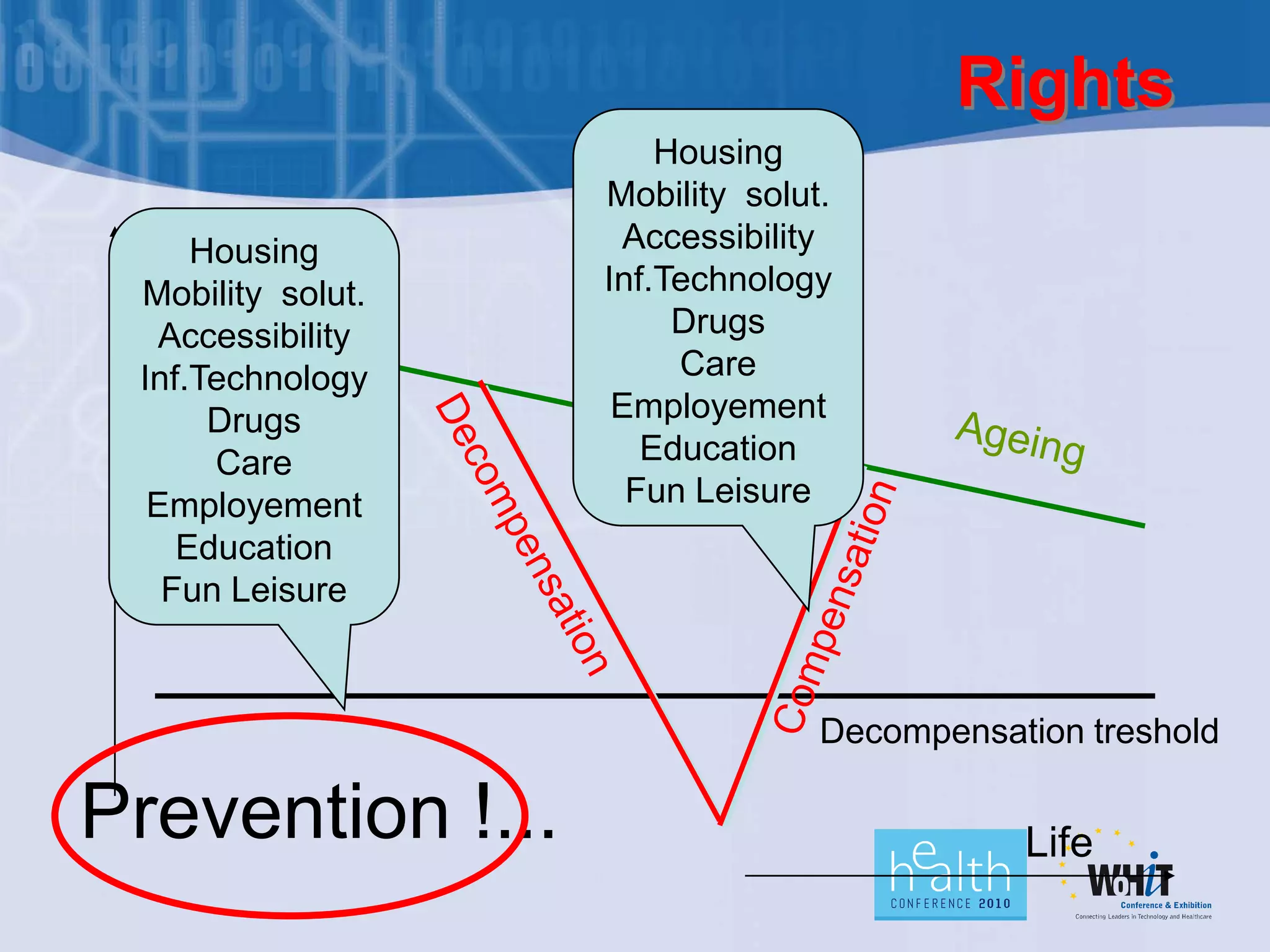
Rights
                       Housing
                   Mobility solut.
 Functioning
   Housing          Accessibility
 Mobility solut.   Inf.Technology
  Accessibility         Drugs
 Inf.Technology         Care
      Drugs         Employement
      Care            Education
  Employement        Fun Leisure
    Education
   Fun Leisure


                                 Decompensation treshold

Prevention !...                             Life
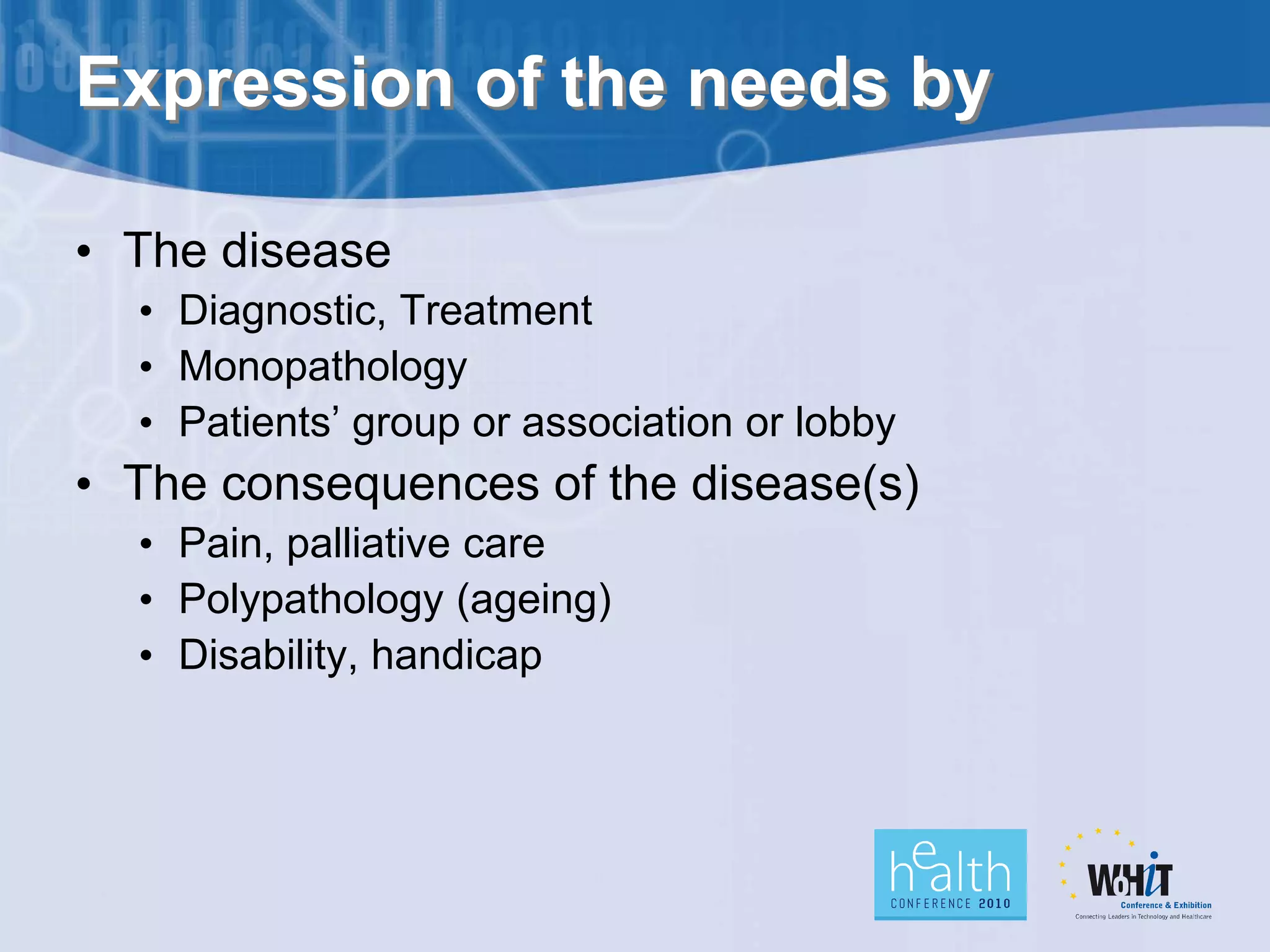
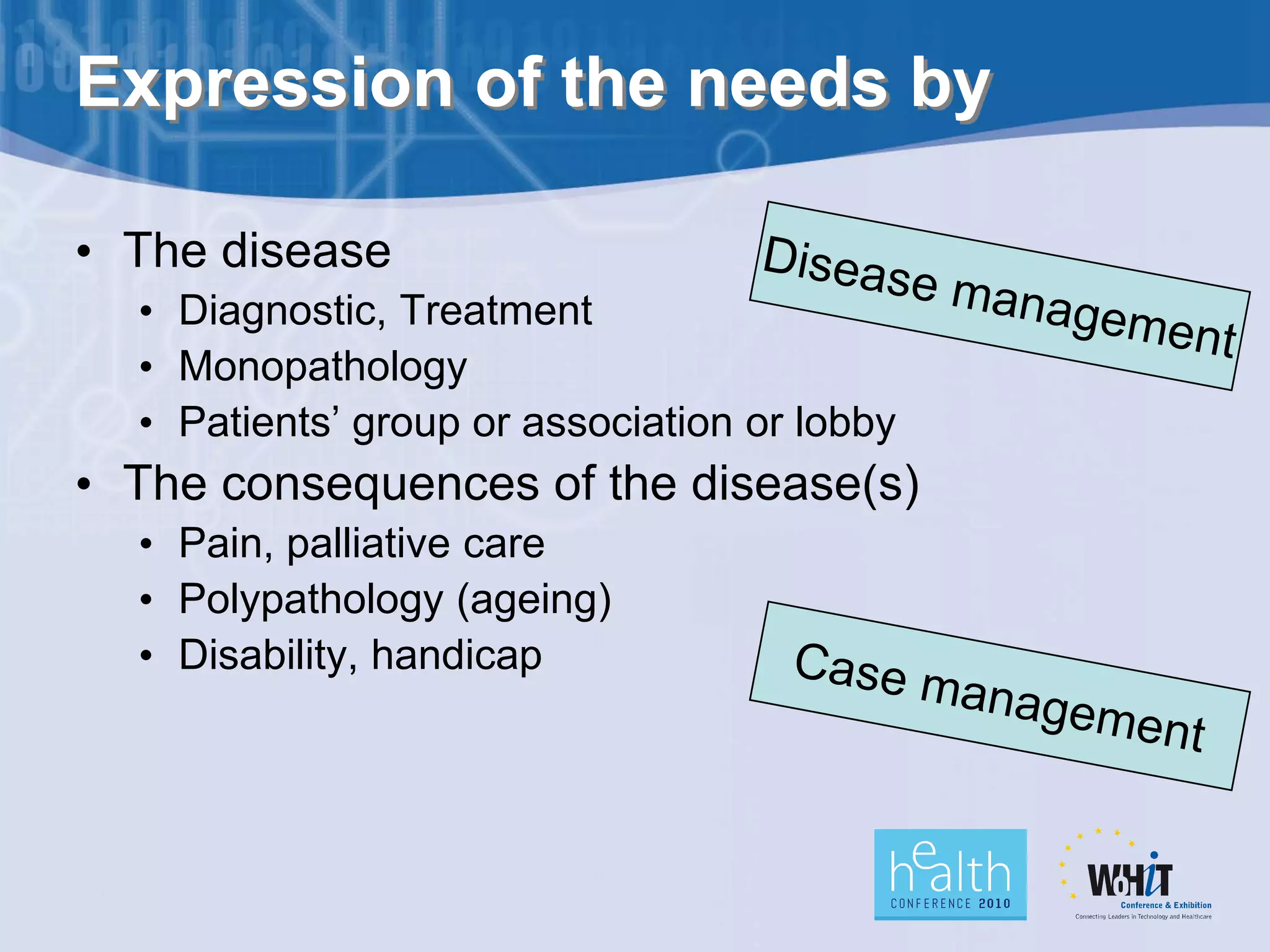
Expression of the needs by

• The disease
  • Diagnostic, Treatment
  • Monopathology
  • Patients’ group or association or lobby
• The consequences of the disease(s)
  • Pain, palliative care
  • Polypathology (ageing)
  • Disability, handicap
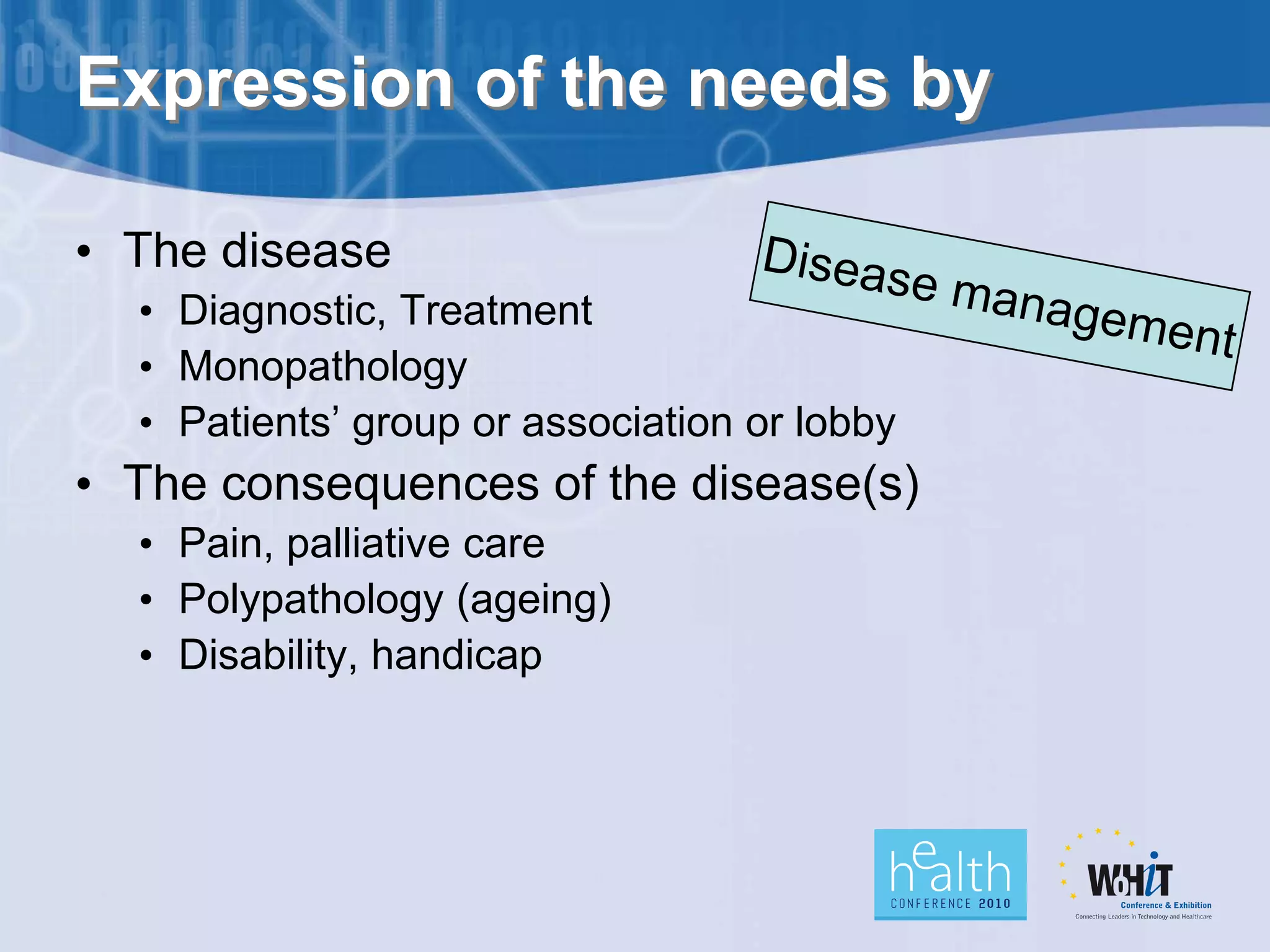
Expression of the needs by

• The disease
  • Diagnostic, Treatment
  • Monopathology
  • Patients’ group or association or lobby
• The consequences of the disease(s)
  • Pain, palliative care
  • Polypathology (ageing)
  • Disability, handicap
Expression of the needs by

• The disease
  • Diagnostic, Treatment
  • Monopathology
  • Patients’ group or association or lobby
• The consequences of the disease(s)
  • Pain, palliative care
  • Polypathology (ageing)
  • Disability, handicap
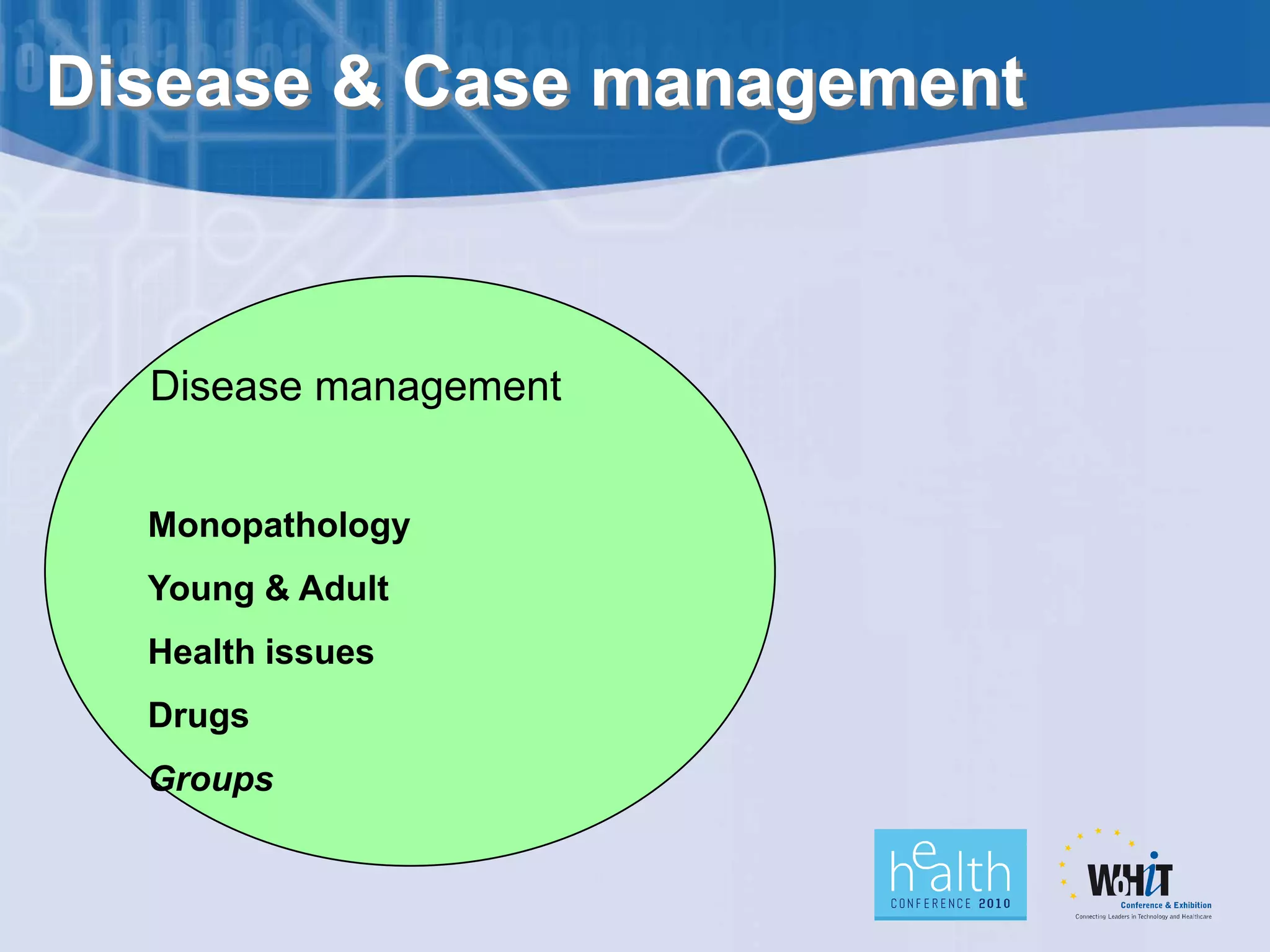
Disease & Case management


  Disease management


  Monopathology
  Young & Adult
  Health issues
  Drugs
  Groups
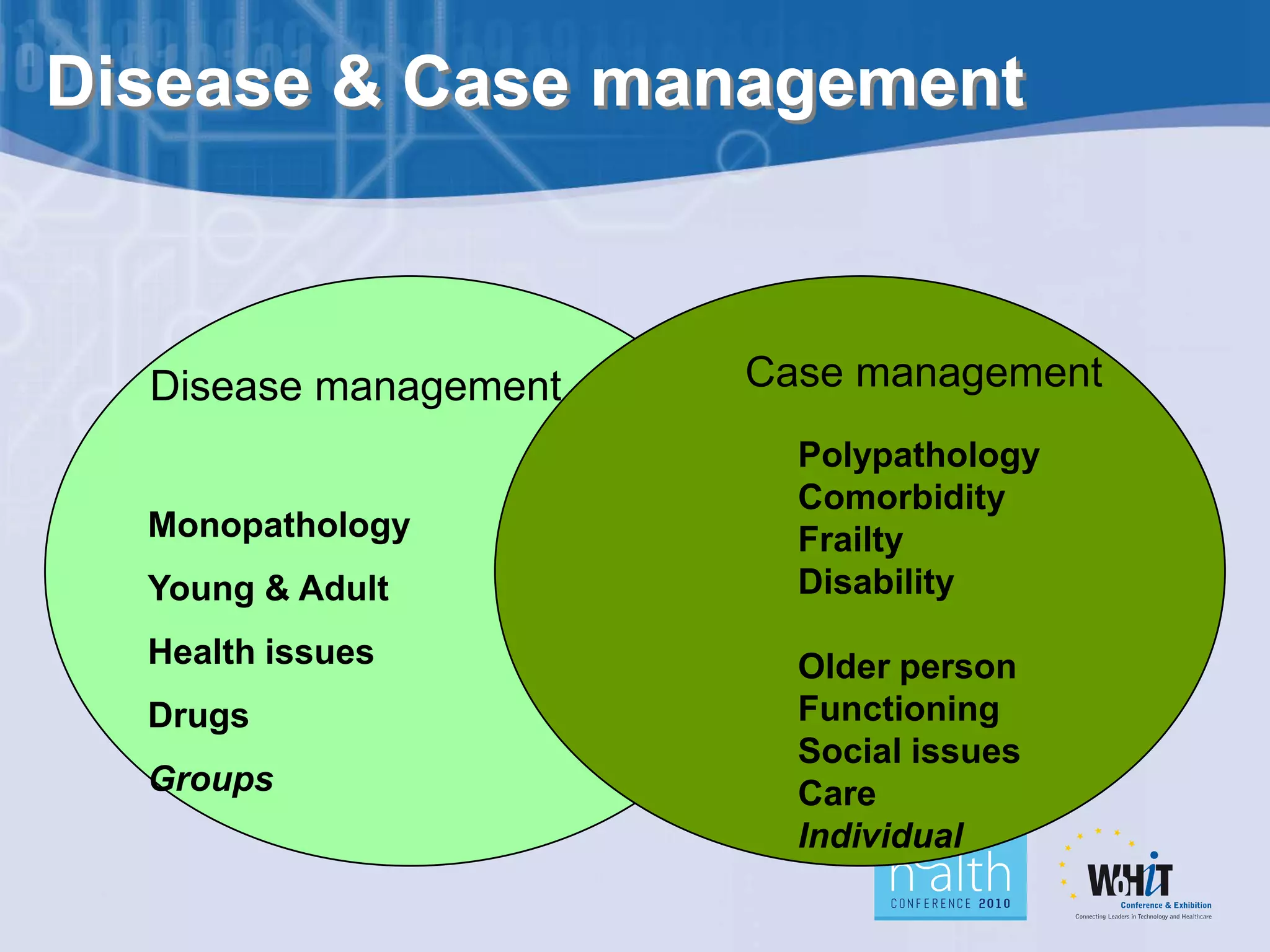
Disease & Case management


  Disease management   Case management
                         Polypathology
                         Comorbidity
  Monopathology          Frailty
  Young & Adult          Disability
  Health issues          Older person
  Drugs                  Functioning
                         Social issues
  Groups                 Care
                         Individual
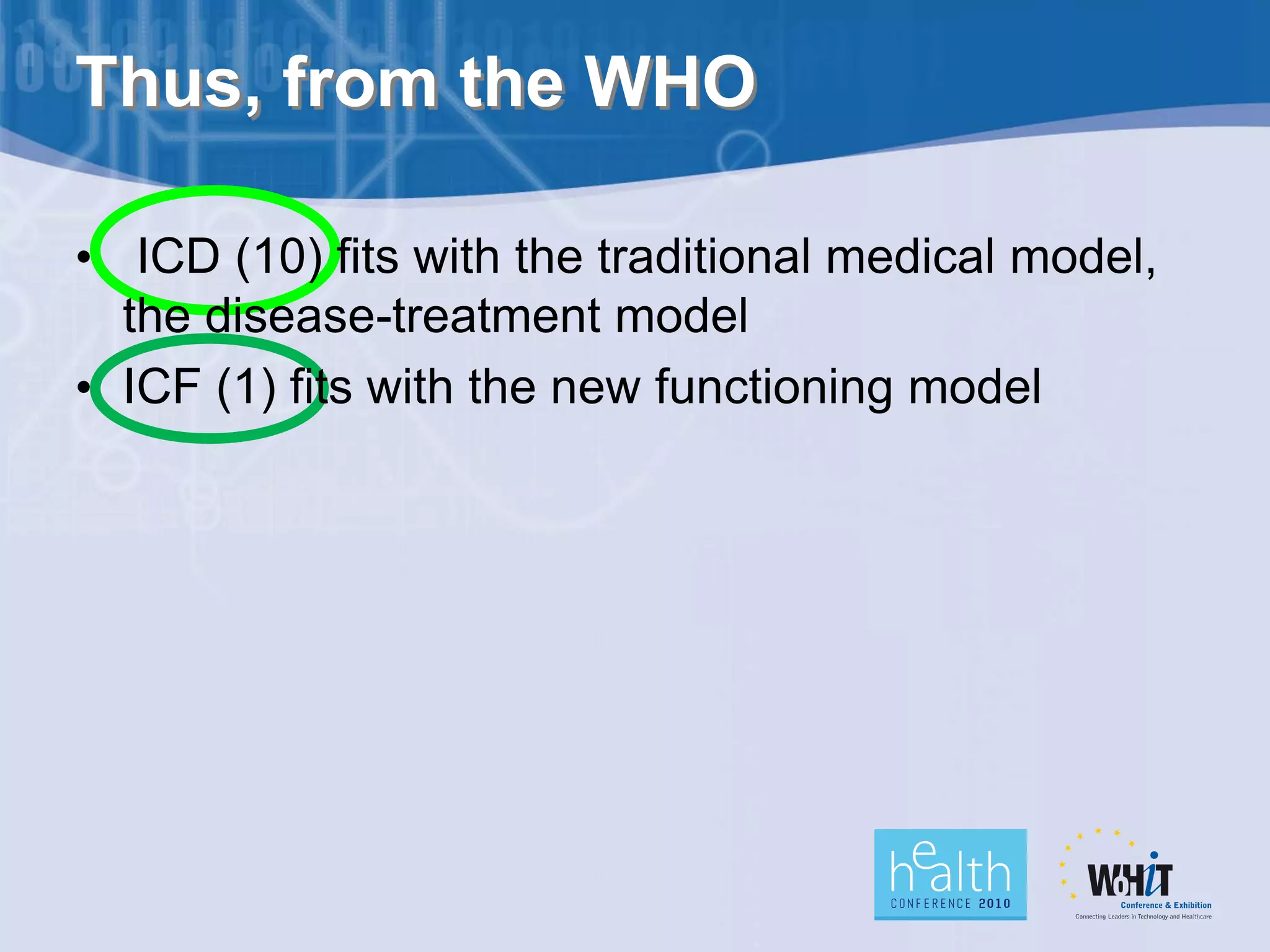
Thus, from the WHO

• ICD (10) fits with the traditional medical model,
  the disease-treatment model
• ICF (1) fits with the new functioning model
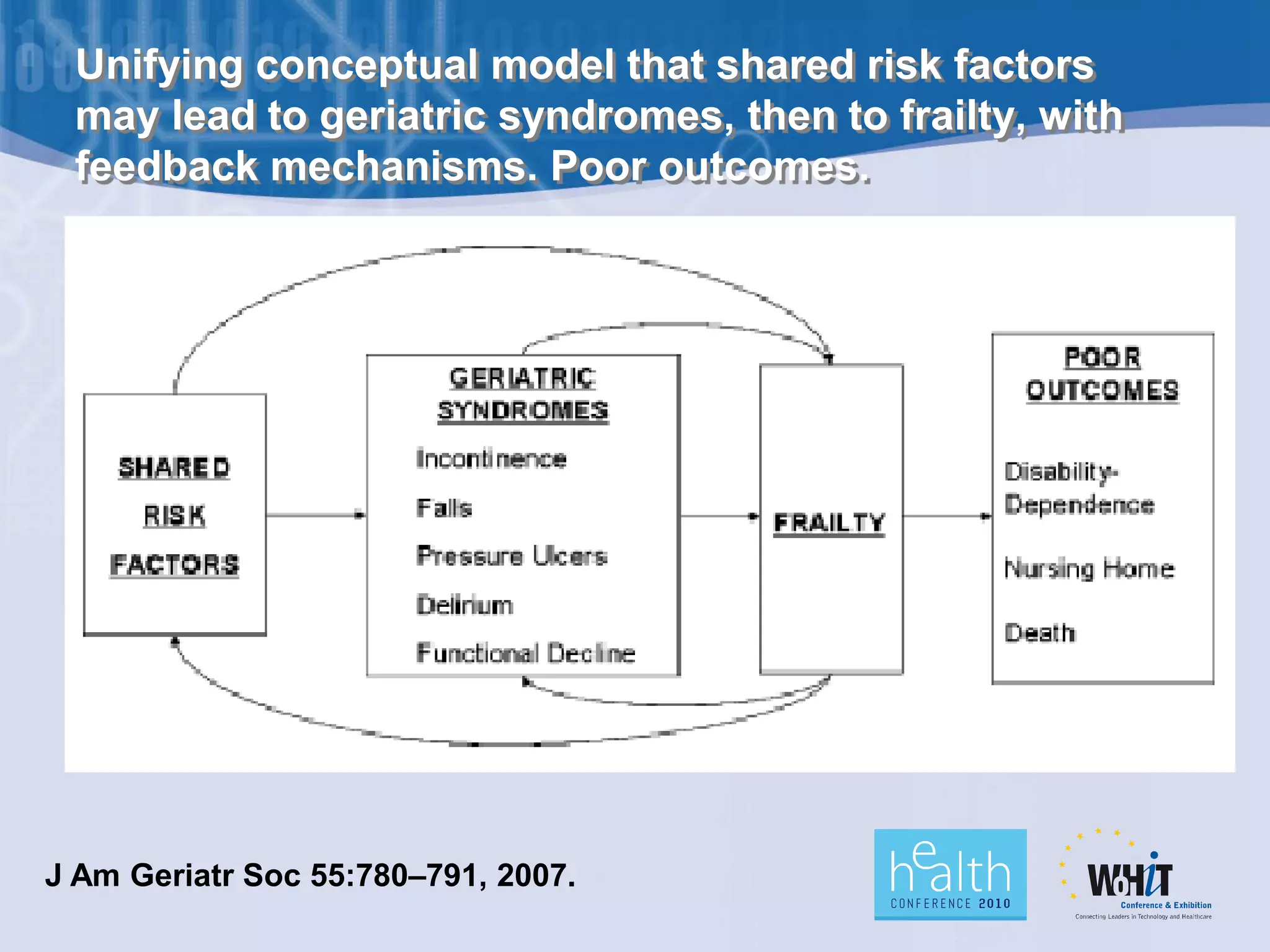
Unifying conceptual model that shared risk factors
 may lead to geriatric syndromes, then to frailty, with
 feedback mechanisms. Poor outcomes.


J Am Geriatr Soc 55:780–791, 2007.
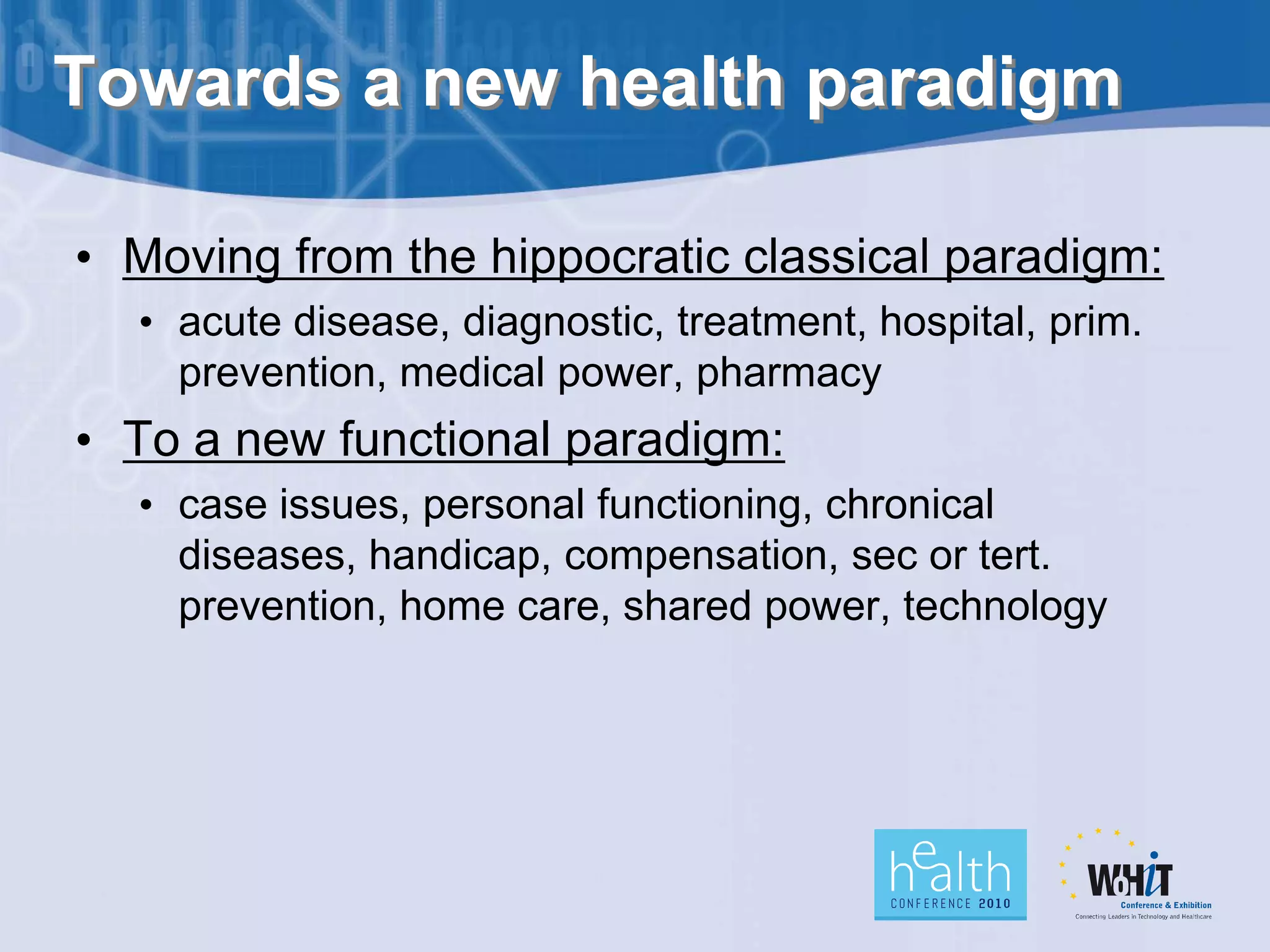
Towards a new health paradigm

• Moving from the hippocratic classical paradigm:
  • acute disease, diagnostic, treatment, hospital, prim.
    prevention, medical power, pharmacy
• To a new functional paradigm:
  • case issues, personal functioning, chronical
    diseases, handicap, compensation, sec or tert.
    prevention, home care, shared power, technology
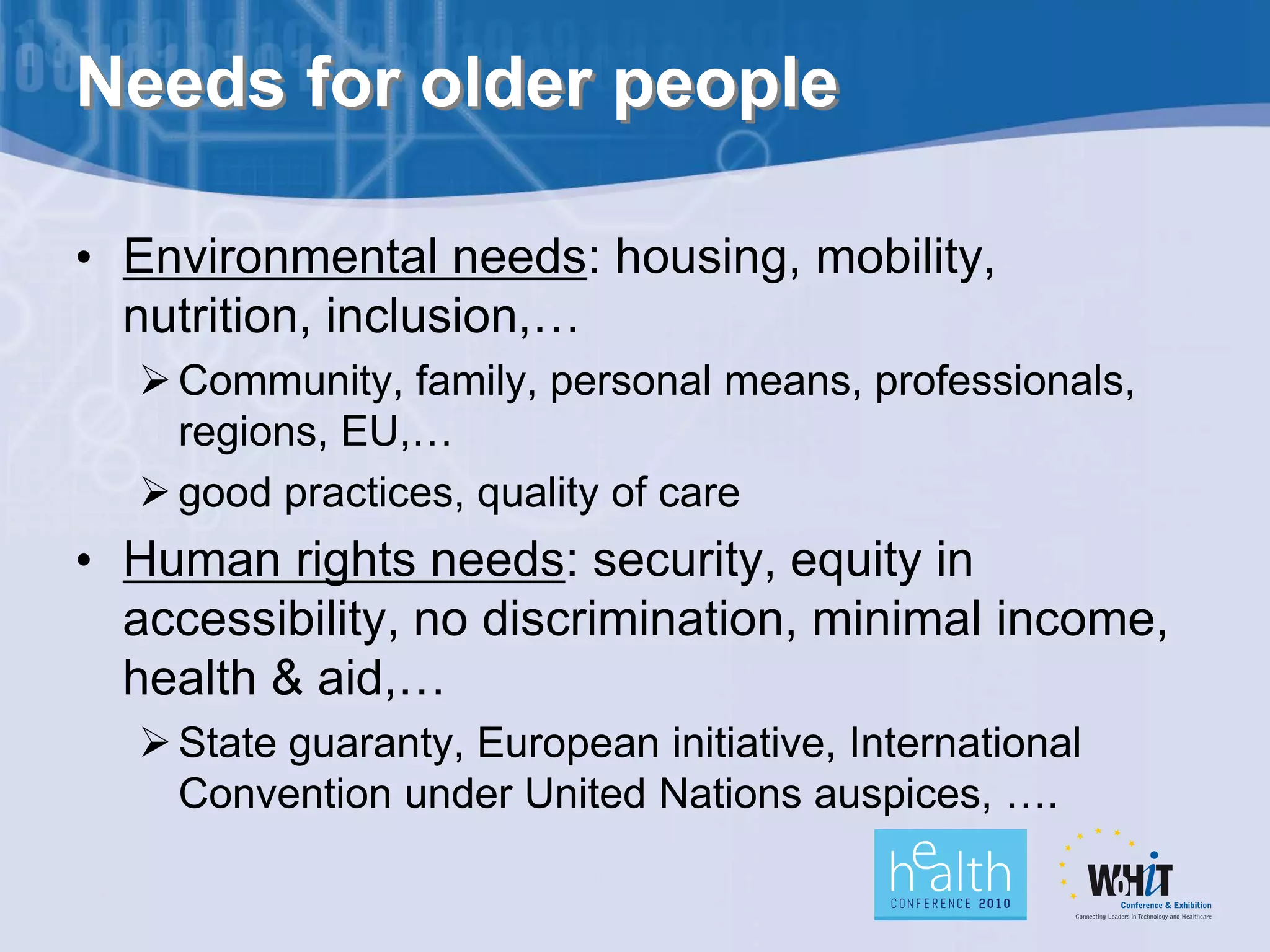
Needs for older people

• Environmental needs: housing, mobility,
  nutrition, inclusion,…
   Community, family, personal means, professionals,
    regions, EU,…
   good practices, quality of care
• Human rights needs: security, equity in
  accessibility, no discrimination, minimal income,
  health & aid,…
   State guaranty, European initiative, International
    Convention under United Nations auspices, ….
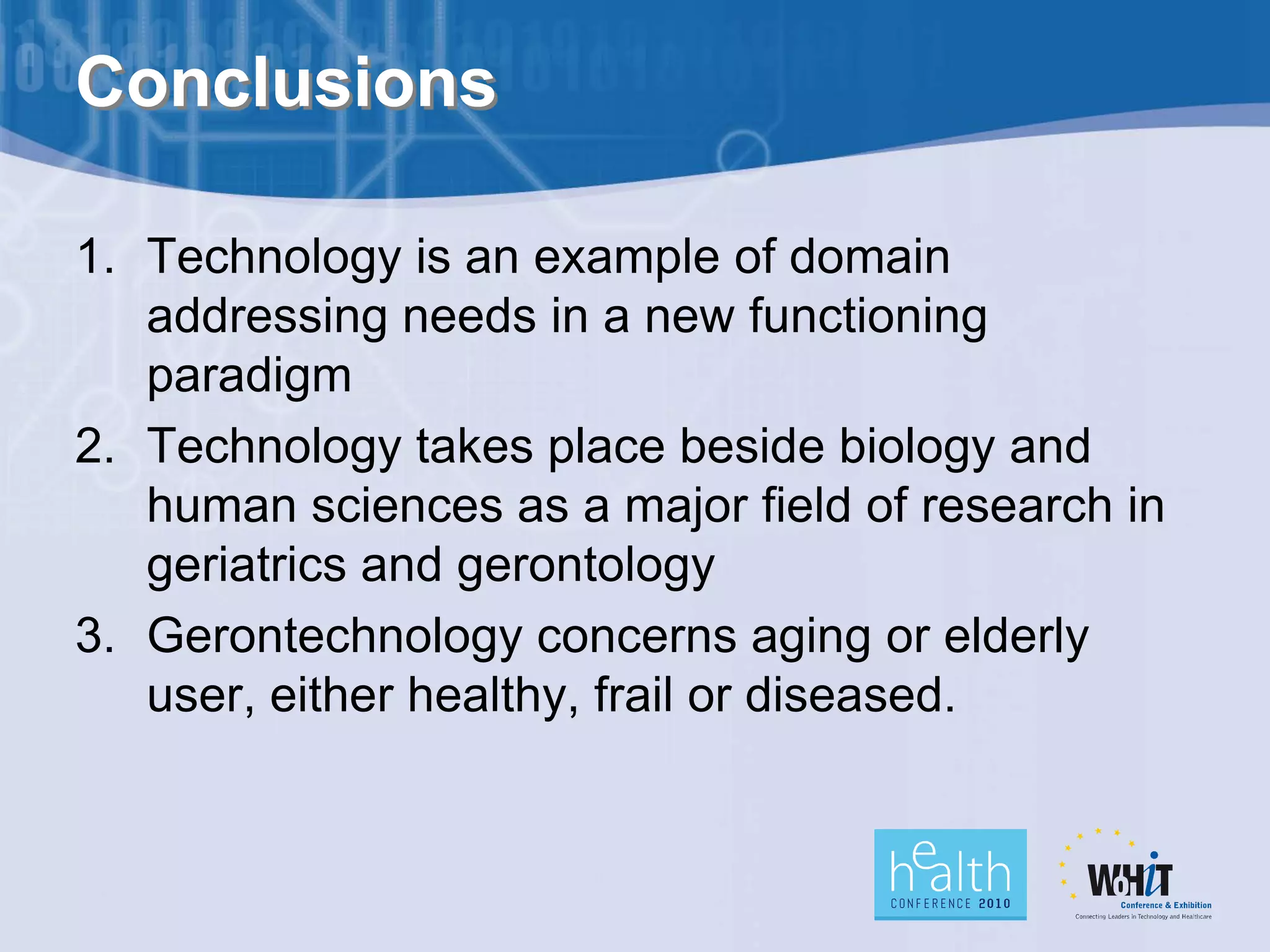
Conclusions

1. Technology is an example of domain
   addressing needs in a new functioning
   paradigm
2. Technology takes place beside biology and
   human sciences as a major field of research in
   geriatrics and gerontology
3. Gerontechnology concerns aging or elderly
   user, either healthy, frail or diseased.
Conclusions

4. Gerontechnology implies a common language
   between health professionals, methodologists,
   psycho-sociologists, technologists and a
   method to work together commonly practiced
   in gerontologic activities
5. In the future technology should efficiently
   contribute to prevention, assist aging
   physically and/or mentally handicapped
   persons, and contribute to reduce the burden
   of caregivers.
Take Home Messages

• Technologies & services face multiple needs
• There is a lack of caregivers in a close future
• Should the market for healthy aging be the
  same or different from the market for diseased
  and frail persons ?
• Who will pay in the routine ?
• Needs for a clinical gerontechnology ?
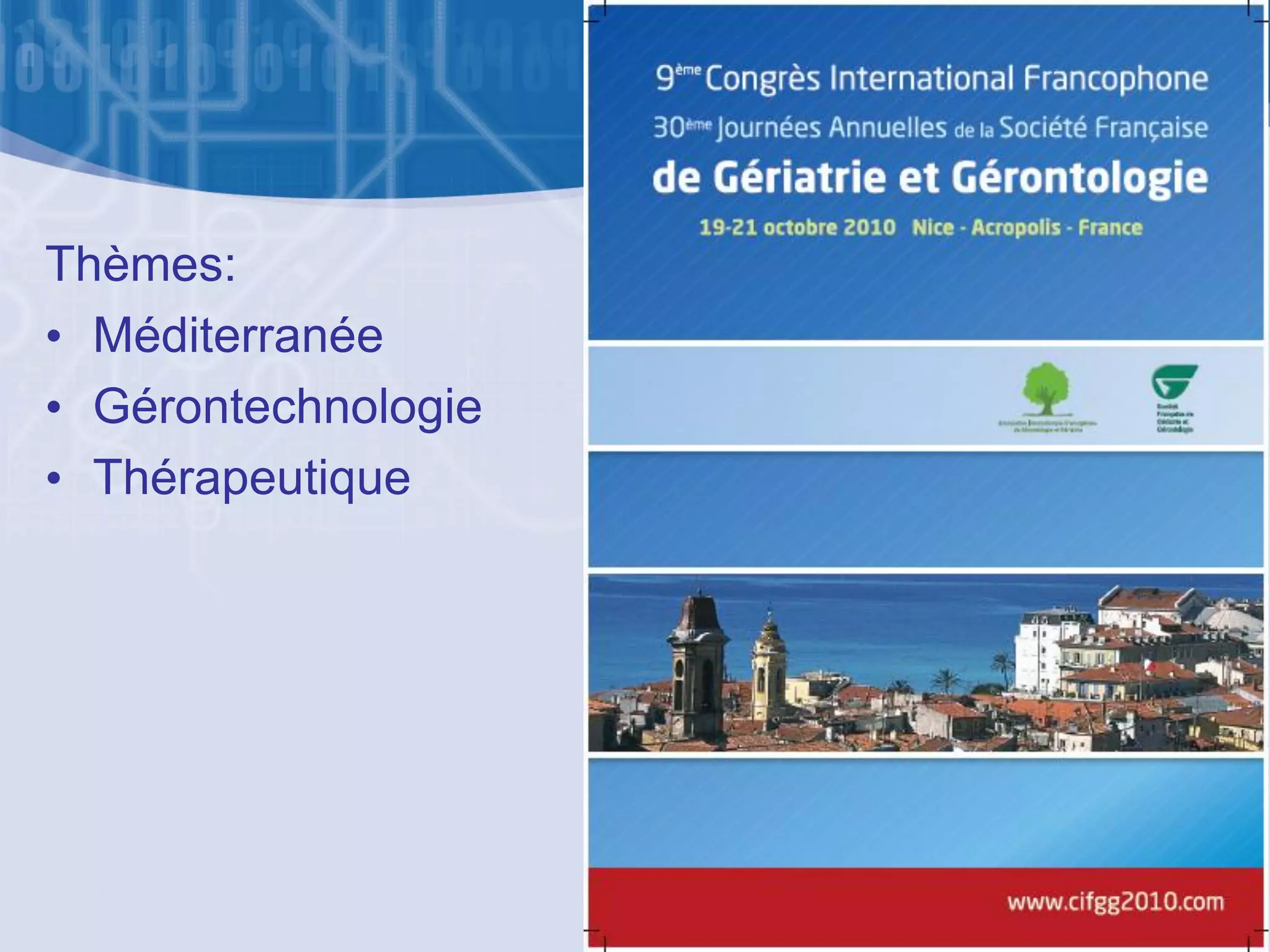
Thèmes:
• Méditerranée
• Gérontechnologie
• Thérapeutique

Ageing – a Global Challenge: Needs: are we moving towards a new health paradigm?

  • 1.
    Needs: are wemoving towards a new health paradigm ? Alain FRANCO – franco.a@chu-nice.fr Professor of Internal Medicine and Geriatrics (Nice) President of the ISG President of the CNRSDA (France)
  • 2.
    Supply • Technology &Services • ICT, • Gerontechnology, • Domotics, • Telemedicine, • ISG matrices
  • 3.
    Gerontechnology matrices J.E.M.H. van Bronswijket al. Gerontechnology 2009;8(1):3-10
  • 4.
    Outlook Age& generation matrix Target population Frailty & Dependence Main working phase Active retirement Formative years 2nd age 3rd age 4th age 1st age Mechanical products, hierarchical organization Technology generation Electro-mechanical products, hierarchical organization Menu driven products, layered software (‘Microsoft generation’) Gaming software with proficiency levels, relational (non- hierarchical) organization at each level J.E.M.H. van Bronswijk Gerontechnology 2009;8(1):3-10
  • 5.
    Science Cross-fertilization Technology Communication (Bio)chemistry Mechatronics management (Bio)Physics Architecture Ergonomics Information Business Robotics Building Design Physiology Nutrition Gerontology Psychology Social psychology Sociology Demographics Medicine Rehabilitation J.E.M.H. van Bronswijk Gerontechnology 2009;8(1):3-10
  • 6.
    Engineering Impact on application domains Application domain Communication Governance Self-esteem Daily living Transport Housing Mobility Leisure Health Work Enrichment Satisfaction Main goal Prevention Engagement Compensation Substitution Care support Care organization J.E.M.H. van Bronswijk Gerontechnology 2009;8(1):3-10
  • 7.
    Demand • Needs •Disability and compensation • Frailty and prevention • Users
  • 9.
    Female longevity isunavoidable, my Dear…!
  • 10.
    Healthy Aging www.eugms2008.org
  • 12.
  • 14.
    Future natural and professional care givers Children become care givers
  • 15.
    Demographic transition (WHO) •> 10% of the 65+ • Europe 2000 15%, World’s number one • Developed countries in 2020 20% • Chronic diseases > acute diseases
  • 16.
    Philip Wood’s Sequence (ICIDH-WHO1980) Disease • Impairment (organ/function) • Disability (activity/ person) • Handicap (social life) Dependency
  • 17.
    Philip Wood’s Sequence (ICIDH-WHO1980) Disease • Impairment (organ/function) • Disability (activity/ person) • Handicap (social life) Dependency
  • 18.
    Interactions between thecomponents of the ICF (International Classification of Functioning – WHO 2001) Health condition (disorder or disease) Body Functions & Structures Activities Participation (Limitations) (Restrictions) (Impairments) Environmental Personal Factors Factors
  • 19.
    Interactions between thecomponents of the ICF (International Classification of Functioning – WHO 2001) Health condition (disorder or disease) Body Functions & Structures Activities Participation (Limitations) (Restrictions) (Impairments) Environmental Personal Factors Factors
  • 20.
    Interactions between thecomponents of the ICF (International Classification of Functioning – WHO 2001) Health condition (disorder or disease) Body Functions & Structures Activities Participation (Limitations) (Restrictions) (Impairments) Environmental Personal Factors Factors
  • 21.
  • 22.
    Growing and aging Function Decompensation threshold Life
  • 23.
    Growing and aging Function Decompensation threshold Life
  • 24.
    Growing and aging Function 1 2 Decompensation threshold Life
  • 25.
    Aging means adecrease in functioning Function Decompensation threshold Life
  • 26.
    Aging means lessreserve for functioning Function Reserve Decompensation threshold Life
  • 27.
    Aging means lessreserve for functioning Function 1 2 Reserve Decompensation threshold Life
  • 28.
    Aging means lessreserve for functioning Function Reserve Frailty threshold Decompensation threshold Life
  • 29.
    Functioning Decompensation treshold Life
  • 30.
    Handicap Situation Functioning Decompensation treshold Life
  • 31.
    Decompensation - Compensation Functioning Decompensation treshold Life
  • 32.
    Prevention Functioning Decompensation treshold Life
  • 33.
    Prevention Functioning Decompensation treshold Life
  • 34.
    Compensation Functioning Decompensation treshold Life
  • 35.
    Needs Housing Mobility solut. Functioning Accessibility Inf.Technology Drugs Care Employement Education Fun Leisure Decompensation treshold Life
  • 36.
    Needs Housing Mobility solut. Functioning Housing Accessibility Mobility solut. Inf.Technology Accessibility Drugs Inf.Technology Care Drugs Employement Care Education Employement Fun Leisure Education Fun Leisure Decompensation treshold Prevention !... Life
  • 37.
    Needs Housing Mobility solut. Functioning Housing Accessibility Mobility solut. Inf.Technology Accessibility Drugs Inf.Technology Care Drugs Employement Care Education Employement Fun Leisure Education Fun Leisure Decompensation treshold Prevention !... Life
  • 38.
    Rights Housing Mobility solut. Functioning Housing Accessibility Mobility solut. Inf.Technology Accessibility Drugs Inf.Technology Care Drugs Employement Care Education Employement Fun Leisure Education Fun Leisure Decompensation treshold Prevention !... Life
  • 39.
    Expression of theneeds by • The disease • Diagnostic, Treatment • Monopathology • Patients’ group or association or lobby • The consequences of the disease(s) • Pain, palliative care • Polypathology (ageing) • Disability, handicap
  • 40.
    Expression of theneeds by • The disease • Diagnostic, Treatment • Monopathology • Patients’ group or association or lobby • The consequences of the disease(s) • Pain, palliative care • Polypathology (ageing) • Disability, handicap
  • 41.
    Expression of theneeds by • The disease • Diagnostic, Treatment • Monopathology • Patients’ group or association or lobby • The consequences of the disease(s) • Pain, palliative care • Polypathology (ageing) • Disability, handicap
  • 42.
    Disease & Casemanagement Disease management Monopathology Young & Adult Health issues Drugs Groups
  • 43.
    Disease & Casemanagement Disease management Case management Polypathology Comorbidity Monopathology Frailty Young & Adult Disability Health issues Older person Drugs Functioning Social issues Groups Care Individual
  • 44.
    Thus, from theWHO • ICD (10) fits with the traditional medical model, the disease-treatment model • ICF (1) fits with the new functioning model
  • 45.
    Unifying conceptual modelthat shared risk factors may lead to geriatric syndromes, then to frailty, with feedback mechanisms. Poor outcomes. J Am Geriatr Soc 55:780–791, 2007.
  • 46.
    Towards a newhealth paradigm • Moving from the hippocratic classical paradigm: • acute disease, diagnostic, treatment, hospital, prim. prevention, medical power, pharmacy • To a new functional paradigm: • case issues, personal functioning, chronical diseases, handicap, compensation, sec or tert. prevention, home care, shared power, technology
  • 47.
    Needs for olderpeople • Environmental needs: housing, mobility, nutrition, inclusion,…  Community, family, personal means, professionals, regions, EU,…  good practices, quality of care • Human rights needs: security, equity in accessibility, no discrimination, minimal income, health & aid,…  State guaranty, European initiative, International Convention under United Nations auspices, ….
  • 48.
    Conclusions 1. Technology isan example of domain addressing needs in a new functioning paradigm 2. Technology takes place beside biology and human sciences as a major field of research in geriatrics and gerontology 3. Gerontechnology concerns aging or elderly user, either healthy, frail or diseased.
  • 49.
    Conclusions 4. Gerontechnology impliesa common language between health professionals, methodologists, psycho-sociologists, technologists and a method to work together commonly practiced in gerontologic activities 5. In the future technology should efficiently contribute to prevention, assist aging physically and/or mentally handicapped persons, and contribute to reduce the burden of caregivers.
  • 50.
    Take Home Messages •Technologies & services face multiple needs • There is a lack of caregivers in a close future • Should the market for healthy aging be the same or different from the market for diseased and frail persons ? • Who will pay in the routine ? • Needs for a clinical gerontechnology ?
  • 52.