Labour and Advanced Education
Hazard Identification
and Control
Heather Matthews, OHS Specialist
Objectives
•Review key elements that are required for a HMS
•IRS
•Responsibilities
• The Law- Regulations Relating to Hazard
Assessment
•Hazard Management System
•Challenges with Health Care
Review – Internal Responsibility System
(IRS)
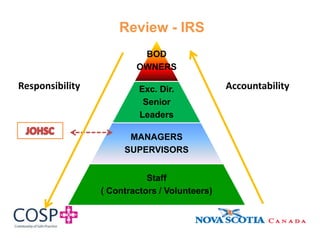
•Everyone has a direct responsibility for safety
BASED ON
•Their level of Responsibility
Accountability
Authority
Review - IRS
BOD
OWNERS
Exc. Dir.
Senior
Leaders
MANAGERS
SUPERVISORS
Staff
( Contractors / Volunteers)
Responsibility Accountability
Review - Responsibilities
• Employees
– Protect themselves and others
– Follow Organization’s rules
– Wear the necessary PPE
– Use only equipment and materials as authorized
– Cooperate with Employer, JOHS Committee
– Report Hazards & Incidents
Review - Responsibilities
• Employer
– Ensure Health & Safety of those at or near
– Maintain Equipment safely
– Inform Workers of Hazards
– Provide Instruction, Training, Supervision and Facilities as
necessary
– Establish Policy & Program
– Establish JOHS Committee
– Follow OHS Act & Regulations
Review – The Law
• Hazard Assessment Law
– OHS Act 13 (1) (a) – every precaution in the circumstance to
ensure health & safety of persons at or near the workplace
– OHS Act 13 (1) (b) Provide or maintain machines, materials,
equipment with safety devices
– OHS Act 13 (1) (c) Provide such information, instruction,
supervision and facilities as are necessary to the health &
safety of the employees
You can only do this if you identify, assess and control hazards!
Review – The Law
• OHS Act (13 (1) (d) Ensure that the employees, and
particularly the supervisors and foreman are made
familiar with any health or safety hazard met by them
at the workplace
• OHS Act (13 (1) (e) Conduct the employers
undertaking so that employees are not exposed to
health or safety hazards as a result of the undertaking
Review – The Law
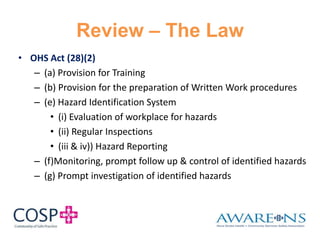
• OHS Act (28)(2)
– (a) Provision for Training
– (b) Provision for the preparation of Written Work procedures
– (e) Hazard Identification System
• (i) Evaluation of workplace for hazards
• (ii) Regular Inspections
• (iii & iv)) Hazard Reporting
– (f)Monitoring, prompt follow up & control of identified hazards
– (g) Prompt investigation of identified hazards
WORKPLACE SAFETY IS ALL ABOUT
MANAGING HAZARDS
Hazard Management and Control
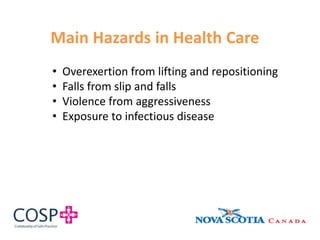
Main Hazards in Health Care
• Overexertion from lifting and repositioning
• Falls from slip and falls
• Violence from aggressiveness
• Exposure to infectious disease
Hazard Management
• Hazards need to be:
–Identified
–Assessed
–Controlled
Identifying and Assessing
Hazard
• What are the hazard?
• How “at Risk” are the staff?
• What are my options?
• What do I have to do Immediately? &
what can I put in place overtime?
Hazard Management
• Identify
–Employee Reporting
• Inspection /Hazard reports
• Near misses
–Supervisor Assessment
–Agency Assessments
–Org Experience
–Client Illness / Status
–Etc.
Hazard Management
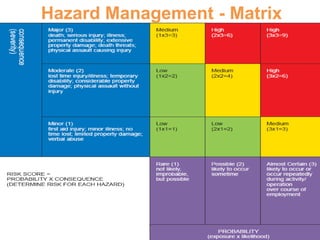
• Assessment (Calculating the Risk)
–Base on
• Probability
• Consequence
Hazard Management - Matrix
Video
Hazard Management
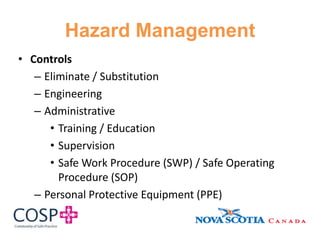
• Controls
– Eliminate / Substitution
– Engineering
– Administrative
• Training / Education
• Supervision
• Safe Work Procedure (SWP) / Safe Operating
Procedure (SOP)
– Personal Protective Equipment (PPE)
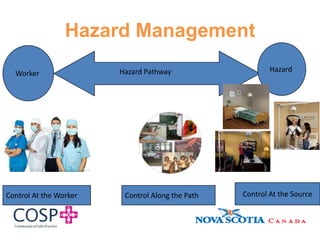
Hazard Management
Worker
Hazard
Control At the Worker Control Along the Path Control At the Source
Hazard Pathway
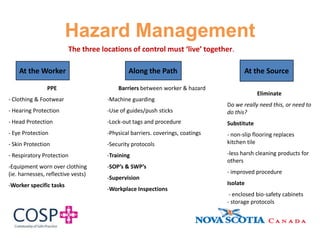
Hazard Management
At the Worker Along the Path At the Source
Eliminate
Do we really need this, or need to
do this?
Substitute
- non-slip flooring replaces
kitchen tile
-less harsh cleaning products for
others
- improved procedure
Isolate
- enclosed bio-safety cabinets
- storage protocols
Barriers between worker & hazard
-Machine guarding
-Use of guides/push sticks
-Lock-out tags and procedure
-Physical barriers. coverings, coatings
-Security protocols
-Training
-SOP’s & SWP’s
-Supervision
-Workplace Inspections
PPE
- Clothing & Footwear
- Hearing Protection
- Head Protection
- Eye Protection
- Skin Protection
- Respiratory Protection
-Equipment worn over clothing
(ie. harnesses, reflective vests)
-Worker specific tasks
The three locations of control must ‘live’ together.
Hazard Management
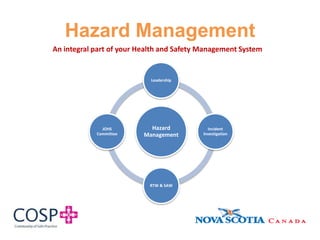
Hazard
Management
Leadership
Incident
Investigation
RTW & SAW
JOHS
Committee
An integral part of your Health and Safety Management System
Hazard Management in Health Care
Challenges
• Supervision
• Empathic Care Givers
• Time Management
• Environment
• Declining Health of Client
• Community
• Inconsistent Service Delivery
– Employee to employee
– Agency to Agency(homecare)
Hazard Management in Health Care
Challenges
– Ever tightening Budgets
– Client wants and needs vs. Contract
– Clients understanding service delivery contract
– Client family interventions (+ or -)
– Increasing Levels of care
– Access to quality Employees
– 6 visits means 6 workplaces in Home Care
Making our Workplaces Safer
Controlling the Hazards
• Better understanding of how to manage the
hazards
• Use of process with Safety Management
System (SMS)
– CSA or ISO SMS
• Build upon existing Best Practices
Making our Workplaces Safer
Controlling the Hazards
• Build upon existing Best Practices
– By sector
– By job function
– Regional
Making our Workplaces Safer
Controlling the Hazards
• Emphasis on Continuous Hazard Id & Control
– Adapting to Driving conditions(home care)
– Always surveying workplace conditions
• Changes within the workplace
• Understanding the contract vs. the wants/wishes of the client
– Continually surveying client conditions
• Declining Health means more care
– Understanding your community(homecare/community
Services)
– Understanding how Hazards are Controlled along the PATH
Thank You/Questions

Hazard id and control training v1

  • 1.
    Labour and AdvancedEducation Hazard Identification and Control Heather Matthews, OHS Specialist
  • 2.
    Objectives •Review key elementsthat are required for a HMS •IRS •Responsibilities • The Law- Regulations Relating to Hazard Assessment •Hazard Management System •Challenges with Health Care
  • 3.
    Review – InternalResponsibility System (IRS) •Everyone has a direct responsibility for safety BASED ON •Their level of Responsibility Accountability Authority
  • 4.
    Review - IRS BOD OWNERS Exc.Dir. Senior Leaders MANAGERS SUPERVISORS Staff ( Contractors / Volunteers) Responsibility Accountability
  • 5.
    Review - Responsibilities •Employees – Protect themselves and others – Follow Organization’s rules – Wear the necessary PPE – Use only equipment and materials as authorized – Cooperate with Employer, JOHS Committee – Report Hazards & Incidents
  • 6.
    Review - Responsibilities •Employer – Ensure Health & Safety of those at or near – Maintain Equipment safely – Inform Workers of Hazards – Provide Instruction, Training, Supervision and Facilities as necessary – Establish Policy & Program – Establish JOHS Committee – Follow OHS Act & Regulations
  • 7.
    Review – TheLaw • Hazard Assessment Law – OHS Act 13 (1) (a) – every precaution in the circumstance to ensure health & safety of persons at or near the workplace – OHS Act 13 (1) (b) Provide or maintain machines, materials, equipment with safety devices – OHS Act 13 (1) (c) Provide such information, instruction, supervision and facilities as are necessary to the health & safety of the employees You can only do this if you identify, assess and control hazards!
  • 8.
    Review – TheLaw • OHS Act (13 (1) (d) Ensure that the employees, and particularly the supervisors and foreman are made familiar with any health or safety hazard met by them at the workplace • OHS Act (13 (1) (e) Conduct the employers undertaking so that employees are not exposed to health or safety hazards as a result of the undertaking
  • 9.
    Review – TheLaw • OHS Act (28)(2) – (a) Provision for Training – (b) Provision for the preparation of Written Work procedures – (e) Hazard Identification System • (i) Evaluation of workplace for hazards • (ii) Regular Inspections • (iii & iv)) Hazard Reporting – (f)Monitoring, prompt follow up & control of identified hazards – (g) Prompt investigation of identified hazards
  • 10.
    WORKPLACE SAFETY ISALL ABOUT MANAGING HAZARDS Hazard Management and Control
  • 11.
    Main Hazards inHealth Care • Overexertion from lifting and repositioning • Falls from slip and falls • Violence from aggressiveness • Exposure to infectious disease
  • 12.
    Hazard Management • Hazardsneed to be: –Identified –Assessed –Controlled
  • 13.
    Identifying and Assessing Hazard •What are the hazard? • How “at Risk” are the staff? • What are my options? • What do I have to do Immediately? & what can I put in place overtime?
  • 14.
    Hazard Management • Identify –EmployeeReporting • Inspection /Hazard reports • Near misses –Supervisor Assessment –Agency Assessments –Org Experience –Client Illness / Status –Etc.
  • 15.
    Hazard Management • Assessment(Calculating the Risk) –Base on • Probability • Consequence
  • 16.
  • 17.
  • 18.
    Hazard Management • Controls –Eliminate / Substitution – Engineering – Administrative • Training / Education • Supervision • Safe Work Procedure (SWP) / Safe Operating Procedure (SOP) – Personal Protective Equipment (PPE)
  • 19.
    Hazard Management Worker Hazard Control Atthe Worker Control Along the Path Control At the Source Hazard Pathway
  • 20.
    Hazard Management At theWorker Along the Path At the Source Eliminate Do we really need this, or need to do this? Substitute - non-slip flooring replaces kitchen tile -less harsh cleaning products for others - improved procedure Isolate - enclosed bio-safety cabinets - storage protocols Barriers between worker & hazard -Machine guarding -Use of guides/push sticks -Lock-out tags and procedure -Physical barriers. coverings, coatings -Security protocols -Training -SOP’s & SWP’s -Supervision -Workplace Inspections PPE - Clothing & Footwear - Hearing Protection - Head Protection - Eye Protection - Skin Protection - Respiratory Protection -Equipment worn over clothing (ie. harnesses, reflective vests) -Worker specific tasks The three locations of control must ‘live’ together.
  • 21.
    Hazard Management Hazard Management Leadership Incident Investigation RTW &SAW JOHS Committee An integral part of your Health and Safety Management System
  • 22.
    Hazard Management inHealth Care Challenges • Supervision • Empathic Care Givers • Time Management • Environment • Declining Health of Client • Community • Inconsistent Service Delivery – Employee to employee – Agency to Agency(homecare)
  • 23.
    Hazard Management inHealth Care Challenges – Ever tightening Budgets – Client wants and needs vs. Contract – Clients understanding service delivery contract – Client family interventions (+ or -) – Increasing Levels of care – Access to quality Employees – 6 visits means 6 workplaces in Home Care
  • 24.
    Making our WorkplacesSafer Controlling the Hazards • Better understanding of how to manage the hazards • Use of process with Safety Management System (SMS) – CSA or ISO SMS • Build upon existing Best Practices
  • 25.
    Making our WorkplacesSafer Controlling the Hazards • Build upon existing Best Practices – By sector – By job function – Regional
  • 26.
    Making our WorkplacesSafer Controlling the Hazards • Emphasis on Continuous Hazard Id & Control – Adapting to Driving conditions(home care) – Always surveying workplace conditions • Changes within the workplace • Understanding the contract vs. the wants/wishes of the client – Continually surveying client conditions • Declining Health means more care – Understanding your community(homecare/community Services) – Understanding how Hazards are Controlled along the PATH
  • 27.

Editor's Notes

  • #3 Review some of the things that feed into Hazard Management systemThen we are going to talk about Hazard management system including some of the challenges as it related to health care
  • #4 Discuss how this module builds on “Exploring Nova Scotia`s OHS Legislative Structure” to approach managing safety from a “systems” perspective.
  • #6 When we review this list it seems obvious. And we like to assume that that all hazards are reported but the employee.
  • #7 Hazard Identification how does it fit with in the larger picture of the HSM System.
  • #8 Lets review the law as it pertains to Hazard ID
  • #13 The Three elements of a Hazard Management System Identify- from the obvious to the not so clearAssessing the risk assessment- probably and Consequences and realityAnd putting controls in place
  • #14 The Three elements of a Hazard Management System Identify- from the obvious to the not so clearAssessing the risk assessment- probably and Consequences and realityAnd putting controls in place
  • #15 How do we idenify
  • #19 .