
Experimental
Studies
Introduction
Experiment
Experiments are used to study causal
relationships. Researcher manipulate one or
more independent variables and measure their
effect on one or more dependent variables.
Conti…
Experimental Study
Experimental study/research is defined
as “experimental research is a scientific
method of conducting research using two
variables: independent and dependent. It
includes a hypothesis, a variable that can be
manipulated by the researcher, and variables
that can be measured, calculated and
compared.”
Conti…
 Experimental design means creating a set of
procedures to systematically test a hypothesis.
 Most importantly, experimental research is
completed in a controlled environment. The
researcher manipulates the independent
variables to see its effect on dependent
variables. (Harland, 2011)
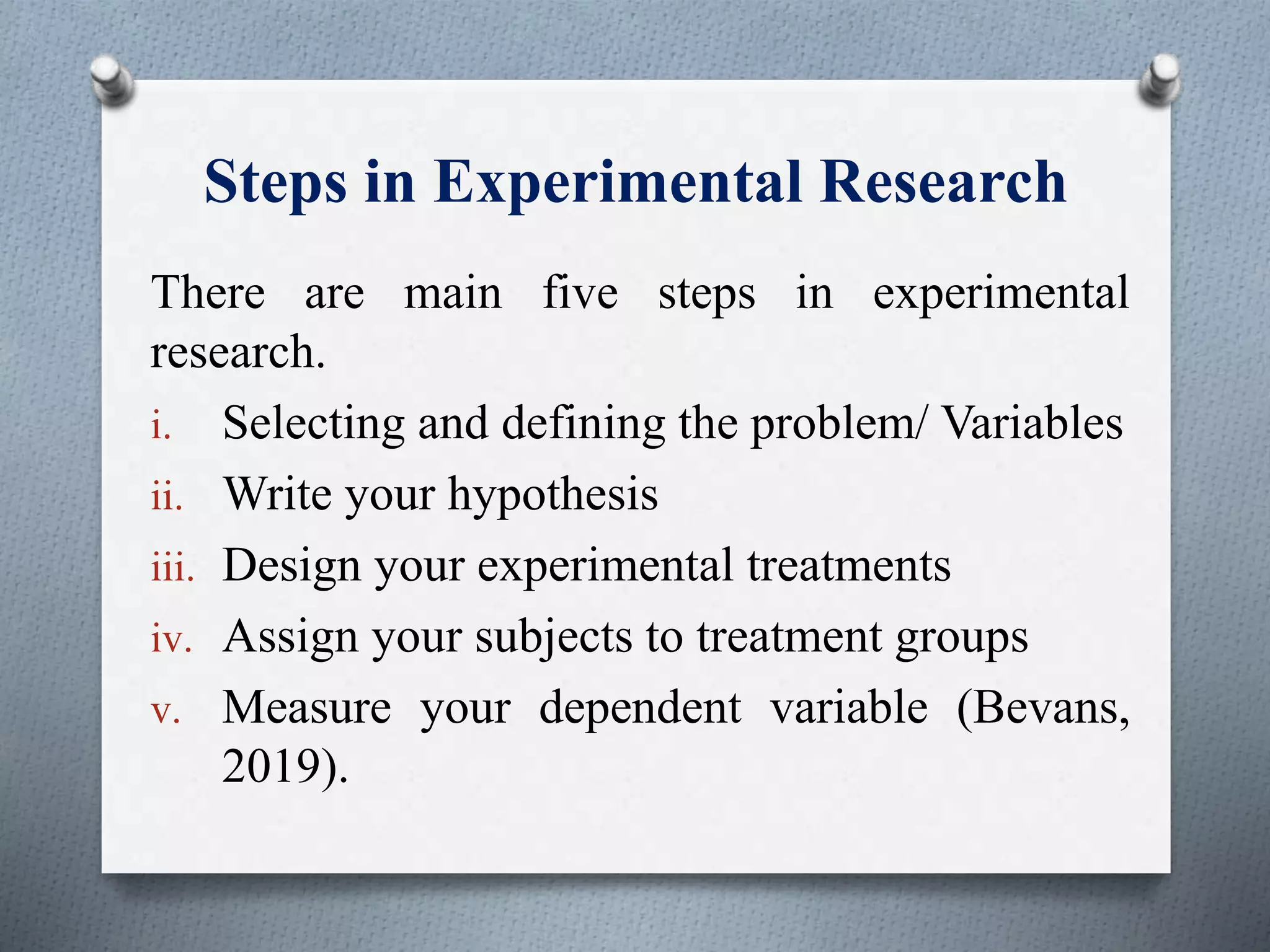
Steps in Experimental Research
There are main five steps in experimental
research.
i. Selecting and defining the problem/ Variables
ii. Write your hypothesis
iii. Design your experimental treatments
iv. Assign your subjects to treatment groups
v. Measure your dependent variable (Bevans,
2019).
Conti…
Step 1- Define your problem/ variables
Research Question, Example: Phone use and sleep
Specifically, you ask how the number of minutes a
person uses their phone before sleep affects the
number of hours they sleep.
Independent Variable Dependent Variable
Minutes of phone
use before sleep
Hours of sleep per
night
Conti…
Extraneous Variables
Natural variation in sleep patterns
among individuals
Conti…
Step 2: Write your Hypothesis
Null Hypothesis Alternate Hypothesis
Phone use before sleep
does not correlate with
the amount of sleep a
person gets.
Increasing phone use
before sleep leads to a
decrease in sleep.
Conti…
Step 3: Design your experimental treatments
Researcher can choose to treat phone use as:
 a categorical variable: either as binary (yes/no)
or as levels of a factor (no phone use, low
phone use, high phone use).
 a continuous variable (minutes of phone use
measured every night).
Conti…
Step 4: Assign your subjects to treatment groups
Then Researcher need to randomly assign your
subjects to treatment groups. Each group receives a
different level of the treatment (e.g. no phone use, low
phone use, high phone use).
Researcher should also include a control group, which
receives no treatment.
Randomized Design
Subjects are all randomly assigned a level of phone
use using a random number generator.
Conti…
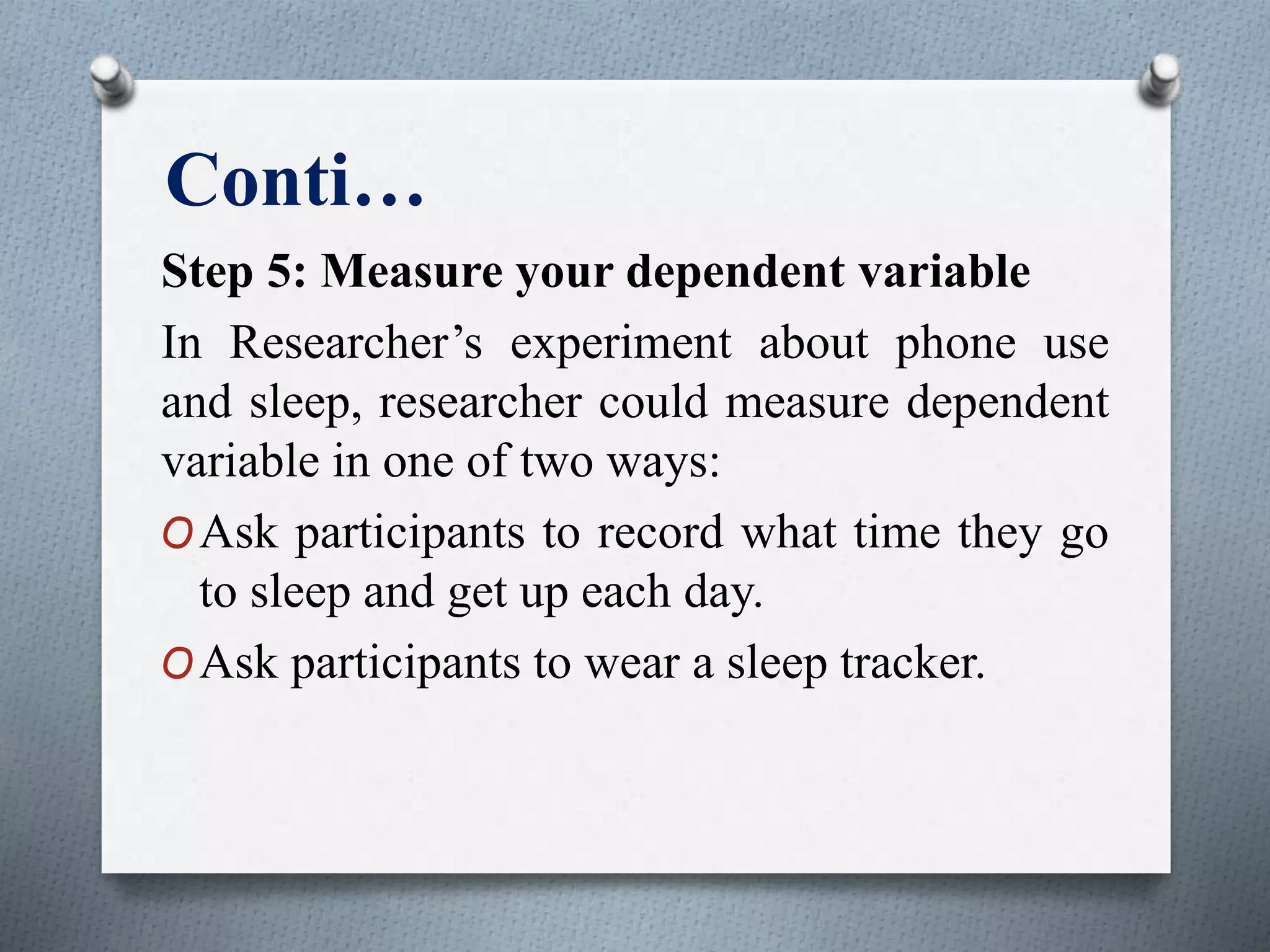
Step 5: Measure your dependent variable
In Researcher’s experiment about phone use
and sleep, researcher could measure dependent
variable in one of two ways:
OAsk participants to record what time they go
to sleep and get up each day.
OAsk participants to wear a sleep tracker.
Uses of Experimental Research
Design
Experimental research design can be majorly
used in physical sciences, social sciences,
education and psychology. It is used to make
predictions and draw conclusions on a subject
matter.
Conti…
Some uses of experimental research design are
highlighted below.
 Medicine
 Education
 Human Behavior
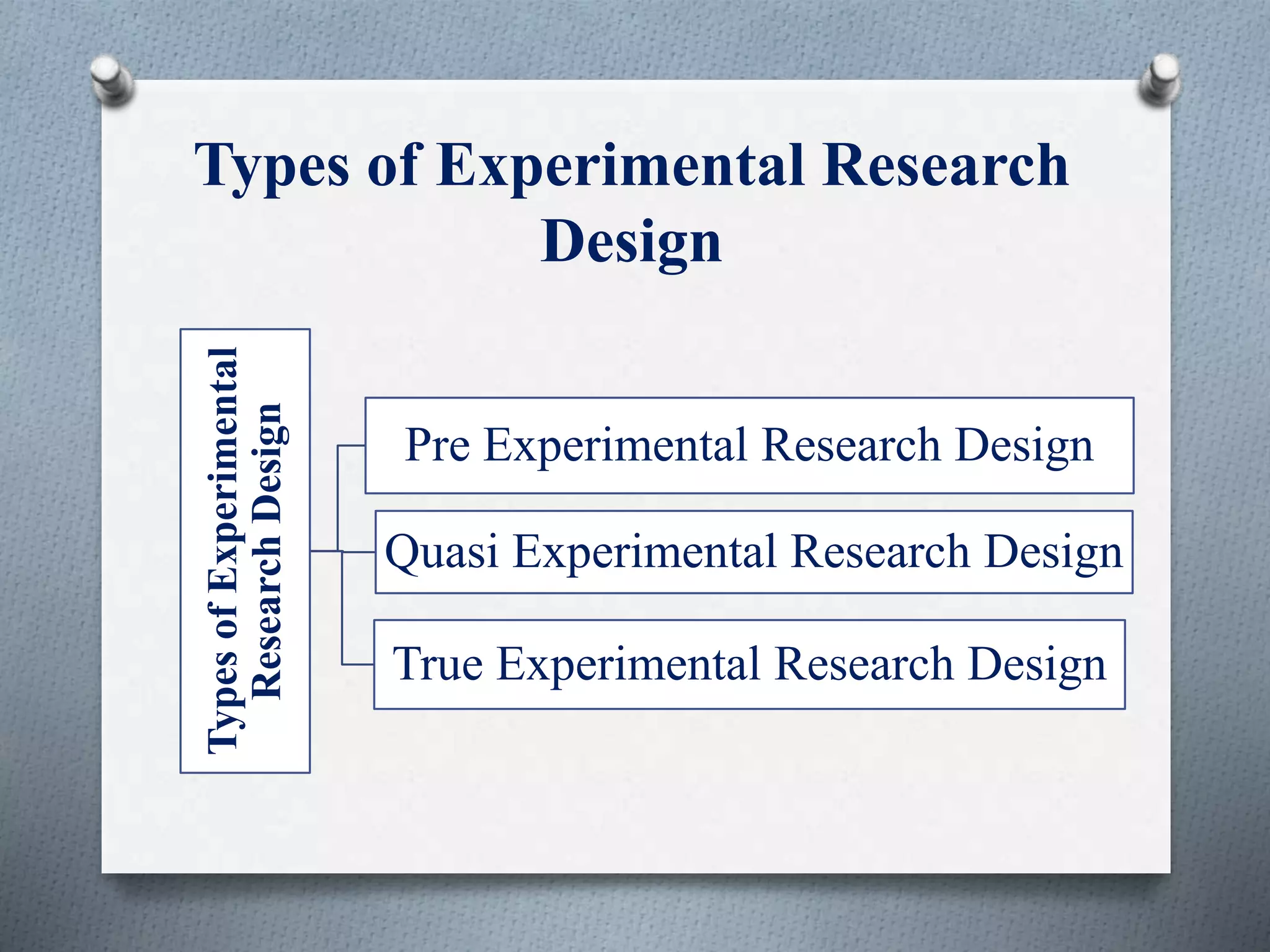
Types of Experimental Research
Design
Types
of
Experimental
Research
Design
Pre Experimental Research Design
Quasi Experimental Research Design
True Experimental Research Design
Pre-experimental Research Design
In pre-experimental research design, either a group
or various dependent groups are observed for the
effect of the application of an independent variable
which is presumed to cause change. It is the
simplest form of experimental research design and
is treated with no control group. It has no control
over the extraneous or situational variables.
Conti…
Extraneous variables
Research Topic: to study the effect of heuristic teaching
method on students learning.
Independent Variable: Heuristic teaching method
Dependent Variable: Students learning
Extraneous Variables: Classroom environment, students
intelligence level, students health related problem etc.
Types of Pre-Experimental
Research Design
 One-shot Case Study Research Design
 One-group Pretest-posttest Research
Design
 Static-group Comparison
One-shot Case Study Research Design
A single group is given treatment and then tested.
X O
treatment observation
Students Tuition Grades
One-group Pretest-posttest Research
Design
A Single Intact group is tested before and
after the treatment.
O1 X O2
Example: Research Topic- study the effect of
heuristic teaching methods on students
learning.
Conti…
Step I Step II Step III
Measure
students
learning before
teaching them
through
heuristic
method
Teach students
through
heuristic
method
Measure
Students
learning after
teaching them
through
heuristic
method
Pre Test Applying IV
and DV
Post Test
Static-group Comparison
Two intact groups are tested after one has
received the treatment.
X O
O
Conti…
Research Topic: study the effect of heuristic teaching
method on students learning.
First Step: Researcher select a group of students and
ensures that these students are equivalent in all aspects.
2nd Step: Divide these students in two groups
i. 1st Group ii. Experimental group
Teach them through
traditional method
Teach them through
Heuristic method
Quasi-experimental Research Design
The quasi-experimental research bearing a
resemblance to the true experimental research,
but not the same. A quasi-experimental design aims
to establish a cause-and-effect relationship between
an independent and dependent variable. In quasi-
experiments, the participants are not randomly
assigned, they are used in settings where
randomization is difficult or impossible.
Types of Quasi Experimental Design
 Times Series
 Nonequivalent Group Design
 Counterbalanced Design
Time Series
In this design, researchers track participants for a
lengthy period, both pre-intervention and post-
intervention. A series of test over time(O1 through O4
in this case). Expose group to the treatment and then
measure the subjects with another series of test. (O5
through O8). Examples: Climate Change, Stock
Marketing, School daily attendance.
Nonequivalent Group design
This design uses a pretest and posttest for
participants to gauge cause and effect. Subjects are
tested in existing or “intact” groups rather than
being randomly selected. Both groups are
measured before and after the treatment. Only one
group receive the treatment.
Counterbalanced
Subjects are not randomly selected but used in
intact groups.
Group 1 receives treatment 1 and test 1. then at
later time they receive the treatment 2 and test
2. Group 2 receives treatment 2 first and then
treatment 1.
Time 1 2
Group 1 X1 O X2 O
Group 2 X2 O X1 O
Conti…
Example
Let’s say your study for depression had two
treatments:
Counseling and meditation
Meditation and Counseling
True Experimental Research
Design
 The true experimental research design relies on
statistical analysis to approve or disprove a
hypothesis. It is the most accurate type of
experimental design and may be carried out with
or without a pretest on at least 2 randomly
assigned dependent subjects.
Conti…
The true experimental research design must
contain a control group, a variable that can be
manipulated by the researcher, and the
distribution must be random.
Characteristics of True Experimental
Research Design
 Manipulation
 Randomization
 Control
The Classification of True
Experimental Design
 The posttest-only Control Group Design
 The pretest-posttest Control Group
Design
 Solomon four-group Design
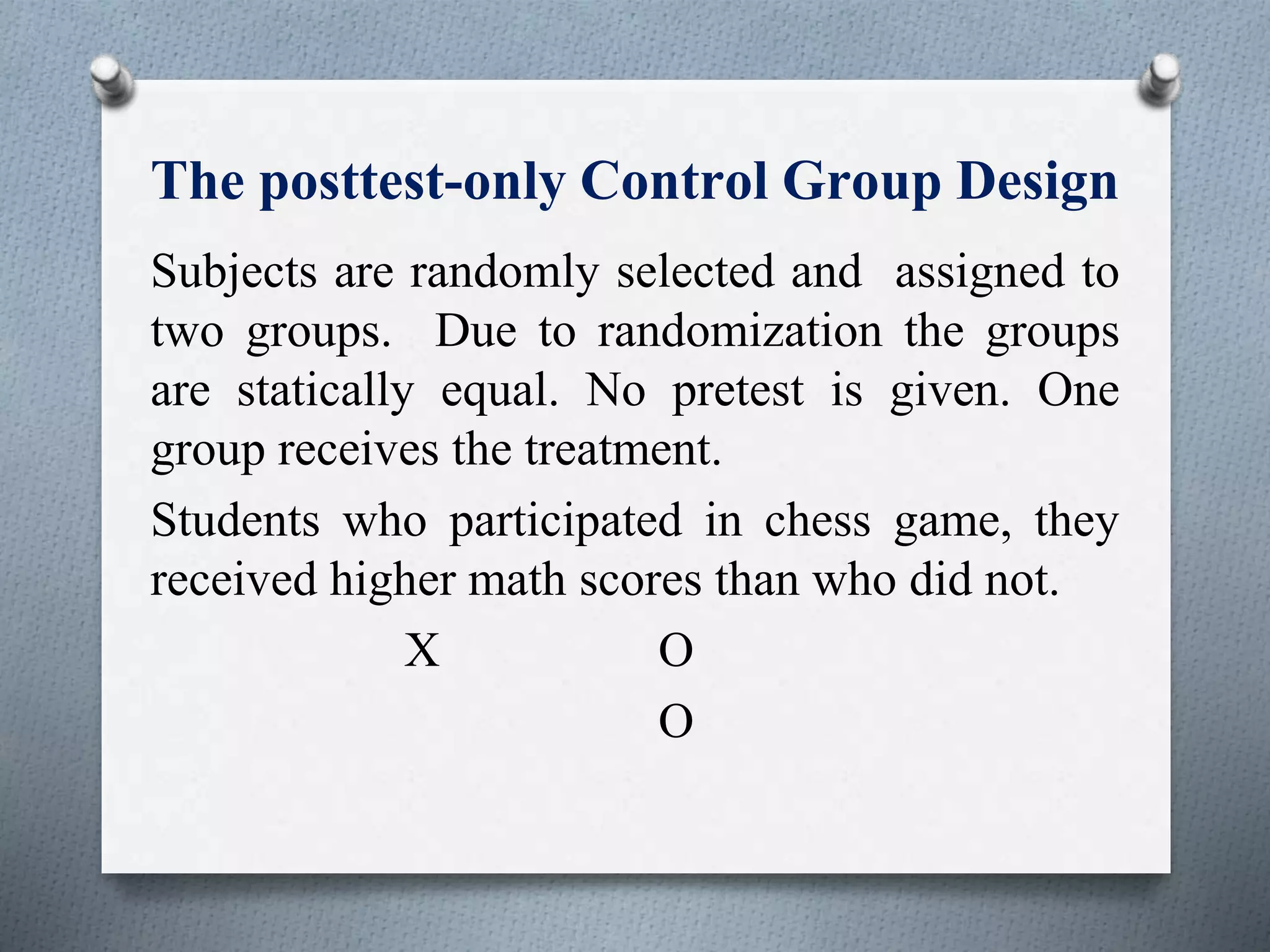
The posttest-only Control Group Design
Subjects are randomly selected and assigned to
two groups. Due to randomization the groups
are statically equal. No pretest is given. One
group receives the treatment.
Students who participated in chess game, they
received higher math scores than who did not.
X O
O
The Pretest-Posttest Control
Group Design
In this research designs, subjects are randomly
assigned to either the experimental and the control
group.
The effect of the dependent variable on both the
groups is seen before the treatment (pretest). Later,
the treatment is carried out on experimental group
only, & after-treatment observation of dependent
variable is made on both the groups to examine the
effect of the manipulation of independent variable on
dependent variable.
Conti…
O X O
O O
Example: A teacher splits randomly assigns half of
her class to a control group and the other half to
treatment group. She then uses the standard
teaching technique and a new teaching technique
with each group for one week and then administers
the post test.
Solomon four-group Design
There are two experimental groups
(experimental group 1 & experimental group
2) & two control groups (control group 1 &
control group 2).
The Solomon design is actually a combination
of the Pre-Test, Post-Test Design (groups 1
and 2) and the Post-Test Only Design (Groups
3 and 4).
Conti…
Methods of Data Collection in
Experimental Research
 Observations
 Simulation
It is frequently used when the actual situation is too
expensive, dangerous, or impractical to replicate in real
life.
 Surveys
Advantages of Experimental
Research
 Researchers have a stronger hold over
variables to obtain desired results.
 The results are specific.
 It can be used in different fields.
 After analyzing the results, you can apply
your findings to similar ideas or situations.
 Researcher can identify the cause and effect
of hypothesis.
Disadvantages of Experimental
Research
 It is expensive.
 It is a time-consuming process.
 Experimental research results are not descriptive.
 There is no control on extraneous variables.
Experimental Studies

Experimental Studies

  • 1.
  • 2.
    Introduction Experiment Experiments are usedto study causal relationships. Researcher manipulate one or more independent variables and measure their effect on one or more dependent variables.
  • 3.
    Conti… Experimental Study Experimental study/researchis defined as “experimental research is a scientific method of conducting research using two variables: independent and dependent. It includes a hypothesis, a variable that can be manipulated by the researcher, and variables that can be measured, calculated and compared.”
  • 4.
    Conti…  Experimental designmeans creating a set of procedures to systematically test a hypothesis.  Most importantly, experimental research is completed in a controlled environment. The researcher manipulates the independent variables to see its effect on dependent variables. (Harland, 2011)
  • 5.
    Steps in ExperimentalResearch There are main five steps in experimental research. i. Selecting and defining the problem/ Variables ii. Write your hypothesis iii. Design your experimental treatments iv. Assign your subjects to treatment groups v. Measure your dependent variable (Bevans, 2019).
  • 6.
    Conti… Step 1- Defineyour problem/ variables Research Question, Example: Phone use and sleep Specifically, you ask how the number of minutes a person uses their phone before sleep affects the number of hours they sleep. Independent Variable Dependent Variable Minutes of phone use before sleep Hours of sleep per night
  • 7.
    Conti… Extraneous Variables Natural variationin sleep patterns among individuals
  • 8.
    Conti… Step 2: Writeyour Hypothesis Null Hypothesis Alternate Hypothesis Phone use before sleep does not correlate with the amount of sleep a person gets. Increasing phone use before sleep leads to a decrease in sleep.
  • 9.
    Conti… Step 3: Designyour experimental treatments Researcher can choose to treat phone use as:  a categorical variable: either as binary (yes/no) or as levels of a factor (no phone use, low phone use, high phone use).  a continuous variable (minutes of phone use measured every night).
  • 10.
    Conti… Step 4: Assignyour subjects to treatment groups Then Researcher need to randomly assign your subjects to treatment groups. Each group receives a different level of the treatment (e.g. no phone use, low phone use, high phone use). Researcher should also include a control group, which receives no treatment. Randomized Design Subjects are all randomly assigned a level of phone use using a random number generator.
  • 11.
    Conti… Step 5: Measureyour dependent variable In Researcher’s experiment about phone use and sleep, researcher could measure dependent variable in one of two ways: OAsk participants to record what time they go to sleep and get up each day. OAsk participants to wear a sleep tracker.
  • 12.
    Uses of ExperimentalResearch Design Experimental research design can be majorly used in physical sciences, social sciences, education and psychology. It is used to make predictions and draw conclusions on a subject matter.
  • 13.
    Conti… Some uses ofexperimental research design are highlighted below.  Medicine  Education  Human Behavior
  • 14.
    Types of ExperimentalResearch Design Types of Experimental Research Design Pre Experimental Research Design Quasi Experimental Research Design True Experimental Research Design
  • 15.
    Pre-experimental Research Design Inpre-experimental research design, either a group or various dependent groups are observed for the effect of the application of an independent variable which is presumed to cause change. It is the simplest form of experimental research design and is treated with no control group. It has no control over the extraneous or situational variables.
  • 16.
    Conti… Extraneous variables Research Topic:to study the effect of heuristic teaching method on students learning. Independent Variable: Heuristic teaching method Dependent Variable: Students learning Extraneous Variables: Classroom environment, students intelligence level, students health related problem etc.
  • 17.
    Types of Pre-Experimental ResearchDesign  One-shot Case Study Research Design  One-group Pretest-posttest Research Design  Static-group Comparison
  • 18.
    One-shot Case StudyResearch Design A single group is given treatment and then tested. X O treatment observation Students Tuition Grades
  • 19.
    One-group Pretest-posttest Research Design ASingle Intact group is tested before and after the treatment. O1 X O2 Example: Research Topic- study the effect of heuristic teaching methods on students learning.
  • 20.
    Conti… Step I StepII Step III Measure students learning before teaching them through heuristic method Teach students through heuristic method Measure Students learning after teaching them through heuristic method Pre Test Applying IV and DV Post Test
  • 21.
    Static-group Comparison Two intactgroups are tested after one has received the treatment. X O O
  • 22.
    Conti… Research Topic: studythe effect of heuristic teaching method on students learning. First Step: Researcher select a group of students and ensures that these students are equivalent in all aspects. 2nd Step: Divide these students in two groups i. 1st Group ii. Experimental group Teach them through traditional method Teach them through Heuristic method
  • 23.
    Quasi-experimental Research Design Thequasi-experimental research bearing a resemblance to the true experimental research, but not the same. A quasi-experimental design aims to establish a cause-and-effect relationship between an independent and dependent variable. In quasi- experiments, the participants are not randomly assigned, they are used in settings where randomization is difficult or impossible.
  • 24.
    Types of QuasiExperimental Design  Times Series  Nonequivalent Group Design  Counterbalanced Design
  • 25.
    Time Series In thisdesign, researchers track participants for a lengthy period, both pre-intervention and post- intervention. A series of test over time(O1 through O4 in this case). Expose group to the treatment and then measure the subjects with another series of test. (O5 through O8). Examples: Climate Change, Stock Marketing, School daily attendance.
  • 26.
    Nonequivalent Group design Thisdesign uses a pretest and posttest for participants to gauge cause and effect. Subjects are tested in existing or “intact” groups rather than being randomly selected. Both groups are measured before and after the treatment. Only one group receive the treatment.
  • 27.
    Counterbalanced Subjects are notrandomly selected but used in intact groups. Group 1 receives treatment 1 and test 1. then at later time they receive the treatment 2 and test 2. Group 2 receives treatment 2 first and then treatment 1. Time 1 2 Group 1 X1 O X2 O Group 2 X2 O X1 O
  • 28.
    Conti… Example Let’s say yourstudy for depression had two treatments: Counseling and meditation Meditation and Counseling
  • 29.
    True Experimental Research Design The true experimental research design relies on statistical analysis to approve or disprove a hypothesis. It is the most accurate type of experimental design and may be carried out with or without a pretest on at least 2 randomly assigned dependent subjects.
  • 30.
    Conti… The true experimentalresearch design must contain a control group, a variable that can be manipulated by the researcher, and the distribution must be random.
  • 31.
    Characteristics of TrueExperimental Research Design  Manipulation  Randomization  Control
  • 32.
    The Classification ofTrue Experimental Design  The posttest-only Control Group Design  The pretest-posttest Control Group Design  Solomon four-group Design
  • 33.
    The posttest-only ControlGroup Design Subjects are randomly selected and assigned to two groups. Due to randomization the groups are statically equal. No pretest is given. One group receives the treatment. Students who participated in chess game, they received higher math scores than who did not. X O O
  • 34.
    The Pretest-Posttest Control GroupDesign In this research designs, subjects are randomly assigned to either the experimental and the control group. The effect of the dependent variable on both the groups is seen before the treatment (pretest). Later, the treatment is carried out on experimental group only, & after-treatment observation of dependent variable is made on both the groups to examine the effect of the manipulation of independent variable on dependent variable.
  • 35.
    Conti… O X O OO Example: A teacher splits randomly assigns half of her class to a control group and the other half to treatment group. She then uses the standard teaching technique and a new teaching technique with each group for one week and then administers the post test.
  • 36.
    Solomon four-group Design Thereare two experimental groups (experimental group 1 & experimental group 2) & two control groups (control group 1 & control group 2). The Solomon design is actually a combination of the Pre-Test, Post-Test Design (groups 1 and 2) and the Post-Test Only Design (Groups 3 and 4).
  • 37.
  • 38.
    Methods of DataCollection in Experimental Research  Observations  Simulation It is frequently used when the actual situation is too expensive, dangerous, or impractical to replicate in real life.  Surveys
  • 39.
    Advantages of Experimental Research Researchers have a stronger hold over variables to obtain desired results.  The results are specific.  It can be used in different fields.  After analyzing the results, you can apply your findings to similar ideas or situations.  Researcher can identify the cause and effect of hypothesis.
  • 40.
    Disadvantages of Experimental Research It is expensive.  It is a time-consuming process.  Experimental research results are not descriptive.  There is no control on extraneous variables.