Magnolia Science Academies
Although the Financial Condition of These Charter Schools
Has Improved, Their Financial Controls Still Need to
Be Strengthened
Report 2014‑135R
May 2015
COMMITMENT
INTEGRITY
LEADERSHIP
The first five copies of each California State Auditor report are free. Additional copies are $3 each, payable by check
or money order. You can obtain reports by contacting the California State Auditor’s Office at the following address:
California State Auditor
621 Capitol Mall, Suite 1200
Sacramento, California 95814
916.445.0255 or TTY 916.445.0033
OR
This report is also available on our website at www.auditor.ca.gov.
The California State Auditor is pleased to announce the availability of an online subscription service.

For information on how to subscribe, visit our website at www.auditor.ca.gov.
Alternate format reports available upon request.
Permission is granted to reproduce reports.
For questions regarding the contents of this report,
please contact Margarita Fernández, Chief of Public Affairs, at 916.445.0255.
For complaints of state employee misconduct, contact the California State Auditor’s
Whistleblower Hotline: 1.800.952.5665.
Doug Cordiner Chief Deputy
Elaine M. Howle State Auditor
621 Capitol Mall, Suite 1200 Sacramento, CA 95814 916.445.0255 916.327.0019 fax www.auditor.ca.gov
May 7, 2015		 2014‑135R
The Governor of California
President pro Tempore of the Senate
Speaker of the Assembly
State Capitol
Sacramento, California 95814
Dear Governor and Legislative Leaders:
As requested by the Joint Legislative Audit Committee, the California State Auditor presents this audit report
concerning the Magnolia Science Academies (academies), a network of 11 charter schools located throughout
the State operated by a charter management organization called the Magnolia Educational and Research
Foundation (Foundation). Our report concludes that the Foundation and the academies have improved their
financial position, but should strengthen some of their financial controls.
Our review confirmed that some of the academies were insolvent at points during the past three fiscal years,
partly because of state funding delays. To help financially struggling academies, the Foundation facilitated loans
between academies and did not charge some academies its full management fee. Our review found that the
academies that loaned funds were not negatively impacted by this practice and that these loans served a useful
purpose by enabling struggling academies to continue to serve their students. As of July 2014 the Foundation
and academies had repaid all but one loan—from the Foundation to one of its academies most in need of
financial assistance—and all of the academies were solvent under the three financial measures we applied.
Even so, the Foundation must strengthen its financial and management processes. For example, the Foundation
could not provide either clear authorization or sufficient support for 52 of the 225 transactions we reviewed.
Moreover, the Foundation’s reliance on verbal authorization for debit-card purchases may have at least partially
led academy principals to make debit-card purchases that could have been made using purchasing mechanisms
withbetterfinancialcontrols.WealsoreviewedaselectionoftheFoundation’svendoragreementsandquestioned
the close relationship to one of its primary vendors. The Foundation should also strengthen its process for
collecting and reviewing the payroll data it submits to its payroll vendor to ensure the information is accurate.
Further, we found that academies did not always follow the Foundation’s procedures when holding fundraisers.
In recent years the academies and the Foundation have been the subject of scrutiny by the Los Angeles
Unified School District (LAUSD)—the authorizing entity for eight of the 11 academies. In June 2014 LAUSD
rescinded its conditional approval of two academies’ charter petitions. We found that LAUSD may have acted
prematurely as its decision was based on a summary of draft findings that did not provide key context about
the financial situations of those academies and it did not provide sufficient time for the Foundation to respond
to its criticisms. To ensure its academies remained open, the Foundation took legal action against LAUSD. In
March 2015 a settlement agreement between the two parties resolved this litigation and resulted in the renewal
of the academies’ charters.
Respectfully submitted,
ELAINE M. HOWLE, CPA
State Auditor
Blank page inserted for reproduction purposes only.
vCalifornia State Auditor Report 2014-135R
May 2015
Contents
Summary	1
Introduction	5
Chapter 1	
All Magnolia Science Academies Were Solvent and All Loans
but One Were Repaid by July 2014	 19
Recommendations	29
Chapter 2	
Weaknesses in Some of the Magnolia Educational and
Research Foundation’s Financial and Management Processes
Could Lead to Inappropriate Expenditures	 31
Recommendations	50
Chapter 3	
The Los Angeles Unified School District Appears to Have Acted
Prematurely in Rescinding Recent Charter Renewals	 53
Recommendations	61
Responses to the Audit
Magnolia Educational and Research Foundation, Magnolia
Public Schools	 63
California State Auditor’s Comments on the Response From the
Magnolia Educational and Research Foundation, Magnolia
Public Schools	 69
Los Angeles Unified School District	 71
California State Auditor’s Comments on the Response From the
Los Angeles Unified School District	 77
vi California State Auditor Report 2014-135R
May 2015
Blank page inserted for reproduction purposes only.
1California State Auditor Report 2014-135R
May 2015
Audit Highlights . . .
OurauditoftheMagnoliaEducationaland
ResearchFoundation(Foundation)andthe
MagnoliaScienceAcademies(academies)
highlightedthefollowing:
»» Someoftheacademieswereinsolventat
pointsduringthepastthree fiscal years.
•	 TheFoundationfacilitatedloans
betweenacademieswithexcessfunds
andacademiesrequiringfundsto
addresstheircash‑flowproblems.
•	 Theloans—allbutonerepaid—
enabledthestrugglingacademiesto
continuetoservetheirstudentsand
didnothaveanegativeimpactonthe
academiesloaningfunds.
»» TheFoundation’sfinancialand
managementprocessesneedimprovement.
•	 Nearlyaquarterofthe225 transactions
wereviewedeitherdidnothaveclear
authorizationorsufficientsupport.
•	 WequestionedtheFoundation’s
relationshipwithoneofits
primary vendors.
•	 Theacademiesdidnotalwaysfollowthe
Foundations’policiesandprocedures
whenholdingfundraisers,whichcreated
thepotentialforlossortheftoffunds.
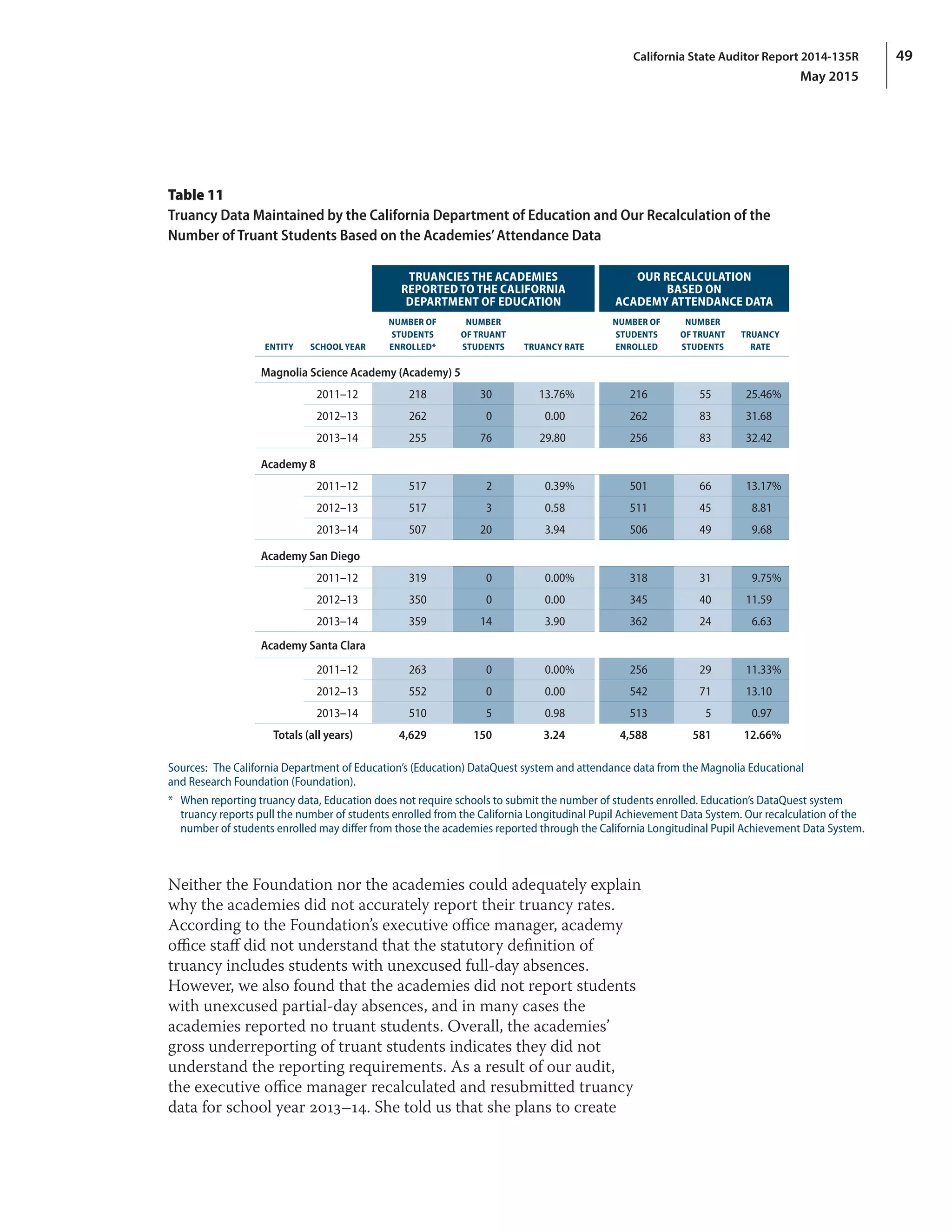
•	 Theacademiesgrosslyunderreported
truancydatatotheCalifornia
DepartmentofEducation.
»» TheLosAngelesUnifiedSchoolDistrict
(LAUSD)andotherauthorizingentities
generallyperformedrequiredsitevisits
oftheacademies.However,LAUSD
mayhaveactedprematurelywhenit
rescindedthecharterrenewalpetitionsof
two academies.
Summary
Results in Brief
California offers its students the option of attending charter
schools. These state‑funded public schools operate independently
from the standard public school system, to a degree, although they
must petition authorizing entities, such as school districts, for
approval of their charters. The Magnolia Educational and Research
Foundation (Foundation) is a charter management organization
that operates a network of 11 charter schools throughout California,
called Magnolia Science Academies (academies). Although the
academies generally perform well academically, a 2014 review
that an outside accounting firm performed for the Los Angeles
Unified School District (LAUSD)—the authorizing entity for
eight of the 11 academies—raised concerns about the financial
solvency of the Foundation and some of the academies. Further,
this review found general fiscal mismanagement by the Foundation,
citing in particular its lack of disclosures in its audited financial
statements, its practice of engaging in interschool borrowing,
its weak fiscal controls, and its processing of questionable or
unexplained transactions. As a result of these concerns, LAUSD
rescinded its conditional approval of two academies’ charter
petitions in June 2014 and did not renew a third academy’s charter
petition in November 2014. The Foundation responded by taking
legal action against LAUSD to ensure that these academies
remained open.
Our review confirmed that some of the academies, under certain
key financial measures—including a cash reserve requirement
specifically required by some of the academies’ charters—were
insolvent at points during the past three fiscal years, partly because
of state funding delays. To offset the cash‑flow problems at some
academies, the Foundation facilitated loans between academies
with excess funds and academies requiring funds to address their
cash‑flow problems and did not charge some academies its full
management fee. We do not believe the academies that provided
excess funds to and through the Foundation to other academies
were negatively impacted and, in fact, these loans served a useful
purpose because they enabled the struggling academies to continue
to serve their students. As of July 2014 the Foundation and
academies had repaid all but one loan—from the Foundation to
one of its academies most in need of financial assistance. Further, by
that date the academies had improved their financial conditions to
the point that all were solvent under three key financial measures.
Although the financial condition of the academies improved,
the Foundation must strengthen its financial and management
processes. For example, we found that the Foundation often lacked
California State Auditor Report 2014-135R
May 2015
2
authorization and support for its expenditures and the academies’
expenditures, which led us to question whether those expenditures
represented appropriate uses of public funds. Specifically, the
Foundation could not provide either clear authorization or
sufficient support for 52 of the 225 transactions we reviewed. In
addition, we reviewed the Foundation’s vendor agreements and
questioned the Foundation’s relationship with one of its primary
vendors. We also found that the academies did not always follow
the Foundation’s policies and procedures when holding fundraisers,
creating the potential for the loss or theft of fundraising proceeds.
Finally, we found that academy staff grossly underreported truancy
data to the California Department of Education (Education).
Additionally, we reviewed the Foundation’s payments to the
California Department of Justice (Justice), the U.S. Department
of Homeland Security (Homeland Security), and immigration
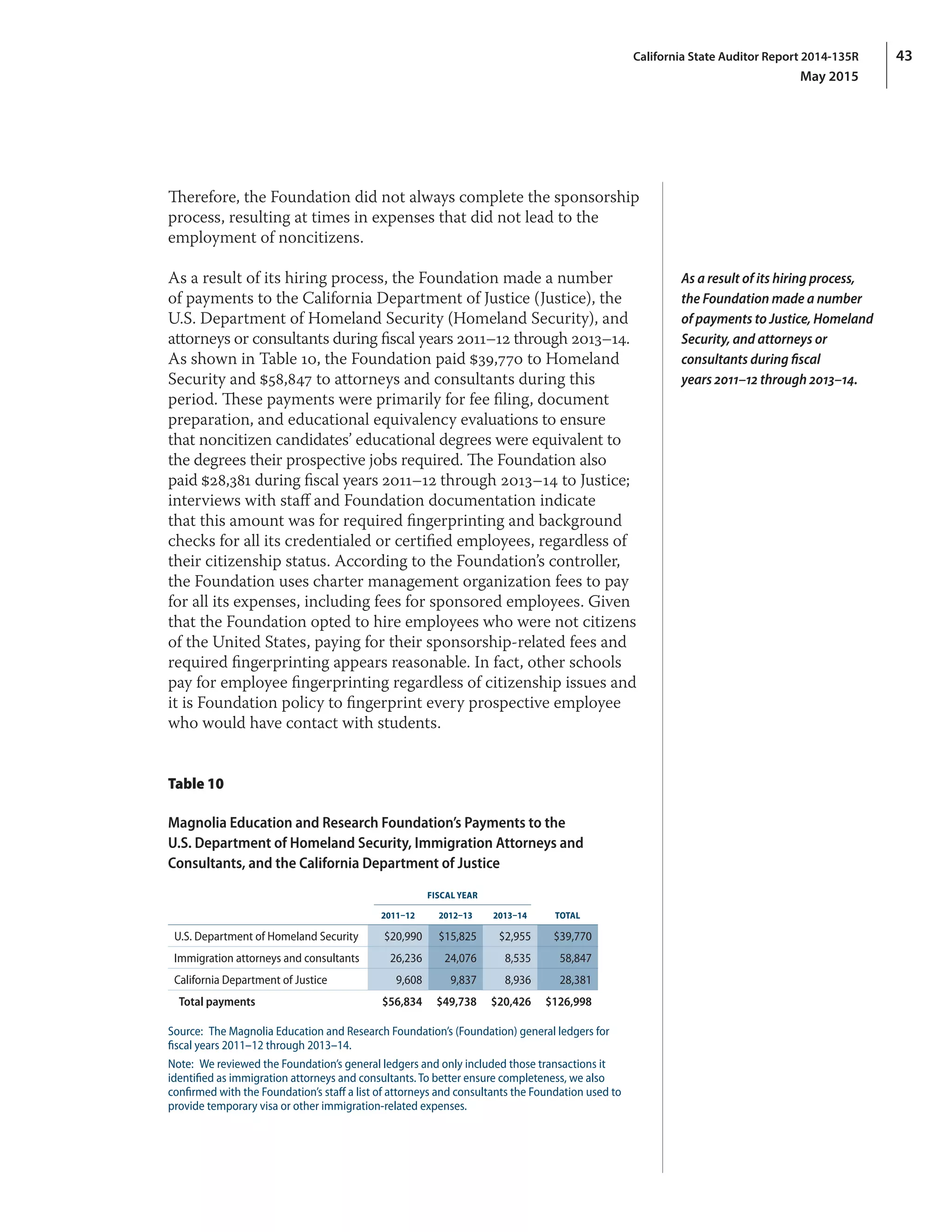
attorneys to determine their purpose. We found that the
Foundation paid roughly $28,000 to Justice, $40,000 to Homeland
Security, and $59,000 to immigration attorneys and consultants
during the three years of our audit period. The Foundation’s
payments to Justice were generally for fingerprinting and
background checks for all of its employees, and its payments to
Homeland Security and immigration attorneys or consultants
related to its hiring of employees from outside the United States.
Overall, we found that the payments appeared reasonable.
Finally, we examined the oversight LAUSD and other authorizing
entities provided to the academies and found that they generally
performed required site visits. However, we concluded that LAUSD
may have acted prematurely when it rescinded the charter renewal
petitions of two academies. Specifically, LAUSD based its June 2014
decision to rescind the charter renewal petitions for two academies
on a summary of an outside accounting firm’s draft findings that
did not provide key context about the financial situations of those
academies. Further, LAUSD did not provide sufficient time for
the Foundation to respond to its criticisms, nor did it share the
accounting firm’s findings in full with the Foundation until after it
had rescinded the two academies’ charter petitions. In addition,
LAUSD denied a third academy’s charter renewal petition several
months later in part because of the accounting firm’s report. In
March 2015 LAUSD and the Foundation reached a settlement
agreement, resulting in the renewal of all three academies’ charters.
Recommendations
Consistent with their charter petition terms, the Foundation
should ensure that each academy maintains the minimum required
cash reserve.
3California State Auditor Report 2014-135R
May 2015
To reduce the risk of misappropriation, the Foundation should
ensure that it appropriately authorizes all of its expenditures and
the academies’ expenditures. It should also ensure that it includes
sufficient supporting documentation for each expense, including
documenting the purpose of each transaction.
To increase transparency and reduce the risk of misuse of funds,
the Foundation should update its policies and procedures regarding
vendor selection to require that it maintain independence in its
relationships with vendors.
To safeguard the funds that the academies raise, the Foundation
should ensure that academy staff follow the fundraising procedures
in its accounting manual, especially with regards to the timeliness of
bank deposits and sign‑offs on cash‑count forms.
To ensure their compliance with state and federal laws,
the Foundation should continue to develop procedures
for the academies to follow when they report truancy data
to Education. The Foundation’s procedures should include a
process for the academies to document their calculations.
To improve its process for considering whether to rescind a charter
school’s conditionally renewed petition, LAUSD should develop
procedures to provide charter schools with a reasonable amount of
time for an appropriate response or to potentially remedy concerns.
Agency Comments
The Foundation stated that our recommendations are
helpful and indicated that it has already begun implementing
corresponding changes. LAUSD generally agreed to implement our
recommendations but believed additional clarification regarding its
past actions and future implementation of the recommendations
was warranted.
4 California State Auditor Report 2014-135R
May 2015
Blank page inserted for reproduction purposes only.
5California State Auditor Report 2014-135R
May 2015
Introduction
Background
In 1992 the Legislature enacted the Charter Schools Act, which
outlines procedures for establishing charter schools that receive
public funding but operate independently from the school district
structure and are generally not subject to laws governing school
districts. Groups of teachers, parents, and community leaders
or community‑based organizations can create charter schools
to provide instruction to students from kindergarten through
grade 12. State law allows nonprofit public‑benefit corporations,
which are subject to all governing state and federal laws related to
their corporate and tax status, to operate charter schools. When a
nonprofit operates multiple charter schools, it is commonly referred
to as a charter management organization (CMO). Generally, local
public school boards, the county boards of education, or in some
instances, the California State Board of Education (state board)
sponsor charter schools, and the agreements (or charters) between
the sponsoring boards and the charter organizers detail the charter
schools’ specific goals. According to the California Department
of Education (Education), more than 514,000 students—roughly
8 percent of California students in public schools—were enrolled in
1,125 charter schools for school year 2013–14.
Magnolia Educational and Research Foundation and Its
Charter Schools
The Magnolia Educational and Research Foundation (Foundation)
is a CMO that operates a network of charter schools throughout
California and it is responsible for ensuring its charter schools’
adherence to federal and state law. A board of directors governs the
Foundation and its schools (governing board) and is responsible
for major strategic and policy decisions related to the schools,
as well as ensuring their financial sustainability. The Foundation
and its schools emphasize a curriculum of science, technology,
engineering, and math (STEM) and aim to improve student
performance in reading, writing, and math; reduce dropout
rates; achieve high student attendance; and increase the number
of students pursuing STEM‑related careers. Headquartered in
Westminster, the Foundation is granted tax‑exempt status by the
Internal Revenue Service and the Franchise Tax Board. This exempt
status allows the Foundation to receive tax‑deductible contributions
in addition to not paying certain taxes. However, to qualify for its
exempt status, the Foundation cannot be operated in a manner that
creates a private benefit to any shareholder or individual with a
personal or private interest in the organization.
California State Auditor Report 2014-135R
May 2015
6
In fall 2002 the Foundation established its first charter school
in the San Fernando Valley, Magnolia Science Academy 1. As of
March 2015, the Foundation operated 11 charter schools located
in Los Angeles, San Diego, Orange, and Santa Clara counties,
as shown in Figure 1. The Los Angeles Unified School District
(LAUSD) is the authorizing entity for eight of the 11 Magnolia
Science Academies (academies). The San Diego Unified School
District, the Santa Clara County Office of Education, and the
state board, respectively, each authorize and oversee one of the
remaining three academies. We discuss the oversight these entities
provide in the following section.1
The academies generally perform well academically. In 1999
the Public School Accountability Act established the Academic
Performance Index (API), a single number that ranges from a
low of 200 to a high of 1,000 and reflects a school’s performance
level based on the results of statewide assessments. According
to Education, which calculates schools’ APIs, the number is a
cross‑sectional look at student achievement from one year to the
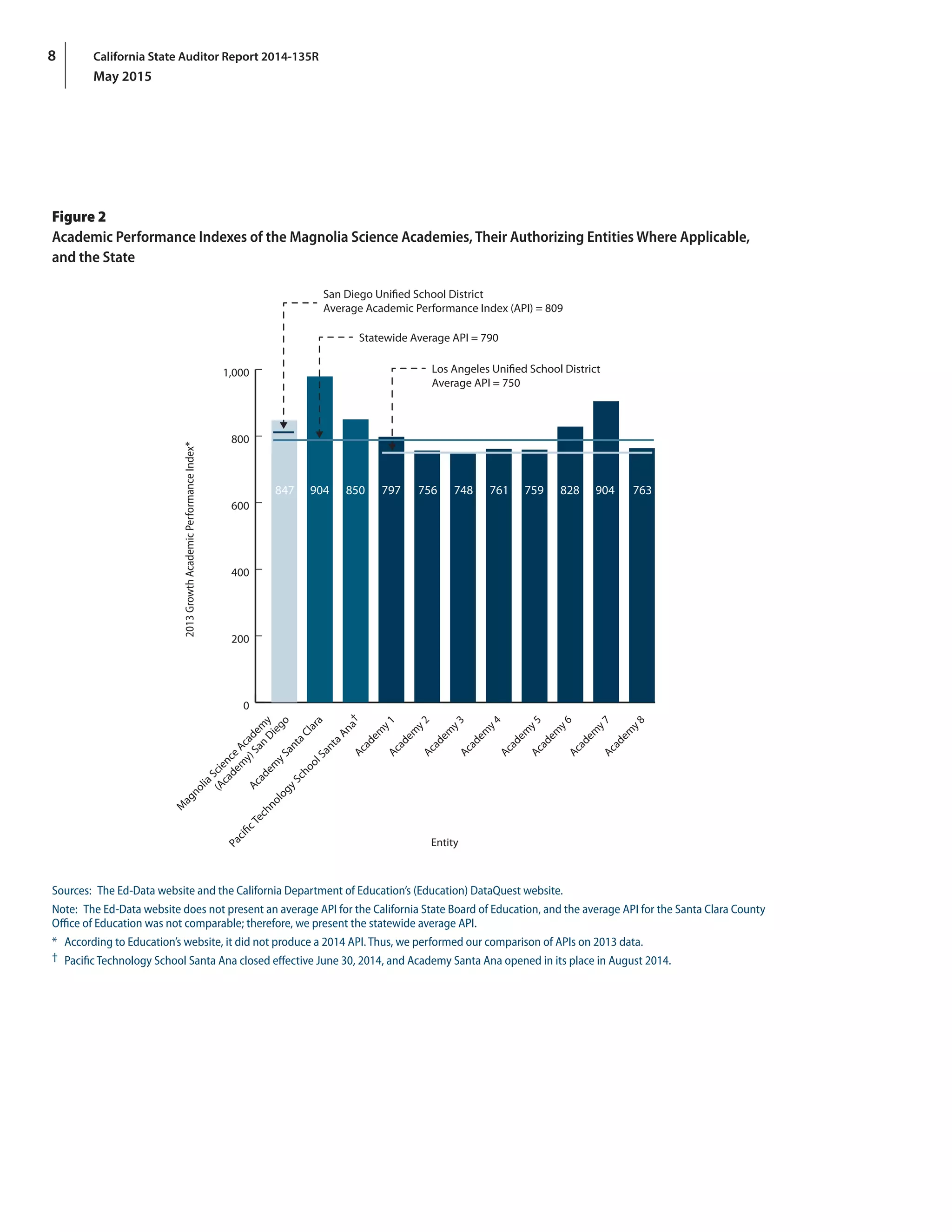
next and is used to rank schools. The academies’ APIs for 2013
ranged from a low of 748 at Academy 3 in Carson to a high of
904 at Academy 7 in Northridge and at Academy Santa Clara, as
shown in Figure 2 on page 8. Compared to the statewide API of
790, six academies had higher scores and five academies had lower
scores. However, where applicable, the academies generally had
higher APIs than their authorizing entities.2
According to their charters, the academies admit all students
residing in the State who wish to attend on a space‑available basis
as outlined in state law. The academies’ charters also outline their
plans to recruit low‑achieving and economically disadvantaged
students, which involves community meetings at regional
neighborhood centers and shopping malls and distributing
materials in English and Spanish to reach populations who are not
proficient in English. Table 1 on page 9 shows the enrollment and
diversity of the academies and their authorizing entities.
1	 The state board is the authorizer of Academy Santa Ana. We did not include a description of the
state board’s oversight process because we did not select this school for our review.
2	 The source we used did not present an average API for the state board, and the average API for
the Santa Clara County Office of Education was not comparable; therefore, we compared the
API’s of academies Santa Ana and Santa Clara to the statewide average API.
7California State Auditor Report 2014-135R
May 2015
Figure 1
Grade Levels and Locations of the Magnolia Science Academies
Sources:  The Magnolia Education and Research Foundation website, school charter petitions, and the Ed‑Data website.
Orange
Santa
Clara
Los Angeles
San Diego
Burbank
Culver City
Long Beach
Santa Ana
101
405
5
5
10
110
710
I
K
E
D F
H
C
J
G
B
A
Academy 1 6th
–12th
grade 18238 Sherman Way, Reseda, CA
Academy 2 6th
–12th
grade 17125 Victory Blvd., Van Nuys, CA
Academy 3 6th
–12th
grade 1254 East Helmick St., Carson, CA
Academy 4 6th
–12th
grade 11330 West Graham Place, Los Angeles, CA
Academy 5 6th
–12th
grade 18230 Kittridge St., Reseda, CA
Academy 6 6th
–11th
grade 3754 Dunn Dr., Los Angeles, CA
Academy 7 K–8th
grade 18355 Roscoe Blvd., Northridge, CA
Academy 8 6th
–8th
grade 6411 Orchard Ave., Bell, CA
Academy San Diego 6th
–8th
grade 6365 Lake Atlin Ave., San Diego, CA
Academy Santa Ana 6th
–12th
grade 102 Baker St., Costa Mesa, CA
Academy Santa Clara 6th
–12th
grade 2720 Sonoma Place, Santa Clara, CA
NAME GRADE LEVEL LOCATION
Magnolia Science Academy (Academy)
8 California State Auditor Report 2014-135R
May 2015
Figure 2
Academic Performance Indexes of the Magnolia Science Academies, Their Authorizing Entities Where Applicable,
and the State
2013GrowthAcademicPerformanceIndex*
0
200
400
600
800
1,000
(Academ
y)San
Diego
M
agnoliaScience
Academ
y
Academ
ySantaClara
Academ
y1Academ
y2Academ
y3Academ
y4
Academ
y5Academ
y6Academ
y7Academ
y8
PacificTechnologySchoolSanta
Ana†
San Diego Unified School District
Average Academic Performance Index (API) = 809
Statewide Average API = 790
Los Angeles Unified School District
Average API = 750
Entity
847 904 850 797 756 748 761 759 828 904 763
Sources:  The Ed‑Data website and the California Department of Education’s (Education) DataQuest website.
Note:  The Ed‑Data website does not present an average API for the California State Board of Education, and the average API for the Santa Clara County
Office of Education was not comparable; therefore, we present the statewide average API.
*	 According to Education’s website, it did not produce a 2014 API. Thus, we performed our comparison of APIs on 2013 data.
†	 Pacific Technology School Santa Ana closed effective June 30, 2014, and Academy Santa Ana opened in its place in August 2014.
9California State Auditor Report 2014-135R
May 2015
Table 1
Enrollment and Diversity of the Magnolia Science Academies and Their Authorizing Entities for
School Year 2013–14
PERCENTAGE OF ENROLLMENT
ETHNICITY
ENTITY ENROLLMENT
SOCIO‑ECONOMICALLY
DISADVANTAGED
HISPANIC
OR LATINO
AFRICAN
AMERICAN WHITE ASIAN FILIPINO OTHER*
Magnolia Science Academy (Academy) 1 538 92.8% 81.0% 0.9% 7.8% 5.0% 4.7% 0.6%
Academy 2 440 79.8 75.2 3.0 11.8 3.9 4.1 2.0
Academy 3 426 89.7 46.7 49.3 1.2 0.5 0.9 1.4
Academy 4 202 76.2 64.9 13.4 15.3 3.4 1.0 2.0
Academy 5 240 90.8 84.6 0.4 6.7 4.6 3.3 0.4
Academy 6 137 72.3 57.7 21.9 8.0 2.9 4.4 5.1
Academy 7 301 71.1 61.5 3.3 19.9 7.0 5.0 3.3
Academy 8 497 94.4 97.0 0.0 3.0 0.0 0.0 0.0
Academy Average 348 83.4 71.1 11.5 9.2 3.4 2.9 1.9
Los Angeles Unified School District 653,826 79.1 73.5 9.2 9.3 4.1 2.0 1.9
Academy San Diego 355 23.9 25.1 4.2 53.8 3.7 0.8 12.4
San Diego Unified School District 130,303 60.2 46.7 9.7 23.1 8.5 5.1 6.9
Pacific Technology School Santa Ana† 176 50.6 52.8 0.6 33.5 5.7 1.1 6.3
Orange County‡ 500,487 50.9 48.7 1.5 28.8 15.0 1.9 4.1
Academy Santa Clara 489 21.3 13.3 7.8 23.1 51.1 1.0 3.7
Santa Clara County§ 276,175 41.1 39.2 2.3 21.4 27.7 4.2 5.2
Source:  The California Department of Education’s DataQuest enrollment report for school year 2013–14.
*	 Other includes American Indian or Alaska Native, Pacific Islander, Two or More Races, and Not Reported.
†	 Pacific Technology School Santa Ana closed effective June 30, 2014, and Academy Santa Ana opened in its place in August 2014.
‡	 We present enrollment and diversity information for Orange County because the Pacific Technology School Santa Ana was authorized by the
California State Board of Education and is located within Orange County.
§	 We present enrollment and diversity for Santa Clara County because the authorizer of Academy Santa Clara—the Santa Clara County Office of
Education—was not comparable and the Academy is located in Santa Clara County.
Authorizing Entities’Oversight of the Academies 
Charter schools receive external oversight from the entities
authorizing their charters. According to Education’s website,
these authorizing entities are responsible for ensuring that charter
schools operate in compliance with all applicable laws and the
10 California State Auditor Report 2014-135R
May 2015
terms of their charters. As shown in the text box,
state law requires the authorizing entities to
perform various functions, including performing
annual visits and providing a contact person for
each charter school it authorizes. State law allows
authorizing entities to charge the charter schools
under their authority for the actual costs
of oversight.
Los Angeles Unified School District
As previously stated, LAUSD is the authorizing
entity for eight of the 11 academies the Foundation
operates. According to its website, LAUSD is
the second largest school district in the nation
and enrolls over 650,000 students—more than
10 percent of all students enrolled in the State
during school year 2013–14. The LAUSD Board
of Education (board) and a superintendent of
schools provide leadership to the LAUSD. LAUSD
states on its website that it views charter schools as integral to its
offerings and an opportunity to teach both students and educators.
According to LAUSD’s website, 248 charter schools are currently
under its jurisdiction, serving approximately 136,778 students in
kindergarten through 12th
grade.
To oversee the charter schools it authorizes, LAUSD created the
Charter Schools Division (division) in 1993. Division staff review,
process, and provide recommendations to the board on whether to
approve or deny charter petitions in open board meetings for new
and renewing charter school petitions. The division also performs
oversight functions and provides support for LAUSD‑authorized
charter schools. The division uses its Administrative Procedures
for Charter School Authorizing (authorizing procedures), which it
last revised in September 2013, and its Policy for Charter School
Authorizing, which it last revised in February 2012, to guide its
work and to give charter school governing boards, administrators,
staff, and the public a clear understanding of LAUSD’s
administrative procedures and authorizing policy. The authorizing
procedures describe the division’s review of new charter petitions,
the division’s oversight processes, and the charter‑petition
renewal process.
In 1998 the board created the LAUSD Office of the Inspector
General (inspector general), which conducts independent audits,
reviews, and investigations of LAUSD’s operations, contracts, and
vendors. Under state law, the inspector general may subpoena
Select Statutory Responsibilities of
Charter‑Authorizing Entities
State law requires charter‑authorizing entities to do the
following for the charter schools they authorize:
•	 Visit each charter school at least annually.
•	 Ensure that each charter school complies with
reporting requirements.
•	 Monitor the fiscal condition of each charter school.
•	 Provide a contact person for each charter school.
•	 Provide timely notification to the California
Department of Education (Education) if it revokes a
school’s charter or grants or denies the renewal of
a charter. It must also inform Education if a charter
school will cease operations.
Source:  California Education Code, Section 47604.32.
11California State Auditor Report 2014-135R
May 2015
witnesses; administer oaths or affirmations; take testimony; and
compel the production of all information, such as documents,
reports, and other data it deems relevant. According to the
deputy inspector general for internal audits, the inspector general
supports the division’s oversight efforts through periodic audits and
investigations, generally at the request of the division.
San Diego Unified School District
The San Diego Unified School District (SDUSD) is the authorizing
entity for Academy San Diego. SDUSD is currently the second largest
school district in the State and oversees nearly 50 charter schools.
SDUSD’s Office of Charter Schools performs several functions,
including performing general oversight responsibilities; reviewing
and evaluating new, revised or amended, and renewal charter
petitions; and acting as liaison between SDUSD and the charter
school community. In December 2014 the SDUSD Board of Education
approved the charter renewal petition for Academy San Diego.
Santa Clara County Office of Education
The Santa Clara County Office of Education (SCCOE) is the
authorizing entity for Academy Santa Clara. SCCOE currently
authorizes 20 charter schools within Santa Clara County. The
SCCOE Board (county board) is responsible for providing oversight
of these charter schools. Similar to LAUSD’s and SDUSD’s charter
school divisions, the county superintendent performs annual
oversight visits, including budgeting and financial reviews, and
makes recommendations to the county board for new or renewal
charter petitions. According to SCCOE’s chief strategy officer, the
county superintendent conducted a comprehensive financial review
of Academy Santa Clara in December 2012 because of concerns
about its fiscal stability that arose during its charter renewal
process. Subsequently, in January 2013 the county board renewed
Academy Santa Clara’s charter petition, with the condition that the
academy rectify all financial concerns, which it did.
Recent Events Involving LAUSD, the Foundation, and
Certain Academies
The Foundation and certain academies have been the subject
of an inspector general audit, several performance and fiscal
reviews by the division, and a review by an outside accounting
firm. Specifically, in August 2012 the inspector general issued
an audit report (2012 audit) on academies 1, 2, and 3 that noted
control weaknesses in their governance structures, employment
California State Auditor Report 2014-135R
May 2015
12
documentation and qualification of staff, and admission and
enrollment requirements. It also noted various financial control
problems at the Foundation and the sites the inspector general
visited. The inspector general made 11 recommendations to
the Foundation, some of which concerned financial statement
disclosures, fund reserves, proper control of cash balances, bank
reconciliations, proper documentation for all disbursements,
and adequate support for journal entries. In its response to
the audit, the Foundation agreed with each of the inspector
general’s recommendations.
In December 2013 the Foundation submitted charter renewal
petitions to LAUSD for academies 6 and 7. At a board meeting
in March 2014, the division stated that the academies were
implementing the recommendations from the 2012 audit but that
the Foundation should build the cash reserves at four of its schools.
The division recommended that the board conditionally approve the
renewal of the charter petitions for academies 6 and 7. Consequently,
the board approved the petitions conditional on a further review
of the two academies’ fiscal processes and operations not resulting in
any material findings. To perform this review, the inspector general
contracted with the accounting firm Vicenti, Lloyd & Stutzman (VLS)
in March 2014.
Three months later, the division rescinded the board’s conditional
approval for academies 6 and 7. Specifically, on June 27, 2014, it
notified the Foundation that the renewal petitions LAUSD had
granted these schools for the period starting July 1, 2014, were
inoperative. In its letter to the Foundation, the division stated that
VLS’s review had caused it to conclude that academies 6 and 7 were
demonstrably unlikely to successfully implement the program set
forth in their renewal petitions pursuant to state law. In reaching its
conclusion, the division cited VLS’s findings related to the following:
•	 The financial insolvency of the Foundation and academies 6 and 7.
•	 The Foundation’s and academies’ fiscal mismanagement,
including not making certain disclosures in their audited
financial statements, their practice of engaging in interschool
borrowing, their failure to follow generally accepted accounting
principles, their weak fiscal controls, and their questionable or
unexplained transactions.
•	 Weaknesses in the Foundation’s and academies’ governance and
administrative services.
In response to this decision, the Foundation went to court and
was granted a preliminary injunction to block LAUSD from
implementing the nonrenewal of the two schools’ charter petitions.
13California State Auditor Report 2014-135R
May 2015
The board subsequently approved another recommendation from
the division and denied a charter renewal petition for Academy 8 at
a public meeting in November 2014. The division again supported its
recommendation to deny the petition based on VLS’s findings related
to the Foundation and academies 6 and 7. However, in March 2015,
the Foundation and LAUSD reached a settlement agreement, which
included LAUSD authorizing the charter petitions of academies 6, 7,
and 8, the details of which we discuss further in Chapter 3.
Scope and Methodology
The Joint Legislative Audit Committee directed the California State
Auditor to conduct an audit of the Foundation and the academies to
determine if they appropriately expended state funds, complied with
state laws, and are financially solvent. The audit analysis that the audit
committee approved contained four separate objectives. We list the
objectives and the methods we used to address them in Table 2.
Table 2
Audit Objectives and the Methods Used to Address Them
AUDIT OBJECTIVE METHOD
1 Review and evaluate the laws, rules,
and regulations significant to the
audit objectives.
Reviewed the applicable laws, rules, and regulations for each objective.
2 For a minimum of four Magnolia
Science Academies (academies),
determine the following for the most
recent three‑year period:
During our selection of four academies for review, we considered litigation that was pending at
the time for academies 6 and 7, as well as a prior audit performed on academies 1, 2, and 3. Of the
remaining three schools authorized by the Los Angeles Unified School District (LAUSD), we selected
Academy 5 and Academy 8 for our review. We also selected Academy Santa Clara and Academy
San Diego because they were authorized by other entities and because Academy Santa Ana had
recently opened.
a.  Evaluate whether the academies
have appropriately expended
state funding in providing
educational resources to
their students.
•	 Obtained and reviewed the final budgets and financial reports the Magnolia Educational and
Research Foundation (Foundation) submitted to charter‑authorizing entities (charter authorizers)
for the four academies for fiscal years 2011–12 through 2013–14. Identified the source and
amount of state funding that the four academies received during those fiscal years. We determined
if the academies’final budgets correctly identified and segregated categorical state funding and
compared the expenditures in the financial reports with the academies’budgets.
•	 Reviewed changes in state funding provided to charter schools under the Local Control Funding
Formula and evaluated the audited financial statements at the four academies we selected for
fiscal years 2011–12 through 2013–14 to determine compliance with these changes.
•	 Interviewed staff at the Foundation to determine the controls in place to ensure that the
academies appropriately expend state funds and to identify the assistance and oversight they
provide to the academies in creating their budgets.
•	 Reviewed the Foundation’s policies and procedures regarding budget creation, implementation,
and monitoring.
•	 Interviewed staff at each of four academies we selected for review to develop an understanding of
how they report accounting and expenditure information to the Foundation, how they create their
academy budgets, and what internal controls they have in place related to their expenditure of
state funds.
•	 We also performed testing of expenditures at the four academies we selected as part of the
method we describe to address Objective 2(c).
continued on next page . . .
14 California State Auditor Report 2014-135R
May 2015
AUDIT OBJECTIVE METHOD
b.  Review a selection of payroll
expenditures and vendor
agreements for academies and
identify any irregularities.
•	 Interviewed staff at the Foundation and at each of the four academies we selected for review to
understand the policies, procedures, and practices regarding payroll expenditures.
•	 Reviewed the payroll transactions in the general ledgers of the four academies we selected to
identify any duplicate payments or payments that appeared out of the ordinary during the past
three fiscal years.
•	 Judgmentally selected 20 individual salary expenditures at each academy and tested those
expenditures against supporting documentation to determine if the payroll expenditures had
sufficient support and had been processed accurately.
•	 Obtained vendor agreements that were active during the past three years for the four academies
we selected and judgmentally selected five vendor agreements for each academy. We reviewed
supporting documentation for these agreements to determine if they were compliant with
relevant laws, regulations, policies, and procedures. We also looked for potential conflicts of
interest between vendors and officials at the Foundation.
c.  To the extent possible, identify
any misappropriation of funds by
the academies.
•	 Reviewed the Foundation’s current and prior accounting manuals for policies and procedures
related to documenting and authorizing expenditures and to identify any controls to avoid
misappropriation of funds.
•	 Interviewed Foundation staff to gain an understanding of how the Foundation
processes purchases.
•	 Judgmentally selected 45 expenditure transactions at each of the four academies we
selected—180 total transactions—and determined whether the selected expenditures had
sufficient supporting documentation, were in compliance with the Foundation’s established
policies and procedures, and were in line with the academy’s educational mission.
•	 Judgmentally selected five debit card transactions at each of the four academies we selected that
were over $500 and reviewed supporting documentation to assess whether the Foundation’s
controls over debit card purchases were an effective means of preventing misuse and
misappropriation of state funds.
d.  Review and evaluate whether
the academies complied with
state laws pertaining to the
reporting of truancy data
and reporting of Academic
Performance Index (API) scores.
•	 Interviewed staff at the Foundation and the four academies we selected to develop an
understanding of the process for reporting truancy data to the California Department of
Education  (Education).
•	 Obtained and reviewed the Foundation’s policies and procedures for reporting truant students to
parents for school years 2011–12 through 2013–14.
•	 Compared the Foundation’s attendance policies and procedures with those of LAUSD, the
San Diego Unified School District, and the Santa Clara County Office of Education.
•	 Obtained and reviewed student attendance reports at the four academies we selected for school
years 2011–12 through 2013–14 and recalculated the academies’truancy rates. We then compared
those rates with the rates displayed on Education’s website.
•	 Interviewed staff at Education and reviewed information on Education’s website regarding API and
determined that Education is responsible for calculating and reporting API for schools and school
districts. Therefore, we did not audit the API scores of the academies.
e.  Ascertain whether academies
engaged in fundraising and
determine whether there were
any fundraising irregularities.
•	 Reviewed the general ledgers of the Foundation and the four academies we selected to
determine the amount each generated from fundraising activities during fiscal years 2011–12
through 2013–14.
•	 Interviewed Foundation staff regarding its methodology for recording fundraising activities.
•	 Selected three approved fundraiser events from each of the four academies during school
years 2011–12 through 2013–14 and determined whether those events met the fundraising
requirements contained in the Foundation’s accounting manual.
•	 Reviewed the Foundation’s financial statements to determine whether it engaged in fundraising
activities over the past three fiscal years.
15California State Auditor Report 2014-135R
May 2015
AUDIT OBJECTIVE METHOD
3 To the extent possible, perform
the following:
•	 Reviewed the charter petitions for each academy to identify the responsibilities of the Foundation.
•	 Interviewed Foundation staff and principals at each of the four academies we selected to develop
an understanding of the ways in which the Foundation supports the academies.
•	 Reviewed the annual budgets for the past three fiscal years of the four academies we selected and
identified any trends.
a.  Evaluate whether the Foundation
has effectively supported
the academies in providing
education consistent with
their charters.
b.  Evaluate the financial solvency
of the Foundation and
the academies.
•	 Identified three key measures of solvency, including required cash reserves based on state
regulations; the Government Accounting, Auditing, and Financial Reporting definition of solvency
(government accounting standard); and the Internal Revenue Service’s definition of financial
solvency (IRS standard).
•	 Determined whether each academy was financially solvent under each of the three standards
during fiscal years 2011–12 through 2013–14. We also evaluated the solvency of the Foundation
as a single entity and as a consolidated entity using the government accounting standard and
IRS standard.
c.  Determine whether the
Foundation borrowed money
from academies. If so, determine
whether it was appropriately
documented, the purpose, and
the impact to the academies’
ability to deliver a high‑quality
education consistent with
their charter.
•	 Determined loan amounts between the Foundation and the academies using the applicable
general ledgers and audited financial statements during fiscal years 2011–12 through 2013–14.
•	 Interviewed staff at the Foundation to determine the purpose of the loans.
•	 Reviewed total expenses and expenses per student at the five academies that loaned money
to the Foundation to determine whether those loans impacted spending at those academies.
Reviewed interim financial reports for academies 1 and 8 to again determine whether loan activity
impacted spending during the past three fiscal years.
d.  Evaluate the charter
management organization (CMO)
fees assessed by the Foundation
to the academies. Determine
whether the Foundation used
these fees consistent with
state law.
•	 Reviewed the charter petitions, budgets, and financial statements for all academies to determine
the CMO fees they paid to the Foundation during fiscal years 2011–12 through 2013–14.
•	 Reviewed the CMO fees the academies paid to the Foundation in the most recent three years.
Compared these fees to the records of CMO fee payments in the Foundation’s general ledger.
•	 Determined whether the Foundation used CMO fees to provide the services described in
charter petitions.
e.  Identify any misappropriation of
funds by the Foundation.
•	 Reviewed the legal structure of the Foundation and examined the restrictions placed on
the Foundation’s expenditure of funds based on relevant laws and regulations, including
organizational and operational tests for the Foundation to obtain and maintain tax exempt status.
•	 Interviewed Foundation staff to develop an understanding of the Foundation’s purchasing process.
•	 Reviewed the Foundation’s accounting manual to understand its controls over its purchasing
process to avoid misappropriation.
•	 Judgmentally selected 45 expenditures from the Foundation’s general ledger during the past
three fiscal years and evaluated the appropriateness of those transactions through supporting
documentation and appropriate approvals to determine whether the Foundation’s expenditures
were in line with its educational mission.
f.  Identify any payments made
by the Foundation to the
U.S. Department of Homeland
Security, the Department
of Justice, and immigration
attorneys, and the purpose for
such payments. Also, determine
the source and amount of
those payments.
•	 Reviewed the Foundation’s general ledgers to identify payments to the U.S. Department of
Homeland Security, the California Department of Justice, and immigration attorneys for fiscal years
2011–12 through 2013–14.
•	 Interviewed Foundation staff regarding the sources and amounts of the payments we identified.
Obtained any supporting documentation.
continued on next page . . .
16 California State Auditor Report 2014-135R
May 2015
AUDIT OBJECTIVE METHOD
g.  Review a selection of vendor
agreements made by the
Foundation and identify
any irregularities.
•	 Reviewed the Statements of Economic Interests—commonly known as Form 700s—for
Foundation and academy staff who are required to file these forms. Determined whether any
potential conflicts of interest exist.
•	 Obtained all of the Foundation’s vendor agreements for the last three fiscal years. Selected five
vendor agreements for testing for each fiscal year. Obtained supporting documentation for these
five agreements.
•	 Determined whether the Foundation’s vendor agreements complied with the California School
Accounting Manual and the Foundation’s accounting manual.
h.  Ascertain whether the
Foundation engaged in
fundraising and determine
whether there were any
fundraising irregularities.
Combined the procedures for this objective with those for Objective 2(e).
4 Review and assess any other issues
that are significant to the Foundation
and the academies.
Examined the oversight performed by the charter authorizers of the four academies we selected for
review, as well as the actions taken by LAUSD in its rescinding of the charters of three academies.
Sources:  California State Auditor’s analysis of the Joint Legislative Audit Committee audit request number 2014‑135, the planning documents, and
analysis of information and documentation identified in the table column titled Method.
Assessment of Data Reliability
In performing this audit, we relied upon electronic data files
extracted from the information system listed in Table 3. The
U.S. Government Accountability Office, whose standards we are
statutorily required to follow, requires us to assess the sufficiency
and appropriateness of computer‑processed information that is
used to support our findings, conclusions, or recommendations.
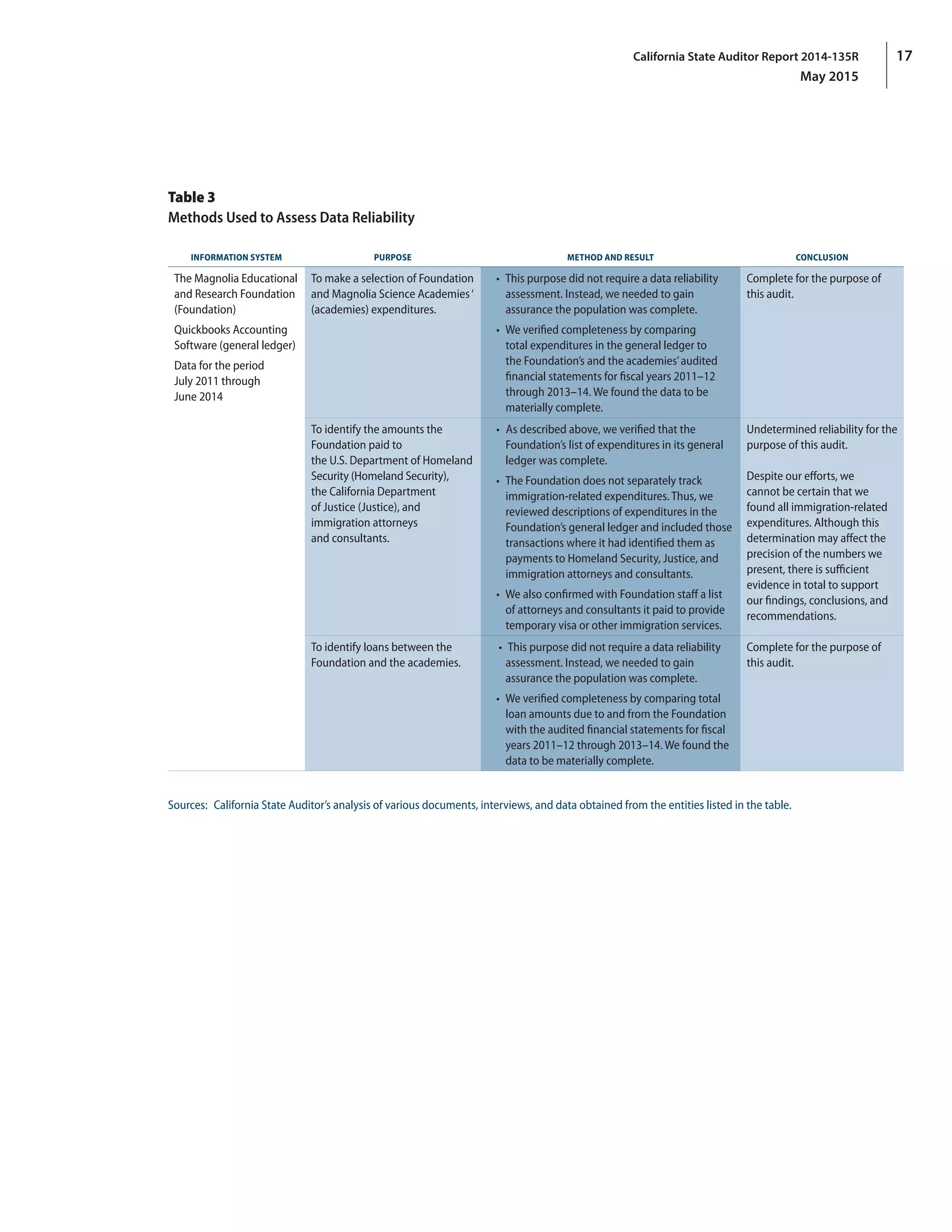
Table 3 shows the results of this analysis.
17California State Auditor Report 2014-135R
May 2015
Table 3
Methods Used to Assess Data Reliability
INFORMATION SYSTEM PURPOSE METHOD AND RESULT CONCLUSION
The Magnolia Educational
and Research Foundation
(Foundation)
Quickbooks Accounting
Software (general ledger)
Data for the period
July 2011 through
June 2014
 
 
To make a selection of Foundation
and Magnolia Science Academies‘
(academies) expenditures.
•  This purpose did not require a data reliability
assessment. Instead, we needed to gain
assurance the population was complete.
•  We verified completeness by comparing
total expenditures in the general ledger to
the Foundation’s and the academies’audited
financial statements for fiscal years 2011–12
through 2013–14. We found the data to be
materially complete.
Complete for the purpose of
this audit.
To identify the amounts the
Foundation paid to
the U.S. Department of Homeland
Security (Homeland Security),
the California Department
of Justice (Justice), and
immigration attorneys
and consultants.
•  As described above, we verified that the
Foundation’s list of expenditures in its general
ledger was complete.
•  The Foundation does not separately track
immigration‑related expenditures. Thus, we
reviewed descriptions of expenditures in the
Foundation’s general ledger and included those
transactions where it had identified them as
payments to Homeland Security, Justice, and
immigration attorneys and consultants.
•  We also confirmed with Foundation staff a list
of attorneys and consultants it paid to provide
temporary visa or other immigration services.
Undetermined reliability for the
purpose of this audit.
Despite our efforts, we
cannot be certain that we
found all immigration‑related
expenditures. Although this
determination may affect the
precision of the numbers we
present, there is sufficient
evidence in total to support
our findings, conclusions, and
recommendations.
To identify loans between the
Foundation and the academies.
 •  This purpose did not require a data reliability
assessment. Instead, we needed to gain
assurance the population was complete.
•  We verified completeness by comparing total
loan amounts due to and from the Foundation
with the audited financial statements for fiscal
years 2011–12 through 2013–14. We found the
data to be materially complete.
Complete for the purpose of
this audit.
Sources:  California State Auditor’s analysis of various documents, interviews, and data obtained from the entities listed in the table.
18 California State Auditor Report 2014-135R
May 2015
Blank page inserted for reproduction purposes only.
19California State Auditor Report 2014-135R
May 2015
Chapter 1
ALL MAGNOLIA SCIENCE ACADEMIES WERE SOLVENT
AND ALL LOANS BUT ONE WERE REPAID BY JULY 2014
Chapter Summary
Due in part to state funding delays, some of the Magnolia
Science Academies (academies) struggled financially during fiscal
years 2011–12 and 2012–13. As a result, several of the academies—
and the Magnolia Education and Research Foundation (Foundation)
when viewed as a single entity—were insolvent under certain
financial measures. However, the Foundation and academies, when
viewed as one consolidated organization, were solvent during fiscal
years 2011–12 through 2013–14 regardless of which measure we
used. To keep struggling academies open, the Foundation acted as
an intermediary in facilitating loans between the academies, so that
academies with extra funds effectively lent those funds to academies
that were struggling. However, the Foundation at one point retained
up to $2.9 million in loaned funds from its schools during fiscal
years 2011–12 through 2013–14. The Foundation tracked these
cash transfers it facilitated between itself and its charter schools
as intercompany receivables and payables; however, we refer to
these transfers as loans, reflecting the Foundation’s stated intention
that they would be repaid. In addition, the Foundation did not
always charge struggling academies its full charter management
organization (CMO) fee.
By July 2014 all the academies were solvent under the three key
financial measures we considered, all but one academy had repaid
their loans, and the Foundation had repaid all of the funds it had
borrowed from the academies. We found no indication that the
financially strong academies that loaned funds during the period
we reviewed were harmed by these loans. Rather, these loans and
the reduction in the Foundation’s CMO fees played a key role in
keeping the struggling academies open, allowing them to fulfill their
mission to educate children.
Despite Past Financial Difficulties, the Academies Were Solvent Under
Three Key Financial Measures at the End of Fiscal Year 2013–14
Delays in state funding at least partially contributed to the financial
difficulties for some academies in fiscal years 2011–12 and 2012–13,
leading several to be financially insolvent under certain measures.
However, because of the strength of the Foundation and academies’
organization as a whole, the struggling academies were able to
California State Auditor Report 2014-135R
May 2015
20
remain operational even when insolvent. Further, they improved
their financial condition to the point that by July 2014, all the
academies were solvent under the measures we considered.
To determine the solvency of the academies, we relied on
three measures. State regulations contain provisions for cash
reserves specific to school districts, which the California
Department of Education (Education) commonly refers to as a
solvency requirement. Although neither the California Education
Code nor relevant state regulations describe exactly how solvency
should be measured for individual charter schools, most academies
acknowledged and, in some cases, agreed to the state regulation
reserves requirement as stated in their current charter petitions.
The one exception we noted was Academy Santa Clara, which
contains no such clause in its charter petition. To broaden our
assessment to include other common measures of solvency, we
also used two additional standards: the Governmental Accounting,
Auditing, and Financial Reporting standard (government
accounting standard) and the Internal Revenue Service Standard
(IRS standard).
•	 Cash reserve requirement: Each charter school, based on
commitments made in its approved charter petition, could be
required to maintain a specified reserve of up to 5 percent of total
annual expenditures, depending on average daily attendance.
•	 Government accounting standard: In the context of a Chapter 9
bankruptcy, insolvency is a government agency’s inability to pay
its obligations as they become due.
•	 IRS standard: Financial insolvency is when an entity’s total
liabilities exceed total assets.
Although we applied the three measures to each individual
academy, it is important to note that the academies’ charters,
which serve as the primary written agreement between the
charter‑authorizing entity and the charter school, do not include
any agreements for the Foundation or the academies to meet the
government accounting standard or the IRS standard. Further,
the cash reserve requirement does not specifically apply to the
Foundation, either as a single entity without the academies or as a
consolidated entity with the academies.
The academies’ degree of solvency varied during fiscal years 2011–12
and 2012–13, as shown in Table 4. Four of the Foundation’s 12 charter
schools in operation at the time were solvent under all three
measures during both years. However, the remaining eight charter
schools—academies 1, 2, 4, 6, 7, San Diego, Santa Clara, and the
Pacific Technology School Orangevale—were insolvent using at
The academies improved their
financial condition to the point that
by July 2014 all of them were solvent
under the measures we considered.
21California State Auditor Report 2014-135R
May 2015
least one measure in fiscal year 2011–12. During fiscal year 2012–13,
three of these schools improved their financial position and were
solvent using all measures. Only one academy was ever insolvent
under all three measures—Academy 6 during fiscal year 2012–13.
The academies fared best using the cash reserve requirement—all
but one were solvent using this measure in fiscal year 2011–12, all but
two were solvent in fiscal year 2012–13, and all were solvent using this
measure in fiscal year 2013–14.
Table 4
Financial Solvency of the Magnolia Educational and Research Foundation (Foundation) and Its Charter Schools
FISCAL YEAR 2011–12 FISCAL YEAR 2012–13 FISCAL YEAR 2013–14
ENTITY
CASH RESERVE
REQUIREMENT*
GOVERNMENT
ACCOUNTING,
AUDITING, AND
FINANCIAL
REPORTING
STANDARD
INTERNAL
REVENUE
SERVICE
STANDARD
CASH RESERVE
REQUIREMENT*
GOVERNMENT
ACCOUNTING,
AUDITING, AND
FINANCIAL
REPORTING
STANDARD
INTERNAL
REVENUE
SERVICE
STANDARD
CASH RESERVE
REQUIREMENT*
GOVERNMENT
ACCOUNTING,
AUDITING, AND
FINANCIAL
REPORTING
STANDARD
INTERNAL
REVENUE
SERVICE
STANDARD
Magnolia Science
Academy (Academy) 1
5        
Academy 2  5  5     
Academy 3         
Academy 4  5 5  5 5   
Academy 5         
Academy 6  5 5 5 5 5   
Academy 7  5 5  5 5   
Academy 8         
Academy San Diego  5 5  5    
Academy Santa Clara  5 5      
Pacific Technology
School Orangevale†  5 5    NA NA NA
Academy Santa Ana‡         
Foundation NA 5 5 NA 5 5 NA 5 5
Foundation as a
consolidated entity
NA   NA   NA  
Sources:  The Foundation and academies’audited financial statements for fiscal years 2011–12 through 2013–14.
 = Yes
5 = No
NA = Not applicable.
n = Indicates the entity met all three solvency standards during the fiscal year.
n = Indicates the entity met at least one solvency standard during the fiscal year.
n = Indicates the entity did not meet any of the three solvency standards during the fiscal year.
*	 The California Education Code, Section 33128.3 (repealed January 1, 2015), temporarily reduced the required reserve amount in fiscal years 2011–12
and 2012–13 to one‑third the percentage in state regulations.
†	 PacificTechnology School Orangevale was closed effective June 30, 2013; therefore, the school did not have financial information for fiscal year 2013–14.
‡	 Academy Santa Ana was rechartered in 2014 and changed its name from Pacific Technology School Santa Ana.
22 California State Auditor Report 2014-135R
May 2015
We also analyzed the Foundation’s solvency both as a single entity
without the academies and as a consolidated entity with all of
the academies. We determined the Foundation was insolvent as
a single entity under both the government accounting standard
and the IRS standard in all three fiscal years of our audit period.
However, we found that the Foundation and academies as a
consolidated organization were solvent throughout the audit period
regardless of which measure of solvency we used. Further, the state
funding delays that occurred in fiscal years 2011–12, 2012–13, and
2013–14 contributed to the financial problems of some academies.
According to the Legislative Analyst’s Office, the State relied heavily
on delayed educational funding to achieve the State’s General Fund
savings during the years in question—in total, it delayed more than
$10 billion in educational funding during fiscal year 2011–12. As
shown in Table 5, Education delayed state funding to the academies
during fiscal years 2011–12 through 2013–14 by roughly $4.5 million,
$3.3 million, and $2.2 million, respectively. According to an
education fiscal services consultant with Education, the Legislature
established a statewide total to be delayed and Education then
divided that amount across all schools, resulting in equal percentage
reductions in each school’s monthly apportionment.
Table 5
Delayed State Apportionment Funding for the Magnolia Educational and Research Foundation’s Charter Schools
AMOUNTS DELAYED
ENTITY
FISCAL YEAR
2011–12
FISCAL YEAR
2012–13
FISCAL YEAR
2013–14
Magnolia Science Academy (Academy) 1 $839,710 $422,722 $490,115
Academy 2 529,648 393,877 312,355
Academy 3 438,408 472,444 272,409
Academy 4 317,791 227,524 86,505
Academy 5 392,379 235,562 91,117
Academy 6 177,103 81,813 81,357
Academy 7 184,531 328,061 207,699
Academy 8 812,084 462,567 354,728
Academy San Diego 203,461 113,390 40,811
Academy Santa Clara 138,584 276,181 51,716
Pacific Technology School Orangevale* 194,731 148,842 NA
Academy Santa Ana† 265,905 163,130 181,378
Total amounts delayed for these
charter schools $4,494,335 $3,326,113 $2,170,190
Sources:  The California Department of Education’s certifications of principal apportionments for fiscal years 2011–12 through 2013–14.
NA = Not applicable.
*	 Pacific Technology School Orangevale was closed effective June 30, 2013; therefore, the school did not have financial information for
fiscal year 2013–14.
†	 Academy Santa Ana was rechartered in 2014 and changed its name from Pacific Technology School Santa Ana.
23California State Auditor Report 2014-135R
May 2015
According to the Foundation’s chief financial officer (CFO), these
delays caused temporary cash‑flow deficiencies in the smaller and
less‑established academies. He explained that the smaller schools,
which have lower student enrollment, cannot benefit from
economies of scale; therefore, until they increase enrollment
and build healthy cash reserves, they are more affected by state
funding delays. Further, state funding delays had less effect on
some academies because they had other sources of funding,
such as funding from the Public Schools Choice Initiative of
2009, which provided selected low‑performing or newly formed
schools with additional financial support through the Los Angeles
Unified School District’s (LAUSD) Investing in Innovation grant.
Specifically, the LAUSD Board of Education voted for Academy 8
to receive such funding upon its inception in fiscal year 2010–11
because it was a new school designated to relieve overcrowding of
public schools. According to the principal at Academy 8, the grant
funding allowed Academy 8 to maintain a healthy financial position
even when faced with state funding delays.
Because the financial statements for the academies we reviewed
included the delayed payments as assets, they did not affect the
academies’ solvency under the government accounting standard
or the IRS standard. However, they had the potential to affect
academies’ solvency under the cash reserve requirement. Each of
the three academies that did not meet the cash reserve standard
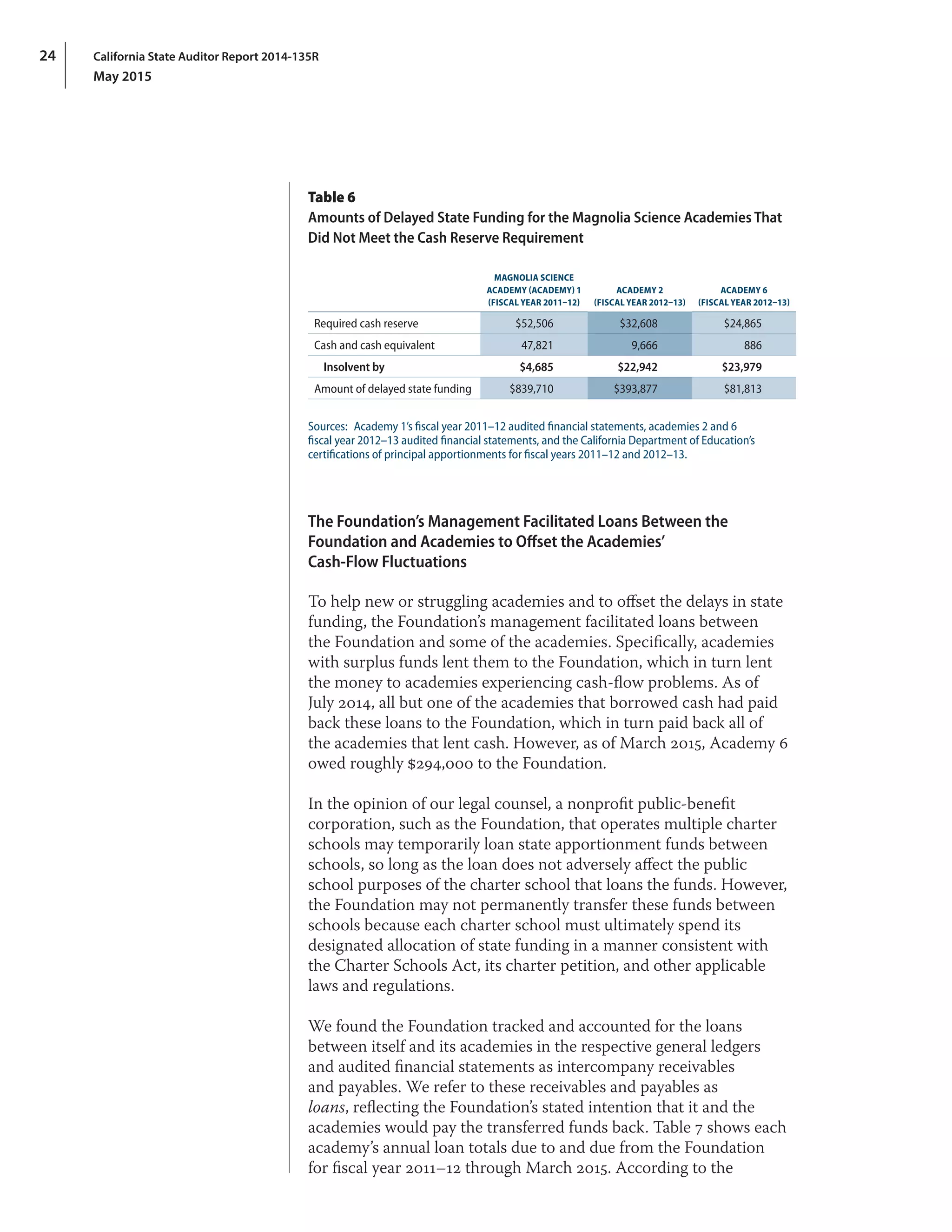
did so by less than $24,000, as shown in Table 6 on the following
page. Because the amount of delayed state funding for each of
these academies was larger than the amount by which they were
insolvent, they could have been solvent had they received the state
funding during the respective fiscal years. For example, Academy 6
needed about $24,000 in additional cash reserves in order to be
solvent in fiscal year 2012–13. That same year, the State delayed
providing it with $81,813 in state funding, which would have more
than made up for the needed amount. Similarly, Academy 1 fell
short of meeting its required cash reserve during fiscal year 2011–12
and Academy 2 fell short during fiscal year 2012–13; however, both
could have met their cash reserve requirements had they received
their state funding on time. Although delayed state funding partially
caused financial difficulties and questions of solvency for some
academies, the overall organization remained financially sound. As
a result, the financially struggling academies were able to continue
to operate. Furthermore, by July 2014, all academies were solvent
under all measures we considered.
Although delayed state funding
partially caused financial difficulties
and questions of solvency for some
academies, the overall organization
remained financially sound.
California State Auditor Report 2014-135R
May 2015
24
Table 6
Amounts of Delayed State Funding for the Magnolia Science Academies That
Did Not Meet the Cash Reserve Requirement
MAGNOLIA SCIENCE
ACADEMY (ACADEMY) 1
(FISCAL YEAR 2011–12)
ACADEMY 2
(FISCAL YEAR 2012–13)
ACADEMY 6
(FISCAL YEAR 2012–13)
Required cash reserve $52,506 $32,608 $24,865
Cash and cash equivalent 47,821 9,666 886
Insolvent by $4,685 $22,942 $23,979
Amount of delayed state funding $839,710 $393,877 $81,813
Sources:  Academy 1’s fiscal year 2011–12 audited financial statements, academies 2 and 6
fiscal year 2012–13 audited financial statements, and the California Department of Education’s
certifications of principal apportionments for fiscal years 2011–12 and 2012–13.
The Foundation’s Management Facilitated Loans Between the
Foundation and Academies to Offset the Academies’
Cash‑Flow Fluctuations
To help new or struggling academies and to offset the delays in state
funding, the Foundation’s management facilitated loans between
the Foundation and some of the academies. Specifically, academies
with surplus funds lent them to the Foundation, which in turn lent
the money to academies experiencing cash‑flow problems. As of
July 2014, all but one of the academies that borrowed cash had paid
back these loans to the Foundation, which in turn paid back all of
the academies that lent cash. However, as of March 2015, Academy 6
owed roughly $294,000 to the Foundation.
In the opinion of our legal counsel, a nonprofit public‑benefit
corporation, such as the Foundation, that operates multiple charter
schools may temporarily loan state apportionment funds between
schools, so long as the loan does not adversely affect the public
school purposes of the charter school that loans the funds. However,
the Foundation may not permanently transfer these funds between
schools because each charter school must ultimately spend its
designated allocation of state funding in a manner consistent with
the Charter Schools Act, its charter petition, and other applicable
laws and regulations.
We found the Foundation tracked and accounted for the loans
between itself and its academies in the respective general ledgers
and audited financial statements as intercompany receivables
and payables. We refer to these receivables and payables as
loans, reflecting the Foundation’s stated intention that it and the
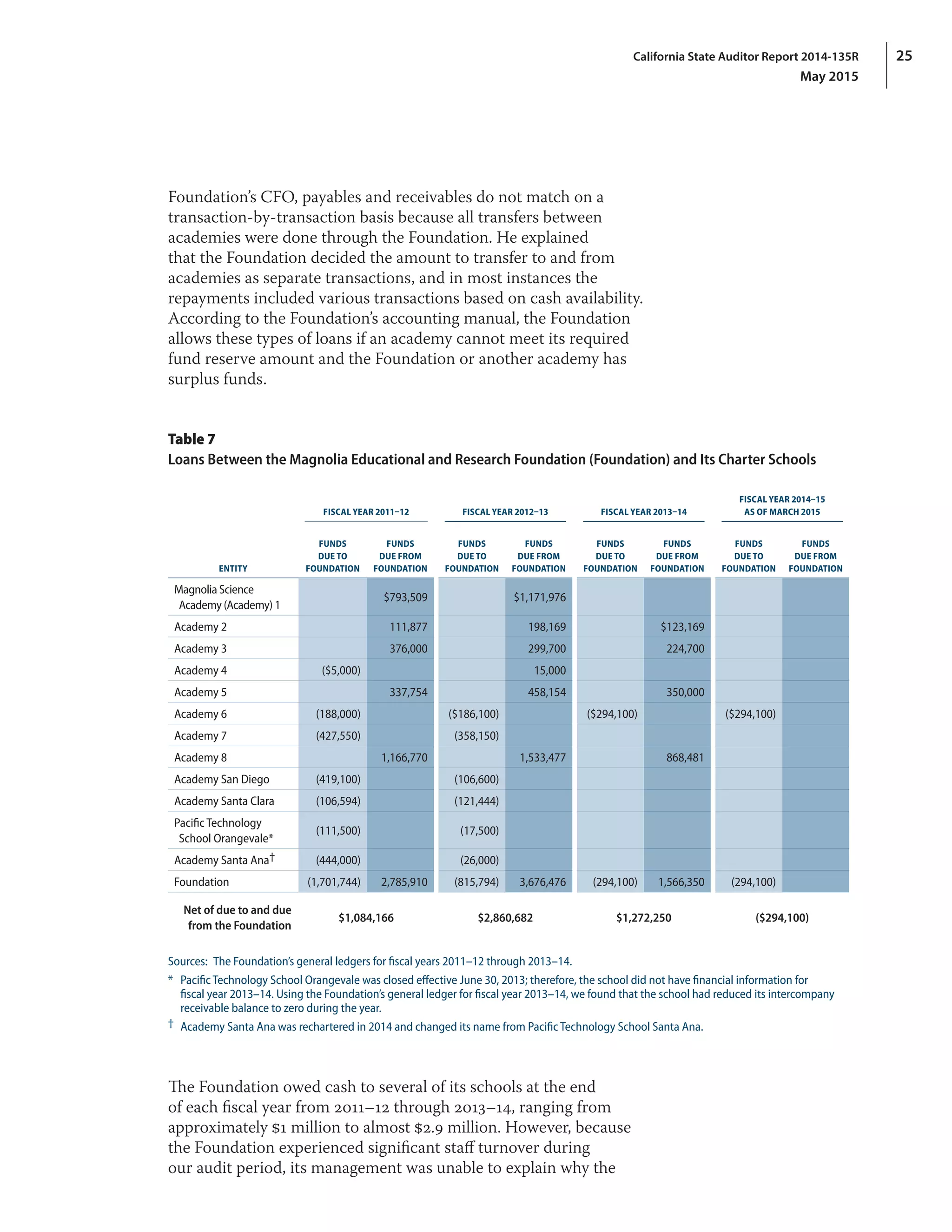
academies would pay the transferred funds back. Table 7 shows each
academy’s annual loan totals due to and due from the Foundation
for fiscal year 2011–12 through March 2015. According to the
25California State Auditor Report 2014-135R
May 2015
Foundation’s CFO, payables and receivables do not match on a
transaction‑by‑transaction basis because all transfers between
academies were done through the Foundation. He explained
that the Foundation decided the amount to transfer to and from
academies as separate transactions, and in most instances the
repayments included various transactions based on cash availability.
According to the Foundation’s accounting manual, the Foundation
allows these types of loans if an academy cannot meet its required
fund reserve amount and the Foundation or another academy has
surplus funds.
Table 7
Loans Between the Magnolia Educational and Research Foundation (Foundation) and Its Charter Schools
FISCAL YEAR 2011–12 FISCAL YEAR 2012–13 FISCAL YEAR 2013–14
FISCAL YEAR 2014–15
AS OF MARCH 2015
ENTITY
FUNDS
DUE TO
FOUNDATION
FUNDS
DUE FROM
FOUNDATION
FUNDS
DUE TO
FOUNDATION
FUNDS
DUE FROM
FOUNDATION
FUNDS
DUE TO
FOUNDATION
FUNDS
DUE FROM
FOUNDATION
FUNDS
DUE TO
FOUNDATION
FUNDS
DUE FROM
FOUNDATION
Magnolia Science
Academy (Academy) 1
$793,509 $1,171,976
Academy 2 111,877 198,169 $123,169
Academy 3 376,000 299,700 224,700
Academy 4 ($5,000) 15,000
Academy 5 337,754 458,154 350,000
Academy 6 (188,000) ($186,100) ($294,100) ($294,100)
Academy 7 (427,550) (358,150)
Academy 8 1,166,770 1,533,477 868,481
Academy San Diego (419,100) (106,600)
Academy Santa Clara (106,594) (121,444)
Pacific Technology
School Orangevale*
(111,500) (17,500)
Academy Santa Ana† (444,000) (26,000)
Foundation (1,701,744) 2,785,910 (815,794) 3,676,476 (294,100) 1,566,350 (294,100)
Net of due to and due
from the Foundation
$1,084,166 $2,860,682 $1,272,250 ($294,100)
Sources:  The Foundation’s general ledgers for fiscal years 2011–12 through 2013–14.
*	 Pacific Technology School Orangevale was closed effective June 30, 2013; therefore, the school did not have financial information for
fiscal year 2013–14. Using the Foundation’s general ledger for fiscal year 2013–14, we found that the school had reduced its intercompany
receivable balance to zero during the year.
†	 Academy Santa Ana was rechartered in 2014 and changed its name from Pacific Technology School Santa Ana.
The Foundation owed cash to several of its schools at the end
of each fiscal year from 2011–12 through 2013–14, ranging from
approximately $1 million to almost $2.9 million. However, because
the Foundation experienced significant staff turnover during
our audit period, its management was unable to explain why the
California State Auditor Report 2014-135R
May 2015
26
Foundation had not returned the excess funds to its academies.
Specifically, the CFO—who started with the Foundation in
November 2014—stated that he was not able to provide information
about why the Foundation retained the funds. In July 2014—the
same month that the Foundation responded to LAUSD’s rescinding
of the conditional charter petition renewals for academies 6 and 7 as
described in the Introduction—the Foundation paid back all of the
cash it owed to the academies. As of March 2015 the only outstanding
loan was from the Foundation to Academy 6 for $294,100. According
to the CFO, the Foundation’s board approved a repayment plan for
this loan in March 2105. According to this plan, Academy 6 will
reimburse roughly half of the balance it owes the Foundation at the
end of fiscal year 2014–15 and make monthly payments throughout
fiscal year 2015–16 for the remaining balance.
Although the Foundation accounted for these intercompany loans
as transactions in the applicable general ledgers, we confirmed with
its CFO that the Foundation did not document them with loan
agreements. According to the CFO, the Foundation considers itself
and all academies as one entity, similar to an agency with multiple
departments. As a result, the Foundation’s external auditor concluded
that executing loan agreements to document these transfers was
unnecessary because an organization cannot contract with itself.
However, we do not agree that the Foundation and its academies
should be considered one entity under charter school law for the
purposes of lending funds between academies. Had the Foundation
documented the details of these loans, such as repayment terms
and interest rates, it could have more easily demonstrated that
the loans were a temporary means to offset cash‑flow troubles at
certain schools.
As we previously described, temporary loans of state apportionment
funds may be permissible so long as the loan does not adversely
affect the public school purposes of the charter school that loans the
funds. According to the Foundation’s CFO, the lending academies
had excess funds; therefore, the loans did not negatively impact their
ability to serve students or meet the requirements of their approved
charter petitions. The principal of Academy 8, which provided a
significant portion of these loans, confirmed that these loans did
not impact his academy’s budgeted spending. To determine whether
making such loans had a negative effect on academies’ spending,
we reviewed loan activity and academy spending during fiscal years
2011–12 through 2013–14 for five academies that loaned money to
the Foundation. We found eight separate instances during those
three fiscal years in which the Foundation borrowed funds from the
five academies. In five of these eight instances, each academy’s total
spending and spending per pupil increased despite the loans they
made. In another instance, Academy 2’s total spending increased
from $2.4 million to $2.5 million in fiscal year 2012–13, but its
We do not agree that the
Foundation and its academies
should be considered one entity
under charter school law for
the purposes of lending funds
between academies.
27California State Auditor Report 2014-135R
May 2015
spending per pupil decreased because its enrollment increased.
However, the academy’s loan to the Foundation that year of $86,000
would have had little to no effect on this trend.
In the remaining two instances, academies 1 and 5 saw their total
and per‑pupil spending decline in fiscal year 2012–13, the same
year they loaned funds to the Foundation. However, Academy 1’s
previous year’s spending per pupil was nearly $8,900, the highest
per‑pupil spending we observed among the academies that loaned
funds. Although Academy 1’s per‑pupil spending decreased to
$8,100 in fiscal year 2012–13—the year that it loaned $378,000 to the
Foundation—it still spent much more per student than the average of
the other academies that loaned funds. Academy 5 loaned $172,000
to the Foundation in fiscal year 2011–12 but still saw its per‑pupil
spending rise from $7,600 to nearly $8,800. However, it experienced
a corresponding decline in per‑pupil spending to $7,500 in fiscal
year 2012–13, the same year it loaned another $120,000 to the
Foundation. Nonetheless, the overall pattern we observed was that the
loans to the Foundation from the academies generally had little to no
effect on those academies’ total or per‑pupil spending.
Despite maintaining that no academy was harmed by the past
transfer of funds, the Foundation management recognizes the
necessity for increased transparency and oversight of the transfer
process. In its annual site reviews of the academies in fiscal
years 2012–13 and 2013–14, the LAUSD’s Charter School Division
(division) recommended that the board of directors that governs
the Foundation and its schools (governing board) approve loan
transactions in advance and document the terms of the transfers
in its meeting minutes. In March 2014 the Foundation updated its
policies and procedures to require its governing board’s approval and
documentation of payment schedules and interest for intercompany
transfers. Further, according to the CFO and the documentation
we reviewed, the Foundation created a finance committee in
December 2014 to improve transparency and oversight by reviewing its
budget and the academies’ budgets, making budget recommendations,
monitoring implementation of budgets, and recommending
appropriate policies for the management of the Foundation’s assets.
Based on our review of its general ledger as of March 2015, the
Foundation does not owe any funds to the academies.
The Foundation Did Not Always Charge the Academies Its Full
Administration Fee for the Support It Provides
The Foundation provides a number of services to the academies, but
it did not always charge the academies its full CMO fee intended
to cover the costs of those services. Applicable charter school law
does not explicitly require a description of CMO fees within schools’
The overall pattern we observed
was that the loans to the
Foundation from the academies
generally had little to no effect
on those academies’ total or
per‑pupil spending.
California State Auditor Report 2014-135R
May 2015
28
charters and provides little guidance to CMOs regarding the
appropriate rates they may charge to charter schools they manage.
In fact, we found no criteria specifically in the laws governing
charter schools that addresses the amount of CMO fees paid by
a charter school. We reviewed each academy’s current charter
petitions and found only three that state that the academies will
pay 11 percent of their revenues each year to the Foundation. The
charter petitions for the remaining academies do not indicate a
CMO fee. However, the Foundation’s governing board approved an
increase of its CMO fee from 8.5 percent to 11 percent for school
year 2010–11. According to the Foundation’s former budget analyst,
the Foundation calculated each academy’s CMO fee based on its
preliminary budget, then adjusted the fee to reflect average daily
attendance figures.
The Foundation did not always charge the academies their full
CMO fees for the business and academic support it provided.
Each academy’s charter petition states that the Foundation will
support it by overseeing its operations to ensure compliance with
the charter agreements; providing curriculum development; and
performing business services such as payroll, purchasing, and
human resources. Additionally, the Foundation provides oversight
of academy principals who have the ability to make purchasing and
hiring decisions for their academies. Because the Foundation does
not directly receive federal or state funding to pay for these services,
its management fees comprise the majority of its revenue. However,
the Foundation did not collect over $520,000 in management fees
from the four academies we reviewed—academies 5, 8, Santa Clara,
and San Diego—during fiscal years 2011–12 through 2013–14—that
it would have received using the 11 percent CMO fee its governing
board approved.
As previously discussed, the Foundation management views itself
and the academies it operates as a single entity because it has one
board of directors and one taxpayer identification number. As such,
staff at the Foundation indicated to us that it may have reduced
or waived an academy’s CMO fees if the academy was having
financial difficulties. However, we found that the Foundation’s
overall process for recording CMO fees during our audit period
was inconsistent and sometimes resulted in accounting errors.
For example, the general ledgers of the academies did not always
agree with the general ledger of the Foundation. Specifically,
Academy Santa Clara’s general ledger showed that that academy
paid the Foundation about $207,000 in CMO fees during school
year 2011–12, yet the Foundation’s general ledger indicated that the
Foundation received only $163,000 in CMO fees from Academy
Santa Clara during that same school year. We asked for and
received additional support from Foundation staff but we were
unable to reconcile these differences, which we attribute to its
We found that the Foundation’s
overall process for recording
CMO fees during our audit period
was inconsistent and sometimes
resulted in accounting errors.
29California State Auditor Report 2014-135R
May 2015
lack of procedures for calculating and recording CMO fees before
January 2015. Retroactively effective to July 1, 2014, the Foundation
implemented in January 2015 an updated methodology to charge
the academies management fees. The Foundation based this new
methodology on an attendance‑tier model that considers each
academy’s operational thresholds and break‑even costs rather than
charging them a flat 11 percent of their revenues, as it did during
our audit period. This new fee structure appears to be reasonable,
provided the Foundation applies it correctly and consistently
moving forward.
Recommendations
Consistent with their charter petition terms, the Foundation
should ensure that each academy maintains the minimum required
cash reserve.
To ensure the CMO fees it charges to its academies are accurate,
the Foundation should develop procedures to ensure that CMO
fees are accurately calculated and recorded, including performing
regular reconciliations of the CMO fees recorded in the
Foundation’s and academies’ general ledgers.
30 California State Auditor Report 2014-135R
May 2015
Blank page inserted for reproduction purposes only.
31California State Auditor Report 2014-135R
May 2015
Chapter 2
WEAKNESSES IN SOME OF THE MAGNOLIA EDUCATIONAL
AND RESEARCH FOUNDATION’S FINANCIAL AND
MANAGEMENT PROCESSES COULD LEAD TO
INAPPROPRIATE EXPENDITURES
Chapter Summary
The Magnolia Educational and Research Foundation (Foundation)
and Magnolia Science Academies (academies) engaged in a
budget development process that provides some assurance that
they budgeted state funds for appropriate activities. However,
the Foundation staff could better monitor academy spending to
ensure that it aligns with academy budgets. Although our audit
did not identify any misappropriation of state funds, we found a
general lack of authorization and support for both Foundation
and academy expenditures and consequently the Foundation was
unable to demonstrate that some transactions we reviewed were
for educational purposes and not for private benefit. For example,
the Foundation spent $2,120 in fiscal year 2012–13 for a cabin rental
but other than an agenda for a training program that occurred on
the same dates as the rental, it could not provide documentation
demonstrating, for instance, that the location of the training was at
or near the cabin rental or what employees attended the event.
We also identified certain deficiencies that caused us to conclude
that the Foundation needs to improve its financial and management
processes, which it appears to be doing. For example, the
Foundation has not established who within its organization can
sign agreements with vendors to provide goods and services.
Additionally, its historical ties to one vendor—the Accord Institute
for Educational Research (Accord)—caused us concern regarding
the Foundation’s independence from Accord. Further, although the
Foundation’s expenditures related to its employment of citizens
from outside the United States appeared lawful and appropriate,
we noted that it did not always provide required notifications to the
U.S. Department of Homeland Security of changes in noncitizen
employment. We also reviewed the Foundation’s payroll process
and identified a lack of policies and procedures outlining the
roles and responsibilities of it and of the academies for collecting
and reporting the academies’ payroll information. We noted that
Foundation staff made several adjustments to the academies’
payroll data that staff were eventually able to explain, but without
a more formalized process, the Foundation risks processing payroll
information incorrectly. Further, the Foundation and academies
could strengthen their controls over fundraising activities by
following the procedures that their accounting manual outlines,
California State Auditor Report 2014-135R
May 2015
32
such as ensuring the timely deposit of fundraising proceeds
to ensure that cash is not lost or stolen. Finally, we found that
academy staff grossly underreported truancy data to the California
Department of Education (Education). Although misleading, such
underreporting had no effect on the funding allocations from
Education the academies received.
Although It Appears to Have Budgeted State Funds Appropriately, the
Foundation Has Not Consistently Monitored the Academies’Spending
The Foundation and its academies described a budget process that
appeared to ensure that their spending plans budgeted state funds
appropriately, but the Foundation needs to strengthen its process
for monitoring academy spending and individual expenditures.
Specifically, during our audit period, Foundation staff worked with
staff at the academies to develop academy budgets that considered
their previous year’s spending, the budget year’s spending needs,
potential revenue sources, and restrictions related to certain
funding. However, Foundation staff could not provide evidence that
they consistently followed Foundation policies requiring them to
provide the academies with the information necessary to monitor
their spending compared with their approved budgets. We found
that the Foundation and its academies could not consistently
demonstrate that their purchases aligned with their educational
missions. Because they did not follow their own procedures or
properly authorize and document expenditures, the Foundation
and academies cannot ensure that they used their funds only for
public benefit.
Although the Foundation Followed a Reasonable Process for Developing
the Academies’ Budgets, It Did Not Adequately Monitor Their Spending
The Foundation and its academies engaged in a budget
development process that provided some assurance that they
budgeted state funds for appropriate activities. State law requires
charter schools, such as the academies, to submit budgets to
their chartering authority annually. To fulfill this requirement,
the Foundation assigns academy principals and their respective
staffs primary responsibility for budget preparation. We spoke
with three academy principals to understand how they prepared
their academy budget and they all described a similar process,
including reviewing the prior year’s budget information; identifying
their spending priorities for the upcoming year; and soliciting
input from teachers, parents, and Foundation staff. The principals
also indicated that they worked with Foundation accounting staff
to identify potential revenue sources. Furthermore, they stated
that they reviewed their budgets with Foundation leadership and
The Foundation needs to
strengthen its process for
monitoring academy spending and
individual expenditures.
33California State Auditor Report 2014-135R
May 2015
presented their final budgets to the Foundation’s governing board
for approval. Because it included input from various sources,
reviews, and approvals, the budget process the principals described
appears rigorous enough to ensure that the academies appropriately
budgeted state funds.
Despite the collaborative budget development process that the
Foundation and academies stated they used, the Foundation was
unable to demonstrate that it fulfilled certain responsibilities to
monitor academy financial performance. Each academy’s approved
charter petition assigns the Foundation the responsibility for
oversight of its respective budget. Consequently, Foundation policy
requires that it prepare and distribute financial reports to the
academies monthly, comparing their actual spending and revenues
with the budgeted amounts. However, the Foundation could not
provide us with these reports for two of the four academies we
reviewed—San Diego and Santa Clara.
We asked the Foundation’s new controller why the Foundation did
not prepare or use these reports for all academies. After checking
with her staff, she informed us that these reports were of limited
usefulness as budget‑monitoring tools because they did not contain
sufficient detail related to revenues and spending. Based on our
review of the reports for academies 5 and 8, we agree that the
reports as prepared did not contain a sufficient level of detail about
issues such as which expenditures were tied to restricted revenues.
The Foundation’s accounting staff explained that they monitored the
academies’ budgets by using a combination of financial statements,
including cash‑flow reports, balance sheets, and profit‑and‑loss
statements. However, when we asked the Foundation’s controller
to provide us with copies of selected reports that staff used for
budget monitoring, such as year‑to‑date cash‑flow reports, she
could not locate them, nor could she confirm that all accounting
staff used these reports consistently and shared them with the
academy principals.
In the absence of such reports, we question the degree of financial
monitoring that the Foundation provides to the academies to ensure
that principals adhere to their spending plans. Without consistent
financial monitoring, the academies may not be able to adequately
plan their spending to ensure that they have the necessary funding
to provide educational resources to their students. We asked the
Foundation’s chief financial officer (CFO) and its controller whether
they saw the lack of evidence of a consistent budget monitoring
program as a problem, and they agreed that the Foundation should
develop a more formalized process and they are planning to
implement new budget monitoring procedures.
The Foundation was unable to
demonstrate that it fulfilled certain
responsibilities to monitor academy
financial performance.
California State Auditor Report 2014-135R
May 2015
34
The Foundation and Academies Could Not Always Demonstrate That
Particular Expenditures Supported Their Educational Mission
Although the Foundation has made improvements to its financial
processes, such as the implementation of a new approval system
for expenditures and an updated accounting manual, we found that
its staff did not consistently follow certain policies and procedures
contained within the accounting manual. As a result, the
Foundation was unable to demonstrate that all of its expenditures
and the academies’ expenditures supported their respective
educational mission. The Foundation’s policies and procedures state
that it must appropriately authorize and document all Foundation
and academy expenditures. Furthermore, the Foundation is
responsible for ensuring its adherence and the academies’
adherence to federal and state law specifying that agencies must use
public funds for public purposes—such as fulfilling the Foundation’s
and academies’ educational mission—rather than for individuals’
private benefit.
We reviewed the appropriateness of 225 expenditures—45 transactions
by the Foundation and 45 transactions by each of the four academies
we selected for review—that the Foundation processed during
fiscal years 2011–12 through 2013–14.3 These 225 expenditures
totaled $682,243. We attempted to identify any misappropriated
funds by reviewing the authorization and the support for each
transaction. In many instances, we had to ask the Foundation
staff for a further explanation and additional documentation for
the expenditures we selected for testing. As indicated in Table 8,
we found the Foundation had proper authorization and support
for 69 of the expenditures, for a total of $281,169. However, we
identified 86 transactions that were not properly authorized
and another 18 transactions that lacked sufficient supporting
documentation for the expenditure. Finally, we found 52 transactions
that lacked both sufficient support and authorization, for a total
of $103,827. Consequently, the Foundation was unable to prove
to us that these 52 expenditures—some of which we describe in
the following paragraphs—supported its educational mission.
As indicated in Table 8, the Foundation and academies generally
appeared to improve over the three fiscal years we reviewed in their
documentation of support and authorization for expenses.
3	 We judgmentally selected these expenditures based on their descriptions in the general ledger
looking for items that were more likely to benefit an individual, such as travel, electronics,
and meals.
We identified 86 transactions that
were not properly authorized,
18 transactions that lacked
sufficient supporting
documentation, and 52 transactions
that lacked both sufficient support
and authorization.
35California State Auditor Report 2014-135R
May 2015
Table 8
Summary of Tested Expenditures by the Magnolia Education and Research
Foundation (Foundation) and Four Magnolia Science Academies From Fiscal
Years 2011–12 Through 2013–14
ENTITY FISCAL YEAR
TOTAL
REVIEWED
PROPERLY
SUPPORTED
AND
AUTHORIZED
PROPERLY
SUPPORTED
BUT LACKING
AUTHORIZATION
PROPERLY
AUTHORIZED
BUT LACKING
SUPPORT
NEITHER
PROPERLY
SUPPORTED
NOR
AUTHORIZED
Foundation
2011–12 15 2 3 2 8
2012–13 15 2 5 0 8
2013–14 15 5 5 3 2
Subtotals 45 9 13 5 18
Magnolia Science Academy (Academy) 5
2011–12 15 5 6 1 3
2012–13 15 7 6 1 1
2013–14 15 14 0 0 1
Subtotals 45 26 12 2 5
Academy 8
2011–12 15 4 6 0 5
2012–13 15 6 6 2 1
2013–14 15 10 4 0 1
Subtotals 45 20 16 2 7
Academy Santa Clara
2011–12 15 1 6 2 6
2012–13 15 1 6 3 5
2013–14 15 7 6 1 1
Subtotals 45 9 18 6 12
Academy San Diego
2011–12 15 2 10 0 3
2012–13 15 0 9 2 4
2013–14 15 3 8 1 3
Subtotals 45 5 27 3 10
Totals 225 69 86 18 52
Total Dollar Amounts $682,243 $281,169 $224,343 $72,903 $103,827
Source:  The California State Auditor’s analysis of selected expenditures from the Foundation’s and
the academies’general ledgers and the supporting documentation for those expenditures.
The Foundation could only provide proper authorization and
sufficient documentation supporting nine of its 45 expenditures that
we reviewed, and it had proper supporting documentation but lacked
authorization for another 13. Further, the Foundation was unable
to demonstrate either clear authorization or sufficient support for
18 expenditures, which ranged in value from $419 to $6,000. The
Foundation often recorded expenditures as food service supplies and
California State Auditor Report 2014-135R
May 2015
36
included notes explaining that the expenses were for professional
development activities; however, it did not clearly document how
the expenses were tied to the professional development activities.
For example, in fiscal year 2012–13, the Foundation spent $1,609 at a
restaurant and supported the expense with a receipt and handwritten
note that the lunch was for professional development, along with an
agenda of a professional activity. However, the Foundation did not
document who attended the activity, where the activity was located,
or why the Foundation paid for lunch at a training program run by
another entity, leading us to question if the expense was necessary to
support the Foundation’s mission or whether it was a private benefit
for the attendees. Similarly, the Foundation spent $2,120 in fiscal
year 2012–13 for a summer retreat program for Foundation staff that
it supported by providing us with an invoice for a cabin rental and an
agenda for a training program that occurred on the same dates as the
rental. However, the Foundation could not provide documentation
demonstrating that the location of the training was at or near the
cabin rental, nor was it able to give us a sign‑in sheet of employees
who attended the event. Without documentation that expenses were
incurred for a public benefit or were necessary to provide services to
the academies, we question their appropriateness.
We discovered similar problems with some of the expenditures
made by the four academies we reviewed. For example, Academy 8
spent $629 during fiscal year 2013–14 on catering for an event that
it supported with only a handwritten note on the invoice that it
was for a winter break holiday dinner with no explanation as to
the educational purpose of the dinner. Additionally, the Academy
Santa Clara paid $1,370 to reimburse a parent in fiscal year 2011–12
for expenses that she reportedly incurred in purchasing multiple
items for a school math competition, but the documentation the
Foundation provided to us to support the reimbursement did not
include a sufficient explanation for how the items purchased—
including $60 in jump ropes, $168 in wristbands, and $446 for
pizza—were connected with the math competition. When we
questioned the Foundation’s controller about this expenditure,
she stated that the competition also served as an open house and
advertisement for prospective students and parents. However,
the purpose of this competition was not clearly described in the
Foundation’s files.
Foundation officials agreed that some of the purchases needed
better supporting documentation and evidence of approval.
However, Foundation officials pointed out that many of the
documents we requested would have been unnecessary at the
time of the purchases because related facts, such as the purposes
of particular events, conferences, or trainings, would have been
well known to Foundation management at the time. Further,
Foundation officials indicated that it was not their practice to retain
Without documentation that
expenses were incurred for a public
benefit or were necessary to provide
services to the academies, we
question their appropriateness.
37California State Auditor Report 2014-135R
May 2015
some documentation we requested, such as employee contracts to
justify salary‑related payments. Even so, they agreed that—as a best
practice—they should have retained the level of documentation
we requested. The Foundation officials added that in the past they
often relied on verbal approvals, but they agreed that documented
authorization would have better demonstrated that their expenses
support their educational mission.
We understand that the Foundation—as a relatively small
organization with fiscal processes that are still in development—
may have been comfortable with verbal approval of expenditures
and may not have felt the need for certain types of support.
However, these controls are critical in demonstrating that its
expenditures are authorized and proper. The Foundation often
had some support for their expenditures (for example, receipts,
invoices, copies of paychecks), but the purpose of the expenditures
was frequently not documented. Although we did not identify
any misappropriated funds, the Foundation will continue to have
difficulty demonstrating that its transactions and the academies’
transactions serve a public benefit without an established procedure
for documenting the purpose and prior approval of expenditures.
The Foundation’s Policy of Allowing Principals to Obtain Verbal
Preauthorization for Some Purchases Could Lead to Misuse
The Foundation allows academy principals to make purchases for
their academies using Foundation‑issued debit cards, but it should
strengthen its policy to ensure that principals do not overuse or
misuse these debit cards. As described in its accounting manual, the
Foundation adopted a policy of providing debit cards to authorized
staff—including academy principals—to facilitate purchases in
lieu of using petty cash. The Foundation’s procedures require its
cardholders to obtain either written or verbal preauthorization
from the Foundation’s CFO before making purchases over
$500. However, the Foundation should revise its policy so that
it allows only written preauthorizations for such purchases
because we found that academy principals rarely received written
preauthorization, creating a potential for misuse.
We reviewed five debit card transactions for amounts over
$500 from each of four academies during fiscal years 2011–12
through 2013–14 to determine if the Foundation could demonstrate
that each transaction was preauthorized and supported. However,
the Foundation—which maintains the documentation and
authorization for these purchases—was unable to demonstrate that
it preauthorized 19 of the 20 transactions we reviewed, as shown
in Table 9 on the following page. According to the Foundation’s
CFO and its controller, the Foundation relied heavily on verbal
The Foundation was unable to
demonstrate that it preauthorized
19 of the 20 debit card transactions
we reviewed.
38 California State Auditor Report 2014-135R
May 2015
approvals because the accounting policy allows them. However, the
Foundation’s reliance on verbal preauthorizations may have at least
partially led academy principals to use the debit cards for purchases
that could have been made using purchasing mechanisms with
better financial controls. Specifically, we found that none of the
19 transactions that lacked evidence of authorization met the
guidelines in the Foundation’s accounting manual for appropriate
debit‑card use. For example, the Foundation’s accounting manual
allows principals to use debit cards when retailers do not accept
checks or purchase orders, and yet we identified five debit‑card
transactions that principals made at retailers such as Best Buy,
Wal‑Mart, Home Depot, and Amazon, which accept checks or
purchase orders.
Table 9
Summary of Debit‑Card Transactions by Four Magnolia Science Academies
Fiscal Years 2011–12 Through 2013–14
ENTITY
TOTAL
REVIEWED
PROPERLY
SUPPORTED AND
AUTHORIZED
PROPERLY
SUPPORTED
BUT LACKING
AUTHORIZATION
NEITHER
PROPERLY
SUPPORTED NOR
AUTHORIZED
Magnolia Science Academy (Academy) 5 5 1 3 1
Academy 8 5 0 4 1
Academy Santa Clara 5 0 3 2
Academy San Diego 5 0 1 4
Totals 20 1 11 8
Total dollar amounts $17,554 $1,765 $8,268 $7,521
Sources:  The California State Auditor’s analysis of selected debit card transactions from the Magnolia Education and Research Foundation’s and the
academies’general ledgers and the supporting documentation for those expenditures.
Moreover, although the Foundation’s accounting manual
allows cardholders to use debit cards for travel costs, it requires
cardholders to plan activities and travel requests far enough
in advance to avoid using debit cards. Nonetheless, five of the
19 transactions by principals that we reviewed were for hotel
reservations or field trips. For example, the principal of Academy
Santa Clara charged $600 to a debit card for a field trip to a marine
mammal center. However, the Foundation provided us with an
invoice for this field trip that was dated more than a month before
the purchase. We believe that a month allowed sufficient time
for the principal to handle the purchase through the Foundation’s
normal purchase‑order process rather than by using his debit
card. The Foundation’s current CFO and its controller agreed that
requiring written preauthorization is a good control over purchases.
39California State Auditor Report 2014-135R
May 2015
To improve its controls over expenditures, the Foundation began
using a system called CoolSIS in 2011 to process purchase orders
electronically, including obtaining approvals before making
purchases and providing justifications for expenditures. This
process creates a document trail that can provide evidence of
the appropriateness of the transactions and could reduce the
risk of misappropriation. However, some of the more recent
transactions we reviewed—which the Foundation should have
performed under the new system—were still missing supporting
documentation, leading us to conclude that the Foundation
needs to further strengthen its system by linking the approval
and justification for a purchase to its supporting documentation
once the purchase is made. After we expressed our concerns to
the Foundation’s management, they informed us that the system
does not always link supporting documentation to specific
purchases by a single identifier, such as a purchase order number.
However, the Foundation’s CFO and its controller plan to
implement such a process to ensure that they can readily access
supporting documentation.
The Foundation Could Strengthen Its Process for Approving
Vendor Agreements
Although we generally found that the vendor agreements of the
Foundation and the academies included pricing structures and
descriptions of services to be provided, the Foundation’s process for
approving vendor agreements lacks a key control. According to the
Foundation’s former budget analyst, the Foundation is responsible
for maintaining all vendor agreements, including those that it
enters into on behalf of the academies.4 However, the Foundation’s
accounting manual does not contain guidance on which positions
at the Foundation and academies have the authority to enter
into or sign vendor agreements. The purchasing manager at the
Foundation informed us that he tries to get the Foundation chief
executive officer’s (CEO) signature on all vendor agreements, but
stated that other Foundation employees, such as the chief operating
officer, have signed agreements in the past. He also stated that
the responsibility for ensuring vendor compliance with the terms
of the agreements rests with either the academy principal or the
contract’s originator and approver.
During our review of 35 vendor agreements—15 at the Foundation
and five at each of the four academies we reviewed—we generally
found that the agreements included information that we expected,
4	 In December 2014 the budget analyst left, and the Foundation hired a controller, which was a
new position.
Some of the more recent
transactions we reviewed—
which the Foundation should
have performed under the new
system—were still missing
supporting documentation.
California State Auditor Report 2014-135R
May 2015
40
including that a representative from the Foundation or the
academies signed them, that the agreements clearly described the
services to be provided by the vendors, and that the agreements
listed a clear pricing structure. Although a Foundation official
signed each vendor agreement we reviewed, we could not
determine if the person signing the agreement possessed adequate
authority because the Foundation has not established this type of
control within its contracting process. Of the 35 agreements we
reviewed, only one did not include a pricing structure. Although it
did not include a pricing structure, the agreement was for school
uniforms and the vendor’s website included pricing for the apparel
they sell.
During our review, we examined contracts between the
Foundation and Accord for the former to provide curriculum
development and training, as well as administrative services, such
as accounting, fiscal planning, and grants management. Although
the Foundation and Accord are separate nonprofit entities, we
found several instances that demonstrated the close relationship
the Foundation had with Accord. For example, the Foundation and
Accord were both on the same lease for office space during our
audit period. According to the Foundation’s chief administrative
officer, the entities shared office space for cost‑saving purposes.
Further, Accord provided a $30,000 interest‑free loan to the
Foundation in April 2012, which the Foundation repaid later
that month.
Additionally, the Foundation’s former CEO helped found Accord
and later served as Accord’s CEO after his work at the Foundation.
According to the Foundation’s chief administrative officer, the
Foundation’s board of directors and officers were separate at
the time Accord was founded. In 2009 one of Accord’s founders
joined the Foundation to serve as its CEO; while in that capacity
he signed the 2011–12 agreement between the Foundation and
Accord for over $700,000. He then left the Foundation at the
end of fiscal year 2011–12 and joined Accord as its CEO until
April 2015. The Foundation’s conflict‑of‑interest code prohibits
designated employees from making decisions that they know or
have reason to know will have a material effect on their personal
finances. However, the former CEO did not start working for
Accord until after the one‑year agreement he signed was no longer
in effect. Therefore, although the former CEO’s involvement in the
Accord contract may raise questions, we did not find any evidence
that his approval of the contract violated state law. However, the
Foundation’s accounting manual instructs employees to be aware
of the “appearance” of improper dealings and states that anything
less than completely removing themselves from certain transactions
may give the appearance that some form of favoritism or improper
dealing may have occurred.
41California State Auditor Report 2014-135R
May 2015
In another example of the Foundation’s close relationship with
Accord, we identified a payment to reimburse the Foundation’s
purchasing manager during our review of payments related to
the hiring of employees from outside the United States, which
we discuss in the next section.  Specifically, the Foundation’s
purchasing manager requested and received reimbursement for
payment of $980 for four credentialing evaluations at a cost of
$245 each.  However, upon further investigation, the Foundation’s
chief administrative officer discovered that an Accord employee
had paid for the four evaluations on his personal credit card in
order to expedite their receipt, which, according to the chief
administrative officer, was verbally approved by the former chief
financial officer (former CFO) and, therefore, the Foundation had
no evidence of it. The former CFO asked the purchasing manager
to submit an electronic request for reimbursement, which the
former CFO then approved.  The purchasing manager cashed the
$980 reimbursement check and gave the cash to the former CFO,
who then gave it to the Accord employee.  As a result of this flawed
process, we initiated a further review of immigration transactions
involving the same personnel and found nothing that raised
concern. Regardless, these activities suggest insufficient separation
between the Foundation and Accord staff, which could lead to a
lack of transparency and the potential for abuse.
According to the Foundation’s chief administrative officer,
representatives of the boards of several charter schools, including
the Foundation, founded Accord to build upon and improve the
academic model that the Foundation had initially developed. The
Foundation’s chief administrative officer stated that Accord’s goal
was to provide its academic model and other services to interested
schools. He believes the Foundation would have had great difficulty
in creating its educational program on its own, and it was only able
to gain the economies of scale necessary to create its program by
pooling with other charter schools through Accord. He further
stated that the Foundation’s relationship with Accord was not
more formal because the nonprofit organizations’ respective staffs
had worked together since Accord’s inception and both entities
shared the same mission and focus.  Although this explanation
identifies some of the reasons for the close relationship between
the Foundation and Accord, the Foundation’s management should
establish procedures to ensure that its relationships with its vendors
do not lack, or appear to lack, an appropriate level of independence.
On January 29, 2015, the Foundation notified Accord that it
would not renew its contractual agreements effective July 1, 2015.
According to the Foundation’s chief administrative officer, the
Foundation’s management felt it needed to step back and assess
its relationship with Accord in part because of concerns the
Los Angeles Unified School District (LAUSD) expressed and in part
These activities suggest insufficient
separation between the Foundation
and Accord staff, which could lead
to a lack of transparency and the
potential for abuse.
California State Auditor Report 2014-135R
May 2015
42
because of its review of its contract with Accord. However, as we
discuss further in Chapter 3, the Foundation agreed to terminate its
contract with Accord and to not enter into contracts with it in the
future related to the academies that are authorized by LAUSD.
The Foundation Paid Legal and Visa Expenses for Employees It Hired
From Outside the United States and Paid for Fingerprinting and
Background Checks for All Its Employees
During our audit period, the Foundation hired a number
of employees who were not citizens of the United States
(noncitizens) to fill positions that it typically found difficult to
staff. According to its human resource specialist, the Foundation
has had difficulty in the past finding qualified teachers—math and
science teachers in particular—but did not actively recruit job
candidates from outside the United States. Rather, she explained
that applicants contacted the Foundation to inquire about and
apply for vacant positions. If the Foundation hires employees who
are noncitizens, the United States Citizenship and Immigration
Service (Immigration) requires the Foundation to submit a petition,
supporting documentation, and related filing fees. To ensure
compliance during this process, the Foundation paid legal and visa
document fees for its sponsored employees and sometimes for their
dependent spouses and children. We found that the Foundation
hired these employees primarily using temporary visas and it
sometimes assisted in petitioning for their permanent visa status.
The particular type of temporary visa the Foundation primarily
used is for professional workers in specialty occupations—including
teachers of grades kindergarten through 12—and requires a
minimum of a bachelor’s degree or equivalent. These visas are
valid for three years, although the sponsoring entity can petition
for a three‑year extension. When the Foundation decided to
hire a noncitizen employee, it initiated the sponsorship process
by enlisting attorneys and consultants to file the required labor
condition application from the U.S. Department of Labor, to
file a petition with Immigration, and to provide evidence of a
specialty occupation and the applicant’s eligibility. However, the
Foundation could withdraw from the sponsorship process at any
time. According to the Foundation’s chief administrative officer,
the Foundation may terminate the process for reasons such
as the following: the prospective employee requests its termination,
the process takes several months and therefore significantly delays
hiring, or the prospective employee fails to qualify for a California
Teaching Credential. Additionally, Immigration can deem an
applicant inadmissible for various reasons, including poor health,
ineligibility, or failure to meet documentation requirements.
The Foundation agreed to
terminate its contract with Accord
and to not enter into contracts
with it in the future related to the
academies that are authorized
by LAUSD.
43California State Auditor Report 2014-135R
May 2015
Therefore, the Foundation did not always complete the sponsorship
process, resulting at times in expenses that did not lead to the
employment of noncitizens.
As a result of its hiring process, the Foundation made a number
of payments to the California Department of Justice (Justice), the
U.S. Department of Homeland Security (Homeland Security), and
attorneys or consultants during fiscal years 2011–12 through 2013–14.
As shown in Table 10, the Foundation paid $39,770 to Homeland
Security and $58,847 to attorneys and consultants during this
period. These payments were primarily for fee filing, document
preparation, and educational equivalency evaluations to ensure
that noncitizen candidates’ educational degrees were equivalent to
the degrees their prospective jobs required. The Foundation also
paid $28,381 during fiscal years 2011–12 through 2013–14 to Justice;
interviews with staff and Foundation documentation indicate
that this amount was for required fingerprinting and background
checks for all its credentialed or certified employees, regardless of
their citizenship status. According to the Foundation’s controller,
the Foundation uses charter management organization fees to pay
for all its expenses, including fees for sponsored employees. Given
that the Foundation opted to hire employees who were not citizens
of the United States, paying for their sponsorship‑related fees and
required fingerprinting appears reasonable. In fact, other schools
pay for employee fingerprinting regardless of citizenship issues and
it is Foundation policy to fingerprint every prospective employee
who would have contact with students.
Table 10
Magnolia Education and Research Foundation’s Payments to the
U.S. Department of Homeland Security, Immigration Attorneys and
Consultants, and the California Department of Justice
FISCAL YEAR
  2011–12 2012–13 2013–14 TOTAL
U.S. Department of Homeland Security $20,990 $15,825 $2,955 $39,770
Immigration attorneys and consultants 26,236 24,076 8,535 58,847
California Department of Justice 9,608 9,837 8,936 28,381
Total payments $56,834 $49,738 $20,426 $126,998
Source:  The Magnolia Education and Research Foundation’s (Foundation) general ledgers for
fiscal years 2011–12 through 2013–14.
Note:  We reviewed the Foundation’s general ledgers and only included those transactions it
identified as immigration attorneys and consultants. To better ensure completeness, we also
confirmed with the Foundation’s staff a list of attorneys and consultants the Foundation used to
provide temporary visa or other immigration‑related expenses.
As a result of its hiring process,
the Foundation made a number
of payments to Justice, Homeland
Security, and attorneys or
consultants during fiscal
years 2011–12 through 2013–14.
California State Auditor Report 2014-135R
May 2015
44
Employees hired from outside the United States represented a
relatively small percentage of the Foundation’s and academies’
total workforce during our audit period, and their length of
employment was consistent with the terms of temporary visas.
From fiscal years 2011–12 through 2013–14, the Foundation
initiated sponsorships for 90 temporary or permanent visas, and it
employed 66 of the candidates it sponsored. As of December 2014
only 29 of the Foundation’s and academies’ 352 total employees
were from outside the United States—18 on permanent visas and
11 on temporary visas. The average length of employment for
current employees on temporary or permanent visas was 4.5 years,
with past employees averaging 2.7 years. In fact, the Foundation
employed only nine of its noncitizen employees for less than one
year and only four for less than six months.
Although the percentage of employees it hired from outside the
United States was relatively small compared to its total workforce,
we found in the course of our review that the Foundation did not
always notify Homeland Security when its sponsored employees
voluntarily or involuntarily terminated employment. Federal law
requires employers to notify Homeland Security immediately of any
material change in employment that would affect eligibility for the
visa. However, when we reviewed the contents of several selected
employment files to determine how well the Foundation maintained
them, we found two instances in which the Foundation failed
to promptly notify Homeland Security of the termination of its
sponsored employees’ employment—one notification was delayed
by nine months and the other by 18 months.
We believe the Foundation’s lack of clear policies and procedures
related to sponsored temporary employees led to these errors.
As a result, the Foundation may have made additional errors in
meeting timelines, reporting, and other federal requirements,
impeding Homeland Security’s ability to accurately track the
Foundation’s former noncitizen employees. According to the chief
administrative officer, the Foundation relied heavily on contracted
attorneys to handle petitions for the initial sponsorships; however,
the Foundation recently became aware of several instances in
which it failed to meet notification requirements regarding material
changes in employment. He further stated that the Foundation is
in the initial stages of hiring a personnel manager and outsourcing
some of its personnel administration functions to an independent
provider to assist it in centralizing and overseeing its many human
resources functions to eliminate such errors in the future.
45California State Auditor Report 2014-135R
May 2015
The Foundation Has Not Ensured That It Accurately Collects and
Reports Payroll Data
Although an outside vendor processes the Foundation’s payroll, its
process for collecting and reviewing the payroll data it submits to
the vendor has not adequately ensured the information’s accuracy.
The academies’ charter petitions indicate that the Foundation is
responsible for business operations support, including oversight
of payroll. However, the Foundation’s policies and procedures do
not document the specific steps it should follow at each stage of
the payroll process or outline the responsibilities of each employee
involved in the process.
The payroll manager acknowledged that the Foundation has not
formalized its payroll review process or documented the procedures
it performs. According to the Foundation’s payroll manager,
academy principals are responsible for ensuring that they accurately
track their employees’ time. The payroll manager stated that he
sends spreadsheets to principals—generally monthly—which the
principals use to record employee absences, hours worked, and
notes. The principals then return the spreadsheets to the payroll
manager, who checks part‑time employee hours for reasonableness,
reviews employee absences, and makes any necessary changes
based on the principals’ notes, such as adjustments for employees
who began or ended employment during the pay period. The chief
financial officer (CFO) then reviews the payroll information before
sending it to the payroll vendor. Although this process appears
reasonable, the Foundation has not formalized these steps. Without
a more formalized process, the Foundation risks processing
the payroll information incorrectly and not having the support
necessary to correct errors.
During our review of payroll data, we examined the salary data of
80 academy employees to determine if the Foundation accurately
reported to the payroll vendor the information that the academy
principals submitted. We found 16 instances where the payroll
information that academy principals sent to the Foundation did
not agree with the payroll information the Foundation sent to its
payroll vendor. Although Foundation staff were eventually able
to provide documentation or explain these differences and thereby
provide assurance that these payroll transactions were accurate, the
initial documentation the Foundation provided did not clearly show
why such changes were made. For example, according to payroll
documents we reviewed, the principal at Academy 5 reported to the
Foundation that one of its employees should be paid $3,800, but
the Foundation reported to the payroll vendor a salary of slightly
more than $4,100 for that same employee. Although not included
in the payroll documentation we reviewed, once we questioned the
difference in pay, the Foundation provided us with a letter from
We found 16 instances where
payroll information that academy
principals sent to the Foundation
did not agree with the payroll
information the Foundation sent to
its payroll vendor.
California State Auditor Report 2014-135R
May 2015
46
the academy principal to the employee indicating a raise that was
included in the salary the Foundation submitted to the vendor. This
gives us assurance that the payroll for this employee was accurate,
but it causes us to question the academy principals’ process for
submitting payroll and the Foundation’s process for documenting
its review of payroll.
The payroll manager informed us that because he had access to
employee records, he was able to identify these differences—most
ranging from a few dollars to a few hundred dollars—during his and
the CFO’s reviews of principals’ payroll submissions and make any
corrections before sending this information to the payroll vendor.
According to the Foundation’s payroll manager, these differences
were generally caused by principals submitting out‑of‑date salary
information to the Foundation—which can happen because the
payroll manager does not always send updated spreadsheets
to the principals. Nonetheless, we believe the payroll manager
should document the review process he performs and should
inform principals when their salary information is out of date to
ensure that the Foundation does not inadvertently report incorrect
information to the vendor that processes its payroll.
Although the payroll manager indicated that both he and the
CFO review the principals’ payroll submissions, we found no
evidence of their review in the form of sign‑offs on the changes the
Foundation made to the payroll data that the principals submitted.
The Foundation informed us that in the past its practice was
for the former CFO to review and verbally approve the submission
of payroll information to the payroll vendor. However, because
the former CFO did not document his review in writing, the
Foundation was unable to support the assertion that he approved
any changes the Foundation made to the data. To strengthen the
Foundation’s controls over its reporting of payroll data to its vendor,
the Foundation’s current CFO informed us he has approved a new
set of desk procedures to document each step in the payroll process
and require written authorization at each stage.
Academy Staff Do Not Always Follow the Foundation’s Policies and
Procedures Regarding Fundraising Activities
Academy staff do not always follow the Foundation’s policies and
procedures regarding fundraising, which creates a risk that funds
may be lost or stolen. Although the Foundation does not directly
engage in fundraising, its accounting manual describes certain
controls that the academies should implement when fundraising.
These controls include safeguarding cash in locking cash boxes,
limiting access to cash boxes, having multiple staff count cash,
verifying cash count and including verification signatures, and
47California State Auditor Report 2014-135R
May 2015
making timely bank deposits. The accounting manual further
states that academies should submit their deposit documentation
to the Foundation after depositing cash in the bank. According to
the Foundation’s controller, school site accountants are supposed
to track each fundraiser’s revenues and expenditures by grouping
it into a fundraising category, such as an academy’s 8th
grade class
category or an athletic group category.
However, our review found that the academies did not consistently
follow the Foundation’s policies. During our audit period, the
four academies we selected for review made 568 deposits from
fundraising activities. These deposits averaged roughly $700, for
a total of nearly $397,000. When we reviewed the supporting
documentation for 12 fundraisers—three at each academy
we selected—we found that four academies did not provide
the appropriate number of signature verifications on seven of the
12 cash‑count forms we reviewed. We also found four instances
in which academy staff did not deposit cash receipts that were
greater than $1,000 on the same day, as the Foundation’s accounting
manual requires. For example, staff at Academy 8 did not deposit
$4,803 in fundraising proceeds for almost two months after the
fundraising date. These delays create the potential for the loss
or theft of cash. According to the Foundation’s current CFO, the
fundraising issues we found at the academies were likely because
of their staff’s lack of familiarity with the Foundation’s policies and
procedures. He provided us documentation demonstrating that
the Foundation held a March 2015 training with the academy and
Foundation staff regarding fundraising policies and procedures.
We also found that six of the 12 fundraisers we reviewed did not
generate revenues sufficient to cover their expenses. For example,
Academy San Diego held a carnival for students in June 2012
that cost $4,200. Although students paid to attend this carnival,
it only raised $1,048. According to the Foundation’s controller,
when an academy fundraiser does not cover expenses, the shortfall
comes from general purpose or unrestricted funds. The controller
provided us accounting reports demonstrating that each of the four
academies we selected made a net profit from fundraising activities
from fiscal years 2011–12 through 2013–14.
Although the Foundation does not engage in fundraising activities,
it received two large cash donations during the period we reviewed.
Specifically, in November 2012 the Foundation received $39,400
from one of its former employees, who became the principal of
Academy Santa Clara three months later. Although the check’s
memo field calls this payment a loan, the principal told us that his
payment was a donation and that he did not expect the Foundation
to pay him back. The Foundation also received a total of $700,000
from a local business person as a donation during October and
We found four instances in which
academy staff did not deposit
cash receipts that were greater
than $1,000 on the same day,
as the Foundation’s accounting
manual requires.
California State Auditor Report 2014-135R
May 2015
48
November 2013. Although the documentation for both of these
donations was limited, we found no indication that the donors
placed wishes or restrictions on the Foundation, nor did we
find that the Foundation made any significant purchases from
businesses that were related to these donors. We, therefore, have no
basis to question them.
The Academies Did Not Correctly Report Truant Students to Education
Academy staff underreported information to Education regarding
the number of their truant students. In summary, state law defines a
truant student as a student who is absent from school for more than
30 minutes three or more times without a valid excuse in a school
year. In California, Education requires every school to report the
number of students who were truant through its yearly California
Basic Educational Data System (basic data system). According to
the Foundation’s executive office manager, each academy submits its
basic data system reports directly to Education.
Although the Foundation’s attendance policy appropriately defines
excused and unexcused absences, the academies implementing
that policy have not fully reported their truant students. According
to the Foundation’s executive office manager, who is responsible
for attendance reporting, when students are absent, academy
office managers call their parents; if the parents are unaware of
the students’ absences, the office managers note on the students’
records that the absences are unexcused. Table 11 compares our
calculation of the truancy rates at the four academies we reviewed
based on the actual attendance data with the truancy rates that
the four academies reported to Education. We found that all
four academies had underreported their truancies. For example,
Academy 8 reported only two truancies during school year 2011–12,
but the attendance data we reviewed indicated it had 66 truancies.
In total, the four academies underreported their truancies by more
than 430 during the three‑year audit period. According to the
manager of Education’s basic data system support office, incorrectly
reporting truancy data reflects poorly upon the school; further, it
could mislead parents of potential students and other interested
stakeholders regarding the school environment.
Although the Foundation’s
attendance policy appropriately
defines excused and unexcused
absences, the academies
implementing that policy have not
fully reported their truant students.
49California State Auditor Report 2014-135R
May 2015
Table 11
Truancy Data Maintained by the California Department of Education and Our Recalculation of the
Number of Truant Students Based on the Academies’Attendance Data
TRUANCIES THE ACADEMIES
REPORTED TO THE CALIFORNIA
DEPARTMENT OF EDUCATION
OUR RECALCULATION
BASED ON
ACADEMY ATTENDANCE DATA
ENTITY SCHOOL YEAR
NUMBER OF
STUDENTS
ENROLLED*
NUMBER
OF TRUANT
STUDENTS TRUANCY RATE
NUMBER OF
STUDENTS
ENROLLED
NUMBER
OF TRUANT
STUDENTS
TRUANCY
RATE
Magnolia Science Academy (Academy) 5
2011–12 218 30 13.76% 216 55 25.46%
2012–13 262 0 0.00 262 83 31.68
2013–14 255 76 29.80 256 83 32.42
Academy 8
2011–12 517 2 0.39% 501 66 13.17%
2012–13 517 3 0.58 511 45 8.81
2013–14 507 20 3.94 506 49 9.68
Academy San Diego
2011–12 319 0 0.00% 318 31 9.75%
2012–13 350 0 0.00 345 40 11.59
2013–14 359 14 3.90 362 24 6.63
Academy Santa Clara
2011–12 263 0 0.00% 256 29 11.33%
2012–13 552 0 0.00 542 71 13.10
2013–14 510 5 0.98 513 5 0.97
Totals (all years) 4,629 150 3.24 4,588 581 12.66%
Sources:  The California Department of Education’s (Education) DataQuest system and attendance data from the Magnolia Educational
and Research Foundation (Foundation).
*	 When reporting truancy data, Education does not require schools to submit the number of students enrolled. Education’s DataQuest system
truancy reports pull the number of students enrolled from the California Longitudinal Pupil Achievement Data System. Our recalculation of the
number of students enrolled may differ from those the academies reported through the California Longitudinal Pupil Achievement Data System.
Neither the Foundation nor the academies could adequately explain
why the academies did not accurately report their truancy rates.
According to the Foundation’s executive office manager, academy
office staff did not understand that the statutory definition of
truancy includes students with unexcused full‑day absences.
However, we also found that the academies did not report students
with unexcused partial‑day absences, and in many cases the
academies reported no truant students. Overall, the academies’
gross underreporting of truant students indicates they did not
understand the reporting requirements. As a result of our audit,
the executive office manager recalculated and resubmitted truancy
data for school year 2013–14. She told us that she plans to create
California State Auditor Report 2014-135R
May 2015
50
an updated written procedure for calculating the number of truant
students that she will share with academy staff at an upcoming
professional development day.
We were also asked to review the academies’ reporting of their
Academic Performance Index (API) scores. However, neither the
Foundation nor its academies play a role in calculating API. Rather,
Education calculates each school’s API based on the test results of
the school’s continuously enrolled students. Currently, the statewide
assessments Education uses to calculate schools’ API scores are
the Standardized Reporting and Testing and the California High
School Exit Examination. According to Education’s interim director
of the analysis, measurement, and accountability reporting division,
schools are responsible for administering these examinations, and
Education is responsible for calculating and reporting the API.
Recommendations
To ensure that the academies’ spending aligns with their budgets,
the Foundation should create and retain standardized reports with a
sufficient level of detail to allow its staff and the academy principals
to compare the academies’ spending to their budgets.
To reduce the risk of misappropriation, the Foundation should
ensure that it appropriately authorizes all of its expenditures and
the academies’ expenditures. It should also ensure that it includes
sufficient supporting documentation for each expense, including
documenting the purpose of each transaction.
To strengthen its controls over purchases that principals make at
the academies, the Foundation should update its accounting manual
to require academy principals to obtain written authorization
before processing purchases on their debit cards that are higher
than established thresholds. The Foundation should also revise
its accounting manual to prohibit the use of debit cards for travel
except in the case of a documented emergency.
To ensure that it can locate documentation supporting its
expenditures and the academies’ expenditures, the Foundation
should develop a stronger document filing system that links all
supporting documentation for expenditures to its authorization
and justification included in the CoolSIS system by using a unique
identifier such as a purchase order number.
To strengthen its contracting process, the Foundation should define
who has authority to sign vendor agreements.
51California State Auditor Report 2014-135R
May 2015
To increase transparency and reduce the risk of misuse of funds,
the Foundation should update its policies and procedures regarding
vendor selection to require that it maintain independence in its
relationships with vendors.
To ensure that it provides proper oversight over its process
for hiring employees who are not citizens of the United States
and that it meets all legal requirements for the employees it
sponsors, the Foundation should enhance its human resources
policies and procedures and implement a centralized system
to track and maintain sponsored employees’ files and publicly
available documentation.  Moreover, the Foundation should use
the centralized system to ensure that proper notification is sent
to Homeland Security for any material changes to sponsored
employees’ employment. The Foundation should also review
all of its past and present noncitizen employees’ files and notify
Homeland Security of any material changes that it has not
previously reported.
To hold its management accountable for meeting their
responsibilities related to the payroll process, the Foundation
should continue to implement its new desk procedures of requiring
review and documentation of that review at each stage in the
payroll process.
To safeguard the funds that the academies raise, the Foundation
should ensure that academy staff follow the fundraising procedures
in its accounting manual, especially with regards to timeliness of
bank deposits and sign‑offs on cash‑count forms. The Foundation
should also annually train its staff to ensure compliance with
fundraising procedures.
To ensure their compliance with state and federal laws,
the Foundation should continue to develop procedures for the
academies to follow when they report truancy data to Education.
The Foundation’s procedures should include a process for the
academies to document their calculations.
52 California State Auditor Report 2014-135R
May 2015
Blank page inserted for reproduction purposes only.
53California State Auditor Report 2014-135R
May 2015
Chapter 3
THE LOS ANGELES UNIFIED SCHOOL DISTRICT APPEARS
TO HAVE ACTED PREMATURELY IN RESCINDING RECENT
CHARTER RENEWALS
Chapter Summary
The charter‑authorizing entities (charter authorizers) of the
Magnolia Science Academies (academies) consistently conducted
required performance and fiscal reviews. However, some of the
Los Angeles Unified School District’s (LAUSD) actions during
the charter renewal petition process for academies 6, 7, and
8 raise questions about its decision‑making process and the
communication between its units. Specifically, the manner in
which the LAUSD Office of the Inspector General (inspector
general) communicated draft findings to the LAUSD’s Charter
School Division (division) about the financial status and operations
at academies 6 and 7 did not provide the division with the
information necessary to make the best decision regarding these
two academies’ future. Rather than allowing the division access to
the full draft report that an outside accounting firm prepared on
these academies, the inspector general provided the division with a
memo that summarized the findings. This memo did not accurately
and comprehensively represent either the draft report’s findings
or the complete financial status at the Magnolia Education and
Research Foundation (Foundation) and the two academies.
The inspector general’s decision to provide the division with only
limited information was further complicated by the fact that neither
the inspector general nor the division allowed the Foundation
to comment on the draft findings or the memo, despite the fact
that such comments would have likely provided valuable insight
and context into the financial positions and operations of the
Foundation and the academies. Instead, the division rescinded
the LAUSD Board of Education’s (board) conditional approval
of the charter renewal petitions (petitions) for academies 6 and
7 just four days before the action would effectively close the
schools. Because LAUSD did not provide the academies with an
opportunity to respond, the academies were unable to effectively
pursue administrative appeal procedures as set forth in state
regulations. Therefore, if not for the legal actions the Foundation
and academies took in response to LAUSD’s decision, the students
who attended the two academies would have had to find other
educational alternatives. Six months later, LAUSD denied the
petition for Academy 8 based on the findings from the same
outside accounting firm’s report, despite Academy 8’s strong
California State Auditor Report 2014-135R
May 2015
54
financial position. In March 2015 LAUSD and the Foundation
reached a settlement agreement, and LAUSD renewed the petitions
for all three academies.
The Entities That Authorized the Academies’Charters Consistently
Conducted Annual Site Reviews
The charter authorizers for the academies consistently performed
the statutorily required annual site visits at their respective
academies during our audit period.5 State law requires charter
authorizers to conduct annual site visits and monitor fiscal
conditions, and to ensure that each charter school meets reporting
requirements. All three charter authorizers conducted these
reviews on all of their respective academies throughout fiscal years
2011–12 through 2013–14.
During the division’s performance evaluations of the eight
academies it authorizes, it assessed each academy on four key
performance areas: student achievement and educational
performance, governance and organizational management, fiscal
operations, and fulfillment of the charter. The division conducted
these reviews not only to provide the oversight that state law
requires but also to highlight the academies’ areas of particular
strength and provide feedback and notes on areas in need of
improvement. For example, during its October 2012 site visit
of Academy 5, the division identified strengths that included the
parents’ satisfaction with the opportunities the academy provided
for them to get involved with their children’s education, increases
in the academy’s Academic Performance Index (API) scores from
previous years, the Foundation’s board of directors’ (governing
board) effective stakeholder communication, and the Foundation’s
appropriate maintenance of documentation supporting the
checks the division reviewed. During the same visit, the division
noted that Academy 5 was not able to produce evidence that the
Foundation’s governing board was reviewing and approving all its
intercompany transactions.
Similar to LAUSD, two other charter authorizers of the
Foundation’s academies—San Diego Unified School District
and Santa Clara County Office of Education—also evaluated
the academies they authorized in key performance areas such
as academics, governance and operations, and finance. These
regular reviews by all three charter authorizers demonstrated
5	 The State Board of Education (state board) is the charter authorizer of Academy Santa Ana. We
did not review the state board’s annual site visits during our audit period because the academy
was rechartered in 2014; it had been previously chartered as the Pacific Technology School
Santa Ana.
Two other charter authorizers of
the Foundation’s academies—
San Diego Unified School District
and Santa Clara County Office
of Education—also evaluated
the academies they authorized
in key performance areas such
as academics, governance and
operations, and finance.
55California State Auditor Report 2014-135R
May 2015
their commitment to fulfilling their statutory responsibilities as
well as their commitment to ensuring that children attending
charter schools within their respective jurisdictions receive high
quality education.
LAUSD Based Its Decision to Effectively Close Academies 6 and 7 on
Limited Information
Although LAUSD identified legitimate financial and operational
concerns related to the two academies and the Foundation, its
actions to rescind the conditional charter renewals for academies 6
and 7 appeared rushed, and the document it used to justify
these actions lacked critical information. As discussed in the
Introduction, the division presented the charter renewal petitions
for academies 6 and 7 at the March 2014 board meeting. At that
time, it recommended that the board conditionally approve the
petitions based upon a lack of material findings in a further review
of the fiscal processes and operations of the two academies and
the Foundation. The division also stated that the academies were
implementing the inspector general’s recommendations from a
2012 audit. The board adopted the division’s recommendation and
requested the assistance of the inspector general to conduct the
new review by June 30, 2014. According to the inspector general,
he selected Vicenti, Lloyd & Stutzman (VLS) to perform the
required review because he lacked available staff and the time frame
was short.
On June 23, 2014, the inspector general issued a memo to the board
and the division summarizing the draft results of VLS’s review;
however, he did not present them with a copy of the draft report.
The inspector general told us that he provided a copy of the draft
report to an LAUSD associate general counsel who was assigned to
the division on the matter but he did not provide the division with a
copy because he anticipated litigation and considered the document
protected under attorney‑client privilege. In a letter to the
Foundation dated June 27, 2014, the division stated that VLS had
identified significant material findings during its review and that,
as a result, the division was rescinding the conditional renewals
of academies 6 and 7—effectively closing those charter schools
for the term beginning July 1, 2014. As Table 12 on the following
page shows, we agree or partially agree with most of the findings
the division described to the Foundation; however, we found that
many of the findings lacked important context. As we describe in
the following section, this missing context was particularly critical
because the division acted so quickly on the information despite
the fact that the inspector general did not allow it to read the full
VLS report.
The division stated that VLS had
identified significant material
findings during its review and
that, as a result, the division was
rescinding the conditional renewal
of academies 6 and 7—effectively
closing those schools.
56 California State Auditor Report 2014-135R
May 2015
Table 12
Material Findings That the Los Angeles Unified School District Charter School Division Cited in Rescinding Its
Conditional Approvals of the Charter Renewal Petitions for Magnolia Science Academies 6 and 7
MATERIAL FINDING OUR CONCLUSION OUR COMMENT
The financial insolvency of the Magnolia Research and
Educational Foundation (Foundation) and of Magnolia
Science Academies (academies) 6 and 7:
•	 Academy 6 met the Internal Revenue Service (IRS)
definition of being insolvent by having negative
net assets as of June 30, 2013, and interim
reports projected it would be insolvent for fiscal
year 2013–14.
•	 Academy 7 met the IRS definition of insolvency as
of June 30, 2013.
•	 The Foundation met the IRS definition of
insolvency as of June 30, 2013.
We agree but believe
additional context
was needed.
Although academies 6 and 7 were insolvent according to the IRS
definition, their charter petitions did not require them to meet
this standard.
Despite interim projections, Academy 6 ended up being solvent at
the end of fiscal year 2013–14 under all three standards described
in Chapter 1, including the cash reserve requirement—the only
solvency‑related standard in its charter. Academy 7 was also solvent at
the end of fiscal year 2013–14 under all three standards we reviewed.
As discussed in Chapter 1, the Foundation, as a single entity, was insolvent
according to the IRS definition and continued to be through fiscal
year 2013–14. However, on a consolidated financial basis, the Foundation
and its academies were solvent under all standards we describe in
Chapter 1 in both fiscal year 2012–13 and fiscal year 2013–14.
Lack of disclosures within audited financial statements:
•	 The Foundation’s external auditor did not disclose
a“going concern”regarding the finances of the
two academies or the Foundation or describe their
negative net assets, which we discuss above.
•	 The statements did not disclose administrative fees
the academies paid to the Foundation. They also
did not disclose the $2.9 million the Foundation
owed to various academies (and related payment
terms or interest rates).
We disagree. Based on the overall finances of the Foundation and academies, the
Foundation’s external auditor did not believe a“going concern”existed.
Further, the Foundation’s audited financial statements clearly displayed
the negative net assets for the Foundation and academies 6 and 7.
Although the administration fee paid for by academies 6 and 7 are not
disclosed in the audited financial statements, the Los Angeles Unified
School District (LAUSD) could have requested this information be
added to the academies’charter petitions. The financial statements
disclosed the fact that the Foundation owed the academies roughly
$2.9 million, and they could not disclose the payment terms because
there were none.
Interschool borrowing:
•	 The Foundation lacked payment terms and
approval from its governing board for the loans
between the academies and itself.
•	 The Foundation borrowed $2.9 million from its
charter schools.
•	 The Foundation loaned money to academies 6 and 7.
We agree but believe
additional context
was needed.
As we describe in Chapter 1, the Foundation viewed itself and its
academies as a single entity; as a result, it did not believe it needed loan
payment terms.The Foundation has since agreed to better document
and obtain approval from its board of directors for any loans.
The Foundation owed approximately $2.9 million to six of its
academies at the end of fiscal year 2012–13, but it reduced that
amount by roughly 55 percent during fiscal year 2013–14. It had paid
back all of the loans from its schools as of July 2014. Academy 7 also
repaid all its loans as of July 2014.
Weak fiscal controls: Academy principals used debit
cards for transactions that were greater than $500
without documented approvals.
We agree. As we describe in Chapter 2, the Foundation needs to improve its
fiscal controls in a number of areas, including principals’use of
debit cards.
Immigration‑related payments: The Foundation and
academies 6 and 7 made payments for immigration
fees and immigration lawyers; further, some of
the payments related to individuals who were not
Foundation or academy employees.
We disagree. As discussed in Chapter 2, the Foundation’s practice of paying for
the sponsorship‑related fees to hire employees from outside the
United States appears reasonable. Because the Foundation and
others can terminate the sponsorship process, not all candidates
become employees.
Payroll irregularities: The Foundation made payments
outside of the payroll system, overstated certain
payroll expenses, and recorded payroll expenses
outside of payroll object codes.
We partially agree. As we describe in Chapter 2, the Foundation needs to improve its
payroll process so that it can better support its personnel payments.
Nonetheless, we would not refer to what we found as“irregularities.”
Rather, the Foundation needs to improve its payroll‑related controls.
Governance and administration of services: The
Foundation’s contract with the Accord Institute for
Educational Research (Accord) appeared expensive,
particularly in light of the Foundation’s fiscal condition,
and the services Accord provided appeared to overlap
with the Foundation’s services.
We partially agree. As we describe in Chapter 2, the historically close relationship
between Accord and the Foundation is concerning.
Source:  California State Auditor’s analysis of material findings LAUSD presented to the Foundation in a letter dated June 27, 2014.
57California State Auditor Report 2014-135R
May 2015
In its letter to the Foundation, the division cites the financial
insolvency of the Foundation and academies 6 and 7. However, the
division narrowly bases its determination on only one definition of
solvency. Specifically, the division states that as of June 30, 2013, the
Foundation and academies 6 and 7 each met the Internal Revenue
Service (IRS) definition of being insolvent, which we provide in
Chapter 1. We confirmed that at the end of fiscal year 2012–13, the
Foundation and academies 6 and 7 were insolvent using the IRS
definition. However, the charter petitions for these academies—
which serve as the primary written agreement between LAUSD
and the academies—do not stipulate that either the Foundation
or the individual academies are to be solvent according to the IRS
definition. Rather, academies 6 and 7 acknowledge in their charter
petitions that the recommended cash reserve was 5 percent of their
prior‑year expenditures, as outlined in state regulations. Using
this cash‑reserve provision—which the California Department of
Education commonly refers to as a solvency requirement—we found
that Academy 7 maintained the required cash reserves during fiscal
year 2012–13 and Academy 6 did not. However, as we describe in
Chapter 1, Academy 6 could have met the cash‑reserve requirement
if it had received the state funding that was delayed during that year.
We believe that LAUSD’s concerns regarding the Foundation’s
insolvency had merit but that further information was needed.
Because the Foundation provides support and services to its
academies, it might not have been able to provide them monetary
support if it were insolvent. Further, as we describe in Chapter 1,
delayed state funding during our audit period resulted in some
of the Foundation’s academies lending surplus funds to the
Foundation, which in turn lent the money to struggling academies.
By the end of fiscal year 2012–13, the net effect of this practice
was that the Foundation owed roughly $2.9 million to various
academies, adding to LAUSD’s concerns. However, the Foundation
reduced the amount it owed to its schools during fiscal year 2013–14
by roughly 55 percent and had repaid all of the remaining loans as
of July 2014. As we describe more fully in the following section,
the division might have understood the Foundation’s plans for
resolving the loans if it had better communicated its concerns
to the Foundation. The fact that the Foundation had the assets to
repay all loans by July 2014—the same month LAUSD rescinded
the petitions for academies 6 and 7—indicates that providing the
Foundation with a reasonable amount of time to respond and
correct deficiencies would have clarified a number of conditions
causing LAUSD concern.
We believe that LAUSD’s concerns
regarding the Foundation’s
insolvency had merit but that
further information was needed.
California State Auditor Report 2014-135R
May 2015
58
Another finding the division presented in its letter to the
Foundation was that the Foundation did not document or seek
its governing board’s approval for the loans it facilitated between
itself and the academies. Because we shared LAUSD’s concern, we
asked the Foundation’s management for its perspective regarding
the transparency of its loan process. As we detail in Chapter 1, the
Foundation’s management recognizes that more transparency and
oversight of the transfer process is necessary. Consequently, in
March 2014—before the division rescinded the charter renewals
for academies 6 and 7—the Foundation updated its policies and
procedures to require documentation, payment schedules, and
interest for loans, along with approval from its governing board.
The division also stated that the Foundation and academies 6 and
7 made payments for immigration fees and immigration lawyers
and that Academy 6 had made such payments for six individuals
whom it did not employ. As we discuss in Chapter 2, we determined
that a number of valid reasons may lead to the termination of the
sponsorship process: The Foundation may choose not to hire
the individual, the individual may choose not to move forward
with the process, or the United States Citizenship and Immigration
Service may deem the individual inadmissible. Each of these
situations could lead to immigration‑related payments that do
not result in employment. In general, we found the Foundation’s
payment of immigration‑related fees reasonable given that it opted
to hire employees who were not citizens of the United States. By
characterizing the Foundation’s immigration‑related expenditures
as fiscal mismanagement, noting them as “questionable or
unexplained transactions” without first establishing that it had
done something wrong, the division only further fueled speculation
regarding the intentions of the Foundation and its academies.
Finally, the division stated in its letter that it had concerns regarding
the Foundation’s fiscal controls and its contract with its major
service provider, Accord. We agree or partially agree with these
concerns. As we indicate in Chapter 2, the Foundation recognizes
that it needs better procedures to ensure that it authorizes and
supports its expenditures and the academies’ expenditures; it also
agrees that it needs a documented payroll process. Further, the
historically close relationship between Accord and the Foundation
is concerning. However, we believe that if the inspector general
had provided the division with a more comprehensive summary
that included the draft VLS report, the division might have made a
different decision about the charter renewals for academies 6 and 7,
or it might have at least given the Foundation time to respond to or
remedy the concerns.
By characterizing the Foundation’s
immigration‑related expenditures
as fiscal mismanagement,
noting them as “questionable or
unexplained transactions” without
first establishing that it had done
something wrong, the division
only further fueled speculation
regarding the intentions of the
Foundation and its academies.
59California State Auditor Report 2014-135R
May 2015
LAUSD Did Not Provide Sufficient Time and the Opportunity for the
Foundation to Respond to or Rectify Concerns
In its apparent rush to decide the outcome of its conditional
approvals of the renewal charters of academies 6 and 7, LAUSD
did not provide the Foundation with an adequate opportunity
to respond to its concerns. The fact that VLS had to perform
an enormous amount of work in less than three months
unquestionably contributed to its inability to fully develop some
of the issues we describe in this chapter. As VLS communicated
in a letter to the inspector general, it had not yet completed its
review when it submitted the draft report, which it only provided
at the specific request of the inspector general. In that same letter,
VLS stated that the inspector general had asked it not to complete
Phase 2 of the review, which would have included interviews of
former employees, current employees, and third parties in an
attempt to gain additional information not apparent from records
and supporting documents. This explains why the draft report is
missing a critical component—the Foundation’s perspective and
explanations regarding VLS’s findings.
Further, the division did not allow the Foundation a reasonable
amount of time or the opportunity to respond to or remedy its
concerns. The division notified the Foundation that academies 6
and 7 did not meet their conditional renewals in a letter that it
emailed to the Foundation at 4:50 p.m. on Friday, June 27, 2014.
The division’s action effectively closed academies 6 and 7 for the
charter term beginning July 1, 2014, which was the following
Tuesday. Because the Foundation and academies 6 and 7 were not
provided a reasonably sufficient time to respond, they were unable
to use the traditional process for appealing the denial of their
petitions. According to state regulations, when the governing
board of a school district denies a charter school’s petition for
renewal, the charter school may submit a petition to the county
board of education not later than 30 days after the district
governing board makes its written factual findings. If the county
board of education does not grant or deny the petition within
60 days, the charter school may then submit a petition to the state
board. The Foundation had no opportunity to follow this process
and obtain a decision to keep its academies open because of the
shortened time frame, as academy operations were set to begin
August 1, 2014, and the fact that LAUSD’s board had not approved
the division’s action to rescind the two academies’ charter renewal
petitions. Consequently, the Foundation sought a preliminary legal
injunction allowing the academies to remain open until the relevant
court could rule on the matter. In late July 2014, the Superior Court
of Los Angeles County granted the Foundation’s request for an
The Foundation had no opportunity
to follow the traditional process
for appealing the denial of charter
petition renewals and obtain a
decision to keep its academies
open because of the shortened
time frame.
California State Auditor Report 2014-135R
May 2015
60
injunction so that the schools could continue to operate as if
LAUSD had renewed their charters until further order of the court
while the lawsuit on the merits was pending.
In his analysis, a judge of the Superior Court of Los Angeles County
cited several other reasons to grant the Foundation’s request for the
injunction. In the judge’s opinion, the weight of the evidence did
not show that the board explicitly delegated its power to rescind the
conditional approvals to the division, nor was it legally authorized
to do so. The judge also stated, based on board member comments
from the March board meeting wherein it conditionally approved
the charter renewals, that the board intended for the division to
report back so the board could review the division’s investigation
and findings before finally approving or denying the academies’
petitions. Specifically, the court referred to statements the board
made during the meeting that “staff will provide the Board of
Education an update as soon as possible and prior to June 30, 2014,
as to the status of the school’s meeting the condition of this action.”
The reasons cited by the judge of the Superior Court further
support our view that the division appears to have prematurely
rescinded the conditional renewal of the petitions for academies 6
and 7.
Had the Foundation not taken legal action to halt the academies’
closures, the shortened time frame would likely have negatively
affected the students who were scheduled to begin school in
mid‑August. According to the Foundation’s chief administrative
officer, the effects would have been devastating to the students,
parents, and community. He added that “the students would have
been socially and scholastically shocked if they were forced to leave
their school, where they are socially comfortable, well‑adjusted, and
enjoy focused educational programs, such as after school tutoring
and extracurricular activities.” Further, as we show in Figure 2 on
page 8 in the Introduction, academies 6 and 7 performed well
academically, with APIs of 828 and 904, respectively. To provide
context, Academy 6 had a higher API than eight of 11 middle
schools we found near Academy 6, and Academy 7 had a higher
API than all 10 elementary schools we found near Academy 7.
Additionally, parents would have been forced to find other schools
within the geographic area for their children to attend, which may
not have been possible with such short notice, causing longer
commute times and afterschool day care considerations.
As discussed in the Introduction, the board also denied the petition
for Academy 8 in November 2014 based on the findings from the
VLS report. As described in Chapter 1, Academy 8 was strong
financially and provided funds that allowed other academies to
remain open. Even so, LAUSD offered no explanation for its actions
Had the Foundation not taken
legal action to halt the academies’
closures, the shortened time frame
would likely have negatively
affected the students who were
scheduled to begin school in
mid‑August.
61California State Auditor Report 2014-135R
May 2015
other than the findings of the VLS report, which as described
previously lacked key information that would have put the findings
in proper context.
In March 2015 LAUSD and the Foundation reached a settlement
agreement, resulting in the dismissal of the pending litigation
and the charter renewals of academies 6, 7, and 8. As part of the
settlement agreement, the Foundation agreed to terminate its
contract with Accord and to not enter into future contracts with
Accord that are related to academies that are authorized by LAUSD.
It also agreed to no longer transfer funds between itself and the
academies, except when the Foundation’s governing board approves
such transactions for legitimate educational and operational
expenses. Further, the Foundation agreed to temporarily cease
expenditures related to hiring employees who are not citizens of
the United States (noncitizens) unless the expenditures are for
existing employees who are renewing their visas. After LAUSD
consults with the Foundation, the Foundation may implement a
noncitizen hiring program that includes the payment of legally
required employer fees. To address fiscal issues, the Foundation
agreed to replace its current auditing firm and receive oversight
for fiscal year 2015–16 from the Fiscal Crisis and Management
Assistance Team—created statutorily to assist and provide guidance
to local educational agencies in the areas of business and financial
management practices.
Recommendations
To improve communication between the inspector general and the
division, LAUSD should develop procedures for discussing relevant
findings in draft form and for determining how those findings
should affect the decisions that the division or the board makes.
To improve its process for considering whether to rescind a charter
school’s conditionally renewed petition, LAUSD should develop
procedures to provide charter schools with a reasonable amount of
time for an appropriate response or to potentially remedy concerns.
62 California State Auditor Report 2014-135R
May 2015
We conducted this audit under the authority vested in the California State Auditor by Section 8543
et seq. of the California Government Code and according to generally accepted government auditing
standards. Those standards require that we plan and perform the audit to obtain sufficient, appropriate
evidence to provide a reasonable basis for our findings and conclusions based on our audit objectives
specified in the scope section of the report. We believe that the evidence obtained provides a
reasonable basis for our findings and conclusions based on our audit objectives.
Respectfully submitted,
ELAINE M. HOWLE, CPA
State Auditor
Date:	 May 7, 2015
Staff:	 Benjamin M. Belnap, CIA, Deputy State Auditor
	 Vance W. Cable
	 Brian D. Boone, CFE
	 Sam Harrison
	 Karen Wells
Legal Counsel:	 Donna Neville, Chief Counsel
Amanda H. Saxton, Sr. Staff Counsel
For questions regarding the contents of this report, please contact
Margarita Fernández, Chief of Public Affairs, at 916.445.0255.
63California State Auditor Report 2014-135R
May 2015
! !
! !
!
Magnolia Public Schools
! 13950!Milton!Ave.!200B!Westminster,!CA!92683!
P:!(714)!892A5066!F:!(714)!362A9588!
!
!
!Page 1 of 5!
April 17, 2015
Ms. Elaine M. Howle, CPA
California State Auditor
621 Capitol Mall, Suite 1200
Sacramento, CA 95814
Response to the California State Auditor Draft Audit Report, “Magnolia Science
Academies”
Dear Ms. Howle:
Thank you for the opportunity to respond to the draft audit report. Magnolia Educational and
Research Foundation (Foundation) appreciates the State Auditor’s review of our charter
management organization and charter schools. As the Foundation’s new administrative team, we
welcome the oversight and believe this report will assist us in improving our organization and
strengthening it for future growth. In addition, we appreciate the positive engagement from your
team and believe we were treated fairly, objectively and professionally.
The report confirms that the Magnolia Foundation and its individual academies are financially
solvent. After extensive review by State Auditors, the investigation did not identify any
misappropriation of state funds, but recommended strengthening our procedures to avoid
potential future problems. We take to heart the deserved operational criticisms of our
organization as outlined in the report. As the State Auditors have indicated, our new
administrative team has begun addressing these issues and will continue to do so. It is our
objective to maintain our strong financial condition and improve our internal controls and
transparency to be considered a model charter school operator in California.
The report also points out that because of the state’s deferral of $10 million in funding to
Magnolia, the loans between our schools were appropriate and “served a useful purpose because
they enabled the struggling academies to continue to serve their students.” Had the state not
deferred payment, the report concludes that the academies could have been solvent.
With regard to the hiring of math and science educators from outside the United States, the
report established that the expenditures appeared lawful and appropriate. This practice has
allowed us to recruit the best and brightest educators to serve our students. We look forward to
strengthening our US recruitment efforts while also reinstating our international efforts with
timely reporting.
1
1
*  California State Auditor’s comments begin on page 69.
*
64 California State Auditor Report 2014-135R
May 2015
! !
! !
!
Magnolia Public Schools
! 13950!Milton!Ave.!200B!Westminster,!CA!92683!
P:!(714)!892A5066!F:!(714)!362A9588!
!
!
!Page 2 of 5!
We were pleased that the report acknowledged that our schools do well academically and “…had
higher APIs then their authorizing entities.” Since its founding, it has been Magnolia’s mission to
ensure that our students are provided an excellent educational experience.
We recognize that being able to provide a high-quality public educational experience must go
hand-in-hand with financial, reporting and internal controls that ensure transparency and
accountability. We immediately began improvements during the audit process. One example is
the report’s identification of challenges related to truancy reporting. While the reporting errors
have not impacted funds received or academic standing, we immediately retrained staff in the
proper procedures and have made changes in our information systems to enable school site
personnel to record truancies properly.
Your recommendations have been extremely helpful in bringing to our attention areas in need of
strengthening and improvement. We have already begun to implement the changes
recommended in your report, which will complement and reinforce our ongoing commitment to
high educational outcomes. We firmly believe the progress we have made and our continuing
commitment to improving financial, reporting and other internal controls, will be apparent when
the California State Auditor reviews our efforts moving forward. Our response to this audit
report outlines our plan, including specific actions we’ll take, to implement the improvements
highlighted in this report.
Sincerely,
Caprice Young, Ed.D.
Chief Executive Officer and Superintendent
Graduates of Magnolia Public Schools are scientific thinkers who contribute to the global community as socially responsible and
educated members of society.
Attachment
65California State Auditor Report 2014-135R
May 2015
! !
! !
!
Magnolia Public Schools
! 13950!Milton!Ave.!200B!Westminster,!CA!92683!
P:!(714)!892A5066!F:!(714)!362A9588!
!
!
!Page 3 of 5!
Response to the California State Auditor Draft Audit Report, “Magnolia Science Academies”
May 2015
Recommendation 1: Consistent with their charter petition terms, the Foundation should ensure that each
academy maintains the minimum required cash reserve.
We have made this a priority. As of June 30, 2014, all academies had required cash reserves. While
reserves may fluctuate throughout the fiscal year to address cash flow needs driven by the timing of
expenses, state apportionment payments, and other revenue schedules, as of June 30, 2015 all academies
will have the required cash reserves. Our independent auditor will verify required reserve levels annually.
In addition, monthly financial reviews by Magnolia’s board will support our focus on ongoing
maintenance of appropriate reserve levels.
Recommendation 2: To ensure the CMO fees it charges to its academies are accurate, the Foundation
should develop procedures to ensure CMO fees are accurately calculated and recorded, including
performing regular reconciliations of the CMO fees recorded in the Foundation’s and academies’
general ledgers.
On April 15, 2015, our board voted to engage a well-respected back-office service provider, EdTec, who
will ensure CMO expense allocations are calculated and recorded properly. In January 2015, the
Foundation board approved a new CMO expense allocation formula for the academies that is consistent
with industry standards and was vetted by an independent accounting firm. This is an attendance-tier
model that has been discussed in the State Auditor’s Report and we are pleased that the State Audit report
indicates that it appears reasonable. (See attached documentation.)
Recommendation 3: To reduce the risk of misappropriation, the Foundation should ensure that it
appropriately authorizes all of its and the academies’ expenditures. It should also ensure it includes
sufficient supporting documentation for each expense, including documenting the purpose of each
transaction.
Although the audit did not identify any misappropriation of funds, the Foundation is committed to
improving the authorization process to better safeguard public funds as recommended by the State
Auditors. By June 30, 2015, our systems will be adapted to include data regarding the educational
purpose, as well as appropriate authorization, of the expenditures. Team members will be trained to
perform the authorization procedure to assure compliance with our accounting manual.
Recommendation 4: To increase transparency and reduce the risk of misuse of funds, the Foundation
should update its policies and procedures regarding vendor selection to require that it maintain
independence in its relationships with vendors.
The Foundation has taken steps to increase transparency and independence, and decrease any risk of
misuse of funds. By June 30, 2015, our policies and procedures manual will be updated to reflect this
recommendation and our staff will receive updated and regular training throughout the year. The State
Auditors have affirmed our progress. An example of the use of objective procurement practices is the
recent open procurement process used by Magnolia to identify and select a back-office service provider.
3
4
2
66 California State Auditor Report 2014-135R
May 2015
! !
! !
!
Magnolia Public Schools
! 13950!Milton!Ave.!200B!Westminster,!CA!92683!
P:!(714)!892A5066!F:!(714)!362A9588!
!
!
!Page 4 of 5!
Going forward, we believe these procedures should be sufficient to ensure vendor procurements—for
educational services as well—are transparent, fair and independent. (See attached documentation.)
Recommendation 5: To ensure that the academies’ spending aligns with their budgets, the Foundation
should create and retain standardized reports with a sufficient level of detail to allow its staff and the
academy principals to compare the academies’ spending to their budgets.
As stated above, on April 15, 2015, we engaged EdTec, a well-respected back-office service provider, to
provide management and principals with standardized reports with appropriate detail that will allow them
to compare both revenue and expenses to budgets, and to make decisions based on up-to-date data. These
systems are expected to be fully operational by June 30, 2015. We will revise our accounting procedures
manual and staff training accordingly. (See attached documentation.)
Recommendation 6: To strengthen its controls over purchases made by principals at the academies, the
Foundation should update its accounting manual to require principals at the academies to obtain written
authorization before purchases on their debit cards that are higher than established thresholds. The
Foundation should also revise its accounting manual to prohibit the use of debit cards for travel except in
the case of a documented emergency.
This is in the process of being implemented. We have eliminated debit cards. We are implementing credit
cards in employee names that will only be paid if proper approvals have been submitted. The process has
been approved by our board and explained in our accounting manual, and employees have been educated
about the new procedures. Our manual will reflect that cards can only be used for travel in the case of
documented emergency. (See attached documentation.)
Recommendation 7: To ensure that it can locate documentation supporting its and the academies’
expenditures, the Foundation should develop a stronger document filing system that links all supporting
documentation for expenditures to its authorization and justification included in the CoolSIS system using
a unique identifier such as a purchase order number.
The document filing system is in the process of being adapted to the above recommendations. We expect
the system will be fully implemented by June 30, 2015. This system will connect all expenditures with
their authorization, justification and supporting documentation. We will use purchase orders and link all
expenditure documentation to the requisite purchase order.
Recommendation 8: To strengthen its contracting process, the Foundation should define who has
authority to sign vendor agreements.
The hierarchy of approvals has been modified and properly listed in the accounting manual. Training will
be completed with staff by June 30, 2015 to assure compliance with our proper procedures. (See attached
documentation.)
Recommendation 9: To ensure that it provides proper oversight over its process for hiring employees
who are not citizens of the United States and that it meets all legal requirements for the employees it
sponsors, the Foundation should enhance its human resources policies and procedures and implement a
centralized system to track and maintain sponsored employees’ file and publicly available documentation.
Moreover, the Foundation should use the centralized system to ensure proper notification is sent to
2
2
2
2
67California State Auditor Report 2014-135R
May 2015
! !
! !
!
Magnolia Public Schools
! 13950!Milton!Ave.!200B!Westminster,!CA!92683!
P:!(714)!892A5066!F:!(714)!362A9588!
!
!
!Page 5 of 5!
Homeland Security for any material changes to sponsored employees’ employment. The Foundation
should also review all of its past and present noncitizen employees’ files and notify Homeland Security of
any material changes that it did not previously report.
As the State Auditors indicated, “… the Foundation’s expenditures related to its employment of citizens
from outside the United States appeared lawful and appropriate …” However, the Foundation has taken
concrete steps to ensure the integrity of its international educators program. The Foundation has:
• Retained legal counsel specializing in immigration matters to advise the Foundation regarding
the legal requirements and human resource processes to assure compliance with appropriate laws
and best practices;
• Begun the process of hiring a dedicated human resources manager who will spearhead the
employment compliance functions; and,
• Contracted with a qualified attorney to review its human resources records, concentrating on
immigration files. This internal audit will be finalized in May 2015 and all findings and
recommendations will be addressed prior to reinstating our international educators program. (See
attached documentation)
Recommendation 10: To hold its management accountable for meeting their responsibilities related to
the payroll process, the Foundation should continue to implement its new desk procedures of requiring
review and documentation of that review at each stage in the payroll process.
Informed by the State Auditor’s recommendations, the Foundation has implemented a revision of the
policies and procedures relating to the payroll processes. New desk procedures were initiated in February
2015. We believe as of today, our review and documentation is effective and will satisfy Committee of
Sponsoring Organizations of the Treadway Commission (COSO)!internal control requirements. (See
attached documentation.)
Recommendation 11: To safeguard the funds that the academies raise, the Foundation should ensure that
academy staff follows the fundraising procedures in its accounting manual, especially with regards to
timeliness of bank deposits and signoffs on cash-count forms. The Foundation should also train its staff
on an annual basis to ensure compliance with fundraising procedures.
We have performed training of staff regarding these procedures. Our first training was for principals on
March, 23, 2015. Assistant principals and business managers will be trained at their next regular staff
meeting in May 2015.
Recommendation 12: To ensure their compliance with state and federal laws, the Foundation should
continue to develop procedures for the academies to follow when they report truancy data to Education.
The Foundation’s procedures should include a process for the academies to document their calculations.
Our truancy underreporting was due to incorrect application of the state truancy definition and to
inadequate staff training. New procedures were developed and trainings of staff have begun. Our office
staff training on the appropriate reporting of truancy took place on March 6, 2015. As the State Auditor’s
noted, underreporting had no effect on our funding. In addition, this underreporting had no effect on our
test scores. (See attached documentation.)
2
2
2
68 California State Auditor Report 2014-135R
May 2015
Blank page inserted for reproduction purposes only.
69California State Auditor Report 2014-135R
May 2015
Comments
CALIFORNIA STATE AUDITOR’S COMMENTS ON THE
RESPONSE FROM THE MAGNOLIA EDUCATIONAL AND
RESEARCH FOUNDATION, MAGNOLIA PUBLIC SCHOOLS
To provide clarity and perspective, we are commenting on the
Magnolia Educational and Research Foundation’s (Foundation)
response to our audit. The numbers below correspond to the
numbers we placed in the margin of the Foundation’s response.
The Foundation’s statements regarding our report findings are not
entirely accurate. First, we state on page 20 that, as of July 2014,
all Magnolia Science Academies (academies) were solvent under
all measures we considered. Also, we do not conclude in our
report and do not agree that delays in state funding were a reason
why the loans between academies were appropriate. Rather, on
pages 24 through 26 we concluded that by July 2014 all but
one of the loans had been repaid and on page 27 we concluded
that the loans had little to no effect on academies’ total or
per‑pupil spending. We do acknowledge on page 23 that delays in
state funding contributed to financial difficulties at some of the
academies. Additionally, on page 23 we state the funding delays had
the potential to affect academies’ solvency under the cash reserve
requirement. However, as indicated in Table 4 on page 21, the cash
reserve‑requirement was not the only financial measure indicating
insolvency at some academies. As we note on page 23, these other
financial measures are not affected by state funding deferrals.
Consequently, we do not agree with the Foundation’s statement that
our report concludes that the academies could have been solvent
had the State not deferred payment.
The Foundation provided us copies of several documents,
including copies of minutes from recent meetings of its board
of directors, policies and procedures, and an engagement letter
related to our audit of the Foundation and the academies,
to which the Foundation refers in its response. Because the
documents the Foundation provided along with its response are
voluminous, we did not publish them with the report, but they
are available for inspection at the California State Auditor’s Office
during business hours upon request.
Although we do say on page 29 that the new fee structure appears
to be reasonable, we also say “provided the Foundation applies it
correctly and consistently moving forward.”
1
2
3
California State Auditor Report 2014-135R
May 2015
70
The Foundation is incorrect in its statement that we have affirmed
its progress. We describe the Foundation’s issues regarding
approving vendor agreements on pages 39 through 42, but do
not affirm any new processes implemented by the Foundation
either before or during our audit. We look forward to reviewing
the Foundation’s implementation of our recommendations at the
60‑day, six month, and one year follow‑up process.
4
71California State Auditor Report 2014-135R
May 2015
1
2
*  California State Auditor’s comments begin on page 77.
*
72 California State Auditor Report 2014-135R
May 2015
2
1
3
1
4
1
73California State Auditor Report 2014-135R
May 2015
6
1
7
5
74 California State Auditor Report 2014-135R
May 2015
1
1
8
9
1
75California State Auditor Report 2014-135R
May 2015
10
76 California State Auditor Report 2014-135R
May 2015
Blank page inserted for reproduction purposes only.
77California State Auditor Report 2014-135R
May 2015
Comments
CALIFORNIA STATE AUDITOR’S COMMENTS ON
THE RESPONSE FROM THE LOS ANGELES UNIFIED
SCHOOL DISTRICT
To provide clarity and perspective, we are commenting on the
Los Angeles Unified School District’s (LAUSD) response to our
audit. The numbers below correspond to the numbers we placed
in the margin of LAUSD’s response.
We provided LAUSD a shorter copy of the audit report containing
only those sections pertaining to it for its use in preparing its
response. Therefore, the page numbers LAUSD cites in its response
do not correspond to the page numbers in our final report.
We need to clarify the statement made by LAUSD in which it
emphasizes that it will ensure that, when it develops procedures for
rescission of conditional renewals, it will abide by applicable laws
and regulations related to charter renewal petitions (petitions).
Neither the conditional approval of petitions, nor the rescinding
of those conditional approvals, can be found in charter school
laws or regulations. This is not to say that the practice is unlawful;
however, LAUSD states in its response that there is no provision
in the law for providing a charter school an opportunity to cure a
finding related to a nonrenewal of a charter. If LAUSD can create
a conditional renewal process that does not explicitly exist in
state law, then it can similarly create within that process a chance
for charter schools to remedy a concern before rescinding its
conditional approval. Arguing that a chance to remedy a problem
is not in state law completely ignores the fact that the entire
conditional renewal process is not in state law. Consequently, we
stand by each component of our recommendation on page 61.
We not only know about LAUSD’s recommendation to
conditionally renew the charters of Magnolia Science Academies
(academies) 6 and 7 pending further review, we describe this
action in detail on page 55 of our audit report. In regards to
the notice of past deficiencies through LAUSD’s oversight, the
Magnolia Educational and Research Foundation (Foundation)
would have known about deficiencies identified by the Office of
the Inspector General (inspector general) resulting from its 2012
audit. However, as we describe on page 55, LAUSD stated at its
March 2014 board meeting that the Foundation was implementing
the recommendations from the inspector general’s 2012 audit.
The Foundation would not have been on notice of deficiencies
discovered by the deeper review LAUSD describes in its response
and, as we conclude on pages 59 and 60, was not provided sufficient
time and the opportunity to respond to or rectify these concerns.
1
2
3
California State Auditor Report 2014-135R
May 2015
78
LAUSD’s statement could be misconstrued to imply that we agreed
with the findings in the report by Vicenti, Lloyd & Stutzman (VLS),
which LAUSD cited in its rescinding of the conditional approvals
of academies 6 and 7’s petitions. As we indicate in Table 12 on
page 56, we disagreed with some of the findings and only partially
agreed with others. The only finding with which we agreed without
reservation was related to weak fiscal controls. Further, the term
“material findings” to which LAUSD refers is open to interpretation
and, therefore, as we describe in Table 12 on page 56, additional
context was needed.
We acknowledge that charter‑authorizing entities such as LAUSD
have broad discretion to determine whether to renew a petition.
However, in this particular circumstance, the June 2014 decision
to rescind the conditional approval of the petitions of academies 6
and 7 was based on limited information. As we state in Table 12
on page 56, the “finding of insolvency,” as LAUSD refers to it in its
response, was based on a single financial measure and did not fully
account for the progress that had occurred in the finances of the
academies and Foundation during fiscal year 2013–14. Further,
the fact that the Foundation, as a consolidated entity, was solvent
would have been important context for LAUSD to consider.
Our statement on page 57 that the financial solvency measure used
by LAUSD was not in the petitions is simply acknowledging that
the Foundation and academies would not have been aware that
this was the standard to be applied, which is particularly important
because, as we describe on pages 59 and 60, LAUSD provided
the Foundation very little time and opportunity to respond to its
concerns. Further, we do not conclude or recommend in the audit
report that a petition must specifically stipulate that a charter
school has to be solvent or it cannot be a basis for nonrenewal.
Rather, we state on page 55, many of the findings LAUSD cited for
rescinding its conditional approvals of academies 6 and 7 lacked
important context, such as the fact discussed on page 57 that the
Internal Revenue Service measure of solvency LAUSD applied
was not a previously established basis for examining the solvency
of these charter schools or the Foundation. Without such a basis,
we believe a broader measurement of solvency, similar to our
calculations in Chapter 1, would have provided valuable context
when making the difficult decision to essentially close these
two schools.
As we state in comment 6, we made no such statement. We cannot,
therefore, revise a statement that does not exist.
LAUSD is misrepresenting the text in our report. We recognize
that LAUSD’s decision was not solely based on the loans between
academies, but rather on several findings—described more
4
5
6
7
8
79California State Auditor Report 2014-135R
May 2015
fully in the Introduction and Chapter 3. However, LAUSD’s
decisions were based solely on a review that did not include the
Foundation’s perspective. As we indicate on page 57, without better
communicating its concerns and providing the Foundation the
opportunity to respond or rectify its concerns, LAUSD was not
aware that the Foundation was able to repay the loans shortly after
LAUSD decided to rescind its conditional renewal of the petitions
for academies 6 and 7, which further supports our statement that
LAUSD acted prematurely.
LAUSD has provided incomplete information regarding the review
of payroll expenditures performed by VLS. In its report, VLS simply
provides the amount paid by academies 6 and 7 related to obtaining
and renewing U.S. visas and that several individuals benefiting
from these payments did not appear on the payroll for those
schools. VLS then stated that additional review and inquiry was
required to determine the relationship between these individuals
and the schools to assess if these were appropriate expenditures.
While we recognize that LAUSD may not have designed its
findings to fuel speculation, it did just that by characterizing these
payments as fiscal mismanagement, as stated on page 58 noting
them as “questionable or unexplained transactions,” without first
establishing that the Foundation had done anything wrong in
incurring these expenses.
The preliminary injunction that blocked LAUSD from closing
academies 6 and 7 was not a decision of the ultimate issues. Rather,
on balance, the Superior Court of Los Angeles County (court)
determined it was desirable to maintain the status quo—keeping
the schools open—pending a final determination. Our discussion
on pages 59 and 60 of the information considered by the court
and its reasoning in reaching this conclusion is not “an attempt to
render a ruling on a case that has already been settled.” Instead,
as our audit report sets forth, the court’s analysis simply provides
further support of our position that LAUSD acted prematurely in
rescinding its conditional renewal of the petitions for academies 6
and 7.
9
10

Audit of Gulen operated Magnolia Science Academy

  • 1.
    Magnolia Science Academies Althoughthe Financial Condition of These Charter Schools Has Improved, Their Financial Controls Still Need to Be Strengthened Report 2014‑135R May 2015 COMMITMENT INTEGRITY LEADERSHIP
  • 2.
    The first fivecopies of each California State Auditor report are free. Additional copies are $3 each, payable by check or money order. You can obtain reports by contacting the California State Auditor’s Office at the following address: California State Auditor 621 Capitol Mall, Suite 1200 Sacramento, California 95814 916.445.0255 or TTY 916.445.0033 OR This report is also available on our website at www.auditor.ca.gov. The California State Auditor is pleased to announce the availability of an online subscription service. For information on how to subscribe, visit our website at www.auditor.ca.gov. Alternate format reports available upon request. Permission is granted to reproduce reports. For questions regarding the contents of this report, please contact Margarita Fernández, Chief of Public Affairs, at 916.445.0255. For complaints of state employee misconduct, contact the California State Auditor’s Whistleblower Hotline: 1.800.952.5665.
  • 3.
    Doug Cordiner ChiefDeputy Elaine M. Howle State Auditor 621 Capitol Mall, Suite 1200 Sacramento, CA 95814 916.445.0255 916.327.0019 fax www.auditor.ca.gov May 7, 2015 2014‑135R The Governor of California President pro Tempore of the Senate Speaker of the Assembly State Capitol Sacramento, California 95814 Dear Governor and Legislative Leaders: As requested by the Joint Legislative Audit Committee, the California State Auditor presents this audit report concerning the Magnolia Science Academies (academies), a network of 11 charter schools located throughout the State operated by a charter management organization called the Magnolia Educational and Research Foundation (Foundation). Our report concludes that the Foundation and the academies have improved their financial position, but should strengthen some of their financial controls. Our review confirmed that some of the academies were insolvent at points during the past three fiscal years, partly because of state funding delays. To help financially struggling academies, the Foundation facilitated loans between academies and did not charge some academies its full management fee. Our review found that the academies that loaned funds were not negatively impacted by this practice and that these loans served a useful purpose by enabling struggling academies to continue to serve their students. As of July 2014 the Foundation and academies had repaid all but one loan—from the Foundation to one of its academies most in need of financial assistance—and all of the academies were solvent under the three financial measures we applied. Even so, the Foundation must strengthen its financial and management processes. For example, the Foundation could not provide either clear authorization or sufficient support for 52 of the 225 transactions we reviewed. Moreover, the Foundation’s reliance on verbal authorization for debit-card purchases may have at least partially led academy principals to make debit-card purchases that could have been made using purchasing mechanisms withbetterfinancialcontrols.WealsoreviewedaselectionoftheFoundation’svendoragreementsandquestioned the close relationship to one of its primary vendors. The Foundation should also strengthen its process for collecting and reviewing the payroll data it submits to its payroll vendor to ensure the information is accurate. Further, we found that academies did not always follow the Foundation’s procedures when holding fundraisers. In recent years the academies and the Foundation have been the subject of scrutiny by the Los Angeles Unified School District (LAUSD)—the authorizing entity for eight of the 11 academies. In June 2014 LAUSD rescinded its conditional approval of two academies’ charter petitions. We found that LAUSD may have acted prematurely as its decision was based on a summary of draft findings that did not provide key context about the financial situations of those academies and it did not provide sufficient time for the Foundation to respond to its criticisms. To ensure its academies remained open, the Foundation took legal action against LAUSD. In March 2015 a settlement agreement between the two parties resolved this litigation and resulted in the renewal of the academies’ charters. Respectfully submitted, ELAINE M. HOWLE, CPA State Auditor
  • 4.
    Blank page insertedfor reproduction purposes only.
  • 5.
    vCalifornia State AuditorReport 2014-135R May 2015 Contents Summary 1 Introduction 5 Chapter 1 All Magnolia Science Academies Were Solvent and All Loans but One Were Repaid by July 2014 19 Recommendations 29 Chapter 2 Weaknesses in Some of the Magnolia Educational and Research Foundation’s Financial and Management Processes Could Lead to Inappropriate Expenditures 31 Recommendations 50 Chapter 3 The Los Angeles Unified School District Appears to Have Acted Prematurely in Rescinding Recent Charter Renewals 53 Recommendations 61 Responses to the Audit Magnolia Educational and Research Foundation, Magnolia Public Schools 63 California State Auditor’s Comments on the Response From the Magnolia Educational and Research Foundation, Magnolia Public Schools 69 Los Angeles Unified School District 71 California State Auditor’s Comments on the Response From the Los Angeles Unified School District 77
  • 6.
    vi California StateAuditor Report 2014-135R May 2015 Blank page inserted for reproduction purposes only.
  • 7.
    1California State AuditorReport 2014-135R May 2015 Audit Highlights . . . OurauditoftheMagnoliaEducationaland ResearchFoundation(Foundation)andthe MagnoliaScienceAcademies(academies) highlightedthefollowing: »» Someoftheacademieswereinsolventat pointsduringthepastthree fiscal years. • TheFoundationfacilitatedloans betweenacademieswithexcessfunds andacademiesrequiringfundsto addresstheircash‑flowproblems. • Theloans—allbutonerepaid— enabledthestrugglingacademiesto continuetoservetheirstudentsand didnothaveanegativeimpactonthe academiesloaningfunds. »» TheFoundation’sfinancialand managementprocessesneedimprovement. • Nearlyaquarterofthe225 transactions wereviewedeitherdidnothaveclear authorizationorsufficientsupport. • WequestionedtheFoundation’s relationshipwithoneofits primary vendors. • Theacademiesdidnotalwaysfollowthe Foundations’policiesandprocedures whenholdingfundraisers,whichcreated thepotentialforlossortheftoffunds. • Theacademiesgrosslyunderreported truancydatatotheCalifornia DepartmentofEducation. »» TheLosAngelesUnifiedSchoolDistrict (LAUSD)andotherauthorizingentities generallyperformedrequiredsitevisits oftheacademies.However,LAUSD mayhaveactedprematurelywhenit rescindedthecharterrenewalpetitionsof two academies. Summary Results in Brief California offers its students the option of attending charter schools. These state‑funded public schools operate independently from the standard public school system, to a degree, although they must petition authorizing entities, such as school districts, for approval of their charters. The Magnolia Educational and Research Foundation (Foundation) is a charter management organization that operates a network of 11 charter schools throughout California, called Magnolia Science Academies (academies). Although the academies generally perform well academically, a 2014 review that an outside accounting firm performed for the Los Angeles Unified School District (LAUSD)—the authorizing entity for eight of the 11 academies—raised concerns about the financial solvency of the Foundation and some of the academies. Further, this review found general fiscal mismanagement by the Foundation, citing in particular its lack of disclosures in its audited financial statements, its practice of engaging in interschool borrowing, its weak fiscal controls, and its processing of questionable or unexplained transactions. As a result of these concerns, LAUSD rescinded its conditional approval of two academies’ charter petitions in June 2014 and did not renew a third academy’s charter petition in November 2014. The Foundation responded by taking legal action against LAUSD to ensure that these academies remained open. Our review confirmed that some of the academies, under certain key financial measures—including a cash reserve requirement specifically required by some of the academies’ charters—were insolvent at points during the past three fiscal years, partly because of state funding delays. To offset the cash‑flow problems at some academies, the Foundation facilitated loans between academies with excess funds and academies requiring funds to address their cash‑flow problems and did not charge some academies its full management fee. We do not believe the academies that provided excess funds to and through the Foundation to other academies were negatively impacted and, in fact, these loans served a useful purpose because they enabled the struggling academies to continue to serve their students. As of July 2014 the Foundation and academies had repaid all but one loan—from the Foundation to one of its academies most in need of financial assistance. Further, by that date the academies had improved their financial conditions to the point that all were solvent under three key financial measures. Although the financial condition of the academies improved, the Foundation must strengthen its financial and management processes. For example, we found that the Foundation often lacked
  • 8.
    California State AuditorReport 2014-135R May 2015 2 authorization and support for its expenditures and the academies’ expenditures, which led us to question whether those expenditures represented appropriate uses of public funds. Specifically, the Foundation could not provide either clear authorization or sufficient support for 52 of the 225 transactions we reviewed. In addition, we reviewed the Foundation’s vendor agreements and questioned the Foundation’s relationship with one of its primary vendors. We also found that the academies did not always follow the Foundation’s policies and procedures when holding fundraisers, creating the potential for the loss or theft of fundraising proceeds. Finally, we found that academy staff grossly underreported truancy data to the California Department of Education (Education). Additionally, we reviewed the Foundation’s payments to the California Department of Justice (Justice), the U.S. Department of Homeland Security (Homeland Security), and immigration attorneys to determine their purpose. We found that the Foundation paid roughly $28,000 to Justice, $40,000 to Homeland Security, and $59,000 to immigration attorneys and consultants during the three years of our audit period. The Foundation’s payments to Justice were generally for fingerprinting and background checks for all of its employees, and its payments to Homeland Security and immigration attorneys or consultants related to its hiring of employees from outside the United States. Overall, we found that the payments appeared reasonable. Finally, we examined the oversight LAUSD and other authorizing entities provided to the academies and found that they generally performed required site visits. However, we concluded that LAUSD may have acted prematurely when it rescinded the charter renewal petitions of two academies. Specifically, LAUSD based its June 2014 decision to rescind the charter renewal petitions for two academies on a summary of an outside accounting firm’s draft findings that did not provide key context about the financial situations of those academies. Further, LAUSD did not provide sufficient time for the Foundation to respond to its criticisms, nor did it share the accounting firm’s findings in full with the Foundation until after it had rescinded the two academies’ charter petitions. In addition, LAUSD denied a third academy’s charter renewal petition several months later in part because of the accounting firm’s report. In March 2015 LAUSD and the Foundation reached a settlement agreement, resulting in the renewal of all three academies’ charters. Recommendations Consistent with their charter petition terms, the Foundation should ensure that each academy maintains the minimum required cash reserve.
  • 9.
    3California State AuditorReport 2014-135R May 2015 To reduce the risk of misappropriation, the Foundation should ensure that it appropriately authorizes all of its expenditures and the academies’ expenditures. It should also ensure that it includes sufficient supporting documentation for each expense, including documenting the purpose of each transaction. To increase transparency and reduce the risk of misuse of funds, the Foundation should update its policies and procedures regarding vendor selection to require that it maintain independence in its relationships with vendors. To safeguard the funds that the academies raise, the Foundation should ensure that academy staff follow the fundraising procedures in its accounting manual, especially with regards to the timeliness of bank deposits and sign‑offs on cash‑count forms. To ensure their compliance with state and federal laws, the Foundation should continue to develop procedures for the academies to follow when they report truancy data to Education. The Foundation’s procedures should include a process for the academies to document their calculations. To improve its process for considering whether to rescind a charter school’s conditionally renewed petition, LAUSD should develop procedures to provide charter schools with a reasonable amount of time for an appropriate response or to potentially remedy concerns. Agency Comments The Foundation stated that our recommendations are helpful and indicated that it has already begun implementing corresponding changes. LAUSD generally agreed to implement our recommendations but believed additional clarification regarding its past actions and future implementation of the recommendations was warranted.
  • 10.
    4 California StateAuditor Report 2014-135R May 2015 Blank page inserted for reproduction purposes only.
  • 11.
    5California State AuditorReport 2014-135R May 2015 Introduction Background In 1992 the Legislature enacted the Charter Schools Act, which outlines procedures for establishing charter schools that receive public funding but operate independently from the school district structure and are generally not subject to laws governing school districts. Groups of teachers, parents, and community leaders or community‑based organizations can create charter schools to provide instruction to students from kindergarten through grade 12. State law allows nonprofit public‑benefit corporations, which are subject to all governing state and federal laws related to their corporate and tax status, to operate charter schools. When a nonprofit operates multiple charter schools, it is commonly referred to as a charter management organization (CMO). Generally, local public school boards, the county boards of education, or in some instances, the California State Board of Education (state board) sponsor charter schools, and the agreements (or charters) between the sponsoring boards and the charter organizers detail the charter schools’ specific goals. According to the California Department of Education (Education), more than 514,000 students—roughly 8 percent of California students in public schools—were enrolled in 1,125 charter schools for school year 2013–14. Magnolia Educational and Research Foundation and Its Charter Schools The Magnolia Educational and Research Foundation (Foundation) is a CMO that operates a network of charter schools throughout California and it is responsible for ensuring its charter schools’ adherence to federal and state law. A board of directors governs the Foundation and its schools (governing board) and is responsible for major strategic and policy decisions related to the schools, as well as ensuring their financial sustainability. The Foundation and its schools emphasize a curriculum of science, technology, engineering, and math (STEM) and aim to improve student performance in reading, writing, and math; reduce dropout rates; achieve high student attendance; and increase the number of students pursuing STEM‑related careers. Headquartered in Westminster, the Foundation is granted tax‑exempt status by the Internal Revenue Service and the Franchise Tax Board. This exempt status allows the Foundation to receive tax‑deductible contributions in addition to not paying certain taxes. However, to qualify for its exempt status, the Foundation cannot be operated in a manner that creates a private benefit to any shareholder or individual with a personal or private interest in the organization.
  • 12.
    California State AuditorReport 2014-135R May 2015 6 In fall 2002 the Foundation established its first charter school in the San Fernando Valley, Magnolia Science Academy 1. As of March 2015, the Foundation operated 11 charter schools located in Los Angeles, San Diego, Orange, and Santa Clara counties, as shown in Figure 1. The Los Angeles Unified School District (LAUSD) is the authorizing entity for eight of the 11 Magnolia Science Academies (academies). The San Diego Unified School District, the Santa Clara County Office of Education, and the state board, respectively, each authorize and oversee one of the remaining three academies. We discuss the oversight these entities provide in the following section.1 The academies generally perform well academically. In 1999 the Public School Accountability Act established the Academic Performance Index (API), a single number that ranges from a low of 200 to a high of 1,000 and reflects a school’s performance level based on the results of statewide assessments. According to Education, which calculates schools’ APIs, the number is a cross‑sectional look at student achievement from one year to the next and is used to rank schools. The academies’ APIs for 2013 ranged from a low of 748 at Academy 3 in Carson to a high of 904 at Academy 7 in Northridge and at Academy Santa Clara, as shown in Figure 2 on page 8. Compared to the statewide API of 790, six academies had higher scores and five academies had lower scores. However, where applicable, the academies generally had higher APIs than their authorizing entities.2 According to their charters, the academies admit all students residing in the State who wish to attend on a space‑available basis as outlined in state law. The academies’ charters also outline their plans to recruit low‑achieving and economically disadvantaged students, which involves community meetings at regional neighborhood centers and shopping malls and distributing materials in English and Spanish to reach populations who are not proficient in English. Table 1 on page 9 shows the enrollment and diversity of the academies and their authorizing entities. 1 The state board is the authorizer of Academy Santa Ana. We did not include a description of the state board’s oversight process because we did not select this school for our review. 2 The source we used did not present an average API for the state board, and the average API for the Santa Clara County Office of Education was not comparable; therefore, we compared the API’s of academies Santa Ana and Santa Clara to the statewide average API.
  • 13.
    7California State AuditorReport 2014-135R May 2015 Figure 1 Grade Levels and Locations of the Magnolia Science Academies Sources:  The Magnolia Education and Research Foundation website, school charter petitions, and the Ed‑Data website. Orange Santa Clara Los Angeles San Diego Burbank Culver City Long Beach Santa Ana 101 405 5 5 10 110 710 I K E D F H C J G B A Academy 1 6th –12th grade 18238 Sherman Way, Reseda, CA Academy 2 6th –12th grade 17125 Victory Blvd., Van Nuys, CA Academy 3 6th –12th grade 1254 East Helmick St., Carson, CA Academy 4 6th –12th grade 11330 West Graham Place, Los Angeles, CA Academy 5 6th –12th grade 18230 Kittridge St., Reseda, CA Academy 6 6th –11th grade 3754 Dunn Dr., Los Angeles, CA Academy 7 K–8th grade 18355 Roscoe Blvd., Northridge, CA Academy 8 6th –8th grade 6411 Orchard Ave., Bell, CA Academy San Diego 6th –8th grade 6365 Lake Atlin Ave., San Diego, CA Academy Santa Ana 6th –12th grade 102 Baker St., Costa Mesa, CA Academy Santa Clara 6th –12th grade 2720 Sonoma Place, Santa Clara, CA NAME GRADE LEVEL LOCATION Magnolia Science Academy (Academy)
  • 14.
    8 California StateAuditor Report 2014-135R May 2015 Figure 2 Academic Performance Indexes of the Magnolia Science Academies, Their Authorizing Entities Where Applicable, and the State 2013GrowthAcademicPerformanceIndex* 0 200 400 600 800 1,000 (Academ y)San Diego M agnoliaScience Academ y Academ ySantaClara Academ y1Academ y2Academ y3Academ y4 Academ y5Academ y6Academ y7Academ y8 PacificTechnologySchoolSanta Ana† San Diego Unified School District Average Academic Performance Index (API) = 809 Statewide Average API = 790 Los Angeles Unified School District Average API = 750 Entity 847 904 850 797 756 748 761 759 828 904 763 Sources:  The Ed‑Data website and the California Department of Education’s (Education) DataQuest website. Note:  The Ed‑Data website does not present an average API for the California State Board of Education, and the average API for the Santa Clara County Office of Education was not comparable; therefore, we present the statewide average API. * According to Education’s website, it did not produce a 2014 API. Thus, we performed our comparison of APIs on 2013 data. † Pacific Technology School Santa Ana closed effective June 30, 2014, and Academy Santa Ana opened in its place in August 2014.
  • 15.
    9California State AuditorReport 2014-135R May 2015 Table 1 Enrollment and Diversity of the Magnolia Science Academies and Their Authorizing Entities for School Year 2013–14 PERCENTAGE OF ENROLLMENT ETHNICITY ENTITY ENROLLMENT SOCIO‑ECONOMICALLY DISADVANTAGED HISPANIC OR LATINO AFRICAN AMERICAN WHITE ASIAN FILIPINO OTHER* Magnolia Science Academy (Academy) 1 538 92.8% 81.0% 0.9% 7.8% 5.0% 4.7% 0.6% Academy 2 440 79.8 75.2 3.0 11.8 3.9 4.1 2.0 Academy 3 426 89.7 46.7 49.3 1.2 0.5 0.9 1.4 Academy 4 202 76.2 64.9 13.4 15.3 3.4 1.0 2.0 Academy 5 240 90.8 84.6 0.4 6.7 4.6 3.3 0.4 Academy 6 137 72.3 57.7 21.9 8.0 2.9 4.4 5.1 Academy 7 301 71.1 61.5 3.3 19.9 7.0 5.0 3.3 Academy 8 497 94.4 97.0 0.0 3.0 0.0 0.0 0.0 Academy Average 348 83.4 71.1 11.5 9.2 3.4 2.9 1.9 Los Angeles Unified School District 653,826 79.1 73.5 9.2 9.3 4.1 2.0 1.9 Academy San Diego 355 23.9 25.1 4.2 53.8 3.7 0.8 12.4 San Diego Unified School District 130,303 60.2 46.7 9.7 23.1 8.5 5.1 6.9 Pacific Technology School Santa Ana† 176 50.6 52.8 0.6 33.5 5.7 1.1 6.3 Orange County‡ 500,487 50.9 48.7 1.5 28.8 15.0 1.9 4.1 Academy Santa Clara 489 21.3 13.3 7.8 23.1 51.1 1.0 3.7 Santa Clara County§ 276,175 41.1 39.2 2.3 21.4 27.7 4.2 5.2 Source:  The California Department of Education’s DataQuest enrollment report for school year 2013–14. * Other includes American Indian or Alaska Native, Pacific Islander, Two or More Races, and Not Reported. † Pacific Technology School Santa Ana closed effective June 30, 2014, and Academy Santa Ana opened in its place in August 2014. ‡ We present enrollment and diversity information for Orange County because the Pacific Technology School Santa Ana was authorized by the California State Board of Education and is located within Orange County. § We present enrollment and diversity for Santa Clara County because the authorizer of Academy Santa Clara—the Santa Clara County Office of Education—was not comparable and the Academy is located in Santa Clara County. Authorizing Entities’Oversight of the Academies  Charter schools receive external oversight from the entities authorizing their charters. According to Education’s website, these authorizing entities are responsible for ensuring that charter schools operate in compliance with all applicable laws and the
  • 16.
    10 California StateAuditor Report 2014-135R May 2015 terms of their charters. As shown in the text box, state law requires the authorizing entities to perform various functions, including performing annual visits and providing a contact person for each charter school it authorizes. State law allows authorizing entities to charge the charter schools under their authority for the actual costs of oversight. Los Angeles Unified School District As previously stated, LAUSD is the authorizing entity for eight of the 11 academies the Foundation operates. According to its website, LAUSD is the second largest school district in the nation and enrolls over 650,000 students—more than 10 percent of all students enrolled in the State during school year 2013–14. The LAUSD Board of Education (board) and a superintendent of schools provide leadership to the LAUSD. LAUSD states on its website that it views charter schools as integral to its offerings and an opportunity to teach both students and educators. According to LAUSD’s website, 248 charter schools are currently under its jurisdiction, serving approximately 136,778 students in kindergarten through 12th grade. To oversee the charter schools it authorizes, LAUSD created the Charter Schools Division (division) in 1993. Division staff review, process, and provide recommendations to the board on whether to approve or deny charter petitions in open board meetings for new and renewing charter school petitions. The division also performs oversight functions and provides support for LAUSD‑authorized charter schools. The division uses its Administrative Procedures for Charter School Authorizing (authorizing procedures), which it last revised in September 2013, and its Policy for Charter School Authorizing, which it last revised in February 2012, to guide its work and to give charter school governing boards, administrators, staff, and the public a clear understanding of LAUSD’s administrative procedures and authorizing policy. The authorizing procedures describe the division’s review of new charter petitions, the division’s oversight processes, and the charter‑petition renewal process. In 1998 the board created the LAUSD Office of the Inspector General (inspector general), which conducts independent audits, reviews, and investigations of LAUSD’s operations, contracts, and vendors. Under state law, the inspector general may subpoena Select Statutory Responsibilities of Charter‑Authorizing Entities State law requires charter‑authorizing entities to do the following for the charter schools they authorize: • Visit each charter school at least annually. • Ensure that each charter school complies with reporting requirements. • Monitor the fiscal condition of each charter school. • Provide a contact person for each charter school. • Provide timely notification to the California Department of Education (Education) if it revokes a school’s charter or grants or denies the renewal of a charter. It must also inform Education if a charter school will cease operations. Source:  California Education Code, Section 47604.32.
  • 17.
    11California State AuditorReport 2014-135R May 2015 witnesses; administer oaths or affirmations; take testimony; and compel the production of all information, such as documents, reports, and other data it deems relevant. According to the deputy inspector general for internal audits, the inspector general supports the division’s oversight efforts through periodic audits and investigations, generally at the request of the division. San Diego Unified School District The San Diego Unified School District (SDUSD) is the authorizing entity for Academy San Diego. SDUSD is currently the second largest school district in the State and oversees nearly 50 charter schools. SDUSD’s Office of Charter Schools performs several functions, including performing general oversight responsibilities; reviewing and evaluating new, revised or amended, and renewal charter petitions; and acting as liaison between SDUSD and the charter school community. In December 2014 the SDUSD Board of Education approved the charter renewal petition for Academy San Diego. Santa Clara County Office of Education The Santa Clara County Office of Education (SCCOE) is the authorizing entity for Academy Santa Clara. SCCOE currently authorizes 20 charter schools within Santa Clara County. The SCCOE Board (county board) is responsible for providing oversight of these charter schools. Similar to LAUSD’s and SDUSD’s charter school divisions, the county superintendent performs annual oversight visits, including budgeting and financial reviews, and makes recommendations to the county board for new or renewal charter petitions. According to SCCOE’s chief strategy officer, the county superintendent conducted a comprehensive financial review of Academy Santa Clara in December 2012 because of concerns about its fiscal stability that arose during its charter renewal process. Subsequently, in January 2013 the county board renewed Academy Santa Clara’s charter petition, with the condition that the academy rectify all financial concerns, which it did. Recent Events Involving LAUSD, the Foundation, and Certain Academies The Foundation and certain academies have been the subject of an inspector general audit, several performance and fiscal reviews by the division, and a review by an outside accounting firm. Specifically, in August 2012 the inspector general issued an audit report (2012 audit) on academies 1, 2, and 3 that noted control weaknesses in their governance structures, employment
  • 18.
    California State AuditorReport 2014-135R May 2015 12 documentation and qualification of staff, and admission and enrollment requirements. It also noted various financial control problems at the Foundation and the sites the inspector general visited. The inspector general made 11 recommendations to the Foundation, some of which concerned financial statement disclosures, fund reserves, proper control of cash balances, bank reconciliations, proper documentation for all disbursements, and adequate support for journal entries. In its response to the audit, the Foundation agreed with each of the inspector general’s recommendations. In December 2013 the Foundation submitted charter renewal petitions to LAUSD for academies 6 and 7. At a board meeting in March 2014, the division stated that the academies were implementing the recommendations from the 2012 audit but that the Foundation should build the cash reserves at four of its schools. The division recommended that the board conditionally approve the renewal of the charter petitions for academies 6 and 7. Consequently, the board approved the petitions conditional on a further review of the two academies’ fiscal processes and operations not resulting in any material findings. To perform this review, the inspector general contracted with the accounting firm Vicenti, Lloyd & Stutzman (VLS) in March 2014. Three months later, the division rescinded the board’s conditional approval for academies 6 and 7. Specifically, on June 27, 2014, it notified the Foundation that the renewal petitions LAUSD had granted these schools for the period starting July 1, 2014, were inoperative. In its letter to the Foundation, the division stated that VLS’s review had caused it to conclude that academies 6 and 7 were demonstrably unlikely to successfully implement the program set forth in their renewal petitions pursuant to state law. In reaching its conclusion, the division cited VLS’s findings related to the following: • The financial insolvency of the Foundation and academies 6 and 7. • The Foundation’s and academies’ fiscal mismanagement, including not making certain disclosures in their audited financial statements, their practice of engaging in interschool borrowing, their failure to follow generally accepted accounting principles, their weak fiscal controls, and their questionable or unexplained transactions. • Weaknesses in the Foundation’s and academies’ governance and administrative services. In response to this decision, the Foundation went to court and was granted a preliminary injunction to block LAUSD from implementing the nonrenewal of the two schools’ charter petitions.
  • 19.
    13California State AuditorReport 2014-135R May 2015 The board subsequently approved another recommendation from the division and denied a charter renewal petition for Academy 8 at a public meeting in November 2014. The division again supported its recommendation to deny the petition based on VLS’s findings related to the Foundation and academies 6 and 7. However, in March 2015, the Foundation and LAUSD reached a settlement agreement, which included LAUSD authorizing the charter petitions of academies 6, 7, and 8, the details of which we discuss further in Chapter 3. Scope and Methodology The Joint Legislative Audit Committee directed the California State Auditor to conduct an audit of the Foundation and the academies to determine if they appropriately expended state funds, complied with state laws, and are financially solvent. The audit analysis that the audit committee approved contained four separate objectives. We list the objectives and the methods we used to address them in Table 2. Table 2 Audit Objectives and the Methods Used to Address Them AUDIT OBJECTIVE METHOD 1 Review and evaluate the laws, rules, and regulations significant to the audit objectives. Reviewed the applicable laws, rules, and regulations for each objective. 2 For a minimum of four Magnolia Science Academies (academies), determine the following for the most recent three‑year period: During our selection of four academies for review, we considered litigation that was pending at the time for academies 6 and 7, as well as a prior audit performed on academies 1, 2, and 3. Of the remaining three schools authorized by the Los Angeles Unified School District (LAUSD), we selected Academy 5 and Academy 8 for our review. We also selected Academy Santa Clara and Academy San Diego because they were authorized by other entities and because Academy Santa Ana had recently opened. a.  Evaluate whether the academies have appropriately expended state funding in providing educational resources to their students. • Obtained and reviewed the final budgets and financial reports the Magnolia Educational and Research Foundation (Foundation) submitted to charter‑authorizing entities (charter authorizers) for the four academies for fiscal years 2011–12 through 2013–14. Identified the source and amount of state funding that the four academies received during those fiscal years. We determined if the academies’final budgets correctly identified and segregated categorical state funding and compared the expenditures in the financial reports with the academies’budgets. • Reviewed changes in state funding provided to charter schools under the Local Control Funding Formula and evaluated the audited financial statements at the four academies we selected for fiscal years 2011–12 through 2013–14 to determine compliance with these changes. • Interviewed staff at the Foundation to determine the controls in place to ensure that the academies appropriately expend state funds and to identify the assistance and oversight they provide to the academies in creating their budgets. • Reviewed the Foundation’s policies and procedures regarding budget creation, implementation, and monitoring. • Interviewed staff at each of four academies we selected for review to develop an understanding of how they report accounting and expenditure information to the Foundation, how they create their academy budgets, and what internal controls they have in place related to their expenditure of state funds. • We also performed testing of expenditures at the four academies we selected as part of the method we describe to address Objective 2(c). continued on next page . . .
  • 20.
    14 California StateAuditor Report 2014-135R May 2015 AUDIT OBJECTIVE METHOD b.  Review a selection of payroll expenditures and vendor agreements for academies and identify any irregularities. • Interviewed staff at the Foundation and at each of the four academies we selected for review to understand the policies, procedures, and practices regarding payroll expenditures. • Reviewed the payroll transactions in the general ledgers of the four academies we selected to identify any duplicate payments or payments that appeared out of the ordinary during the past three fiscal years. • Judgmentally selected 20 individual salary expenditures at each academy and tested those expenditures against supporting documentation to determine if the payroll expenditures had sufficient support and had been processed accurately. • Obtained vendor agreements that were active during the past three years for the four academies we selected and judgmentally selected five vendor agreements for each academy. We reviewed supporting documentation for these agreements to determine if they were compliant with relevant laws, regulations, policies, and procedures. We also looked for potential conflicts of interest between vendors and officials at the Foundation. c.  To the extent possible, identify any misappropriation of funds by the academies. • Reviewed the Foundation’s current and prior accounting manuals for policies and procedures related to documenting and authorizing expenditures and to identify any controls to avoid misappropriation of funds. • Interviewed Foundation staff to gain an understanding of how the Foundation processes purchases. • Judgmentally selected 45 expenditure transactions at each of the four academies we selected—180 total transactions—and determined whether the selected expenditures had sufficient supporting documentation, were in compliance with the Foundation’s established policies and procedures, and were in line with the academy’s educational mission. • Judgmentally selected five debit card transactions at each of the four academies we selected that were over $500 and reviewed supporting documentation to assess whether the Foundation’s controls over debit card purchases were an effective means of preventing misuse and misappropriation of state funds. d.  Review and evaluate whether the academies complied with state laws pertaining to the reporting of truancy data and reporting of Academic Performance Index (API) scores. • Interviewed staff at the Foundation and the four academies we selected to develop an understanding of the process for reporting truancy data to the California Department of Education  (Education). • Obtained and reviewed the Foundation’s policies and procedures for reporting truant students to parents for school years 2011–12 through 2013–14. • Compared the Foundation’s attendance policies and procedures with those of LAUSD, the San Diego Unified School District, and the Santa Clara County Office of Education. • Obtained and reviewed student attendance reports at the four academies we selected for school years 2011–12 through 2013–14 and recalculated the academies’truancy rates. We then compared those rates with the rates displayed on Education’s website. • Interviewed staff at Education and reviewed information on Education’s website regarding API and determined that Education is responsible for calculating and reporting API for schools and school districts. Therefore, we did not audit the API scores of the academies. e.  Ascertain whether academies engaged in fundraising and determine whether there were any fundraising irregularities. • Reviewed the general ledgers of the Foundation and the four academies we selected to determine the amount each generated from fundraising activities during fiscal years 2011–12 through 2013–14. • Interviewed Foundation staff regarding its methodology for recording fundraising activities. • Selected three approved fundraiser events from each of the four academies during school years 2011–12 through 2013–14 and determined whether those events met the fundraising requirements contained in the Foundation’s accounting manual. • Reviewed the Foundation’s financial statements to determine whether it engaged in fundraising activities over the past three fiscal years.
  • 21.
    15California State AuditorReport 2014-135R May 2015 AUDIT OBJECTIVE METHOD 3 To the extent possible, perform the following: • Reviewed the charter petitions for each academy to identify the responsibilities of the Foundation. • Interviewed Foundation staff and principals at each of the four academies we selected to develop an understanding of the ways in which the Foundation supports the academies. • Reviewed the annual budgets for the past three fiscal years of the four academies we selected and identified any trends. a.  Evaluate whether the Foundation has effectively supported the academies in providing education consistent with their charters. b.  Evaluate the financial solvency of the Foundation and the academies. • Identified three key measures of solvency, including required cash reserves based on state regulations; the Government Accounting, Auditing, and Financial Reporting definition of solvency (government accounting standard); and the Internal Revenue Service’s definition of financial solvency (IRS standard). • Determined whether each academy was financially solvent under each of the three standards during fiscal years 2011–12 through 2013–14. We also evaluated the solvency of the Foundation as a single entity and as a consolidated entity using the government accounting standard and IRS standard. c.  Determine whether the Foundation borrowed money from academies. If so, determine whether it was appropriately documented, the purpose, and the impact to the academies’ ability to deliver a high‑quality education consistent with their charter. • Determined loan amounts between the Foundation and the academies using the applicable general ledgers and audited financial statements during fiscal years 2011–12 through 2013–14. • Interviewed staff at the Foundation to determine the purpose of the loans. • Reviewed total expenses and expenses per student at the five academies that loaned money to the Foundation to determine whether those loans impacted spending at those academies. Reviewed interim financial reports for academies 1 and 8 to again determine whether loan activity impacted spending during the past three fiscal years. d.  Evaluate the charter management organization (CMO) fees assessed by the Foundation to the academies. Determine whether the Foundation used these fees consistent with state law. • Reviewed the charter petitions, budgets, and financial statements for all academies to determine the CMO fees they paid to the Foundation during fiscal years 2011–12 through 2013–14. • Reviewed the CMO fees the academies paid to the Foundation in the most recent three years. Compared these fees to the records of CMO fee payments in the Foundation’s general ledger. • Determined whether the Foundation used CMO fees to provide the services described in charter petitions. e.  Identify any misappropriation of funds by the Foundation. • Reviewed the legal structure of the Foundation and examined the restrictions placed on the Foundation’s expenditure of funds based on relevant laws and regulations, including organizational and operational tests for the Foundation to obtain and maintain tax exempt status. • Interviewed Foundation staff to develop an understanding of the Foundation’s purchasing process. • Reviewed the Foundation’s accounting manual to understand its controls over its purchasing process to avoid misappropriation. • Judgmentally selected 45 expenditures from the Foundation’s general ledger during the past three fiscal years and evaluated the appropriateness of those transactions through supporting documentation and appropriate approvals to determine whether the Foundation’s expenditures were in line with its educational mission. f.  Identify any payments made by the Foundation to the U.S. Department of Homeland Security, the Department of Justice, and immigration attorneys, and the purpose for such payments. Also, determine the source and amount of those payments. • Reviewed the Foundation’s general ledgers to identify payments to the U.S. Department of Homeland Security, the California Department of Justice, and immigration attorneys for fiscal years 2011–12 through 2013–14. • Interviewed Foundation staff regarding the sources and amounts of the payments we identified. Obtained any supporting documentation. continued on next page . . .
  • 22.
    16 California StateAuditor Report 2014-135R May 2015 AUDIT OBJECTIVE METHOD g.  Review a selection of vendor agreements made by the Foundation and identify any irregularities. • Reviewed the Statements of Economic Interests—commonly known as Form 700s—for Foundation and academy staff who are required to file these forms. Determined whether any potential conflicts of interest exist. • Obtained all of the Foundation’s vendor agreements for the last three fiscal years. Selected five vendor agreements for testing for each fiscal year. Obtained supporting documentation for these five agreements. • Determined whether the Foundation’s vendor agreements complied with the California School Accounting Manual and the Foundation’s accounting manual. h.  Ascertain whether the Foundation engaged in fundraising and determine whether there were any fundraising irregularities. Combined the procedures for this objective with those for Objective 2(e). 4 Review and assess any other issues that are significant to the Foundation and the academies. Examined the oversight performed by the charter authorizers of the four academies we selected for review, as well as the actions taken by LAUSD in its rescinding of the charters of three academies. Sources:  California State Auditor’s analysis of the Joint Legislative Audit Committee audit request number 2014‑135, the planning documents, and analysis of information and documentation identified in the table column titled Method. Assessment of Data Reliability In performing this audit, we relied upon electronic data files extracted from the information system listed in Table 3. The U.S. Government Accountability Office, whose standards we are statutorily required to follow, requires us to assess the sufficiency and appropriateness of computer‑processed information that is used to support our findings, conclusions, or recommendations. Table 3 shows the results of this analysis.
  • 23.
    17California State AuditorReport 2014-135R May 2015 Table 3 Methods Used to Assess Data Reliability INFORMATION SYSTEM PURPOSE METHOD AND RESULT CONCLUSION The Magnolia Educational and Research Foundation (Foundation) Quickbooks Accounting Software (general ledger) Data for the period July 2011 through June 2014     To make a selection of Foundation and Magnolia Science Academies‘ (academies) expenditures. •  This purpose did not require a data reliability assessment. Instead, we needed to gain assurance the population was complete. •  We verified completeness by comparing total expenditures in the general ledger to the Foundation’s and the academies’audited financial statements for fiscal years 2011–12 through 2013–14. We found the data to be materially complete. Complete for the purpose of this audit. To identify the amounts the Foundation paid to the U.S. Department of Homeland Security (Homeland Security), the California Department of Justice (Justice), and immigration attorneys and consultants. •  As described above, we verified that the Foundation’s list of expenditures in its general ledger was complete. •  The Foundation does not separately track immigration‑related expenditures. Thus, we reviewed descriptions of expenditures in the Foundation’s general ledger and included those transactions where it had identified them as payments to Homeland Security, Justice, and immigration attorneys and consultants. •  We also confirmed with Foundation staff a list of attorneys and consultants it paid to provide temporary visa or other immigration services. Undetermined reliability for the purpose of this audit. Despite our efforts, we cannot be certain that we found all immigration‑related expenditures. Although this determination may affect the precision of the numbers we present, there is sufficient evidence in total to support our findings, conclusions, and recommendations. To identify loans between the Foundation and the academies.  •  This purpose did not require a data reliability assessment. Instead, we needed to gain assurance the population was complete. •  We verified completeness by comparing total loan amounts due to and from the Foundation with the audited financial statements for fiscal years 2011–12 through 2013–14. We found the data to be materially complete. Complete for the purpose of this audit. Sources:  California State Auditor’s analysis of various documents, interviews, and data obtained from the entities listed in the table.
  • 24.
    18 California StateAuditor Report 2014-135R May 2015 Blank page inserted for reproduction purposes only.
  • 25.
    19California State AuditorReport 2014-135R May 2015 Chapter 1 ALL MAGNOLIA SCIENCE ACADEMIES WERE SOLVENT AND ALL LOANS BUT ONE WERE REPAID BY JULY 2014 Chapter Summary Due in part to state funding delays, some of the Magnolia Science Academies (academies) struggled financially during fiscal years 2011–12 and 2012–13. As a result, several of the academies— and the Magnolia Education and Research Foundation (Foundation) when viewed as a single entity—were insolvent under certain financial measures. However, the Foundation and academies, when viewed as one consolidated organization, were solvent during fiscal years 2011–12 through 2013–14 regardless of which measure we used. To keep struggling academies open, the Foundation acted as an intermediary in facilitating loans between the academies, so that academies with extra funds effectively lent those funds to academies that were struggling. However, the Foundation at one point retained up to $2.9 million in loaned funds from its schools during fiscal years 2011–12 through 2013–14. The Foundation tracked these cash transfers it facilitated between itself and its charter schools as intercompany receivables and payables; however, we refer to these transfers as loans, reflecting the Foundation’s stated intention that they would be repaid. In addition, the Foundation did not always charge struggling academies its full charter management organization (CMO) fee. By July 2014 all the academies were solvent under the three key financial measures we considered, all but one academy had repaid their loans, and the Foundation had repaid all of the funds it had borrowed from the academies. We found no indication that the financially strong academies that loaned funds during the period we reviewed were harmed by these loans. Rather, these loans and the reduction in the Foundation’s CMO fees played a key role in keeping the struggling academies open, allowing them to fulfill their mission to educate children. Despite Past Financial Difficulties, the Academies Were Solvent Under Three Key Financial Measures at the End of Fiscal Year 2013–14 Delays in state funding at least partially contributed to the financial difficulties for some academies in fiscal years 2011–12 and 2012–13, leading several to be financially insolvent under certain measures. However, because of the strength of the Foundation and academies’ organization as a whole, the struggling academies were able to
  • 26.
    California State AuditorReport 2014-135R May 2015 20 remain operational even when insolvent. Further, they improved their financial condition to the point that by July 2014, all the academies were solvent under the measures we considered. To determine the solvency of the academies, we relied on three measures. State regulations contain provisions for cash reserves specific to school districts, which the California Department of Education (Education) commonly refers to as a solvency requirement. Although neither the California Education Code nor relevant state regulations describe exactly how solvency should be measured for individual charter schools, most academies acknowledged and, in some cases, agreed to the state regulation reserves requirement as stated in their current charter petitions. The one exception we noted was Academy Santa Clara, which contains no such clause in its charter petition. To broaden our assessment to include other common measures of solvency, we also used two additional standards: the Governmental Accounting, Auditing, and Financial Reporting standard (government accounting standard) and the Internal Revenue Service Standard (IRS standard). • Cash reserve requirement: Each charter school, based on commitments made in its approved charter petition, could be required to maintain a specified reserve of up to 5 percent of total annual expenditures, depending on average daily attendance. • Government accounting standard: In the context of a Chapter 9 bankruptcy, insolvency is a government agency’s inability to pay its obligations as they become due. • IRS standard: Financial insolvency is when an entity’s total liabilities exceed total assets. Although we applied the three measures to each individual academy, it is important to note that the academies’ charters, which serve as the primary written agreement between the charter‑authorizing entity and the charter school, do not include any agreements for the Foundation or the academies to meet the government accounting standard or the IRS standard. Further, the cash reserve requirement does not specifically apply to the Foundation, either as a single entity without the academies or as a consolidated entity with the academies. The academies’ degree of solvency varied during fiscal years 2011–12 and 2012–13, as shown in Table 4. Four of the Foundation’s 12 charter schools in operation at the time were solvent under all three measures during both years. However, the remaining eight charter schools—academies 1, 2, 4, 6, 7, San Diego, Santa Clara, and the Pacific Technology School Orangevale—were insolvent using at The academies improved their financial condition to the point that by July 2014 all of them were solvent under the measures we considered.
  • 27.
    21California State AuditorReport 2014-135R May 2015 least one measure in fiscal year 2011–12. During fiscal year 2012–13, three of these schools improved their financial position and were solvent using all measures. Only one academy was ever insolvent under all three measures—Academy 6 during fiscal year 2012–13. The academies fared best using the cash reserve requirement—all but one were solvent using this measure in fiscal year 2011–12, all but two were solvent in fiscal year 2012–13, and all were solvent using this measure in fiscal year 2013–14. Table 4 Financial Solvency of the Magnolia Educational and Research Foundation (Foundation) and Its Charter Schools FISCAL YEAR 2011–12 FISCAL YEAR 2012–13 FISCAL YEAR 2013–14 ENTITY CASH RESERVE REQUIREMENT* GOVERNMENT ACCOUNTING, AUDITING, AND FINANCIAL REPORTING STANDARD INTERNAL REVENUE SERVICE STANDARD CASH RESERVE REQUIREMENT* GOVERNMENT ACCOUNTING, AUDITING, AND FINANCIAL REPORTING STANDARD INTERNAL REVENUE SERVICE STANDARD CASH RESERVE REQUIREMENT* GOVERNMENT ACCOUNTING, AUDITING, AND FINANCIAL REPORTING STANDARD INTERNAL REVENUE SERVICE STANDARD Magnolia Science Academy (Academy) 1 5         Academy 2  5  5      Academy 3          Academy 4  5 5  5 5    Academy 5          Academy 6  5 5 5 5 5    Academy 7  5 5  5 5    Academy 8          Academy San Diego  5 5  5     Academy Santa Clara  5 5       Pacific Technology School Orangevale†  5 5    NA NA NA Academy Santa Ana‡          Foundation NA 5 5 NA 5 5 NA 5 5 Foundation as a consolidated entity NA   NA   NA   Sources:  The Foundation and academies’audited financial statements for fiscal years 2011–12 through 2013–14.  = Yes 5 = No NA = Not applicable. n = Indicates the entity met all three solvency standards during the fiscal year. n = Indicates the entity met at least one solvency standard during the fiscal year. n = Indicates the entity did not meet any of the three solvency standards during the fiscal year. * The California Education Code, Section 33128.3 (repealed January 1, 2015), temporarily reduced the required reserve amount in fiscal years 2011–12 and 2012–13 to one‑third the percentage in state regulations. † PacificTechnology School Orangevale was closed effective June 30, 2013; therefore, the school did not have financial information for fiscal year 2013–14. ‡ Academy Santa Ana was rechartered in 2014 and changed its name from Pacific Technology School Santa Ana.
  • 28.
    22 California StateAuditor Report 2014-135R May 2015 We also analyzed the Foundation’s solvency both as a single entity without the academies and as a consolidated entity with all of the academies. We determined the Foundation was insolvent as a single entity under both the government accounting standard and the IRS standard in all three fiscal years of our audit period. However, we found that the Foundation and academies as a consolidated organization were solvent throughout the audit period regardless of which measure of solvency we used. Further, the state funding delays that occurred in fiscal years 2011–12, 2012–13, and 2013–14 contributed to the financial problems of some academies. According to the Legislative Analyst’s Office, the State relied heavily on delayed educational funding to achieve the State’s General Fund savings during the years in question—in total, it delayed more than $10 billion in educational funding during fiscal year 2011–12. As shown in Table 5, Education delayed state funding to the academies during fiscal years 2011–12 through 2013–14 by roughly $4.5 million, $3.3 million, and $2.2 million, respectively. According to an education fiscal services consultant with Education, the Legislature established a statewide total to be delayed and Education then divided that amount across all schools, resulting in equal percentage reductions in each school’s monthly apportionment. Table 5 Delayed State Apportionment Funding for the Magnolia Educational and Research Foundation’s Charter Schools AMOUNTS DELAYED ENTITY FISCAL YEAR 2011–12 FISCAL YEAR 2012–13 FISCAL YEAR 2013–14 Magnolia Science Academy (Academy) 1 $839,710 $422,722 $490,115 Academy 2 529,648 393,877 312,355 Academy 3 438,408 472,444 272,409 Academy 4 317,791 227,524 86,505 Academy 5 392,379 235,562 91,117 Academy 6 177,103 81,813 81,357 Academy 7 184,531 328,061 207,699 Academy 8 812,084 462,567 354,728 Academy San Diego 203,461 113,390 40,811 Academy Santa Clara 138,584 276,181 51,716 Pacific Technology School Orangevale* 194,731 148,842 NA Academy Santa Ana† 265,905 163,130 181,378 Total amounts delayed for these charter schools $4,494,335 $3,326,113 $2,170,190 Sources:  The California Department of Education’s certifications of principal apportionments for fiscal years 2011–12 through 2013–14. NA = Not applicable. * Pacific Technology School Orangevale was closed effective June 30, 2013; therefore, the school did not have financial information for fiscal year 2013–14. † Academy Santa Ana was rechartered in 2014 and changed its name from Pacific Technology School Santa Ana.
  • 29.
    23California State AuditorReport 2014-135R May 2015 According to the Foundation’s chief financial officer (CFO), these delays caused temporary cash‑flow deficiencies in the smaller and less‑established academies. He explained that the smaller schools, which have lower student enrollment, cannot benefit from economies of scale; therefore, until they increase enrollment and build healthy cash reserves, they are more affected by state funding delays. Further, state funding delays had less effect on some academies because they had other sources of funding, such as funding from the Public Schools Choice Initiative of 2009, which provided selected low‑performing or newly formed schools with additional financial support through the Los Angeles Unified School District’s (LAUSD) Investing in Innovation grant. Specifically, the LAUSD Board of Education voted for Academy 8 to receive such funding upon its inception in fiscal year 2010–11 because it was a new school designated to relieve overcrowding of public schools. According to the principal at Academy 8, the grant funding allowed Academy 8 to maintain a healthy financial position even when faced with state funding delays. Because the financial statements for the academies we reviewed included the delayed payments as assets, they did not affect the academies’ solvency under the government accounting standard or the IRS standard. However, they had the potential to affect academies’ solvency under the cash reserve requirement. Each of the three academies that did not meet the cash reserve standard did so by less than $24,000, as shown in Table 6 on the following page. Because the amount of delayed state funding for each of these academies was larger than the amount by which they were insolvent, they could have been solvent had they received the state funding during the respective fiscal years. For example, Academy 6 needed about $24,000 in additional cash reserves in order to be solvent in fiscal year 2012–13. That same year, the State delayed providing it with $81,813 in state funding, which would have more than made up for the needed amount. Similarly, Academy 1 fell short of meeting its required cash reserve during fiscal year 2011–12 and Academy 2 fell short during fiscal year 2012–13; however, both could have met their cash reserve requirements had they received their state funding on time. Although delayed state funding partially caused financial difficulties and questions of solvency for some academies, the overall organization remained financially sound. As a result, the financially struggling academies were able to continue to operate. Furthermore, by July 2014, all academies were solvent under all measures we considered. Although delayed state funding partially caused financial difficulties and questions of solvency for some academies, the overall organization remained financially sound.
  • 30.
    California State AuditorReport 2014-135R May 2015 24 Table 6 Amounts of Delayed State Funding for the Magnolia Science Academies That Did Not Meet the Cash Reserve Requirement MAGNOLIA SCIENCE ACADEMY (ACADEMY) 1 (FISCAL YEAR 2011–12) ACADEMY 2 (FISCAL YEAR 2012–13) ACADEMY 6 (FISCAL YEAR 2012–13) Required cash reserve $52,506 $32,608 $24,865 Cash and cash equivalent 47,821 9,666 886 Insolvent by $4,685 $22,942 $23,979 Amount of delayed state funding $839,710 $393,877 $81,813 Sources:  Academy 1’s fiscal year 2011–12 audited financial statements, academies 2 and 6 fiscal year 2012–13 audited financial statements, and the California Department of Education’s certifications of principal apportionments for fiscal years 2011–12 and 2012–13. The Foundation’s Management Facilitated Loans Between the Foundation and Academies to Offset the Academies’ Cash‑Flow Fluctuations To help new or struggling academies and to offset the delays in state funding, the Foundation’s management facilitated loans between the Foundation and some of the academies. Specifically, academies with surplus funds lent them to the Foundation, which in turn lent the money to academies experiencing cash‑flow problems. As of July 2014, all but one of the academies that borrowed cash had paid back these loans to the Foundation, which in turn paid back all of the academies that lent cash. However, as of March 2015, Academy 6 owed roughly $294,000 to the Foundation. In the opinion of our legal counsel, a nonprofit public‑benefit corporation, such as the Foundation, that operates multiple charter schools may temporarily loan state apportionment funds between schools, so long as the loan does not adversely affect the public school purposes of the charter school that loans the funds. However, the Foundation may not permanently transfer these funds between schools because each charter school must ultimately spend its designated allocation of state funding in a manner consistent with the Charter Schools Act, its charter petition, and other applicable laws and regulations. We found the Foundation tracked and accounted for the loans between itself and its academies in the respective general ledgers and audited financial statements as intercompany receivables and payables. We refer to these receivables and payables as loans, reflecting the Foundation’s stated intention that it and the academies would pay the transferred funds back. Table 7 shows each academy’s annual loan totals due to and due from the Foundation for fiscal year 2011–12 through March 2015. According to the
  • 31.
    25California State AuditorReport 2014-135R May 2015 Foundation’s CFO, payables and receivables do not match on a transaction‑by‑transaction basis because all transfers between academies were done through the Foundation. He explained that the Foundation decided the amount to transfer to and from academies as separate transactions, and in most instances the repayments included various transactions based on cash availability. According to the Foundation’s accounting manual, the Foundation allows these types of loans if an academy cannot meet its required fund reserve amount and the Foundation or another academy has surplus funds. Table 7 Loans Between the Magnolia Educational and Research Foundation (Foundation) and Its Charter Schools FISCAL YEAR 2011–12 FISCAL YEAR 2012–13 FISCAL YEAR 2013–14 FISCAL YEAR 2014–15 AS OF MARCH 2015 ENTITY FUNDS DUE TO FOUNDATION FUNDS DUE FROM FOUNDATION FUNDS DUE TO FOUNDATION FUNDS DUE FROM FOUNDATION FUNDS DUE TO FOUNDATION FUNDS DUE FROM FOUNDATION FUNDS DUE TO FOUNDATION FUNDS DUE FROM FOUNDATION Magnolia Science Academy (Academy) 1 $793,509 $1,171,976 Academy 2 111,877 198,169 $123,169 Academy 3 376,000 299,700 224,700 Academy 4 ($5,000) 15,000 Academy 5 337,754 458,154 350,000 Academy 6 (188,000) ($186,100) ($294,100) ($294,100) Academy 7 (427,550) (358,150) Academy 8 1,166,770 1,533,477 868,481 Academy San Diego (419,100) (106,600) Academy Santa Clara (106,594) (121,444) Pacific Technology School Orangevale* (111,500) (17,500) Academy Santa Ana† (444,000) (26,000) Foundation (1,701,744) 2,785,910 (815,794) 3,676,476 (294,100) 1,566,350 (294,100) Net of due to and due from the Foundation $1,084,166 $2,860,682 $1,272,250 ($294,100) Sources:  The Foundation’s general ledgers for fiscal years 2011–12 through 2013–14. * Pacific Technology School Orangevale was closed effective June 30, 2013; therefore, the school did not have financial information for fiscal year 2013–14. Using the Foundation’s general ledger for fiscal year 2013–14, we found that the school had reduced its intercompany receivable balance to zero during the year. † Academy Santa Ana was rechartered in 2014 and changed its name from Pacific Technology School Santa Ana. The Foundation owed cash to several of its schools at the end of each fiscal year from 2011–12 through 2013–14, ranging from approximately $1 million to almost $2.9 million. However, because the Foundation experienced significant staff turnover during our audit period, its management was unable to explain why the
  • 32.
    California State AuditorReport 2014-135R May 2015 26 Foundation had not returned the excess funds to its academies. Specifically, the CFO—who started with the Foundation in November 2014—stated that he was not able to provide information about why the Foundation retained the funds. In July 2014—the same month that the Foundation responded to LAUSD’s rescinding of the conditional charter petition renewals for academies 6 and 7 as described in the Introduction—the Foundation paid back all of the cash it owed to the academies. As of March 2015 the only outstanding loan was from the Foundation to Academy 6 for $294,100. According to the CFO, the Foundation’s board approved a repayment plan for this loan in March 2105. According to this plan, Academy 6 will reimburse roughly half of the balance it owes the Foundation at the end of fiscal year 2014–15 and make monthly payments throughout fiscal year 2015–16 for the remaining balance. Although the Foundation accounted for these intercompany loans as transactions in the applicable general ledgers, we confirmed with its CFO that the Foundation did not document them with loan agreements. According to the CFO, the Foundation considers itself and all academies as one entity, similar to an agency with multiple departments. As a result, the Foundation’s external auditor concluded that executing loan agreements to document these transfers was unnecessary because an organization cannot contract with itself. However, we do not agree that the Foundation and its academies should be considered one entity under charter school law for the purposes of lending funds between academies. Had the Foundation documented the details of these loans, such as repayment terms and interest rates, it could have more easily demonstrated that the loans were a temporary means to offset cash‑flow troubles at certain schools. As we previously described, temporary loans of state apportionment funds may be permissible so long as the loan does not adversely affect the public school purposes of the charter school that loans the funds. According to the Foundation’s CFO, the lending academies had excess funds; therefore, the loans did not negatively impact their ability to serve students or meet the requirements of their approved charter petitions. The principal of Academy 8, which provided a significant portion of these loans, confirmed that these loans did not impact his academy’s budgeted spending. To determine whether making such loans had a negative effect on academies’ spending, we reviewed loan activity and academy spending during fiscal years 2011–12 through 2013–14 for five academies that loaned money to the Foundation. We found eight separate instances during those three fiscal years in which the Foundation borrowed funds from the five academies. In five of these eight instances, each academy’s total spending and spending per pupil increased despite the loans they made. In another instance, Academy 2’s total spending increased from $2.4 million to $2.5 million in fiscal year 2012–13, but its We do not agree that the Foundation and its academies should be considered one entity under charter school law for the purposes of lending funds between academies.
  • 33.
    27California State AuditorReport 2014-135R May 2015 spending per pupil decreased because its enrollment increased. However, the academy’s loan to the Foundation that year of $86,000 would have had little to no effect on this trend. In the remaining two instances, academies 1 and 5 saw their total and per‑pupil spending decline in fiscal year 2012–13, the same year they loaned funds to the Foundation. However, Academy 1’s previous year’s spending per pupil was nearly $8,900, the highest per‑pupil spending we observed among the academies that loaned funds. Although Academy 1’s per‑pupil spending decreased to $8,100 in fiscal year 2012–13—the year that it loaned $378,000 to the Foundation—it still spent much more per student than the average of the other academies that loaned funds. Academy 5 loaned $172,000 to the Foundation in fiscal year 2011–12 but still saw its per‑pupil spending rise from $7,600 to nearly $8,800. However, it experienced a corresponding decline in per‑pupil spending to $7,500 in fiscal year 2012–13, the same year it loaned another $120,000 to the Foundation. Nonetheless, the overall pattern we observed was that the loans to the Foundation from the academies generally had little to no effect on those academies’ total or per‑pupil spending. Despite maintaining that no academy was harmed by the past transfer of funds, the Foundation management recognizes the necessity for increased transparency and oversight of the transfer process. In its annual site reviews of the academies in fiscal years 2012–13 and 2013–14, the LAUSD’s Charter School Division (division) recommended that the board of directors that governs the Foundation and its schools (governing board) approve loan transactions in advance and document the terms of the transfers in its meeting minutes. In March 2014 the Foundation updated its policies and procedures to require its governing board’s approval and documentation of payment schedules and interest for intercompany transfers. Further, according to the CFO and the documentation we reviewed, the Foundation created a finance committee in December 2014 to improve transparency and oversight by reviewing its budget and the academies’ budgets, making budget recommendations, monitoring implementation of budgets, and recommending appropriate policies for the management of the Foundation’s assets. Based on our review of its general ledger as of March 2015, the Foundation does not owe any funds to the academies. The Foundation Did Not Always Charge the Academies Its Full Administration Fee for the Support It Provides The Foundation provides a number of services to the academies, but it did not always charge the academies its full CMO fee intended to cover the costs of those services. Applicable charter school law does not explicitly require a description of CMO fees within schools’ The overall pattern we observed was that the loans to the Foundation from the academies generally had little to no effect on those academies’ total or per‑pupil spending.
  • 34.
    California State AuditorReport 2014-135R May 2015 28 charters and provides little guidance to CMOs regarding the appropriate rates they may charge to charter schools they manage. In fact, we found no criteria specifically in the laws governing charter schools that addresses the amount of CMO fees paid by a charter school. We reviewed each academy’s current charter petitions and found only three that state that the academies will pay 11 percent of their revenues each year to the Foundation. The charter petitions for the remaining academies do not indicate a CMO fee. However, the Foundation’s governing board approved an increase of its CMO fee from 8.5 percent to 11 percent for school year 2010–11. According to the Foundation’s former budget analyst, the Foundation calculated each academy’s CMO fee based on its preliminary budget, then adjusted the fee to reflect average daily attendance figures. The Foundation did not always charge the academies their full CMO fees for the business and academic support it provided. Each academy’s charter petition states that the Foundation will support it by overseeing its operations to ensure compliance with the charter agreements; providing curriculum development; and performing business services such as payroll, purchasing, and human resources. Additionally, the Foundation provides oversight of academy principals who have the ability to make purchasing and hiring decisions for their academies. Because the Foundation does not directly receive federal or state funding to pay for these services, its management fees comprise the majority of its revenue. However, the Foundation did not collect over $520,000 in management fees from the four academies we reviewed—academies 5, 8, Santa Clara, and San Diego—during fiscal years 2011–12 through 2013–14—that it would have received using the 11 percent CMO fee its governing board approved. As previously discussed, the Foundation management views itself and the academies it operates as a single entity because it has one board of directors and one taxpayer identification number. As such, staff at the Foundation indicated to us that it may have reduced or waived an academy’s CMO fees if the academy was having financial difficulties. However, we found that the Foundation’s overall process for recording CMO fees during our audit period was inconsistent and sometimes resulted in accounting errors. For example, the general ledgers of the academies did not always agree with the general ledger of the Foundation. Specifically, Academy Santa Clara’s general ledger showed that that academy paid the Foundation about $207,000 in CMO fees during school year 2011–12, yet the Foundation’s general ledger indicated that the Foundation received only $163,000 in CMO fees from Academy Santa Clara during that same school year. We asked for and received additional support from Foundation staff but we were unable to reconcile these differences, which we attribute to its We found that the Foundation’s overall process for recording CMO fees during our audit period was inconsistent and sometimes resulted in accounting errors.
  • 35.
    29California State AuditorReport 2014-135R May 2015 lack of procedures for calculating and recording CMO fees before January 2015. Retroactively effective to July 1, 2014, the Foundation implemented in January 2015 an updated methodology to charge the academies management fees. The Foundation based this new methodology on an attendance‑tier model that considers each academy’s operational thresholds and break‑even costs rather than charging them a flat 11 percent of their revenues, as it did during our audit period. This new fee structure appears to be reasonable, provided the Foundation applies it correctly and consistently moving forward. Recommendations Consistent with their charter petition terms, the Foundation should ensure that each academy maintains the minimum required cash reserve. To ensure the CMO fees it charges to its academies are accurate, the Foundation should develop procedures to ensure that CMO fees are accurately calculated and recorded, including performing regular reconciliations of the CMO fees recorded in the Foundation’s and academies’ general ledgers.
  • 36.
    30 California StateAuditor Report 2014-135R May 2015 Blank page inserted for reproduction purposes only.
  • 37.
    31California State AuditorReport 2014-135R May 2015 Chapter 2 WEAKNESSES IN SOME OF THE MAGNOLIA EDUCATIONAL AND RESEARCH FOUNDATION’S FINANCIAL AND MANAGEMENT PROCESSES COULD LEAD TO INAPPROPRIATE EXPENDITURES Chapter Summary The Magnolia Educational and Research Foundation (Foundation) and Magnolia Science Academies (academies) engaged in a budget development process that provides some assurance that they budgeted state funds for appropriate activities. However, the Foundation staff could better monitor academy spending to ensure that it aligns with academy budgets. Although our audit did not identify any misappropriation of state funds, we found a general lack of authorization and support for both Foundation and academy expenditures and consequently the Foundation was unable to demonstrate that some transactions we reviewed were for educational purposes and not for private benefit. For example, the Foundation spent $2,120 in fiscal year 2012–13 for a cabin rental but other than an agenda for a training program that occurred on the same dates as the rental, it could not provide documentation demonstrating, for instance, that the location of the training was at or near the cabin rental or what employees attended the event. We also identified certain deficiencies that caused us to conclude that the Foundation needs to improve its financial and management processes, which it appears to be doing. For example, the Foundation has not established who within its organization can sign agreements with vendors to provide goods and services. Additionally, its historical ties to one vendor—the Accord Institute for Educational Research (Accord)—caused us concern regarding the Foundation’s independence from Accord. Further, although the Foundation’s expenditures related to its employment of citizens from outside the United States appeared lawful and appropriate, we noted that it did not always provide required notifications to the U.S. Department of Homeland Security of changes in noncitizen employment. We also reviewed the Foundation’s payroll process and identified a lack of policies and procedures outlining the roles and responsibilities of it and of the academies for collecting and reporting the academies’ payroll information. We noted that Foundation staff made several adjustments to the academies’ payroll data that staff were eventually able to explain, but without a more formalized process, the Foundation risks processing payroll information incorrectly. Further, the Foundation and academies could strengthen their controls over fundraising activities by following the procedures that their accounting manual outlines,
  • 38.
    California State AuditorReport 2014-135R May 2015 32 such as ensuring the timely deposit of fundraising proceeds to ensure that cash is not lost or stolen. Finally, we found that academy staff grossly underreported truancy data to the California Department of Education (Education). Although misleading, such underreporting had no effect on the funding allocations from Education the academies received. Although It Appears to Have Budgeted State Funds Appropriately, the Foundation Has Not Consistently Monitored the Academies’Spending The Foundation and its academies described a budget process that appeared to ensure that their spending plans budgeted state funds appropriately, but the Foundation needs to strengthen its process for monitoring academy spending and individual expenditures. Specifically, during our audit period, Foundation staff worked with staff at the academies to develop academy budgets that considered their previous year’s spending, the budget year’s spending needs, potential revenue sources, and restrictions related to certain funding. However, Foundation staff could not provide evidence that they consistently followed Foundation policies requiring them to provide the academies with the information necessary to monitor their spending compared with their approved budgets. We found that the Foundation and its academies could not consistently demonstrate that their purchases aligned with their educational missions. Because they did not follow their own procedures or properly authorize and document expenditures, the Foundation and academies cannot ensure that they used their funds only for public benefit. Although the Foundation Followed a Reasonable Process for Developing the Academies’ Budgets, It Did Not Adequately Monitor Their Spending The Foundation and its academies engaged in a budget development process that provided some assurance that they budgeted state funds for appropriate activities. State law requires charter schools, such as the academies, to submit budgets to their chartering authority annually. To fulfill this requirement, the Foundation assigns academy principals and their respective staffs primary responsibility for budget preparation. We spoke with three academy principals to understand how they prepared their academy budget and they all described a similar process, including reviewing the prior year’s budget information; identifying their spending priorities for the upcoming year; and soliciting input from teachers, parents, and Foundation staff. The principals also indicated that they worked with Foundation accounting staff to identify potential revenue sources. Furthermore, they stated that they reviewed their budgets with Foundation leadership and The Foundation needs to strengthen its process for monitoring academy spending and individual expenditures.
  • 39.
    33California State AuditorReport 2014-135R May 2015 presented their final budgets to the Foundation’s governing board for approval. Because it included input from various sources, reviews, and approvals, the budget process the principals described appears rigorous enough to ensure that the academies appropriately budgeted state funds. Despite the collaborative budget development process that the Foundation and academies stated they used, the Foundation was unable to demonstrate that it fulfilled certain responsibilities to monitor academy financial performance. Each academy’s approved charter petition assigns the Foundation the responsibility for oversight of its respective budget. Consequently, Foundation policy requires that it prepare and distribute financial reports to the academies monthly, comparing their actual spending and revenues with the budgeted amounts. However, the Foundation could not provide us with these reports for two of the four academies we reviewed—San Diego and Santa Clara. We asked the Foundation’s new controller why the Foundation did not prepare or use these reports for all academies. After checking with her staff, she informed us that these reports were of limited usefulness as budget‑monitoring tools because they did not contain sufficient detail related to revenues and spending. Based on our review of the reports for academies 5 and 8, we agree that the reports as prepared did not contain a sufficient level of detail about issues such as which expenditures were tied to restricted revenues. The Foundation’s accounting staff explained that they monitored the academies’ budgets by using a combination of financial statements, including cash‑flow reports, balance sheets, and profit‑and‑loss statements. However, when we asked the Foundation’s controller to provide us with copies of selected reports that staff used for budget monitoring, such as year‑to‑date cash‑flow reports, she could not locate them, nor could she confirm that all accounting staff used these reports consistently and shared them with the academy principals. In the absence of such reports, we question the degree of financial monitoring that the Foundation provides to the academies to ensure that principals adhere to their spending plans. Without consistent financial monitoring, the academies may not be able to adequately plan their spending to ensure that they have the necessary funding to provide educational resources to their students. We asked the Foundation’s chief financial officer (CFO) and its controller whether they saw the lack of evidence of a consistent budget monitoring program as a problem, and they agreed that the Foundation should develop a more formalized process and they are planning to implement new budget monitoring procedures. The Foundation was unable to demonstrate that it fulfilled certain responsibilities to monitor academy financial performance.
  • 40.
    California State AuditorReport 2014-135R May 2015 34 The Foundation and Academies Could Not Always Demonstrate That Particular Expenditures Supported Their Educational Mission Although the Foundation has made improvements to its financial processes, such as the implementation of a new approval system for expenditures and an updated accounting manual, we found that its staff did not consistently follow certain policies and procedures contained within the accounting manual. As a result, the Foundation was unable to demonstrate that all of its expenditures and the academies’ expenditures supported their respective educational mission. The Foundation’s policies and procedures state that it must appropriately authorize and document all Foundation and academy expenditures. Furthermore, the Foundation is responsible for ensuring its adherence and the academies’ adherence to federal and state law specifying that agencies must use public funds for public purposes—such as fulfilling the Foundation’s and academies’ educational mission—rather than for individuals’ private benefit. We reviewed the appropriateness of 225 expenditures—45 transactions by the Foundation and 45 transactions by each of the four academies we selected for review—that the Foundation processed during fiscal years 2011–12 through 2013–14.3 These 225 expenditures totaled $682,243. We attempted to identify any misappropriated funds by reviewing the authorization and the support for each transaction. In many instances, we had to ask the Foundation staff for a further explanation and additional documentation for the expenditures we selected for testing. As indicated in Table 8, we found the Foundation had proper authorization and support for 69 of the expenditures, for a total of $281,169. However, we identified 86 transactions that were not properly authorized and another 18 transactions that lacked sufficient supporting documentation for the expenditure. Finally, we found 52 transactions that lacked both sufficient support and authorization, for a total of $103,827. Consequently, the Foundation was unable to prove to us that these 52 expenditures—some of which we describe in the following paragraphs—supported its educational mission. As indicated in Table 8, the Foundation and academies generally appeared to improve over the three fiscal years we reviewed in their documentation of support and authorization for expenses. 3 We judgmentally selected these expenditures based on their descriptions in the general ledger looking for items that were more likely to benefit an individual, such as travel, electronics, and meals. We identified 86 transactions that were not properly authorized, 18 transactions that lacked sufficient supporting documentation, and 52 transactions that lacked both sufficient support and authorization.
  • 41.
    35California State AuditorReport 2014-135R May 2015 Table 8 Summary of Tested Expenditures by the Magnolia Education and Research Foundation (Foundation) and Four Magnolia Science Academies From Fiscal Years 2011–12 Through 2013–14 ENTITY FISCAL YEAR TOTAL REVIEWED PROPERLY SUPPORTED AND AUTHORIZED PROPERLY SUPPORTED BUT LACKING AUTHORIZATION PROPERLY AUTHORIZED BUT LACKING SUPPORT NEITHER PROPERLY SUPPORTED NOR AUTHORIZED Foundation 2011–12 15 2 3 2 8 2012–13 15 2 5 0 8 2013–14 15 5 5 3 2 Subtotals 45 9 13 5 18 Magnolia Science Academy (Academy) 5 2011–12 15 5 6 1 3 2012–13 15 7 6 1 1 2013–14 15 14 0 0 1 Subtotals 45 26 12 2 5 Academy 8 2011–12 15 4 6 0 5 2012–13 15 6 6 2 1 2013–14 15 10 4 0 1 Subtotals 45 20 16 2 7 Academy Santa Clara 2011–12 15 1 6 2 6 2012–13 15 1 6 3 5 2013–14 15 7 6 1 1 Subtotals 45 9 18 6 12 Academy San Diego 2011–12 15 2 10 0 3 2012–13 15 0 9 2 4 2013–14 15 3 8 1 3 Subtotals 45 5 27 3 10 Totals 225 69 86 18 52 Total Dollar Amounts $682,243 $281,169 $224,343 $72,903 $103,827 Source:  The California State Auditor’s analysis of selected expenditures from the Foundation’s and the academies’general ledgers and the supporting documentation for those expenditures. The Foundation could only provide proper authorization and sufficient documentation supporting nine of its 45 expenditures that we reviewed, and it had proper supporting documentation but lacked authorization for another 13. Further, the Foundation was unable to demonstrate either clear authorization or sufficient support for 18 expenditures, which ranged in value from $419 to $6,000. The Foundation often recorded expenditures as food service supplies and
  • 42.
    California State AuditorReport 2014-135R May 2015 36 included notes explaining that the expenses were for professional development activities; however, it did not clearly document how the expenses were tied to the professional development activities. For example, in fiscal year 2012–13, the Foundation spent $1,609 at a restaurant and supported the expense with a receipt and handwritten note that the lunch was for professional development, along with an agenda of a professional activity. However, the Foundation did not document who attended the activity, where the activity was located, or why the Foundation paid for lunch at a training program run by another entity, leading us to question if the expense was necessary to support the Foundation’s mission or whether it was a private benefit for the attendees. Similarly, the Foundation spent $2,120 in fiscal year 2012–13 for a summer retreat program for Foundation staff that it supported by providing us with an invoice for a cabin rental and an agenda for a training program that occurred on the same dates as the rental. However, the Foundation could not provide documentation demonstrating that the location of the training was at or near the cabin rental, nor was it able to give us a sign‑in sheet of employees who attended the event. Without documentation that expenses were incurred for a public benefit or were necessary to provide services to the academies, we question their appropriateness. We discovered similar problems with some of the expenditures made by the four academies we reviewed. For example, Academy 8 spent $629 during fiscal year 2013–14 on catering for an event that it supported with only a handwritten note on the invoice that it was for a winter break holiday dinner with no explanation as to the educational purpose of the dinner. Additionally, the Academy Santa Clara paid $1,370 to reimburse a parent in fiscal year 2011–12 for expenses that she reportedly incurred in purchasing multiple items for a school math competition, but the documentation the Foundation provided to us to support the reimbursement did not include a sufficient explanation for how the items purchased— including $60 in jump ropes, $168 in wristbands, and $446 for pizza—were connected with the math competition. When we questioned the Foundation’s controller about this expenditure, she stated that the competition also served as an open house and advertisement for prospective students and parents. However, the purpose of this competition was not clearly described in the Foundation’s files. Foundation officials agreed that some of the purchases needed better supporting documentation and evidence of approval. However, Foundation officials pointed out that many of the documents we requested would have been unnecessary at the time of the purchases because related facts, such as the purposes of particular events, conferences, or trainings, would have been well known to Foundation management at the time. Further, Foundation officials indicated that it was not their practice to retain Without documentation that expenses were incurred for a public benefit or were necessary to provide services to the academies, we question their appropriateness.
  • 43.
    37California State AuditorReport 2014-135R May 2015 some documentation we requested, such as employee contracts to justify salary‑related payments. Even so, they agreed that—as a best practice—they should have retained the level of documentation we requested. The Foundation officials added that in the past they often relied on verbal approvals, but they agreed that documented authorization would have better demonstrated that their expenses support their educational mission. We understand that the Foundation—as a relatively small organization with fiscal processes that are still in development— may have been comfortable with verbal approval of expenditures and may not have felt the need for certain types of support. However, these controls are critical in demonstrating that its expenditures are authorized and proper. The Foundation often had some support for their expenditures (for example, receipts, invoices, copies of paychecks), but the purpose of the expenditures was frequently not documented. Although we did not identify any misappropriated funds, the Foundation will continue to have difficulty demonstrating that its transactions and the academies’ transactions serve a public benefit without an established procedure for documenting the purpose and prior approval of expenditures. The Foundation’s Policy of Allowing Principals to Obtain Verbal Preauthorization for Some Purchases Could Lead to Misuse The Foundation allows academy principals to make purchases for their academies using Foundation‑issued debit cards, but it should strengthen its policy to ensure that principals do not overuse or misuse these debit cards. As described in its accounting manual, the Foundation adopted a policy of providing debit cards to authorized staff—including academy principals—to facilitate purchases in lieu of using petty cash. The Foundation’s procedures require its cardholders to obtain either written or verbal preauthorization from the Foundation’s CFO before making purchases over $500. However, the Foundation should revise its policy so that it allows only written preauthorizations for such purchases because we found that academy principals rarely received written preauthorization, creating a potential for misuse. We reviewed five debit card transactions for amounts over $500 from each of four academies during fiscal years 2011–12 through 2013–14 to determine if the Foundation could demonstrate that each transaction was preauthorized and supported. However, the Foundation—which maintains the documentation and authorization for these purchases—was unable to demonstrate that it preauthorized 19 of the 20 transactions we reviewed, as shown in Table 9 on the following page. According to the Foundation’s CFO and its controller, the Foundation relied heavily on verbal The Foundation was unable to demonstrate that it preauthorized 19 of the 20 debit card transactions we reviewed.
  • 44.
    38 California StateAuditor Report 2014-135R May 2015 approvals because the accounting policy allows them. However, the Foundation’s reliance on verbal preauthorizations may have at least partially led academy principals to use the debit cards for purchases that could have been made using purchasing mechanisms with better financial controls. Specifically, we found that none of the 19 transactions that lacked evidence of authorization met the guidelines in the Foundation’s accounting manual for appropriate debit‑card use. For example, the Foundation’s accounting manual allows principals to use debit cards when retailers do not accept checks or purchase orders, and yet we identified five debit‑card transactions that principals made at retailers such as Best Buy, Wal‑Mart, Home Depot, and Amazon, which accept checks or purchase orders. Table 9 Summary of Debit‑Card Transactions by Four Magnolia Science Academies Fiscal Years 2011–12 Through 2013–14 ENTITY TOTAL REVIEWED PROPERLY SUPPORTED AND AUTHORIZED PROPERLY SUPPORTED BUT LACKING AUTHORIZATION NEITHER PROPERLY SUPPORTED NOR AUTHORIZED Magnolia Science Academy (Academy) 5 5 1 3 1 Academy 8 5 0 4 1 Academy Santa Clara 5 0 3 2 Academy San Diego 5 0 1 4 Totals 20 1 11 8 Total dollar amounts $17,554 $1,765 $8,268 $7,521 Sources:  The California State Auditor’s analysis of selected debit card transactions from the Magnolia Education and Research Foundation’s and the academies’general ledgers and the supporting documentation for those expenditures. Moreover, although the Foundation’s accounting manual allows cardholders to use debit cards for travel costs, it requires cardholders to plan activities and travel requests far enough in advance to avoid using debit cards. Nonetheless, five of the 19 transactions by principals that we reviewed were for hotel reservations or field trips. For example, the principal of Academy Santa Clara charged $600 to a debit card for a field trip to a marine mammal center. However, the Foundation provided us with an invoice for this field trip that was dated more than a month before the purchase. We believe that a month allowed sufficient time for the principal to handle the purchase through the Foundation’s normal purchase‑order process rather than by using his debit card. The Foundation’s current CFO and its controller agreed that requiring written preauthorization is a good control over purchases.
  • 45.
    39California State AuditorReport 2014-135R May 2015 To improve its controls over expenditures, the Foundation began using a system called CoolSIS in 2011 to process purchase orders electronically, including obtaining approvals before making purchases and providing justifications for expenditures. This process creates a document trail that can provide evidence of the appropriateness of the transactions and could reduce the risk of misappropriation. However, some of the more recent transactions we reviewed—which the Foundation should have performed under the new system—were still missing supporting documentation, leading us to conclude that the Foundation needs to further strengthen its system by linking the approval and justification for a purchase to its supporting documentation once the purchase is made. After we expressed our concerns to the Foundation’s management, they informed us that the system does not always link supporting documentation to specific purchases by a single identifier, such as a purchase order number. However, the Foundation’s CFO and its controller plan to implement such a process to ensure that they can readily access supporting documentation. The Foundation Could Strengthen Its Process for Approving Vendor Agreements Although we generally found that the vendor agreements of the Foundation and the academies included pricing structures and descriptions of services to be provided, the Foundation’s process for approving vendor agreements lacks a key control. According to the Foundation’s former budget analyst, the Foundation is responsible for maintaining all vendor agreements, including those that it enters into on behalf of the academies.4 However, the Foundation’s accounting manual does not contain guidance on which positions at the Foundation and academies have the authority to enter into or sign vendor agreements. The purchasing manager at the Foundation informed us that he tries to get the Foundation chief executive officer’s (CEO) signature on all vendor agreements, but stated that other Foundation employees, such as the chief operating officer, have signed agreements in the past. He also stated that the responsibility for ensuring vendor compliance with the terms of the agreements rests with either the academy principal or the contract’s originator and approver. During our review of 35 vendor agreements—15 at the Foundation and five at each of the four academies we reviewed—we generally found that the agreements included information that we expected, 4 In December 2014 the budget analyst left, and the Foundation hired a controller, which was a new position. Some of the more recent transactions we reviewed— which the Foundation should have performed under the new system—were still missing supporting documentation.
  • 46.
    California State AuditorReport 2014-135R May 2015 40 including that a representative from the Foundation or the academies signed them, that the agreements clearly described the services to be provided by the vendors, and that the agreements listed a clear pricing structure. Although a Foundation official signed each vendor agreement we reviewed, we could not determine if the person signing the agreement possessed adequate authority because the Foundation has not established this type of control within its contracting process. Of the 35 agreements we reviewed, only one did not include a pricing structure. Although it did not include a pricing structure, the agreement was for school uniforms and the vendor’s website included pricing for the apparel they sell. During our review, we examined contracts between the Foundation and Accord for the former to provide curriculum development and training, as well as administrative services, such as accounting, fiscal planning, and grants management. Although the Foundation and Accord are separate nonprofit entities, we found several instances that demonstrated the close relationship the Foundation had with Accord. For example, the Foundation and Accord were both on the same lease for office space during our audit period. According to the Foundation’s chief administrative officer, the entities shared office space for cost‑saving purposes. Further, Accord provided a $30,000 interest‑free loan to the Foundation in April 2012, which the Foundation repaid later that month. Additionally, the Foundation’s former CEO helped found Accord and later served as Accord’s CEO after his work at the Foundation. According to the Foundation’s chief administrative officer, the Foundation’s board of directors and officers were separate at the time Accord was founded. In 2009 one of Accord’s founders joined the Foundation to serve as its CEO; while in that capacity he signed the 2011–12 agreement between the Foundation and Accord for over $700,000. He then left the Foundation at the end of fiscal year 2011–12 and joined Accord as its CEO until April 2015. The Foundation’s conflict‑of‑interest code prohibits designated employees from making decisions that they know or have reason to know will have a material effect on their personal finances. However, the former CEO did not start working for Accord until after the one‑year agreement he signed was no longer in effect. Therefore, although the former CEO’s involvement in the Accord contract may raise questions, we did not find any evidence that his approval of the contract violated state law. However, the Foundation’s accounting manual instructs employees to be aware of the “appearance” of improper dealings and states that anything less than completely removing themselves from certain transactions may give the appearance that some form of favoritism or improper dealing may have occurred.
  • 47.
    41California State AuditorReport 2014-135R May 2015 In another example of the Foundation’s close relationship with Accord, we identified a payment to reimburse the Foundation’s purchasing manager during our review of payments related to the hiring of employees from outside the United States, which we discuss in the next section.  Specifically, the Foundation’s purchasing manager requested and received reimbursement for payment of $980 for four credentialing evaluations at a cost of $245 each.  However, upon further investigation, the Foundation’s chief administrative officer discovered that an Accord employee had paid for the four evaluations on his personal credit card in order to expedite their receipt, which, according to the chief administrative officer, was verbally approved by the former chief financial officer (former CFO) and, therefore, the Foundation had no evidence of it. The former CFO asked the purchasing manager to submit an electronic request for reimbursement, which the former CFO then approved.  The purchasing manager cashed the $980 reimbursement check and gave the cash to the former CFO, who then gave it to the Accord employee.  As a result of this flawed process, we initiated a further review of immigration transactions involving the same personnel and found nothing that raised concern. Regardless, these activities suggest insufficient separation between the Foundation and Accord staff, which could lead to a lack of transparency and the potential for abuse. According to the Foundation’s chief administrative officer, representatives of the boards of several charter schools, including the Foundation, founded Accord to build upon and improve the academic model that the Foundation had initially developed. The Foundation’s chief administrative officer stated that Accord’s goal was to provide its academic model and other services to interested schools. He believes the Foundation would have had great difficulty in creating its educational program on its own, and it was only able to gain the economies of scale necessary to create its program by pooling with other charter schools through Accord. He further stated that the Foundation’s relationship with Accord was not more formal because the nonprofit organizations’ respective staffs had worked together since Accord’s inception and both entities shared the same mission and focus.  Although this explanation identifies some of the reasons for the close relationship between the Foundation and Accord, the Foundation’s management should establish procedures to ensure that its relationships with its vendors do not lack, or appear to lack, an appropriate level of independence. On January 29, 2015, the Foundation notified Accord that it would not renew its contractual agreements effective July 1, 2015. According to the Foundation’s chief administrative officer, the Foundation’s management felt it needed to step back and assess its relationship with Accord in part because of concerns the Los Angeles Unified School District (LAUSD) expressed and in part These activities suggest insufficient separation between the Foundation and Accord staff, which could lead to a lack of transparency and the potential for abuse.
  • 48.
    California State AuditorReport 2014-135R May 2015 42 because of its review of its contract with Accord. However, as we discuss further in Chapter 3, the Foundation agreed to terminate its contract with Accord and to not enter into contracts with it in the future related to the academies that are authorized by LAUSD. The Foundation Paid Legal and Visa Expenses for Employees It Hired From Outside the United States and Paid for Fingerprinting and Background Checks for All Its Employees During our audit period, the Foundation hired a number of employees who were not citizens of the United States (noncitizens) to fill positions that it typically found difficult to staff. According to its human resource specialist, the Foundation has had difficulty in the past finding qualified teachers—math and science teachers in particular—but did not actively recruit job candidates from outside the United States. Rather, she explained that applicants contacted the Foundation to inquire about and apply for vacant positions. If the Foundation hires employees who are noncitizens, the United States Citizenship and Immigration Service (Immigration) requires the Foundation to submit a petition, supporting documentation, and related filing fees. To ensure compliance during this process, the Foundation paid legal and visa document fees for its sponsored employees and sometimes for their dependent spouses and children. We found that the Foundation hired these employees primarily using temporary visas and it sometimes assisted in petitioning for their permanent visa status. The particular type of temporary visa the Foundation primarily used is for professional workers in specialty occupations—including teachers of grades kindergarten through 12—and requires a minimum of a bachelor’s degree or equivalent. These visas are valid for three years, although the sponsoring entity can petition for a three‑year extension. When the Foundation decided to hire a noncitizen employee, it initiated the sponsorship process by enlisting attorneys and consultants to file the required labor condition application from the U.S. Department of Labor, to file a petition with Immigration, and to provide evidence of a specialty occupation and the applicant’s eligibility. However, the Foundation could withdraw from the sponsorship process at any time. According to the Foundation’s chief administrative officer, the Foundation may terminate the process for reasons such as the following: the prospective employee requests its termination, the process takes several months and therefore significantly delays hiring, or the prospective employee fails to qualify for a California Teaching Credential. Additionally, Immigration can deem an applicant inadmissible for various reasons, including poor health, ineligibility, or failure to meet documentation requirements. The Foundation agreed to terminate its contract with Accord and to not enter into contracts with it in the future related to the academies that are authorized by LAUSD.
  • 49.
    43California State AuditorReport 2014-135R May 2015 Therefore, the Foundation did not always complete the sponsorship process, resulting at times in expenses that did not lead to the employment of noncitizens. As a result of its hiring process, the Foundation made a number of payments to the California Department of Justice (Justice), the U.S. Department of Homeland Security (Homeland Security), and attorneys or consultants during fiscal years 2011–12 through 2013–14. As shown in Table 10, the Foundation paid $39,770 to Homeland Security and $58,847 to attorneys and consultants during this period. These payments were primarily for fee filing, document preparation, and educational equivalency evaluations to ensure that noncitizen candidates’ educational degrees were equivalent to the degrees their prospective jobs required. The Foundation also paid $28,381 during fiscal years 2011–12 through 2013–14 to Justice; interviews with staff and Foundation documentation indicate that this amount was for required fingerprinting and background checks for all its credentialed or certified employees, regardless of their citizenship status. According to the Foundation’s controller, the Foundation uses charter management organization fees to pay for all its expenses, including fees for sponsored employees. Given that the Foundation opted to hire employees who were not citizens of the United States, paying for their sponsorship‑related fees and required fingerprinting appears reasonable. In fact, other schools pay for employee fingerprinting regardless of citizenship issues and it is Foundation policy to fingerprint every prospective employee who would have contact with students. Table 10 Magnolia Education and Research Foundation’s Payments to the U.S. Department of Homeland Security, Immigration Attorneys and Consultants, and the California Department of Justice FISCAL YEAR   2011–12 2012–13 2013–14 TOTAL U.S. Department of Homeland Security $20,990 $15,825 $2,955 $39,770 Immigration attorneys and consultants 26,236 24,076 8,535 58,847 California Department of Justice 9,608 9,837 8,936 28,381 Total payments $56,834 $49,738 $20,426 $126,998 Source:  The Magnolia Education and Research Foundation’s (Foundation) general ledgers for fiscal years 2011–12 through 2013–14. Note:  We reviewed the Foundation’s general ledgers and only included those transactions it identified as immigration attorneys and consultants. To better ensure completeness, we also confirmed with the Foundation’s staff a list of attorneys and consultants the Foundation used to provide temporary visa or other immigration‑related expenses. As a result of its hiring process, the Foundation made a number of payments to Justice, Homeland Security, and attorneys or consultants during fiscal years 2011–12 through 2013–14.
  • 50.
    California State AuditorReport 2014-135R May 2015 44 Employees hired from outside the United States represented a relatively small percentage of the Foundation’s and academies’ total workforce during our audit period, and their length of employment was consistent with the terms of temporary visas. From fiscal years 2011–12 through 2013–14, the Foundation initiated sponsorships for 90 temporary or permanent visas, and it employed 66 of the candidates it sponsored. As of December 2014 only 29 of the Foundation’s and academies’ 352 total employees were from outside the United States—18 on permanent visas and 11 on temporary visas. The average length of employment for current employees on temporary or permanent visas was 4.5 years, with past employees averaging 2.7 years. In fact, the Foundation employed only nine of its noncitizen employees for less than one year and only four for less than six months. Although the percentage of employees it hired from outside the United States was relatively small compared to its total workforce, we found in the course of our review that the Foundation did not always notify Homeland Security when its sponsored employees voluntarily or involuntarily terminated employment. Federal law requires employers to notify Homeland Security immediately of any material change in employment that would affect eligibility for the visa. However, when we reviewed the contents of several selected employment files to determine how well the Foundation maintained them, we found two instances in which the Foundation failed to promptly notify Homeland Security of the termination of its sponsored employees’ employment—one notification was delayed by nine months and the other by 18 months. We believe the Foundation’s lack of clear policies and procedures related to sponsored temporary employees led to these errors. As a result, the Foundation may have made additional errors in meeting timelines, reporting, and other federal requirements, impeding Homeland Security’s ability to accurately track the Foundation’s former noncitizen employees. According to the chief administrative officer, the Foundation relied heavily on contracted attorneys to handle petitions for the initial sponsorships; however, the Foundation recently became aware of several instances in which it failed to meet notification requirements regarding material changes in employment. He further stated that the Foundation is in the initial stages of hiring a personnel manager and outsourcing some of its personnel administration functions to an independent provider to assist it in centralizing and overseeing its many human resources functions to eliminate such errors in the future.
  • 51.
    45California State AuditorReport 2014-135R May 2015 The Foundation Has Not Ensured That It Accurately Collects and Reports Payroll Data Although an outside vendor processes the Foundation’s payroll, its process for collecting and reviewing the payroll data it submits to the vendor has not adequately ensured the information’s accuracy. The academies’ charter petitions indicate that the Foundation is responsible for business operations support, including oversight of payroll. However, the Foundation’s policies and procedures do not document the specific steps it should follow at each stage of the payroll process or outline the responsibilities of each employee involved in the process. The payroll manager acknowledged that the Foundation has not formalized its payroll review process or documented the procedures it performs. According to the Foundation’s payroll manager, academy principals are responsible for ensuring that they accurately track their employees’ time. The payroll manager stated that he sends spreadsheets to principals—generally monthly—which the principals use to record employee absences, hours worked, and notes. The principals then return the spreadsheets to the payroll manager, who checks part‑time employee hours for reasonableness, reviews employee absences, and makes any necessary changes based on the principals’ notes, such as adjustments for employees who began or ended employment during the pay period. The chief financial officer (CFO) then reviews the payroll information before sending it to the payroll vendor. Although this process appears reasonable, the Foundation has not formalized these steps. Without a more formalized process, the Foundation risks processing the payroll information incorrectly and not having the support necessary to correct errors. During our review of payroll data, we examined the salary data of 80 academy employees to determine if the Foundation accurately reported to the payroll vendor the information that the academy principals submitted. We found 16 instances where the payroll information that academy principals sent to the Foundation did not agree with the payroll information the Foundation sent to its payroll vendor. Although Foundation staff were eventually able to provide documentation or explain these differences and thereby provide assurance that these payroll transactions were accurate, the initial documentation the Foundation provided did not clearly show why such changes were made. For example, according to payroll documents we reviewed, the principal at Academy 5 reported to the Foundation that one of its employees should be paid $3,800, but the Foundation reported to the payroll vendor a salary of slightly more than $4,100 for that same employee. Although not included in the payroll documentation we reviewed, once we questioned the difference in pay, the Foundation provided us with a letter from We found 16 instances where payroll information that academy principals sent to the Foundation did not agree with the payroll information the Foundation sent to its payroll vendor.
  • 52.
    California State AuditorReport 2014-135R May 2015 46 the academy principal to the employee indicating a raise that was included in the salary the Foundation submitted to the vendor. This gives us assurance that the payroll for this employee was accurate, but it causes us to question the academy principals’ process for submitting payroll and the Foundation’s process for documenting its review of payroll. The payroll manager informed us that because he had access to employee records, he was able to identify these differences—most ranging from a few dollars to a few hundred dollars—during his and the CFO’s reviews of principals’ payroll submissions and make any corrections before sending this information to the payroll vendor. According to the Foundation’s payroll manager, these differences were generally caused by principals submitting out‑of‑date salary information to the Foundation—which can happen because the payroll manager does not always send updated spreadsheets to the principals. Nonetheless, we believe the payroll manager should document the review process he performs and should inform principals when their salary information is out of date to ensure that the Foundation does not inadvertently report incorrect information to the vendor that processes its payroll. Although the payroll manager indicated that both he and the CFO review the principals’ payroll submissions, we found no evidence of their review in the form of sign‑offs on the changes the Foundation made to the payroll data that the principals submitted. The Foundation informed us that in the past its practice was for the former CFO to review and verbally approve the submission of payroll information to the payroll vendor. However, because the former CFO did not document his review in writing, the Foundation was unable to support the assertion that he approved any changes the Foundation made to the data. To strengthen the Foundation’s controls over its reporting of payroll data to its vendor, the Foundation’s current CFO informed us he has approved a new set of desk procedures to document each step in the payroll process and require written authorization at each stage. Academy Staff Do Not Always Follow the Foundation’s Policies and Procedures Regarding Fundraising Activities Academy staff do not always follow the Foundation’s policies and procedures regarding fundraising, which creates a risk that funds may be lost or stolen. Although the Foundation does not directly engage in fundraising, its accounting manual describes certain controls that the academies should implement when fundraising. These controls include safeguarding cash in locking cash boxes, limiting access to cash boxes, having multiple staff count cash, verifying cash count and including verification signatures, and
  • 53.
    47California State AuditorReport 2014-135R May 2015 making timely bank deposits. The accounting manual further states that academies should submit their deposit documentation to the Foundation after depositing cash in the bank. According to the Foundation’s controller, school site accountants are supposed to track each fundraiser’s revenues and expenditures by grouping it into a fundraising category, such as an academy’s 8th grade class category or an athletic group category. However, our review found that the academies did not consistently follow the Foundation’s policies. During our audit period, the four academies we selected for review made 568 deposits from fundraising activities. These deposits averaged roughly $700, for a total of nearly $397,000. When we reviewed the supporting documentation for 12 fundraisers—three at each academy we selected—we found that four academies did not provide the appropriate number of signature verifications on seven of the 12 cash‑count forms we reviewed. We also found four instances in which academy staff did not deposit cash receipts that were greater than $1,000 on the same day, as the Foundation’s accounting manual requires. For example, staff at Academy 8 did not deposit $4,803 in fundraising proceeds for almost two months after the fundraising date. These delays create the potential for the loss or theft of cash. According to the Foundation’s current CFO, the fundraising issues we found at the academies were likely because of their staff’s lack of familiarity with the Foundation’s policies and procedures. He provided us documentation demonstrating that the Foundation held a March 2015 training with the academy and Foundation staff regarding fundraising policies and procedures. We also found that six of the 12 fundraisers we reviewed did not generate revenues sufficient to cover their expenses. For example, Academy San Diego held a carnival for students in June 2012 that cost $4,200. Although students paid to attend this carnival, it only raised $1,048. According to the Foundation’s controller, when an academy fundraiser does not cover expenses, the shortfall comes from general purpose or unrestricted funds. The controller provided us accounting reports demonstrating that each of the four academies we selected made a net profit from fundraising activities from fiscal years 2011–12 through 2013–14. Although the Foundation does not engage in fundraising activities, it received two large cash donations during the period we reviewed. Specifically, in November 2012 the Foundation received $39,400 from one of its former employees, who became the principal of Academy Santa Clara three months later. Although the check’s memo field calls this payment a loan, the principal told us that his payment was a donation and that he did not expect the Foundation to pay him back. The Foundation also received a total of $700,000 from a local business person as a donation during October and We found four instances in which academy staff did not deposit cash receipts that were greater than $1,000 on the same day, as the Foundation’s accounting manual requires.
  • 54.
    California State AuditorReport 2014-135R May 2015 48 November 2013. Although the documentation for both of these donations was limited, we found no indication that the donors placed wishes or restrictions on the Foundation, nor did we find that the Foundation made any significant purchases from businesses that were related to these donors. We, therefore, have no basis to question them. The Academies Did Not Correctly Report Truant Students to Education Academy staff underreported information to Education regarding the number of their truant students. In summary, state law defines a truant student as a student who is absent from school for more than 30 minutes three or more times without a valid excuse in a school year. In California, Education requires every school to report the number of students who were truant through its yearly California Basic Educational Data System (basic data system). According to the Foundation’s executive office manager, each academy submits its basic data system reports directly to Education. Although the Foundation’s attendance policy appropriately defines excused and unexcused absences, the academies implementing that policy have not fully reported their truant students. According to the Foundation’s executive office manager, who is responsible for attendance reporting, when students are absent, academy office managers call their parents; if the parents are unaware of the students’ absences, the office managers note on the students’ records that the absences are unexcused. Table 11 compares our calculation of the truancy rates at the four academies we reviewed based on the actual attendance data with the truancy rates that the four academies reported to Education. We found that all four academies had underreported their truancies. For example, Academy 8 reported only two truancies during school year 2011–12, but the attendance data we reviewed indicated it had 66 truancies. In total, the four academies underreported their truancies by more than 430 during the three‑year audit period. According to the manager of Education’s basic data system support office, incorrectly reporting truancy data reflects poorly upon the school; further, it could mislead parents of potential students and other interested stakeholders regarding the school environment. Although the Foundation’s attendance policy appropriately defines excused and unexcused absences, the academies implementing that policy have not fully reported their truant students.
  • 55.
    49California State AuditorReport 2014-135R May 2015 Table 11 Truancy Data Maintained by the California Department of Education and Our Recalculation of the Number of Truant Students Based on the Academies’Attendance Data TRUANCIES THE ACADEMIES REPORTED TO THE CALIFORNIA DEPARTMENT OF EDUCATION OUR RECALCULATION BASED ON ACADEMY ATTENDANCE DATA ENTITY SCHOOL YEAR NUMBER OF STUDENTS ENROLLED* NUMBER OF TRUANT STUDENTS TRUANCY RATE NUMBER OF STUDENTS ENROLLED NUMBER OF TRUANT STUDENTS TRUANCY RATE Magnolia Science Academy (Academy) 5 2011–12 218 30 13.76% 216 55 25.46% 2012–13 262 0 0.00 262 83 31.68 2013–14 255 76 29.80 256 83 32.42 Academy 8 2011–12 517 2 0.39% 501 66 13.17% 2012–13 517 3 0.58 511 45 8.81 2013–14 507 20 3.94 506 49 9.68 Academy San Diego 2011–12 319 0 0.00% 318 31 9.75% 2012–13 350 0 0.00 345 40 11.59 2013–14 359 14 3.90 362 24 6.63 Academy Santa Clara 2011–12 263 0 0.00% 256 29 11.33% 2012–13 552 0 0.00 542 71 13.10 2013–14 510 5 0.98 513 5 0.97 Totals (all years) 4,629 150 3.24 4,588 581 12.66% Sources:  The California Department of Education’s (Education) DataQuest system and attendance data from the Magnolia Educational and Research Foundation (Foundation). * When reporting truancy data, Education does not require schools to submit the number of students enrolled. Education’s DataQuest system truancy reports pull the number of students enrolled from the California Longitudinal Pupil Achievement Data System. Our recalculation of the number of students enrolled may differ from those the academies reported through the California Longitudinal Pupil Achievement Data System. Neither the Foundation nor the academies could adequately explain why the academies did not accurately report their truancy rates. According to the Foundation’s executive office manager, academy office staff did not understand that the statutory definition of truancy includes students with unexcused full‑day absences. However, we also found that the academies did not report students with unexcused partial‑day absences, and in many cases the academies reported no truant students. Overall, the academies’ gross underreporting of truant students indicates they did not understand the reporting requirements. As a result of our audit, the executive office manager recalculated and resubmitted truancy data for school year 2013–14. She told us that she plans to create
  • 56.
    California State AuditorReport 2014-135R May 2015 50 an updated written procedure for calculating the number of truant students that she will share with academy staff at an upcoming professional development day. We were also asked to review the academies’ reporting of their Academic Performance Index (API) scores. However, neither the Foundation nor its academies play a role in calculating API. Rather, Education calculates each school’s API based on the test results of the school’s continuously enrolled students. Currently, the statewide assessments Education uses to calculate schools’ API scores are the Standardized Reporting and Testing and the California High School Exit Examination. According to Education’s interim director of the analysis, measurement, and accountability reporting division, schools are responsible for administering these examinations, and Education is responsible for calculating and reporting the API. Recommendations To ensure that the academies’ spending aligns with their budgets, the Foundation should create and retain standardized reports with a sufficient level of detail to allow its staff and the academy principals to compare the academies’ spending to their budgets. To reduce the risk of misappropriation, the Foundation should ensure that it appropriately authorizes all of its expenditures and the academies’ expenditures. It should also ensure that it includes sufficient supporting documentation for each expense, including documenting the purpose of each transaction. To strengthen its controls over purchases that principals make at the academies, the Foundation should update its accounting manual to require academy principals to obtain written authorization before processing purchases on their debit cards that are higher than established thresholds. The Foundation should also revise its accounting manual to prohibit the use of debit cards for travel except in the case of a documented emergency. To ensure that it can locate documentation supporting its expenditures and the academies’ expenditures, the Foundation should develop a stronger document filing system that links all supporting documentation for expenditures to its authorization and justification included in the CoolSIS system by using a unique identifier such as a purchase order number. To strengthen its contracting process, the Foundation should define who has authority to sign vendor agreements.
  • 57.
    51California State AuditorReport 2014-135R May 2015 To increase transparency and reduce the risk of misuse of funds, the Foundation should update its policies and procedures regarding vendor selection to require that it maintain independence in its relationships with vendors. To ensure that it provides proper oversight over its process for hiring employees who are not citizens of the United States and that it meets all legal requirements for the employees it sponsors, the Foundation should enhance its human resources policies and procedures and implement a centralized system to track and maintain sponsored employees’ files and publicly available documentation.  Moreover, the Foundation should use the centralized system to ensure that proper notification is sent to Homeland Security for any material changes to sponsored employees’ employment. The Foundation should also review all of its past and present noncitizen employees’ files and notify Homeland Security of any material changes that it has not previously reported. To hold its management accountable for meeting their responsibilities related to the payroll process, the Foundation should continue to implement its new desk procedures of requiring review and documentation of that review at each stage in the payroll process. To safeguard the funds that the academies raise, the Foundation should ensure that academy staff follow the fundraising procedures in its accounting manual, especially with regards to timeliness of bank deposits and sign‑offs on cash‑count forms. The Foundation should also annually train its staff to ensure compliance with fundraising procedures. To ensure their compliance with state and federal laws, the Foundation should continue to develop procedures for the academies to follow when they report truancy data to Education. The Foundation’s procedures should include a process for the academies to document their calculations.
  • 58.
    52 California StateAuditor Report 2014-135R May 2015 Blank page inserted for reproduction purposes only.
  • 59.
    53California State AuditorReport 2014-135R May 2015 Chapter 3 THE LOS ANGELES UNIFIED SCHOOL DISTRICT APPEARS TO HAVE ACTED PREMATURELY IN RESCINDING RECENT CHARTER RENEWALS Chapter Summary The charter‑authorizing entities (charter authorizers) of the Magnolia Science Academies (academies) consistently conducted required performance and fiscal reviews. However, some of the Los Angeles Unified School District’s (LAUSD) actions during the charter renewal petition process for academies 6, 7, and 8 raise questions about its decision‑making process and the communication between its units. Specifically, the manner in which the LAUSD Office of the Inspector General (inspector general) communicated draft findings to the LAUSD’s Charter School Division (division) about the financial status and operations at academies 6 and 7 did not provide the division with the information necessary to make the best decision regarding these two academies’ future. Rather than allowing the division access to the full draft report that an outside accounting firm prepared on these academies, the inspector general provided the division with a memo that summarized the findings. This memo did not accurately and comprehensively represent either the draft report’s findings or the complete financial status at the Magnolia Education and Research Foundation (Foundation) and the two academies. The inspector general’s decision to provide the division with only limited information was further complicated by the fact that neither the inspector general nor the division allowed the Foundation to comment on the draft findings or the memo, despite the fact that such comments would have likely provided valuable insight and context into the financial positions and operations of the Foundation and the academies. Instead, the division rescinded the LAUSD Board of Education’s (board) conditional approval of the charter renewal petitions (petitions) for academies 6 and 7 just four days before the action would effectively close the schools. Because LAUSD did not provide the academies with an opportunity to respond, the academies were unable to effectively pursue administrative appeal procedures as set forth in state regulations. Therefore, if not for the legal actions the Foundation and academies took in response to LAUSD’s decision, the students who attended the two academies would have had to find other educational alternatives. Six months later, LAUSD denied the petition for Academy 8 based on the findings from the same outside accounting firm’s report, despite Academy 8’s strong
  • 60.
    California State AuditorReport 2014-135R May 2015 54 financial position. In March 2015 LAUSD and the Foundation reached a settlement agreement, and LAUSD renewed the petitions for all three academies. The Entities That Authorized the Academies’Charters Consistently Conducted Annual Site Reviews The charter authorizers for the academies consistently performed the statutorily required annual site visits at their respective academies during our audit period.5 State law requires charter authorizers to conduct annual site visits and monitor fiscal conditions, and to ensure that each charter school meets reporting requirements. All three charter authorizers conducted these reviews on all of their respective academies throughout fiscal years 2011–12 through 2013–14. During the division’s performance evaluations of the eight academies it authorizes, it assessed each academy on four key performance areas: student achievement and educational performance, governance and organizational management, fiscal operations, and fulfillment of the charter. The division conducted these reviews not only to provide the oversight that state law requires but also to highlight the academies’ areas of particular strength and provide feedback and notes on areas in need of improvement. For example, during its October 2012 site visit of Academy 5, the division identified strengths that included the parents’ satisfaction with the opportunities the academy provided for them to get involved with their children’s education, increases in the academy’s Academic Performance Index (API) scores from previous years, the Foundation’s board of directors’ (governing board) effective stakeholder communication, and the Foundation’s appropriate maintenance of documentation supporting the checks the division reviewed. During the same visit, the division noted that Academy 5 was not able to produce evidence that the Foundation’s governing board was reviewing and approving all its intercompany transactions. Similar to LAUSD, two other charter authorizers of the Foundation’s academies—San Diego Unified School District and Santa Clara County Office of Education—also evaluated the academies they authorized in key performance areas such as academics, governance and operations, and finance. These regular reviews by all three charter authorizers demonstrated 5 The State Board of Education (state board) is the charter authorizer of Academy Santa Ana. We did not review the state board’s annual site visits during our audit period because the academy was rechartered in 2014; it had been previously chartered as the Pacific Technology School Santa Ana. Two other charter authorizers of the Foundation’s academies— San Diego Unified School District and Santa Clara County Office of Education—also evaluated the academies they authorized in key performance areas such as academics, governance and operations, and finance.
  • 61.
    55California State AuditorReport 2014-135R May 2015 their commitment to fulfilling their statutory responsibilities as well as their commitment to ensuring that children attending charter schools within their respective jurisdictions receive high quality education. LAUSD Based Its Decision to Effectively Close Academies 6 and 7 on Limited Information Although LAUSD identified legitimate financial and operational concerns related to the two academies and the Foundation, its actions to rescind the conditional charter renewals for academies 6 and 7 appeared rushed, and the document it used to justify these actions lacked critical information. As discussed in the Introduction, the division presented the charter renewal petitions for academies 6 and 7 at the March 2014 board meeting. At that time, it recommended that the board conditionally approve the petitions based upon a lack of material findings in a further review of the fiscal processes and operations of the two academies and the Foundation. The division also stated that the academies were implementing the inspector general’s recommendations from a 2012 audit. The board adopted the division’s recommendation and requested the assistance of the inspector general to conduct the new review by June 30, 2014. According to the inspector general, he selected Vicenti, Lloyd & Stutzman (VLS) to perform the required review because he lacked available staff and the time frame was short. On June 23, 2014, the inspector general issued a memo to the board and the division summarizing the draft results of VLS’s review; however, he did not present them with a copy of the draft report. The inspector general told us that he provided a copy of the draft report to an LAUSD associate general counsel who was assigned to the division on the matter but he did not provide the division with a copy because he anticipated litigation and considered the document protected under attorney‑client privilege. In a letter to the Foundation dated June 27, 2014, the division stated that VLS had identified significant material findings during its review and that, as a result, the division was rescinding the conditional renewals of academies 6 and 7—effectively closing those charter schools for the term beginning July 1, 2014. As Table 12 on the following page shows, we agree or partially agree with most of the findings the division described to the Foundation; however, we found that many of the findings lacked important context. As we describe in the following section, this missing context was particularly critical because the division acted so quickly on the information despite the fact that the inspector general did not allow it to read the full VLS report. The division stated that VLS had identified significant material findings during its review and that, as a result, the division was rescinding the conditional renewal of academies 6 and 7—effectively closing those schools.
  • 62.
    56 California StateAuditor Report 2014-135R May 2015 Table 12 Material Findings That the Los Angeles Unified School District Charter School Division Cited in Rescinding Its Conditional Approvals of the Charter Renewal Petitions for Magnolia Science Academies 6 and 7 MATERIAL FINDING OUR CONCLUSION OUR COMMENT The financial insolvency of the Magnolia Research and Educational Foundation (Foundation) and of Magnolia Science Academies (academies) 6 and 7: • Academy 6 met the Internal Revenue Service (IRS) definition of being insolvent by having negative net assets as of June 30, 2013, and interim reports projected it would be insolvent for fiscal year 2013–14. • Academy 7 met the IRS definition of insolvency as of June 30, 2013. • The Foundation met the IRS definition of insolvency as of June 30, 2013. We agree but believe additional context was needed. Although academies 6 and 7 were insolvent according to the IRS definition, their charter petitions did not require them to meet this standard. Despite interim projections, Academy 6 ended up being solvent at the end of fiscal year 2013–14 under all three standards described in Chapter 1, including the cash reserve requirement—the only solvency‑related standard in its charter. Academy 7 was also solvent at the end of fiscal year 2013–14 under all three standards we reviewed. As discussed in Chapter 1, the Foundation, as a single entity, was insolvent according to the IRS definition and continued to be through fiscal year 2013–14. However, on a consolidated financial basis, the Foundation and its academies were solvent under all standards we describe in Chapter 1 in both fiscal year 2012–13 and fiscal year 2013–14. Lack of disclosures within audited financial statements: • The Foundation’s external auditor did not disclose a“going concern”regarding the finances of the two academies or the Foundation or describe their negative net assets, which we discuss above. • The statements did not disclose administrative fees the academies paid to the Foundation. They also did not disclose the $2.9 million the Foundation owed to various academies (and related payment terms or interest rates). We disagree. Based on the overall finances of the Foundation and academies, the Foundation’s external auditor did not believe a“going concern”existed. Further, the Foundation’s audited financial statements clearly displayed the negative net assets for the Foundation and academies 6 and 7. Although the administration fee paid for by academies 6 and 7 are not disclosed in the audited financial statements, the Los Angeles Unified School District (LAUSD) could have requested this information be added to the academies’charter petitions. The financial statements disclosed the fact that the Foundation owed the academies roughly $2.9 million, and they could not disclose the payment terms because there were none. Interschool borrowing: • The Foundation lacked payment terms and approval from its governing board for the loans between the academies and itself. • The Foundation borrowed $2.9 million from its charter schools. • The Foundation loaned money to academies 6 and 7. We agree but believe additional context was needed. As we describe in Chapter 1, the Foundation viewed itself and its academies as a single entity; as a result, it did not believe it needed loan payment terms.The Foundation has since agreed to better document and obtain approval from its board of directors for any loans. The Foundation owed approximately $2.9 million to six of its academies at the end of fiscal year 2012–13, but it reduced that amount by roughly 55 percent during fiscal year 2013–14. It had paid back all of the loans from its schools as of July 2014. Academy 7 also repaid all its loans as of July 2014. Weak fiscal controls: Academy principals used debit cards for transactions that were greater than $500 without documented approvals. We agree. As we describe in Chapter 2, the Foundation needs to improve its fiscal controls in a number of areas, including principals’use of debit cards. Immigration‑related payments: The Foundation and academies 6 and 7 made payments for immigration fees and immigration lawyers; further, some of the payments related to individuals who were not Foundation or academy employees. We disagree. As discussed in Chapter 2, the Foundation’s practice of paying for the sponsorship‑related fees to hire employees from outside the United States appears reasonable. Because the Foundation and others can terminate the sponsorship process, not all candidates become employees. Payroll irregularities: The Foundation made payments outside of the payroll system, overstated certain payroll expenses, and recorded payroll expenses outside of payroll object codes. We partially agree. As we describe in Chapter 2, the Foundation needs to improve its payroll process so that it can better support its personnel payments. Nonetheless, we would not refer to what we found as“irregularities.” Rather, the Foundation needs to improve its payroll‑related controls. Governance and administration of services: The Foundation’s contract with the Accord Institute for Educational Research (Accord) appeared expensive, particularly in light of the Foundation’s fiscal condition, and the services Accord provided appeared to overlap with the Foundation’s services. We partially agree. As we describe in Chapter 2, the historically close relationship between Accord and the Foundation is concerning. Source:  California State Auditor’s analysis of material findings LAUSD presented to the Foundation in a letter dated June 27, 2014.
  • 63.
    57California State AuditorReport 2014-135R May 2015 In its letter to the Foundation, the division cites the financial insolvency of the Foundation and academies 6 and 7. However, the division narrowly bases its determination on only one definition of solvency. Specifically, the division states that as of June 30, 2013, the Foundation and academies 6 and 7 each met the Internal Revenue Service (IRS) definition of being insolvent, which we provide in Chapter 1. We confirmed that at the end of fiscal year 2012–13, the Foundation and academies 6 and 7 were insolvent using the IRS definition. However, the charter petitions for these academies— which serve as the primary written agreement between LAUSD and the academies—do not stipulate that either the Foundation or the individual academies are to be solvent according to the IRS definition. Rather, academies 6 and 7 acknowledge in their charter petitions that the recommended cash reserve was 5 percent of their prior‑year expenditures, as outlined in state regulations. Using this cash‑reserve provision—which the California Department of Education commonly refers to as a solvency requirement—we found that Academy 7 maintained the required cash reserves during fiscal year 2012–13 and Academy 6 did not. However, as we describe in Chapter 1, Academy 6 could have met the cash‑reserve requirement if it had received the state funding that was delayed during that year. We believe that LAUSD’s concerns regarding the Foundation’s insolvency had merit but that further information was needed. Because the Foundation provides support and services to its academies, it might not have been able to provide them monetary support if it were insolvent. Further, as we describe in Chapter 1, delayed state funding during our audit period resulted in some of the Foundation’s academies lending surplus funds to the Foundation, which in turn lent the money to struggling academies. By the end of fiscal year 2012–13, the net effect of this practice was that the Foundation owed roughly $2.9 million to various academies, adding to LAUSD’s concerns. However, the Foundation reduced the amount it owed to its schools during fiscal year 2013–14 by roughly 55 percent and had repaid all of the remaining loans as of July 2014. As we describe more fully in the following section, the division might have understood the Foundation’s plans for resolving the loans if it had better communicated its concerns to the Foundation. The fact that the Foundation had the assets to repay all loans by July 2014—the same month LAUSD rescinded the petitions for academies 6 and 7—indicates that providing the Foundation with a reasonable amount of time to respond and correct deficiencies would have clarified a number of conditions causing LAUSD concern. We believe that LAUSD’s concerns regarding the Foundation’s insolvency had merit but that further information was needed.
  • 64.
    California State AuditorReport 2014-135R May 2015 58 Another finding the division presented in its letter to the Foundation was that the Foundation did not document or seek its governing board’s approval for the loans it facilitated between itself and the academies. Because we shared LAUSD’s concern, we asked the Foundation’s management for its perspective regarding the transparency of its loan process. As we detail in Chapter 1, the Foundation’s management recognizes that more transparency and oversight of the transfer process is necessary. Consequently, in March 2014—before the division rescinded the charter renewals for academies 6 and 7—the Foundation updated its policies and procedures to require documentation, payment schedules, and interest for loans, along with approval from its governing board. The division also stated that the Foundation and academies 6 and 7 made payments for immigration fees and immigration lawyers and that Academy 6 had made such payments for six individuals whom it did not employ. As we discuss in Chapter 2, we determined that a number of valid reasons may lead to the termination of the sponsorship process: The Foundation may choose not to hire the individual, the individual may choose not to move forward with the process, or the United States Citizenship and Immigration Service may deem the individual inadmissible. Each of these situations could lead to immigration‑related payments that do not result in employment. In general, we found the Foundation’s payment of immigration‑related fees reasonable given that it opted to hire employees who were not citizens of the United States. By characterizing the Foundation’s immigration‑related expenditures as fiscal mismanagement, noting them as “questionable or unexplained transactions” without first establishing that it had done something wrong, the division only further fueled speculation regarding the intentions of the Foundation and its academies. Finally, the division stated in its letter that it had concerns regarding the Foundation’s fiscal controls and its contract with its major service provider, Accord. We agree or partially agree with these concerns. As we indicate in Chapter 2, the Foundation recognizes that it needs better procedures to ensure that it authorizes and supports its expenditures and the academies’ expenditures; it also agrees that it needs a documented payroll process. Further, the historically close relationship between Accord and the Foundation is concerning. However, we believe that if the inspector general had provided the division with a more comprehensive summary that included the draft VLS report, the division might have made a different decision about the charter renewals for academies 6 and 7, or it might have at least given the Foundation time to respond to or remedy the concerns. By characterizing the Foundation’s immigration‑related expenditures as fiscal mismanagement, noting them as “questionable or unexplained transactions” without first establishing that it had done something wrong, the division only further fueled speculation regarding the intentions of the Foundation and its academies.
  • 65.
    59California State AuditorReport 2014-135R May 2015 LAUSD Did Not Provide Sufficient Time and the Opportunity for the Foundation to Respond to or Rectify Concerns In its apparent rush to decide the outcome of its conditional approvals of the renewal charters of academies 6 and 7, LAUSD did not provide the Foundation with an adequate opportunity to respond to its concerns. The fact that VLS had to perform an enormous amount of work in less than three months unquestionably contributed to its inability to fully develop some of the issues we describe in this chapter. As VLS communicated in a letter to the inspector general, it had not yet completed its review when it submitted the draft report, which it only provided at the specific request of the inspector general. In that same letter, VLS stated that the inspector general had asked it not to complete Phase 2 of the review, which would have included interviews of former employees, current employees, and third parties in an attempt to gain additional information not apparent from records and supporting documents. This explains why the draft report is missing a critical component—the Foundation’s perspective and explanations regarding VLS’s findings. Further, the division did not allow the Foundation a reasonable amount of time or the opportunity to respond to or remedy its concerns. The division notified the Foundation that academies 6 and 7 did not meet their conditional renewals in a letter that it emailed to the Foundation at 4:50 p.m. on Friday, June 27, 2014. The division’s action effectively closed academies 6 and 7 for the charter term beginning July 1, 2014, which was the following Tuesday. Because the Foundation and academies 6 and 7 were not provided a reasonably sufficient time to respond, they were unable to use the traditional process for appealing the denial of their petitions. According to state regulations, when the governing board of a school district denies a charter school’s petition for renewal, the charter school may submit a petition to the county board of education not later than 30 days after the district governing board makes its written factual findings. If the county board of education does not grant or deny the petition within 60 days, the charter school may then submit a petition to the state board. The Foundation had no opportunity to follow this process and obtain a decision to keep its academies open because of the shortened time frame, as academy operations were set to begin August 1, 2014, and the fact that LAUSD’s board had not approved the division’s action to rescind the two academies’ charter renewal petitions. Consequently, the Foundation sought a preliminary legal injunction allowing the academies to remain open until the relevant court could rule on the matter. In late July 2014, the Superior Court of Los Angeles County granted the Foundation’s request for an The Foundation had no opportunity to follow the traditional process for appealing the denial of charter petition renewals and obtain a decision to keep its academies open because of the shortened time frame.
  • 66.
    California State AuditorReport 2014-135R May 2015 60 injunction so that the schools could continue to operate as if LAUSD had renewed their charters until further order of the court while the lawsuit on the merits was pending. In his analysis, a judge of the Superior Court of Los Angeles County cited several other reasons to grant the Foundation’s request for the injunction. In the judge’s opinion, the weight of the evidence did not show that the board explicitly delegated its power to rescind the conditional approvals to the division, nor was it legally authorized to do so. The judge also stated, based on board member comments from the March board meeting wherein it conditionally approved the charter renewals, that the board intended for the division to report back so the board could review the division’s investigation and findings before finally approving or denying the academies’ petitions. Specifically, the court referred to statements the board made during the meeting that “staff will provide the Board of Education an update as soon as possible and prior to June 30, 2014, as to the status of the school’s meeting the condition of this action.” The reasons cited by the judge of the Superior Court further support our view that the division appears to have prematurely rescinded the conditional renewal of the petitions for academies 6 and 7. Had the Foundation not taken legal action to halt the academies’ closures, the shortened time frame would likely have negatively affected the students who were scheduled to begin school in mid‑August. According to the Foundation’s chief administrative officer, the effects would have been devastating to the students, parents, and community. He added that “the students would have been socially and scholastically shocked if they were forced to leave their school, where they are socially comfortable, well‑adjusted, and enjoy focused educational programs, such as after school tutoring and extracurricular activities.” Further, as we show in Figure 2 on page 8 in the Introduction, academies 6 and 7 performed well academically, with APIs of 828 and 904, respectively. To provide context, Academy 6 had a higher API than eight of 11 middle schools we found near Academy 6, and Academy 7 had a higher API than all 10 elementary schools we found near Academy 7. Additionally, parents would have been forced to find other schools within the geographic area for their children to attend, which may not have been possible with such short notice, causing longer commute times and afterschool day care considerations. As discussed in the Introduction, the board also denied the petition for Academy 8 in November 2014 based on the findings from the VLS report. As described in Chapter 1, Academy 8 was strong financially and provided funds that allowed other academies to remain open. Even so, LAUSD offered no explanation for its actions Had the Foundation not taken legal action to halt the academies’ closures, the shortened time frame would likely have negatively affected the students who were scheduled to begin school in mid‑August.
  • 67.
    61California State AuditorReport 2014-135R May 2015 other than the findings of the VLS report, which as described previously lacked key information that would have put the findings in proper context. In March 2015 LAUSD and the Foundation reached a settlement agreement, resulting in the dismissal of the pending litigation and the charter renewals of academies 6, 7, and 8. As part of the settlement agreement, the Foundation agreed to terminate its contract with Accord and to not enter into future contracts with Accord that are related to academies that are authorized by LAUSD. It also agreed to no longer transfer funds between itself and the academies, except when the Foundation’s governing board approves such transactions for legitimate educational and operational expenses. Further, the Foundation agreed to temporarily cease expenditures related to hiring employees who are not citizens of the United States (noncitizens) unless the expenditures are for existing employees who are renewing their visas. After LAUSD consults with the Foundation, the Foundation may implement a noncitizen hiring program that includes the payment of legally required employer fees. To address fiscal issues, the Foundation agreed to replace its current auditing firm and receive oversight for fiscal year 2015–16 from the Fiscal Crisis and Management Assistance Team—created statutorily to assist and provide guidance to local educational agencies in the areas of business and financial management practices. Recommendations To improve communication between the inspector general and the division, LAUSD should develop procedures for discussing relevant findings in draft form and for determining how those findings should affect the decisions that the division or the board makes. To improve its process for considering whether to rescind a charter school’s conditionally renewed petition, LAUSD should develop procedures to provide charter schools with a reasonable amount of time for an appropriate response or to potentially remedy concerns.
  • 68.
    62 California StateAuditor Report 2014-135R May 2015 We conducted this audit under the authority vested in the California State Auditor by Section 8543 et seq. of the California Government Code and according to generally accepted government auditing standards. Those standards require that we plan and perform the audit to obtain sufficient, appropriate evidence to provide a reasonable basis for our findings and conclusions based on our audit objectives specified in the scope section of the report. We believe that the evidence obtained provides a reasonable basis for our findings and conclusions based on our audit objectives. Respectfully submitted, ELAINE M. HOWLE, CPA State Auditor Date: May 7, 2015 Staff: Benjamin M. Belnap, CIA, Deputy State Auditor Vance W. Cable Brian D. Boone, CFE Sam Harrison Karen Wells Legal Counsel: Donna Neville, Chief Counsel Amanda H. Saxton, Sr. Staff Counsel For questions regarding the contents of this report, please contact Margarita Fernández, Chief of Public Affairs, at 916.445.0255.
  • 69.
    63California State AuditorReport 2014-135R May 2015 ! ! ! ! ! Magnolia Public Schools ! 13950!Milton!Ave.!200B!Westminster,!CA!92683! P:!(714)!892A5066!F:!(714)!362A9588! ! ! !Page 1 of 5! April 17, 2015 Ms. Elaine M. Howle, CPA California State Auditor 621 Capitol Mall, Suite 1200 Sacramento, CA 95814 Response to the California State Auditor Draft Audit Report, “Magnolia Science Academies” Dear Ms. Howle: Thank you for the opportunity to respond to the draft audit report. Magnolia Educational and Research Foundation (Foundation) appreciates the State Auditor’s review of our charter management organization and charter schools. As the Foundation’s new administrative team, we welcome the oversight and believe this report will assist us in improving our organization and strengthening it for future growth. In addition, we appreciate the positive engagement from your team and believe we were treated fairly, objectively and professionally. The report confirms that the Magnolia Foundation and its individual academies are financially solvent. After extensive review by State Auditors, the investigation did not identify any misappropriation of state funds, but recommended strengthening our procedures to avoid potential future problems. We take to heart the deserved operational criticisms of our organization as outlined in the report. As the State Auditors have indicated, our new administrative team has begun addressing these issues and will continue to do so. It is our objective to maintain our strong financial condition and improve our internal controls and transparency to be considered a model charter school operator in California. The report also points out that because of the state’s deferral of $10 million in funding to Magnolia, the loans between our schools were appropriate and “served a useful purpose because they enabled the struggling academies to continue to serve their students.” Had the state not deferred payment, the report concludes that the academies could have been solvent. With regard to the hiring of math and science educators from outside the United States, the report established that the expenditures appeared lawful and appropriate. This practice has allowed us to recruit the best and brightest educators to serve our students. We look forward to strengthening our US recruitment efforts while also reinstating our international efforts with timely reporting. 1 1 *  California State Auditor’s comments begin on page 69. *
  • 70.
    64 California StateAuditor Report 2014-135R May 2015 ! ! ! ! ! Magnolia Public Schools ! 13950!Milton!Ave.!200B!Westminster,!CA!92683! P:!(714)!892A5066!F:!(714)!362A9588! ! ! !Page 2 of 5! We were pleased that the report acknowledged that our schools do well academically and “…had higher APIs then their authorizing entities.” Since its founding, it has been Magnolia’s mission to ensure that our students are provided an excellent educational experience. We recognize that being able to provide a high-quality public educational experience must go hand-in-hand with financial, reporting and internal controls that ensure transparency and accountability. We immediately began improvements during the audit process. One example is the report’s identification of challenges related to truancy reporting. While the reporting errors have not impacted funds received or academic standing, we immediately retrained staff in the proper procedures and have made changes in our information systems to enable school site personnel to record truancies properly. Your recommendations have been extremely helpful in bringing to our attention areas in need of strengthening and improvement. We have already begun to implement the changes recommended in your report, which will complement and reinforce our ongoing commitment to high educational outcomes. We firmly believe the progress we have made and our continuing commitment to improving financial, reporting and other internal controls, will be apparent when the California State Auditor reviews our efforts moving forward. Our response to this audit report outlines our plan, including specific actions we’ll take, to implement the improvements highlighted in this report. Sincerely, Caprice Young, Ed.D. Chief Executive Officer and Superintendent Graduates of Magnolia Public Schools are scientific thinkers who contribute to the global community as socially responsible and educated members of society. Attachment
  • 71.
    65California State AuditorReport 2014-135R May 2015 ! ! ! ! ! Magnolia Public Schools ! 13950!Milton!Ave.!200B!Westminster,!CA!92683! P:!(714)!892A5066!F:!(714)!362A9588! ! ! !Page 3 of 5! Response to the California State Auditor Draft Audit Report, “Magnolia Science Academies” May 2015 Recommendation 1: Consistent with their charter petition terms, the Foundation should ensure that each academy maintains the minimum required cash reserve. We have made this a priority. As of June 30, 2014, all academies had required cash reserves. While reserves may fluctuate throughout the fiscal year to address cash flow needs driven by the timing of expenses, state apportionment payments, and other revenue schedules, as of June 30, 2015 all academies will have the required cash reserves. Our independent auditor will verify required reserve levels annually. In addition, monthly financial reviews by Magnolia’s board will support our focus on ongoing maintenance of appropriate reserve levels. Recommendation 2: To ensure the CMO fees it charges to its academies are accurate, the Foundation should develop procedures to ensure CMO fees are accurately calculated and recorded, including performing regular reconciliations of the CMO fees recorded in the Foundation’s and academies’ general ledgers. On April 15, 2015, our board voted to engage a well-respected back-office service provider, EdTec, who will ensure CMO expense allocations are calculated and recorded properly. In January 2015, the Foundation board approved a new CMO expense allocation formula for the academies that is consistent with industry standards and was vetted by an independent accounting firm. This is an attendance-tier model that has been discussed in the State Auditor’s Report and we are pleased that the State Audit report indicates that it appears reasonable. (See attached documentation.) Recommendation 3: To reduce the risk of misappropriation, the Foundation should ensure that it appropriately authorizes all of its and the academies’ expenditures. It should also ensure it includes sufficient supporting documentation for each expense, including documenting the purpose of each transaction. Although the audit did not identify any misappropriation of funds, the Foundation is committed to improving the authorization process to better safeguard public funds as recommended by the State Auditors. By June 30, 2015, our systems will be adapted to include data regarding the educational purpose, as well as appropriate authorization, of the expenditures. Team members will be trained to perform the authorization procedure to assure compliance with our accounting manual. Recommendation 4: To increase transparency and reduce the risk of misuse of funds, the Foundation should update its policies and procedures regarding vendor selection to require that it maintain independence in its relationships with vendors. The Foundation has taken steps to increase transparency and independence, and decrease any risk of misuse of funds. By June 30, 2015, our policies and procedures manual will be updated to reflect this recommendation and our staff will receive updated and regular training throughout the year. The State Auditors have affirmed our progress. An example of the use of objective procurement practices is the recent open procurement process used by Magnolia to identify and select a back-office service provider. 3 4 2
  • 72.
    66 California StateAuditor Report 2014-135R May 2015 ! ! ! ! ! Magnolia Public Schools ! 13950!Milton!Ave.!200B!Westminster,!CA!92683! P:!(714)!892A5066!F:!(714)!362A9588! ! ! !Page 4 of 5! Going forward, we believe these procedures should be sufficient to ensure vendor procurements—for educational services as well—are transparent, fair and independent. (See attached documentation.) Recommendation 5: To ensure that the academies’ spending aligns with their budgets, the Foundation should create and retain standardized reports with a sufficient level of detail to allow its staff and the academy principals to compare the academies’ spending to their budgets. As stated above, on April 15, 2015, we engaged EdTec, a well-respected back-office service provider, to provide management and principals with standardized reports with appropriate detail that will allow them to compare both revenue and expenses to budgets, and to make decisions based on up-to-date data. These systems are expected to be fully operational by June 30, 2015. We will revise our accounting procedures manual and staff training accordingly. (See attached documentation.) Recommendation 6: To strengthen its controls over purchases made by principals at the academies, the Foundation should update its accounting manual to require principals at the academies to obtain written authorization before purchases on their debit cards that are higher than established thresholds. The Foundation should also revise its accounting manual to prohibit the use of debit cards for travel except in the case of a documented emergency. This is in the process of being implemented. We have eliminated debit cards. We are implementing credit cards in employee names that will only be paid if proper approvals have been submitted. The process has been approved by our board and explained in our accounting manual, and employees have been educated about the new procedures. Our manual will reflect that cards can only be used for travel in the case of documented emergency. (See attached documentation.) Recommendation 7: To ensure that it can locate documentation supporting its and the academies’ expenditures, the Foundation should develop a stronger document filing system that links all supporting documentation for expenditures to its authorization and justification included in the CoolSIS system using a unique identifier such as a purchase order number. The document filing system is in the process of being adapted to the above recommendations. We expect the system will be fully implemented by June 30, 2015. This system will connect all expenditures with their authorization, justification and supporting documentation. We will use purchase orders and link all expenditure documentation to the requisite purchase order. Recommendation 8: To strengthen its contracting process, the Foundation should define who has authority to sign vendor agreements. The hierarchy of approvals has been modified and properly listed in the accounting manual. Training will be completed with staff by June 30, 2015 to assure compliance with our proper procedures. (See attached documentation.) Recommendation 9: To ensure that it provides proper oversight over its process for hiring employees who are not citizens of the United States and that it meets all legal requirements for the employees it sponsors, the Foundation should enhance its human resources policies and procedures and implement a centralized system to track and maintain sponsored employees’ file and publicly available documentation. Moreover, the Foundation should use the centralized system to ensure proper notification is sent to 2 2 2 2
  • 73.
    67California State AuditorReport 2014-135R May 2015 ! ! ! ! ! Magnolia Public Schools ! 13950!Milton!Ave.!200B!Westminster,!CA!92683! P:!(714)!892A5066!F:!(714)!362A9588! ! ! !Page 5 of 5! Homeland Security for any material changes to sponsored employees’ employment. The Foundation should also review all of its past and present noncitizen employees’ files and notify Homeland Security of any material changes that it did not previously report. As the State Auditors indicated, “… the Foundation’s expenditures related to its employment of citizens from outside the United States appeared lawful and appropriate …” However, the Foundation has taken concrete steps to ensure the integrity of its international educators program. The Foundation has: • Retained legal counsel specializing in immigration matters to advise the Foundation regarding the legal requirements and human resource processes to assure compliance with appropriate laws and best practices; • Begun the process of hiring a dedicated human resources manager who will spearhead the employment compliance functions; and, • Contracted with a qualified attorney to review its human resources records, concentrating on immigration files. This internal audit will be finalized in May 2015 and all findings and recommendations will be addressed prior to reinstating our international educators program. (See attached documentation) Recommendation 10: To hold its management accountable for meeting their responsibilities related to the payroll process, the Foundation should continue to implement its new desk procedures of requiring review and documentation of that review at each stage in the payroll process. Informed by the State Auditor’s recommendations, the Foundation has implemented a revision of the policies and procedures relating to the payroll processes. New desk procedures were initiated in February 2015. We believe as of today, our review and documentation is effective and will satisfy Committee of Sponsoring Organizations of the Treadway Commission (COSO)!internal control requirements. (See attached documentation.) Recommendation 11: To safeguard the funds that the academies raise, the Foundation should ensure that academy staff follows the fundraising procedures in its accounting manual, especially with regards to timeliness of bank deposits and signoffs on cash-count forms. The Foundation should also train its staff on an annual basis to ensure compliance with fundraising procedures. We have performed training of staff regarding these procedures. Our first training was for principals on March, 23, 2015. Assistant principals and business managers will be trained at their next regular staff meeting in May 2015. Recommendation 12: To ensure their compliance with state and federal laws, the Foundation should continue to develop procedures for the academies to follow when they report truancy data to Education. The Foundation’s procedures should include a process for the academies to document their calculations. Our truancy underreporting was due to incorrect application of the state truancy definition and to inadequate staff training. New procedures were developed and trainings of staff have begun. Our office staff training on the appropriate reporting of truancy took place on March 6, 2015. As the State Auditor’s noted, underreporting had no effect on our funding. In addition, this underreporting had no effect on our test scores. (See attached documentation.) 2 2 2
  • 74.
    68 California StateAuditor Report 2014-135R May 2015 Blank page inserted for reproduction purposes only.
  • 75.
    69California State AuditorReport 2014-135R May 2015 Comments CALIFORNIA STATE AUDITOR’S COMMENTS ON THE RESPONSE FROM THE MAGNOLIA EDUCATIONAL AND RESEARCH FOUNDATION, MAGNOLIA PUBLIC SCHOOLS To provide clarity and perspective, we are commenting on the Magnolia Educational and Research Foundation’s (Foundation) response to our audit. The numbers below correspond to the numbers we placed in the margin of the Foundation’s response. The Foundation’s statements regarding our report findings are not entirely accurate. First, we state on page 20 that, as of July 2014, all Magnolia Science Academies (academies) were solvent under all measures we considered. Also, we do not conclude in our report and do not agree that delays in state funding were a reason why the loans between academies were appropriate. Rather, on pages 24 through 26 we concluded that by July 2014 all but one of the loans had been repaid and on page 27 we concluded that the loans had little to no effect on academies’ total or per‑pupil spending. We do acknowledge on page 23 that delays in state funding contributed to financial difficulties at some of the academies. Additionally, on page 23 we state the funding delays had the potential to affect academies’ solvency under the cash reserve requirement. However, as indicated in Table 4 on page 21, the cash reserve‑requirement was not the only financial measure indicating insolvency at some academies. As we note on page 23, these other financial measures are not affected by state funding deferrals. Consequently, we do not agree with the Foundation’s statement that our report concludes that the academies could have been solvent had the State not deferred payment. The Foundation provided us copies of several documents, including copies of minutes from recent meetings of its board of directors, policies and procedures, and an engagement letter related to our audit of the Foundation and the academies, to which the Foundation refers in its response. Because the documents the Foundation provided along with its response are voluminous, we did not publish them with the report, but they are available for inspection at the California State Auditor’s Office during business hours upon request. Although we do say on page 29 that the new fee structure appears to be reasonable, we also say “provided the Foundation applies it correctly and consistently moving forward.” 1 2 3
  • 76.
    California State AuditorReport 2014-135R May 2015 70 The Foundation is incorrect in its statement that we have affirmed its progress. We describe the Foundation’s issues regarding approving vendor agreements on pages 39 through 42, but do not affirm any new processes implemented by the Foundation either before or during our audit. We look forward to reviewing the Foundation’s implementation of our recommendations at the 60‑day, six month, and one year follow‑up process. 4
  • 77.
    71California State AuditorReport 2014-135R May 2015 1 2 *  California State Auditor’s comments begin on page 77. *
  • 78.
    72 California StateAuditor Report 2014-135R May 2015 2 1 3 1 4 1
  • 79.
    73California State AuditorReport 2014-135R May 2015 6 1 7 5
  • 80.
    74 California StateAuditor Report 2014-135R May 2015 1 1 8 9 1
  • 81.
    75California State AuditorReport 2014-135R May 2015 10
  • 82.
    76 California StateAuditor Report 2014-135R May 2015 Blank page inserted for reproduction purposes only.
  • 83.
    77California State AuditorReport 2014-135R May 2015 Comments CALIFORNIA STATE AUDITOR’S COMMENTS ON THE RESPONSE FROM THE LOS ANGELES UNIFIED SCHOOL DISTRICT To provide clarity and perspective, we are commenting on the Los Angeles Unified School District’s (LAUSD) response to our audit. The numbers below correspond to the numbers we placed in the margin of LAUSD’s response. We provided LAUSD a shorter copy of the audit report containing only those sections pertaining to it for its use in preparing its response. Therefore, the page numbers LAUSD cites in its response do not correspond to the page numbers in our final report. We need to clarify the statement made by LAUSD in which it emphasizes that it will ensure that, when it develops procedures for rescission of conditional renewals, it will abide by applicable laws and regulations related to charter renewal petitions (petitions). Neither the conditional approval of petitions, nor the rescinding of those conditional approvals, can be found in charter school laws or regulations. This is not to say that the practice is unlawful; however, LAUSD states in its response that there is no provision in the law for providing a charter school an opportunity to cure a finding related to a nonrenewal of a charter. If LAUSD can create a conditional renewal process that does not explicitly exist in state law, then it can similarly create within that process a chance for charter schools to remedy a concern before rescinding its conditional approval. Arguing that a chance to remedy a problem is not in state law completely ignores the fact that the entire conditional renewal process is not in state law. Consequently, we stand by each component of our recommendation on page 61. We not only know about LAUSD’s recommendation to conditionally renew the charters of Magnolia Science Academies (academies) 6 and 7 pending further review, we describe this action in detail on page 55 of our audit report. In regards to the notice of past deficiencies through LAUSD’s oversight, the Magnolia Educational and Research Foundation (Foundation) would have known about deficiencies identified by the Office of the Inspector General (inspector general) resulting from its 2012 audit. However, as we describe on page 55, LAUSD stated at its March 2014 board meeting that the Foundation was implementing the recommendations from the inspector general’s 2012 audit. The Foundation would not have been on notice of deficiencies discovered by the deeper review LAUSD describes in its response and, as we conclude on pages 59 and 60, was not provided sufficient time and the opportunity to respond to or rectify these concerns. 1 2 3
  • 84.
    California State AuditorReport 2014-135R May 2015 78 LAUSD’s statement could be misconstrued to imply that we agreed with the findings in the report by Vicenti, Lloyd & Stutzman (VLS), which LAUSD cited in its rescinding of the conditional approvals of academies 6 and 7’s petitions. As we indicate in Table 12 on page 56, we disagreed with some of the findings and only partially agreed with others. The only finding with which we agreed without reservation was related to weak fiscal controls. Further, the term “material findings” to which LAUSD refers is open to interpretation and, therefore, as we describe in Table 12 on page 56, additional context was needed. We acknowledge that charter‑authorizing entities such as LAUSD have broad discretion to determine whether to renew a petition. However, in this particular circumstance, the June 2014 decision to rescind the conditional approval of the petitions of academies 6 and 7 was based on limited information. As we state in Table 12 on page 56, the “finding of insolvency,” as LAUSD refers to it in its response, was based on a single financial measure and did not fully account for the progress that had occurred in the finances of the academies and Foundation during fiscal year 2013–14. Further, the fact that the Foundation, as a consolidated entity, was solvent would have been important context for LAUSD to consider. Our statement on page 57 that the financial solvency measure used by LAUSD was not in the petitions is simply acknowledging that the Foundation and academies would not have been aware that this was the standard to be applied, which is particularly important because, as we describe on pages 59 and 60, LAUSD provided the Foundation very little time and opportunity to respond to its concerns. Further, we do not conclude or recommend in the audit report that a petition must specifically stipulate that a charter school has to be solvent or it cannot be a basis for nonrenewal. Rather, we state on page 55, many of the findings LAUSD cited for rescinding its conditional approvals of academies 6 and 7 lacked important context, such as the fact discussed on page 57 that the Internal Revenue Service measure of solvency LAUSD applied was not a previously established basis for examining the solvency of these charter schools or the Foundation. Without such a basis, we believe a broader measurement of solvency, similar to our calculations in Chapter 1, would have provided valuable context when making the difficult decision to essentially close these two schools. As we state in comment 6, we made no such statement. We cannot, therefore, revise a statement that does not exist. LAUSD is misrepresenting the text in our report. We recognize that LAUSD’s decision was not solely based on the loans between academies, but rather on several findings—described more 4 5 6 7 8
  • 85.
    79California State AuditorReport 2014-135R May 2015 fully in the Introduction and Chapter 3. However, LAUSD’s decisions were based solely on a review that did not include the Foundation’s perspective. As we indicate on page 57, without better communicating its concerns and providing the Foundation the opportunity to respond or rectify its concerns, LAUSD was not aware that the Foundation was able to repay the loans shortly after LAUSD decided to rescind its conditional renewal of the petitions for academies 6 and 7, which further supports our statement that LAUSD acted prematurely. LAUSD has provided incomplete information regarding the review of payroll expenditures performed by VLS. In its report, VLS simply provides the amount paid by academies 6 and 7 related to obtaining and renewing U.S. visas and that several individuals benefiting from these payments did not appear on the payroll for those schools. VLS then stated that additional review and inquiry was required to determine the relationship between these individuals and the schools to assess if these were appropriate expenditures. While we recognize that LAUSD may not have designed its findings to fuel speculation, it did just that by characterizing these payments as fiscal mismanagement, as stated on page 58 noting them as “questionable or unexplained transactions,” without first establishing that the Foundation had done anything wrong in incurring these expenses. The preliminary injunction that blocked LAUSD from closing academies 6 and 7 was not a decision of the ultimate issues. Rather, on balance, the Superior Court of Los Angeles County (court) determined it was desirable to maintain the status quo—keeping the schools open—pending a final determination. Our discussion on pages 59 and 60 of the information considered by the court and its reasoning in reaching this conclusion is not “an attempt to render a ruling on a case that has already been settled.” Instead, as our audit report sets forth, the court’s analysis simply provides further support of our position that LAUSD acted prematurely in rescinding its conditional renewal of the petitions for academies 6 and 7. 9 10