~ @gianarb - https://gianarb.it ~
Debug like a pro on
Kubernetes
Golab - Florence - 2018
~ @gianarb - https://gianarb.it ~
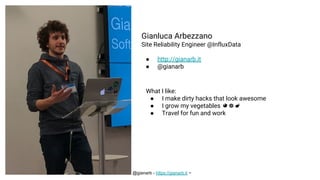
Gianluca Arbezzano
Site Reliability Engineer @InfluxData
● http://gianarb.it
● @gianarb
What I like:
● I make dirty hacks that look awesome
● I grow my vegetables 🍅🌻🍆
● Travel for fun and work
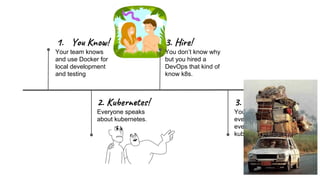
1. Yo n !
Your team knows
and use Docker for
local development
and testing
2. Kub te !
Everyone speaks
about kubernetes.
3. Hir !
You don’t know why
but you hired a
DevOps that kind of
know k8s.
3. Ex i m !
You are moving
everything and
everyone to
kubernetes
Inspired by a true story
You need a good book
1. Short
2. Driven by experiences
3. Practical
4. Easy
We need to make our
hands dirty
Spin up a cluster that you
can break
Bring developers in the loop
Deploy CI on Kubernetes
Bring developers in the loop
Run your code in prod
Bring developers in the loop
Don’t be scared and write your
own tools!
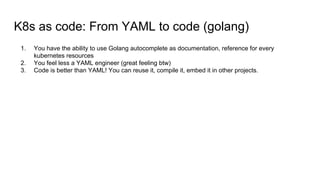
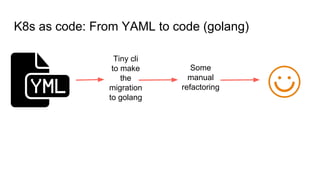
K8s as code: From YAML to code (golang)
1. You have the ability to use Golang autocomplete as documentation, reference for every
kubernetes resources
2. You feel less a YAML engineer (great feeling btw)
3. Code is better than YAML! You can reuse it, compile it, embed it in other projects.
K8s as code: From YAML to code (golang)
Tiny cli
to make
the
migration
to golang
Some
manual
refactoring
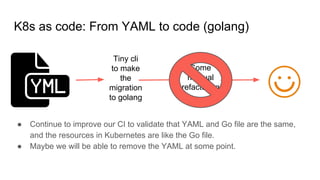
K8s as code: From YAML to code (golang)
Tiny cli
to make
the
migration
to golang
Some
manual
refactoring
● Continue to improve our CI to validate that YAML and Go file are the same,
and the resources in Kubernetes are like the Go file.
● Maybe we will be able to remove the YAML at some point.
Examples
● Everything has an API because you should USE it TO make something good!
(cURL is good but you can make something better)
● Some of our tools:
○ Backup and Restore Operator for Persistent Volumes
○ We have a service to create runtime isolated environment to allow devs to test or product
people to have a safe environment to demo, try. We also use it for the integration and smoke
tests.
○ We have a tool to replicate environment locally on minikube to install and configure all the
dependencies
Instrumentation and
Observability
We need to have processes and tools that give us
the ability to take a real time picture of our system
Observability
It is all about how we collect and aggregate the data
Normal state vs Current state
Bring developers in the loop
You need knowledgeable devs to drive the team
Observability
Events, metrics, logs and traces
Golang and Kubernetes: OpenCensus
● Open Source project sponsored by Google
● It is a SPEC plus a set of libraries in different languages to instrument your
application
● To collect metrics, traces and events.
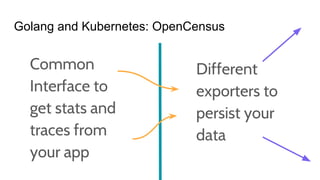
Golang and Kubernetes: OpenCensus
Common
Interface to
get stats and
traces from
your app
Different
exporters to
persist your
data
gianarb.it ~ @gianarb
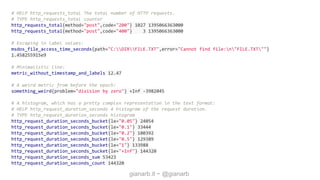
# HELP http_requests_total The total number of HTTP requests.
# TYPE http_requests_total counter
http_requests_total{method="post",code="200"} 1027 1395066363000
http_requests_total{method="post",code="400"} 3 1395066363000
# Escaping in label values:
msdos_file_access_time_seconds{path="C:DIRFILE.TXT",error="Cannot find file:n"FILE.TXT""}
1.458255915e9
# Minimalistic line:
metric_without_timestamp_and_labels 12.47
# A weird metric from before the epoch:
something_weird{problem="division by zero"} +Inf -3982045
# A histogram, which has a pretty complex representation in the text format:
# HELP http_request_duration_seconds A histogram of the request duration.
# TYPE http_request_duration_seconds histogram
http_request_duration_seconds_bucket{le="0.05"} 24054
http_request_duration_seconds_bucket{le="0.1"} 33444
http_request_duration_seconds_bucket{le="0.2"} 100392
http_request_duration_seconds_bucket{le="0.5"} 129389
http_request_duration_seconds_bucket{le="1"} 133988
http_request_duration_seconds_bucket{le="+Inf"} 144320
http_request_duration_seconds_sum 53423
http_request_duration_seconds_count 144320
OpenMetrics
v2 Prometheus exposition format
gianarb.it ~ @gianarb
func FetchMetricFamilies(url string, ch chan<- *dto.MetricFamily, certificate string, key string, skipServerCertCheck bool) error {
defer close(ch)
var transport *http.Transport
if certificate != "" && key != "" {
cert, err := tls.LoadX509KeyPair(certificate, key)
if err != nil {
return err
}
tlsConfig := &tls.Config{
Certificates: []tls.Certificate{cert},
InsecureSkipVerify: skipServerCertCheck,
}
tlsConfig.BuildNameToCertificate()
transport = &http.Transport{TLSClientConfig: tlsConfig}
} else {
transport = &http.Transport{
TLSClientConfig: &tls.Config{InsecureSkipVerify: skipServerCertCheck},
}
}
client := &http.Client{Transport: transport}
return decodeContent(client, url, ch)
}
https://github.com/prometheus/prom2json/blob/master/prom2json.go#L123
gianarb.it ~ @gianarb
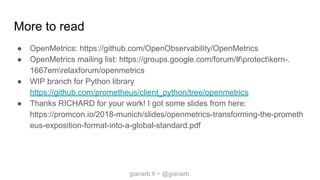
More to read
● OpenMetrics: https://github.com/OpenObservability/OpenMetrics
● OpenMetrics mailing list: https://groups.google.com/forum/#protectkern-.
1667emrelaxforum/openmetrics
● WIP branch for Python library
https://github.com/prometheus/client_python/tree/openmetrics
● Thanks RICHARD for your work! I got some slides from here:
https://promcon.io/2018-munich/slides/openmetrics-transforming-the-prometh
eus-exposition-format-into-a-global-standard.pdf
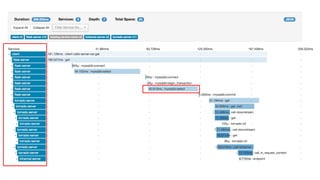
Tracing
How do you “tell stories” about concurrent
systems?
How do you “tell stories” about
concurrent systems?
OpenTracing
gianarb.it ~ @gianarb
OpenTracing
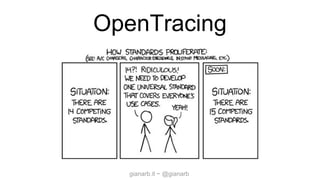
I was just waiting for a new
standard!
cit. Troll
© 2017 InfluxData. All rights reserved.34
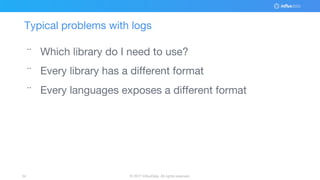
Typical problems with logs
¨ Which library do I need to use?
¨ Every library has a different format
¨ Every languages exposes a different format
© 2017 InfluxData. All rights reserved.35
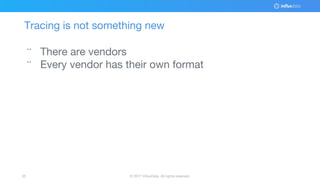
Tracing is not something new
¨ There are vendors
¨ Every vendor has their own format
© 2017 InfluxData. All rights reserved.36
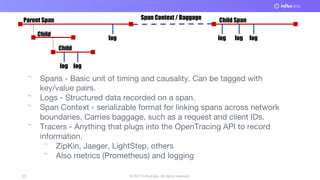
log log log
log log
log
Parent Span Span Context / Baggage
Child
Child
Child Span
¨ Spans - Basic unit of timing and causality. Can be tagged with
key/value pairs.
¨ Logs - Structured data recorded on a span.
¨ Span Context - serializable format for linking spans across network
boundaries. Carries baggage, such as a request and client IDs.
¨ Tracers - Anything that plugs into the OpenTracing API to record
information.
¨ ZipKin, Jaeger, LightStep, others
¨ Also metrics (Prometheus) and logging
© 2017 InfluxData. All rights reserved.37
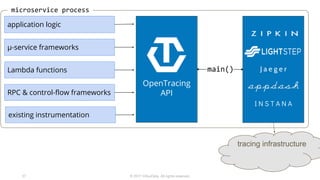
OpenTracing
API
application logic
µ-service frameworks
Lambda functions
RPC & control-flow frameworks
existing instrumentation
tracing infrastructure
main()
I N S T A N A
J a e g e r
microservice process
© 2017 InfluxData. All rights reserved.38
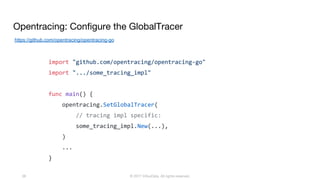
import "github.com/opentracing/opentracing-go"
import ".../some_tracing_impl"
func main() {
opentracing.SetGlobalTracer(
// tracing impl specific:
some_tracing_impl.New(...),
)
...
}
https://github.com/opentracing/opentracing-go
Opentracing: Configure the GlobalTracer
© 2017 InfluxData. All rights reserved.39
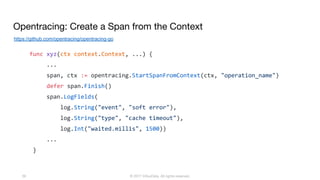
func xyz(ctx context.Context, ...) {
...
span, ctx := opentracing.StartSpanFromContext(ctx, "operation_name")
defer span.Finish()
span.LogFields(
log.String("event", "soft error"),
log.String("type", "cache timeout"),
log.Int("waited.millis", 1500))
...
}
https://github.com/opentracing/opentracing-go
Opentracing: Create a Span from the Context
© 2017 InfluxData. All rights reserved.40
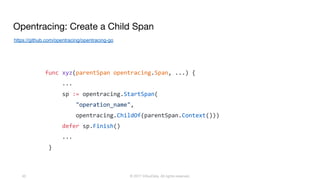
func xyz(parentSpan opentracing.Span, ...) {
...
sp := opentracing.StartSpan(
"operation_name",
opentracing.ChildOf(parentSpan.Context()))
defer sp.Finish()
...
}
https://github.com/opentracing/opentracing-go
Opentracing: Create a Child Span
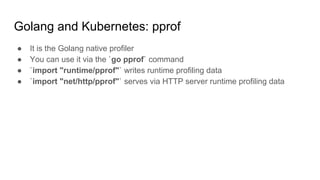
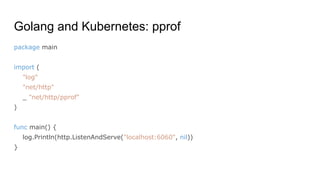
Golang and Kubernetes: pprof
● It is the Golang native profiler
● You can use it via the `go pprof` command
● `import "runtime/pprof"` writes runtime profiling data
● `import "net/http/pprof"` serves via HTTP server runtime profiling data
Golang and Kubernetes: pprof
package main
import (
"log"
"net/http"
_ "net/http/pprof"
)
func main() {
log.Println(http.ListenAndServe("localhost:6060", nil))
}
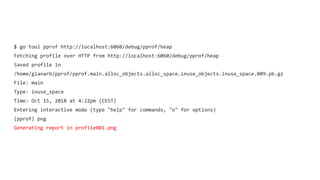
$ go tool pprof http://localhost:6060/debug/pprof/heap
Fetching profile over HTTP from http://localhost:6060/debug/pprof/heap
Saved profile in
/home/gianarb/pprof/pprof.main.alloc_objects.alloc_space.inuse_objects.inuse_space.009.pb.gz
File: main
Type: inuse_space
Time: Oct 15, 2018 at 4:22pm (CEST)
Entering interactive mode (type "help" for commands, "o" for options)
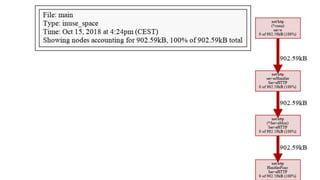
(pprof) png
Generating report in profile001.png
Golang and Kubernetes: pprof
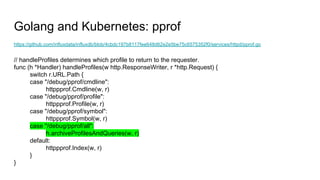
https://github.com/influxdata/influxdb/blob/4cbdc197b8117fee648d62e2e5be75c6575352f0/services/httpd/pprof.go
// handleProfiles determines which profile to return to the requester.
func (h *Handler) handleProfiles(w http.ResponseWriter, r *http.Request) {
switch r.URL.Path {
case "/debug/pprof/cmdline":
httppprof.Cmdline(w, r)
case "/debug/pprof/profile":
httppprof.Profile(w, r)
case "/debug/pprof/symbol":
httppprof.Symbol(w, r)
case "/debug/pprof/all":
h.archiveProfilesAndQueries(w, r)
default:
httppprof.Index(w, r)
}
}
Golang and Kubernetes: pprof
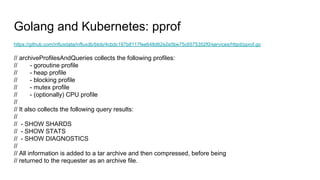
https://github.com/influxdata/influxdb/blob/4cbdc197b8117fee648d62e2e5be75c6575352f0/services/httpd/pprof.go
// archiveProfilesAndQueries collects the following profiles:
// - goroutine profile
// - heap profile
// - blocking profile
// - mutex profile
// - (optionally) CPU profile
//
// It also collects the following query results:
//
// - SHOW SHARDS
// - SHOW STATS
// - SHOW DIAGNOSTICS
//
// All information is added to a tar archive and then compressed, before being
// returned to the requester as an archive file.
Golang and Kubernetes: pprof
https://github.com/influxdata/influxdb/blob/4cbdc197b8117fee648d62e2e5be75c6575352f0/services/httpd/pprof.go
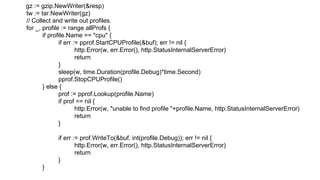
var allProfs = []*prof{
{Name: "goroutine", Debug: 1},
{Name: "block", Debug: 1},
{Name: "mutex", Debug: 1},
{Name: "heap", Debug: 1},
}
gz := gzip.NewWriter(&resp)
tw := tar.NewWriter(gz)
// Collect and write out profiles.
for _, profile := range allProfs {
if profile.Name == "cpu" {
if err := pprof.StartCPUProfile(&buf); err != nil {
http.Error(w, err.Error(), http.StatusInternalServerError)
return
}
sleep(w, time.Duration(profile.Debug)*time.Second)
pprof.StopCPUProfile()
} else {
prof := pprof.Lookup(profile.Name)
if prof == nil {
http.Error(w, "unable to find profile "+profile.Name, http.StatusInternalServerError)
return
}
if err := prof.WriteTo(&buf, int(profile.Debug)); err != nil {
http.Error(w, err.Error(), http.StatusInternalServerError)
return
}
}
Golang and Kubernetes: pprof
https://github.com/influxdata/influxdb/blob/4cbdc197b8117fee648d62e2e5be75c6575352f0/services/httpd/pprof.go
// Collect and write out the queries.
var allQueries = []struct {
name string
fn func() ([]*models.Row, error)
}{
{"shards", h.showShards},
{"stats", h.showStats},
{"diagnostics", h.showDiagnostics},
}
tabW := tabwriter.NewWriter(&buf, 8, 8, 1, 't', 0)
for _, query := range allQueries {
rows, err := query.fn()
if err != nil {
http.Error(w, err.Error(), http.StatusInternalServerError)
}
func (h *Handler) showDiagnostics() ([]*models.Row, error) {
diags, err := h.Monitor.Diagnostics()
if err != nil {
return nil, err
}
// Get a sorted list of diagnostics keys.
sortedKeys := make([]string, 0, len(diags))
for k := range diags {
sortedKeys = append(sortedKeys, k)
}
sort.Strings(sortedKeys)
rows := make([]*models.Row, 0, len(diags))
for _, k := range sortedKeys {
row := &models.Row{Name: k}
row.Columns = diags[k].Columns
row.Values = diags[k].Rows
rows = append(rows, row)
}
return rows, nil
}
Remote Debugging
in Kubernetes
Delve, GDB
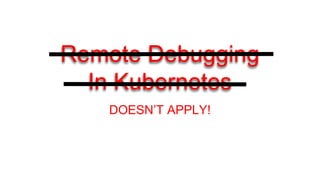
Remote Debugging
In Kubernetes
DOESN’T APPLY!
That’s not totally true. You can expose the debugger
endpoint. It works. It doesn’t apply for production
workload.
~ @gianarb - https://gianarb.it ~
Thanks
@gianarb

Kubernetes debug like a pro

  • 1.
    ~ @gianarb -https://gianarb.it ~ Debug like a pro on Kubernetes Golab - Florence - 2018
  • 2.
    ~ @gianarb -https://gianarb.it ~ Gianluca Arbezzano Site Reliability Engineer @InfluxData ● http://gianarb.it ● @gianarb What I like: ● I make dirty hacks that look awesome ● I grow my vegetables 🍅🌻🍆 ● Travel for fun and work
  • 3.
    1. Yo n! Your team knows and use Docker for local development and testing 2. Kub te ! Everyone speaks about kubernetes. 3. Hir ! You don’t know why but you hired a DevOps that kind of know k8s. 3. Ex i m ! You are moving everything and everyone to kubernetes
  • 4.
    Inspired by atrue story
  • 5.
    You need agood book 1. Short 2. Driven by experiences 3. Practical 4. Easy
  • 6.
    We need tomake our hands dirty
  • 7.
    Spin up acluster that you can break Bring developers in the loop
  • 8.
    Deploy CI onKubernetes Bring developers in the loop
  • 9.
    Run your codein prod Bring developers in the loop
  • 10.
    Don’t be scaredand write your own tools!
  • 11.
    K8s as code:From YAML to code (golang) 1. You have the ability to use Golang autocomplete as documentation, reference for every kubernetes resources 2. You feel less a YAML engineer (great feeling btw) 3. Code is better than YAML! You can reuse it, compile it, embed it in other projects.
  • 12.
    K8s as code:From YAML to code (golang) Tiny cli to make the migration to golang Some manual refactoring
  • 13.
    K8s as code:From YAML to code (golang) Tiny cli to make the migration to golang Some manual refactoring ● Continue to improve our CI to validate that YAML and Go file are the same, and the resources in Kubernetes are like the Go file. ● Maybe we will be able to remove the YAML at some point.
  • 14.
    Examples ● Everything hasan API because you should USE it TO make something good! (cURL is good but you can make something better) ● Some of our tools: ○ Backup and Restore Operator for Persistent Volumes ○ We have a service to create runtime isolated environment to allow devs to test or product people to have a safe environment to demo, try. We also use it for the integration and smoke tests. ○ We have a tool to replicate environment locally on minikube to install and configure all the dependencies
  • 15.
  • 16.
    We need tohave processes and tools that give us the ability to take a real time picture of our system
  • 17.
    Observability It is allabout how we collect and aggregate the data
  • 18.
    Normal state vsCurrent state
  • 19.
    Bring developers inthe loop You need knowledgeable devs to drive the team
  • 20.
  • 21.
    Golang and Kubernetes:OpenCensus ● Open Source project sponsored by Google ● It is a SPEC plus a set of libraries in different languages to instrument your application ● To collect metrics, traces and events.
  • 22.
    Golang and Kubernetes:OpenCensus Common Interface to get stats and traces from your app Different exporters to persist your data
  • 23.
    gianarb.it ~ @gianarb #HELP http_requests_total The total number of HTTP requests. # TYPE http_requests_total counter http_requests_total{method="post",code="200"} 1027 1395066363000 http_requests_total{method="post",code="400"} 3 1395066363000 # Escaping in label values: msdos_file_access_time_seconds{path="C:DIRFILE.TXT",error="Cannot find file:n"FILE.TXT""} 1.458255915e9 # Minimalistic line: metric_without_timestamp_and_labels 12.47 # A weird metric from before the epoch: something_weird{problem="division by zero"} +Inf -3982045 # A histogram, which has a pretty complex representation in the text format: # HELP http_request_duration_seconds A histogram of the request duration. # TYPE http_request_duration_seconds histogram http_request_duration_seconds_bucket{le="0.05"} 24054 http_request_duration_seconds_bucket{le="0.1"} 33444 http_request_duration_seconds_bucket{le="0.2"} 100392 http_request_duration_seconds_bucket{le="0.5"} 129389 http_request_duration_seconds_bucket{le="1"} 133988 http_request_duration_seconds_bucket{le="+Inf"} 144320 http_request_duration_seconds_sum 53423 http_request_duration_seconds_count 144320
  • 24.
  • 25.
  • 26.
    gianarb.it ~ @gianarb funcFetchMetricFamilies(url string, ch chan<- *dto.MetricFamily, certificate string, key string, skipServerCertCheck bool) error { defer close(ch) var transport *http.Transport if certificate != "" && key != "" { cert, err := tls.LoadX509KeyPair(certificate, key) if err != nil { return err } tlsConfig := &tls.Config{ Certificates: []tls.Certificate{cert}, InsecureSkipVerify: skipServerCertCheck, } tlsConfig.BuildNameToCertificate() transport = &http.Transport{TLSClientConfig: tlsConfig} } else { transport = &http.Transport{ TLSClientConfig: &tls.Config{InsecureSkipVerify: skipServerCertCheck}, } } client := &http.Client{Transport: transport} return decodeContent(client, url, ch) } https://github.com/prometheus/prom2json/blob/master/prom2json.go#L123
  • 27.
    gianarb.it ~ @gianarb Moreto read ● OpenMetrics: https://github.com/OpenObservability/OpenMetrics ● OpenMetrics mailing list: https://groups.google.com/forum/#protectkern-. 1667emrelaxforum/openmetrics ● WIP branch for Python library https://github.com/prometheus/client_python/tree/openmetrics ● Thanks RICHARD for your work! I got some slides from here: https://promcon.io/2018-munich/slides/openmetrics-transforming-the-prometh eus-exposition-format-into-a-global-standard.pdf
  • 28.
    Tracing How do you“tell stories” about concurrent systems?
  • 29.
    How do you“tell stories” about concurrent systems?
  • 31.
  • 32.
  • 33.
    I was justwaiting for a new standard! cit. Troll
  • 34.
    © 2017 InfluxData.All rights reserved.34 Typical problems with logs ¨ Which library do I need to use? ¨ Every library has a different format ¨ Every languages exposes a different format
  • 35.
    © 2017 InfluxData.All rights reserved.35 Tracing is not something new ¨ There are vendors ¨ Every vendor has their own format
  • 36.
    © 2017 InfluxData.All rights reserved.36 log log log log log log Parent Span Span Context / Baggage Child Child Child Span ¨ Spans - Basic unit of timing and causality. Can be tagged with key/value pairs. ¨ Logs - Structured data recorded on a span. ¨ Span Context - serializable format for linking spans across network boundaries. Carries baggage, such as a request and client IDs. ¨ Tracers - Anything that plugs into the OpenTracing API to record information. ¨ ZipKin, Jaeger, LightStep, others ¨ Also metrics (Prometheus) and logging
  • 37.
    © 2017 InfluxData.All rights reserved.37 OpenTracing API application logic µ-service frameworks Lambda functions RPC & control-flow frameworks existing instrumentation tracing infrastructure main() I N S T A N A J a e g e r microservice process
  • 38.
    © 2017 InfluxData.All rights reserved.38 import "github.com/opentracing/opentracing-go" import ".../some_tracing_impl" func main() { opentracing.SetGlobalTracer( // tracing impl specific: some_tracing_impl.New(...), ) ... } https://github.com/opentracing/opentracing-go Opentracing: Configure the GlobalTracer
  • 39.
    © 2017 InfluxData.All rights reserved.39 func xyz(ctx context.Context, ...) { ... span, ctx := opentracing.StartSpanFromContext(ctx, "operation_name") defer span.Finish() span.LogFields( log.String("event", "soft error"), log.String("type", "cache timeout"), log.Int("waited.millis", 1500)) ... } https://github.com/opentracing/opentracing-go Opentracing: Create a Span from the Context
  • 40.
    © 2017 InfluxData.All rights reserved.40 func xyz(parentSpan opentracing.Span, ...) { ... sp := opentracing.StartSpan( "operation_name", opentracing.ChildOf(parentSpan.Context())) defer sp.Finish() ... } https://github.com/opentracing/opentracing-go Opentracing: Create a Child Span
  • 41.
    Golang and Kubernetes:pprof ● It is the Golang native profiler ● You can use it via the `go pprof` command ● `import "runtime/pprof"` writes runtime profiling data ● `import "net/http/pprof"` serves via HTTP server runtime profiling data
  • 42.
    Golang and Kubernetes:pprof package main import ( "log" "net/http" _ "net/http/pprof" ) func main() { log.Println(http.ListenAndServe("localhost:6060", nil)) }
  • 43.
    $ go toolpprof http://localhost:6060/debug/pprof/heap Fetching profile over HTTP from http://localhost:6060/debug/pprof/heap Saved profile in /home/gianarb/pprof/pprof.main.alloc_objects.alloc_space.inuse_objects.inuse_space.009.pb.gz File: main Type: inuse_space Time: Oct 15, 2018 at 4:22pm (CEST) Entering interactive mode (type "help" for commands, "o" for options) (pprof) png Generating report in profile001.png
  • 45.
    Golang and Kubernetes:pprof https://github.com/influxdata/influxdb/blob/4cbdc197b8117fee648d62e2e5be75c6575352f0/services/httpd/pprof.go // handleProfiles determines which profile to return to the requester. func (h *Handler) handleProfiles(w http.ResponseWriter, r *http.Request) { switch r.URL.Path { case "/debug/pprof/cmdline": httppprof.Cmdline(w, r) case "/debug/pprof/profile": httppprof.Profile(w, r) case "/debug/pprof/symbol": httppprof.Symbol(w, r) case "/debug/pprof/all": h.archiveProfilesAndQueries(w, r) default: httppprof.Index(w, r) } }
  • 46.
    Golang and Kubernetes:pprof https://github.com/influxdata/influxdb/blob/4cbdc197b8117fee648d62e2e5be75c6575352f0/services/httpd/pprof.go // archiveProfilesAndQueries collects the following profiles: // - goroutine profile // - heap profile // - blocking profile // - mutex profile // - (optionally) CPU profile // // It also collects the following query results: // // - SHOW SHARDS // - SHOW STATS // - SHOW DIAGNOSTICS // // All information is added to a tar archive and then compressed, before being // returned to the requester as an archive file.
  • 47.
    Golang and Kubernetes:pprof https://github.com/influxdata/influxdb/blob/4cbdc197b8117fee648d62e2e5be75c6575352f0/services/httpd/pprof.go var allProfs = []*prof{ {Name: "goroutine", Debug: 1}, {Name: "block", Debug: 1}, {Name: "mutex", Debug: 1}, {Name: "heap", Debug: 1}, }
  • 48.
    gz := gzip.NewWriter(&resp) tw:= tar.NewWriter(gz) // Collect and write out profiles. for _, profile := range allProfs { if profile.Name == "cpu" { if err := pprof.StartCPUProfile(&buf); err != nil { http.Error(w, err.Error(), http.StatusInternalServerError) return } sleep(w, time.Duration(profile.Debug)*time.Second) pprof.StopCPUProfile() } else { prof := pprof.Lookup(profile.Name) if prof == nil { http.Error(w, "unable to find profile "+profile.Name, http.StatusInternalServerError) return } if err := prof.WriteTo(&buf, int(profile.Debug)); err != nil { http.Error(w, err.Error(), http.StatusInternalServerError) return } }
  • 49.
    Golang and Kubernetes:pprof https://github.com/influxdata/influxdb/blob/4cbdc197b8117fee648d62e2e5be75c6575352f0/services/httpd/pprof.go // Collect and write out the queries. var allQueries = []struct { name string fn func() ([]*models.Row, error) }{ {"shards", h.showShards}, {"stats", h.showStats}, {"diagnostics", h.showDiagnostics}, } tabW := tabwriter.NewWriter(&buf, 8, 8, 1, 't', 0) for _, query := range allQueries { rows, err := query.fn() if err != nil { http.Error(w, err.Error(), http.StatusInternalServerError) }
  • 50.
    func (h *Handler)showDiagnostics() ([]*models.Row, error) { diags, err := h.Monitor.Diagnostics() if err != nil { return nil, err } // Get a sorted list of diagnostics keys. sortedKeys := make([]string, 0, len(diags)) for k := range diags { sortedKeys = append(sortedKeys, k) } sort.Strings(sortedKeys) rows := make([]*models.Row, 0, len(diags)) for _, k := range sortedKeys { row := &models.Row{Name: k} row.Columns = diags[k].Columns row.Values = diags[k].Rows rows = append(rows, row) } return rows, nil }
  • 51.
  • 52.
  • 53.
    That’s not totallytrue. You can expose the debugger endpoint. It works. It doesn’t apply for production workload.
  • 54.
    ~ @gianarb -https://gianarb.it ~ Thanks @gianarb