DESIGN AND ANALYSIS OF
ALGORITHMS
Dr. G.Geetha Mohan
Professor
Department of Computer Science and Engineering,
Jerusalem College of Engineering,
Chennai-600100
1/23/2019 1
Outline
 Notion of an Algorithm
 Fundamentals of Algorithmic Problem
Solving
 Important ProblemTypes
1/23/2019 2
What is a Computer Algorithm?
A sequence of unambiguous instructions
for solving a problem
For obtaining a required output for any
legitimate input in a finite amount of time
1/23/2019 3
Computer Algorithm Vs Program
 Computer algorithm
A detailed step-by-step method for
solving a problem using a computer
 Program
An implementation of one or more
algorithms.
1/23/2019 4
Find Greatest Common Divisor of
Two Nonnegative
1. Euclid’s algorithm
gcd(m n) = gcd(n, m mod n)
gcd(60, 24) = gcd(24, 12) = gcd(12, 0) = 12.
2. Consecutive integer checking
algorithm
 For numbers 60 and 24, the algorithm will
try first 24, then 23, and so on, until it
reaches 12, where it stops.
1/23/2019 5
Find Greatest Common Divisor of
Two Nonnegative
 Middle-school procedure
for the numbers 60 and 24, we get
60 = 2 . 2 . 3 . 5
24 = 2 . 2 . 2 . 3
gcd(60, 24) = 2 . 2 . 3 = 12.
1/23/2019 6
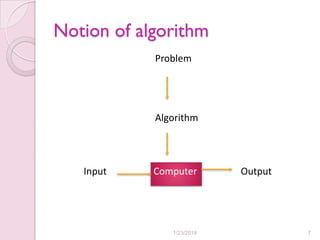
Notion of algorithm
1/23/2019 7
Problem
Algorithm
ComputerInput Output
Notion of algorithm
 Non-ambiguity requirement for each step of an
algorithm
 Range of inputs for which an algorithm works has
to be specified
 Same algorithm can be represented in several
different ways.
 Exist several algorithms for solving the same
problem.
 Algorithms for the same problem can be based on
very different ideas and can solve the problem
with dramatically different speeds.
1/23/2019 8
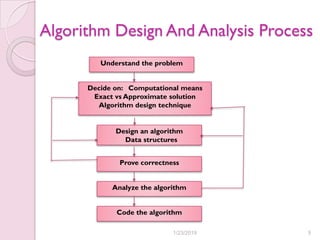
Understand the problem
Decide on: Computational means
Exact vs Approximate solution
Algorithm design technique
Design an algorithm
Data structures
Prove correctness
Analyze the algorithm
Code the algorithm
Algorithm Design And Analysis Process
1/23/2019 9
1.Understand the problem
 Understand completely the problem
given
 Input
 Output
 An input to an algorithm specifies an
instance of the problem the algorithm
solves.
1/23/2019 10
2.1 Ascertaining the Capabilities of
the Computational Device
 Sequential Algorithms
Instructions are executed one after another,
one operation at a time.
Random-access Machine (RAM)
 Parallel Algorithms
Execute operations concurrently( parallel)
1/23/2019 11
2.2 Choosing between Exact and
Approximate Problem Solving
 Exact algorithm
 Approximation algorithm
 Extracting square roots,
 Solving nonlinear equations,
 Evaluating definite integrals
1/23/2019 12
2.3 Algorithm Design Technique
 An algorithm design technique
(“strategy” or “paradigm”)
General approach to solving problems
algorithmically that is applicable to a variety
of problems from different areas of
computing.
 Algorithm design techniques make it
possible to classify algorithms according to
an underlying design idea
1/23/2019 13
3.Designing an Algorithm and Data
Structures
 Several techniques need to be combined,
 Hard to pinpoint as applications of the
known design techniques
 Algorithms+ data structures = programs
 Object-oriented programming
Data structures remain crucially
important for both design and analysis of
algorithms.
1/23/2019 14
Methods of Specifying an Algorithm
 Pseudo code
A mixture of a natural language and
programming language
 Flowchart
A method of expressing an algorithm by a
collection of connected geometric shapes
containing descriptions of the algorithm’s
steps.
 Programs
Another way of specifying the algorithm
1/23/2019 15
4.Prove Correctness
To prove that the algorithm yields a
required result for every legitimate input in
a finite amount of time
 A common technique for proving correctness is to use
mathematical induction
 Tracing the algorithm’s performance for a few specific
inputs to show that an algorithm is incorrect
The notion of correctness for
 Exact algorithms -straight forward
 Approximation algorithms- less straight forward
to be able to show that the error produced by the
algorithm does not exceed a predefined limit.
1/23/2019 16
5.Analyze the Algorithm
 Efficiency
 Time efficiency,
How fast the algorithm runs,
 Space efficiency,
How much extra memory it uses.
Simplicity
Easier to understand and easier to program
Generality
Issues - Algorithm solves
Set of inputs it accepts
1/23/2019 17
6. Code the Algorithm
 Programming an algorithm
both a peril and an opportunity.
 Test and debug program thoroughly
whenever implement an algorithm.
 Implementing an algorithm correctly is
necessary but not sufficient
 An analysis is based on timing the
program on several inputs and then
analyzing the results obtained.
1/23/2019 18
6. Code the Algorithm (cond…)
 Algorithm’s Optimality.
 Not about the efficiency of an algorithm
 About the complexity of the problem it solves
 What is the minimum amount of effort any
algorithm will need to exert to solve the
problem?
 Another important issue of algorithmic problem
solving
 Whether or not every problem can be solved
by an algorithm.
 Not talking about problems that do not have a
solution 1/23/2019 19
Algorithms
 Inventing (or discovering?) Algorithms is
a very creative and rewarding process.
 A good algorithm is a result of repeated
effort and rework
1/23/2019 20
Important Problem Types
 Sorting
 Searching
 String processing
 Graph problems
 Combinatorial problems
 Geometric problems
 Numerical problems
1/23/2019 21
1. Sorting
 Rearrange the items of a given list in non
decreasing order
 Specially chosen piece of information- key
 Used as an auxiliary step in several important
algorithms in other areas
 Geometric Algorithms and Data Compression
 Greedy approach an important algorithm design
technique requires a sorted input.
1/23/2019 22
1. Sorting
Two properties
 Stable
 Preserves the relative order of any two
equal elements in its input.
 In-place
 The amount of extra memory the
algorithm requires
 An algorithm is said to be in-place if it
does not require extra memory
1/23/2019 23
2. Searching
 Deals with finding a given value, called a
search key, in a given set
(or a multiset, which permits several
elements to have the same value)
 Sequential Search or linear Search
 Binary search
1/23/2019 24
2. Searching
 Considered in conjunction with two
other operations:
 Addition to
 Deletion from the data set of an item.
 Data structures and Algorithms should be
chosen to strike a balance among the
requirements of each operation.
1/23/2019 25
3. String processing
 Sequence of characters from an alphabet
 Strings of particular interest are
 Text strings, which comprise letters,
numbers, and special characters;
 Bit strings, which comprise zeros and ones;
 Gene sequences, which can be modeled by
strings of characters from the four-
character alphabet {A,C, G,T}.
1/23/2019
26
String Matching
 Searching for a given word in a text
1/23/2019 27
4. Graph Problems
 Collection of points called vertices,
 Some of which are connected by line
segments called edges.
 Used for modeling a wide variety of
applications
 Transportation,
 Communication,
 Social and Economic networks
 Project scheduling
 Games.
1/23/2019 28
Graph Problems
 Basic graph algorithms
 Graph traversal algorithms
How can one reach all the points in a
network?
 Shortest-path algorithms
What is the best route between two cities?
 Topological sorting for graphs with
directed edges
set of courses with their prerequisites
consistent or self-contradictory?.
1/23/2019 29
Graph Problems
 Traveling Salesman Problem (TSP)
Problem of finding the shortest tour
through n cities that visits every city
exactly once.
 Route Planning
 Circuit board
 VLSI chip fabrication
 X-ray crystallography
 Genetic Engineering
1/23/2019 30
Graph Problems
 Graph-coloring problem
 seeks to assign the smallest number of
colors to the vertices of a graph so that
no two adjacent vertices are the same
color
Event Scheduling:
Events are represented by vertices that are connected
by an edge if and only if the corresponding events
cannot be scheduled at the same time, a solution to the
graph-coloring problem yields an optimal schedule.
1/23/2019 31
5. Combinatorial Problems
 Traveling Salesman Problem and the
Graph Coloring Problem are examples of
combinatorial problems.
 These are problems that ask, explicitly or
implicitly, to find a combinatorial object
such as a permutation, a combination, or a
subset that satisfies certain constraints.
1/23/2019 32
5. Combinatorial Problems
 Issues
 Number of combinatorial objects typically grows
extremely fast with a problem’s size, reaching
unimaginable magnitudes even for moderate-
sized instances.
 There are no known algorithms for solving most
such problems exactly in an acceptable amount
of time.
1/23/2019 33
6.Geometric Algorithms
 Geometric algorithms deal with geometric
objects such as points, lines, and polygons.
 Ancient Greeks -developing procedures
For solving a variety of geometric problems,
 Constructing simple geometric shapes
-triangles, circles
 Computer graphics
 Robotics
 Tomography
1/23/2019 34
6.Geometric Algorithms
 Closest-pair problem
Given n points in the plane, find the closest
pair among them.
 Convex-hull problem
To find the smallest convex polygon that
would include all the points of a given set.
1/23/2019 35
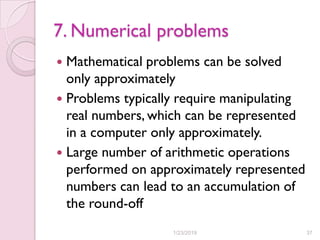
7. Numerical problems
 Problems that involve mathematical
objects of continuous nature
 Solving equations
 Systems of equations,
 Computing definite integrals,
 Evaluating functions
1/23/2019 36
7. Numerical problems
 Mathematical problems can be solved
only approximately
 Problems typically require manipulating
real numbers, which can be represented
in a computer only approximately.
 Large number of arithmetic operations
performed on approximately represented
numbers can lead to an accumulation of
the round-off
1/23/2019 37
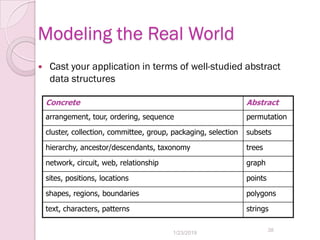
Modeling the Real World
 Cast your application in terms of well-studied abstract
data structures
1/23/2019
38
Concrete Abstract
arrangement, tour, ordering, sequence permutation
cluster, collection, committee, group, packaging, selection subsets
hierarchy, ancestor/descendants, taxonomy trees
network, circuit, web, relationship graph
sites, positions, locations points
shapes, regions, boundaries polygons
text, characters, patterns strings
Real-World Applications
 Hardware design: VLSI
chips
 Compilers
 Computer graphics: movies,
video games
 Routing messages in the
Internet
 Searching the Web
 Distributed file sharing
1/23/2019
39
• Computer aided design and
manufacturing
• Security: e-commerce,
voting machines
• Multimedia: CD player, DVD,
MP3, JPG, HDTV
• DNA sequencing, protein
folding
• and many more!
Some Important Problem Types
 Sorting
◦ a set of items
 Searching
◦ among a set of items
 String processing
◦ text, bit strings, gene
sequences
 Graphs
◦ model objects and their
relationships
1/23/2019
40
• Combinatorial
– find desired permutation,
combination or subset
• Geometric
– graphics, imaging,
robotics
• Numerical
– continuous math: solving
equations, evaluating
functions
Algorithm Design Techniques
• Brute Force & Exhaustive
Search
– follow definition / try all
possibilities
• Divide & Conquer
– break problem into
distinct subproblems
• Transformation
– convert problem to
another one
• Dynamic Programming
– break problem into overlapping
sub problems
• Greedy
– repeatedly do what is best now
• Iterative Improvement
– repeatedly improve current
solution
• Randomization
– use random numbers
1/23/2019
41

Design and analysis of algorithms

  • 1.
    DESIGN AND ANALYSISOF ALGORITHMS Dr. G.Geetha Mohan Professor Department of Computer Science and Engineering, Jerusalem College of Engineering, Chennai-600100 1/23/2019 1
  • 2.
    Outline  Notion ofan Algorithm  Fundamentals of Algorithmic Problem Solving  Important ProblemTypes 1/23/2019 2
  • 3.
    What is aComputer Algorithm? A sequence of unambiguous instructions for solving a problem For obtaining a required output for any legitimate input in a finite amount of time 1/23/2019 3
  • 4.
    Computer Algorithm VsProgram  Computer algorithm A detailed step-by-step method for solving a problem using a computer  Program An implementation of one or more algorithms. 1/23/2019 4
  • 5.
    Find Greatest CommonDivisor of Two Nonnegative 1. Euclid’s algorithm gcd(m n) = gcd(n, m mod n) gcd(60, 24) = gcd(24, 12) = gcd(12, 0) = 12. 2. Consecutive integer checking algorithm  For numbers 60 and 24, the algorithm will try first 24, then 23, and so on, until it reaches 12, where it stops. 1/23/2019 5
  • 6.
    Find Greatest CommonDivisor of Two Nonnegative  Middle-school procedure for the numbers 60 and 24, we get 60 = 2 . 2 . 3 . 5 24 = 2 . 2 . 2 . 3 gcd(60, 24) = 2 . 2 . 3 = 12. 1/23/2019 6
  • 7.
    Notion of algorithm 1/23/20197 Problem Algorithm ComputerInput Output
  • 8.
    Notion of algorithm Non-ambiguity requirement for each step of an algorithm  Range of inputs for which an algorithm works has to be specified  Same algorithm can be represented in several different ways.  Exist several algorithms for solving the same problem.  Algorithms for the same problem can be based on very different ideas and can solve the problem with dramatically different speeds. 1/23/2019 8
  • 9.
    Understand the problem Decideon: Computational means Exact vs Approximate solution Algorithm design technique Design an algorithm Data structures Prove correctness Analyze the algorithm Code the algorithm Algorithm Design And Analysis Process 1/23/2019 9
  • 10.
    1.Understand the problem Understand completely the problem given  Input  Output  An input to an algorithm specifies an instance of the problem the algorithm solves. 1/23/2019 10
  • 11.
    2.1 Ascertaining theCapabilities of the Computational Device  Sequential Algorithms Instructions are executed one after another, one operation at a time. Random-access Machine (RAM)  Parallel Algorithms Execute operations concurrently( parallel) 1/23/2019 11
  • 12.
    2.2 Choosing betweenExact and Approximate Problem Solving  Exact algorithm  Approximation algorithm  Extracting square roots,  Solving nonlinear equations,  Evaluating definite integrals 1/23/2019 12
  • 13.
    2.3 Algorithm DesignTechnique  An algorithm design technique (“strategy” or “paradigm”) General approach to solving problems algorithmically that is applicable to a variety of problems from different areas of computing.  Algorithm design techniques make it possible to classify algorithms according to an underlying design idea 1/23/2019 13
  • 14.
    3.Designing an Algorithmand Data Structures  Several techniques need to be combined,  Hard to pinpoint as applications of the known design techniques  Algorithms+ data structures = programs  Object-oriented programming Data structures remain crucially important for both design and analysis of algorithms. 1/23/2019 14
  • 15.
    Methods of Specifyingan Algorithm  Pseudo code A mixture of a natural language and programming language  Flowchart A method of expressing an algorithm by a collection of connected geometric shapes containing descriptions of the algorithm’s steps.  Programs Another way of specifying the algorithm 1/23/2019 15
  • 16.
    4.Prove Correctness To provethat the algorithm yields a required result for every legitimate input in a finite amount of time  A common technique for proving correctness is to use mathematical induction  Tracing the algorithm’s performance for a few specific inputs to show that an algorithm is incorrect The notion of correctness for  Exact algorithms -straight forward  Approximation algorithms- less straight forward to be able to show that the error produced by the algorithm does not exceed a predefined limit. 1/23/2019 16
  • 17.
    5.Analyze the Algorithm Efficiency  Time efficiency, How fast the algorithm runs,  Space efficiency, How much extra memory it uses. Simplicity Easier to understand and easier to program Generality Issues - Algorithm solves Set of inputs it accepts 1/23/2019 17
  • 18.
    6. Code theAlgorithm  Programming an algorithm both a peril and an opportunity.  Test and debug program thoroughly whenever implement an algorithm.  Implementing an algorithm correctly is necessary but not sufficient  An analysis is based on timing the program on several inputs and then analyzing the results obtained. 1/23/2019 18
  • 19.
    6. Code theAlgorithm (cond…)  Algorithm’s Optimality.  Not about the efficiency of an algorithm  About the complexity of the problem it solves  What is the minimum amount of effort any algorithm will need to exert to solve the problem?  Another important issue of algorithmic problem solving  Whether or not every problem can be solved by an algorithm.  Not talking about problems that do not have a solution 1/23/2019 19
  • 20.
    Algorithms  Inventing (ordiscovering?) Algorithms is a very creative and rewarding process.  A good algorithm is a result of repeated effort and rework 1/23/2019 20
  • 21.
    Important Problem Types Sorting  Searching  String processing  Graph problems  Combinatorial problems  Geometric problems  Numerical problems 1/23/2019 21
  • 22.
    1. Sorting  Rearrangethe items of a given list in non decreasing order  Specially chosen piece of information- key  Used as an auxiliary step in several important algorithms in other areas  Geometric Algorithms and Data Compression  Greedy approach an important algorithm design technique requires a sorted input. 1/23/2019 22
  • 23.
    1. Sorting Two properties Stable  Preserves the relative order of any two equal elements in its input.  In-place  The amount of extra memory the algorithm requires  An algorithm is said to be in-place if it does not require extra memory 1/23/2019 23
  • 24.
    2. Searching  Dealswith finding a given value, called a search key, in a given set (or a multiset, which permits several elements to have the same value)  Sequential Search or linear Search  Binary search 1/23/2019 24
  • 25.
    2. Searching  Consideredin conjunction with two other operations:  Addition to  Deletion from the data set of an item.  Data structures and Algorithms should be chosen to strike a balance among the requirements of each operation. 1/23/2019 25
  • 26.
    3. String processing Sequence of characters from an alphabet  Strings of particular interest are  Text strings, which comprise letters, numbers, and special characters;  Bit strings, which comprise zeros and ones;  Gene sequences, which can be modeled by strings of characters from the four- character alphabet {A,C, G,T}. 1/23/2019 26
  • 27.
    String Matching  Searchingfor a given word in a text 1/23/2019 27
  • 28.
    4. Graph Problems Collection of points called vertices,  Some of which are connected by line segments called edges.  Used for modeling a wide variety of applications  Transportation,  Communication,  Social and Economic networks  Project scheduling  Games. 1/23/2019 28
  • 29.
    Graph Problems  Basicgraph algorithms  Graph traversal algorithms How can one reach all the points in a network?  Shortest-path algorithms What is the best route between two cities?  Topological sorting for graphs with directed edges set of courses with their prerequisites consistent or self-contradictory?. 1/23/2019 29
  • 30.
    Graph Problems  TravelingSalesman Problem (TSP) Problem of finding the shortest tour through n cities that visits every city exactly once.  Route Planning  Circuit board  VLSI chip fabrication  X-ray crystallography  Genetic Engineering 1/23/2019 30
  • 31.
    Graph Problems  Graph-coloringproblem  seeks to assign the smallest number of colors to the vertices of a graph so that no two adjacent vertices are the same color Event Scheduling: Events are represented by vertices that are connected by an edge if and only if the corresponding events cannot be scheduled at the same time, a solution to the graph-coloring problem yields an optimal schedule. 1/23/2019 31
  • 32.
    5. Combinatorial Problems Traveling Salesman Problem and the Graph Coloring Problem are examples of combinatorial problems.  These are problems that ask, explicitly or implicitly, to find a combinatorial object such as a permutation, a combination, or a subset that satisfies certain constraints. 1/23/2019 32
  • 33.
    5. Combinatorial Problems Issues  Number of combinatorial objects typically grows extremely fast with a problem’s size, reaching unimaginable magnitudes even for moderate- sized instances.  There are no known algorithms for solving most such problems exactly in an acceptable amount of time. 1/23/2019 33
  • 34.
    6.Geometric Algorithms  Geometricalgorithms deal with geometric objects such as points, lines, and polygons.  Ancient Greeks -developing procedures For solving a variety of geometric problems,  Constructing simple geometric shapes -triangles, circles  Computer graphics  Robotics  Tomography 1/23/2019 34
  • 35.
    6.Geometric Algorithms  Closest-pairproblem Given n points in the plane, find the closest pair among them.  Convex-hull problem To find the smallest convex polygon that would include all the points of a given set. 1/23/2019 35
  • 36.
    7. Numerical problems Problems that involve mathematical objects of continuous nature  Solving equations  Systems of equations,  Computing definite integrals,  Evaluating functions 1/23/2019 36
  • 37.
    7. Numerical problems Mathematical problems can be solved only approximately  Problems typically require manipulating real numbers, which can be represented in a computer only approximately.  Large number of arithmetic operations performed on approximately represented numbers can lead to an accumulation of the round-off 1/23/2019 37
  • 38.
    Modeling the RealWorld  Cast your application in terms of well-studied abstract data structures 1/23/2019 38 Concrete Abstract arrangement, tour, ordering, sequence permutation cluster, collection, committee, group, packaging, selection subsets hierarchy, ancestor/descendants, taxonomy trees network, circuit, web, relationship graph sites, positions, locations points shapes, regions, boundaries polygons text, characters, patterns strings
  • 39.
    Real-World Applications  Hardwaredesign: VLSI chips  Compilers  Computer graphics: movies, video games  Routing messages in the Internet  Searching the Web  Distributed file sharing 1/23/2019 39 • Computer aided design and manufacturing • Security: e-commerce, voting machines • Multimedia: CD player, DVD, MP3, JPG, HDTV • DNA sequencing, protein folding • and many more!
  • 40.
    Some Important ProblemTypes  Sorting ◦ a set of items  Searching ◦ among a set of items  String processing ◦ text, bit strings, gene sequences  Graphs ◦ model objects and their relationships 1/23/2019 40 • Combinatorial – find desired permutation, combination or subset • Geometric – graphics, imaging, robotics • Numerical – continuous math: solving equations, evaluating functions
  • 41.
    Algorithm Design Techniques •Brute Force & Exhaustive Search – follow definition / try all possibilities • Divide & Conquer – break problem into distinct subproblems • Transformation – convert problem to another one • Dynamic Programming – break problem into overlapping sub problems • Greedy – repeatedly do what is best now • Iterative Improvement – repeatedly improve current solution • Randomization – use random numbers 1/23/2019 41