Pollen Germination under MicroscopeFrank Soto02/11/2011
First of all, Germination is the development of a plant. Pollen Germination is when a pollen grain is attached to the stigma of a flower and then germinates to create a pollen tube toward the flower’s ovule. This pollen tube transports the sperm toward the ovule to fertilize it. Pollen Germination
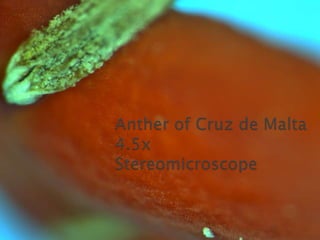
Anther of Cruz de Malta 4.5xStereomicroscope
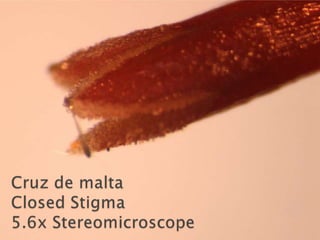
Cruz de maltaClosed Stigma5.6x Stereomicroscope
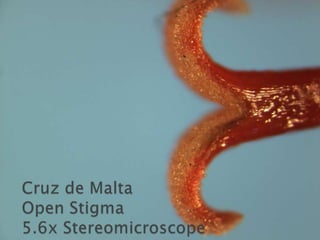
Cruz de MaltaOpen Stigma5.6x Stereomicroscope
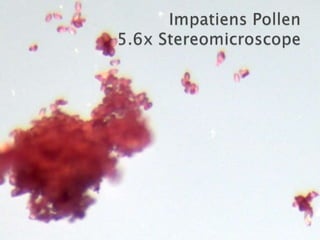
Impatiens Pollen5.6x Stereomicroscope
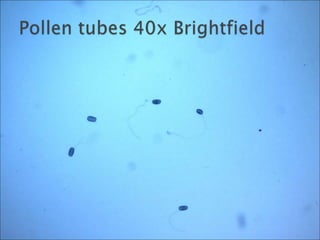
Pollen tubes 40x Brightfield
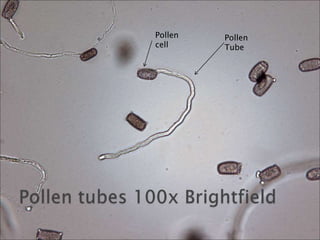
Pollen cellPollen TubePollen tubes 100x Brightfield
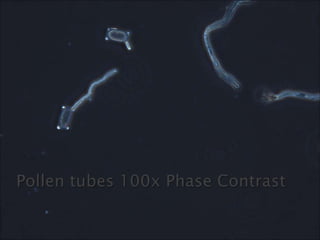
Pollen tubes 100x Phase Contrast
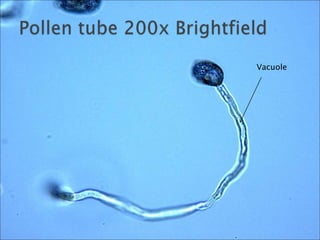
Pollen tube 200x BrightfieldVacuole
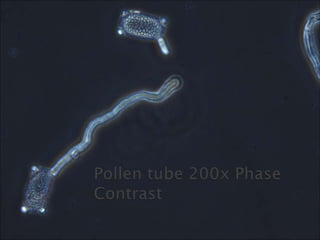
Pollen tube 200x Phase Contrast
Pollen tube 400x BrightfieldOrganelles
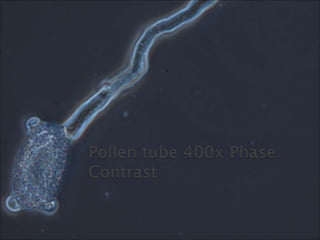
Pollen tube 400x Phase Contrast
END

Pollen germination under microscope

Editor's Notes

  • #3 Many aspects of Angiosperm pollen germination and tube growth are discussed including mechanisms of dehydration and rehydration, in vitro germination, pollen coat compounds, the dynamic involvement of cytoskeletal elements (actin, microtubules), calcium ion fluxes, extracellular matrix elements (stylararabinogalactan proteins), and control mechanisms of gene expression in dehydrating and germinating pollen.Pollen germinates when the stigma releases a sugar like sucrose, then it starts growing the pollen tube. Though, this only occurs if the stigma recognizes the pollen grain. Another germination event during the life cycle of gymnosperms and flowering plants is the germination of a pollen grain after pollination. Like seeds, pollen grains are severely dehydrated before being released to facilitate their dispersal from one plant to another. They consist of a protective coat containing several cells (up to 8 in gymnosperms, 2-3 in flowering plants). One of these cells is a tube cell. Once the pollen grain lands on the stigma of a receptive flower (or a female cone in gymnosperms), it takes up water and germinates. Pollen germination is facilitated by hydration on the stigma, as well as by the structure and physiology of the stigma and style.[2] Pollen can also be induced to germinate in vitro (in a petri dish or test tube).[6][7]During germination, the tube cell elongates into a pollen tube. In the flower, the pollen tube then grows towards the ovule where it discharges the sperm produced in the pollen grain for fertilization. The germinated pollen grain with its two sperm cells is the mature male microgametophyte of these plants
  • #4 Anther Cruz de Malta 4.5x
  • #5 Stigma Cruz de Malta 5.6xStigma stays closed until the ovule’s matured and also to avoid self-pollination.
  • #6 Stigma Cruz de Malta 5.6x When the stigma has opened, it is ready to receive pollen from other flowers. The pollen cells are trapped by the adhesive fibers of the stigma. Though, the stigma doesn’t send the signal to germinate unless it is identified as pollen cell from a cruz de malta flower.
  • #7 Impatiens Pollen 5.6x
  • #8 Pollen tubes 40xBrightfield
  • #9 Pollen Tubes 100x Brightfield
  • #10 Pollen tubes 100x Phase
  • #11 Pollen tube 200x BrightfieldThe pollen tube needs water and nutrients to elongate. Which these nutrients are carried by the organelles moving alongside the Vacuole.
  • #12 Pollen tubes 200x phase
  • #13 Pollen tube 400x brightfield
  • #14 Pollen tube 400x phase