1Aluminum Foundry Alloy Basicsfor BackyardMetalcasting.com Foundry JoeRev 0, May 2010
2ContentBasics of Aluminum AlloysCast  vs. WroughtPrimary vs. SecondaryUnderstand Alloy Element EffectsDeliberate AdditionsSi, Mg, Cu, Zn, BeUnwanted AdditionsFe, OthersEffects of Gases (H2, O2)Grain Refiners (TiBor)Modifiers (Sr)
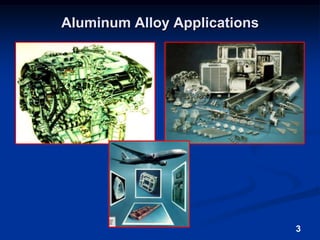
3Aluminum Alloy Applications
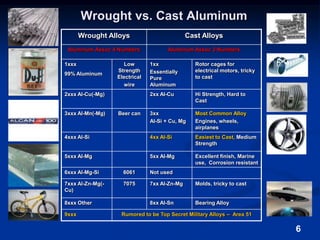
4Basics of Aluminum AlloysWrought alloys Wrought  means “worked”Rolled, Extruded, Forged6061, 7075 Aircraft Aluminum3104  Beer cansCasting alloys are different than wroughtHave been specifically designed to be cast  and not worked
5Aluminum Foundry Casting AlloysIn North America the Aluminum Association numbering system is most commonWrought alloys series have 4 numbers1000 to 9000 series6061, 7075 are familiar examplesFoundry alloy series have 3 numbers100 series to 800 series319, 356, 380 are the most common foundry alloysThere are more than 60 foundry alloysBut just a few make up 80% of tonnage cast
6Wrought vs. Cast Aluminum
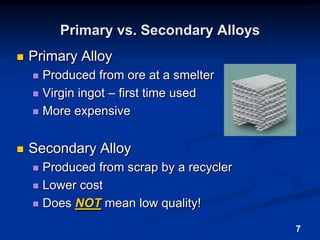
7Primary vs. Secondary AlloysPrimary AlloyProduced from ore at a smelterVirgin ingot – first time usedMore expensiveSecondary AlloyProduced from scrap by a recyclerLower costDoes NOT mean low quality!
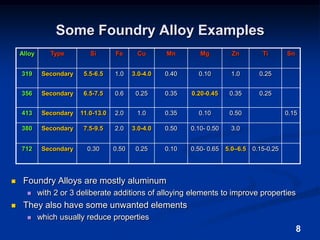
8Some Foundry Alloy ExamplesFoundry Alloys are mostly aluminum 	with 2 or 3 deliberate additions of alloying elements to improve propertiesThey also have some unwanted elements which usually reduce properties
9What do all these Alloying Elements Do?Deliberate Alloy AdditionsSi, Mg, Cu, ZnUnwanted Alloy AdditionsFe, Many OthersOther AdditivesGrain Refiners (TiBor)Modifiers (Sr)Effects of Gases (H2, O2)
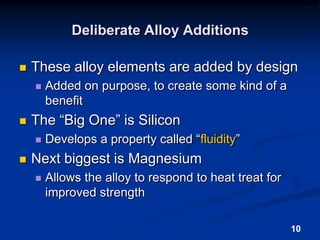
10Deliberate Alloy AdditionsThese alloy elements are added by designAdded on purpose, to create some kind of a benefitThe “Big One” is SiliconDevelops a property called “fluidity”Next biggest is MagnesiumAllows the alloy to respond to heat treat for improved strength
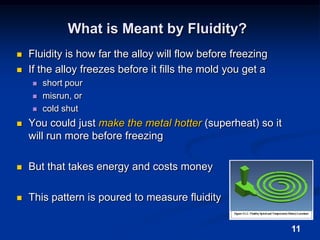
What is Meant by Fluidity?  Fluidity is how far the alloy will flow before freezingIf the alloy freezes before it fills the mold you get a short pour	misrun, or cold shutYou could just make the metal hotter (superheat) so it will run more before freezingBut that takes energy and costs moneyThis pattern is poured to measure fluidity 11
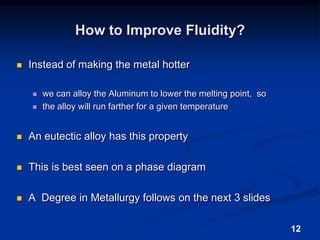
How to Improve Fluidity?  Instead of making the metal hotter we can alloy the Aluminum to lower the melting point,  sothe alloy will run farther for a given temperatureAn eutectic alloy has this propertyThis is best seen on a phase diagramA  Degree in Metallurgy follows on the next 3 slides12
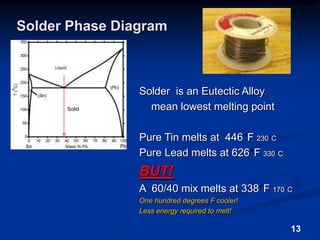
13Solder Phase DiagramSolder  is an Eutectic Alloy	mean lowest melting pointPure Tin melts at  446°F 230°CPure Lead melts at 626°F 330°CBUT!A  60/40 mix melts at 338°F 170°COne hundred degrees F cooler!Less energy required to melt!Solid
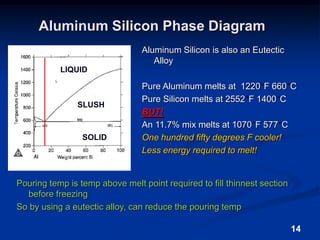
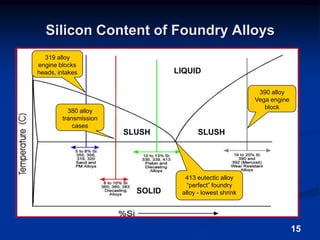
14Aluminum Silicon Phase DiagramAluminum Silicon is also an Eutectic AlloyPure Aluminum melts at  1220°F 660°CPure Silicon melts at 2552°F 1400°CBUT!An 11.7% mix melts at 1070°F 577°COne hundred fifty degrees F cooler!Less energy required to melt!LIQUIDSLUSHSOLIDPouring temp is temp above melt point required to fill thinnest section before freezingSo by using a eutectic alloy, can reduce the pouring temp
15Silicon Content of Foundry Alloys319 alloyengine blocks  heads, intakesLIQUID390 alloyVega engine block380 alloytransmission casesSLUSHSLUSH413 eutectic alloy“perfect” foundry alloy - lowest shrinkSOLID
Review of Element Effects16
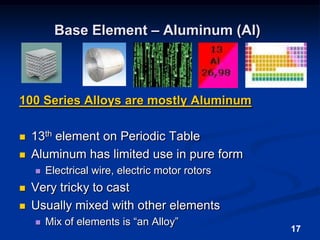
17Base Element – Aluminum (Al)100 Series Alloys are mostly Aluminum13th element on Periodic TableAluminum has limited use in pure form Electrical wire, electric motor rotorsVery tricky to castUsually mixed with other elementsMix of elements is “an Alloy”
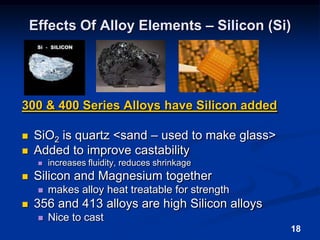
18Effects Of Alloy Elements – Silicon (Si)300 & 400 Series Alloys have Silicon addedSiO2 is quartz <sand – used to make glass> Added to improve castabilityincreases fluidity, reduces shrinkageSilicon and Magnesium togethermakes alloy heat treatable for strength356 and 413 alloys are high Silicon alloysNice to cast
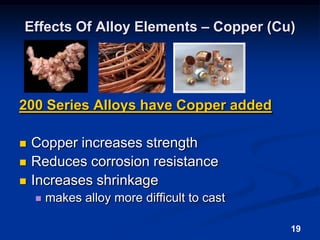
19Effects Of Alloy Elements – Copper (Cu)200 Series Alloys have Copper addedCopper increases strengthReduces corrosion resistanceIncreases shrinkage makes alloy more difficult to cast
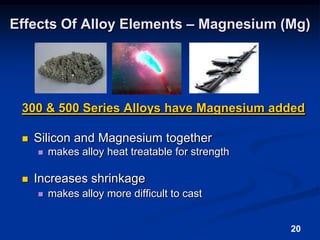
20Effects Of Alloy Elements – Magnesium (Mg)300 & 500 Series Alloys have Magnesium addedSilicon and Magnesium togethermakes alloy heat treatable for strengthIncreases shrinkage makes alloy more difficult to cast
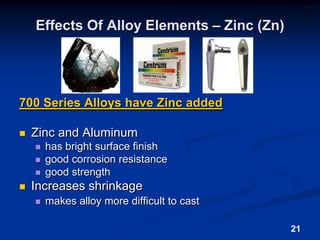
21Effects Of Alloy Elements – Zinc (Zn)700 Series Alloys have Zinc addedZinc and Aluminum		has bright surface finishgood corrosion resistance good strengthIncreases shrinkage makes alloy more difficult to cast
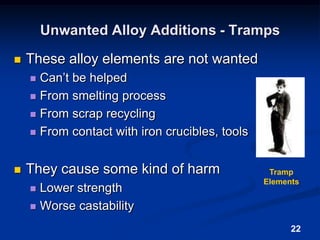
22Unwanted Alloy Additions - TrampsThese alloy elements are not wantedCan’t be helpedFrom smelting processFrom scrap recyclingFrom contact with iron crucibles, toolsThey cause some kind of harmLower strengthWorse castabilityTramp Elements
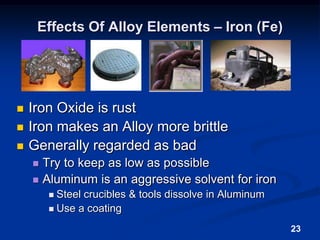
23Effects Of Alloy Elements – Iron (Fe)Iron Oxide is rust Iron makes an Alloy more brittleGenerally regarded as badTry to keep as low as possibleAluminum is an aggressive solvent for ironSteel crucibles & tools dissolve in AluminumUse a coating
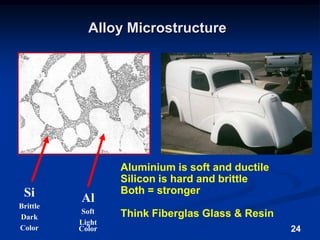
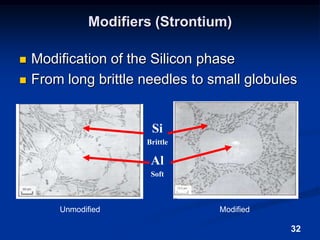
24Alloy MicrostructureAluminium is soft and ductileSilicon is hard and brittleBoth = strongerThink Fiberglas Glass & ResinSiBrittleDarkColorAlSoftLight Color
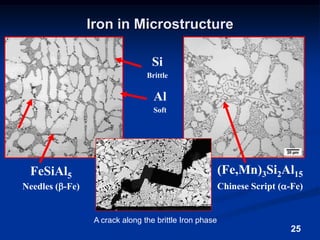
25Iron in MicrostructureSiBrittleAlSoft(Fe,Mn)3Si2Al15Chinese Script (-Fe)FeSiAl5Needles (-Fe)A crack along the brittle Iron phase
26Other Minor Tramp ElementsChromium, Nickel, Tin
Lithium, Calcium, Phosphorous
Others
Each and Total
Just control them under the spec limit
How?
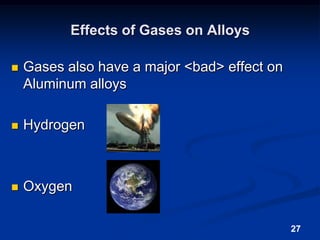
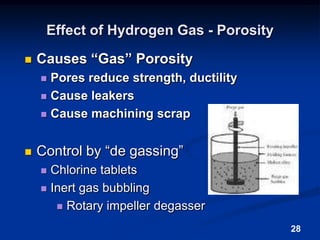
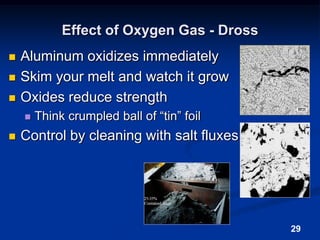
Add more Aluminum to dilute them down27Effects of Gases on AlloysGases also have a major <bad> effect on Aluminum alloysHydrogenOxygen

Aluminum alloys for hobby foundry

  • 1.
    1Aluminum Foundry AlloyBasicsfor BackyardMetalcasting.com Foundry JoeRev 0, May 2010
  • 2.
    2ContentBasics of AluminumAlloysCast vs. WroughtPrimary vs. SecondaryUnderstand Alloy Element EffectsDeliberate AdditionsSi, Mg, Cu, Zn, BeUnwanted AdditionsFe, OthersEffects of Gases (H2, O2)Grain Refiners (TiBor)Modifiers (Sr)
  • 3.
  • 4.
    4Basics of AluminumAlloysWrought alloys Wrought means “worked”Rolled, Extruded, Forged6061, 7075 Aircraft Aluminum3104 Beer cansCasting alloys are different than wroughtHave been specifically designed to be cast and not worked
  • 5.
    5Aluminum Foundry CastingAlloysIn North America the Aluminum Association numbering system is most commonWrought alloys series have 4 numbers1000 to 9000 series6061, 7075 are familiar examplesFoundry alloy series have 3 numbers100 series to 800 series319, 356, 380 are the most common foundry alloysThere are more than 60 foundry alloysBut just a few make up 80% of tonnage cast
  • 6.
  • 7.
    7Primary vs. SecondaryAlloysPrimary AlloyProduced from ore at a smelterVirgin ingot – first time usedMore expensiveSecondary AlloyProduced from scrap by a recyclerLower costDoes NOT mean low quality!
  • 8.
    8Some Foundry AlloyExamplesFoundry Alloys are mostly aluminum with 2 or 3 deliberate additions of alloying elements to improve propertiesThey also have some unwanted elements which usually reduce properties
  • 9.
    9What do allthese Alloying Elements Do?Deliberate Alloy AdditionsSi, Mg, Cu, ZnUnwanted Alloy AdditionsFe, Many OthersOther AdditivesGrain Refiners (TiBor)Modifiers (Sr)Effects of Gases (H2, O2)
  • 10.
    10Deliberate Alloy AdditionsThesealloy elements are added by designAdded on purpose, to create some kind of a benefitThe “Big One” is SiliconDevelops a property called “fluidity”Next biggest is MagnesiumAllows the alloy to respond to heat treat for improved strength
  • 11.
    What is Meantby Fluidity? Fluidity is how far the alloy will flow before freezingIf the alloy freezes before it fills the mold you get a short pour misrun, or cold shutYou could just make the metal hotter (superheat) so it will run more before freezingBut that takes energy and costs moneyThis pattern is poured to measure fluidity 11
  • 12.
    How to ImproveFluidity? Instead of making the metal hotter we can alloy the Aluminum to lower the melting point, sothe alloy will run farther for a given temperatureAn eutectic alloy has this propertyThis is best seen on a phase diagramA Degree in Metallurgy follows on the next 3 slides12
  • 13.
    13Solder Phase DiagramSolder is an Eutectic Alloy mean lowest melting pointPure Tin melts at 446°F 230°CPure Lead melts at 626°F 330°CBUT!A 60/40 mix melts at 338°F 170°COne hundred degrees F cooler!Less energy required to melt!Solid
  • 14.
    14Aluminum Silicon PhaseDiagramAluminum Silicon is also an Eutectic AlloyPure Aluminum melts at 1220°F 660°CPure Silicon melts at 2552°F 1400°CBUT!An 11.7% mix melts at 1070°F 577°COne hundred fifty degrees F cooler!Less energy required to melt!LIQUIDSLUSHSOLIDPouring temp is temp above melt point required to fill thinnest section before freezingSo by using a eutectic alloy, can reduce the pouring temp
  • 15.
    15Silicon Content ofFoundry Alloys319 alloyengine blocks heads, intakesLIQUID390 alloyVega engine block380 alloytransmission casesSLUSHSLUSH413 eutectic alloy“perfect” foundry alloy - lowest shrinkSOLID
  • 16.
  • 17.
    17Base Element –Aluminum (Al)100 Series Alloys are mostly Aluminum13th element on Periodic TableAluminum has limited use in pure form Electrical wire, electric motor rotorsVery tricky to castUsually mixed with other elementsMix of elements is “an Alloy”
  • 18.
    18Effects Of AlloyElements – Silicon (Si)300 & 400 Series Alloys have Silicon addedSiO2 is quartz <sand – used to make glass> Added to improve castabilityincreases fluidity, reduces shrinkageSilicon and Magnesium togethermakes alloy heat treatable for strength356 and 413 alloys are high Silicon alloysNice to cast
  • 19.
    19Effects Of AlloyElements – Copper (Cu)200 Series Alloys have Copper addedCopper increases strengthReduces corrosion resistanceIncreases shrinkage makes alloy more difficult to cast
  • 20.
    20Effects Of AlloyElements – Magnesium (Mg)300 & 500 Series Alloys have Magnesium addedSilicon and Magnesium togethermakes alloy heat treatable for strengthIncreases shrinkage makes alloy more difficult to cast
  • 21.
    21Effects Of AlloyElements – Zinc (Zn)700 Series Alloys have Zinc addedZinc and Aluminum has bright surface finishgood corrosion resistance good strengthIncreases shrinkage makes alloy more difficult to cast
  • 22.
    22Unwanted Alloy Additions- TrampsThese alloy elements are not wantedCan’t be helpedFrom smelting processFrom scrap recyclingFrom contact with iron crucibles, toolsThey cause some kind of harmLower strengthWorse castabilityTramp Elements
  • 23.
    23Effects Of AlloyElements – Iron (Fe)Iron Oxide is rust Iron makes an Alloy more brittleGenerally regarded as badTry to keep as low as possibleAluminum is an aggressive solvent for ironSteel crucibles & tools dissolve in AluminumUse a coating
  • 24.
    24Alloy MicrostructureAluminium issoft and ductileSilicon is hard and brittleBoth = strongerThink Fiberglas Glass & ResinSiBrittleDarkColorAlSoftLight Color
  • 25.
    25Iron in MicrostructureSiBrittleAlSoft(Fe,Mn)3Si2Al15ChineseScript (-Fe)FeSiAl5Needles (-Fe)A crack along the brittle Iron phase
  • 26.
    26Other Minor TrampElementsChromium, Nickel, Tin
  • 27.
  • 28.
  • 29.
  • 30.
    Just control themunder the spec limit
  • 31.
  • 32.
    Add more Aluminumto dilute them down27Effects of Gases on AlloysGases also have a major <bad> effect on Aluminum alloysHydrogenOxygen