PDE201 – Dam Engineering I
1-1
Arba Minch University
School of Graduate studies
DAM ENGINEERING I: PLANNING, DESIGN AND CONSTRUCTION
OF CONCRETE/RIGID DAMS
PDE201 – Dam Engineering I
1-2
Course Title: Dam Engineering I: Planning, design and construction
of concrete/rigid dams
Course Code: PDE201
Course Contents
 An overview of dam engineering including historical perspectives
 Types of dams
 Site investigation and selection of dam types
 Principles of concrete dam design and construction
o Design and analysis of gravity dam
o Roller compacted concrete (RCC) dam
o Design and analysis of arch and buttress dam
 Advanced methods of design
 Foundation treatment
 Instrumentation, surveillance and risk analysis
References
 Novak, P., Moffat, A.I.B., Nalluri, C. and Narayanan, R. (1996). Hydraulic
Structures, 2nd edition, Chapman & Hall
 Herzog, A.M. (1999). Practical Dam Analysis, Thomas Telford
 Creager, W.P., Justin, J.D. and Hinds, J. (1945). Engineering for Dams,
volumes I & II.
 Jansen, R.B. ( ). Advanced Dam Engineering
 U.S. Bureau of Reclamation (USBR), 1987. Design of Small Dams, 3rd
edition, United States Department of the Interior, Water Resources
Technical Publication.
 World Commission on Dams (2000). Dams and Development: A New
Framework for Decision-making, Report of the World Commission on
Dams (WCD), London.
 Davis, C.V. and Sorensen, K.E. (1980). Handbook of Applied Hydraulics,
McGraw-Hill Book Company
 U.S. Army Corps of Engineers (USACE), Engineer Manual (1994). Arch
Dam Design, Washington, DC.
PDE201 – Dam Engineering I
1-3
 An Overviewof Dam Engineering IncludingHistorical
Perspectives
1.1 Introduction
Over 450001 times in the last century, people took the decision to build a dam. Dams
were built to provide water for irrigated agriculture, domestic or industrial use, to
generate hydropower or help control floods. But dams also altered and diverted river
flows, affecting existing rights and access to water, and resulting in significant
impacts on livelihoods and the environment. Decisions to build dams are being
contested increasingly as human knowledge and experience expand, as we develop
new technologies, and as decision-making becomes more open, inclusive and
transparent.
Dams are a means to an end, not an end in themselves. What is that end? How
central are the challenges that large dams set out to meet? And how well can dams
meet them?
The World Commission on Dams (WCD) considers that the end of any dam project
must be the sustainable improvement of human welfare. This means a significant
advance of human development on a basis that is economically viable, socially
equitable, and environmentally sustainable. If a large dam is the best way to achieve
this goal it deserves our support. Where other options offer better solutions we
should favour them over large dams. Thus the debate around dams challenges our
view of how we develop and manage our water resources.
The issues surrounding dams are the issues surrounding water, and how water-
related decisions are made. There is little public controversy about the choice
between an embankment dam or a gravity dam, or whether to use earth, concrete or
rock-fill, possibly even over financing the development. The issues all relate to what
the dam will do to river flow, to rights of access to water and river resources, to
whether it will uproot existing human settlements, disrupt the culture and sources of
livelihood of local communities and deplete and degrade environmental resources.
Conflicts over dams are more than conflicts over water. They are conflicts over
human development and life itself. (1 - more than 300,000 dams are constructed worldwide of
which more than about 45000 are large dams).
1.2 Developmentand Dams
River basins are renowned as the cradles of civilization and cultural heritage.
Ancient and modern communities alike have depended on rivers for livelihood,
commerce, habitat and the sustaining ecological functions they provide. Throughout
history alterations to rivers – natural or human generated – have affected riverine
communities in one way or another.
PDE201 – Dam Engineering I
1-4
The earliest evidence of river engineering is the ruins of irrigation canals over eight
thousand years old in Mesopotamia. Remains of water storage dams found in
Jordan, Egypt and other parts of the Middle East date back to at least 3000 BC.
Historical records suggest that the use of dams for irrigation and water supply
became more widespread about a thousand years later. At that time, dams were
built in the Mediterranean region, China and Meso America. Remains of earth
embankment dams built for diverting water to large community reservoirs can still be
found in Sri Lanka and Israel. The Dujiang irrigation project, which supplied 800000
hectares in China, is 2200 years old. Dams and aqueducts built by the Romans to
supply drinking water and sewer systems for towns still exist today.
The first use of dams for hydropower generation was around 1890. By 1900, several
hundred large dams had been built in different parts of the world, mostly for water
supply and irrigation.
1.3 Dams in the 20th
century
The last century saw a rapid increase in large dam building. By 1949 about 5000
large dams had been constructed worldwide, three-quarters of them in industrialized
countries. By the end of the 20th century, there were over 45000 large dams in over
140 countries.
The period of economic growth following the Second World War saw a phenomenal
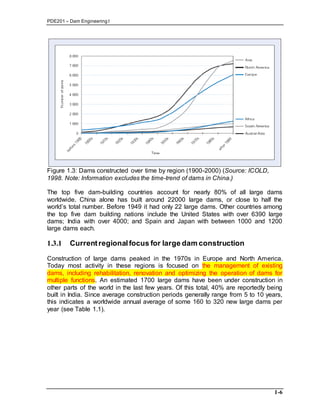
rise in the global dam construction rate, lasting well into the 1970s and 1980s. At its
peak, nearly 5000 large dams were built worldwide in the period from 1970 to 1975.
The decline in the pace of dam building over the past two decades has been equally
dramatic, especially in North America and Europe where most technically attractive
sites are already developed. The average large dam today is about 35 years old.
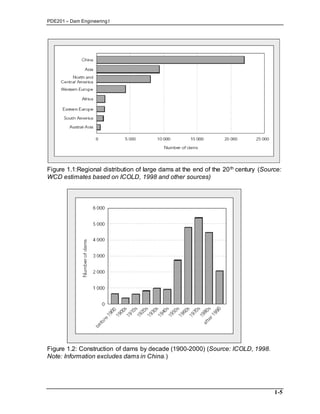
Figure 1.1 shows the proportional distribution of large dams in different regions of
the world. Approximately two thirds of the world’s existing large dams are in
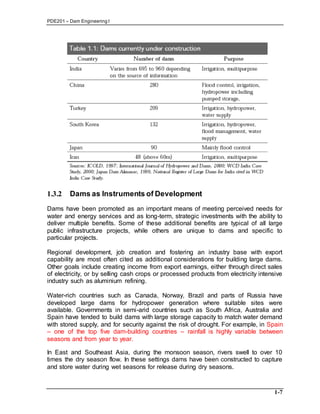
developing countries. Figures 1.2 and 1.3 show the cumulative and time-line trends
in the construction of large dams in the last century. The time-trend figures exclude
data on most of the dams in China and therefore differ slightly from the trends
described in the text.
PDE201 – Dam Engineering I
1-5
Figure 1.1:Regional distribution of large dams at the end of the 20th century (Source:
WCD estimates based on ICOLD, 1998 and other sources)
Figure 1.2: Construction of dams by decade (1900-2000) (Source: ICOLD, 1998.
Note: Information excludes dams in China.)
PDE201 – Dam Engineering I
1-6
Figure 1.3: Dams constructed over time by region (1900-2000) (Source: ICOLD,
1998. Note: Information excludes the time-trend of dams in China.)
The top five dam-building countries account for nearly 80% of all large dams
worldwide. China alone has built around 22000 large dams, or close to half the
world’s total number. Before 1949 it had only 22 large dams. Other countries among
the top five dam building nations include the United States with over 6390 large
dams; India with over 4000; and Spain and Japan with between 1000 and 1200
large dams each.
1.3.1 Currentregionalfocus for large dam construction
Construction of large dams peaked in the 1970s in Europe and North America.
Today most activity in these regions is focused on the management of existing
dams, including rehabilitation, renovation and optimizing the operation of dams for
multiple functions. An estimated 1700 large dams have been under construction in
other parts of the world in the last few years. Of this total, 40% are reportedly being
built in India. Since average construction periods generally range from 5 to 10 years,
this indicates a worldwide annual average of some 160 to 320 new large dams per
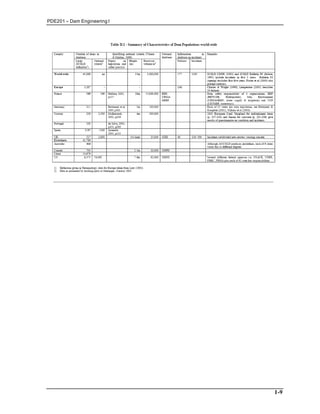
year (see Table 1.1).
PDE201 – Dam Engineering I
1-7
1.3.2 Dams as Instruments of Development
Dams have been promoted as an important means of meeting perceived needs for
water and energy services and as long-term, strategic investments with the ability to
deliver multiple benefits. Some of these additional benefits are typical of all large
public infrastructure projects, while others are unique to dams and specific to
particular projects.
Regional development, job creation and fostering an industry base with export
capability are most often cited as additional considerations for building large dams.
Other goals include creating income from export earnings, either through direct sales
of electricity, or by selling cash crops or processed products from electricity intensive
industry such as aluminium refining.
Water-rich countries such as Canada, Norway, Brazil and parts of Russia have
developed large dams for hydropower generation where suitable sites were
available. Governments in semi-arid countries such as South Africa, Australia and
Spain have tended to build dams with large storage capacity to match water demand
with stored supply, and for security against the risk of drought. For example, in Spain
– one of the top five dam-building countries – rainfall is highly variable between
seasons and from year to year.
In East and Southeast Asia, during the monsoon season, rivers swell to over 10
times the dry season flow. In these settings dams have been constructed to capture
and store water during wet seasons for release during dry seasons.
PDE201 – Dam Engineering I
1-8
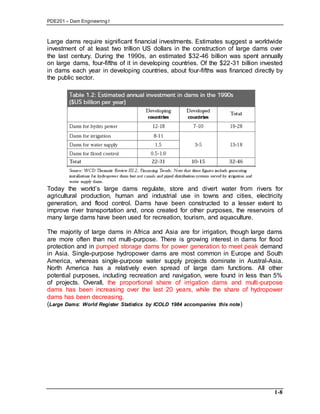
Large dams require significant financial investments. Estimates suggest a worldwide
investment of at least two trillion US dollars in the construction of large dams over
the last century. During the 1990s, an estimated $32-46 billion was spent annually
on large dams, four-fifths of it in developing countries. Of the $22-31 billion invested
in dams each year in developing countries, about four-fifths was financed directly by
the public sector.
Today the world’s large dams regulate, store and divert water from rivers for
agricultural production, human and industrial use in towns and cities, electricity
generation, and flood control. Dams have been constructed to a lesser extent to
improve river transportation and, once created for other purposes, the reservoirs of
many large dams have been used for recreation, tourism, and aquaculture.
The majority of large dams in Africa and Asia are for irrigation, though large dams
are more often than not multi-purpose. There is growing interest in dams for flood
protection and in pumped storage dams for power generation to meet peak demand
in Asia. Single-purpose hydropower dams are most common in Europe and South
America, whereas single-purpose water supply projects dominate in Austral-Asia.
North America has a relatively even spread of large dam functions. All other
potential purposes, including recreation and navigation, were found in less than 5%
of projects. Overall, the proportional share of irrigation dams and multi-purpose
dams has been increasing over the last 20 years, while the share of hydropower
dams has been decreasing.
(Large Dams: World Register Statistics by ICOLD 1984 accompanies this note)
PDE201 – Dam Engineering I
1-9
PDE201 – Dam Engineering I
1-10
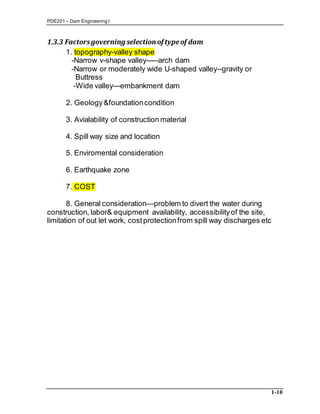
1.3.3 Factorsgoverning selection of typeof dam
1. topography-valley shape
-Narrow v-shape valley-----arch dam
-Narrow or moderately wide U-shaped valley--gravity or
Buttress
-Wide valley---embankment dam
2. Geology&foundationcondition
3. Avialability of construction material
4. Spill way size and location
5. Enviromental consideration
6. Earthquake zone
7. COST
8. General consideration—problem to divert the water during
construction, labor& equipment availability, accessibilityof the site,
limitation of out let work, costprotectionfrom spill way discharges etc

Dam engineering i 1

  • 1.
    PDE201 – DamEngineering I 1-1 Arba Minch University School of Graduate studies DAM ENGINEERING I: PLANNING, DESIGN AND CONSTRUCTION OF CONCRETE/RIGID DAMS
  • 2.
    PDE201 – DamEngineering I 1-2 Course Title: Dam Engineering I: Planning, design and construction of concrete/rigid dams Course Code: PDE201 Course Contents  An overview of dam engineering including historical perspectives  Types of dams  Site investigation and selection of dam types  Principles of concrete dam design and construction o Design and analysis of gravity dam o Roller compacted concrete (RCC) dam o Design and analysis of arch and buttress dam  Advanced methods of design  Foundation treatment  Instrumentation, surveillance and risk analysis References  Novak, P., Moffat, A.I.B., Nalluri, C. and Narayanan, R. (1996). Hydraulic Structures, 2nd edition, Chapman & Hall  Herzog, A.M. (1999). Practical Dam Analysis, Thomas Telford  Creager, W.P., Justin, J.D. and Hinds, J. (1945). Engineering for Dams, volumes I & II.  Jansen, R.B. ( ). Advanced Dam Engineering  U.S. Bureau of Reclamation (USBR), 1987. Design of Small Dams, 3rd edition, United States Department of the Interior, Water Resources Technical Publication.  World Commission on Dams (2000). Dams and Development: A New Framework for Decision-making, Report of the World Commission on Dams (WCD), London.  Davis, C.V. and Sorensen, K.E. (1980). Handbook of Applied Hydraulics, McGraw-Hill Book Company  U.S. Army Corps of Engineers (USACE), Engineer Manual (1994). Arch Dam Design, Washington, DC.
  • 3.
    PDE201 – DamEngineering I 1-3  An Overviewof Dam Engineering IncludingHistorical Perspectives 1.1 Introduction Over 450001 times in the last century, people took the decision to build a dam. Dams were built to provide water for irrigated agriculture, domestic or industrial use, to generate hydropower or help control floods. But dams also altered and diverted river flows, affecting existing rights and access to water, and resulting in significant impacts on livelihoods and the environment. Decisions to build dams are being contested increasingly as human knowledge and experience expand, as we develop new technologies, and as decision-making becomes more open, inclusive and transparent. Dams are a means to an end, not an end in themselves. What is that end? How central are the challenges that large dams set out to meet? And how well can dams meet them? The World Commission on Dams (WCD) considers that the end of any dam project must be the sustainable improvement of human welfare. This means a significant advance of human development on a basis that is economically viable, socially equitable, and environmentally sustainable. If a large dam is the best way to achieve this goal it deserves our support. Where other options offer better solutions we should favour them over large dams. Thus the debate around dams challenges our view of how we develop and manage our water resources. The issues surrounding dams are the issues surrounding water, and how water- related decisions are made. There is little public controversy about the choice between an embankment dam or a gravity dam, or whether to use earth, concrete or rock-fill, possibly even over financing the development. The issues all relate to what the dam will do to river flow, to rights of access to water and river resources, to whether it will uproot existing human settlements, disrupt the culture and sources of livelihood of local communities and deplete and degrade environmental resources. Conflicts over dams are more than conflicts over water. They are conflicts over human development and life itself. (1 - more than 300,000 dams are constructed worldwide of which more than about 45000 are large dams). 1.2 Developmentand Dams River basins are renowned as the cradles of civilization and cultural heritage. Ancient and modern communities alike have depended on rivers for livelihood, commerce, habitat and the sustaining ecological functions they provide. Throughout history alterations to rivers – natural or human generated – have affected riverine communities in one way or another.
  • 4.
    PDE201 – DamEngineering I 1-4 The earliest evidence of river engineering is the ruins of irrigation canals over eight thousand years old in Mesopotamia. Remains of water storage dams found in Jordan, Egypt and other parts of the Middle East date back to at least 3000 BC. Historical records suggest that the use of dams for irrigation and water supply became more widespread about a thousand years later. At that time, dams were built in the Mediterranean region, China and Meso America. Remains of earth embankment dams built for diverting water to large community reservoirs can still be found in Sri Lanka and Israel. The Dujiang irrigation project, which supplied 800000 hectares in China, is 2200 years old. Dams and aqueducts built by the Romans to supply drinking water and sewer systems for towns still exist today. The first use of dams for hydropower generation was around 1890. By 1900, several hundred large dams had been built in different parts of the world, mostly for water supply and irrigation. 1.3 Dams in the 20th century The last century saw a rapid increase in large dam building. By 1949 about 5000 large dams had been constructed worldwide, three-quarters of them in industrialized countries. By the end of the 20th century, there were over 45000 large dams in over 140 countries. The period of economic growth following the Second World War saw a phenomenal rise in the global dam construction rate, lasting well into the 1970s and 1980s. At its peak, nearly 5000 large dams were built worldwide in the period from 1970 to 1975. The decline in the pace of dam building over the past two decades has been equally dramatic, especially in North America and Europe where most technically attractive sites are already developed. The average large dam today is about 35 years old. Figure 1.1 shows the proportional distribution of large dams in different regions of the world. Approximately two thirds of the world’s existing large dams are in developing countries. Figures 1.2 and 1.3 show the cumulative and time-line trends in the construction of large dams in the last century. The time-trend figures exclude data on most of the dams in China and therefore differ slightly from the trends described in the text.
  • 5.
    PDE201 – DamEngineering I 1-5 Figure 1.1:Regional distribution of large dams at the end of the 20th century (Source: WCD estimates based on ICOLD, 1998 and other sources) Figure 1.2: Construction of dams by decade (1900-2000) (Source: ICOLD, 1998. Note: Information excludes dams in China.)
  • 6.
    PDE201 – DamEngineering I 1-6 Figure 1.3: Dams constructed over time by region (1900-2000) (Source: ICOLD, 1998. Note: Information excludes the time-trend of dams in China.) The top five dam-building countries account for nearly 80% of all large dams worldwide. China alone has built around 22000 large dams, or close to half the world’s total number. Before 1949 it had only 22 large dams. Other countries among the top five dam building nations include the United States with over 6390 large dams; India with over 4000; and Spain and Japan with between 1000 and 1200 large dams each. 1.3.1 Currentregionalfocus for large dam construction Construction of large dams peaked in the 1970s in Europe and North America. Today most activity in these regions is focused on the management of existing dams, including rehabilitation, renovation and optimizing the operation of dams for multiple functions. An estimated 1700 large dams have been under construction in other parts of the world in the last few years. Of this total, 40% are reportedly being built in India. Since average construction periods generally range from 5 to 10 years, this indicates a worldwide annual average of some 160 to 320 new large dams per year (see Table 1.1).
  • 7.
    PDE201 – DamEngineering I 1-7 1.3.2 Dams as Instruments of Development Dams have been promoted as an important means of meeting perceived needs for water and energy services and as long-term, strategic investments with the ability to deliver multiple benefits. Some of these additional benefits are typical of all large public infrastructure projects, while others are unique to dams and specific to particular projects. Regional development, job creation and fostering an industry base with export capability are most often cited as additional considerations for building large dams. Other goals include creating income from export earnings, either through direct sales of electricity, or by selling cash crops or processed products from electricity intensive industry such as aluminium refining. Water-rich countries such as Canada, Norway, Brazil and parts of Russia have developed large dams for hydropower generation where suitable sites were available. Governments in semi-arid countries such as South Africa, Australia and Spain have tended to build dams with large storage capacity to match water demand with stored supply, and for security against the risk of drought. For example, in Spain – one of the top five dam-building countries – rainfall is highly variable between seasons and from year to year. In East and Southeast Asia, during the monsoon season, rivers swell to over 10 times the dry season flow. In these settings dams have been constructed to capture and store water during wet seasons for release during dry seasons.
  • 8.
    PDE201 – DamEngineering I 1-8 Large dams require significant financial investments. Estimates suggest a worldwide investment of at least two trillion US dollars in the construction of large dams over the last century. During the 1990s, an estimated $32-46 billion was spent annually on large dams, four-fifths of it in developing countries. Of the $22-31 billion invested in dams each year in developing countries, about four-fifths was financed directly by the public sector. Today the world’s large dams regulate, store and divert water from rivers for agricultural production, human and industrial use in towns and cities, electricity generation, and flood control. Dams have been constructed to a lesser extent to improve river transportation and, once created for other purposes, the reservoirs of many large dams have been used for recreation, tourism, and aquaculture. The majority of large dams in Africa and Asia are for irrigation, though large dams are more often than not multi-purpose. There is growing interest in dams for flood protection and in pumped storage dams for power generation to meet peak demand in Asia. Single-purpose hydropower dams are most common in Europe and South America, whereas single-purpose water supply projects dominate in Austral-Asia. North America has a relatively even spread of large dam functions. All other potential purposes, including recreation and navigation, were found in less than 5% of projects. Overall, the proportional share of irrigation dams and multi-purpose dams has been increasing over the last 20 years, while the share of hydropower dams has been decreasing. (Large Dams: World Register Statistics by ICOLD 1984 accompanies this note)
  • 9.
    PDE201 – DamEngineering I 1-9
  • 10.
    PDE201 – DamEngineering I 1-10 1.3.3 Factorsgoverning selection of typeof dam 1. topography-valley shape -Narrow v-shape valley-----arch dam -Narrow or moderately wide U-shaped valley--gravity or Buttress -Wide valley---embankment dam 2. Geology&foundationcondition 3. Avialability of construction material 4. Spill way size and location 5. Enviromental consideration 6. Earthquake zone 7. COST 8. General consideration—problem to divert the water during construction, labor& equipment availability, accessibilityof the site, limitation of out let work, costprotectionfrom spill way discharges etc