MORNING
GOOD
DR. FARJAD IKRAM
HOUSE OFFICER ||| CARDIOLOGY
PULSE
BLOOD PRESSURE
JUGULAR VENOUS PRESSURE
OBJECTIVES
• Definition of pulse
• Determinants of arterial pulse
• Sites for arterial pulse
• Characteristics of arterial pulse
• Comparision of arterial pulses
• Jugular venous pulse
INTRODUCTION
“
Pulse is the rhythmic dilation of an artery or
a vein that results from beating of the heart.
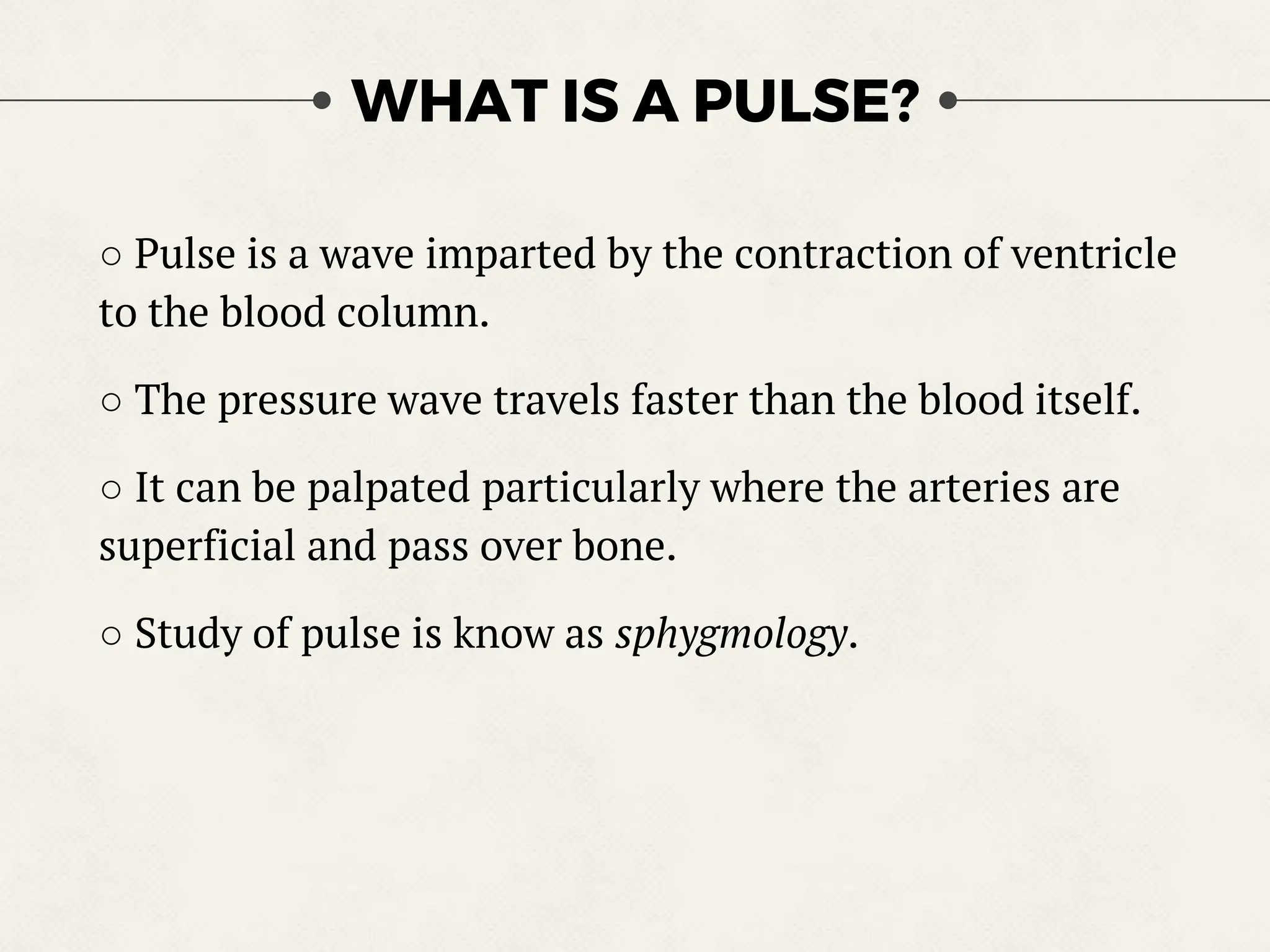
WHAT IS A PULSE?
○ Pulse is a wave imparted by the contraction of ventricle
to the blood column.
○ The pressure wave travels faster than the blood itself.
○ It can be palpated particularly where the arteries are
superficial and pass over bone.
○ Study of pulse is know as sphygmology.
TYPES OF PULSES
VENOUS
ARTERIAL
• Pulses can be arterial or venous.
• Unless stated, pulse is usually inferred as arterial.
• Venous pulses can be visible, but not palpable.
ARTERY VS VEIN
ARTERY VEIN
DETERMINANTS
The arterial pulse waveform depends on:
• heart rate,
• stroke volume,
• peripheral resistance,
• left ventricular outflow obstruction, and
• the elasticity of peripheral vessels
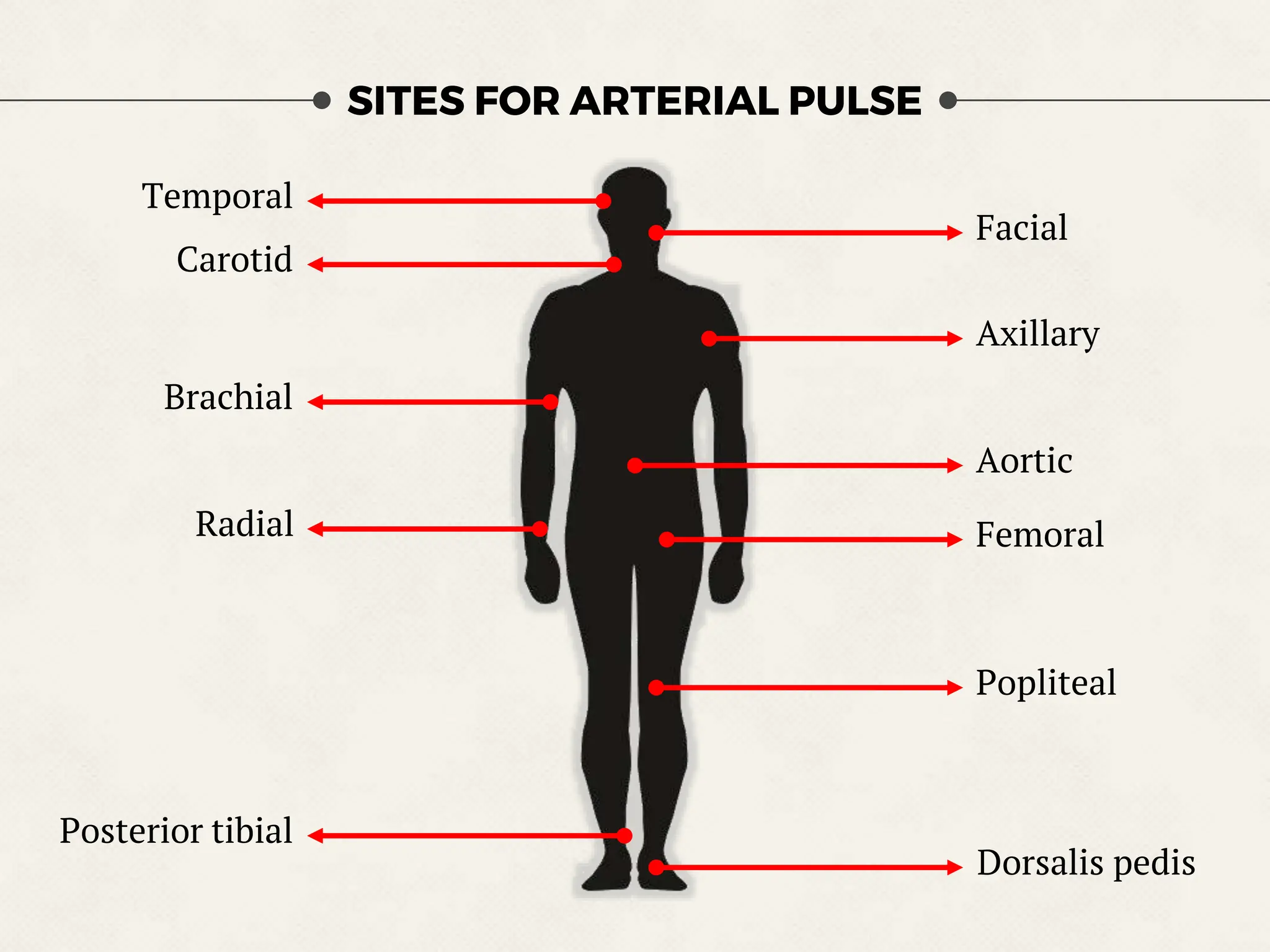
SITES FOR PULSE
SITES FOR ARTERIAL PULSE
Temporal
Carotid
Brachial
Radial
Posterior tibial
Dorsalis pedis
Popliteal
Femoral
Aortic
Axillary
Facial
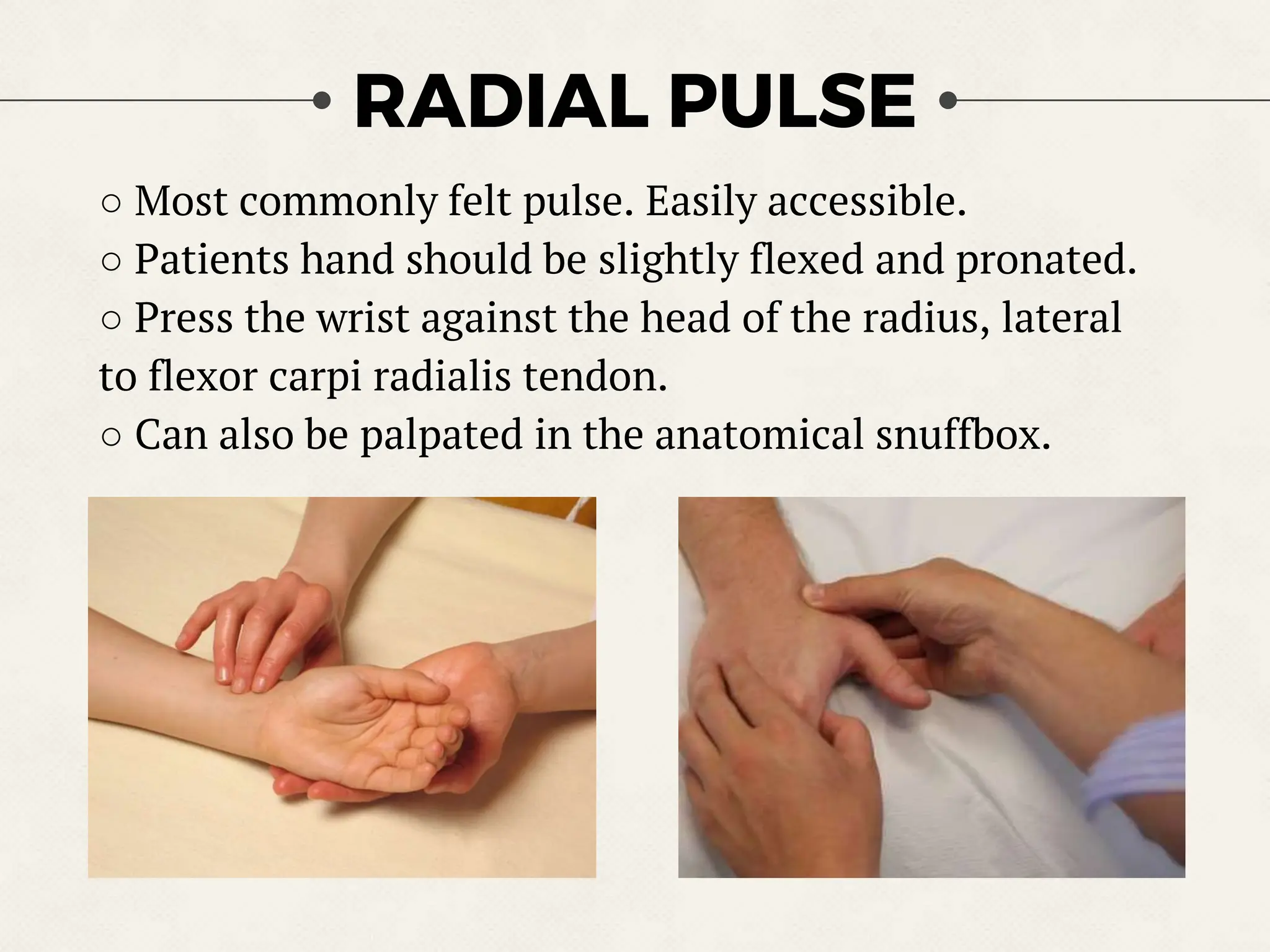
RADIAL PULSE
○ Most commonly felt pulse. Easily accessible.
○ Patient’s hand should be slightly flexed and pronated.
○ Press the wrist against the head of the radius, lateral
to flexor carpi radialis tendon.
○ Can also be palpated in the anatomical snuffbox.
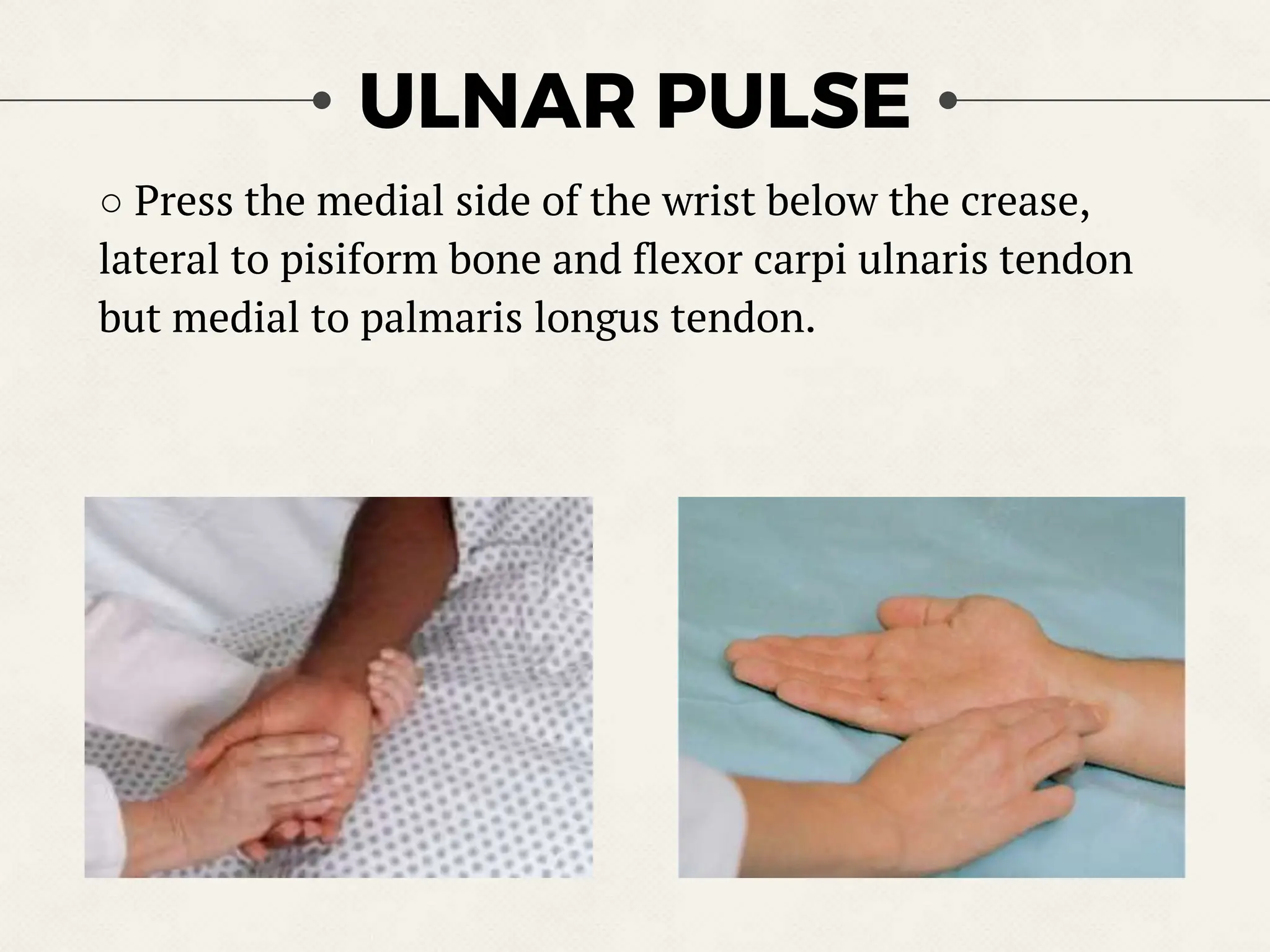
ULNAR PULSE
○ Press the medial side of the wrist below the crease,
lateral to pisiform bone and flexor carpi ulnaris tendon
but medial to palmaris longus tendon.
WRIST PULSES
BRACHIAL PULSE
○ It is palpable in the ante-cubital fossa of a slightly
flexed elbow, medial to the biceps tendon.
AXILLARY PULSE
○ Press the axilla deep against the humerus behind the
anterior axillary fold in an abducted arm.
CAROTID PULSE
○ Press at angle of the jaw, anterior to the SCM muscle
and lateral to the thyroid cartilage.
○ Never press both the carotid arteries at the same time.
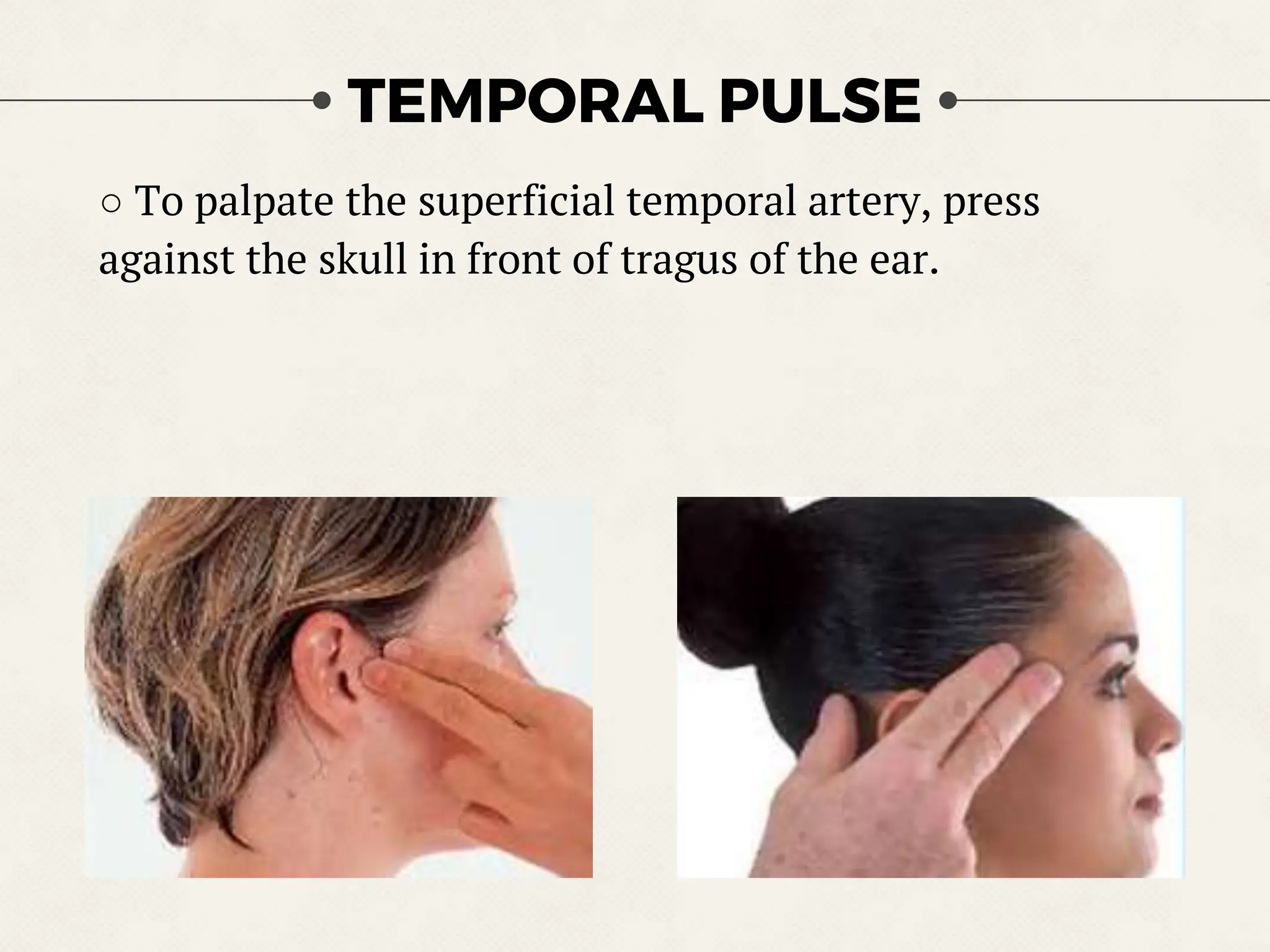
TEMPORAL PULSE
○ To palpate the superficial temporal artery, press
against the skull in front of tragus of the ear.
FACIAL PULSE
○ Press against the lower margin of the mandible,
inferior and postero-lateral to the angle of the mouth.
FEMORAL PULSE
○ Press just below the inguinal ligament, midway
between the anterior superior iliac spine (ASIS) and the
pubic symphysis.
○ It is immediately lateral to the femoral vein and
medial to the femoral nerve.
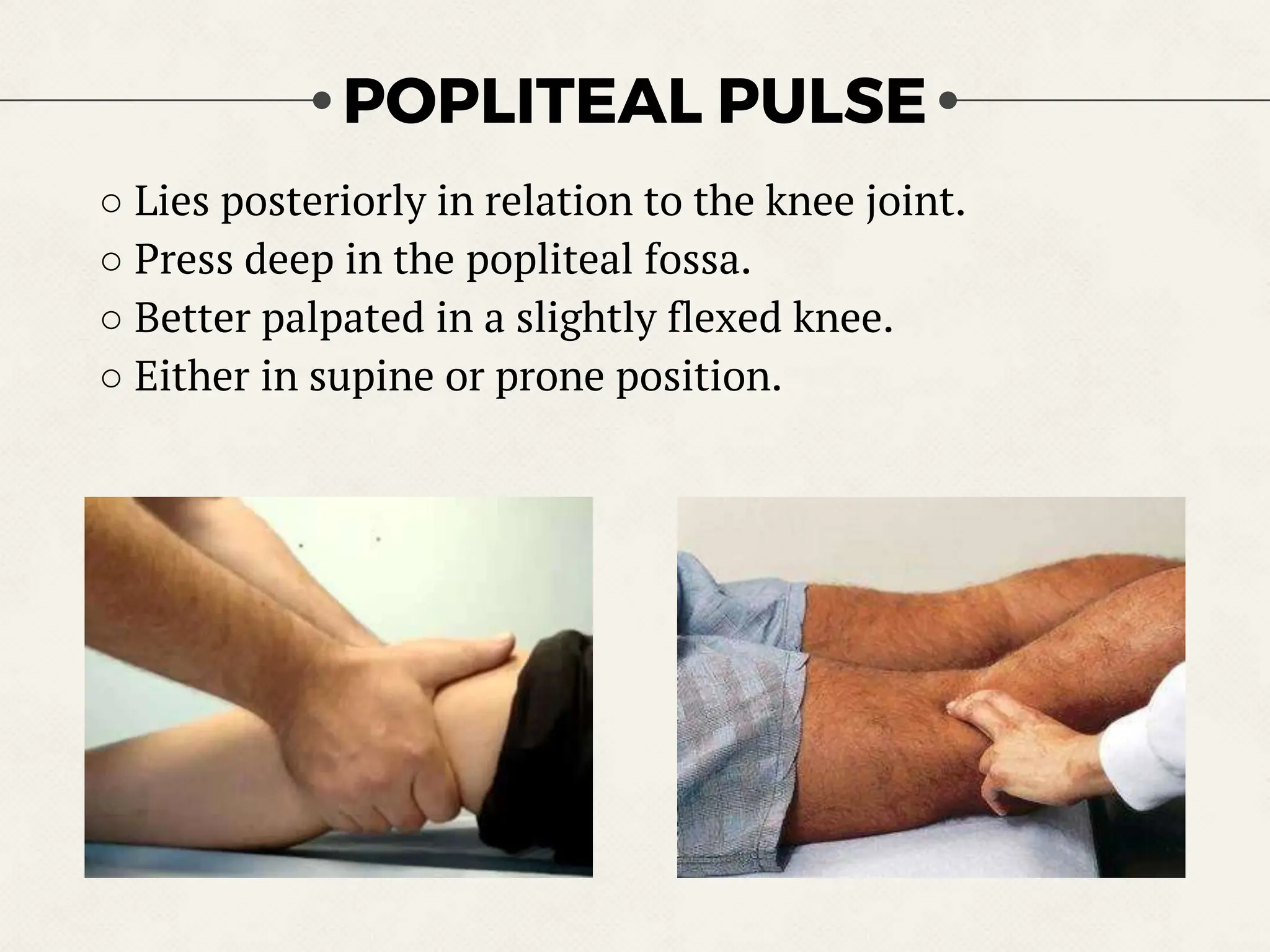
POPLITEAL PULSE
○ Lies posteriorly in relation to the knee joint.
○ Press deep in the popliteal fossa.
○ Better palpated in a slightly flexed knee.
○ Either in supine or prone position.
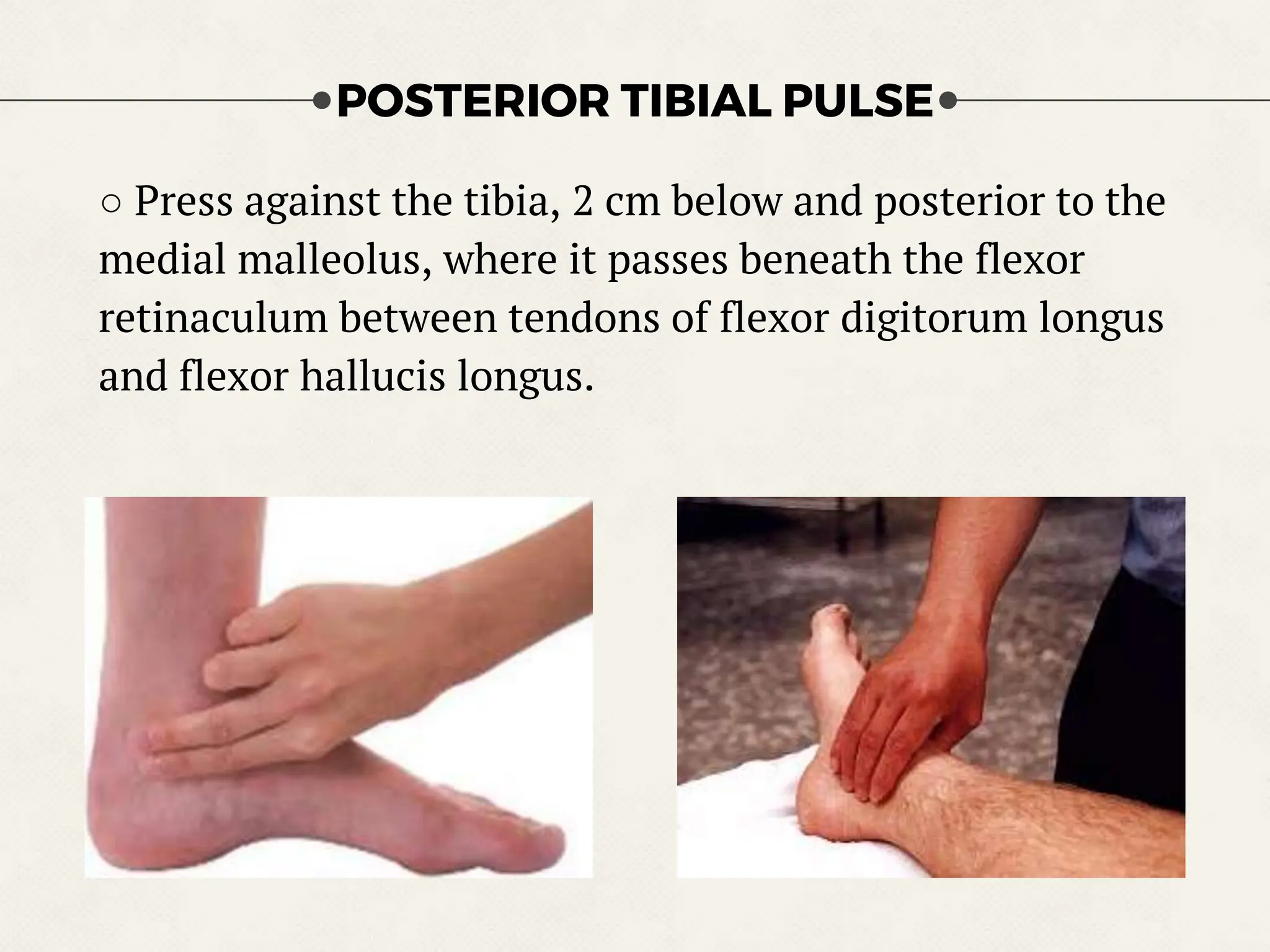
POSTERIOR TIBIAL PULSE
○ Press against the tibia, 2 cm below and posterior to the
medial malleolus, where it passes beneath the flexor
retinaculum between tendons of flexor digitorum longus
and flexor hallucis longus.
DORSALIS PEDIS PULSE
○ Passes lateral to the tendon of extensor hallucis longus.
○ Best felt at the proximal extent of the groove between
the first and second metatarsals.
AORTIC PULSE
○ Expansile pulsation of abdominal aorta may be felt by
pressing the fingertips of one or both hands deep into the
umbilical region.
○ Anterior expansion is normal and felt in lean people.
○ Lateral expansion may be because of aortic aneurysm.
EXAMINATION
CHARACTERISTICS
When palpating for arteries assess the following:
• pulse rate,
• pulse rhythm,
• character,
• volume,
• comparison with other pulses
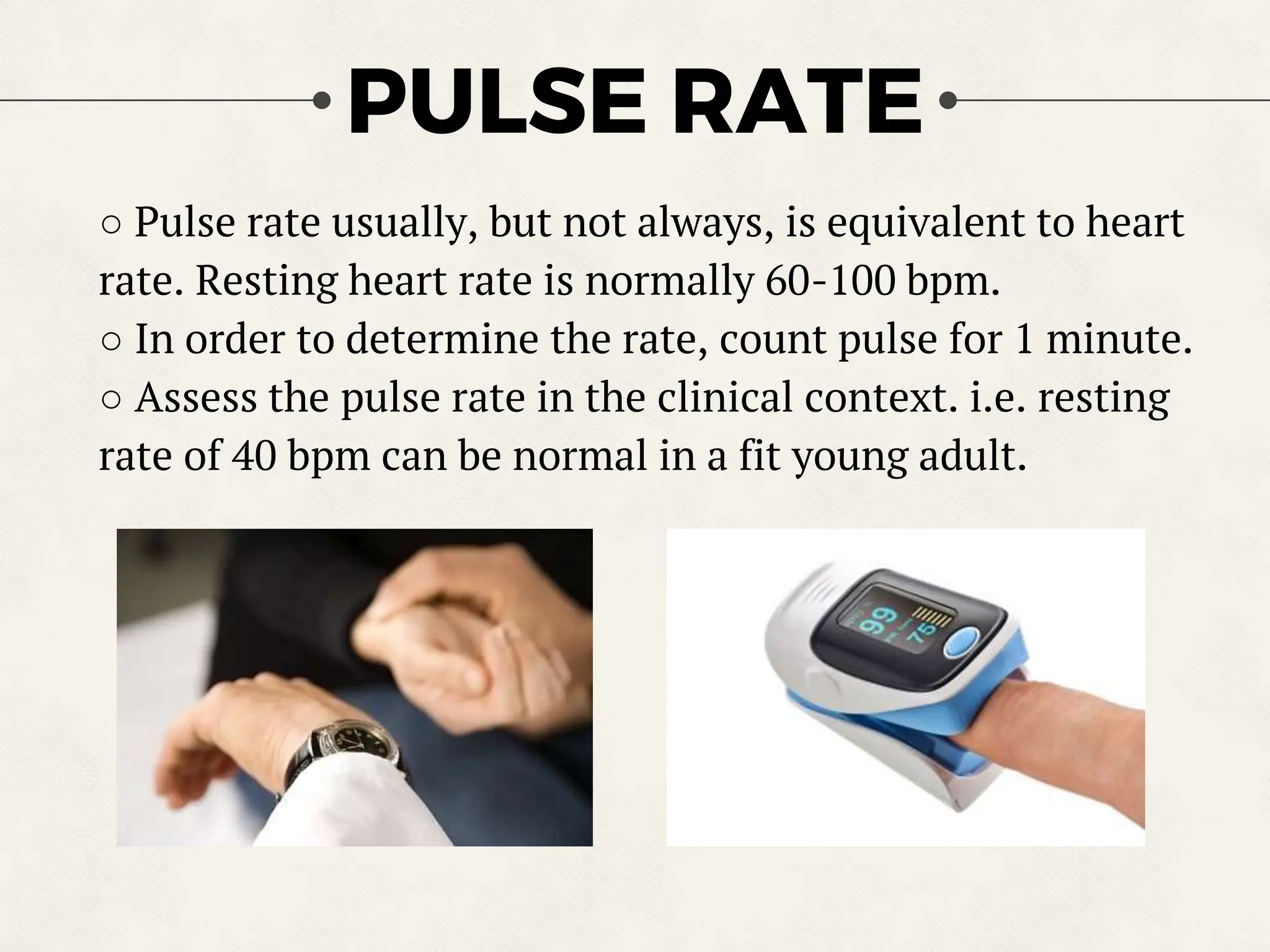
PULSE RATE
○ Pulse rate usually, but not always, is equivalent to heart
rate. Resting heart rate is normally 60-100 bpm.
○ In order to determine the rate, count pulse for 1 minute.
○ Assess the pulse rate in the clinical context. i.e. resting
rate of 40 bpm can be normal in a fit young adult.
PULSE RATE
Bradycardia is a pulse rate <60 bpm.
 Physiologic i.e. athletes at rest
 Inappropriate i.e. heart blocks, vaso-vagal reflex,
beta blockers, calcium channel blockers
Tachycardia is a pulse rate of >100 bpm.
 Physiologic i.e. exercise
 Inappropriate i.e. fever, anxiety, tachyarrhythmia
Effect of respiration.
 Pulse rate increases with inspiration.
 Pulse rate decreases with expiration.
PULSE RHYTHM
Regular
 Intervals between two beats is constant
Regularly irregular
 Irregularity comes at regular intervals
 Causes include digoxin toxicity
Irregularly irregular
 There is no regularity at all
 Causes include atrial fibrillation / flutter, multiple ectopics
Pulses deficit
 Heart rate faster than pulse rate
 Atrial fibrillation, mitral stenosis, thyrotoxicosis, IHD
RATE & RHYTHM
NORMAL
IRREGULARLY
IRREGULAR
INTERMITENT
IRREGULAR
TACHYCARDIA
BRADYCARDIA
PULSE VOLUME
This is the amplitude of pulse wave and is determined
by the amount of displacement of palpating fingers
□ Normal volume
□ Low volume (weak) i.e. heart failure, hypovolemic shock
□ High volume (bounding) i.e. pregnancy, fever, anemia, AR
NORMAL
BOUNDING
WEAK
PULSE VOLUME
Pulse 4 point scale
PULSE CHARACTER
□ In certain diseases, pulse wave has a specific
waveform, or character.
□ A major pulse close to the heart (brachial, carotid
and femoral) should be palpated for this purpose.
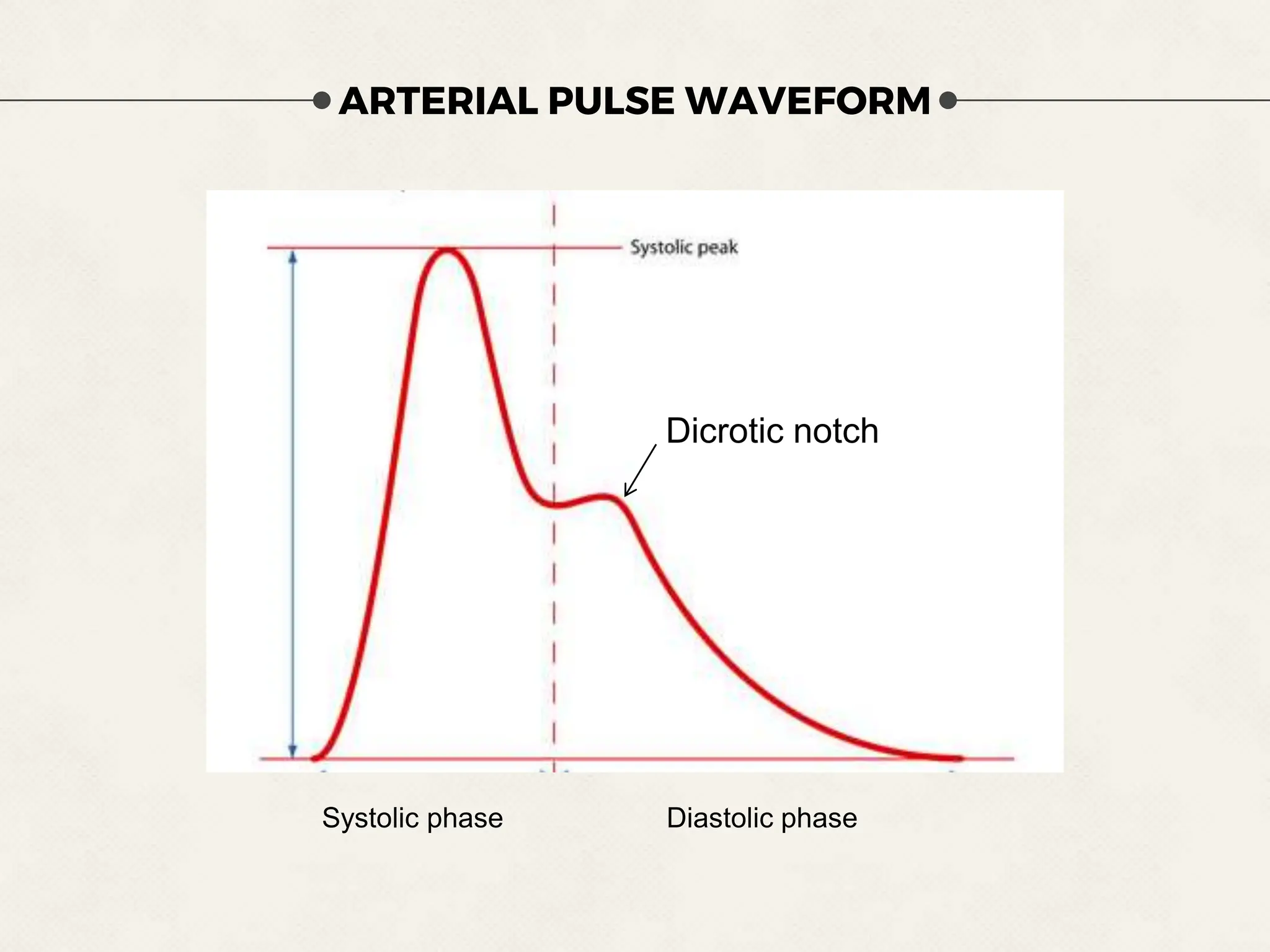
□ A normal arterial waveform has an up-slope and a
down-slope.
□ The peak represents the systolic blood pressure.
□ The trough represents diastolic blood pressure.
□ Dicrotic notch in the downslope is due to closure
of aortic valve. Generally not palpable.
ARTERIAL PULSE WAVEFORM
Systolic phase Diastolic phase
Dicrotic notch
PULSE CHARACTER
Slow rising pulse (pulsus plateau)
□ A kind of low volume pulse
□ Has a slow upstroke and late peak (Tardus)
□ Low amplitude (Parvus)
□ Stays longer
□ Causes: severe AS
NORMAL PULSE PULSUS PLATEAU
PULSE CHARACTER
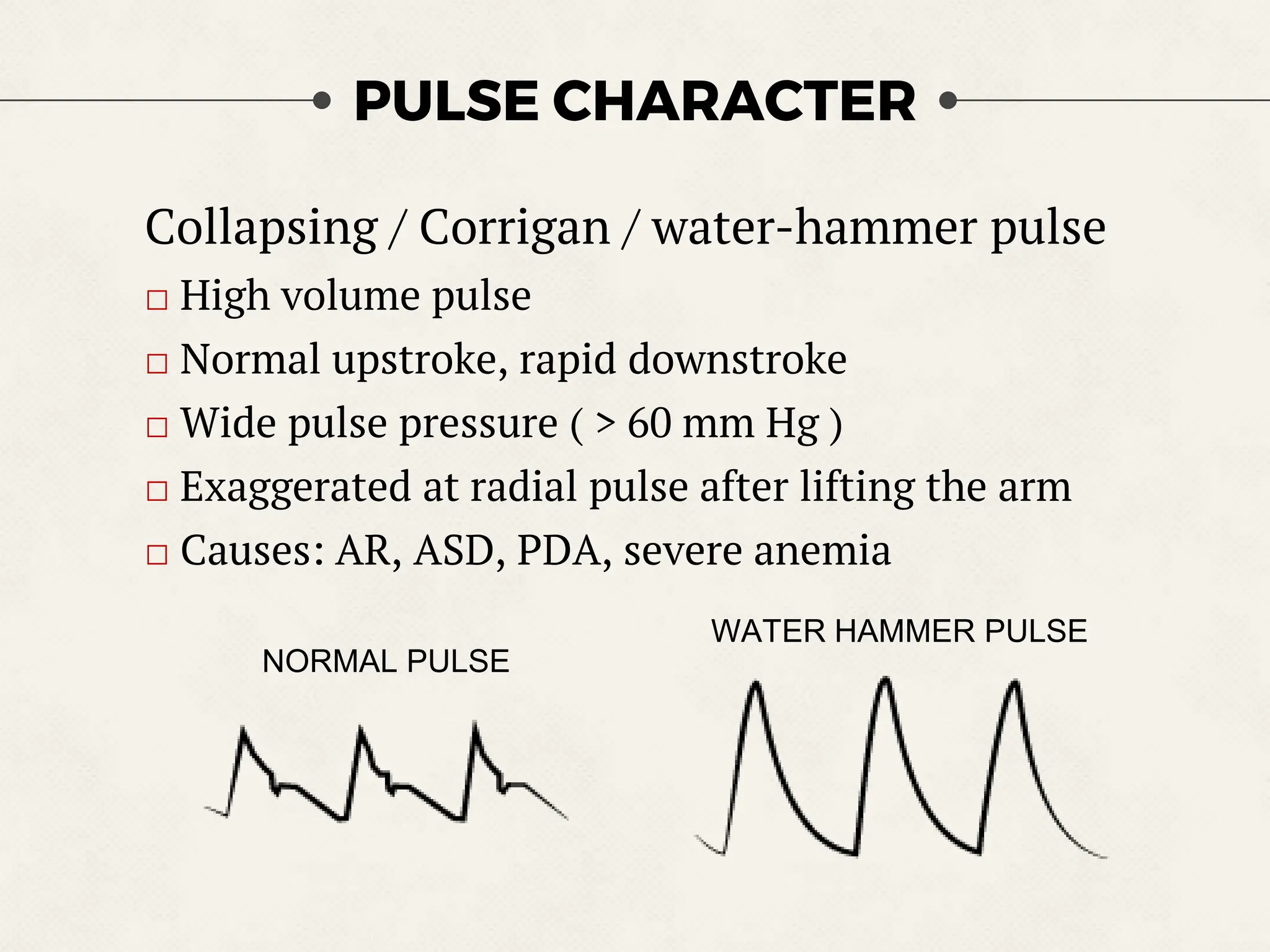
Collapsing / Corrigan / water-hammer pulse
□ High volume pulse
□ Normal upstroke, rapid downstroke
□ Wide pulse pressure ( > 60 mm Hg )
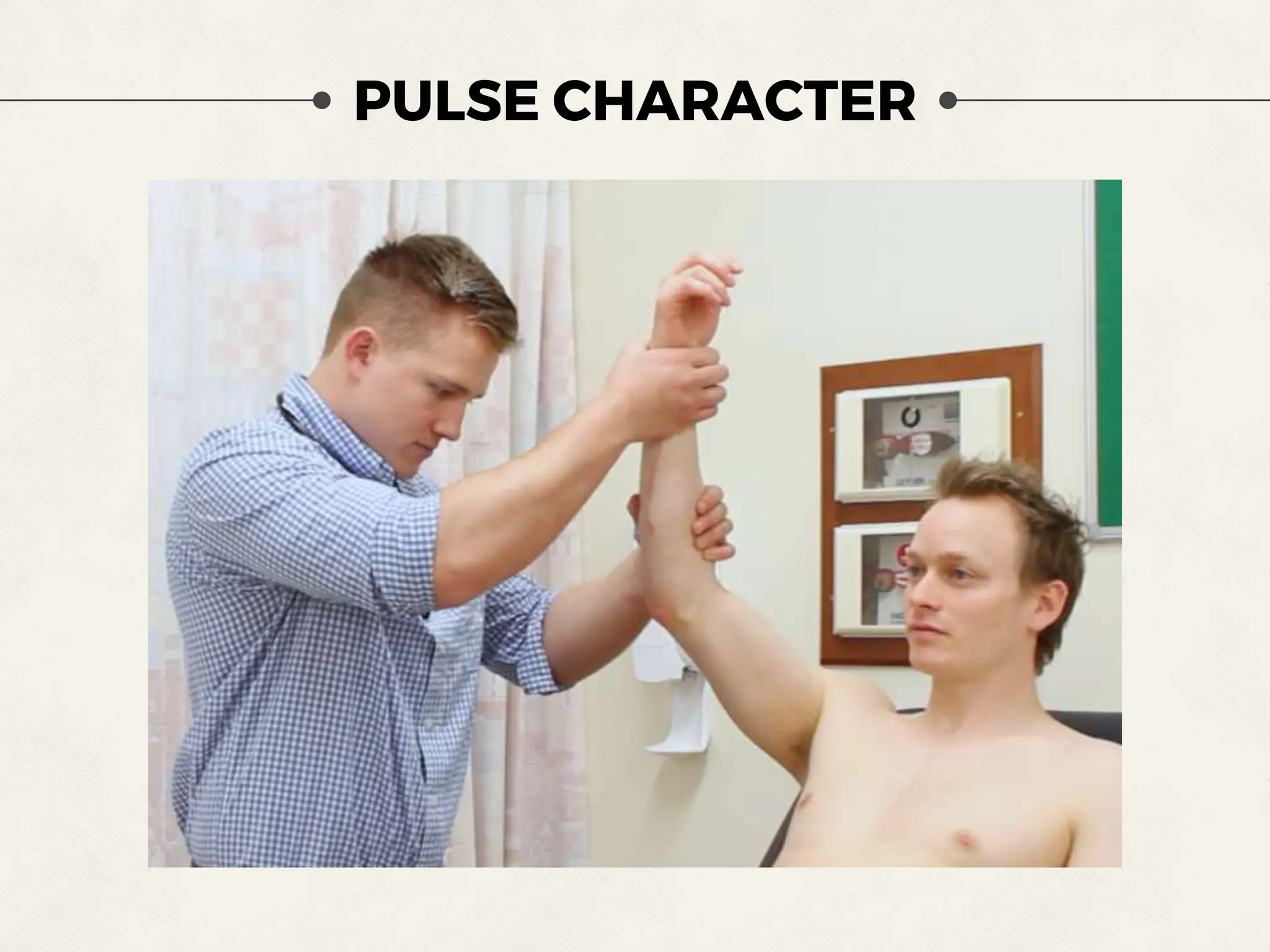
□ Exaggerated at radial pulse after lifting the arm
□ Causes: AR, ASD, PDA, severe anemia
NORMAL PULSE
WATER HAMMER PULSE
PULSE CHARACTER
PULSE CHARACTER
Pulsus bisfeirens (ancrotic pulse)
□ Is a double peaked pulse
□ Two systolic peaks are present in one pulse
□ Amplitude of the pulse is high
□ Causes: combined AS and AR
□ Unilateral pulsus bisfeirens in aortic dissection
NORMAL PULSE BISFEIRENS PULSE
PULSE CHARACTER
Pulsus dicroticus
□ Also called spike and dome pulse or jerky pulse
□ Blood ejection into aorta is normal initially
□ Then becomes suddenly obstructed by the contraction
of a band of muscle in aortic outflow tract
□ Causes: HOCM
NORMAL PULSE PULSUS DICROTICUS
PULSE CHARACTER
Pulsus paradoxus
□ Pulse is weak during inspiration. Normally, during inspiration
there is a fall in systolic blood pressure about 5 mmHg or less.
In pulsus paradoxus, fall is more than 5mmHg.
□ Causes: massive pericardial effusion (tamponade), constrictive
pericarditis, acute severe asthma.
□ Reverse pulsus paradoxus is seen in HOCM, intermittent
positive pressure ventilation (IPPV) and AV dissociation.
PULSE CHARACTER
Pulsus paradoxus
PULSE CHARACTER
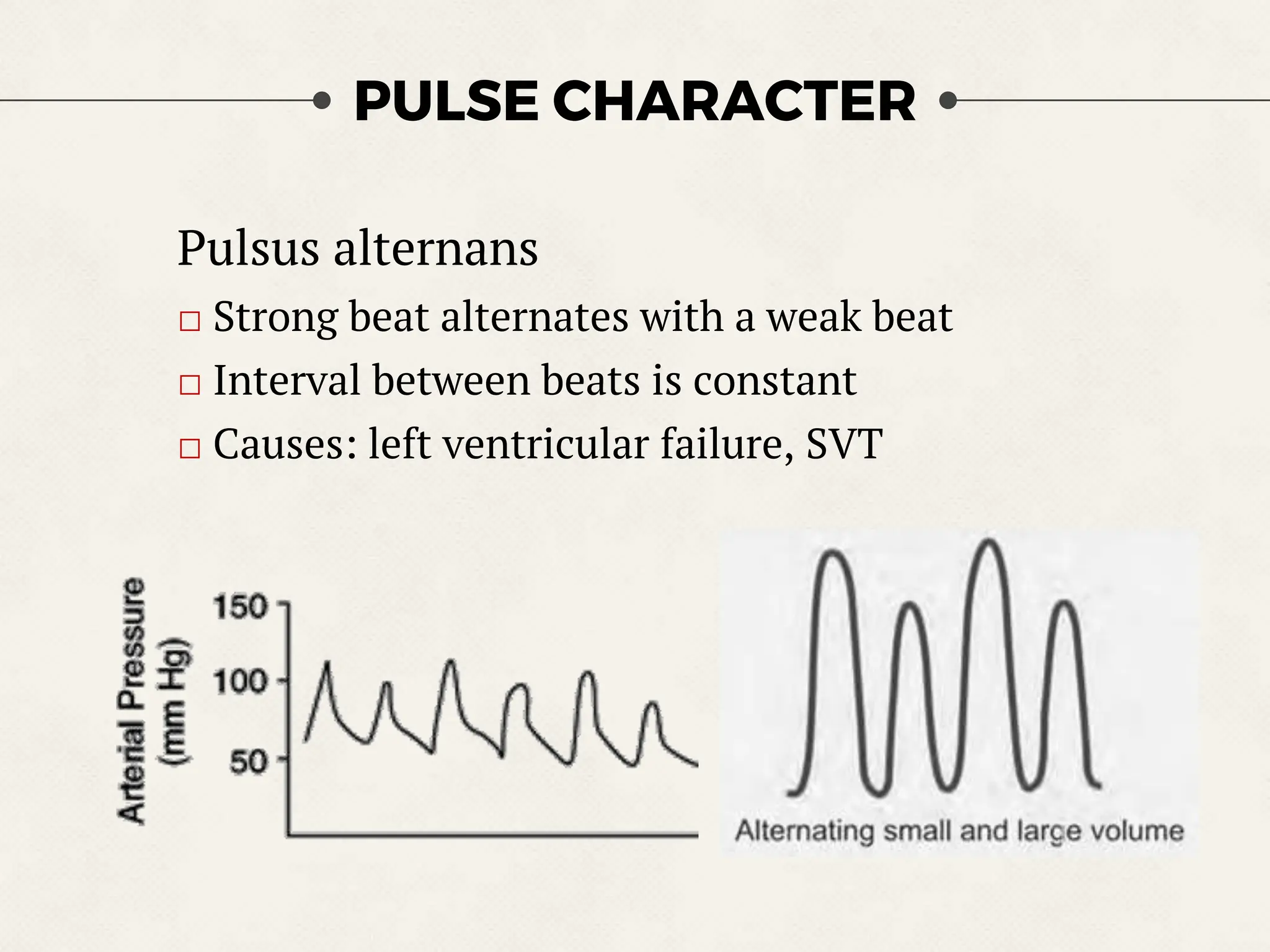
Pulsus alternans
□ Strong beat alternates with a weak beat
□ Interval between beats is constant
□ Causes: left ventricular failure, SVT
PULSE CHARACTER
Pulsus bigeminus
□ Similar to pulsus alternans but interval between
beats is variable
□ Causes: digoxin toxicity
PULSUS BIGEMINUS
COMPARISION
WITH OTHER PULSES
Radio-radial delay
is seen in:
□ Pre-subclavian
coarctation of aorta
□ Thoracic inlet syndrome
COMPARISION
WITH OTHER PULSES
Radio-femoral delay
is seen in:
□ Coarctation of aorta
(COA)
PULSE IN DIFFERENT DISEASES
THANK
YOU!

Cardiology 2.1. Pulse - by Dr. Farjad Ikram.pptx

  • 1.
  • 2.
  • 3.
    OBJECTIVES • Definition ofpulse • Determinants of arterial pulse • Sites for arterial pulse • Characteristics of arterial pulse • Comparision of arterial pulses • Jugular venous pulse
  • 4.
  • 5.
    “ Pulse is therhythmic dilation of an artery or a vein that results from beating of the heart.
  • 6.
    WHAT IS APULSE? ○ Pulse is a wave imparted by the contraction of ventricle to the blood column. ○ The pressure wave travels faster than the blood itself. ○ It can be palpated particularly where the arteries are superficial and pass over bone. ○ Study of pulse is know as sphygmology.
  • 7.
    TYPES OF PULSES VENOUS ARTERIAL •Pulses can be arterial or venous. • Unless stated, pulse is usually inferred as arterial. • Venous pulses can be visible, but not palpable.
  • 8.
  • 9.
    DETERMINANTS The arterial pulsewaveform depends on: • heart rate, • stroke volume, • peripheral resistance, • left ventricular outflow obstruction, and • the elasticity of peripheral vessels
  • 10.
  • 11.
    SITES FOR ARTERIALPULSE Temporal Carotid Brachial Radial Posterior tibial Dorsalis pedis Popliteal Femoral Aortic Axillary Facial
  • 12.
    RADIAL PULSE ○ Mostcommonly felt pulse. Easily accessible. ○ Patient’s hand should be slightly flexed and pronated. ○ Press the wrist against the head of the radius, lateral to flexor carpi radialis tendon. ○ Can also be palpated in the anatomical snuffbox.
  • 13.
    ULNAR PULSE ○ Pressthe medial side of the wrist below the crease, lateral to pisiform bone and flexor carpi ulnaris tendon but medial to palmaris longus tendon.
  • 14.
  • 15.
    BRACHIAL PULSE ○ Itis palpable in the ante-cubital fossa of a slightly flexed elbow, medial to the biceps tendon.
  • 16.
    AXILLARY PULSE ○ Pressthe axilla deep against the humerus behind the anterior axillary fold in an abducted arm.
  • 17.
    CAROTID PULSE ○ Pressat angle of the jaw, anterior to the SCM muscle and lateral to the thyroid cartilage. ○ Never press both the carotid arteries at the same time.
  • 18.
    TEMPORAL PULSE ○ Topalpate the superficial temporal artery, press against the skull in front of tragus of the ear.
  • 19.
    FACIAL PULSE ○ Pressagainst the lower margin of the mandible, inferior and postero-lateral to the angle of the mouth.
  • 20.
    FEMORAL PULSE ○ Pressjust below the inguinal ligament, midway between the anterior superior iliac spine (ASIS) and the pubic symphysis. ○ It is immediately lateral to the femoral vein and medial to the femoral nerve.
  • 21.
    POPLITEAL PULSE ○ Liesposteriorly in relation to the knee joint. ○ Press deep in the popliteal fossa. ○ Better palpated in a slightly flexed knee. ○ Either in supine or prone position.
  • 22.
    POSTERIOR TIBIAL PULSE ○Press against the tibia, 2 cm below and posterior to the medial malleolus, where it passes beneath the flexor retinaculum between tendons of flexor digitorum longus and flexor hallucis longus.
  • 23.
    DORSALIS PEDIS PULSE ○Passes lateral to the tendon of extensor hallucis longus. ○ Best felt at the proximal extent of the groove between the first and second metatarsals.
  • 24.
    AORTIC PULSE ○ Expansilepulsation of abdominal aorta may be felt by pressing the fingertips of one or both hands deep into the umbilical region. ○ Anterior expansion is normal and felt in lean people. ○ Lateral expansion may be because of aortic aneurysm.
  • 25.
  • 26.
    CHARACTERISTICS When palpating forarteries assess the following: • pulse rate, • pulse rhythm, • character, • volume, • comparison with other pulses
  • 27.
    PULSE RATE ○ Pulserate usually, but not always, is equivalent to heart rate. Resting heart rate is normally 60-100 bpm. ○ In order to determine the rate, count pulse for 1 minute. ○ Assess the pulse rate in the clinical context. i.e. resting rate of 40 bpm can be normal in a fit young adult.
  • 28.
    PULSE RATE Bradycardia isa pulse rate <60 bpm.  Physiologic i.e. athletes at rest  Inappropriate i.e. heart blocks, vaso-vagal reflex, beta blockers, calcium channel blockers Tachycardia is a pulse rate of >100 bpm.  Physiologic i.e. exercise  Inappropriate i.e. fever, anxiety, tachyarrhythmia Effect of respiration.  Pulse rate increases with inspiration.  Pulse rate decreases with expiration.
  • 29.
    PULSE RHYTHM Regular  Intervalsbetween two beats is constant Regularly irregular  Irregularity comes at regular intervals  Causes include digoxin toxicity Irregularly irregular  There is no regularity at all  Causes include atrial fibrillation / flutter, multiple ectopics Pulses deficit  Heart rate faster than pulse rate  Atrial fibrillation, mitral stenosis, thyrotoxicosis, IHD
  • 30.
  • 31.
    PULSE VOLUME This isthe amplitude of pulse wave and is determined by the amount of displacement of palpating fingers □ Normal volume □ Low volume (weak) i.e. heart failure, hypovolemic shock □ High volume (bounding) i.e. pregnancy, fever, anemia, AR NORMAL BOUNDING WEAK
  • 32.
  • 33.
    PULSE CHARACTER □ Incertain diseases, pulse wave has a specific waveform, or character. □ A major pulse close to the heart (brachial, carotid and femoral) should be palpated for this purpose. □ A normal arterial waveform has an up-slope and a down-slope. □ The peak represents the systolic blood pressure. □ The trough represents diastolic blood pressure. □ Dicrotic notch in the downslope is due to closure of aortic valve. Generally not palpable.
  • 34.
    ARTERIAL PULSE WAVEFORM Systolicphase Diastolic phase Dicrotic notch
  • 35.
    PULSE CHARACTER Slow risingpulse (pulsus plateau) □ A kind of low volume pulse □ Has a slow upstroke and late peak (Tardus) □ Low amplitude (Parvus) □ Stays longer □ Causes: severe AS NORMAL PULSE PULSUS PLATEAU
  • 36.
    PULSE CHARACTER Collapsing /Corrigan / water-hammer pulse □ High volume pulse □ Normal upstroke, rapid downstroke □ Wide pulse pressure ( > 60 mm Hg ) □ Exaggerated at radial pulse after lifting the arm □ Causes: AR, ASD, PDA, severe anemia NORMAL PULSE WATER HAMMER PULSE
  • 37.
  • 38.
    PULSE CHARACTER Pulsus bisfeirens(ancrotic pulse) □ Is a double peaked pulse □ Two systolic peaks are present in one pulse □ Amplitude of the pulse is high □ Causes: combined AS and AR □ Unilateral pulsus bisfeirens in aortic dissection NORMAL PULSE BISFEIRENS PULSE
  • 39.
    PULSE CHARACTER Pulsus dicroticus □Also called spike and dome pulse or jerky pulse □ Blood ejection into aorta is normal initially □ Then becomes suddenly obstructed by the contraction of a band of muscle in aortic outflow tract □ Causes: HOCM NORMAL PULSE PULSUS DICROTICUS
  • 40.
    PULSE CHARACTER Pulsus paradoxus □Pulse is weak during inspiration. Normally, during inspiration there is a fall in systolic blood pressure about 5 mmHg or less. In pulsus paradoxus, fall is more than 5mmHg. □ Causes: massive pericardial effusion (tamponade), constrictive pericarditis, acute severe asthma. □ Reverse pulsus paradoxus is seen in HOCM, intermittent positive pressure ventilation (IPPV) and AV dissociation.
  • 41.
  • 42.
    PULSE CHARACTER Pulsus alternans □Strong beat alternates with a weak beat □ Interval between beats is constant □ Causes: left ventricular failure, SVT
  • 43.
    PULSE CHARACTER Pulsus bigeminus □Similar to pulsus alternans but interval between beats is variable □ Causes: digoxin toxicity PULSUS BIGEMINUS
  • 44.
    COMPARISION WITH OTHER PULSES Radio-radialdelay is seen in: □ Pre-subclavian coarctation of aorta □ Thoracic inlet syndrome
  • 45.
    COMPARISION WITH OTHER PULSES Radio-femoraldelay is seen in: □ Coarctation of aorta (COA)
  • 46.
  • 47.