Theme 3: Remediation of
polluted sites
Ms. Melisa Lim
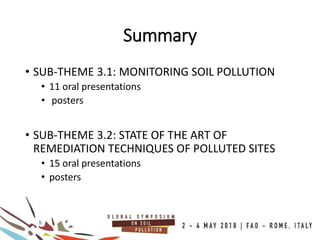
Summary
• SUB-THEME 3.1: MONITORING SOIL POLLUTION
• 11 oral presentations
• posters
• SUB-THEME 3.2: STATE OF THE ART OF
REMEDIATION TECHNIQUES OF POLLUTED SITES
• 15 oral presentations
• posters
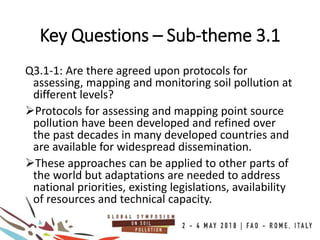
Key Questions – Sub-theme 3.1
Q3.1-1: Are there agreed upon protocols for
assessing, mapping and monitoring soil pollution at
different levels?
Protocols for assessing and mapping point source
pollution have been developed and refined over
the past decades in many developed countries and
are available for widespread dissemination.
These approaches can be applied to other parts of
the world but adaptations are needed to address
national priorities, existing legislations, availability
of resources and technical capacity.
More efforts are needed to assess and monitor
diffuse pollution and develop strategies for
prioritizing pollutants of concern
Need to raise political awareness of the benefits of
soil pollution remediation in developing countries
e.g., by showing impact on food safety and
developing measurements of such benefits in terms
of public health and economic metrics
Key Questions – Sub-theme 3.1
Q3.1-2: Is there a baseline of soil pollution at the
global level?
 Soil pollution is determined by a complex
combination of factors, such as the type of
pollutant, site history, geological background and is
therefore specific to the local and regional level.
Several countries have programmes to collect data
on existing level of soil pollution and have
established databases that can be used for policy
development.
Q3.2-1: What are the criteria that determine
whether a polluted site can/must be remediated?
 Human health impact should the priority criteria
Many countries now favour a risk-based approach
to decide on whether a site must be remediated
Determination must be site-specific and should
prioritise the presence and sensitivity of receptors
In developing countries, financial resources, human
capacity and availability of analytical tools are
limitations to remediation
Key Questions – Sub-theme 3.2
Q3.2-2: Which tools/technologies can be used to
increase the remediation of polluted sites?
 Many tools exist but they can be costly
Better tools are needed to better understand the
complexity of subsurface pollution which is needed for
full remediation
Decision of whether to apply a technology should
follow a risk-based approach
There are many examples of new technologies
including bioremediation being tested in developing
countries
Key Questions – Sub-theme 3.2
Q3.2-3: To what extent can polluted sites be restored
for safe food production?
 This is feasible especially in the case of broad
scale, low-level pollution
For the remediation of large agricultural sites, need
cost-effective technologies and more research is
needed in this area.
Key Questions – Sub-theme 3.2
Recommendations
Develop best practice guidance on the assessment
and remediation of polluted sites, building on the
long experience of developed countries and the
lessons learnt.
Establish an expert group to develop such
guidance.
Raise political and public awareness of the benefits
of soil remediation and develop appropriate human
health and economic metrics for doing so
Build capacity in developing countries for soil
pollution assessment and remediation.
Theme 3: Remediation of polluted sites (final)

Theme 3: Remediation of polluted sites (final)

  • 2.
    Theme 3: Remediationof polluted sites Ms. Melisa Lim
  • 3.
    Summary • SUB-THEME 3.1:MONITORING SOIL POLLUTION • 11 oral presentations • posters • SUB-THEME 3.2: STATE OF THE ART OF REMEDIATION TECHNIQUES OF POLLUTED SITES • 15 oral presentations • posters
  • 4.
    Key Questions –Sub-theme 3.1 Q3.1-1: Are there agreed upon protocols for assessing, mapping and monitoring soil pollution at different levels? Protocols for assessing and mapping point source pollution have been developed and refined over the past decades in many developed countries and are available for widespread dissemination. These approaches can be applied to other parts of the world but adaptations are needed to address national priorities, existing legislations, availability of resources and technical capacity.
  • 5.
    More efforts areneeded to assess and monitor diffuse pollution and develop strategies for prioritizing pollutants of concern Need to raise political awareness of the benefits of soil pollution remediation in developing countries e.g., by showing impact on food safety and developing measurements of such benefits in terms of public health and economic metrics
  • 6.
    Key Questions –Sub-theme 3.1 Q3.1-2: Is there a baseline of soil pollution at the global level?  Soil pollution is determined by a complex combination of factors, such as the type of pollutant, site history, geological background and is therefore specific to the local and regional level. Several countries have programmes to collect data on existing level of soil pollution and have established databases that can be used for policy development.
  • 7.
    Q3.2-1: What arethe criteria that determine whether a polluted site can/must be remediated?  Human health impact should the priority criteria Many countries now favour a risk-based approach to decide on whether a site must be remediated Determination must be site-specific and should prioritise the presence and sensitivity of receptors In developing countries, financial resources, human capacity and availability of analytical tools are limitations to remediation Key Questions – Sub-theme 3.2
  • 8.
    Q3.2-2: Which tools/technologiescan be used to increase the remediation of polluted sites?  Many tools exist but they can be costly Better tools are needed to better understand the complexity of subsurface pollution which is needed for full remediation Decision of whether to apply a technology should follow a risk-based approach There are many examples of new technologies including bioremediation being tested in developing countries Key Questions – Sub-theme 3.2
  • 9.
    Q3.2-3: To whatextent can polluted sites be restored for safe food production?  This is feasible especially in the case of broad scale, low-level pollution For the remediation of large agricultural sites, need cost-effective technologies and more research is needed in this area. Key Questions – Sub-theme 3.2
  • 10.
    Recommendations Develop best practiceguidance on the assessment and remediation of polluted sites, building on the long experience of developed countries and the lessons learnt. Establish an expert group to develop such guidance. Raise political and public awareness of the benefits of soil remediation and develop appropriate human health and economic metrics for doing so Build capacity in developing countries for soil pollution assessment and remediation.