Integrating Agriculture in National Adaptation Plans
NAP-Ag Programme
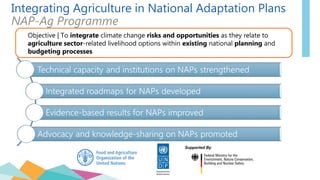
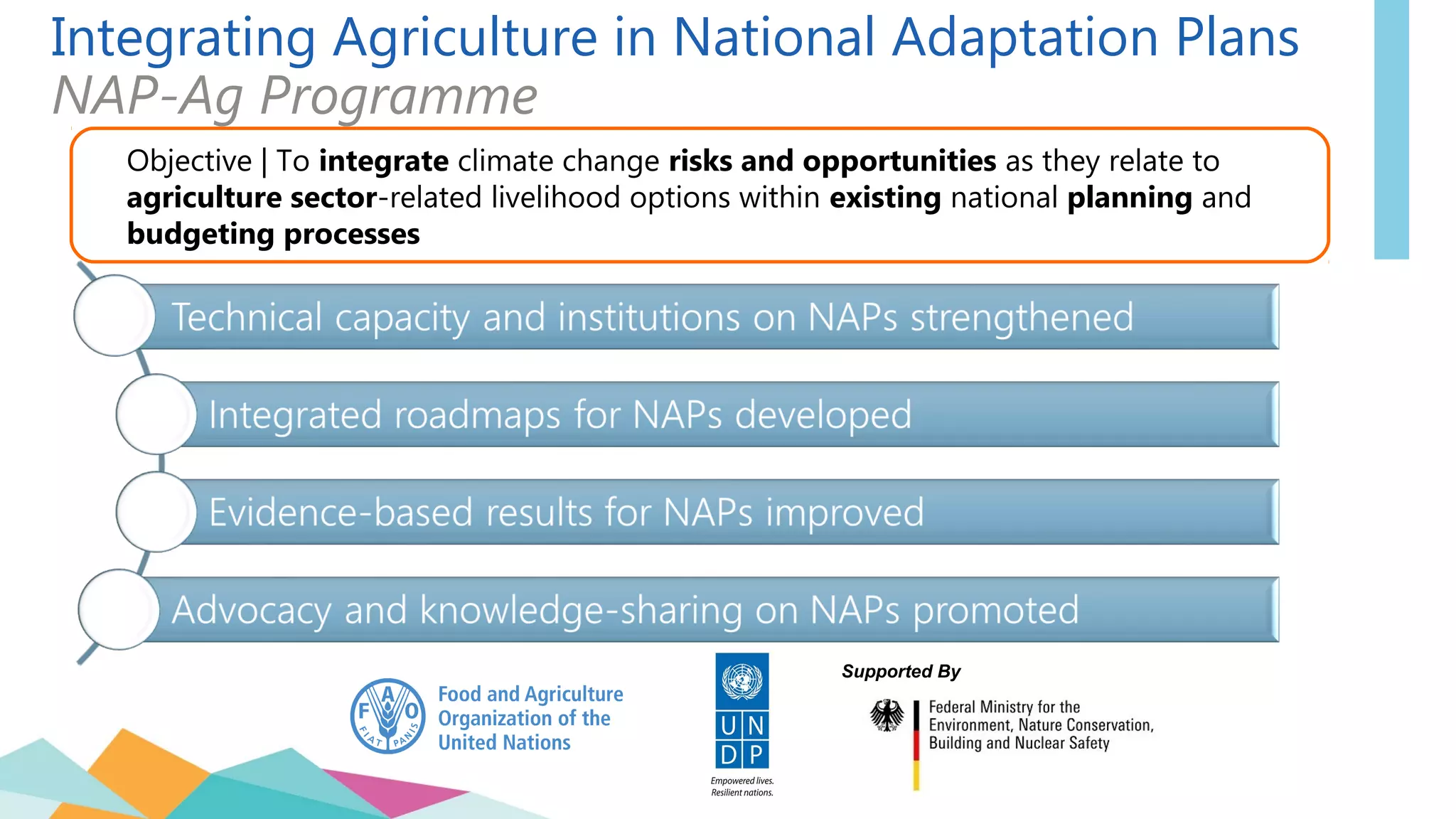
Objective | To integrate climate change risks and opportunities as they relate to
agriculture sector-related livelihood options within existing national planning and
budgeting processes
Supported By
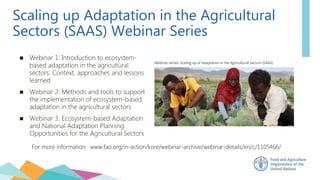
Scaling up Adaptation in the Agricultural
Sectors (SAAS) Webinar Series
■ Webinar 1: Introduction to ecosystem-
based adaptation in the agricultural
sectors: Context, approaches and lessons
learned
■ Webinar 2: Methods and tools to support
the implementation of ecosystem-based
adaptation in the agricultural sectors
■ Webinar 3: Ecosystem-based Adaptation
and National Adaptation Planning:
Opportunities for the Agricultural Sectors
For more information: www.fao.org/in-action/kore/webinar-archive/webinar-details/en/c/1105466/
Webinar Objectives
1. Increased knowledge and capacity to understand what EbA means in practice as
part of a country’s adaptation planning or NAP process, and how EbA can
enhance such processes
2. Support exchange of experiences between members of NAP and EbA
communities of practice
3. Encourage practitioners to share resources on EbA and NAPs with each other
and with the NAP-Ag
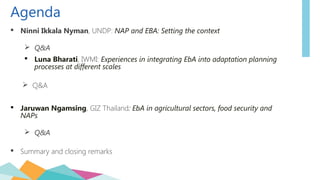
Agenda
 Ninni Ikkala Nyman, UNDP: NAP and EBA: Setting the context
 Q&A
 Luna Bharati, IWMI: Experiences in integrating EbA into adaptation planning
processes at different scales
 Q&A
 Jaruwan Ngamsing, GIZ Thailand: EbA in agricultural sectors, food security and
NAPs
 Q&A
 Summary and closing remarks

Introductory Slides for the EbA Webinar

  • 1.
    Integrating Agriculture inNational Adaptation Plans NAP-Ag Programme Objective | To integrate climate change risks and opportunities as they relate to agriculture sector-related livelihood options within existing national planning and budgeting processes Supported By
  • 2.
    Scaling up Adaptationin the Agricultural Sectors (SAAS) Webinar Series ■ Webinar 1: Introduction to ecosystem- based adaptation in the agricultural sectors: Context, approaches and lessons learned ■ Webinar 2: Methods and tools to support the implementation of ecosystem-based adaptation in the agricultural sectors ■ Webinar 3: Ecosystem-based Adaptation and National Adaptation Planning: Opportunities for the Agricultural Sectors For more information: www.fao.org/in-action/kore/webinar-archive/webinar-details/en/c/1105466/
  • 3.
    Webinar Objectives 1. Increasedknowledge and capacity to understand what EbA means in practice as part of a country’s adaptation planning or NAP process, and how EbA can enhance such processes 2. Support exchange of experiences between members of NAP and EbA communities of practice 3. Encourage practitioners to share resources on EbA and NAPs with each other and with the NAP-Ag
  • 4.
    Agenda  Ninni IkkalaNyman, UNDP: NAP and EBA: Setting the context  Q&A  Luna Bharati, IWMI: Experiences in integrating EbA into adaptation planning processes at different scales  Q&A  Jaruwan Ngamsing, GIZ Thailand: EbA in agricultural sectors, food security and NAPs  Q&A  Summary and closing remarks

Editor's Notes

  • #2 75% of the world’s poor & food insecure people rely directly on agriculture & natural resources for their living. The Integrating Agriculture in National Adaptation Plans (NAPs) programme is a multiyear initiative funded by Germany’s Federal Ministry for the Environment, Nature Conservation, Building and Nuclear Safety (BMUB) through its International Climate Initiative (IKI). It supports partners under a country-driven process to identify and integrate climate adaptation measures for agricultural sectors into relevant national planning and budgeting processes. The programme initially targets eight countries: Kenya, Nepal, Philippines, Thailand, Uganda, Uruguay, Vietnam and Zambia. However, it plans to expand to other countries in the Pacific, Asia, Africa as well as Latin America and the Caribbean. The new programme builds on existing FAO and UNDP country activities, by assisting them to develop tailored responses to their needs. For instance: In Nepal, there is a need to increase conservation of drought-resistant crop varieties by adopting water-conserving farming practices and promoting crop diversification. The consequences of last year's earthquakes highlight the importance of reducing risks for farmers due to climate and disasters. In Uganda, UNDP is helping set up a much-needed early-warning system for climate risks. The program will link to FAO projects that include educating farmers in the use of drought-tolerant seeds, plants and trees, as well as expand eucalyptus plantations for charcoal. FAO and UNDP will also expand their efforts in the Philippines to map vulnerability to food insecurity due to climate change, and explore ways to scale up risk-transfer mechanisms for farming communities. In Uruguay, efforts to restore degraded pasture lands and at-risk coastal ecosystems will be central to the new programme.