1
2
GSOP18:
Conclusions and
way Forward100COUNTRIES
Ronald Vargas
Global Soil Partnership, FAO
3
100COUNTRIES
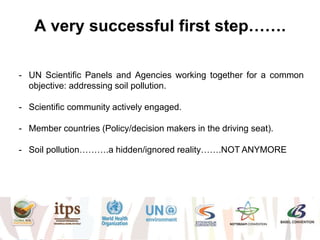
A very successful first step…….
- UN Scientific Panels and Agencies working together for a common
objective: addressing soil pollution.
- Scientific community actively engaged.
- Member countries (Policy/decision makers in the driving seat).
- Soil pollution……….a hidden/ignored reality…….NOT ANYMORE
4
100COUNTRIES
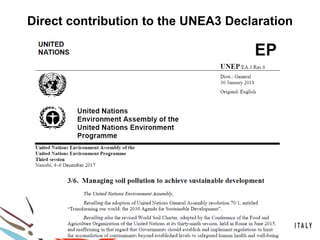
Direct contribution to the UNEA3 Declaration
5
44+DELEGATES
100COUNTRIES
44+DELEGATES
100COUNTRIES
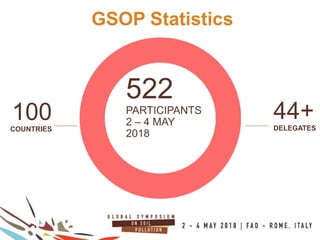
GSOP Statistics
522
PARTICIPANTS
2 – 4 MAY
2018
6
44+DELEGATES
100COUNTRIES
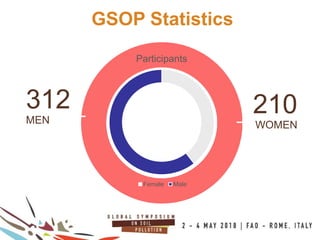
Participants
Female Male
312
MEN
210
WOMEN
GSOP Statistics
7
44+DELEGATES
100COUNTRIES
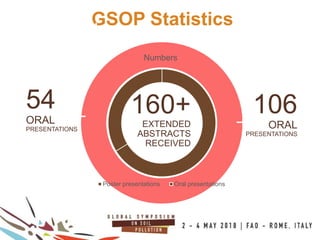
54
ORAL
PRESENTATIONS
106
ORAL
PRESENTATIONS
GSOP Statistics160+ EXTENDED ABSTRACTS RECEIVED
160+
EXTENDED
ABSTRACTS
RECEIVED
Numbers
Poster presentations Oral presentations
8
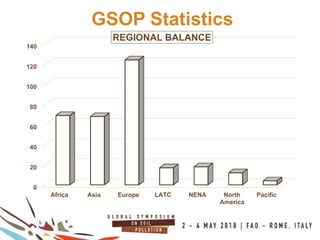
GSOP Statistics
44+DELEGATES
100COUNTRIES
0
20
40
60
80
100
120
140
Africa Asia Europe LATC NENA North
America
Pacific
REGIONAL BALANCE
9
100COUNTRIES
Conclusions? Findings?
10
100COUNTRIES
Is there scientific evidence that soil pollution is a
real threat to food security/safety, environment and
health?
- Through all the presentations in the different sessions, this was very
clear.
- Soil Pollution is a reality and a fact, but should not be
hidden/ignored further!
- Scientific gaps: yes, there is a need to invest on concrete case
studies that demonstrate scientifically the problem and its impacts.
- Conventional soil survey: focused on increasing productivity but not
addressing the need for understanding the content of
pollutants……we need to change this!
- Evidence based and applied research is needed: advanced countries
need to share their know how with developing countries.
11
100COUNTRIES
It will be interesting to understand (scientifically)
how many pollutants people ingest (without
knowing) in an average per day in different locations
through the different sources (food, air, water,
medicines, etc.)…….
12
100COUNTRIES
What is the main driver of soil
pollution?
- HUMAN ACTIVITIES
- Focus is on increasing PRODUCTIVITY/PRODUCTION……..How to
produce more? But there is no sensitivity towards the impacts of
doing so!
- Consumers (general public): unaware of the impacts (to the
environment, health and food) of consuming more, the risks of
processed products without information on the ingredients (and
impacts they have)……not even aware on the existence of soils, its
importance and the risk of soil pollution.
- Producers: driven by economic benefits but not much with the
environmental, social and life responsibility.
13
100COUNTRIES
Can we deal with soil pollution as soil
scientists alone?
- Soil pollution requires an integral approach as there are different
sources, land uses and decision makers.
- Soil pollution should be addressed through Sustainable soil
Management.
- A multidisciplinary group of stakeholders (like participants of
GSOP18) should take the lead in addressing this threat.
- Researchers need to work together with decision makers (science
policy interface) and please join the efforts of the UN.
14
100COUNTRIES
Way forward
15
100COUNTRIES
Specific outputs
- GSOP18 Proceedings
- GSOP18 Outcome document “Be the solution to soil pollution”.
- Special issue on “Environmental Pollution Journal” and
“Environmental Monitoring and Assessment Journal”.
- A forum of experts that will work towards addressing soil pollution.
16
100COUNTRIES
Building scientific evidence
- To jointly build case studies with scientific evidence regarding
concrete examples of soil pollution and its impacts in the different
sectors in different regions.
- They will serve as the evidence to demonstrate the need for concrete
bold actions against sol pollution.
- Awareness raising campaigns can be developed based on these
findings……
17
100COUNTRIES
Awareness raising and advocacy
- Join the campaign “Be the solution to soil pollution”
- Organize regional and national awareness raising campaigns
- Target: children, youth, general public and decision makers.
- A continuous process……...
18
100COUNTRIES
Capacity development and training
- Develop educational material on soil pollution (from assessment to
remediation) by a core group of experts in all languages and make them
available online and through printed copies for free distribution.
- Organize training courses at regional and national levels on soil
pollution.
- Facilitate the exchange of researcher/students from developing and
developed countries.
- Organize a symposiums every certain period of time (at global and
regional levels) to monitor progress made after GSOP18.
19
100COUNTRIES
Global Assessment of Soil Pollution
- Although we heard many times that data availability is an issue, we
cannot postpone this responsibility (an assessment).
- A collaborative effort and from FAO/GSP/ITPS, we are fully committed
to make it a reality.
- Condition: bottom-up approach where countries lead it under agreed
technical specifications and methodology.
- Harmonization is a very important condition for this assessment.
20
100COUNTRIES
Establishment of Working groups
- To develop feasible and regionally contextualized guidelines for
assessing, mapping, monitoring and reporting on soil pollution,
including threshold levels and background levels that guarantee the
inclusion of bioavailability.
- Also, countries who are making efforts against this threat, should
have the opportunity to report under different platforms.
- On managing soil pollution, so they can prepare guidelines, manuals,
etc.
21
100COUNTRIES
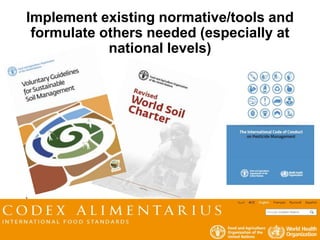
Implement existing normative/tools and
formulate others needed (especially at
national levels)
22
100COUNTRIES
Targeted research and technical
cooperation
- Technical cooperation between countries with experience on soil
pollution and those that require technical support should be envisioned.
- Advances on research, especially on remediation of polluted sites
should be promoted (emerging pollutants but also on residuals from old
contaminants). This should take into account the reality in the
developing countries.
- A platform for research findings on soil pollution should be established
and database of successful practices addressing soil pollution be
established.
- Create a neutral fund for supporting research on soil pollution especially
of young researchers.
23
100COUNTRIES
It is our responsibility to provide healthy
soils for our children…..
Let’s work against soil pollution and let’s
promote sustainable soil management.

GSOP18 - Conclusions and way forward

  • 1.
  • 2.
  • 3.
    3 100COUNTRIES A very successfulfirst step……. - UN Scientific Panels and Agencies working together for a common objective: addressing soil pollution. - Scientific community actively engaged. - Member countries (Policy/decision makers in the driving seat). - Soil pollution……….a hidden/ignored reality…….NOT ANYMORE
  • 4.
  • 5.
  • 6.
  • 7.
    7 44+DELEGATES 100COUNTRIES 54 ORAL PRESENTATIONS 106 ORAL PRESENTATIONS GSOP Statistics160+ EXTENDEDABSTRACTS RECEIVED 160+ EXTENDED ABSTRACTS RECEIVED Numbers Poster presentations Oral presentations
  • 8.
    8 GSOP Statistics 44+DELEGATES 100COUNTRIES 0 20 40 60 80 100 120 140 Africa AsiaEurope LATC NENA North America Pacific REGIONAL BALANCE
  • 9.
  • 10.
    10 100COUNTRIES Is there scientificevidence that soil pollution is a real threat to food security/safety, environment and health? - Through all the presentations in the different sessions, this was very clear. - Soil Pollution is a reality and a fact, but should not be hidden/ignored further! - Scientific gaps: yes, there is a need to invest on concrete case studies that demonstrate scientifically the problem and its impacts. - Conventional soil survey: focused on increasing productivity but not addressing the need for understanding the content of pollutants……we need to change this! - Evidence based and applied research is needed: advanced countries need to share their know how with developing countries.
  • 11.
    11 100COUNTRIES It will beinteresting to understand (scientifically) how many pollutants people ingest (without knowing) in an average per day in different locations through the different sources (food, air, water, medicines, etc.)…….
  • 12.
    12 100COUNTRIES What is themain driver of soil pollution? - HUMAN ACTIVITIES - Focus is on increasing PRODUCTIVITY/PRODUCTION……..How to produce more? But there is no sensitivity towards the impacts of doing so! - Consumers (general public): unaware of the impacts (to the environment, health and food) of consuming more, the risks of processed products without information on the ingredients (and impacts they have)……not even aware on the existence of soils, its importance and the risk of soil pollution. - Producers: driven by economic benefits but not much with the environmental, social and life responsibility.
  • 13.
    13 100COUNTRIES Can we dealwith soil pollution as soil scientists alone? - Soil pollution requires an integral approach as there are different sources, land uses and decision makers. - Soil pollution should be addressed through Sustainable soil Management. - A multidisciplinary group of stakeholders (like participants of GSOP18) should take the lead in addressing this threat. - Researchers need to work together with decision makers (science policy interface) and please join the efforts of the UN.
  • 14.
  • 15.
    15 100COUNTRIES Specific outputs - GSOP18Proceedings - GSOP18 Outcome document “Be the solution to soil pollution”. - Special issue on “Environmental Pollution Journal” and “Environmental Monitoring and Assessment Journal”. - A forum of experts that will work towards addressing soil pollution.
  • 16.
    16 100COUNTRIES Building scientific evidence -To jointly build case studies with scientific evidence regarding concrete examples of soil pollution and its impacts in the different sectors in different regions. - They will serve as the evidence to demonstrate the need for concrete bold actions against sol pollution. - Awareness raising campaigns can be developed based on these findings……
  • 17.
    17 100COUNTRIES Awareness raising andadvocacy - Join the campaign “Be the solution to soil pollution” - Organize regional and national awareness raising campaigns - Target: children, youth, general public and decision makers. - A continuous process……...
  • 18.
    18 100COUNTRIES Capacity development andtraining - Develop educational material on soil pollution (from assessment to remediation) by a core group of experts in all languages and make them available online and through printed copies for free distribution. - Organize training courses at regional and national levels on soil pollution. - Facilitate the exchange of researcher/students from developing and developed countries. - Organize a symposiums every certain period of time (at global and regional levels) to monitor progress made after GSOP18.
  • 19.
    19 100COUNTRIES Global Assessment ofSoil Pollution - Although we heard many times that data availability is an issue, we cannot postpone this responsibility (an assessment). - A collaborative effort and from FAO/GSP/ITPS, we are fully committed to make it a reality. - Condition: bottom-up approach where countries lead it under agreed technical specifications and methodology. - Harmonization is a very important condition for this assessment.
  • 20.
    20 100COUNTRIES Establishment of Workinggroups - To develop feasible and regionally contextualized guidelines for assessing, mapping, monitoring and reporting on soil pollution, including threshold levels and background levels that guarantee the inclusion of bioavailability. - Also, countries who are making efforts against this threat, should have the opportunity to report under different platforms. - On managing soil pollution, so they can prepare guidelines, manuals, etc.
  • 21.
    21 100COUNTRIES Implement existing normative/toolsand formulate others needed (especially at national levels)
  • 22.
    22 100COUNTRIES Targeted research andtechnical cooperation - Technical cooperation between countries with experience on soil pollution and those that require technical support should be envisioned. - Advances on research, especially on remediation of polluted sites should be promoted (emerging pollutants but also on residuals from old contaminants). This should take into account the reality in the developing countries. - A platform for research findings on soil pollution should be established and database of successful practices addressing soil pollution be established. - Create a neutral fund for supporting research on soil pollution especially of young researchers.
  • 23.
    23 100COUNTRIES It is ourresponsibility to provide healthy soils for our children….. Let’s work against soil pollution and let’s promote sustainable soil management.