United Nations Convention
to Combat Desertification
Collaboration
between the ITPS
and the UNCCD-SPI
Fifth Working session of the
Intergovernmental Technical Panel on on
Soil (ITPS)
14-18 March 2016, Rome
Subject
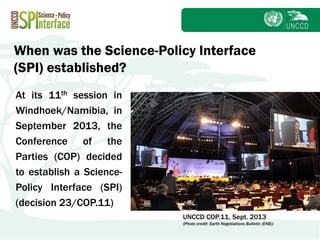
At its 11th session in
Windhoek/Namibia, in
September 2013, the
Conference of the
Parties (COP) decided
to establish a Science-
Policy Interface (SPI)
(decision 23/COP.11)
When was the Science-Policy Interface
(SPI) established?
UNCCD COP.11, Sept. 2013
(Photo credit: Earth Negotiations Bulletin (ENB))
Subject
The goal of the SPI is to facilitate a two-way
dialogue between scientists and policy
makers in order to ensure the delivery of
policy-relevant information, knowledge and
advice on desertification/land degradation
and drought (DLDD)
The SPI’s mandate and scope of activities are
designed to strengthen the work of the
scientific community working on DLDD,
including the UNCCD’s Committee on Science
and Technology
Why was the SPI established?
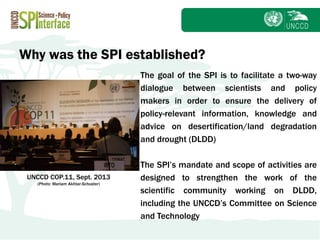
UNCCD COP.11, Sept. 2013
(Photo: Mariam Akhtar-Schuster)
Subject
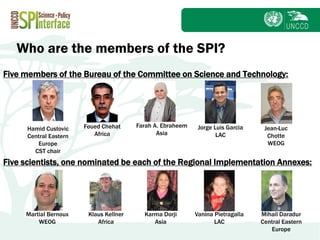
Who are the members of the SPI?
Five members of the Bureau of the Committee on Science and Technology:
Jean-Luc
Chotte
WEOG
Foued Chehat
Africa
Farah A. Ebraheem
Asia
Jorge Luis Garcia
LAC
Hamid Custovic
Central Eastern
Europe
CST chair
Five scientists, one nominated be each of the Regional Implementation Annexes:
Martial Bernoux
WEOG
Klaus Kellner
Africa
Karma Dorji
Asia
Vanina Pietragalla
LAC
Mihail Daradur
Central Eastern
Europe
Subject
Ct’d
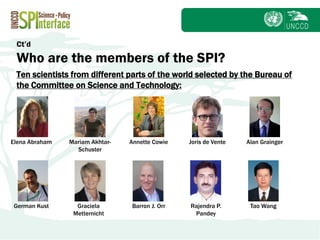
Who are the members of the SPI?
Ten scientists from different parts of the world selected by the Bureau of
the Committee on Science and Technology:
Elena Abraham Mariam Akhtar-
Schuster
Annette Cowie Joris de Vente Alan Grainger
German Kust Graciela
Metternicht
Barron J. Orr Rajendra P.
Pandey
Tao Wang
Subject
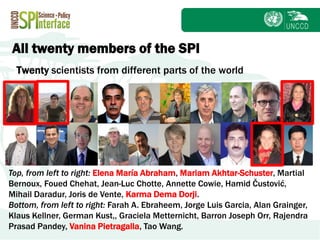
Twenty scientists from different parts of the world
Top, from left to right: Elena María Abraham, Mariam Akhtar-Schuster, Martial
Bernoux, Foued Chehat, Jean-Luc Chotte, Annette Cowie, Hamid Čustović,
Mihail Daradur, Joris de Vente, Karma Dema Dorji.
Bottom, from left to right: Farah A. Ebraheem, Jorge Luis Garcia, Alan Grainger,
Klaus Kellner, German Kust,, Graciela Metternicht, Barron Joseph Orr, Rajendra
Prasad Pandey, Vanina Pietragalla, Tao Wang.
All twenty members of the SPI
Subject
Observers to the SPI
(Jonathan Davies)
(Adamou Bouhari)
CSO representative: Nathalie van Haren (Both ENDS)
Subject
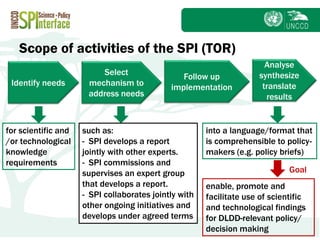
Scope of activities of the SPI (TOR)
for scientific and
/or technological
knowledge
requirements
such as:
- SPI develops a report
jointly with other experts.
- SPI commissions and
supervises an expert group
that develops a report.
- SPI collaborates jointly with
other ongoing initiatives and
develops under agreed terms
into a language/format that
is comprehensible to policy-
makers (e.g. policy briefs)
enable, promote and
facilitate use of scientific
and technological findings
for DLDD-relevant policy/
decision making
Goal
Identify needs
Select
mechanism to
address needs
Follow up
implementation
Analyse
synthesize
translate
results
Subject
 Interact with existing multiple scientific mechanisms, including:
• Intergovernmental Platform on Biodiversity and Ecosystem
Services (IPBES)
• Intergovernmental Panel on Climate Change (IPCC)
• Intergovernmental Technical Panel on Soils (ITPS)
…and other new and existing scientific networks and platforms
Mandate of the SPI (decision 23/COP.11)
Subject
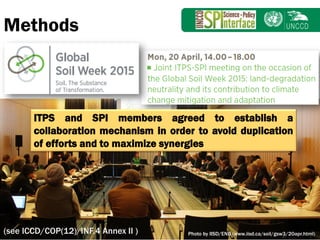
Methods
Photo by IISD/ENB (www.iisd.ca/soil/gsw3/20apr.html)
ITPS and SPI members agreed to establish a
collaboration mechanism in order to avoid duplication
of efforts and to maximize synergies
(see ICCD/COP(12)/INF.4 Annex II )
Subject
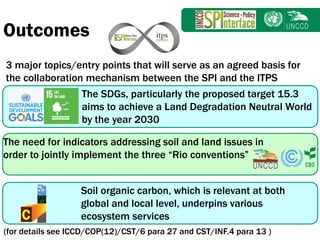
Outcomes
3 major topics/entry points that will serve as an agreed basis for
the collaboration mechanism between the SPI and the ITPS
The SDGs, particularly the proposed target 15.3
aims to achieve a Land Degradation Neutral World
by the year 2030
The need for indicators addressing soil and land issues in
order to jointly implement the three “Rio conventions”
Soil organic carbon, which is relevant at both
global and local level, underpins various
ecosystem servicesC
(for details see ICCD/COP(12)/CST/6 para 27 and CST/INF.4 para 13 )
Subject
The third Plenary Assembly of
the GSP endorsed the three
aforementioned topics/entry
points in June 2015
(Document GSPPA: III/2015/2 Add.2)
It concerns all proposed
objectives, and more specifically
proposed Coordination activity 3
Follow up current collaboration
and explore further means of
collaboration with the
Intergovernmental Technical
Panel on Soil
(Objectives see ICCD/COP(12)/CST/6 p. 9-10
Coord. act. seeICCD/COP(12)/CST/6 p. 10-11)
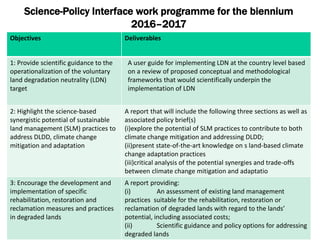
Objectives Deliverables
1: Provide scientific guidance to the
operationalization of the voluntary
land degradation neutrality (LDN)
target
A user guide for implementing LDN at the country level based
on a review of proposed conceptual and methodological
frameworks that would scientifically underpin the
implementation of LDN
2: Highlight the science-based
synergistic potential of sustainable
land management (SLM) practices to
address DLDD, climate change
mitigation and adaptation
A report that will include the following three sections as well as
associated policy brief(s)
(i)explore the potential of SLM practices to contribute to both
climate change mitigation and addressing DLDD;
(ii)present state-of-the-art knowledge on s land-based climate
change adaptation practices
(iii)critical analysis of the potential synergies and trade-offs
between climate change mitigation and adaptatio
3: Encourage the development and
implementation of specific
rehabilitation, restoration and
reclamation measures and practices
in degraded lands
A report providing:
(i) An assessment of existing land management
practices suitable for the rehabilitation, restoration or
reclamation of degraded lands with regard to the lands’
potential, including associated costs;
(ii) Scientific guidance and policy options for addressing
degraded lands
Science-Policy Interface work programme for the biennium
2016–2017
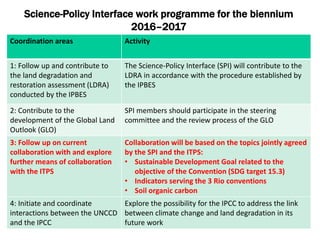
Coordination areas Activity
1: Follow up and contribute to
the land degradation and
restoration assessment (LDRA)
conducted by the IPBES
The Science-Policy Interface (SPI) will contribute to the
LDRA in accordance with the procedure established by
the IPBES
2: Contribute to the
development of the Global Land
Outlook (GLO)
SPI members should participate in the steering
committee and the review process of the GLO
3: Follow up on current
collaboration with and explore
further means of collaboration
with the ITPS
Collaboration will be based on the topics jointly agreed
by the SPI and the ITPS:
• Sustainable Development Goal related to the
objective of the Convention (SDG target 15.3)
• Indicators serving the 3 Rio conventions
• Soil organic carbon
4: Initiate and coordinate
interactions between the UNCCD
and the IPCC
Explore the possibility for the IPCC to address the link
between climate change and land degradation in its
future work
Science-Policy Interface work programme for the biennium
2016–2017
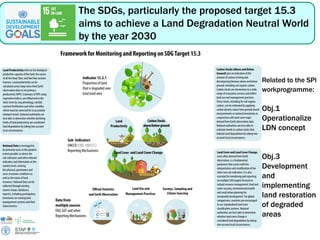
The SDGs, particularly the proposed target 15.3
aims to achieve a Land Degradation Neutral World
by the year 2030
Related to the SPI
workprogramme:
Obj.1
Operationalize
LDN concept
Obj.3
Development
and
implementing
land restoration
of degraded
areas
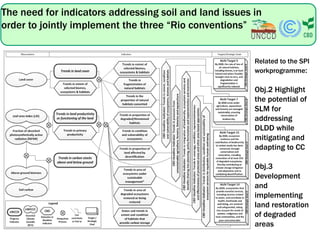
The need for indicators addressing soil and land issues in
order to jointly implement the three “Rio conventions”
Related to the SPI
workprogramme:
Obj.2 Highlight
the potential of
SLM for
addressing
DLDD while
mitigating and
adapting to CC
Obj.3
Development
and
implementing
land restoration
of degraded
areas
Related to the SPI workprogramme:
Obj.1 Operationalize LDN concpet
Obj.2 Highlight the potential of SLM for
addressing DLDD while mitigating and
adapting to CC
Soil organic carbon, which is relevant at both
global and local level, underpins various
ecosystem services
Subject
Thank you !!

Collaboration between the ITPS and the UNCCD-SPI

  • 1.
    United Nations Convention toCombat Desertification Collaboration between the ITPS and the UNCCD-SPI Fifth Working session of the Intergovernmental Technical Panel on on Soil (ITPS) 14-18 March 2016, Rome
  • 2.
    Subject At its 11thsession in Windhoek/Namibia, in September 2013, the Conference of the Parties (COP) decided to establish a Science- Policy Interface (SPI) (decision 23/COP.11) When was the Science-Policy Interface (SPI) established? UNCCD COP.11, Sept. 2013 (Photo credit: Earth Negotiations Bulletin (ENB))
  • 3.
    Subject The goal ofthe SPI is to facilitate a two-way dialogue between scientists and policy makers in order to ensure the delivery of policy-relevant information, knowledge and advice on desertification/land degradation and drought (DLDD) The SPI’s mandate and scope of activities are designed to strengthen the work of the scientific community working on DLDD, including the UNCCD’s Committee on Science and Technology Why was the SPI established? UNCCD COP.11, Sept. 2013 (Photo: Mariam Akhtar-Schuster)
  • 4.
    Subject Who are themembers of the SPI? Five members of the Bureau of the Committee on Science and Technology: Jean-Luc Chotte WEOG Foued Chehat Africa Farah A. Ebraheem Asia Jorge Luis Garcia LAC Hamid Custovic Central Eastern Europe CST chair Five scientists, one nominated be each of the Regional Implementation Annexes: Martial Bernoux WEOG Klaus Kellner Africa Karma Dorji Asia Vanina Pietragalla LAC Mihail Daradur Central Eastern Europe
  • 5.
    Subject Ct’d Who are themembers of the SPI? Ten scientists from different parts of the world selected by the Bureau of the Committee on Science and Technology: Elena Abraham Mariam Akhtar- Schuster Annette Cowie Joris de Vente Alan Grainger German Kust Graciela Metternicht Barron J. Orr Rajendra P. Pandey Tao Wang
  • 6.
    Subject Twenty scientists fromdifferent parts of the world Top, from left to right: Elena María Abraham, Mariam Akhtar-Schuster, Martial Bernoux, Foued Chehat, Jean-Luc Chotte, Annette Cowie, Hamid Čustović, Mihail Daradur, Joris de Vente, Karma Dema Dorji. Bottom, from left to right: Farah A. Ebraheem, Jorge Luis Garcia, Alan Grainger, Klaus Kellner, German Kust,, Graciela Metternicht, Barron Joseph Orr, Rajendra Prasad Pandey, Vanina Pietragalla, Tao Wang. All twenty members of the SPI
  • 7.
    Subject Observers to theSPI (Jonathan Davies) (Adamou Bouhari) CSO representative: Nathalie van Haren (Both ENDS)
  • 8.
    Subject Scope of activitiesof the SPI (TOR) for scientific and /or technological knowledge requirements such as: - SPI develops a report jointly with other experts. - SPI commissions and supervises an expert group that develops a report. - SPI collaborates jointly with other ongoing initiatives and develops under agreed terms into a language/format that is comprehensible to policy- makers (e.g. policy briefs) enable, promote and facilitate use of scientific and technological findings for DLDD-relevant policy/ decision making Goal Identify needs Select mechanism to address needs Follow up implementation Analyse synthesize translate results
  • 9.
    Subject  Interact withexisting multiple scientific mechanisms, including: • Intergovernmental Platform on Biodiversity and Ecosystem Services (IPBES) • Intergovernmental Panel on Climate Change (IPCC) • Intergovernmental Technical Panel on Soils (ITPS) …and other new and existing scientific networks and platforms Mandate of the SPI (decision 23/COP.11)
  • 10.
    Subject Methods Photo by IISD/ENB(www.iisd.ca/soil/gsw3/20apr.html) ITPS and SPI members agreed to establish a collaboration mechanism in order to avoid duplication of efforts and to maximize synergies (see ICCD/COP(12)/INF.4 Annex II )
  • 11.
    Subject Outcomes 3 major topics/entrypoints that will serve as an agreed basis for the collaboration mechanism between the SPI and the ITPS The SDGs, particularly the proposed target 15.3 aims to achieve a Land Degradation Neutral World by the year 2030 The need for indicators addressing soil and land issues in order to jointly implement the three “Rio conventions” Soil organic carbon, which is relevant at both global and local level, underpins various ecosystem servicesC (for details see ICCD/COP(12)/CST/6 para 27 and CST/INF.4 para 13 )
  • 12.
    Subject The third PlenaryAssembly of the GSP endorsed the three aforementioned topics/entry points in June 2015 (Document GSPPA: III/2015/2 Add.2) It concerns all proposed objectives, and more specifically proposed Coordination activity 3 Follow up current collaboration and explore further means of collaboration with the Intergovernmental Technical Panel on Soil (Objectives see ICCD/COP(12)/CST/6 p. 9-10 Coord. act. seeICCD/COP(12)/CST/6 p. 10-11)
  • 13.
    Objectives Deliverables 1: Providescientific guidance to the operationalization of the voluntary land degradation neutrality (LDN) target A user guide for implementing LDN at the country level based on a review of proposed conceptual and methodological frameworks that would scientifically underpin the implementation of LDN 2: Highlight the science-based synergistic potential of sustainable land management (SLM) practices to address DLDD, climate change mitigation and adaptation A report that will include the following three sections as well as associated policy brief(s) (i)explore the potential of SLM practices to contribute to both climate change mitigation and addressing DLDD; (ii)present state-of-the-art knowledge on s land-based climate change adaptation practices (iii)critical analysis of the potential synergies and trade-offs between climate change mitigation and adaptatio 3: Encourage the development and implementation of specific rehabilitation, restoration and reclamation measures and practices in degraded lands A report providing: (i) An assessment of existing land management practices suitable for the rehabilitation, restoration or reclamation of degraded lands with regard to the lands’ potential, including associated costs; (ii) Scientific guidance and policy options for addressing degraded lands Science-Policy Interface work programme for the biennium 2016–2017
  • 14.
    Coordination areas Activity 1:Follow up and contribute to the land degradation and restoration assessment (LDRA) conducted by the IPBES The Science-Policy Interface (SPI) will contribute to the LDRA in accordance with the procedure established by the IPBES 2: Contribute to the development of the Global Land Outlook (GLO) SPI members should participate in the steering committee and the review process of the GLO 3: Follow up on current collaboration with and explore further means of collaboration with the ITPS Collaboration will be based on the topics jointly agreed by the SPI and the ITPS: • Sustainable Development Goal related to the objective of the Convention (SDG target 15.3) • Indicators serving the 3 Rio conventions • Soil organic carbon 4: Initiate and coordinate interactions between the UNCCD and the IPCC Explore the possibility for the IPCC to address the link between climate change and land degradation in its future work Science-Policy Interface work programme for the biennium 2016–2017
  • 15.
    The SDGs, particularlythe proposed target 15.3 aims to achieve a Land Degradation Neutral World by the year 2030 Related to the SPI workprogramme: Obj.1 Operationalize LDN concept Obj.3 Development and implementing land restoration of degraded areas
  • 16.
    The need forindicators addressing soil and land issues in order to jointly implement the three “Rio conventions” Related to the SPI workprogramme: Obj.2 Highlight the potential of SLM for addressing DLDD while mitigating and adapting to CC Obj.3 Development and implementing land restoration of degraded areas
  • 17.
    Related to theSPI workprogramme: Obj.1 Operationalize LDN concpet Obj.2 Highlight the potential of SLM for addressing DLDD while mitigating and adapting to CC Soil organic carbon, which is relevant at both global and local level, underpins various ecosystem services
  • 18.