CODES & CONVENTIONS
OF A DOCUMENTARY
What are Codes and Conventions
of Documentaries?
■ Codes and conventions are techniques used repeatedly within a
Documentary- things you expect. For example, I would say that
in Documentaries they are always factual.
■ Codes are something that give more meaning.Codes tell a
story within media text.
■ Conventions are something that are widely recognised within a
certain media field, for example interviewing an expert in a
Documentary.
Codes & Conventions in
documentaries
■ Interviews
■ Presenter (on screen)
■ Presenter (off screen)
■ Voice overs
■ Direct address/ breaking the 4th wall
■ Reconstruction/ reinactment
■ Hand held cameras (real life events)
■ Expert interviews (static cameras used)
■ Location – MES- e.g. at an office
■ Mediation – encoding a message
■ Music
■ Point ofView
■ Specific subject
■ Vox Pop (voice of the population)
■ Background footage
■ Credits
■ Conflicting views
■ Archival footage (e.g. old home videos)
■ Facts and Statistics
■ Personal Perspective
■ Dialogue/ narrative
■ Title sequence (montage)
■ Variety of shots
■ Pacey, quick shots
■ Special effects/ transitions
Presenters/Voice overs
■ OFF SCREEN: In some documentaries
the audience won’t see the presenter
but instead hear a voice over.The
narrator talks over and in between
footage explaining what is going on, and
sometimes voices their opinions.Often
an off screen presenter/ voiceover is
used to create a more realistic Fly on the
Wall effect (e.g. our world, Benefits
Street).
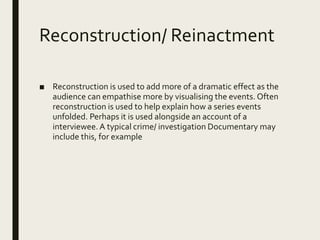
■ ON SCREEN: In other documentaries the
audience will see the presenter
themselves (e.g. Queer Britain, Inside
Out). Sometimes they are shot with
handheld cameras, talking to the
audience or may be filmed interviewing
an expert.
(Queer Britain) presenter shot in an interview walking
down the street, handheld camera used.
Reconstruction/ Reinactment
■ Reconstruction is used to add more of a dramatic effect as the
audience can empathise more by visualising the events. Often
reconstruction is used to help explain how a series events
unfolded. Perhaps it is used alongside an account of a
interviewee. A typical crime/ investigation Documentary may
include this, for example
Hand held camera/ Static
camera
■ Hand held cameras are used to give a sense of realism.This helps
in recreating a realistic, (sometimes) informal experience. It is
often used when interviewing someone who is not an expert. Also
they would be used in home video clips for example. (e.g. Amy).
■ Static cameras (used on a tripod to keep the camera still and
steady) are used when filming a formal interview with an ‘expert’
for example, it remains still in order to look professional. (e.g.
Diana documentary).
Credits (experts)
■ Credits are a description of a person for example their name
and job description (if they are an expert).
■ E.g. Dr Phil – Psychologist.
This gives the audience an indication of who they are and what
they do, they know their purpose. Often in interviews with experts,
their profession is included so that the audience knows the expert
is trustworthy. (e.g. Inside Out)
Location - MES
■ Location is used so that the visuals match the narrative; for
example, in an interview with a doctor being in his office or at
the hospital is realistic and it suits the scene that is being
played or explained.
Mediation (encoding a
message)
■ Often events may be slightly exaggerated. It explains what is
going on and can also be made entertaining for the audience.
Sometimes content is presented in a certain way to make an
audience have a certain opinion.This is more difficult to say
exactly as it is personal opinion. (e.g.Amy)
Music
■ Music is used frequently in documentaries especially in the
background of footage. For example there may be a clip of
people walking down the street so music makes it more
entertaining.
Vox pop
■ ‘Voice of the population’.
Interviewers will go somewhere (e.g. a town centre) and interview
random members of the public to gather information and opinions
on the topic that they’re discussing. They do this so that it doesn’t
look biased to their argument by asking a target audience but
instead they are receiving opposing opinions.
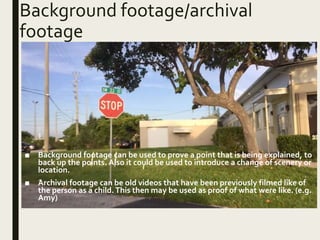
Background footage/archival
footage
■ Background footage can be used to prove a point that is being explained, to
back up the points. Also it could be used to introduce a change of scenery or
location.
■ Archival footage can be old videos that have been previously filmed like of
the person as a child.This then may be used as proof of what were like. (e.g.
Amy)
OurWorld
■ This is shown to be a factual documentary.The programme contains interviews
with families and experts with their opposing opinions to do with the illness.
■ Off screen presenter/ voice over
■ Background music
■ Interviews with families – some with hand held cameras, some with static
■ Interviews with experts – static cameras used
■ Locations (e.g. homes, hospitals, swimming pools)
■ Archival footage (at the beach, the little girl in her bed and at the mental
hospital)
■ Online articles – facts/statistics
■ Credits – experts name’s and job titles shown whilst being interviewed
Queer Britain
■ This documentary is based on people’s personal life experiences. It has more
entertainment value opposed to factual (e.g. The expert wearing more casual
clothing, slouching etc…)
■ On screen presenter - static camera
■ Voiceover
■ Stats
■ Montage footage in title sequence
■ Specific subject
■ Hand held camera
■ Interviews (not showing mans face)
■ Interviews with experts
■ Location – Birmingham
■ Credits – experts
■ Participatory - Interview gets involved.
Conventions I will include
■ In my documentary I will include an on screen presenter, as I
find it more interesting to watch someone on screen, rather
than just a voiceover.
■ I think I will use a voiceover as well as an on screen presenter in
my documentary, for example over archival footage.
■ If I conduct any interviews in public I will use a handheld
camera, as this is more relaxed and is often used within
interviews with the public.

Codes and conventions of docs

  • 1.
  • 2.
    What are Codesand Conventions of Documentaries? ■ Codes and conventions are techniques used repeatedly within a Documentary- things you expect. For example, I would say that in Documentaries they are always factual. ■ Codes are something that give more meaning.Codes tell a story within media text. ■ Conventions are something that are widely recognised within a certain media field, for example interviewing an expert in a Documentary.
  • 3.
    Codes & Conventionsin documentaries ■ Interviews ■ Presenter (on screen) ■ Presenter (off screen) ■ Voice overs ■ Direct address/ breaking the 4th wall ■ Reconstruction/ reinactment ■ Hand held cameras (real life events) ■ Expert interviews (static cameras used) ■ Location – MES- e.g. at an office ■ Mediation – encoding a message ■ Music ■ Point ofView ■ Specific subject ■ Vox Pop (voice of the population) ■ Background footage ■ Credits ■ Conflicting views ■ Archival footage (e.g. old home videos) ■ Facts and Statistics ■ Personal Perspective ■ Dialogue/ narrative ■ Title sequence (montage) ■ Variety of shots ■ Pacey, quick shots ■ Special effects/ transitions
  • 4.
    Presenters/Voice overs ■ OFFSCREEN: In some documentaries the audience won’t see the presenter but instead hear a voice over.The narrator talks over and in between footage explaining what is going on, and sometimes voices their opinions.Often an off screen presenter/ voiceover is used to create a more realistic Fly on the Wall effect (e.g. our world, Benefits Street). ■ ON SCREEN: In other documentaries the audience will see the presenter themselves (e.g. Queer Britain, Inside Out). Sometimes they are shot with handheld cameras, talking to the audience or may be filmed interviewing an expert. (Queer Britain) presenter shot in an interview walking down the street, handheld camera used.
  • 5.
    Reconstruction/ Reinactment ■ Reconstructionis used to add more of a dramatic effect as the audience can empathise more by visualising the events. Often reconstruction is used to help explain how a series events unfolded. Perhaps it is used alongside an account of a interviewee. A typical crime/ investigation Documentary may include this, for example
  • 6.
    Hand held camera/Static camera ■ Hand held cameras are used to give a sense of realism.This helps in recreating a realistic, (sometimes) informal experience. It is often used when interviewing someone who is not an expert. Also they would be used in home video clips for example. (e.g. Amy). ■ Static cameras (used on a tripod to keep the camera still and steady) are used when filming a formal interview with an ‘expert’ for example, it remains still in order to look professional. (e.g. Diana documentary).
  • 7.
    Credits (experts) ■ Creditsare a description of a person for example their name and job description (if they are an expert). ■ E.g. Dr Phil – Psychologist. This gives the audience an indication of who they are and what they do, they know their purpose. Often in interviews with experts, their profession is included so that the audience knows the expert is trustworthy. (e.g. Inside Out)
  • 8.
    Location - MES ■Location is used so that the visuals match the narrative; for example, in an interview with a doctor being in his office or at the hospital is realistic and it suits the scene that is being played or explained.
  • 9.
    Mediation (encoding a message) ■Often events may be slightly exaggerated. It explains what is going on and can also be made entertaining for the audience. Sometimes content is presented in a certain way to make an audience have a certain opinion.This is more difficult to say exactly as it is personal opinion. (e.g.Amy)
  • 10.
    Music ■ Music isused frequently in documentaries especially in the background of footage. For example there may be a clip of people walking down the street so music makes it more entertaining.
  • 11.
    Vox pop ■ ‘Voiceof the population’. Interviewers will go somewhere (e.g. a town centre) and interview random members of the public to gather information and opinions on the topic that they’re discussing. They do this so that it doesn’t look biased to their argument by asking a target audience but instead they are receiving opposing opinions.
  • 12.
    Background footage/archival footage ■ Backgroundfootage can be used to prove a point that is being explained, to back up the points. Also it could be used to introduce a change of scenery or location. ■ Archival footage can be old videos that have been previously filmed like of the person as a child.This then may be used as proof of what were like. (e.g. Amy)
  • 13.
    OurWorld ■ This isshown to be a factual documentary.The programme contains interviews with families and experts with their opposing opinions to do with the illness. ■ Off screen presenter/ voice over ■ Background music ■ Interviews with families – some with hand held cameras, some with static ■ Interviews with experts – static cameras used ■ Locations (e.g. homes, hospitals, swimming pools) ■ Archival footage (at the beach, the little girl in her bed and at the mental hospital) ■ Online articles – facts/statistics ■ Credits – experts name’s and job titles shown whilst being interviewed
  • 14.
    Queer Britain ■ Thisdocumentary is based on people’s personal life experiences. It has more entertainment value opposed to factual (e.g. The expert wearing more casual clothing, slouching etc…) ■ On screen presenter - static camera ■ Voiceover ■ Stats ■ Montage footage in title sequence ■ Specific subject ■ Hand held camera ■ Interviews (not showing mans face) ■ Interviews with experts ■ Location – Birmingham ■ Credits – experts ■ Participatory - Interview gets involved.
  • 15.
    Conventions I willinclude ■ In my documentary I will include an on screen presenter, as I find it more interesting to watch someone on screen, rather than just a voiceover. ■ I think I will use a voiceover as well as an on screen presenter in my documentary, for example over archival footage. ■ If I conduct any interviews in public I will use a handheld camera, as this is more relaxed and is often used within interviews with the public.