POST 13
RESEARCH INTO SIMILAR PRODUCTS: AMY DOCUMENTARY
PURPOSE:
TO ENTERTAIN
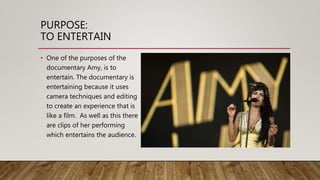
• One of the purposes of the
documentary Amy, is to
entertain. The documentary is
entertaining because it uses
camera techniques and editing
to create an experience that is
like a film. As well as this there
are clips of her performing
which entertains the audience.
PURPOSE:
TO INFORM
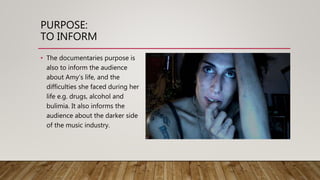
• The documentaries purpose is
also to inform the audience
about Amy’s life, and the
difficulties she faced during her
life e.g. drugs, alcohol and
bulimia. It also informs the
audience about the darker side
of the music industry.
PURPOSE:
TO ANSWER QUESTIONS
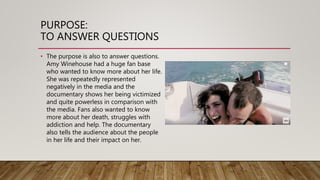
• The purpose is also to answer questions.
Amy Winehouse had a huge fan base
who wanted to know more about her life.
She was repeatedly represented
negatively in the media and the
documentary shows her being victimized
and quite powerless in comparison with
the media. Fans also wanted to know
more about her death, struggles with
addiction and help. The documentary
also tells the audience about the people
in her life and their impact on her.
CODES AND CONVENTIONS:
BACKGROUND FOOTAGE
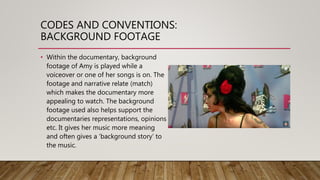
• Within the documentary, background
footage of Amy is played while a
voiceover or one of her songs is on. The
footage and narrative relate (match)
which makes the documentary more
appealing to watch. The background
footage used also helps support the
documentaries representations, opinions
etc. It gives her music more meaning
and often gives a ‘background story’ to
the music.
CODES AND CONVENTIONS:
INTERVIEWS
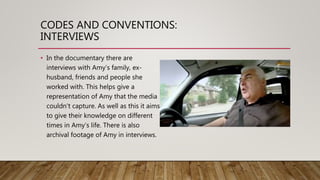
• In the documentary there are
interviews with Amy’s family, ex-
husband, friends and people she
worked with. This helps give a
representation of Amy that the media
couldn't capture. As well as this it aims
to give their knowledge on different
times in Amy’s life. There is also
archival footage of Amy in interviews.
CODES AND CONVENTIONS:
ENDING SEQUENCE (MONTAGE)
• A montage of videos of Amy are used at the end of the film which create an
emotional response, there is piano contrapuntal music played in the background. It
also summarises much of the footage shown in the film to conclude the
documentary and the desired message from the director.
MODE:
OBSERVATIONAL
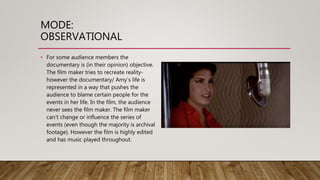
• For some audience members the
documentary is (in their opinion) objective.
The film maker tries to recreate reality-
however the documentary/ Amy’s life is
represented in a way that pushes the
audience to blame certain people for the
events in her life. In the film, the audience
never sees the film maker. The film maker
can’t change or influence the series of
events (even though the majority is archival
footage). However the film is highly edited
and has music played throughout.
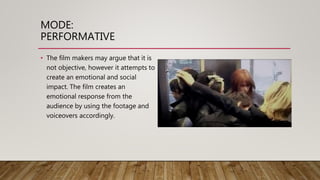
MODE:
PERFORMATIVE
• The film makers may argue that it is
not objective, however it attempts to
create an emotional and social
impact. The film creates an
emotional response from the
audience by using the footage and
voiceovers accordingly.
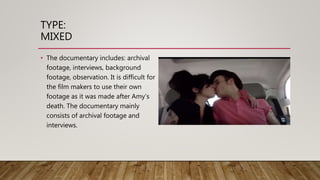
TYPE:
MIXED
• The documentary includes: archival
footage, interviews, background
footage, observation. It is difficult for
the film makers to use their own
footage as it was made after Amy’s
death. The documentary mainly
consists of archival footage and
interviews.
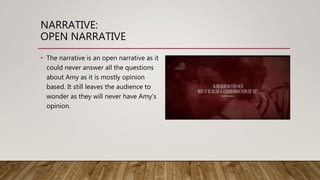
NARRATIVE:
OPEN NARRATIVE
• The narrative is an open narrative as it
could never answer all the questions
about Amy as it is mostly opinion
based. It still leaves the audience to
wonder as they will never have Amy’s
opinion.
NARRATIVE:
LINEAR
• The narrative follows a timeline of events from when Amy was a child through to her
death. The events are shown chronologically.
NARRATIVE:
MULTI STRAND
• The narrative is multi strand as it covers the topic of Amy’s life however there are
many issues within this that are shown. For example, her battles with alcohol, drugs
and bulimia. As well as this her relationships with people, the music industry etc..
WHAT WE WILL USE AND WHAT I HAVE LEARNT
• We will use an open narrative in our documentary so that the audience can make
their own decisions on the question. As well as this we will use multi strand, in
order to cover all the issues and topics surrounding alcohol. We will use a mixed
type of documentary as we will use a range of different conventions like archival
footage, interviews etc.. From the Amy documentary I have learnt that there is no
real need for a lot of original footage, in Amy the birds eye view shots are
original. As well as this there were inserts from different tabloids which show
mediation and representation which I found interesting.

Post 13

  • 1.
    POST 13 RESEARCH INTOSIMILAR PRODUCTS: AMY DOCUMENTARY
  • 2.
    PURPOSE: TO ENTERTAIN • Oneof the purposes of the documentary Amy, is to entertain. The documentary is entertaining because it uses camera techniques and editing to create an experience that is like a film. As well as this there are clips of her performing which entertains the audience.
  • 3.
    PURPOSE: TO INFORM • Thedocumentaries purpose is also to inform the audience about Amy’s life, and the difficulties she faced during her life e.g. drugs, alcohol and bulimia. It also informs the audience about the darker side of the music industry.
  • 4.
    PURPOSE: TO ANSWER QUESTIONS •The purpose is also to answer questions. Amy Winehouse had a huge fan base who wanted to know more about her life. She was repeatedly represented negatively in the media and the documentary shows her being victimized and quite powerless in comparison with the media. Fans also wanted to know more about her death, struggles with addiction and help. The documentary also tells the audience about the people in her life and their impact on her.
  • 5.
    CODES AND CONVENTIONS: BACKGROUNDFOOTAGE • Within the documentary, background footage of Amy is played while a voiceover or one of her songs is on. The footage and narrative relate (match) which makes the documentary more appealing to watch. The background footage used also helps support the documentaries representations, opinions etc. It gives her music more meaning and often gives a ‘background story’ to the music.
  • 6.
    CODES AND CONVENTIONS: INTERVIEWS •In the documentary there are interviews with Amy’s family, ex- husband, friends and people she worked with. This helps give a representation of Amy that the media couldn't capture. As well as this it aims to give their knowledge on different times in Amy’s life. There is also archival footage of Amy in interviews.
  • 7.
    CODES AND CONVENTIONS: ENDINGSEQUENCE (MONTAGE) • A montage of videos of Amy are used at the end of the film which create an emotional response, there is piano contrapuntal music played in the background. It also summarises much of the footage shown in the film to conclude the documentary and the desired message from the director.
  • 8.
    MODE: OBSERVATIONAL • For someaudience members the documentary is (in their opinion) objective. The film maker tries to recreate reality- however the documentary/ Amy’s life is represented in a way that pushes the audience to blame certain people for the events in her life. In the film, the audience never sees the film maker. The film maker can’t change or influence the series of events (even though the majority is archival footage). However the film is highly edited and has music played throughout.
  • 9.
    MODE: PERFORMATIVE • The filmmakers may argue that it is not objective, however it attempts to create an emotional and social impact. The film creates an emotional response from the audience by using the footage and voiceovers accordingly.
  • 10.
    TYPE: MIXED • The documentaryincludes: archival footage, interviews, background footage, observation. It is difficult for the film makers to use their own footage as it was made after Amy’s death. The documentary mainly consists of archival footage and interviews.
  • 11.
    NARRATIVE: OPEN NARRATIVE • Thenarrative is an open narrative as it could never answer all the questions about Amy as it is mostly opinion based. It still leaves the audience to wonder as they will never have Amy’s opinion.
  • 12.
    NARRATIVE: LINEAR • The narrativefollows a timeline of events from when Amy was a child through to her death. The events are shown chronologically.
  • 13.
    NARRATIVE: MULTI STRAND • Thenarrative is multi strand as it covers the topic of Amy’s life however there are many issues within this that are shown. For example, her battles with alcohol, drugs and bulimia. As well as this her relationships with people, the music industry etc..
  • 14.
    WHAT WE WILLUSE AND WHAT I HAVE LEARNT • We will use an open narrative in our documentary so that the audience can make their own decisions on the question. As well as this we will use multi strand, in order to cover all the issues and topics surrounding alcohol. We will use a mixed type of documentary as we will use a range of different conventions like archival footage, interviews etc.. From the Amy documentary I have learnt that there is no real need for a lot of original footage, in Amy the birds eye view shots are original. As well as this there were inserts from different tabloids which show mediation and representation which I found interesting.