What does codes &
conventions mean?
Codes and conventions are used to create meaning or the ‘norm’ of
what is used in a media context e.g. tv show, magazine, documentary
etc… Codes are systems of signs, which create meaning. Codes can be
divided into two categories – technical and symbolic. Conventions are
the generally accepted ways of doing something. There are general
conventions in any medium, such as the use of interviewee quotes in a
print article, but conventions are also genre specific.
Codes & Conventions in
documentaries
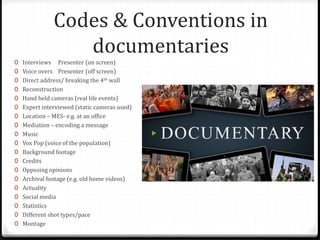
0 Interviews Presenter (on screen)
0 Voice overs Presenter (off screen)
0 Direct address/ breaking the 4th wall
0 Reconstruction
0 Hand held cameras (real life events)
0 Expert interviewed (static cameras used)
0 Location – MES- e.g. at an office
0 Mediation – encoding a message
0 Music
0 Vox Pop (voice of the population)
0 Background footage
0 Credits
0 Opposing opinions
0 Archival footage (e.g. old home videos)
0 Actuality
0 Social media
0 Statistics
0 Different shot types/pace
0 Montage
Music bed
0 Music is used a lot in
documentaries and
tv shows especially in
the background of
scenes. For example
there may be a clip of
people walking down
the street so music
will be brought in to
add effect.
Presenters/voice overs
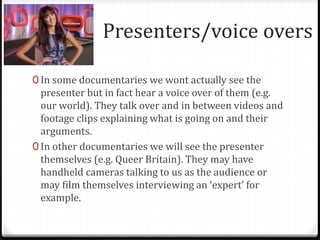
0 In some documentaries we wont actually see the
presenter but in fact hear a voice over of them (e.g.
our world). They talk over and in between videos and
footage clips explaining what is going on and their
arguments.
0 In other documentaries we will see the presenter
themselves (e.g. Queer Britain). They may have
handheld cameras talking to us as the audience or
may film themselves interviewing an ‘expert’ for
example.
Hand held camera/static
camera
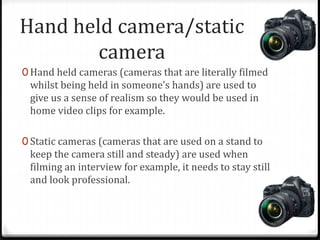
0 Hand held cameras (cameras that are literally filmed
whilst being held in someone’s hands) are used to
give us a sense of realism so they would be used in
home video clips for example.
0 Static cameras (cameras that are used on a stand to
keep the camera still and steady) are used when
filming an interview for example, it needs to stay still
and look professional.
Credits (experts)
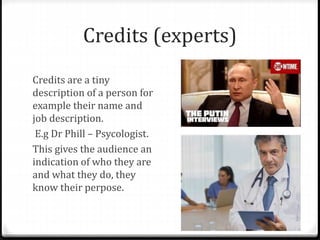
Credits are a tiny
description of a person for
example their name and
job description.
E.g Dr Phill – Psycologist.
This gives the audience an
indication of who they are
and what they do, they
know their perpose.
Location - MES
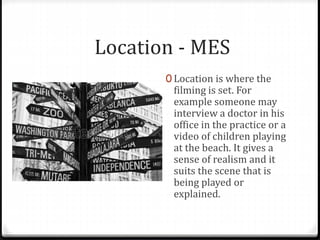
0 Location is where the
filming is set. For
example someone may
interview a doctor in his
office in the practice or a
video of children playing
at the beach. It gives a
sense of realism and it
suits the scene that is
being played or
explained.
Mediation (encoding a
message)
0 Things may be slightly exaggerated or had to be rein
acted for the purpose of the documentary (media). It
explains what is going on and can also be entertaining
for the audience.
More or less everything that
we see or hear in the media
today is mediated for YOUR
entertainment.
Vox pop
‘Voice of the population’.
Interviewers will go
somewhere (e.g. a town
centre) and interview
random members of the
public to gather
information and opinions
they have on the topic
that they’re discussing.
They do this so that it
doesn’t look biased to
their argument by asking
a target audience but
instead they are
receiving opposing
opinions.
Background footage/archival
footage
0 Background footage can be used to prove a point that
is being explained, to back up the points.
0 Similarly archival footage but these are old videos that
have been previously filmed like old home videos of a
child with a disability. This then may be used as proof
of what children of that condition are like.
Actuality
Actuality gives a sense of realism to the viewers. They
see archival footage and vox pops for example to prove
the points that they’re making. It shows the viewers
what is actually going on.
Social Media
Social media is used to create awareness to the viewers that
want to find out more information on the documentary or for
people who haven’t heard about the show in general and it
appears on their social media sites.
Also, media producers are now ethically responsible to help
viewers of the programme find out more information on
what is being presented to them. For a example, if they’re
creating a documentary on mental illness, they should
include some helplines and websites people have access too
in case they feel offended or need/want any further
information on what they have watched.
Statistics
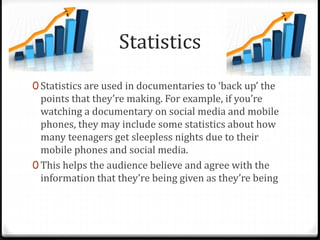
0 Statistics are used in documentaries to ‘back up’ the
points that they’re making. For example, if you’re
watching a documentary on social media and mobile
phones, they may include some statistics about how
many teenagers get sleepless nights due to their
mobile phones and social media.
0 This helps the audience believe and agree with the
information that they’re being given as they’re being
Montage
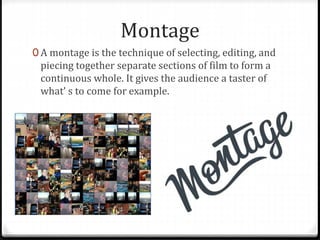
0 A montage is the technique of selecting, editing, and
piecing together separate sections of film to form a
continuous whole. It gives the audience a taster of
what’ s to come for example.
Different types of shots &
pace
Different types of shots are
always used to keep viewers
interested and to see things
from different perspectives.
Also the shots have different
pace lengths for example you
may see one type of shot e.g.
medium close up for about 3
seconds then it changes to a
long shot. You can
occasionally get a longer
paced shot for 10seconds for
example but it can
sometimes make an audience
feel uncomfortable if what
they’re watching doesn’t look
‘natural’.
<iframe width="560"
height="315"
src="https://www.youtube.c
om/embed/k-2zrWh82iU"
frameborder="0"
allowfullscreen></iframe>
Our World
0 This is shown to be a factual documentary. It has a serious
feel it is about an illness. Interviewing families and experts
with their opposing opinions to do with the illness.
0 C&C’s used:
0 Voice over - presenter – off screen
0 Background music
0 Interviews – families – some with hand held cameras, some with static
0 Interview – experts – static cameras
0 Locations (homes, hospitals, swimming pools etc…)
0 Actual footage (at the beach, the little girl in her bed and at the mental hospital)
0 Online articles – facts/figures
0 Credits – experts name’s and job titles shown whilst being interviewed
0 Stats
0 Expert shot
Queer Britain
0 This documentary is based on people’s personal life experiences.
It has a more relaxed feel to it (e.g. The expert wearing more
casual clothing, slouching etc…)
0 C&C’s Used:
0 Voice over – presenter – on screen - Static camera
0 Stats
0 Montage footage (in the beginning)
0 Can tell within 30 seconds what the doc’s about
0 Hand held camera
0 Interviews (not showing mans face)
0 Interviews with experts
0 Location – Birmingham
0 Credits – experts
0 Actuality – real life experiences
0 Real life footage
0 Participatory - Interview gets involved.
What have we learnt
0 We have learnt about a large variety of different codes
and conventions that are used in documentaries and
their meanings. Learning this will enable us to use
these codes and conventions to our own advantage in
our documentary to make it realistic, professional and
the best it can be. We have also learnt about different
codes and conventions that certain documentaries
use e.g. ‘Our world’ uses and off screen presenter
rather than an onscreen presenter. Again enabling us
to figure out which codes and conventions we need to
follow for the documentary style/purpose we choose.
What conventions will we use
and why?
0 We would like to use as many types of conventions that we can,
in particular:
0 Interview
0 Vox pops
0 Real life scenarios
0 Factual information
0 Expert interview
0 Location – Mise en scene
0 Credits
0 Music bed
We will use these codes and conventions because we want to
replicate and follow the C&C’s of a real documentary.

Post 2 codes and conventions

  • 2.
    What does codes& conventions mean? Codes and conventions are used to create meaning or the ‘norm’ of what is used in a media context e.g. tv show, magazine, documentary etc… Codes are systems of signs, which create meaning. Codes can be divided into two categories – technical and symbolic. Conventions are the generally accepted ways of doing something. There are general conventions in any medium, such as the use of interviewee quotes in a print article, but conventions are also genre specific.
  • 3.
    Codes & Conventionsin documentaries 0 Interviews Presenter (on screen) 0 Voice overs Presenter (off screen) 0 Direct address/ breaking the 4th wall 0 Reconstruction 0 Hand held cameras (real life events) 0 Expert interviewed (static cameras used) 0 Location – MES- e.g. at an office 0 Mediation – encoding a message 0 Music 0 Vox Pop (voice of the population) 0 Background footage 0 Credits 0 Opposing opinions 0 Archival footage (e.g. old home videos) 0 Actuality 0 Social media 0 Statistics 0 Different shot types/pace 0 Montage
  • 4.
    Music bed 0 Musicis used a lot in documentaries and tv shows especially in the background of scenes. For example there may be a clip of people walking down the street so music will be brought in to add effect.
  • 5.
    Presenters/voice overs 0 Insome documentaries we wont actually see the presenter but in fact hear a voice over of them (e.g. our world). They talk over and in between videos and footage clips explaining what is going on and their arguments. 0 In other documentaries we will see the presenter themselves (e.g. Queer Britain). They may have handheld cameras talking to us as the audience or may film themselves interviewing an ‘expert’ for example.
  • 6.
    Hand held camera/static camera 0Hand held cameras (cameras that are literally filmed whilst being held in someone’s hands) are used to give us a sense of realism so they would be used in home video clips for example. 0 Static cameras (cameras that are used on a stand to keep the camera still and steady) are used when filming an interview for example, it needs to stay still and look professional.
  • 7.
    Credits (experts) Credits area tiny description of a person for example their name and job description. E.g Dr Phill – Psycologist. This gives the audience an indication of who they are and what they do, they know their perpose.
  • 8.
    Location - MES 0Location is where the filming is set. For example someone may interview a doctor in his office in the practice or a video of children playing at the beach. It gives a sense of realism and it suits the scene that is being played or explained.
  • 9.
    Mediation (encoding a message) 0Things may be slightly exaggerated or had to be rein acted for the purpose of the documentary (media). It explains what is going on and can also be entertaining for the audience. More or less everything that we see or hear in the media today is mediated for YOUR entertainment.
  • 10.
    Vox pop ‘Voice ofthe population’. Interviewers will go somewhere (e.g. a town centre) and interview random members of the public to gather information and opinions they have on the topic that they’re discussing. They do this so that it doesn’t look biased to their argument by asking a target audience but instead they are receiving opposing opinions.
  • 11.
    Background footage/archival footage 0 Backgroundfootage can be used to prove a point that is being explained, to back up the points. 0 Similarly archival footage but these are old videos that have been previously filmed like old home videos of a child with a disability. This then may be used as proof of what children of that condition are like.
  • 12.
    Actuality Actuality gives asense of realism to the viewers. They see archival footage and vox pops for example to prove the points that they’re making. It shows the viewers what is actually going on.
  • 13.
    Social Media Social mediais used to create awareness to the viewers that want to find out more information on the documentary or for people who haven’t heard about the show in general and it appears on their social media sites. Also, media producers are now ethically responsible to help viewers of the programme find out more information on what is being presented to them. For a example, if they’re creating a documentary on mental illness, they should include some helplines and websites people have access too in case they feel offended or need/want any further information on what they have watched.
  • 14.
    Statistics 0 Statistics areused in documentaries to ‘back up’ the points that they’re making. For example, if you’re watching a documentary on social media and mobile phones, they may include some statistics about how many teenagers get sleepless nights due to their mobile phones and social media. 0 This helps the audience believe and agree with the information that they’re being given as they’re being
  • 15.
    Montage 0 A montageis the technique of selecting, editing, and piecing together separate sections of film to form a continuous whole. It gives the audience a taster of what’ s to come for example.
  • 16.
    Different types ofshots & pace Different types of shots are always used to keep viewers interested and to see things from different perspectives. Also the shots have different pace lengths for example you may see one type of shot e.g. medium close up for about 3 seconds then it changes to a long shot. You can occasionally get a longer paced shot for 10seconds for example but it can sometimes make an audience feel uncomfortable if what they’re watching doesn’t look ‘natural’. <iframe width="560" height="315" src="https://www.youtube.c om/embed/k-2zrWh82iU" frameborder="0" allowfullscreen></iframe>
  • 17.
    Our World 0 Thisis shown to be a factual documentary. It has a serious feel it is about an illness. Interviewing families and experts with their opposing opinions to do with the illness. 0 C&C’s used: 0 Voice over - presenter – off screen 0 Background music 0 Interviews – families – some with hand held cameras, some with static 0 Interview – experts – static cameras 0 Locations (homes, hospitals, swimming pools etc…) 0 Actual footage (at the beach, the little girl in her bed and at the mental hospital) 0 Online articles – facts/figures 0 Credits – experts name’s and job titles shown whilst being interviewed 0 Stats 0 Expert shot
  • 18.
    Queer Britain 0 Thisdocumentary is based on people’s personal life experiences. It has a more relaxed feel to it (e.g. The expert wearing more casual clothing, slouching etc…) 0 C&C’s Used: 0 Voice over – presenter – on screen - Static camera 0 Stats 0 Montage footage (in the beginning) 0 Can tell within 30 seconds what the doc’s about 0 Hand held camera 0 Interviews (not showing mans face) 0 Interviews with experts 0 Location – Birmingham 0 Credits – experts 0 Actuality – real life experiences 0 Real life footage 0 Participatory - Interview gets involved.
  • 19.
    What have welearnt 0 We have learnt about a large variety of different codes and conventions that are used in documentaries and their meanings. Learning this will enable us to use these codes and conventions to our own advantage in our documentary to make it realistic, professional and the best it can be. We have also learnt about different codes and conventions that certain documentaries use e.g. ‘Our world’ uses and off screen presenter rather than an onscreen presenter. Again enabling us to figure out which codes and conventions we need to follow for the documentary style/purpose we choose.
  • 20.
    What conventions willwe use and why? 0 We would like to use as many types of conventions that we can, in particular: 0 Interview 0 Vox pops 0 Real life scenarios 0 Factual information 0 Expert interview 0 Location – Mise en scene 0 Credits 0 Music bed We will use these codes and conventions because we want to replicate and follow the C&C’s of a real documentary.