DOCUMENTARY
BECKY UNG
Code and Conventions
Code and conventions are the way a documentary is made and the
features that are what makes it a documentary and creates meaning
within it. They follow a basic set of rules that ensure that it is produced
in a similar way to each other. Conventions are seen as the norm and
are generally seen as the accepted way of doing something and very
rarely does documentaries challenge these code and conventions and
they can stir controversy if they are challenged. An example of a
documentary challenging code and conventions is the Netflix
documentary, Casting JonBenet which discussed the death of a child
beauty pageant. The documentary focuses almost entirely on
dramatisation as the director invites residents of Boulder (the place of
death) to audition to play the real people in the case and then they
reveal their own opinions and speculations. There are no voice overs
or presenters that ask questions or explain details of the murder case,
this is left entirely up to the actors.
CODES AND CONVENTIONS
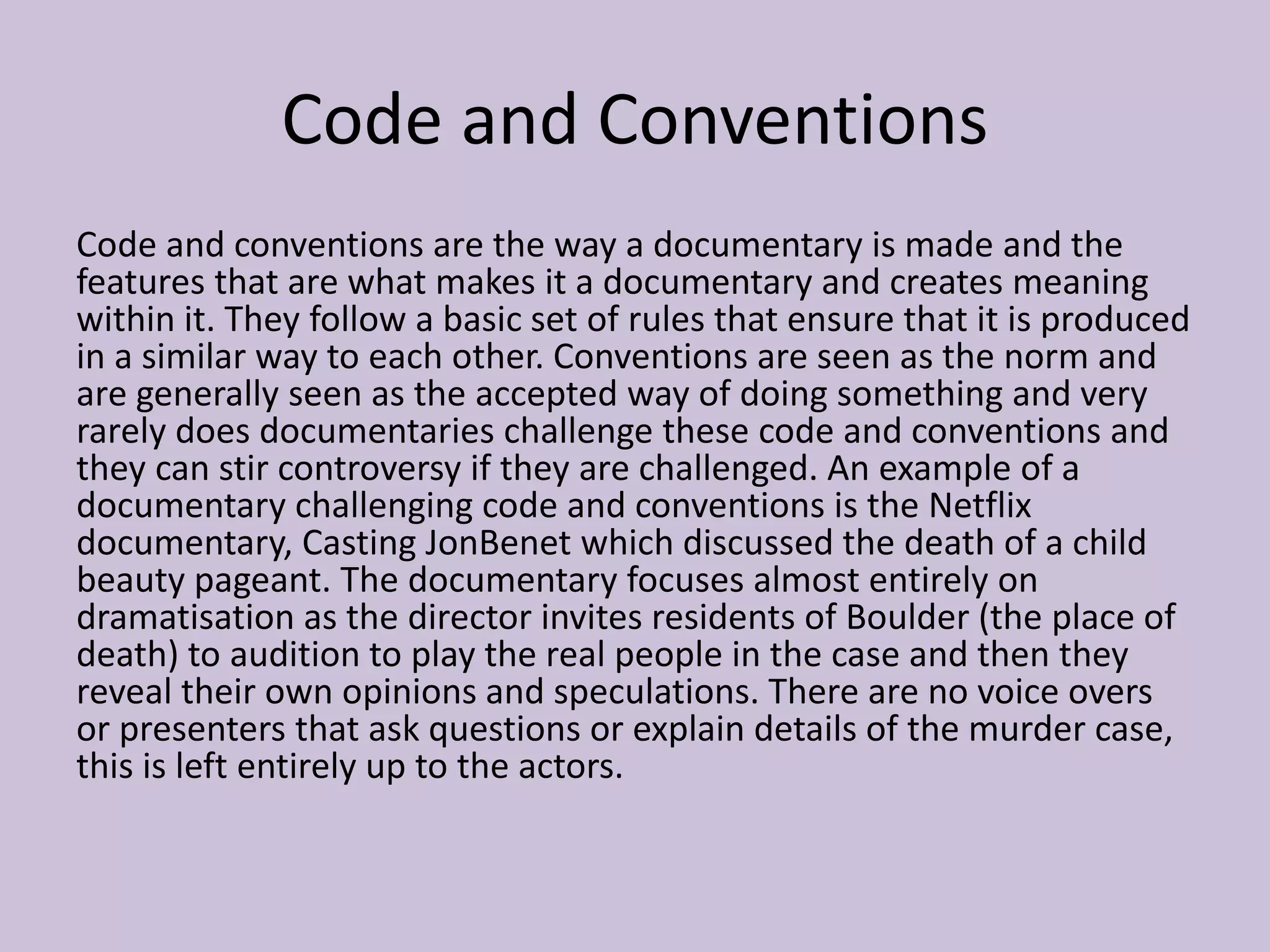
• Presenter: can be shown off screen or on
screen. If they are off screen, they are
generally portrayed in a voice over (e.g. in
‘Queer Britain’ , the presenter was on
screen most of the time and also used his
own personal opinions)
• Interview: these provide trustworthy
information and involve relevant people or
experts to the topic (e.g. in ‘Our World’, a
psychiatrist was portrayed in an office with
many books and dressed in a smart suit to
show he was an expert in brain study)
• Facts/ statistics: these further back
up a claim and can be portrayed
from the presenter as facts or
graphs or on screen. They are
normally sourced. (e.g. In both
‘Queer Britain’ and ‘Our World’,
these facts were said in an voice
over but can be displayed with
graphics)
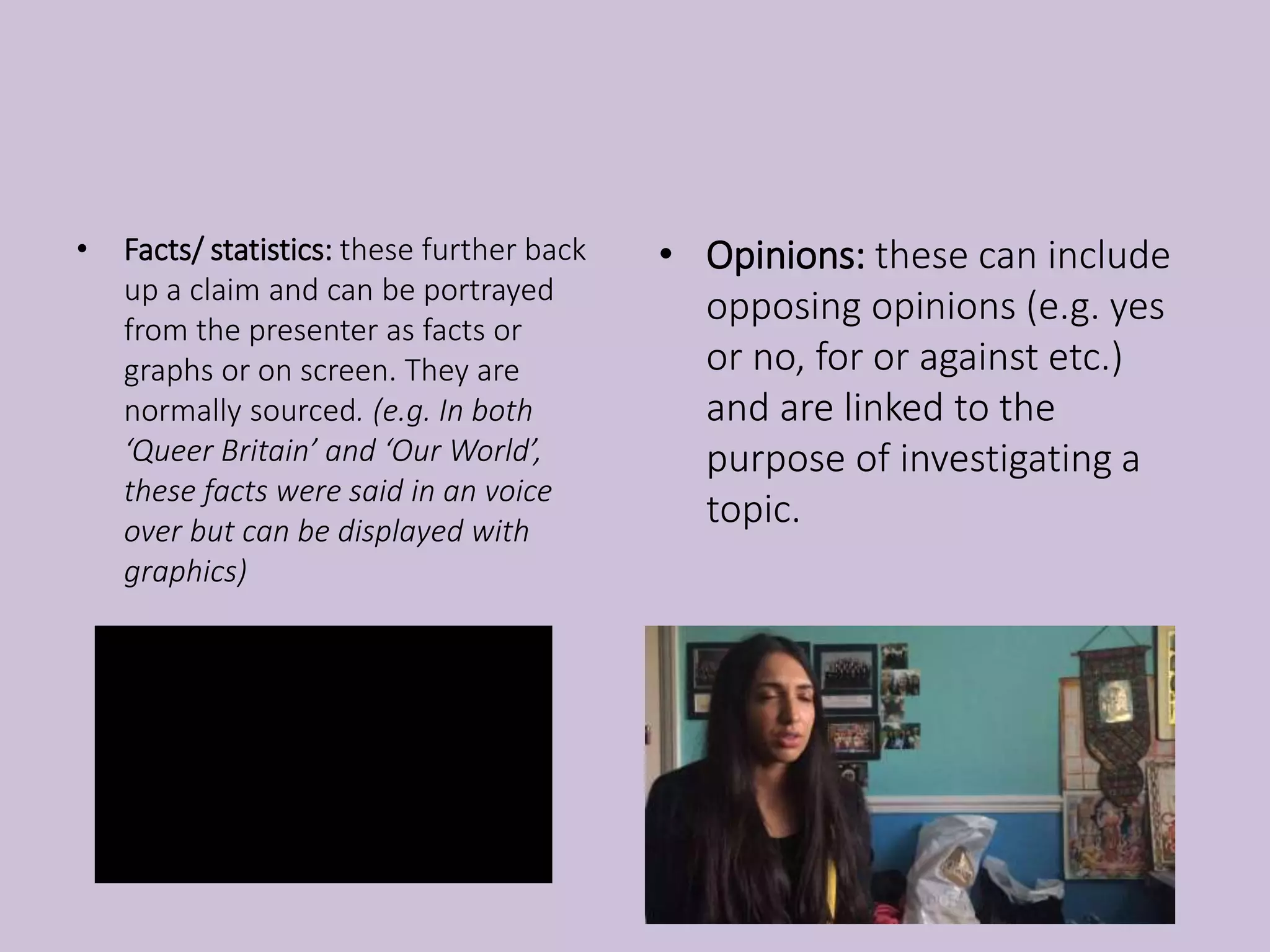
• Opinions: these can include
opposing opinions (e.g. yes
or no, for or against etc.)
and are linked to the
purpose of investigating a
topic.
• Music: this is used to evoke
atmosphere within footage and
can depict how an audience is
meant to feel. (e.g. in ‘Our World’,
sad music was used to evoke
sympathy from the audience)
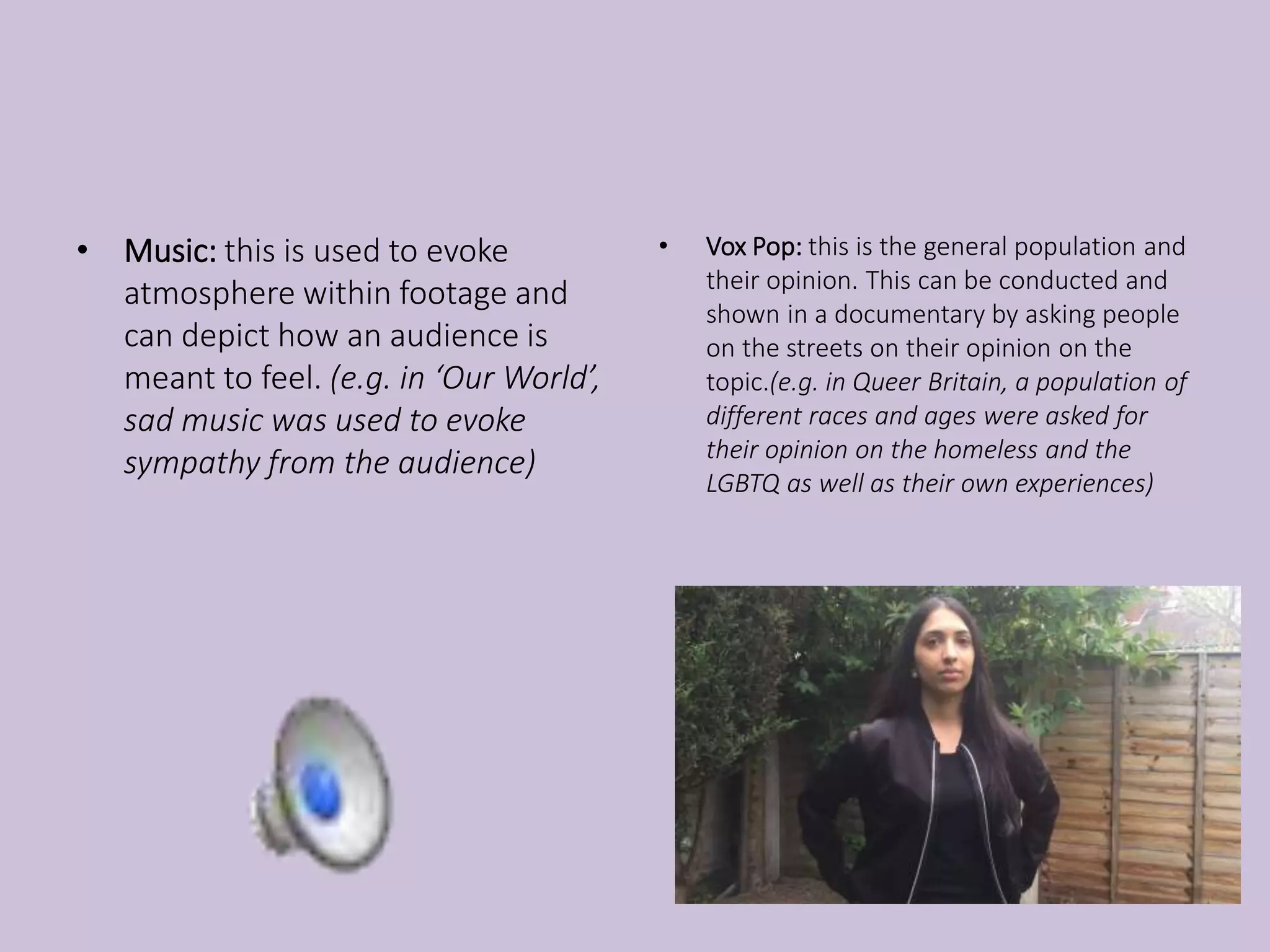
• Vox Pop: this is the general population and
their opinion. This can be conducted and
shown in a documentary by asking people
on the streets on their opinion on the
topic.(e.g. in Queer Britain, a population of
different races and ages were asked for
their opinion on the homeless and the
LGBTQ as well as their own experiences)
• Graphics/ special effects: These
are used on screen to show the
experts name or to provide extra
information that is relevant.
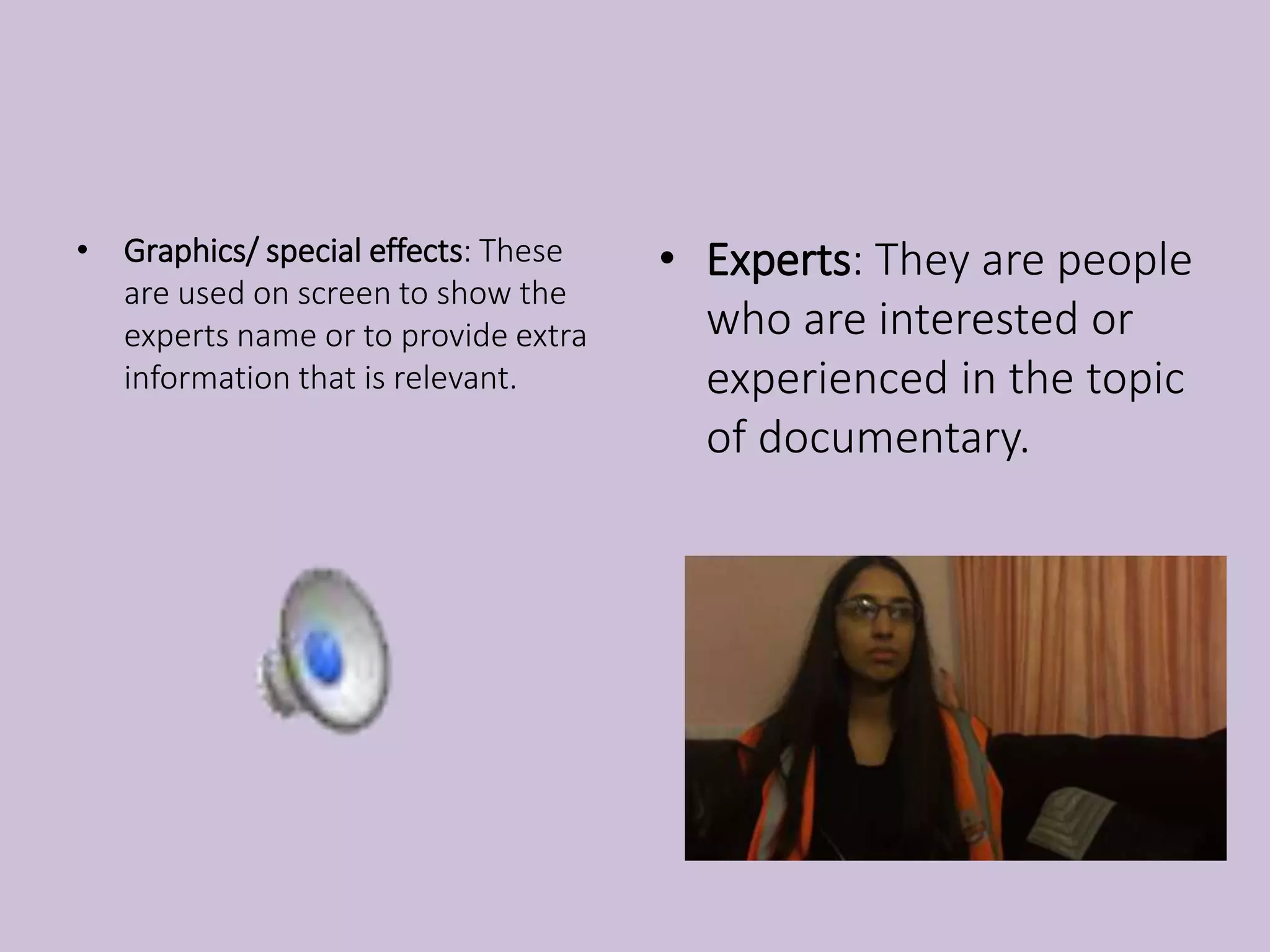
• Experts: They are people
who are interested or
experienced in the topic
of documentary.
CODE AND CONVENTIONS continued…
• Archival Footage: this is footage that is
old and shows historical events or
adds detail without the need for
additional filming (e.g. In ‘Our World’,
old footage of the children harming
themselves were shown)
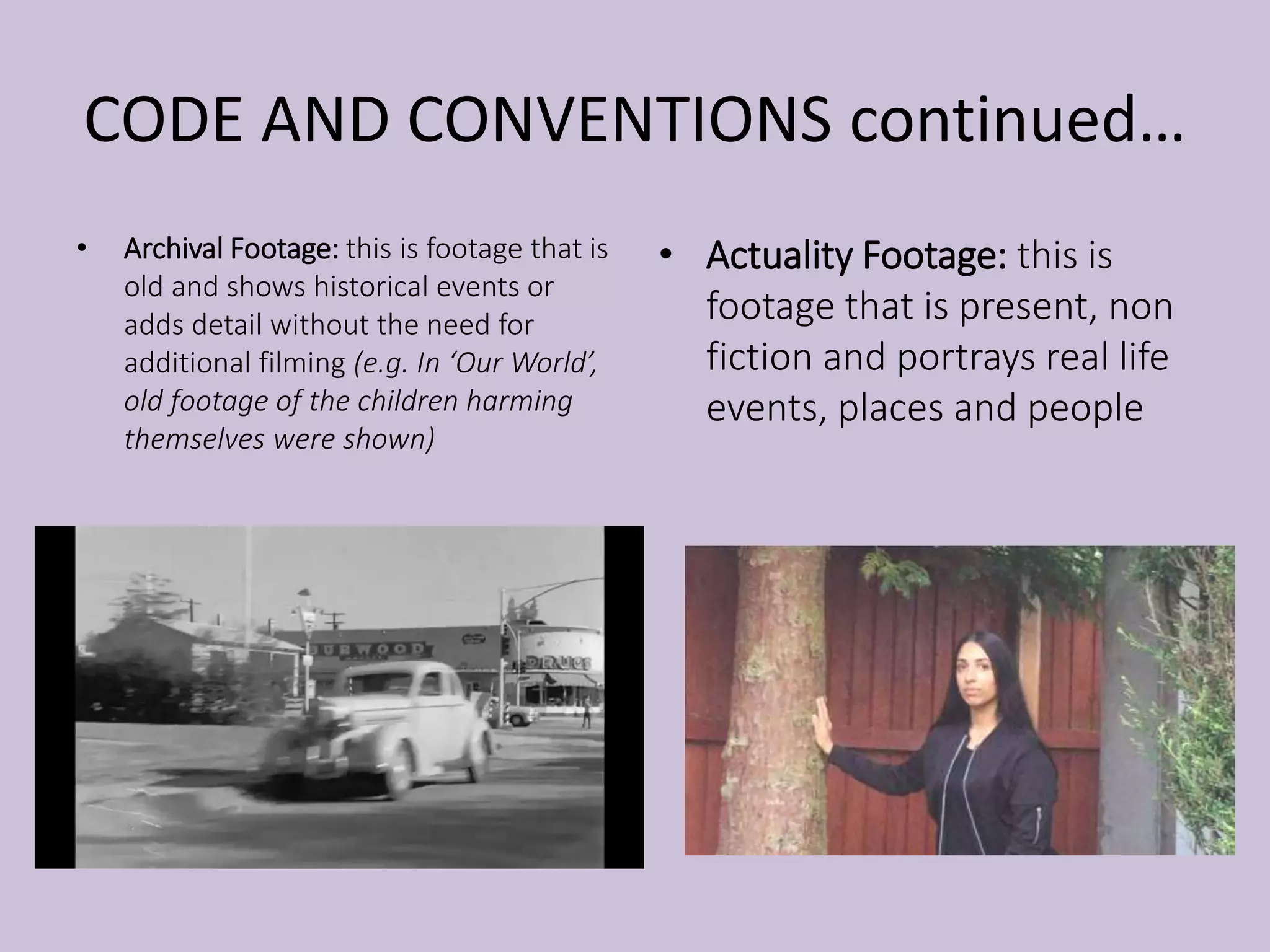
• Actuality Footage: this is
footage that is present, non
fiction and portrays real life
events, places and people
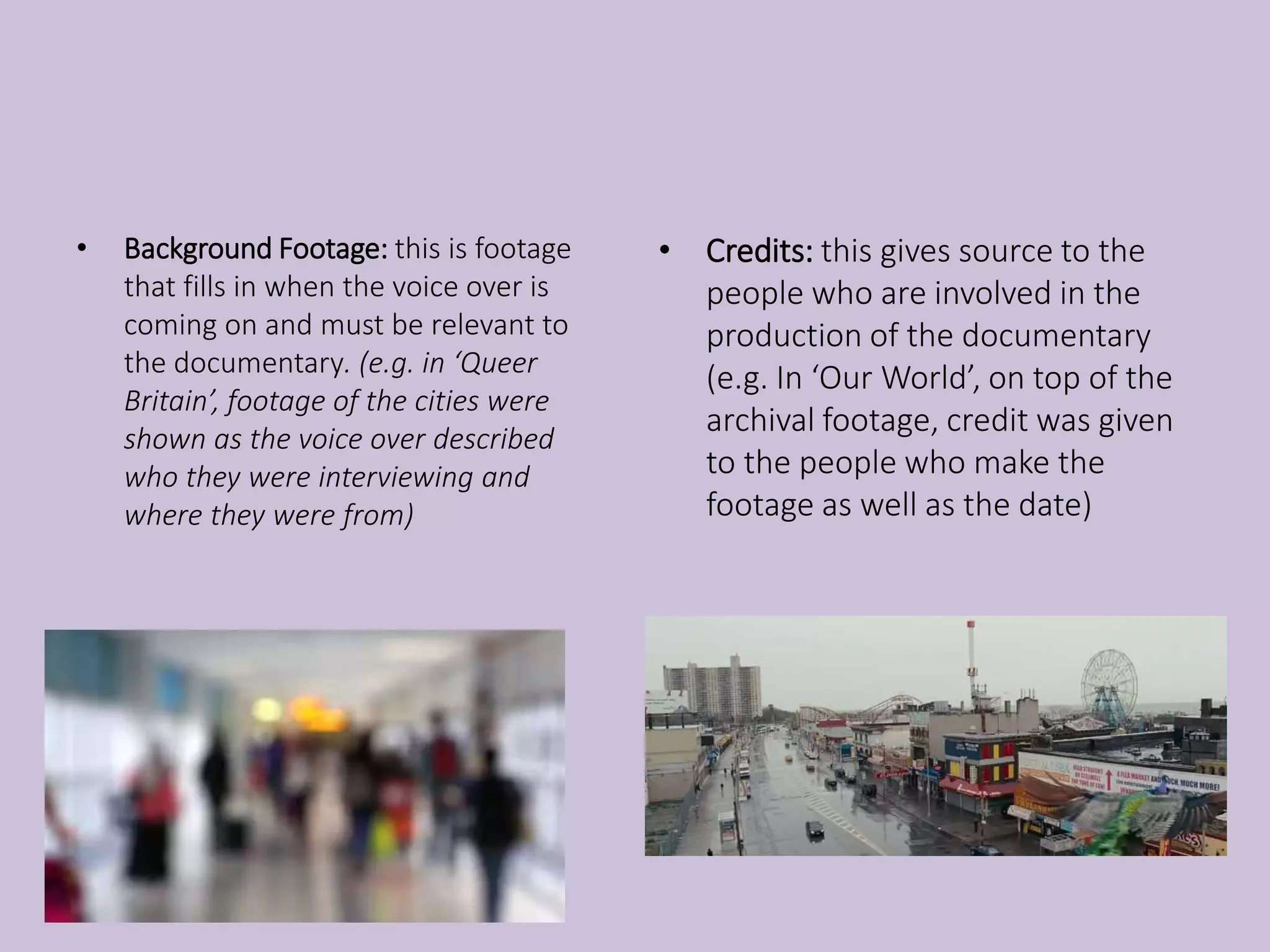
• Background Footage: this is footage
that fills in when the voice over is
coming on and must be relevant to
the documentary. (e.g. in ‘Queer
Britain’, footage of the cities were
shown as the voice over described
who they were interviewing and
where they were from)
• Credits: this gives source to the
people who are involved in the
production of the documentary
(e.g. In ‘Our World’, on top of the
archival footage, credit was given
to the people who make the
footage as well as the date)
• Title sequence: this happens at the
beginning of the documentary to
draw in the audience and give a
general idea of the purpose of the
documentary. A short intro normally
comes before the title.
• Mise-en-scene: this is taken into
consideration and this may include
setting/location, clothing, behaviour of
people etc. This involves everything that is
in the frame. This contributes to how the
audience intakes the footage and decides
how credible it can be. (e.g. in ‘Our World’,
the doctor was speaking in a hospital with
a white doctors coat and a stethoscope to
portray his career and professionalism)
• Observation: The action or process of closely
observing or monitoring something or
someone.
• Dramatization: This is a reconstruction of an
event/story that is acted out in a dramatic way
• Exposition: this is the portion of the story that
introduces important background information
to the audience
We will be using these conventions in our documentary:
• Onscreen and off screen presenter: An onscreen presenter will maintain interest and establish a
personal relationship with the audience. At times, an off screen presenter will also be used to
input extra information without having to cut to the onscreen presenter which would disorientate
the audience and the flow of the documentary.
• Interview: There will be 2 interviews which will include the experts where they will be discussing
the topic in depth.
• Facts and statistics: This will be added because they clarify why this issue is being discussed and
also back up opinions.
• Opinions: They are going to be used to back up the issue being discussed but also may be used for
opposing arguments.
• Music: this will be used to create the mood within the documentary and also makes it entertaining
• Vox Pop: This will be added to provoke the publics opinion making our documentary more valid
• Actuality footage: This will be added to include footage that has the presenter in it
• Background footage: This will be used to establish certain locations.
• Archival footage: This will be used to create some kind of realism into our documentary
• Credits: This will be used to give acknowledgement to the documentary makers.
• Title sequence: This will be used to capture the audiences attention. It will establish the purpose of
the documentary and what it’s going to be about.
• Mise-en-scene: this will be used to create verisimilitude and it will relate to the topic of the
documentary.
• Graphics/ special effects: these will be used to show captions when someone is doing an interview.
• Experts: they will be used to offer their facts and also opinions making the documentary more
plausible.
• Dramatisation: They will be used to show the audience an example of the topic to perhaps make
them feel more emotive and able to understand it a bit more.

C and c of doc

  • 1.
  • 2.
    Code and Conventions Codeand conventions are the way a documentary is made and the features that are what makes it a documentary and creates meaning within it. They follow a basic set of rules that ensure that it is produced in a similar way to each other. Conventions are seen as the norm and are generally seen as the accepted way of doing something and very rarely does documentaries challenge these code and conventions and they can stir controversy if they are challenged. An example of a documentary challenging code and conventions is the Netflix documentary, Casting JonBenet which discussed the death of a child beauty pageant. The documentary focuses almost entirely on dramatisation as the director invites residents of Boulder (the place of death) to audition to play the real people in the case and then they reveal their own opinions and speculations. There are no voice overs or presenters that ask questions or explain details of the murder case, this is left entirely up to the actors.
  • 3.
    CODES AND CONVENTIONS •Presenter: can be shown off screen or on screen. If they are off screen, they are generally portrayed in a voice over (e.g. in ‘Queer Britain’ , the presenter was on screen most of the time and also used his own personal opinions) • Interview: these provide trustworthy information and involve relevant people or experts to the topic (e.g. in ‘Our World’, a psychiatrist was portrayed in an office with many books and dressed in a smart suit to show he was an expert in brain study)
  • 4.
    • Facts/ statistics:these further back up a claim and can be portrayed from the presenter as facts or graphs or on screen. They are normally sourced. (e.g. In both ‘Queer Britain’ and ‘Our World’, these facts were said in an voice over but can be displayed with graphics) • Opinions: these can include opposing opinions (e.g. yes or no, for or against etc.) and are linked to the purpose of investigating a topic.
  • 5.
    • Music: thisis used to evoke atmosphere within footage and can depict how an audience is meant to feel. (e.g. in ‘Our World’, sad music was used to evoke sympathy from the audience) • Vox Pop: this is the general population and their opinion. This can be conducted and shown in a documentary by asking people on the streets on their opinion on the topic.(e.g. in Queer Britain, a population of different races and ages were asked for their opinion on the homeless and the LGBTQ as well as their own experiences)
  • 6.
    • Graphics/ specialeffects: These are used on screen to show the experts name or to provide extra information that is relevant. • Experts: They are people who are interested or experienced in the topic of documentary.
  • 7.
    CODE AND CONVENTIONScontinued… • Archival Footage: this is footage that is old and shows historical events or adds detail without the need for additional filming (e.g. In ‘Our World’, old footage of the children harming themselves were shown) • Actuality Footage: this is footage that is present, non fiction and portrays real life events, places and people
  • 8.
    • Background Footage:this is footage that fills in when the voice over is coming on and must be relevant to the documentary. (e.g. in ‘Queer Britain’, footage of the cities were shown as the voice over described who they were interviewing and where they were from) • Credits: this gives source to the people who are involved in the production of the documentary (e.g. In ‘Our World’, on top of the archival footage, credit was given to the people who make the footage as well as the date)
  • 9.
    • Title sequence:this happens at the beginning of the documentary to draw in the audience and give a general idea of the purpose of the documentary. A short intro normally comes before the title. • Mise-en-scene: this is taken into consideration and this may include setting/location, clothing, behaviour of people etc. This involves everything that is in the frame. This contributes to how the audience intakes the footage and decides how credible it can be. (e.g. in ‘Our World’, the doctor was speaking in a hospital with a white doctors coat and a stethoscope to portray his career and professionalism)
  • 10.
    • Observation: Theaction or process of closely observing or monitoring something or someone. • Dramatization: This is a reconstruction of an event/story that is acted out in a dramatic way • Exposition: this is the portion of the story that introduces important background information to the audience
  • 11.
    We will beusing these conventions in our documentary: • Onscreen and off screen presenter: An onscreen presenter will maintain interest and establish a personal relationship with the audience. At times, an off screen presenter will also be used to input extra information without having to cut to the onscreen presenter which would disorientate the audience and the flow of the documentary. • Interview: There will be 2 interviews which will include the experts where they will be discussing the topic in depth. • Facts and statistics: This will be added because they clarify why this issue is being discussed and also back up opinions. • Opinions: They are going to be used to back up the issue being discussed but also may be used for opposing arguments. • Music: this will be used to create the mood within the documentary and also makes it entertaining • Vox Pop: This will be added to provoke the publics opinion making our documentary more valid • Actuality footage: This will be added to include footage that has the presenter in it • Background footage: This will be used to establish certain locations. • Archival footage: This will be used to create some kind of realism into our documentary • Credits: This will be used to give acknowledgement to the documentary makers. • Title sequence: This will be used to capture the audiences attention. It will establish the purpose of the documentary and what it’s going to be about. • Mise-en-scene: this will be used to create verisimilitude and it will relate to the topic of the documentary. • Graphics/ special effects: these will be used to show captions when someone is doing an interview. • Experts: they will be used to offer their facts and also opinions making the documentary more plausible. • Dramatisation: They will be used to show the audience an example of the topic to perhaps make them feel more emotive and able to understand it a bit more.