Codes and
conventions Of
a documentary
By Ali Cornwall
Convention
Conventions are a generally accepted
way of doing something e.g upbeat
enigmatic music in a horror movie
Codes
2 Types of codes: Technical & symbolic
Technical – Equipment used to tell the story
in a media text e.g camera work in a film
Symbolic – The underlying meaning of what
we see e.g mise-en-scene of red carpet to
insinuate blood
Voice over
 A voice over is usually on top of the
footage to help with the narrative. It
can sometimes be seen as a voice of
God and effectively be unethical as is
can lead to subjectivity of the
audiences’ thoughts. All documentaries
use this convention to link scenes.
Documentation of truth
 The main purpose of a documentary is to
document the truth. People relay on a
documentary to educate them on the
truth of a subject and allow the
audience to make an opinion based
on the footage.
Interviews
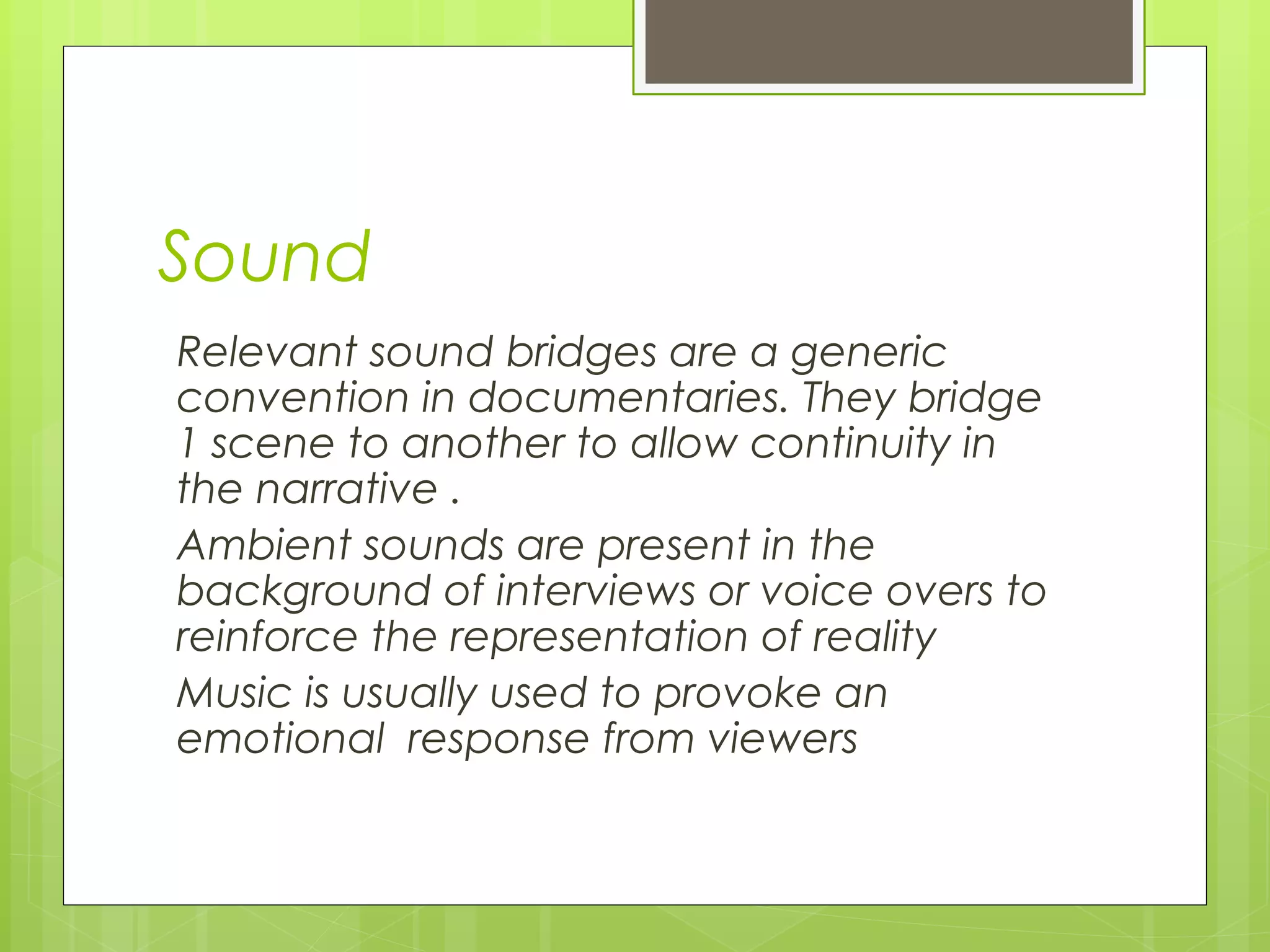
Interviews are a common convention in a documentary. The
interviewee is usually shot using the rule of thirds and close up
shots. The person in shot is generally on the left or right side of the
screen and is not moving. Chromakey is normally used, or a
background with relevance to the subject of the documentary of
relevant to the interviewee is situated behind them. The
interviewee are suppose to be looking at the interviewer and not
the camera.
Sound
Relevant sound bridges are a generic
convention in documentaries. They bridge
1 scene to another to allow continuity in
the narrative .
Ambient sounds are present in the
background of interviews or voice overs to
reinforce the representation of reality
Music is usually used to provoke an
emotional response from viewers
Editing
 Selective editing is something all documentary
makers use no matter what mode. However this is
arguably sparks ethical and political debates. It
potentially emphasise the impression of subjectivity
leading to an untruthful unethical documentary.
 Establishing shots are commonly used to set the
scene of the documentary.
 Handheld cams are used to simulate the impression
of reality and truthfulness.
 Intercutting/parallel editing is used normally in
interviews to give examples of what they are
talking about or to cut away to archive footage.
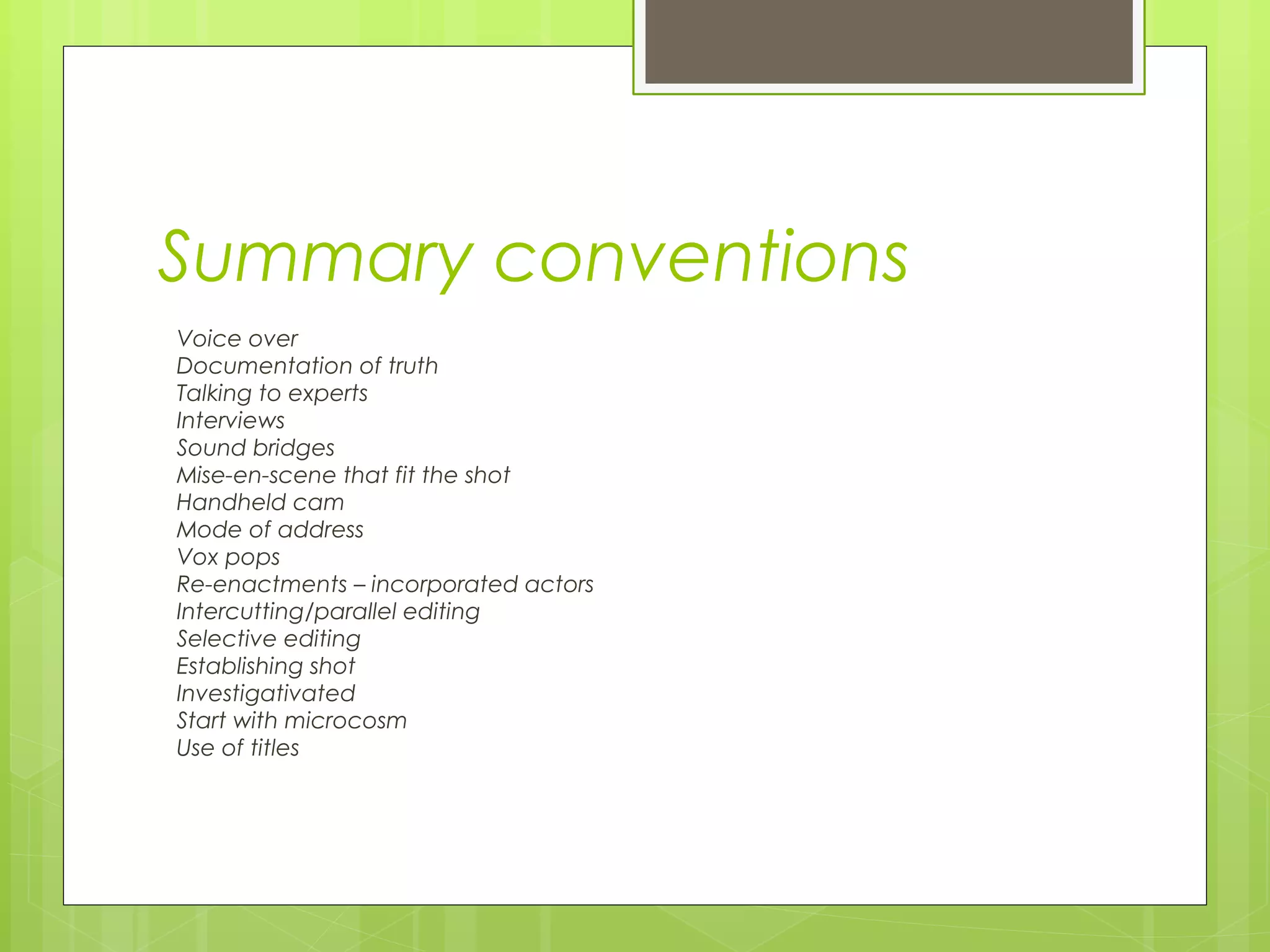
Summary conventions
Voice over
Documentation of truth
Talking to experts
Interviews
Sound bridges
Mise-en-scene that fit the shot
Handheld cam
Mode of address
Vox pops
Re-enactments – incorporated actors
Intercutting/parallel editing
Selective editing
Establishing shot
Investigativated
Start with microcosm
Use of titles
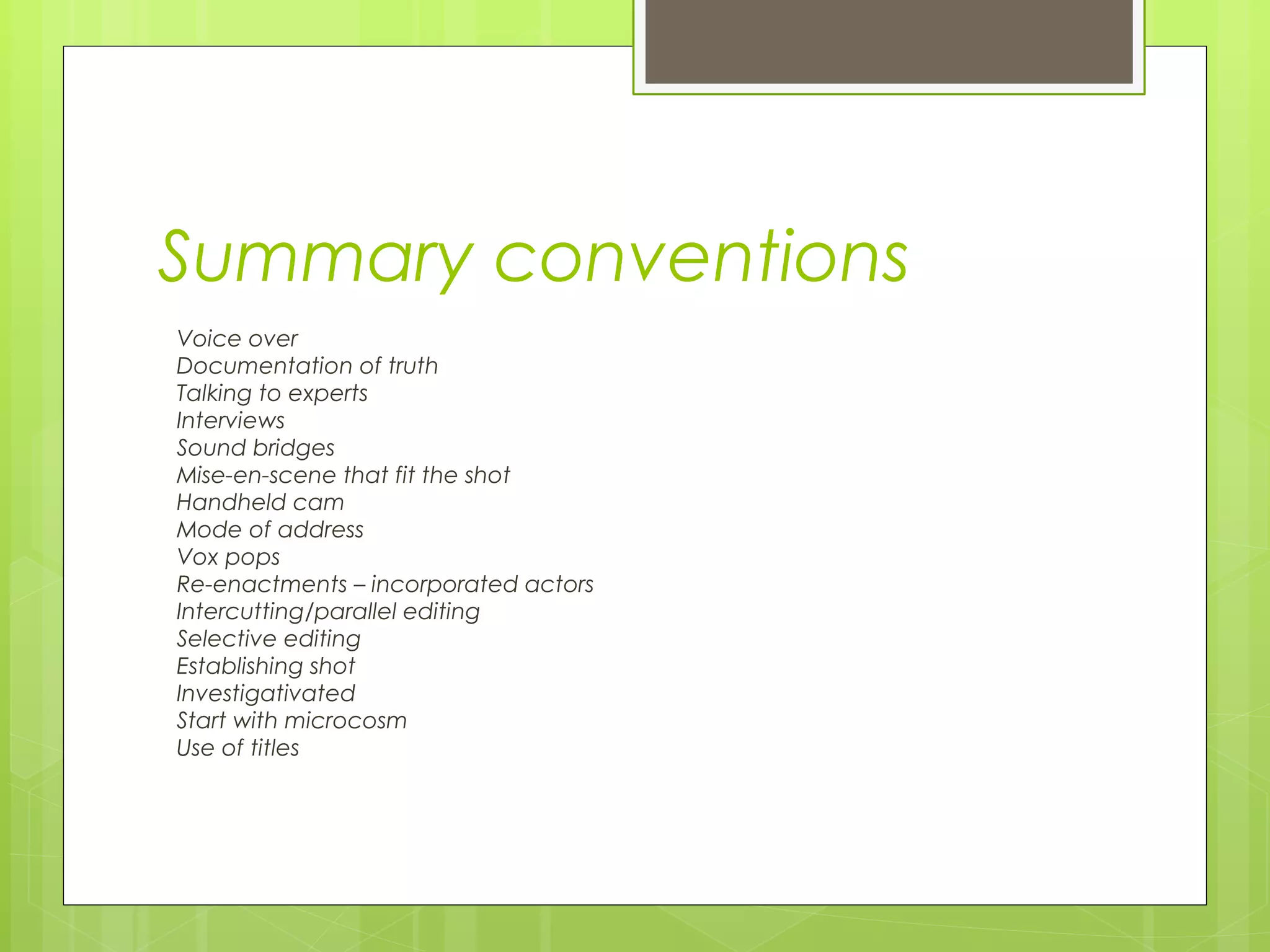
Summary conventions
Voice over
Documentation of truth
Talking to experts
Interviews
Sound bridges
Mise-en-scene that fit the shot
Handheld cam
Mode of address
Vox pops
Re-enactments – incorporated actors
Intercutting/parallel editing
Selective editing
Establishing shot
Investigativated
Start with microcosm
Use of titles

Codes and conventions of a documentary

  • 1.
    Codes and conventions Of adocumentary By Ali Cornwall
  • 2.
    Convention Conventions are agenerally accepted way of doing something e.g upbeat enigmatic music in a horror movie
  • 3.
    Codes 2 Types ofcodes: Technical & symbolic Technical – Equipment used to tell the story in a media text e.g camera work in a film Symbolic – The underlying meaning of what we see e.g mise-en-scene of red carpet to insinuate blood
  • 4.
    Voice over  Avoice over is usually on top of the footage to help with the narrative. It can sometimes be seen as a voice of God and effectively be unethical as is can lead to subjectivity of the audiences’ thoughts. All documentaries use this convention to link scenes.
  • 5.
    Documentation of truth The main purpose of a documentary is to document the truth. People relay on a documentary to educate them on the truth of a subject and allow the audience to make an opinion based on the footage.
  • 6.
    Interviews Interviews are acommon convention in a documentary. The interviewee is usually shot using the rule of thirds and close up shots. The person in shot is generally on the left or right side of the screen and is not moving. Chromakey is normally used, or a background with relevance to the subject of the documentary of relevant to the interviewee is situated behind them. The interviewee are suppose to be looking at the interviewer and not the camera.
  • 7.
    Sound Relevant sound bridgesare a generic convention in documentaries. They bridge 1 scene to another to allow continuity in the narrative . Ambient sounds are present in the background of interviews or voice overs to reinforce the representation of reality Music is usually used to provoke an emotional response from viewers
  • 8.
    Editing  Selective editingis something all documentary makers use no matter what mode. However this is arguably sparks ethical and political debates. It potentially emphasise the impression of subjectivity leading to an untruthful unethical documentary.  Establishing shots are commonly used to set the scene of the documentary.  Handheld cams are used to simulate the impression of reality and truthfulness.  Intercutting/parallel editing is used normally in interviews to give examples of what they are talking about or to cut away to archive footage.
  • 9.
    Summary conventions Voice over Documentationof truth Talking to experts Interviews Sound bridges Mise-en-scene that fit the shot Handheld cam Mode of address Vox pops Re-enactments – incorporated actors Intercutting/parallel editing Selective editing Establishing shot Investigativated Start with microcosm Use of titles
  • 10.
    Summary conventions Voice over Documentationof truth Talking to experts Interviews Sound bridges Mise-en-scene that fit the shot Handheld cam Mode of address Vox pops Re-enactments – incorporated actors Intercutting/parallel editing Selective editing Establishing shot Investigativated Start with microcosm Use of titles