Ethnographic Encounters Project: Using
the Residence Abroad to Explore Other
Societies and Cultures
The Student Perspective on Ethnographic Research
Dr Lisa Bernasek
Sarah Beeken
Claire St John Eve
Background to project
Most modern languages degrees include a Residence
Abroad component, one of the key aims of which is to
help students acquire a greater understanding of a new
language and culture and to develop research skills.
While the acquisition of linguistic competences has
been well-documented, the academic dimension of
the year abroad is less researched. This project
seeks to innovate in developing the academic
disciplinary content of the curriculum. It will support
the Digital Literacy Agenda by enabling students to
explore and experiment with the dynamics of
interculturality and to develop new creative
forms of ethnographic encounters.
What we did
February 2014 – July 2014
• Ten students chosen from written applications
• Ethnographic methods training sessions
– Project overview and initial feedback on ethnographic projects
– Doing Ethnography Q&A session
– Ethnographic methods session (in LANG 2005)
– Participant Observation activity and discussion
– Individual discussions of ethnographic projects
• Students advised on archiving of research materials
• Digital literacy skills assessment and training session
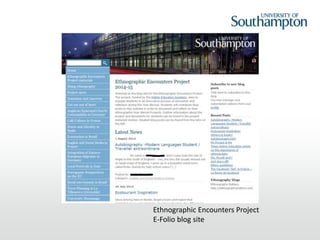
• E-Folio Ethnographic Encounters blog site established
Ethnographic Encounters Project
E-Folio blog site
What we did
August 2014 – October 2015
• Students wrote reflective blog posts during Year Abroad
• Feedback provided through comments, over email
• Students gathered research materials for their projects,
future public archive
• Ethnographic Encounters website established with key
resources for students and staff:
http://www.southampton.ac.uk/ethnographicencounters
5

EEP Overview

  • 1.
    Ethnographic Encounters Project:Using the Residence Abroad to Explore Other Societies and Cultures The Student Perspective on Ethnographic Research Dr Lisa Bernasek Sarah Beeken Claire St John Eve
  • 2.
    Background to project Mostmodern languages degrees include a Residence Abroad component, one of the key aims of which is to help students acquire a greater understanding of a new language and culture and to develop research skills. While the acquisition of linguistic competences has been well-documented, the academic dimension of the year abroad is less researched. This project seeks to innovate in developing the academic disciplinary content of the curriculum. It will support the Digital Literacy Agenda by enabling students to explore and experiment with the dynamics of interculturality and to develop new creative forms of ethnographic encounters.
  • 3.
    What we did February2014 – July 2014 • Ten students chosen from written applications • Ethnographic methods training sessions – Project overview and initial feedback on ethnographic projects – Doing Ethnography Q&A session – Ethnographic methods session (in LANG 2005) – Participant Observation activity and discussion – Individual discussions of ethnographic projects • Students advised on archiving of research materials • Digital literacy skills assessment and training session • E-Folio Ethnographic Encounters blog site established
  • 4.
  • 5.
    What we did August2014 – October 2015 • Students wrote reflective blog posts during Year Abroad • Feedback provided through comments, over email • Students gathered research materials for their projects, future public archive • Ethnographic Encounters website established with key resources for students and staff: http://www.southampton.ac.uk/ethnographicencounters 5

Editor's Notes

  • #4 Reflexive and critical learning process; cultural and language biography Writing and Archiving ‘I as a researcher’
  • #5 Keep this?