ACTIVE CITIZENSHIP
Erasmus + KA2
S.I.S.
DIMITRIOS VAGIANIS
MARINA PANAGIOTOPOULOU
5th Senior High School of Ilion, Greece
24-28 April 2017
Giving people a voice
Active citizenship dates back to Athenian democracy where
citizens had direct participation in society and governance.
The word citizen incorporates the meaning of active. Those
who did not participate in society or attempt to influence the
decisions taken on their behalf were looked down upon.
Indeed, the Greek Constitution’s last article states that the
defense of democracy is in the hands of its people.
“If we participate in society then the public becomes ours”
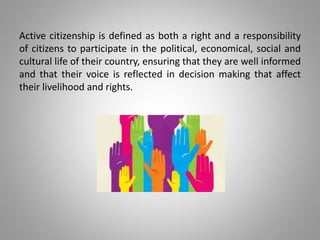
Active citizenship is defined as both a right and a responsibility
of citizens to participate in the political, economical, social and
cultural life of their country, ensuring that they are well informed
and that their voice is reflected in decision making that affect
their livelihood and rights.
Get up and get active!
A catalogue of the activities that could qualify as
active citizenship would be wide-ranging and
extensive, and together they build a healthy,
participative democracy.
They cover voting and standing for election,
teaching and learning, donating to good causes,
recycling and caring for the environment,
campaigning and volunteering.
We can identify some key characteristics of Active Citizenship:
• Participation in the community (involvement in a voluntary
activity or engaging with local government agencies)
• People are empowered to play a part in the decisions and
processes that affect them, particularly public policy and
services
• Knowledge and understanding of the political/social/economic
context of their participation so that they can make informed
decisions
• Able to challenge policies or actions and existing structures on
the basis of principles such as equality, inclusiveness, diversity
and social justice.
Council of Europe, Education for Democratic Citizenship, Dec 2004.
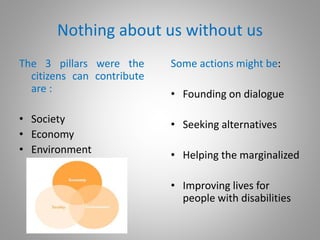
Nothing about us without us
The 3 pillars were the
citizens can contribute
are :
• Society
• Economy
• Environment
Some actions might be:
• Founding on dialogue
• Seeking alternatives
• Helping the marginalized
• Improving lives for
people with disabilities
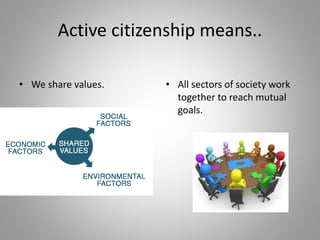
Active citizenship means..
• We share values. • All sectors of society work
together to reach mutual
goals.
Active citizenship means people getting involved in their
local communities and democracy at all levels, from towns
to cities to nationwide activity. Active citizenship can be as
small as a campaign to clean up your street or as big as
educating young people about democratic values, skills and
participation.
Also, educational program’s need to be developed to
improve competencies like co-operation and
communication as well working to increase critical ability,
reduce prejudice and build tolerance, understanding,
empathy, and an openness to diversity.
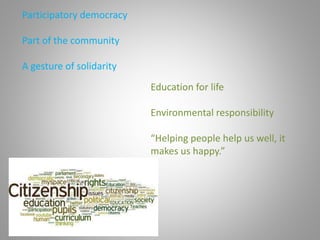
Education for life
Environmental responsibility
“Helping people help us well, it
makes us happy.”
Participatory democracy
Part of the community
A gesture of solidarity
Bibliography
• https://sheffrock.wordpress.com/2016/03/09/civic-and-citizenship-teach-by-
example-learn-through-participation/
• http://jcimarina.com/news/council-of-europe-definition-of-active-citizenshi
• http://ccinjax.blogspot.gr/2012/03/active-citizens-create-sustainable.html
• http://european-intercultural-forum.org/?page_id=65
• http://jcisingapore.cc/blog/2013/04/14/council-of-europe-definition-of-active-
citizenship/
• https://www.opensocietyfoundations.org/voices/active-citizenship-can-change-
your-country-better
• http://www.eesc.europa.eu/resources/docs/eesc-2011-35-en.pdf
• https://computingforsustainability.files.wordpress.com/2009/03/3weak.jpg
• https://www.hsj.co.uk/Pictures/web/f/q/o/hands_up_learning_education_trainin
_384.jpg
• https://computingforsustainability.files.wordpress.com/2009/03/asc_diagram.gif?
w=594
Thank you for the attendance

Final presentasion active citizenship 27 04-2017

  • 1.
    ACTIVE CITIZENSHIP Erasmus +KA2 S.I.S. DIMITRIOS VAGIANIS MARINA PANAGIOTOPOULOU 5th Senior High School of Ilion, Greece 24-28 April 2017
  • 2.
    Giving people avoice Active citizenship dates back to Athenian democracy where citizens had direct participation in society and governance. The word citizen incorporates the meaning of active. Those who did not participate in society or attempt to influence the decisions taken on their behalf were looked down upon. Indeed, the Greek Constitution’s last article states that the defense of democracy is in the hands of its people. “If we participate in society then the public becomes ours”
  • 3.
    Active citizenship isdefined as both a right and a responsibility of citizens to participate in the political, economical, social and cultural life of their country, ensuring that they are well informed and that their voice is reflected in decision making that affect their livelihood and rights.
  • 4.
    Get up andget active! A catalogue of the activities that could qualify as active citizenship would be wide-ranging and extensive, and together they build a healthy, participative democracy. They cover voting and standing for election, teaching and learning, donating to good causes, recycling and caring for the environment, campaigning and volunteering.
  • 5.
    We can identifysome key characteristics of Active Citizenship: • Participation in the community (involvement in a voluntary activity or engaging with local government agencies) • People are empowered to play a part in the decisions and processes that affect them, particularly public policy and services • Knowledge and understanding of the political/social/economic context of their participation so that they can make informed decisions • Able to challenge policies or actions and existing structures on the basis of principles such as equality, inclusiveness, diversity and social justice. Council of Europe, Education for Democratic Citizenship, Dec 2004.
  • 6.
    Nothing about uswithout us The 3 pillars were the citizens can contribute are : • Society • Economy • Environment Some actions might be: • Founding on dialogue • Seeking alternatives • Helping the marginalized • Improving lives for people with disabilities
  • 7.
    Active citizenship means.. •We share values. • All sectors of society work together to reach mutual goals.
  • 8.
    Active citizenship meanspeople getting involved in their local communities and democracy at all levels, from towns to cities to nationwide activity. Active citizenship can be as small as a campaign to clean up your street or as big as educating young people about democratic values, skills and participation. Also, educational program’s need to be developed to improve competencies like co-operation and communication as well working to increase critical ability, reduce prejudice and build tolerance, understanding, empathy, and an openness to diversity.
  • 9.
    Education for life Environmentalresponsibility “Helping people help us well, it makes us happy.” Participatory democracy Part of the community A gesture of solidarity
  • 10.
    Bibliography • https://sheffrock.wordpress.com/2016/03/09/civic-and-citizenship-teach-by- example-learn-through-participation/ • http://jcimarina.com/news/council-of-europe-definition-of-active-citizenshi •http://ccinjax.blogspot.gr/2012/03/active-citizens-create-sustainable.html • http://european-intercultural-forum.org/?page_id=65 • http://jcisingapore.cc/blog/2013/04/14/council-of-europe-definition-of-active- citizenship/ • https://www.opensocietyfoundations.org/voices/active-citizenship-can-change- your-country-better • http://www.eesc.europa.eu/resources/docs/eesc-2011-35-en.pdf • https://computingforsustainability.files.wordpress.com/2009/03/3weak.jpg • https://www.hsj.co.uk/Pictures/web/f/q/o/hands_up_learning_education_trainin _384.jpg • https://computingforsustainability.files.wordpress.com/2009/03/asc_diagram.gif? w=594
  • 11.
    Thank you forthe attendance