Financial Mechanism by GOLD STANDARD
A Presentation By: Harish Sharma
EnvironmentFirst Energy Services (P) Ltd.
Water Benefit Certificates
(AN OPPORTUNITY FOR INDUSTRIAL, RESIDENTIAL, AGRICULTURE, HORTICULTURE, INSTITUTIONAL WATER
EFFICIENT AND WASTE WATER TREATMENT PROJECTS)
Water Benefit Certificates (WBC)
Harish Sharma
EnvironmentFirst Energy Services (P) Ltd.
The Water Benefit Standard is a results-
based finance mechanism to drive funding
for water supply, purification and
conservation projects. These projects help
maintain the water balance within a
watershed, encourage local stakeholder
engagement and consultation, promote
sustainable development, ensure
environmental integrity and prepare
water users to contend with a world of
increasing water scarcity.
Water
Benefit
Standard
Water Benefit Certificate (WBC):
A unit of water outcome (or
benefit) representing that a certain
volume of water has been
sustainably supplied, purified
and/or conserved by a given project
during a specific period of time.
Projects are issued Water Benefit
Certificates (WBCs) according to the
volume of water benefits they
generate per year.
Project Must Address
Water balance Water scarcity
Water
sensitivity
Environmental
integrity
sustainable
development
Eligibility Requirements
Water supply Water purification Water conservation
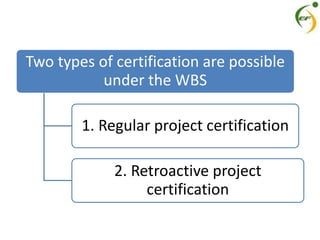
Two types of certification are possible
under the WBS
1. Regular project certification
2. Retroactive project
certification
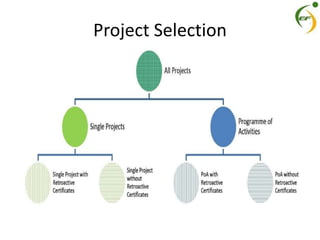
Project Selection
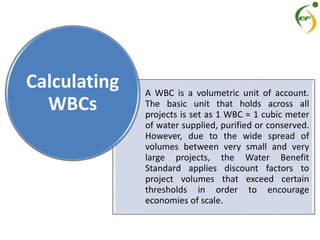
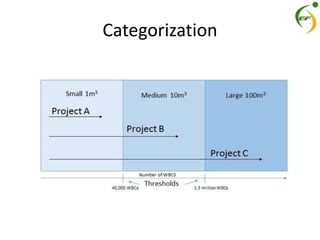
A WBC is a volumetric unit of account.
The basic unit that holds across all
projects is set as 1 WBC = 1 cubic meter
of water supplied, purified or conserved.
However, due to the wide spread of
volumes between very small and very
large projects, the Water Benefit
Standard applies discount factors to
project volumes that exceed certain
thresholds in order to encourage
economies of scale.
Calculating
WBCs
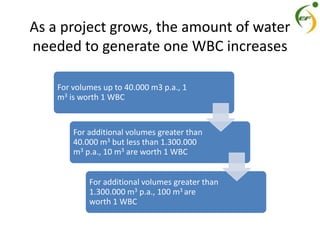
As a project grows, the amount of water
needed to generate one WBC increases
For volumes up to 40.000 m3 p.a., 1
m3 is worth 1 WBC
For additional volumes greater than
40.000 m3 but less than 1.300.000
m3 p.a., 10 m3 are worth 1 WBC
For additional volumes greater than
1.300.000 m3 p.a., 100 m3 are
worth 1 WBC
Categorization
Sustainability
• Sustainability ensures that projects are
designed and implemented in a
sustainable and participatory way. to
assess the risk the projects may pose to
the project's area of influence and to
ensure the projects meet the sustainable
development requirements of the Gold
Standard. Projects shall provide clear
evidence that there are no negative
impacts in set socio-economic and
environmental criteria.
1
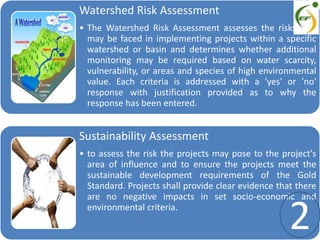
Watershed Risk Assessment
• The Watershed Risk Assessment assesses the risks that
may be faced in implementing projects within a specific
watershed or basin and determines whether additional
monitoring may be required based on water scarcity,
vulnerability, or areas and species of high environmental
value. Each criteria is addressed with a 'yes' or 'no'
response with justification provided as to why the
response has been entered.
Sustainability Assessment
• to assess the risk the projects may pose to the project's
area of influence and to ensure the projects meet the
sustainable development requirements of the Gold
Standard. Projects shall provide clear evidence that there
are no negative impacts in set socio-economic and
environmental criteria.
2
• Each requirement is assessed according to the following
criteria.
• Negative (-): There is a risk that the project will negatively
impact the requirement. Mitigation is required and will be
monitored for the duration of the project.
• Neutral (0): The project will not have any impact on the
requirement. Mitigation is not required.
• Positive (+): The project will positively impact the requirement
and will be monitored for the duration of the project.
• Enhance (E): The indicator is neutral, but can be improved
over the lifetime of the project and become positive. Requires
monitoring for the duration of the project.
• Not Relevant (NR): The requirement is not relevant to the
project methodology and/or design. Mitigation is not
required.
Sustainability
Assessment
3
Human rights and socio-economic
situation
The project respects internationally proclaimed human rights including
Universal access to water, and dignity.
Cultural property and uniqueness of indigenous people.
Legal rights, customary rights, special cultural
ecological, economic, religious or spiritual significance
4
The project don’t have any negative
Impact on
Good Working condition
Food Security
Water Quality
Pollution Level
Ecology
5
Demonstration of
Financial
Additionality
• Projects that issue Water Benefit Certificates via the Water
Benefit Standard must demonstrate that they are beyond
business as usual, meaning that they would not have been
implemented without the Water Benefit Standard. The
project developer proves this by conducting a Financial
Needs Assessment (FNA) as part of the initial certification.
The FNA can be completed in one of two ways:
• Compliance with a positive list of preferred technologies,
methods or geographical regions that permits the project to
per se pass the FNA. Such projects must still disclose a
financial forecast over the project period.
• If a project does not comply with the positive list, a formal
financial analysis must be conducted to demonstrate that
the revenue from WBCs is required to make the project
financially feasible.
6
Real, Measurable and
Verifiable
• First, a baseline methodology estimates the state
of water use in the absence of the project. Then a
monitoring methodology calculates the actual
water benefits directly resulting from the project,
taking into account any water benefits from
sources within the project boundary. By
determining both the baseline and project
scenario, water benefits are objectively verified in
a transparent way. Due to the variety and
complexity of project types and location, there is
likely to be additional criteria that are not
specified in the universal Water Benefit Standard.
7
How is this different from other initiatives?
• The primary difference is the Water Benefit Standard’s focus on
catalysing finance for water projects and making the most of these funds.
While the other initiatives provide methods for measuring a water
footprint or define specific water stewardship actions, the Water Benefit
Standard is designed to make funding flow to critical water projects and
to ensure that every dollar makes the greatest impact.
What type of projects are eligible?
• The Water Benefit Standard is open to any technologies and measures
that address locally defined water issues and create verifiable benefits to
natural and human environments according to an approved
methodology.
Who Audits the Outcome?
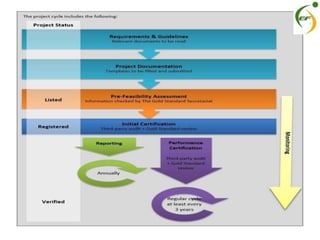
• Pre-Feasibility Assessment (Gold Standard Foundation) After completing the project
documentation, The Gold Standard conducts a desk review assesses whether the project is
likely to comply with its requirements.
• Initial Certification (Independent Auditor) An independent auditor determines whether the
project adheres to the rules of the Standard and is thus eligible to be registered as a Gold
Standard project.
• Performance Certification (Independent Auditor) After each year of monitoring the
registered project, the independent auditor verifies the outcomes. This reviews the water
benefits that occurred over the previous year, and determine the number of WBCs to be
issued.
How Long is project cycle?
• A regular project term is either 10 years or 3x7 years using a flexible baseline approach after
each 7 year period. For projects that are part of a programme of activities (PoA), the project
term is up to 28 years. All outcomes, including sustainable development metrics, are audited
and reported in a transparent public registry each year.
Who is going to buy Water Benefit Certificates?
• Corporates, governments and public institutions, NGOs and concerned
citizens that want to make the greatest impact with every dollar they
invest in water initiatives. Several corporate buyers have already
committed to purchasing Water Benefit Certificates. Like these
companies, corporate buyers will have an interest in good water
stewardship as part of their corporate social responsibility programmes
and/or to preserve the basins that support their supply chains.
How are Water Benefit Certificates priced?
• By 2016, an anticipated 10-15 projects will have Water Benefit Certificates
available for sale covering WASH, water-efficient agriculture, household and
industrial wastewater treatment, irrigation techniques and more. Currently
WBCs have traded in the range of 7-10 US$ per Certificate.
How do Water Benefit Certificates fit into Organization's CSR strategy?
•Corporates are encouraged to responsibly manage and reduce their own water footprint wherever
possible. But recognizing that most organizations cannot reduce to zero, Water Benefit Certificates
are a way to invest in water security. It is important to consider that water is inherently a local
resource, such that a cubic metre of water from a project in Canada is qualitatively vastly different
from a cubic metre of water from a project in the Sahel. Further, water has value on multiple levels,
ranging from economic to social to cultural. Therefore, in order to make purchases of WBCs
credible, it is important that they be used as one component of a larger, comprehensive water
stewardship strategy, and that the desired outcomes from purchasing WBCs are communicated
appropriately and effectively.
How are sustainable development principles measured and managed?
•Unlike many donor/ public funded efforts where sustainable development outcomes are often
unclear or anecdotal, all projects under the Water Benefit Standard must first be evaluated for
sustainable development outcomes and these must then be tracked and measured on an annual
basis. Any negative impacts must be mitigated whilst all neutral and positive impacts are monitored
for project duration. This process involves local stakeholder consultation and is reviewed externally,
and all reports are transparent and publicly available online.
Registered Office:
Abhishek Kumar Mazumdar
405 A, Prakrati Corporate, Y N Road, Indore
(INDIA) 452001 • +91-731-6007860
Chandigarh Office:
Harish Sharma
SCO 48, 2nd Floor, Opposite P.O., Sector-8,
Panchkula (INDIA) 134109 • +91-7696644244
Mumbai Office:
Anand Pandey
A1-1603, Runwal Garden City, Balkum, Thane
(W), Mumbai (INDIA) – 400607 •+91-9699559222
Other Representative Locations
Delhi, Chennai, Ahmadabad and Jaipur
Email ID: info@environmentfirst.in

Water Benefit Standard (WBS)

  • 1.
    Financial Mechanism byGOLD STANDARD A Presentation By: Harish Sharma EnvironmentFirst Energy Services (P) Ltd. Water Benefit Certificates (AN OPPORTUNITY FOR INDUSTRIAL, RESIDENTIAL, AGRICULTURE, HORTICULTURE, INSTITUTIONAL WATER EFFICIENT AND WASTE WATER TREATMENT PROJECTS)
  • 2.
    Water Benefit Certificates(WBC) Harish Sharma EnvironmentFirst Energy Services (P) Ltd.
  • 5.
    The Water BenefitStandard is a results- based finance mechanism to drive funding for water supply, purification and conservation projects. These projects help maintain the water balance within a watershed, encourage local stakeholder engagement and consultation, promote sustainable development, ensure environmental integrity and prepare water users to contend with a world of increasing water scarcity. Water Benefit Standard
  • 6.
    Water Benefit Certificate(WBC): A unit of water outcome (or benefit) representing that a certain volume of water has been sustainably supplied, purified and/or conserved by a given project during a specific period of time. Projects are issued Water Benefit Certificates (WBCs) according to the volume of water benefits they generate per year.
  • 7.
    Project Must Address Waterbalance Water scarcity Water sensitivity Environmental integrity sustainable development Eligibility Requirements Water supply Water purification Water conservation
  • 8.
    Two types ofcertification are possible under the WBS 1. Regular project certification 2. Retroactive project certification
  • 9.
  • 11.
    A WBC isa volumetric unit of account. The basic unit that holds across all projects is set as 1 WBC = 1 cubic meter of water supplied, purified or conserved. However, due to the wide spread of volumes between very small and very large projects, the Water Benefit Standard applies discount factors to project volumes that exceed certain thresholds in order to encourage economies of scale. Calculating WBCs
  • 12.
    As a projectgrows, the amount of water needed to generate one WBC increases For volumes up to 40.000 m3 p.a., 1 m3 is worth 1 WBC For additional volumes greater than 40.000 m3 but less than 1.300.000 m3 p.a., 10 m3 are worth 1 WBC For additional volumes greater than 1.300.000 m3 p.a., 100 m3 are worth 1 WBC
  • 13.
  • 15.
    Sustainability • Sustainability ensuresthat projects are designed and implemented in a sustainable and participatory way. to assess the risk the projects may pose to the project's area of influence and to ensure the projects meet the sustainable development requirements of the Gold Standard. Projects shall provide clear evidence that there are no negative impacts in set socio-economic and environmental criteria. 1
  • 16.
    Watershed Risk Assessment •The Watershed Risk Assessment assesses the risks that may be faced in implementing projects within a specific watershed or basin and determines whether additional monitoring may be required based on water scarcity, vulnerability, or areas and species of high environmental value. Each criteria is addressed with a 'yes' or 'no' response with justification provided as to why the response has been entered. Sustainability Assessment • to assess the risk the projects may pose to the project's area of influence and to ensure the projects meet the sustainable development requirements of the Gold Standard. Projects shall provide clear evidence that there are no negative impacts in set socio-economic and environmental criteria. 2
  • 17.
    • Each requirementis assessed according to the following criteria. • Negative (-): There is a risk that the project will negatively impact the requirement. Mitigation is required and will be monitored for the duration of the project. • Neutral (0): The project will not have any impact on the requirement. Mitigation is not required. • Positive (+): The project will positively impact the requirement and will be monitored for the duration of the project. • Enhance (E): The indicator is neutral, but can be improved over the lifetime of the project and become positive. Requires monitoring for the duration of the project. • Not Relevant (NR): The requirement is not relevant to the project methodology and/or design. Mitigation is not required. Sustainability Assessment 3
  • 18.
    Human rights andsocio-economic situation The project respects internationally proclaimed human rights including Universal access to water, and dignity. Cultural property and uniqueness of indigenous people. Legal rights, customary rights, special cultural ecological, economic, religious or spiritual significance 4
  • 19.
    The project don’thave any negative Impact on Good Working condition Food Security Water Quality Pollution Level Ecology 5
  • 20.
    Demonstration of Financial Additionality • Projectsthat issue Water Benefit Certificates via the Water Benefit Standard must demonstrate that they are beyond business as usual, meaning that they would not have been implemented without the Water Benefit Standard. The project developer proves this by conducting a Financial Needs Assessment (FNA) as part of the initial certification. The FNA can be completed in one of two ways: • Compliance with a positive list of preferred technologies, methods or geographical regions that permits the project to per se pass the FNA. Such projects must still disclose a financial forecast over the project period. • If a project does not comply with the positive list, a formal financial analysis must be conducted to demonstrate that the revenue from WBCs is required to make the project financially feasible. 6
  • 21.
    Real, Measurable and Verifiable •First, a baseline methodology estimates the state of water use in the absence of the project. Then a monitoring methodology calculates the actual water benefits directly resulting from the project, taking into account any water benefits from sources within the project boundary. By determining both the baseline and project scenario, water benefits are objectively verified in a transparent way. Due to the variety and complexity of project types and location, there is likely to be additional criteria that are not specified in the universal Water Benefit Standard. 7
  • 23.
    How is thisdifferent from other initiatives? • The primary difference is the Water Benefit Standard’s focus on catalysing finance for water projects and making the most of these funds. While the other initiatives provide methods for measuring a water footprint or define specific water stewardship actions, the Water Benefit Standard is designed to make funding flow to critical water projects and to ensure that every dollar makes the greatest impact. What type of projects are eligible? • The Water Benefit Standard is open to any technologies and measures that address locally defined water issues and create verifiable benefits to natural and human environments according to an approved methodology.
  • 24.
    Who Audits theOutcome? • Pre-Feasibility Assessment (Gold Standard Foundation) After completing the project documentation, The Gold Standard conducts a desk review assesses whether the project is likely to comply with its requirements. • Initial Certification (Independent Auditor) An independent auditor determines whether the project adheres to the rules of the Standard and is thus eligible to be registered as a Gold Standard project. • Performance Certification (Independent Auditor) After each year of monitoring the registered project, the independent auditor verifies the outcomes. This reviews the water benefits that occurred over the previous year, and determine the number of WBCs to be issued. How Long is project cycle? • A regular project term is either 10 years or 3x7 years using a flexible baseline approach after each 7 year period. For projects that are part of a programme of activities (PoA), the project term is up to 28 years. All outcomes, including sustainable development metrics, are audited and reported in a transparent public registry each year.
  • 25.
    Who is goingto buy Water Benefit Certificates? • Corporates, governments and public institutions, NGOs and concerned citizens that want to make the greatest impact with every dollar they invest in water initiatives. Several corporate buyers have already committed to purchasing Water Benefit Certificates. Like these companies, corporate buyers will have an interest in good water stewardship as part of their corporate social responsibility programmes and/or to preserve the basins that support their supply chains. How are Water Benefit Certificates priced? • By 2016, an anticipated 10-15 projects will have Water Benefit Certificates available for sale covering WASH, water-efficient agriculture, household and industrial wastewater treatment, irrigation techniques and more. Currently WBCs have traded in the range of 7-10 US$ per Certificate.
  • 26.
    How do WaterBenefit Certificates fit into Organization's CSR strategy? •Corporates are encouraged to responsibly manage and reduce their own water footprint wherever possible. But recognizing that most organizations cannot reduce to zero, Water Benefit Certificates are a way to invest in water security. It is important to consider that water is inherently a local resource, such that a cubic metre of water from a project in Canada is qualitatively vastly different from a cubic metre of water from a project in the Sahel. Further, water has value on multiple levels, ranging from economic to social to cultural. Therefore, in order to make purchases of WBCs credible, it is important that they be used as one component of a larger, comprehensive water stewardship strategy, and that the desired outcomes from purchasing WBCs are communicated appropriately and effectively. How are sustainable development principles measured and managed? •Unlike many donor/ public funded efforts where sustainable development outcomes are often unclear or anecdotal, all projects under the Water Benefit Standard must first be evaluated for sustainable development outcomes and these must then be tracked and measured on an annual basis. Any negative impacts must be mitigated whilst all neutral and positive impacts are monitored for project duration. This process involves local stakeholder consultation and is reviewed externally, and all reports are transparent and publicly available online.
  • 27.
    Registered Office: Abhishek KumarMazumdar 405 A, Prakrati Corporate, Y N Road, Indore (INDIA) 452001 • +91-731-6007860 Chandigarh Office: Harish Sharma SCO 48, 2nd Floor, Opposite P.O., Sector-8, Panchkula (INDIA) 134109 • +91-7696644244 Mumbai Office: Anand Pandey A1-1603, Runwal Garden City, Balkum, Thane (W), Mumbai (INDIA) – 400607 •+91-9699559222 Other Representative Locations Delhi, Chennai, Ahmadabad and Jaipur Email ID: info@environmentfirst.in