FILM OPENING CODES AND
CONVENTIONS
Ellie Smart
THE MAIN CONVENTIONS
• The key purpose of an opening sequence is to capture a viewers interest and retain that interest
to ensure they watch the rest of the film.
• There are fundamental conventions that opening sequences follow such as the establishing of
genre, through distinctive visual and sound codes, to give a viewer an insight as to what they can
expect in the wider film e.g key themes. This will build anticipation and fuel intrigue, persuading
them to continue watching.
• As openings tend to be short in length, it is important that key themes and principle characters
are introduced in a way as efficient and quick as possible, so that the viewer can gain a
maximum understanding and intrigue before the film begins. Characters are often identified in
conjunction with the actors name, to provide the audience with a deeper understanding of the
portrayal of the character, as well as to perhaps increase anticipation if they recognise the actor.
ART OF THE TITLE
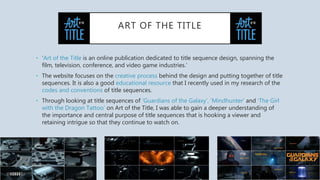
• ‘Art of the Title is an online publication dedicated to title sequence design, spanning the
film, television, conference, and video game industries.’
• The website focuses on the creative process behind the design and putting together of title
sequences. It is also a good educational resource that I recently used in my research of the
codes and conventions of title sequences.
• Through looking at title sequences of ‘Guardians of the Galaxy’, ‘Mindhunter’ and ‘The Girl
with the Dragon Tattoo’ on Art of the Title, I was able to gain a deeper understanding of
the importance and central purpose of title sequences that is hooking a viewer and
retaining intrigue so that they continue to watch on.
NARRATIVE CODES
• Narrative codes – media language used to tell the story
• French social and literary critic, Roland Barthes developed a concept of narrative being interwoven with
one of 2 codes – action or enigma.
• Barthes created the concept of an enigma code, after developing the idea that in order to maintain an
audiences interest in a story, suspense can be created in the narrative through the proposition of
unanswered questions and unexplained plot elements manipulated into the story line. This leads to the
creation of anticipation for resolution, on the behalf of the viewer and a desire for the narrative to
continue to reveal answers to the questions proposed. He named this technique the enigma code.
• Film narrative can also be expressed through action codes, as each event triggers further action to unfold.
Each time this happens the narrative progresses, building up until a climax is reached.
ENIGMA
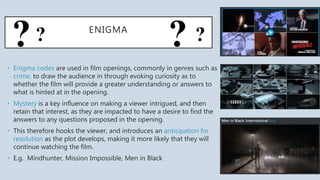
• Enigma codes are used in film openings, commonly in genres such as
crime, to draw the audience in through evoking curiosity as to
whether the film will provide a greater understanding or answers to
what is hinted at in the opening.
• Mystery is a key influence on making a viewer intrigued, and then
retain that interest, as they are impacted to have a desire to find the
answers to any questions proposed in the opening.
• This therefore hooks the viewer, and introduces an anticipation for
resolution as the plot develops, making it more likely that they will
continue watching the film.
• E.g. Mindhunter, Mission Impossible, Men in Black
ACTION
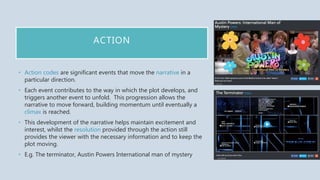
• Action codes are significant events that move the narrative in a
particular direction.
• Each event contributes to the way in which the plot develops, and
triggers another event to unfold. This progression allows the
narrative to move forward, building momentum until eventually a
climax is reached.
• This development of the narrative helps maintain excitement and
interest, whilst the resolution provided through the action still
provides the viewer with the necessary information and to keep the
plot moving.
• E.g. The terminator, Austin Powers International man of mystery
ESTABLISHING GENRE
• In film openings, the genre is established early on through the mise-en-scene and visual codes that
provide the viewer with an understanding as to what characteristics the film is likely to entail. They
can contribute to the mood and tone of the opening, which may alter an audiences perception of
the film genre.
• Mise-en-scene is the design and arrangement of the scenery, props, cast etc. put on the set.
• Visual codes can help to establish genre through the use of different camera shots, angles,
movements, lighting and other visual elements such as cast members and their body language.
• In a romantic comedy for example, the notebook, the genre may be
conveyed through warm lighting to convey a light-hearted
atmosphere and playful mood, or a two shot of characters to display
intimacy. Whereas in a thriller, low lighting and unclear camera shots
may infer the genre, contributing to the sense of the unknown and
build up of suspense, gripping the viewer. This is also effective in
foreshadowing to the audience unsettling scenes of mystery to follow.
SOUND CODES
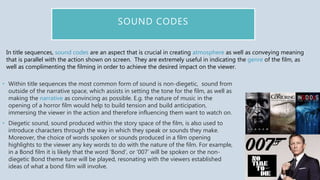
• Within title sequences the most common form of sound is non-diegetic, sound from
outside of the narrative space, which assists in setting the tone for the film, as well as
making the narrative as convincing as possible. E.g. the nature of music in the
opening of a horror film would help to build tension and build anticipation,
immersing the viewer in the action and therefore influencing them want to watch on.
• Diegetic sound, sound produced within the story space of the film, is also used to
introduce characters through the way in which they speak or sounds they make.
Moreover, the choice of words spoken or sounds produced in a film opening
highlights to the viewer any key words to do with the nature of the film. For example,
in a Bond film it is likely that the word ‘Bond’, or ‘007’ will be spoken or the non-
diegetic Bond theme tune will be played, resonating with the viewers established
ideas of what a bond film will involve.
In title sequences, sound codes are an aspect that is crucial in creating atmosphere as well as conveying meaning
that is parallel with the action shown on screen. They are extremely useful in indicating the genre of the film, as
well as complimenting the filming in order to achieve the desired impact on the viewer.
TITLES
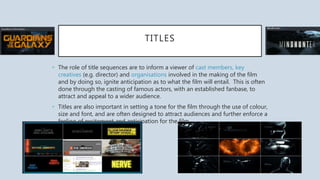
• The role of title sequences are to inform a viewer of cast members, key
creatives (e.g. director) and organisations involved in the making of the film
and by doing so, ignite anticipation as to what the film will entail. This is often
done through the casting of famous actors, with an established fanbase, to
attract and appeal to a wider audience.
• Titles are also important in setting a tone for the film through the use of colour,
size and font, and are often designed to attract audiences and further enforce a
feeling of excitement and anticipation for the film.
TYPOGRAPHY
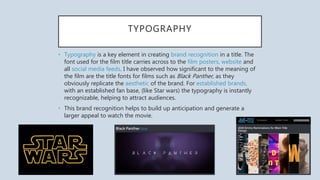
• Typography is a key element in creating brand recognition in a title. The
font used for the film title carries across to the film posters, website and
all social media feeds. I have observed how significant to the meaning of
the film are the title fonts for films such as Black Panther, as they
obviously replicate the aesthetic of the brand. For established brands,
with an established fan base, (like Star wars) the typography is instantly
recognizable, helping to attract audiences.
• This brand recognition helps to build up anticipation and generate a
larger appeal to watch the movie.
LOGOS FOR DISTRIBUTERS, STUDIOS
AND PRODUCTION COMPANIES
• Film openings will always show identification of some sort (e.g. a logo) of production and
distribution companies. This will fuel expectations and increase intrigue for a viewer, if it is
a well-known production company. By recognising a logo a viewer may associate the
company with a film they have previously seen, giving them an insight as to what the film
might be like.
• Larger production companies tend to have larger budgets, meaning that the film is more
likely to be a big budget film, this may increase an audiences desire to watch on as there is
the promise that it will be of good quality.
Major film production companies:
1) Warner bros. pictures
2) 2) Walt Disney Studios
3) 20th Century Fox
4) Paramount Pictures
5) Universal Pictures
6) Sony Pictures entertainment

Title sequence codes and coventions

  • 1.
    FILM OPENING CODESAND CONVENTIONS Ellie Smart
  • 2.
    THE MAIN CONVENTIONS •The key purpose of an opening sequence is to capture a viewers interest and retain that interest to ensure they watch the rest of the film. • There are fundamental conventions that opening sequences follow such as the establishing of genre, through distinctive visual and sound codes, to give a viewer an insight as to what they can expect in the wider film e.g key themes. This will build anticipation and fuel intrigue, persuading them to continue watching. • As openings tend to be short in length, it is important that key themes and principle characters are introduced in a way as efficient and quick as possible, so that the viewer can gain a maximum understanding and intrigue before the film begins. Characters are often identified in conjunction with the actors name, to provide the audience with a deeper understanding of the portrayal of the character, as well as to perhaps increase anticipation if they recognise the actor.
  • 3.
    ART OF THETITLE • ‘Art of the Title is an online publication dedicated to title sequence design, spanning the film, television, conference, and video game industries.’ • The website focuses on the creative process behind the design and putting together of title sequences. It is also a good educational resource that I recently used in my research of the codes and conventions of title sequences. • Through looking at title sequences of ‘Guardians of the Galaxy’, ‘Mindhunter’ and ‘The Girl with the Dragon Tattoo’ on Art of the Title, I was able to gain a deeper understanding of the importance and central purpose of title sequences that is hooking a viewer and retaining intrigue so that they continue to watch on.
  • 4.
    NARRATIVE CODES • Narrativecodes – media language used to tell the story • French social and literary critic, Roland Barthes developed a concept of narrative being interwoven with one of 2 codes – action or enigma. • Barthes created the concept of an enigma code, after developing the idea that in order to maintain an audiences interest in a story, suspense can be created in the narrative through the proposition of unanswered questions and unexplained plot elements manipulated into the story line. This leads to the creation of anticipation for resolution, on the behalf of the viewer and a desire for the narrative to continue to reveal answers to the questions proposed. He named this technique the enigma code. • Film narrative can also be expressed through action codes, as each event triggers further action to unfold. Each time this happens the narrative progresses, building up until a climax is reached.
  • 5.
    ENIGMA • Enigma codesare used in film openings, commonly in genres such as crime, to draw the audience in through evoking curiosity as to whether the film will provide a greater understanding or answers to what is hinted at in the opening. • Mystery is a key influence on making a viewer intrigued, and then retain that interest, as they are impacted to have a desire to find the answers to any questions proposed in the opening. • This therefore hooks the viewer, and introduces an anticipation for resolution as the plot develops, making it more likely that they will continue watching the film. • E.g. Mindhunter, Mission Impossible, Men in Black
  • 6.
    ACTION • Action codesare significant events that move the narrative in a particular direction. • Each event contributes to the way in which the plot develops, and triggers another event to unfold. This progression allows the narrative to move forward, building momentum until eventually a climax is reached. • This development of the narrative helps maintain excitement and interest, whilst the resolution provided through the action still provides the viewer with the necessary information and to keep the plot moving. • E.g. The terminator, Austin Powers International man of mystery
  • 7.
    ESTABLISHING GENRE • Infilm openings, the genre is established early on through the mise-en-scene and visual codes that provide the viewer with an understanding as to what characteristics the film is likely to entail. They can contribute to the mood and tone of the opening, which may alter an audiences perception of the film genre. • Mise-en-scene is the design and arrangement of the scenery, props, cast etc. put on the set. • Visual codes can help to establish genre through the use of different camera shots, angles, movements, lighting and other visual elements such as cast members and their body language. • In a romantic comedy for example, the notebook, the genre may be conveyed through warm lighting to convey a light-hearted atmosphere and playful mood, or a two shot of characters to display intimacy. Whereas in a thriller, low lighting and unclear camera shots may infer the genre, contributing to the sense of the unknown and build up of suspense, gripping the viewer. This is also effective in foreshadowing to the audience unsettling scenes of mystery to follow.
  • 8.
    SOUND CODES • Withintitle sequences the most common form of sound is non-diegetic, sound from outside of the narrative space, which assists in setting the tone for the film, as well as making the narrative as convincing as possible. E.g. the nature of music in the opening of a horror film would help to build tension and build anticipation, immersing the viewer in the action and therefore influencing them want to watch on. • Diegetic sound, sound produced within the story space of the film, is also used to introduce characters through the way in which they speak or sounds they make. Moreover, the choice of words spoken or sounds produced in a film opening highlights to the viewer any key words to do with the nature of the film. For example, in a Bond film it is likely that the word ‘Bond’, or ‘007’ will be spoken or the non- diegetic Bond theme tune will be played, resonating with the viewers established ideas of what a bond film will involve. In title sequences, sound codes are an aspect that is crucial in creating atmosphere as well as conveying meaning that is parallel with the action shown on screen. They are extremely useful in indicating the genre of the film, as well as complimenting the filming in order to achieve the desired impact on the viewer.
  • 9.
    TITLES • The roleof title sequences are to inform a viewer of cast members, key creatives (e.g. director) and organisations involved in the making of the film and by doing so, ignite anticipation as to what the film will entail. This is often done through the casting of famous actors, with an established fanbase, to attract and appeal to a wider audience. • Titles are also important in setting a tone for the film through the use of colour, size and font, and are often designed to attract audiences and further enforce a feeling of excitement and anticipation for the film.
  • 10.
    TYPOGRAPHY • Typography isa key element in creating brand recognition in a title. The font used for the film title carries across to the film posters, website and all social media feeds. I have observed how significant to the meaning of the film are the title fonts for films such as Black Panther, as they obviously replicate the aesthetic of the brand. For established brands, with an established fan base, (like Star wars) the typography is instantly recognizable, helping to attract audiences. • This brand recognition helps to build up anticipation and generate a larger appeal to watch the movie.
  • 11.
    LOGOS FOR DISTRIBUTERS,STUDIOS AND PRODUCTION COMPANIES • Film openings will always show identification of some sort (e.g. a logo) of production and distribution companies. This will fuel expectations and increase intrigue for a viewer, if it is a well-known production company. By recognising a logo a viewer may associate the company with a film they have previously seen, giving them an insight as to what the film might be like. • Larger production companies tend to have larger budgets, meaning that the film is more likely to be a big budget film, this may increase an audiences desire to watch on as there is the promise that it will be of good quality. Major film production companies: 1) Warner bros. pictures 2) 2) Walt Disney Studios 3) 20th Century Fox 4) Paramount Pictures 5) Universal Pictures 6) Sony Pictures entertainment