FIRE SAFETY DECISION
TREE :
BY EDWIN JACOB Y
LOGIC GATES.
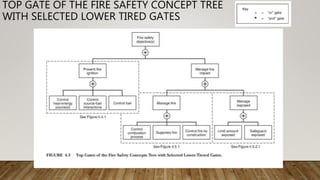
• The Fire Safety Concepts Tree uses logic gates to show a hierarchical relationship of fire
safety concepts. There are two types of logic gates in the Fire Safety Concepts Tree-"or"
gates and "and" gates.
• An "or" gate, represented by a circle with a plus sign in it, indicates that any of the
concepts below it will cause or have as an outcome the concept above it.
• An "and" gate is represented by a circle with a dot in the middle. This indicates that all of
the concepts below the "and" gate are needed to achieve the concept above the gate.
FIRE SAFETY OBJECTIVES
• The top box of the Fire Safety Concepts Tree is labeled "Fire Safety Objective (s). The logic of
the tree is directed toward the achievement of specified objectives. Strategies for achieving
fire safety objectives are divided into two categories: "Prevent Fire Ignition" and "Manage Fire
Impact.
• These concepts are connected through an "or" gate to the fire safety objective. Thus, the
logic of the tree is that fire safety objectives can be accomplished by preventing a fire from
starting or by managing the impact of the fire.
• The "or" gate is the "inclusive or," which means that all the concepts below the gate can be
included, but only one of them is necessary. In theory, this implies that either prevention or
management alone could be followed to achieve the objective. However, practically, it is not
possible to achieve perfect prevention or management.
TOP GATE OF THE FIRE SAFETY CONCEPT TREE
WITH SELECTED LOWER TIRED GATES
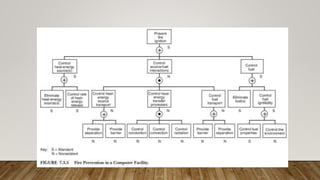
PREVENT FIRE IGNITION
• The "Prevent Fire Ignition branch of the Fire Safety Concepts Tree includes measures
representative of a fire prevention code. Fire safety measures included in this branch of
the tree require continuous monitoring to ensure their effectiveness. The responsibility,
therefore, is more the owner's or the occupant's than the designer's
“PREVENT FIRE IGNITION “ BRANCH OF THE FIRE
SAFETY CONCEPTS TREE
MANAGE FIRE IMPACT
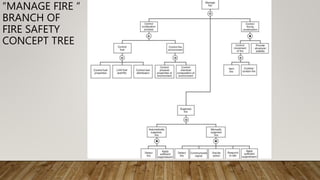
• Manage Fire Impact. The "Manage Fire Impact" side of the tree has two major branches
as inputs to an "or gate “ : “Manage Fire" and "Manage Exposed" .This is the basic
approach to loss control (ie., to limit the magnitude of the hazard or to minimize the
effects).
MANAGE EXPOSED
• Manage Exposed" means to coordinate measures involving any or all of the items specified in
the fire safety objectives (eg.. people, property, activities, or other valuable considerations).
• The "Manage Exposed" branch is achieved by either limiting the number of individuals and
amount of property that are exposed or safeguarding all persons and property subject to
exposure .In the case of property or immobile persons, such as non ambulatory hospital
patients, the exposed is safeguarded most often by defending the occupied space from fire
exposure.
• "Hardening against fire” is another term for the strategy of making the exposed resistant to
the effects of fire. For more mobile occupants, the most common strategy for safe guarding
the exposed is to relocate the exposed while protecting the route for the duration of transit.
This includes smoke management as described by the "Vent Fire" and "Confine/ Contain Fire"
elements under the "Control Movement of Fire branch of the tree.
“MANAGE FIRE “
BRANCH OF
FIRE SAFETY
CONCEPT TREE
“MANAGE EXPOSED” BRANCH OF FIRE SAFETY CONCEPTS TREE
APPLICATIONS
Communications
• Perhaps the most important use of the tree is for communication with architects and
other professionals involved in building design and management. Codes and standards
are not intended to be tutorial; they presume a significant level of comprehension of the
principles of fire protection engineering.
• The Fire Safety Concepts Tree is a simple visual representation of the total concept of fire
safety incorporated in codes and standards. It can be used as a means of communication
between fire safety specialists and others to help identify the role of specific
requirements. The tree should be considered as a first level of education in fire
protection engineering (i.e.. as an introduction to the full breadth of the subject).
CONT…
Building Management
• The Fire Safety Concepts Tree can be used to assess fire safety in an existing building.
Inputs to "and" gates in the tree comprise a checklist of required components that
should be maintained in order to accomplish their respective strategies.
• Thus, in a structure for which particular strategies are identified as necessary to achieve
fire safety objectives, appraisal of inputs to those strategies constitutes a fire safety
assessment of the structure.
CONT…
Building Design
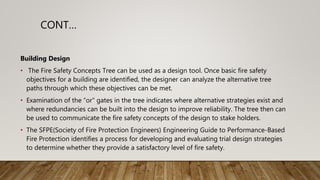
• The Fire Safety Concepts Tree can be used as a design tool. Once basic fire safety
objectives for a building are identified, the designer can analyze the alternative tree
paths through which these objectives can be met.
• Examination of the “or" gates in the tree indicates where alternative strategies exist and
where redundancies can be built into the design to improve reliability. The tree then can
be used to communicate the fire safety concepts of the design to stake holders.
• The SFPE(Society of Fire Protection Engineers) Engineering Guide to Performance-Based
Fire Protection identifies a process for developing and evaluating trial design strategies
to determine whether they provide a satisfactory level of fire safety.
USE OF THE TREE
General
There are many methods for using the Fire Safety Concepts Tree. These range from
cursory visual examination through systematic consideration of each concept to
adaptation for quantitative analysis. This section illustrates one systematic approach to
qualitative assessment of fire safety.
Procedure
step by-step approach for one way in which the Fire Safety Concepts Tree can be used to
evaluate fire safety. It should not be inferred that this is the only way the tree can be used.
• Step one – Define the objectives
• Step two – Assess each of the lowest elements in the tree
CONT….
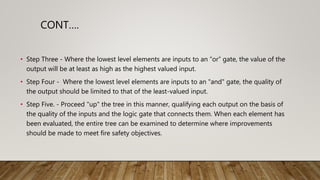
• Step Three - Where the lowest level elements are inputs to an “or” gate, the value of the
output will be at least as high as the highest valued input.
• Step Four - Where the lowest level elements are inputs to an "and" gate, the quality of
the output should be limited to that of the least-valued input.
• Step Five. - Proceed "up" the tree in this manner, qualifying each output on the basis of
the quality of the inputs and the logic gate that connects them. When each element has
been evaluated, the entire tree can be examined to determine where improvements
should be made to meet fire safety objectives.
ADMINISTRATIVE ACTION
Administrative Action Guide
• The Administrative Action Guide uses the logic format to show various ways to regulate
or promote fire safety strategies.
• It is intended as a generalized guide to encourage any of the measures described in the
Fire Safety Concepts Tree.
• This administrative scheme could pertain to any means throughout the tree, since it
represents only a generalized conceptual scheme (entirely nontechnical) for facilitating a
means to achieve goals
ADMINISTRATIVE ACTION GUIDE
BIS
BIS has formulated more than 150 standards on fire safety in buildings and firefighting
equipment & systems and important ones are: Code of practice for fire safety of building (IS
1641 to IS 1646), electrical generating and distributing stations (IS 3034), cotton textile mills (IS
3079), rubber and plastic (IS 11457 Part 1), libraries and archives (IS 11460), iron and steel
industries (IS 13694), hotels (IS 13716), educational institutions (IS 14435); fire detection and
alarm systems (IS 2189); first aid fire extinguishers (IS 2190); internal hydrants and hose reels (IS
3844); temporary structures and pandals (IS 8758); fire protection-safety signs (IS 12349);
external hydrant systems (IS 13039 ); fixed automatic sprinkler fire extinguishing systems (IS
15105); gaseous fire extinguishing systems (IS 15493); HFC 227ea (IS 15517); water mist system
(IS 15519); portable fire extinguishers (IS 15683); long range foam monitors (IS 15811); fire
detection and alarm system (IS 15908)
THANK YOU

Fire safety decision tree

  • 1.
    FIRE SAFETY DECISION TREE: BY EDWIN JACOB Y
  • 2.
    LOGIC GATES. • TheFire Safety Concepts Tree uses logic gates to show a hierarchical relationship of fire safety concepts. There are two types of logic gates in the Fire Safety Concepts Tree-"or" gates and "and" gates. • An "or" gate, represented by a circle with a plus sign in it, indicates that any of the concepts below it will cause or have as an outcome the concept above it. • An "and" gate is represented by a circle with a dot in the middle. This indicates that all of the concepts below the "and" gate are needed to achieve the concept above the gate.
  • 3.
    FIRE SAFETY OBJECTIVES •The top box of the Fire Safety Concepts Tree is labeled "Fire Safety Objective (s). The logic of the tree is directed toward the achievement of specified objectives. Strategies for achieving fire safety objectives are divided into two categories: "Prevent Fire Ignition" and "Manage Fire Impact. • These concepts are connected through an "or" gate to the fire safety objective. Thus, the logic of the tree is that fire safety objectives can be accomplished by preventing a fire from starting or by managing the impact of the fire. • The "or" gate is the "inclusive or," which means that all the concepts below the gate can be included, but only one of them is necessary. In theory, this implies that either prevention or management alone could be followed to achieve the objective. However, practically, it is not possible to achieve perfect prevention or management.
  • 4.
    TOP GATE OFTHE FIRE SAFETY CONCEPT TREE WITH SELECTED LOWER TIRED GATES
  • 5.
    PREVENT FIRE IGNITION •The "Prevent Fire Ignition branch of the Fire Safety Concepts Tree includes measures representative of a fire prevention code. Fire safety measures included in this branch of the tree require continuous monitoring to ensure their effectiveness. The responsibility, therefore, is more the owner's or the occupant's than the designer's
  • 6.
    “PREVENT FIRE IGNITION“ BRANCH OF THE FIRE SAFETY CONCEPTS TREE
  • 7.
    MANAGE FIRE IMPACT •Manage Fire Impact. The "Manage Fire Impact" side of the tree has two major branches as inputs to an "or gate “ : “Manage Fire" and "Manage Exposed" .This is the basic approach to loss control (ie., to limit the magnitude of the hazard or to minimize the effects).
  • 8.
    MANAGE EXPOSED • ManageExposed" means to coordinate measures involving any or all of the items specified in the fire safety objectives (eg.. people, property, activities, or other valuable considerations). • The "Manage Exposed" branch is achieved by either limiting the number of individuals and amount of property that are exposed or safeguarding all persons and property subject to exposure .In the case of property or immobile persons, such as non ambulatory hospital patients, the exposed is safeguarded most often by defending the occupied space from fire exposure. • "Hardening against fire” is another term for the strategy of making the exposed resistant to the effects of fire. For more mobile occupants, the most common strategy for safe guarding the exposed is to relocate the exposed while protecting the route for the duration of transit. This includes smoke management as described by the "Vent Fire" and "Confine/ Contain Fire" elements under the "Control Movement of Fire branch of the tree.
  • 9.
    “MANAGE FIRE “ BRANCHOF FIRE SAFETY CONCEPT TREE
  • 10.
    “MANAGE EXPOSED” BRANCHOF FIRE SAFETY CONCEPTS TREE
  • 11.
    APPLICATIONS Communications • Perhaps themost important use of the tree is for communication with architects and other professionals involved in building design and management. Codes and standards are not intended to be tutorial; they presume a significant level of comprehension of the principles of fire protection engineering. • The Fire Safety Concepts Tree is a simple visual representation of the total concept of fire safety incorporated in codes and standards. It can be used as a means of communication between fire safety specialists and others to help identify the role of specific requirements. The tree should be considered as a first level of education in fire protection engineering (i.e.. as an introduction to the full breadth of the subject).
  • 12.
    CONT… Building Management • TheFire Safety Concepts Tree can be used to assess fire safety in an existing building. Inputs to "and" gates in the tree comprise a checklist of required components that should be maintained in order to accomplish their respective strategies. • Thus, in a structure for which particular strategies are identified as necessary to achieve fire safety objectives, appraisal of inputs to those strategies constitutes a fire safety assessment of the structure.
  • 13.
    CONT… Building Design • TheFire Safety Concepts Tree can be used as a design tool. Once basic fire safety objectives for a building are identified, the designer can analyze the alternative tree paths through which these objectives can be met. • Examination of the “or" gates in the tree indicates where alternative strategies exist and where redundancies can be built into the design to improve reliability. The tree then can be used to communicate the fire safety concepts of the design to stake holders. • The SFPE(Society of Fire Protection Engineers) Engineering Guide to Performance-Based Fire Protection identifies a process for developing and evaluating trial design strategies to determine whether they provide a satisfactory level of fire safety.
  • 14.
    USE OF THETREE General There are many methods for using the Fire Safety Concepts Tree. These range from cursory visual examination through systematic consideration of each concept to adaptation for quantitative analysis. This section illustrates one systematic approach to qualitative assessment of fire safety. Procedure step by-step approach for one way in which the Fire Safety Concepts Tree can be used to evaluate fire safety. It should not be inferred that this is the only way the tree can be used. • Step one – Define the objectives • Step two – Assess each of the lowest elements in the tree
  • 15.
    CONT…. • Step Three- Where the lowest level elements are inputs to an “or” gate, the value of the output will be at least as high as the highest valued input. • Step Four - Where the lowest level elements are inputs to an "and" gate, the quality of the output should be limited to that of the least-valued input. • Step Five. - Proceed "up" the tree in this manner, qualifying each output on the basis of the quality of the inputs and the logic gate that connects them. When each element has been evaluated, the entire tree can be examined to determine where improvements should be made to meet fire safety objectives.
  • 17.
    ADMINISTRATIVE ACTION Administrative ActionGuide • The Administrative Action Guide uses the logic format to show various ways to regulate or promote fire safety strategies. • It is intended as a generalized guide to encourage any of the measures described in the Fire Safety Concepts Tree. • This administrative scheme could pertain to any means throughout the tree, since it represents only a generalized conceptual scheme (entirely nontechnical) for facilitating a means to achieve goals
  • 18.
  • 19.
    BIS BIS has formulatedmore than 150 standards on fire safety in buildings and firefighting equipment & systems and important ones are: Code of practice for fire safety of building (IS 1641 to IS 1646), electrical generating and distributing stations (IS 3034), cotton textile mills (IS 3079), rubber and plastic (IS 11457 Part 1), libraries and archives (IS 11460), iron and steel industries (IS 13694), hotels (IS 13716), educational institutions (IS 14435); fire detection and alarm systems (IS 2189); first aid fire extinguishers (IS 2190); internal hydrants and hose reels (IS 3844); temporary structures and pandals (IS 8758); fire protection-safety signs (IS 12349); external hydrant systems (IS 13039 ); fixed automatic sprinkler fire extinguishing systems (IS 15105); gaseous fire extinguishing systems (IS 15493); HFC 227ea (IS 15517); water mist system (IS 15519); portable fire extinguishers (IS 15683); long range foam monitors (IS 15811); fire detection and alarm system (IS 15908)
  • 20.