BETA-LACTAMBETA-LACTAM
ANTIBIOTICSANTIBIOTICS
Antimicrobial agents are among the most dramatic
examples of the advances of modern medicine.
Many infectious diseases once considered incurable
and lethal now can be treated. The remarkably powerful
and specific activity of antimicrobial drugs is due to their
selective toxicityselective toxicity for targetsfor targets that are either unique
to microorganisms or much more important in them
than in humans.
Among these targets are bacterial and fungal
cell wall-synthesizing enzymes, the bacterial ribosome,
the enzymes required for nucleotide synthesis and
DNA replication, the mechanism of viral replication,
etc. The much older and less selective cytotoxicselective cytotoxic
drugsdrugs are the antiseptics and disinfectants.
Sponsored
Medical Lecture Notes – All Subjects
USMLE Exam (America) – Practice
AntiinfectiveAntiinfective agentsagents may be classifiedmay be classified
according toaccording to their antimicrobial activity::
1. Antibacterial drugs (antibiotics1. Antibacterial drugs (antibiotics
and synthetic drugs)and synthetic drugs)
2. Antiviral drugs2. Antiviral drugs
3. Antifungal drugs3. Antifungal drugs
4. Antiprotozoal drugs4. Antiprotozoal drugs
5. Anthelmintic drugs5. Anthelmintic drugs
6. Insecticides for ectoparasites6. Insecticides for ectoparasites
7. Antiseptics and7. Antiseptics and Disenfectant (Not are drugs)Disenfectant (Not are drugs)
8. Prepartaions for Disinsection (Not are drugs)8. Prepartaions for Disinsection (Not are drugs)
9. Prepartaions for Deratisation (Not are drugs)9. Prepartaions for Deratisation (Not are drugs)
10. Vaccines, Serums, and Immunoglobulins10. Vaccines, Serums, and Immunoglobulins
Antibacterial drugsAntibacterial drugs have beenhave been
classified broadly into:classified broadly into:
1.1. bacteriostaticbacteriostatic,, i.e. those that act primarilyi.e. those that act primarily
by arresting bacterial multiplication, such asby arresting bacterial multiplication, such as
tetracyclines, chloramphenicol, macrolides,etracyclines, chloramphenicol, macrolides,
incosamides, sulfonamides, etc.incosamides, sulfonamides, etc.
2.2. bactericidalbactericidal, i.e. those which act primarily, i.e. those which act primarily
by killing bacteria, such as penicillins,by killing bacteria, such as penicillins,
cephalosporins, aminoglycosides, isoniazid,cephalosporins, aminoglycosides, isoniazid,
rifampicin, quinolones, etc.rifampicin, quinolones, etc.
30S: Aminoglycosides30S: Aminoglycosides
30S: Tetracyclines30S: Tetracyclines
50S: Chloramphenicol50S: Chloramphenicol
50S: Macrolides, Lincosamides50S: Macrolides, Lincosamides
50S: Linezolide, Streptogramins50S: Linezolide, Streptogramins
RifampicinRifampicinPolymyxinsPolymyxins
ANTIBIOTICS – mechanism of actionANTIBIOTICS – mechanism of action
β-lactams, Glycopeptidesβ-lactams, Glycopeptides
Adverse Drug Reactions (ADRs)
Antibacterial drugs may cause:
●direct host toxicity (aminoglycosides, peptides)
●toxic interactions with other drugs
●interference with protective effects of normal host
microflora (by suppressing obligate anaerobes, for
example selection or promotion of drug resistance
●tissue lesions at injection sites (tetracyclines)
●impairment of host immune or defense
mechanisms (chloramphenicol)
●reduced phagocytosis, and chemotactic activity
of neutrophils (tetracyclines)
●inhibition of phagocytosis (aminoglycosides)
●hypersensitivity reactions (beta-lactams,
aminosides, sulfonamides)
●hepatic microsomal enzyme induction
(e.g. rifampin) or inhibition (e.g. chloramphenicol)
that interferes with their own metabolism as well as
that of concurrent medications,
Selection or promotion of resistance
Antibacterial agents do not cause bacteria to
become resistant but their use preferentially
selects resistant populations of bacteria.
Some genes that code for resistance have been
identified in bacterial cultures. The most clinically
important for resistance are plasmids. They carry
genes that may benefit survival of the
organism (e.g. antibacterial resistance)
transmitted from one bacterium to another.
Plasmids are cytoplasmic
genetic elements which transfer drug
resistance to previously susceptible bacteria.
Acquired resistance is not a problem in all bacteria.
For example, Gram-positive bacteria (with
some exceptions, incl. Staphylococcus spp) are
often unable to acquire resistance plasmids
(and thus acquire resistance through mutation,
a slower process), whereas resistance is an
increasing problem in many Gram-negative
pathogens such as the Enterobacteriaceae.
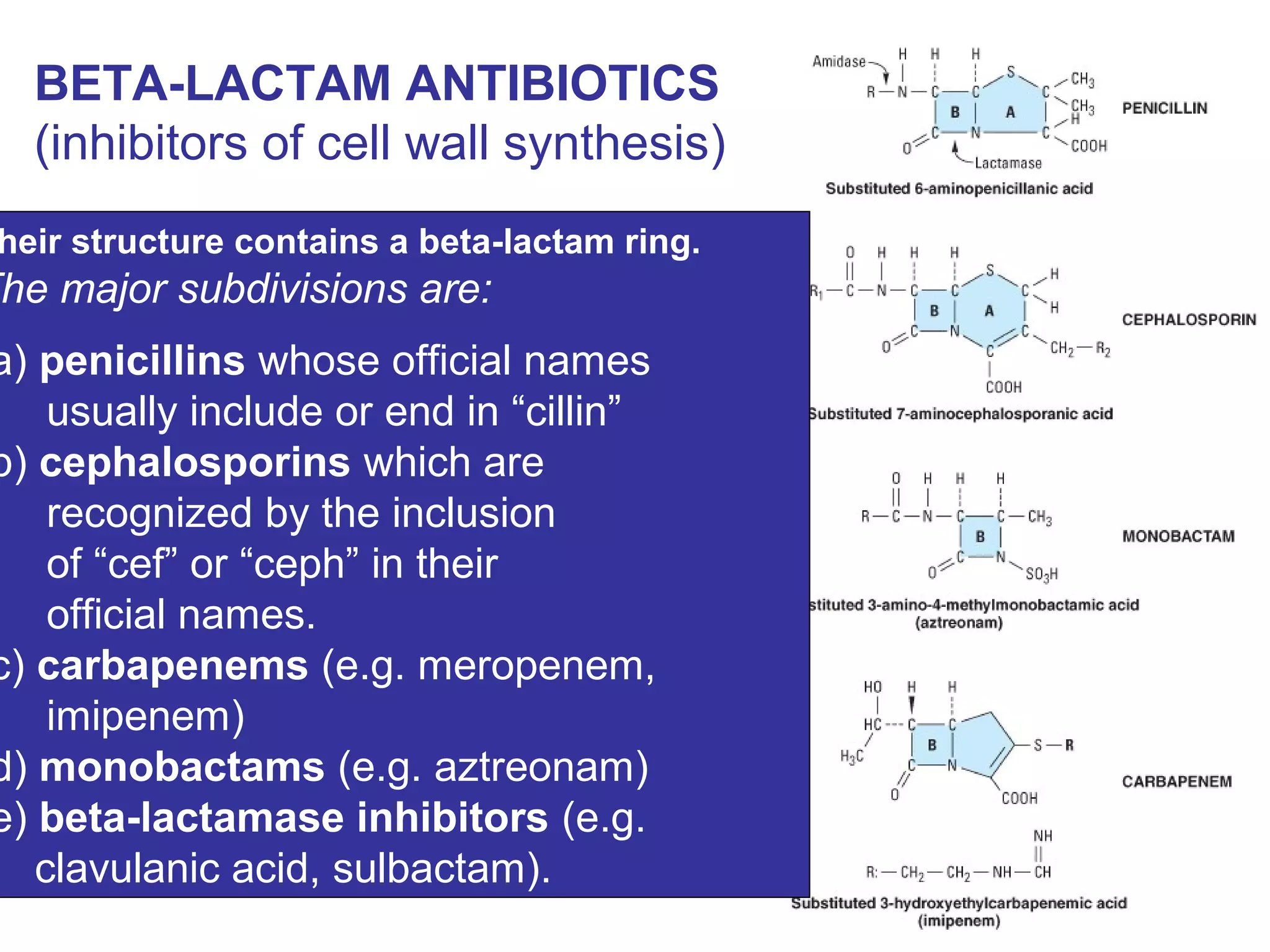
BETA-LACTAM ANTIBIOTICS
(inhibitors of cell wall synthesis)
heir structure contains a beta-lactam ring.
The major subdivisions are:
a) penicillins whose official names
usually include or end in “cillin”
b) cephalosporins which are
recognized by the inclusion
of “cef” or “ceph” in their
official names.
c) carbapenems (e.g. meropenem,
imipenem)
d) monobactams (e.g. aztreonam)
e) beta-lactamase inhibitors (e.g.
clavulanic acid, sulbactam).
I. PENICILLINSA. FLEMING
(1881–1955)
•Penicillin G
- P. notatum
(1929)(1929)
Penicillium chrysogenum
The cell wall completely surrounds the cytoplasmic
membrane, maintains cell shape and integrity, and
prevents cell lysis from high osmotic pressure. The
cell wall is composed of a complex cross-linked
polymer of polysaccharides and polypeptides,
peptidoglycan (murein, mucopeptide). The
polysaccharide contains alternating amino sugars,
N-acetylglucosamine, and N-acetylmuramic acid.
A five-amino-acid peptide is linked to the
N-acetylmuramic acid sugar. This peptide
terminates in D-alanyl-D-alanine.
Penicillin-binding protein (PBP, an enzyme)
removes the terminal alanine in the process of
forming a cross-link with a nearby peptide.
Cross-links give the cell wall its structural rigidity.
Beta-lactam antibiotics covalently bind to
the active site of PBPs. This inhibits the
transpeptidation reaction, halting
peptidoglycan synthesis, and the cell dies.
Beta-lactams kill bacterial cells only
when they are actively growing and
synthesizing cell wall.
NARROW SPECTRUM PENICILLINS
• Biosynthetic (natural) penicillins
• Antistaphylococcal beta-lactamase
resistant penicillins
BROAD SPECTRUM PENICILLINS
• Aminopenicillins
• Antipseudomonal penicillins
- Carboxypenicillins
- Ureidopenicillins
Adverse effects
The main hazard with the penicillins is allergic reaction.
These include itching, rashes (eczematous or urticarial),
fever, and angioedema. Rarely (about 1 in 10 000) there
is anaphylactic shock which can be fatal (about 1 in
50 000 – 100 000 treatment courses). Allergies are
least likely when penicillins are given orally and most
likely with local application. Metabolic opening of the
β-lactam ring creates a highly reactive penicilloyl
group which polymerizes and binds with tissue
proteins to form the major antigenic determinant.
The anaphylactic reaction involves specific IgE
antibodies which can be detected in the plasma
of susceptible persons.
Amoxicillin:
rash 11 hours after
administration
There is cross-allergy between all the various
forms of penicillin, probably due in part to their
common structure, and in part to the degradation
products common to them all.
Partial cross-allergy exists between penicillins
and cephalosporins (a maximum of 10%) which
is of particular concern when the reaction to either
group of antimicrobials has been angioedema or
anaphylactic shock.
Carbapenems and the monobactams
apparently have a much lower risk of cross-reactivity.
When the history of allergy is not clear and it is
necessary to prescribe a penicillin,
the presence of of IgE antibodies in serum
is a useful indicator of reactions mediated by
these antibodies, i.e. immediate (type 1) reactions.
Additionally, an intradermal test for allergy may
be performed; appearance of a flare and wheal
reaction indicates a positive response.
Only about 10% of patients with a history
of “penicillin allergy” respond positively.
Other (nonallergic) adverse effects include diarrhoea
due to alteration in normal intestinal flora
which may progress to Clostridium difficile-associated
diarrhoea. Neutropenia is a risk if penicillins or
other β-lactam antibiotics are used in high dose
and usually for a period of longer than 10 days.
Rarely penicillins cause anaemia, sometimes
haemolytic, and thrombocytopenia or interstitial
nephritis. Penicillins are presented as their sodium
or potassium salts. Physicians should be aware of this
unexpected source of sodium or potassium, especially
in patients with renal or cardiac disease. Extremely
high plasma penicillin concentrations cause convulsions.
Co-amoxiclav, flucloxacillin, or oxacillin given in high doses
for prolonged periods in the elderly may cause
hepatic toxicity.
1. NARROW SPECTRUM PENICILLINS
a) Biosynthetic (natural) penicillins
Benzylpenicillin (Penicillin G®
) is used when
high plasma concentrations are required. The short
t1/2 (0.5 h) means that reasonably spaced doses
have to be large to maintain a therapeutic
concentration. The unusually large therapeutic ratio
of penicillin allows the resulting fluctuations to
be tolerable. Benzylpenicillin is eliminated by the
kidney, with about 80% being actively secreted by
the renal tubule and this can be blocked by
probenecid.
Penicillin G®
is a drug of choice for infections caused
by streptococci, meningococci, enterococci, penicillin-
susceptible pneumococci, non-β-lactamase-producing
staphylococci, T. pallidum and many other spirochetes,
clostridium species, actinomyces, and other Gram-
positive rods and non-β-lactamase-producing Gram-
negative anaerobic organisms. Depending on the
organism, the site, and the severity of infection,
effective doses range is between 4 and 24 million units
per day administered i.m. or i.v. in 4 to 6 divided
doses. High-dose Penicillin G®
Sodium can also be
given as a continuous i. v. infusion.
Phenoxymethylpenicillin PotassiumPhenoxymethylpenicillin Potassium (Penicillin-VK(Penicillin-VK®®
))
the oral form of penicillin, is indicated only in minor
infections (e.g. tonsillitis) because of its relatively poor
bioavailability, the need for dosing four times a day,
and its narrow antibacterial spectrum.
Benzathine penicillinBenzathine penicillin andand Procaine Penicillin GProcaine Penicillin G®®
maintain low but prolonged drug levels.
A single i.m. injection of benzathine penicillin,
1.2 million units, is an effective treatment for β-hemolytic
streptococcal pharyngitis; given once every 3–4
weeks, it prevents reinfection. Benzathine penicillin G,
2.4 million units i.m. once a week for 1–3 weeks, is
effective in the treatment of syphilis.
Penicilline G Sodium®®
PhenoxymethylpenicillinPhenoxymethylpenicillin
PotassiumPotassium (Penicillin-VK(Penicillin-VK®®
))
Procaine penicillin G is rarely used nowadays
because many strains are penicillin-resistant.
b) Antistaphylococcal penicillins
•Isoxazolyl penicillins
- Cloxacillin, Dicloxacillin
- Flucloxacillin, Oxacillin
•Others
- Methicillin
- Nafcillin
500 mg
Flucloxacillin
These semisynthetic penicillins are indicated for
infection by beta-lactamase-producing staphylococci,
although penicillin-susceptible strains of streptococci
and pneumococci are also susceptible.
Listeria, enterococci, and methicillin-resistant strains
(MRS) of staphylococci are resistant.
An isoxazolyl penicillin (cloxacillin, dicloxacillin,
or oxacillin), 250–500 mg orally every 4 to 6 h
(25 mg/kg/d for children), is suitable for the treatment
of mild to moderate localized staphylococcal infections.
All are relatively acid-stable but food interferes with
their absorption, and the drugs should be administered
1 h before or after meals.
2. BROAD-SPECTRUM PENICILLINS
a) Aminopenicillins
The aminopenicillins have identical spectrum and
activity, but amoxicillin is better absorbed orally
(70–90%). They are effective against
streptococci, enterococci, and some
Gram-negative organisms (including H. pylori)
but have variable activity against staphylococci
and are ineffective against P. aeruginosa.
Amoxicillin and Ampicillin
Amoxicillin, 500 mg 3 times daily,
is equivalent to the same amount of ampicillin given
four times daily. These drugs are given orally to treat
urinary tract infections, sinusitis, otitis, and lower
respiratory tract infections. Aminopenicillins are
the most active of the oral beta-lactams against
penicillin-resistant pneumococci and are the
preferred beta-lactams for treating infections
suspected to be caused by these resistant strains.
Amoxicillin in VMAmoxicillin in VM
Ampicillin (but not amoxicillin) is effective for
shigellosis.
Ampicillin, at dosages of 4–12 g/d i.v., is useful for
treating serious infections caused by penicillin-
susceptible organisms, including anaerobes,
enterococci, L. monocytogenes, and beta-lactamase-
negative strains of Gram-negative cocci and bacilli
such as E. coli, and salmonella species. Non-beta-
lactamase-producing strains of H. influenzae are
generally susceptible. Many Gram-negative species
produce beta-lactamases and are resistant.
•Carboxypenicillins
- Carbenicillin
- Ticarcillin
•Ureidopenicillins
- Azlocillin
- Mezlocillin
- Piperacillin
b) Antipseudomonal penicillins
These drugs retain activity against streptococci and
possess additional effects against Gram-negative
organisms, including various Enterobacteriaceae
and Pseudomonas.
Carbenicillin, the very first antipseudomonal
carboxypenicillin, is obsolete.
There are more active, better tolerated alternatives.
A carboxypenicillin with activity similar to that of
carbenicillin is Ticarcillin. It is less active than
ampicillin against enterococci.
The ureidopenicillins,
piperacillin, mezlocillin, and azlocillin, are also
active against selected Gram-negative bacilli,
such as K. pneumoniae. Although supportive
clinical data are lacking for superiority
of combination therapy over single-drug therapy,
because of the propensity of P. aeruginosa to
develop resistance, an antipseudomonal penicillin
is frequently used in combination with an
aminoglycoside or fluoroquinolone for
pseudomonal infections outside the urinary tract.
II. CEPHALOSPORINS
The nucleus of the cephalosporins, 7-aminocephalo-
sporanic acid, bears a close resemblance to 6-amino-
penicillanic acid. The intrinsic antimicrobial activity
of natural cephalosporins is low, but the attachment
of various R1 and R2 groups has yielded hundreds
of potent compounds of low toxicity. Cephalosporins
can be classified into four major groups or
generations, depending mainly on the spectrum
of their antimicrobial activity.
7-Aminocephalosporanic acid nucleus
Cephalosporins are similar to penicillins, but more
stable to many bacterial beta-lactamases and
therefore have a broader spectrum of activity.
However, strains ofstrains of E. coliE. coli andand KlebsiellaKlebsiella speciesspecies
expressing extended-spectrum beta-lactamases
that can hydrolyze most cephalosporins are
becoming a problem.
Cephalosporins are not active against
enterococci and L. monocytogenes.
Klebsiella pneumoniaeKlebsiella pneumoniae
1. First-generation cephalosporins
• cefadroxil, cefazolin, cefalexin,
• cefalothin, cefapirin, cefradine
These drugs are very active against Gram-positive
cocci (such as pneumococci, streptococci, and
Staphylococci). Cephalosporins are not active
against methicillin-resistant strains of staphylococci.
E. coli, K. pneumoniae, and P. mirabilis are
often sensitive. Anaerobic cocci (e.g., peptococcus,
peptostreptococcus) are usually sensitive, but
Bacteroides fragilis is not.
They do not cross BBB.
Cefalexin p.o.
Although the first-generation cephalosporins are broad
spectrum and relatively nontoxic, they are rarely the
drug of choice for any infection.
Oral cephalosporins (cefalexin, cefadroxil,
and cefradine) are absorbed from the gut to a
variable extent. They may be used for the treatment
of urinary tract infections, for staphylococcal,
or for streptococcal infections including cellulitis
or soft tissue abscess. However, oral cephalosporins
should not be relied on in serious systemic infections.
Cefazolin penetrates well into most tissues. It is a drug
of choice for surgical prophylaxis. Cefazolin (i.m./i.v.)
may be a choice in infections for which it is the least
toxic drug (eg, K. pneumoniae) and in persons with
staphylococcal or streptococcal infections with a
history of penicillin allergy.
Cefazolin does not penetrate the CNS and cannot be
used to treat meningitis. Cefazolin is an alternative
to an antistaphylococcal penicillin for patients who
are allergic to penicillin.
2. Second-generation cephalosporins
•cefaclor, cefamandole, cefprozil,
•cefotetan, cefuroxime, cefoxitin
In general, they are active against organisms inhibited
by first-generation drugs, but in addition they have
extended Gram-negative coverage. Klebsiellae
(including those resistant to cefalothin) are usually
sensitive. Cefamandole, cefuroxime, and cefaclor are
active against H. influenzae but not against serratia
or B. fragilis. In contrast, cefoxitin, and
cefotetan are active against B. fragilis and some
serratia strains but are less active against
H. influenzae. As with first-generation agents, none
is active against enterococci or P. aeruginosa.
Cefaclor, cefuroxime axetil, and cefprozil, can
be given orally. The usual dosage for adults is 10 to
15 mg/kg/d in 2 to 4 divided doses; children should
be given 20 to 40 mg/kg/d up to a maximum of 1 g/d.
Except for cefuroxime axetil, these drugs are not
predictably active against penicillin-resistant
pneumococci and should be used cautiously,
if at all, to treat suspected or proved pneumococcal
infections.
Cefaclor is more susceptible to β-lactamase
hydrolysis compared with the other agents, and its
usefulness is correspondingly diminished.
The oral second-generation cephalosporins are active
against beta-lactamase-producing H. influenzae or
Moraxella catarrhalis and have been primarily used
to treat sinusitis, otitis, or lower respiratory tract
infections, in which these organisms have an
important role. Because of their activity against
anaerobes (including B. fragilis), cefoxitin or cefotetan,
can be used to treat mixed anaerobic infections such
as peritonitis or diverticulitis. Cefuroxime is used to
treat community-acquired pneumonia because it is
active against β-lactamase-producing H. influenzae
or K. pneumoniae and penicillin-resistant pneumococci.
Although cefuroxime crosses the BBB, it is less
effective in the treatment of meningitis than ceftriaxone
or cefotaxime, and should not be used.
CefuroximeCefuroxime
• Zinacef™Zinacef™
CefoxitinCefoxitin
3. Third-generation cephalosporins
•cefixime, cefoperazone, cefotaxime,
•cefdinir, cefpodoxime, ceftriaxone
Compared with second-generation agents, these drugs
have expanded Gram-negative coverage, and some are
able to cross the BBB. Third-generation drugs are active
against Citrobacter, Serratia marcescens, and
Providencia. They are also effective against
β-lactamase-producing strains of Haemophilus and
Neisseria. Ceftazidime and cefoperazone are the only
two drugs with useful activity against P. aeruginosa.
Neisseria MeningitidisNeisseria MeningitidisNeisseria Gonorrhoea
Like the second-generation drugs, third-generation
cephalosporins are hydrolyzable by constitutively
produced beta-lactamase, and they are not
reliably active against enterobacter species.
Serratia, Providencia, and Citrobacter also produce
a chromosomally encoded cephalosporinase that,
when constitutively expressed, can confer resistance
to third-generation cephalosporins.
Cefixime, cefdinir, and cefpodoxime are oral agents.
Third-generation cephalosporins are used to treat
a wide variety of serious infections caused by
organisms that are resistant to most other drugs.
Strains expressing extended-spectrum beta-
lactamases, however, are not susceptible.
Third-generation cephalosporins should be
avoided in the treatment of Enterobacter infections.
Ceftriaxone and cefotaxime are approved for the
treatment of meningitis, including meningitis
caused by pneumococci, meningococci,
H. influenzae, and susceptible enteric
Gram-negative rods, but not by L. monocytogenes.
Ceftriaxone and cefotaxime are the most active
cephalosporins against penicillin-resistant strains
of pneumococci and are recommended for empirical
therapy of serious infections that may be caused
by these strains. Meningitis caused by highly
penicillin-resistant strains of pneumococci
(i.e., those susceptible only to penicillin
MICs > 1 mcg/mL) may not respond even
to these agents, and addition of vancomycin is
recommended. Other potential indications include
empirical therapy of sepsis of unknown cause in
both the immunocompetent and the
immunocompromised patient. In neutropenic, febrile
immunocompromised patients, III-generation cepha-
losporins are often used with an aminoglycoside.
CeftriaxoneCeftriaxone
4. Fourth-generation cephalosporins
•cefepime, cefpirome
Cefepime is more resistant to hydrolysis by
chromosomal beta-lactamases (eg, those produced
by enterobacter). It has good activity against
P. aeruginosa, Enterobacteriaceae, S. aureus,
and S. pneumoniae.
Cefepime is highly active against Haemophilus and
Neisseria. It penetrates well into the cerebrospinal
fluid. It has good activity against most penicillin-
resistant strains of streptococci, and it may be
useful in the treatment of Enterobacter infections.
III. CARBAPENEMS
•Doripenem
•Ertapenem
•Meropenem
•Tienam®
(imipenem/cilastatin)
Imipenem has a wide spectrum with good activity
against many Gram-negative rods, including P. aeru-
ginosa, Gram-positive organisms, and anaerobes.
It is resistant to most β-lactamases but not metallo-
beta-lactamases. E. faecium, MRS of staphylococci,
C. difficile and some others microorganisms are
resistant.
Imipenem is inactivated by dehydropeptidases
in renal tubules, resulting in low urinary concen-
trations. Consequently, it is administered together
with an inhibitor of renal dehydropeptidase,
Cilastatin, for clinical use.
Meropenem is similar to imipenem but has slightly
greater activity against Gram-negative aerobes and
slightly less activity against Gram-positives. It is not
significantly degraded by renal dehydropeptidase
and does not require an inhibitor.
Ertapenem is less active than meropenem or imipe-
nem against P. aeruginosa and Acinetobacter species.
It is not degraded by renal dehydropeptidase.
Carbapenems penetrate body tissues and fluids well,
including the cerebrospinal fluid. All are cleared renally,
and the dose must be reduced in patients with renal
insufficiency.
Carbapenems are indicated for infections caused
by susceptible organisms, e.g. P. aeruginosa, which
are resistant to other available drugs and for the
treatment of mixed aerobic and anaerobic
infections. Carbapenems are active against
many highly penicillin-resistant strains of
pneumococci. A carbapenem is the beta-lactam of
choice for the treatment of Enterobacter infections
because it is resistant to destruction by the beta-
lactamase produced by these organisms.
Imipenem or meropenem with or without an
aminoglycoside may be an effective treatment
for febrile neutropenic patients.
The most common adverse effects of carbapenems
which tend to be more common with imipenem
are nausea, vomiting, diarrhea, skin rashes, and
reactions at the infusion sites. Excessive levels
of imipenem in patients with renal failure may
lead to seizures.
Meropenem and ertapenem are less likely to
cause seizures than imipenem. Patients allergic
to penicillins may be allergic to carbapenems.
IV. MONOBACTAMS
•Aztreonam
Monobactams are drugs with a monocyclic β-lactam
ring. They are relatively resistant to beta-lactamases
and active against Gram-negative rods (including
Pseudomonas and Serratia). They have no activity
against Gram-positive bacteria or anaerobes.
Aztreonam is given i.v. The half-life is 1–2 h
and is greatly prolonged in renal failure.
Penicillin-allergic patients tolerate aztreonam
without reaction.
V. BETA-LACTAMASE INHIBITORS
•Clavulanic acid
•Sulbactam
•Tazobactam
( )
Resistance to penicillins and other beta-lactams
s due to one of four general mechanisms:
(1) inactivation of the antibiotic by beta-lactamase;
(2) modification of the target PBPs;
(3) impaired penetration of the drug to the target PBPs;
(4) efflux of the drug from bacterial cells.
Beta-lactamase production is the most common
mechanism of resistance. Many hundreds of different
beta-lactamases have been identified. Some, such
as those produced by Staphylococcus aureus,
Haemophilus spp., and Escherichia coli, are relatively
narrow in substrate specificity, preferring penicillins
to cephalosporins. They are called penicillinases
and cephalosporinases.
Other β-lactamases produced by P. aeruginosa
and Enterobacter spp., and extended-spectrum
beta-lactamases, hydrolyze both cephalosporins
and penicillins.
Carbapenems are highly resistant to hydrolysis
by penicillinases and cephalosporinases but
they are hydrolyzed by metallo-beta-lactamase
and carbapenemases.
Ampicillin, amoxicillin, ticarcillin, and piperacillin
are also available in combination with one of
several beta-lactamase inhibitors: clavulanic acid,
sulbactam, or tazobactam. The addition of a beta-
lactamase inhibitor extends the activity of these
penicillins to include beta-lactamase-producing
strains of S. aureus as well as some beta-
lactamase-producing Gram-negative bacteria
(E. coli, K. pneumoniae, P. aeruginosa, Proteus,
H. influenzae).
•CO-AMOXICLAVCO-AMOXICLAV
(amoxicillin + clavulanic acid)(amoxicillin + clavulanic acid)
AugmentinAugmentin®®
•SULTAMICILLINSULTAMICILLIN
(ampicillin ( sulbactam)(ampicillin ( sulbactam)
•PIPERACILLIN + TAZOBACTAMPIPERACILLIN + TAZOBACTAM
TazocinTazocin®®
•CEFOPERAZONE + SULBACTAMCEFOPERAZONE + SULBACTAM
SulperazonSulperazon®®
Antibacterial spectrum
for amoxicillin-
clavulanate
* MRSA are resistant
Co-Amoxiclave (BAN):
Amoxicillin & Clavulanate
• Augmentin®®
• Clavulox®®
Amoxicillin & Clavulanate
(Augmentin®®
, Clavulox®®
)
Clavulox®
in VM
(Veterinary
Medicine!)
Clavulox®
in VM
(Veterinary
Medicine!)
Antibacterial spectrum for ticarcillin-clavulanate
* MRSA are resistant
Beta lactam antibiotics

Beta lactam antibiotics

  • 1.
  • 2.
    Antimicrobial agents areamong the most dramatic examples of the advances of modern medicine. Many infectious diseases once considered incurable and lethal now can be treated. The remarkably powerful and specific activity of antimicrobial drugs is due to their selective toxicityselective toxicity for targetsfor targets that are either unique to microorganisms or much more important in them than in humans. Among these targets are bacterial and fungal cell wall-synthesizing enzymes, the bacterial ribosome, the enzymes required for nucleotide synthesis and DNA replication, the mechanism of viral replication, etc. The much older and less selective cytotoxicselective cytotoxic drugsdrugs are the antiseptics and disinfectants.
  • 5.
    Sponsored Medical Lecture Notes– All Subjects USMLE Exam (America) – Practice
  • 8.
    AntiinfectiveAntiinfective agentsagents maybe classifiedmay be classified according toaccording to their antimicrobial activity:: 1. Antibacterial drugs (antibiotics1. Antibacterial drugs (antibiotics and synthetic drugs)and synthetic drugs) 2. Antiviral drugs2. Antiviral drugs 3. Antifungal drugs3. Antifungal drugs 4. Antiprotozoal drugs4. Antiprotozoal drugs 5. Anthelmintic drugs5. Anthelmintic drugs 6. Insecticides for ectoparasites6. Insecticides for ectoparasites 7. Antiseptics and7. Antiseptics and Disenfectant (Not are drugs)Disenfectant (Not are drugs) 8. Prepartaions for Disinsection (Not are drugs)8. Prepartaions for Disinsection (Not are drugs) 9. Prepartaions for Deratisation (Not are drugs)9. Prepartaions for Deratisation (Not are drugs) 10. Vaccines, Serums, and Immunoglobulins10. Vaccines, Serums, and Immunoglobulins
  • 9.
    Antibacterial drugsAntibacterial drugshave beenhave been classified broadly into:classified broadly into: 1.1. bacteriostaticbacteriostatic,, i.e. those that act primarilyi.e. those that act primarily by arresting bacterial multiplication, such asby arresting bacterial multiplication, such as tetracyclines, chloramphenicol, macrolides,etracyclines, chloramphenicol, macrolides, incosamides, sulfonamides, etc.incosamides, sulfonamides, etc. 2.2. bactericidalbactericidal, i.e. those which act primarily, i.e. those which act primarily by killing bacteria, such as penicillins,by killing bacteria, such as penicillins, cephalosporins, aminoglycosides, isoniazid,cephalosporins, aminoglycosides, isoniazid, rifampicin, quinolones, etc.rifampicin, quinolones, etc.
  • 12.
    30S: Aminoglycosides30S: Aminoglycosides 30S:Tetracyclines30S: Tetracyclines 50S: Chloramphenicol50S: Chloramphenicol 50S: Macrolides, Lincosamides50S: Macrolides, Lincosamides 50S: Linezolide, Streptogramins50S: Linezolide, Streptogramins RifampicinRifampicinPolymyxinsPolymyxins ANTIBIOTICS – mechanism of actionANTIBIOTICS – mechanism of action β-lactams, Glycopeptidesβ-lactams, Glycopeptides
  • 13.
    Adverse Drug Reactions(ADRs) Antibacterial drugs may cause: ●direct host toxicity (aminoglycosides, peptides) ●toxic interactions with other drugs ●interference with protective effects of normal host microflora (by suppressing obligate anaerobes, for example selection or promotion of drug resistance ●tissue lesions at injection sites (tetracyclines) ●impairment of host immune or defense mechanisms (chloramphenicol)
  • 14.
    ●reduced phagocytosis, andchemotactic activity of neutrophils (tetracyclines) ●inhibition of phagocytosis (aminoglycosides) ●hypersensitivity reactions (beta-lactams, aminosides, sulfonamides) ●hepatic microsomal enzyme induction (e.g. rifampin) or inhibition (e.g. chloramphenicol) that interferes with their own metabolism as well as that of concurrent medications,
  • 15.
    Selection or promotionof resistance Antibacterial agents do not cause bacteria to become resistant but their use preferentially selects resistant populations of bacteria. Some genes that code for resistance have been identified in bacterial cultures. The most clinically important for resistance are plasmids. They carry genes that may benefit survival of the organism (e.g. antibacterial resistance) transmitted from one bacterium to another.
  • 16.
    Plasmids are cytoplasmic geneticelements which transfer drug resistance to previously susceptible bacteria. Acquired resistance is not a problem in all bacteria. For example, Gram-positive bacteria (with some exceptions, incl. Staphylococcus spp) are often unable to acquire resistance plasmids (and thus acquire resistance through mutation, a slower process), whereas resistance is an increasing problem in many Gram-negative pathogens such as the Enterobacteriaceae.
  • 17.
    BETA-LACTAM ANTIBIOTICS (inhibitors ofcell wall synthesis) heir structure contains a beta-lactam ring. The major subdivisions are: a) penicillins whose official names usually include or end in “cillin” b) cephalosporins which are recognized by the inclusion of “cef” or “ceph” in their official names. c) carbapenems (e.g. meropenem, imipenem) d) monobactams (e.g. aztreonam) e) beta-lactamase inhibitors (e.g. clavulanic acid, sulbactam).
  • 18.
  • 19.
  • 20.
    The cell wallcompletely surrounds the cytoplasmic membrane, maintains cell shape and integrity, and prevents cell lysis from high osmotic pressure. The cell wall is composed of a complex cross-linked polymer of polysaccharides and polypeptides, peptidoglycan (murein, mucopeptide). The polysaccharide contains alternating amino sugars, N-acetylglucosamine, and N-acetylmuramic acid. A five-amino-acid peptide is linked to the N-acetylmuramic acid sugar. This peptide terminates in D-alanyl-D-alanine.
  • 21.
    Penicillin-binding protein (PBP,an enzyme) removes the terminal alanine in the process of forming a cross-link with a nearby peptide. Cross-links give the cell wall its structural rigidity. Beta-lactam antibiotics covalently bind to the active site of PBPs. This inhibits the transpeptidation reaction, halting peptidoglycan synthesis, and the cell dies. Beta-lactams kill bacterial cells only when they are actively growing and synthesizing cell wall.
  • 23.
    NARROW SPECTRUM PENICILLINS •Biosynthetic (natural) penicillins • Antistaphylococcal beta-lactamase resistant penicillins BROAD SPECTRUM PENICILLINS • Aminopenicillins • Antipseudomonal penicillins - Carboxypenicillins - Ureidopenicillins
  • 24.
    Adverse effects The mainhazard with the penicillins is allergic reaction. These include itching, rashes (eczematous or urticarial), fever, and angioedema. Rarely (about 1 in 10 000) there is anaphylactic shock which can be fatal (about 1 in 50 000 – 100 000 treatment courses). Allergies are least likely when penicillins are given orally and most likely with local application. Metabolic opening of the β-lactam ring creates a highly reactive penicilloyl group which polymerizes and binds with tissue proteins to form the major antigenic determinant. The anaphylactic reaction involves specific IgE antibodies which can be detected in the plasma of susceptible persons.
  • 25.
    Amoxicillin: rash 11 hoursafter administration
  • 26.
    There is cross-allergybetween all the various forms of penicillin, probably due in part to their common structure, and in part to the degradation products common to them all. Partial cross-allergy exists between penicillins and cephalosporins (a maximum of 10%) which is of particular concern when the reaction to either group of antimicrobials has been angioedema or anaphylactic shock. Carbapenems and the monobactams apparently have a much lower risk of cross-reactivity.
  • 27.
    When the historyof allergy is not clear and it is necessary to prescribe a penicillin, the presence of of IgE antibodies in serum is a useful indicator of reactions mediated by these antibodies, i.e. immediate (type 1) reactions. Additionally, an intradermal test for allergy may be performed; appearance of a flare and wheal reaction indicates a positive response. Only about 10% of patients with a history of “penicillin allergy” respond positively.
  • 28.
    Other (nonallergic) adverseeffects include diarrhoea due to alteration in normal intestinal flora which may progress to Clostridium difficile-associated diarrhoea. Neutropenia is a risk if penicillins or other β-lactam antibiotics are used in high dose and usually for a period of longer than 10 days. Rarely penicillins cause anaemia, sometimes haemolytic, and thrombocytopenia or interstitial nephritis. Penicillins are presented as their sodium or potassium salts. Physicians should be aware of this unexpected source of sodium or potassium, especially in patients with renal or cardiac disease. Extremely high plasma penicillin concentrations cause convulsions. Co-amoxiclav, flucloxacillin, or oxacillin given in high doses for prolonged periods in the elderly may cause hepatic toxicity.
  • 29.
    1. NARROW SPECTRUMPENICILLINS a) Biosynthetic (natural) penicillins Benzylpenicillin (Penicillin G® ) is used when high plasma concentrations are required. The short t1/2 (0.5 h) means that reasonably spaced doses have to be large to maintain a therapeutic concentration. The unusually large therapeutic ratio of penicillin allows the resulting fluctuations to be tolerable. Benzylpenicillin is eliminated by the kidney, with about 80% being actively secreted by the renal tubule and this can be blocked by probenecid.
  • 31.
    Penicillin G® is adrug of choice for infections caused by streptococci, meningococci, enterococci, penicillin- susceptible pneumococci, non-β-lactamase-producing staphylococci, T. pallidum and many other spirochetes, clostridium species, actinomyces, and other Gram- positive rods and non-β-lactamase-producing Gram- negative anaerobic organisms. Depending on the organism, the site, and the severity of infection, effective doses range is between 4 and 24 million units per day administered i.m. or i.v. in 4 to 6 divided doses. High-dose Penicillin G® Sodium can also be given as a continuous i. v. infusion.
  • 32.
    Phenoxymethylpenicillin PotassiumPhenoxymethylpenicillin Potassium(Penicillin-VK(Penicillin-VK®® )) the oral form of penicillin, is indicated only in minor infections (e.g. tonsillitis) because of its relatively poor bioavailability, the need for dosing four times a day, and its narrow antibacterial spectrum. Benzathine penicillinBenzathine penicillin andand Procaine Penicillin GProcaine Penicillin G®® maintain low but prolonged drug levels. A single i.m. injection of benzathine penicillin, 1.2 million units, is an effective treatment for β-hemolytic streptococcal pharyngitis; given once every 3–4 weeks, it prevents reinfection. Benzathine penicillin G, 2.4 million units i.m. once a week for 1–3 weeks, is effective in the treatment of syphilis.
  • 33.
  • 34.
    Procaine penicillin Gis rarely used nowadays because many strains are penicillin-resistant. b) Antistaphylococcal penicillins •Isoxazolyl penicillins - Cloxacillin, Dicloxacillin - Flucloxacillin, Oxacillin •Others - Methicillin - Nafcillin
  • 35.
  • 36.
    These semisynthetic penicillinsare indicated for infection by beta-lactamase-producing staphylococci, although penicillin-susceptible strains of streptococci and pneumococci are also susceptible. Listeria, enterococci, and methicillin-resistant strains (MRS) of staphylococci are resistant. An isoxazolyl penicillin (cloxacillin, dicloxacillin, or oxacillin), 250–500 mg orally every 4 to 6 h (25 mg/kg/d for children), is suitable for the treatment of mild to moderate localized staphylococcal infections. All are relatively acid-stable but food interferes with their absorption, and the drugs should be administered 1 h before or after meals.
  • 38.
    2. BROAD-SPECTRUM PENICILLINS a)Aminopenicillins The aminopenicillins have identical spectrum and activity, but amoxicillin is better absorbed orally (70–90%). They are effective against streptococci, enterococci, and some Gram-negative organisms (including H. pylori) but have variable activity against staphylococci and are ineffective against P. aeruginosa. Amoxicillin and Ampicillin
  • 40.
    Amoxicillin, 500 mg3 times daily, is equivalent to the same amount of ampicillin given four times daily. These drugs are given orally to treat urinary tract infections, sinusitis, otitis, and lower respiratory tract infections. Aminopenicillins are the most active of the oral beta-lactams against penicillin-resistant pneumococci and are the preferred beta-lactams for treating infections suspected to be caused by these resistant strains.
  • 41.
  • 42.
    Ampicillin (but notamoxicillin) is effective for shigellosis. Ampicillin, at dosages of 4–12 g/d i.v., is useful for treating serious infections caused by penicillin- susceptible organisms, including anaerobes, enterococci, L. monocytogenes, and beta-lactamase- negative strains of Gram-negative cocci and bacilli such as E. coli, and salmonella species. Non-beta- lactamase-producing strains of H. influenzae are generally susceptible. Many Gram-negative species produce beta-lactamases and are resistant.
  • 43.
    •Carboxypenicillins - Carbenicillin - Ticarcillin •Ureidopenicillins -Azlocillin - Mezlocillin - Piperacillin b) Antipseudomonal penicillins These drugs retain activity against streptococci and possess additional effects against Gram-negative organisms, including various Enterobacteriaceae and Pseudomonas.
  • 44.
    Carbenicillin, the veryfirst antipseudomonal carboxypenicillin, is obsolete. There are more active, better tolerated alternatives. A carboxypenicillin with activity similar to that of carbenicillin is Ticarcillin. It is less active than ampicillin against enterococci.
  • 45.
    The ureidopenicillins, piperacillin, mezlocillin,and azlocillin, are also active against selected Gram-negative bacilli, such as K. pneumoniae. Although supportive clinical data are lacking for superiority of combination therapy over single-drug therapy, because of the propensity of P. aeruginosa to develop resistance, an antipseudomonal penicillin is frequently used in combination with an aminoglycoside or fluoroquinolone for pseudomonal infections outside the urinary tract.
  • 46.
    II. CEPHALOSPORINS The nucleusof the cephalosporins, 7-aminocephalo- sporanic acid, bears a close resemblance to 6-amino- penicillanic acid. The intrinsic antimicrobial activity of natural cephalosporins is low, but the attachment of various R1 and R2 groups has yielded hundreds of potent compounds of low toxicity. Cephalosporins can be classified into four major groups or generations, depending mainly on the spectrum of their antimicrobial activity.
  • 47.
  • 48.
    Cephalosporins are similarto penicillins, but more stable to many bacterial beta-lactamases and therefore have a broader spectrum of activity. However, strains ofstrains of E. coliE. coli andand KlebsiellaKlebsiella speciesspecies expressing extended-spectrum beta-lactamases that can hydrolyze most cephalosporins are becoming a problem. Cephalosporins are not active against enterococci and L. monocytogenes. Klebsiella pneumoniaeKlebsiella pneumoniae
  • 49.
    1. First-generation cephalosporins •cefadroxil, cefazolin, cefalexin, • cefalothin, cefapirin, cefradine These drugs are very active against Gram-positive cocci (such as pneumococci, streptococci, and Staphylococci). Cephalosporins are not active against methicillin-resistant strains of staphylococci. E. coli, K. pneumoniae, and P. mirabilis are often sensitive. Anaerobic cocci (e.g., peptococcus, peptostreptococcus) are usually sensitive, but Bacteroides fragilis is not. They do not cross BBB.
  • 50.
  • 51.
    Although the first-generationcephalosporins are broad spectrum and relatively nontoxic, they are rarely the drug of choice for any infection. Oral cephalosporins (cefalexin, cefadroxil, and cefradine) are absorbed from the gut to a variable extent. They may be used for the treatment of urinary tract infections, for staphylococcal, or for streptococcal infections including cellulitis or soft tissue abscess. However, oral cephalosporins should not be relied on in serious systemic infections.
  • 52.
    Cefazolin penetrates wellinto most tissues. It is a drug of choice for surgical prophylaxis. Cefazolin (i.m./i.v.) may be a choice in infections for which it is the least toxic drug (eg, K. pneumoniae) and in persons with staphylococcal or streptococcal infections with a history of penicillin allergy. Cefazolin does not penetrate the CNS and cannot be used to treat meningitis. Cefazolin is an alternative to an antistaphylococcal penicillin for patients who are allergic to penicillin.
  • 53.
    2. Second-generation cephalosporins •cefaclor,cefamandole, cefprozil, •cefotetan, cefuroxime, cefoxitin In general, they are active against organisms inhibited by first-generation drugs, but in addition they have extended Gram-negative coverage. Klebsiellae (including those resistant to cefalothin) are usually sensitive. Cefamandole, cefuroxime, and cefaclor are active against H. influenzae but not against serratia or B. fragilis. In contrast, cefoxitin, and cefotetan are active against B. fragilis and some serratia strains but are less active against H. influenzae. As with first-generation agents, none is active against enterococci or P. aeruginosa.
  • 54.
    Cefaclor, cefuroxime axetil,and cefprozil, can be given orally. The usual dosage for adults is 10 to 15 mg/kg/d in 2 to 4 divided doses; children should be given 20 to 40 mg/kg/d up to a maximum of 1 g/d. Except for cefuroxime axetil, these drugs are not predictably active against penicillin-resistant pneumococci and should be used cautiously, if at all, to treat suspected or proved pneumococcal infections. Cefaclor is more susceptible to β-lactamase hydrolysis compared with the other agents, and its usefulness is correspondingly diminished.
  • 55.
    The oral second-generationcephalosporins are active against beta-lactamase-producing H. influenzae or Moraxella catarrhalis and have been primarily used to treat sinusitis, otitis, or lower respiratory tract infections, in which these organisms have an important role. Because of their activity against anaerobes (including B. fragilis), cefoxitin or cefotetan, can be used to treat mixed anaerobic infections such as peritonitis or diverticulitis. Cefuroxime is used to treat community-acquired pneumonia because it is active against β-lactamase-producing H. influenzae or K. pneumoniae and penicillin-resistant pneumococci. Although cefuroxime crosses the BBB, it is less effective in the treatment of meningitis than ceftriaxone or cefotaxime, and should not be used.
  • 56.
  • 57.
  • 58.
    3. Third-generation cephalosporins •cefixime,cefoperazone, cefotaxime, •cefdinir, cefpodoxime, ceftriaxone Compared with second-generation agents, these drugs have expanded Gram-negative coverage, and some are able to cross the BBB. Third-generation drugs are active against Citrobacter, Serratia marcescens, and Providencia. They are also effective against β-lactamase-producing strains of Haemophilus and Neisseria. Ceftazidime and cefoperazone are the only two drugs with useful activity against P. aeruginosa.
  • 59.
  • 60.
    Like the second-generationdrugs, third-generation cephalosporins are hydrolyzable by constitutively produced beta-lactamase, and they are not reliably active against enterobacter species. Serratia, Providencia, and Citrobacter also produce a chromosomally encoded cephalosporinase that, when constitutively expressed, can confer resistance to third-generation cephalosporins. Cefixime, cefdinir, and cefpodoxime are oral agents.
  • 61.
    Third-generation cephalosporins areused to treat a wide variety of serious infections caused by organisms that are resistant to most other drugs. Strains expressing extended-spectrum beta- lactamases, however, are not susceptible. Third-generation cephalosporins should be avoided in the treatment of Enterobacter infections. Ceftriaxone and cefotaxime are approved for the treatment of meningitis, including meningitis caused by pneumococci, meningococci, H. influenzae, and susceptible enteric Gram-negative rods, but not by L. monocytogenes.
  • 62.
    Ceftriaxone and cefotaximeare the most active cephalosporins against penicillin-resistant strains of pneumococci and are recommended for empirical therapy of serious infections that may be caused by these strains. Meningitis caused by highly penicillin-resistant strains of pneumococci (i.e., those susceptible only to penicillin MICs > 1 mcg/mL) may not respond even to these agents, and addition of vancomycin is recommended. Other potential indications include empirical therapy of sepsis of unknown cause in both the immunocompetent and the immunocompromised patient. In neutropenic, febrile immunocompromised patients, III-generation cepha- losporins are often used with an aminoglycoside.
  • 63.
  • 64.
    4. Fourth-generation cephalosporins •cefepime,cefpirome Cefepime is more resistant to hydrolysis by chromosomal beta-lactamases (eg, those produced by enterobacter). It has good activity against P. aeruginosa, Enterobacteriaceae, S. aureus, and S. pneumoniae. Cefepime is highly active against Haemophilus and Neisseria. It penetrates well into the cerebrospinal fluid. It has good activity against most penicillin- resistant strains of streptococci, and it may be useful in the treatment of Enterobacter infections.
  • 65.
  • 66.
    Imipenem has awide spectrum with good activity against many Gram-negative rods, including P. aeru- ginosa, Gram-positive organisms, and anaerobes. It is resistant to most β-lactamases but not metallo- beta-lactamases. E. faecium, MRS of staphylococci, C. difficile and some others microorganisms are resistant. Imipenem is inactivated by dehydropeptidases in renal tubules, resulting in low urinary concen- trations. Consequently, it is administered together with an inhibitor of renal dehydropeptidase, Cilastatin, for clinical use.
  • 67.
    Meropenem is similarto imipenem but has slightly greater activity against Gram-negative aerobes and slightly less activity against Gram-positives. It is not significantly degraded by renal dehydropeptidase and does not require an inhibitor. Ertapenem is less active than meropenem or imipe- nem against P. aeruginosa and Acinetobacter species. It is not degraded by renal dehydropeptidase. Carbapenems penetrate body tissues and fluids well, including the cerebrospinal fluid. All are cleared renally, and the dose must be reduced in patients with renal insufficiency.
  • 68.
    Carbapenems are indicatedfor infections caused by susceptible organisms, e.g. P. aeruginosa, which are resistant to other available drugs and for the treatment of mixed aerobic and anaerobic infections. Carbapenems are active against many highly penicillin-resistant strains of pneumococci. A carbapenem is the beta-lactam of choice for the treatment of Enterobacter infections because it is resistant to destruction by the beta- lactamase produced by these organisms. Imipenem or meropenem with or without an aminoglycoside may be an effective treatment for febrile neutropenic patients.
  • 69.
    The most commonadverse effects of carbapenems which tend to be more common with imipenem are nausea, vomiting, diarrhea, skin rashes, and reactions at the infusion sites. Excessive levels of imipenem in patients with renal failure may lead to seizures. Meropenem and ertapenem are less likely to cause seizures than imipenem. Patients allergic to penicillins may be allergic to carbapenems.
  • 70.
    IV. MONOBACTAMS •Aztreonam Monobactams aredrugs with a monocyclic β-lactam ring. They are relatively resistant to beta-lactamases and active against Gram-negative rods (including Pseudomonas and Serratia). They have no activity against Gram-positive bacteria or anaerobes. Aztreonam is given i.v. The half-life is 1–2 h and is greatly prolonged in renal failure. Penicillin-allergic patients tolerate aztreonam without reaction.
  • 71.
    V. BETA-LACTAMASE INHIBITORS •Clavulanicacid •Sulbactam •Tazobactam ( )
  • 72.
    Resistance to penicillinsand other beta-lactams s due to one of four general mechanisms: (1) inactivation of the antibiotic by beta-lactamase; (2) modification of the target PBPs; (3) impaired penetration of the drug to the target PBPs; (4) efflux of the drug from bacterial cells. Beta-lactamase production is the most common mechanism of resistance. Many hundreds of different beta-lactamases have been identified. Some, such as those produced by Staphylococcus aureus, Haemophilus spp., and Escherichia coli, are relatively narrow in substrate specificity, preferring penicillins to cephalosporins. They are called penicillinases and cephalosporinases.
  • 73.
    Other β-lactamases producedby P. aeruginosa and Enterobacter spp., and extended-spectrum beta-lactamases, hydrolyze both cephalosporins and penicillins. Carbapenems are highly resistant to hydrolysis by penicillinases and cephalosporinases but they are hydrolyzed by metallo-beta-lactamase and carbapenemases.
  • 74.
    Ampicillin, amoxicillin, ticarcillin,and piperacillin are also available in combination with one of several beta-lactamase inhibitors: clavulanic acid, sulbactam, or tazobactam. The addition of a beta- lactamase inhibitor extends the activity of these penicillins to include beta-lactamase-producing strains of S. aureus as well as some beta- lactamase-producing Gram-negative bacteria (E. coli, K. pneumoniae, P. aeruginosa, Proteus, H. influenzae).
  • 75.
    •CO-AMOXICLAVCO-AMOXICLAV (amoxicillin + clavulanicacid)(amoxicillin + clavulanic acid) AugmentinAugmentin®® •SULTAMICILLINSULTAMICILLIN (ampicillin ( sulbactam)(ampicillin ( sulbactam) •PIPERACILLIN + TAZOBACTAMPIPERACILLIN + TAZOBACTAM TazocinTazocin®® •CEFOPERAZONE + SULBACTAMCEFOPERAZONE + SULBACTAM SulperazonSulperazon®®
  • 76.
    Antibacterial spectrum for amoxicillin- clavulanate *MRSA are resistant Co-Amoxiclave (BAN): Amoxicillin & Clavulanate • Augmentin®® • Clavulox®®
  • 77.
    Amoxicillin & Clavulanate (Augmentin®® ,Clavulox®® ) Clavulox® in VM (Veterinary Medicine!) Clavulox® in VM (Veterinary Medicine!)
  • 78.
    Antibacterial spectrum forticarcillin-clavulanate * MRSA are resistant